
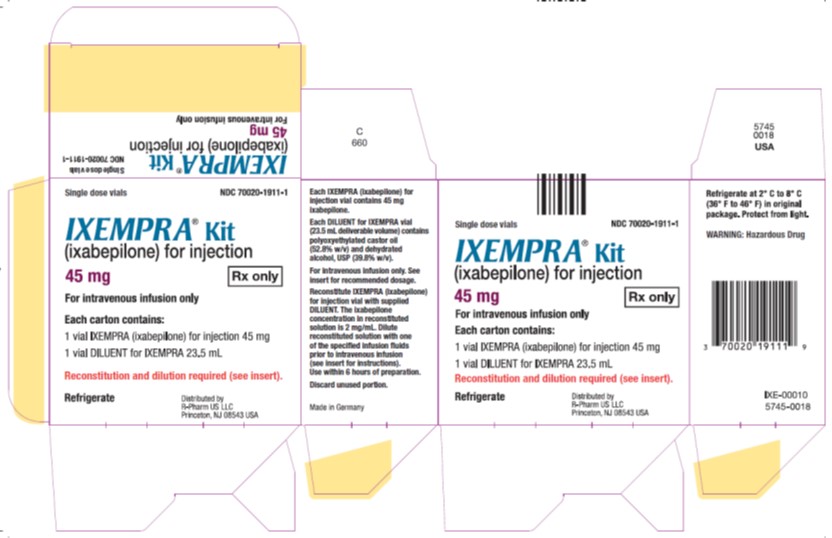
IXEMPRA ixabepilone Kit — NDC 70020-1911-1 (Billing 70020-1911-01)
This is a package of IXEMPRA ixabepilone Kit from R-Pharm US Operating, LLC, marketed since Oct 2007 and currently FDA-listed. It is this product's only package size.
NDC database record
One package, one record: these facts belong to NDC 70020-1911-1 alone.
- Record
- FDA NDC Directory package listing · Human prescription drug
- Code segments
- 70020 labeler · 1911 product · 1 package
- Package marketed since
- Oct 16, 2007
- Sample package
- No — commercial package
- Listing certified through
- Dec 31, 2026
- Barcode (UPC-A, from the NDC)
- 3 7002019111 9
- FDA record last changed
- Jul 24, 2026
Identity & classification
Regulatory identifiers FDA, NLM and CMS codes for this package
Drug-database identifiers Medi-Span GPI and First Databank GCN / HICL / AHFS classification
- GSN (GCN sequence number): 063246
- GCN: 98999
- GPI-14 (Medi-Span): 21500011002140
- HICL (First Databank): 035083
- AHFS class code: 10:00.00.00
- RxCUI (RxNorm): 1726271
Where does this data come from?
- FDA openFDA NDC Directory · synced Oct 8, 2026
- FDA label on DailyMed · label index refreshed Oct 8, 2026
- RxNorm (NLM RxNav) · catalog refreshed Oct 1, 2026
- Medi-Span GPI (licensed)
- First Databank (licensed) · refreshed Oct 8, 2026
RxNorm drug class
This medicine belongs to the Microtubule Inhibitor class.
Where does this data come from?
- RxClass (NLM) · catalog refreshed Oct 1, 2026
Clinical
- It treats metastatic or locally advanced breast cancer that has stopped responding to other chemotherapy. It may be given with capecitabine or alone, depending on your situation.
- It is given through an IV over about 3 hours, usually every 3 weeks, at a treatment center. You will get allergy-prevention medicines about an hour beforehand.
- Common ones are numb or tingly hands and feet, tiredness, muscle and joint aches, hair loss, nausea, mouth sores and diarrhea. Your blood counts may also drop, so your team will ch...
- Call right away for fever, chills or signs of infection, trouble breathing or swelling during infusion, chest pain, or worsening numbness or weakness.
Patient education
Supplement & herbal interactions
Where does this data come from?
- MedlinePlus (NLM) · refreshed Oct 8, 2026
- FDA label on DailyMed · label index refreshed Oct 8, 2026
Ask a licensed pharmacist directly — free, answered by our team.
Pricing
A drug doesn't have one price. Each row is a different public payment system, and none is what you'd pay at the counter — that depends on your insurance. The ⓘ on each row explains what it measures.
| Price system | Per each | Per package |
|---|---|---|
| Retail pharmacies payNADAC · weekly | Not in the retail survey — common for institutional, discontinued, or low-volume packs. | |
| Medicaid paysCMS SDUD · 12 mo | No recent Medicaid claims on file for this NDC — rare and low-volume NDCs are suppressed in the public data. | |
| Medicare drug plans payPart D · quarterly | No Part D plan price is available for this NDC in our data. | |
| Medicare Part B allowsASP · J9207 | $139.754 / J9207 unit | — |
Where does this data come from?
- CMS NADAC weekly file
- CMS ASP pricing files · refreshed Sep 20, 2026
- CMS Medicaid State Drug Utilization Data · refreshed Oct 8, 2026
- CMS Part D plan pricing files · refreshed Sep 24, 2026
- VA National Acquisition Center price file
Billing & reimbursement
Where does this data come from?
- CMS ASP NDC-HCPCS crosswalk · refreshed Sep 22, 2026
- DMEPDAC NDC-HCPCS crosswalk
- openFDA NSDE billing units · refreshed Oct 7, 2026
Packaging — all sizes for this product
| Package NDC | Description | Marketing start | Marketing end | Status |
|---|---|---|---|---|
| 70020-1911-01 You're viewing this Main listing | 1 KIT in 1 PACKAGE, COMBINATION * 45 mg in 1 VIAL, SINGLE-USE * 23.5 mL in 1 VIAL, SINGLE-USE | 2007-10-16 | — | Active |
Therapeutic equivalents
| Product | Labeler | Pack | NADAC/unit | TE | Status | Price vs. this |
|---|---|---|---|---|---|---|
| Ixemprathis 70020-1911-01 | R-Pharm | 1 kit | — | — | FDA listed | — |
Where does this data come from?
- FDA openFDA NDC Directory · synced Oct 8, 2026
- FDA Orange Book · refreshed Oct 3, 2026
- CMS NADAC weekly file
Availability & generic status
We did not find an FDA-approved generic match for this exact strength, form and route.
Where does this data come from?
- FDA Orange Book · refreshed Oct 3, 2026
Inactive Ingredients / Excipients
Inactive ingredients, also called excipients, are components of the drug product other than the active ingredient. They may include fillers, dyes, coatings, preservatives, flavors, or other formulation ingredients.
🧪 Avoiding an ingredient? See Ixabepilone Injection inactive ingredients by manufacturer: every current product's list side by side, so you can ask your pharmacy for the version that does not list it.
Where does this data come from?
IACT rows and label-wide narrative are kept separate; availability and product-level specificity depend on the submitted label.- FDA label on DailyMed · label index refreshed Oct 8, 2026
- FDA openFDA NDC Directory · synced Oct 8, 2026
Inactive ingredient FAQ
Are inactive ingredients the same for every manufacturer?
Why might an inactive ingredient be missing?
Can inactive ingredients matter?
Manufacturer & labeler
More NDCs from R-Pharm US Operating, LLC labeler code 70020
Where does this data come from?
- FDA openFDA NDC Directory · synced Oct 8, 2026
- Drugs@FDA
Full prescribing information FDA SPL
🚨 Boxed Warning ▾
WARNING: TOXICITY IN PATIENTS WITH HEPATIC IMPAIRMENT IXEMPRA in combination with capecitabine is contraindicated in patients with AST or ALT >2.5 x ULN or bilirubin >1 x ULN due to increased risk of toxicity and neutropenia-related death [see Contraindications ( 4 ) and Warnings and Precautions ( 5.3 )]. WARNING: TOXICITY IN PATIENTS WITH HEPATIC IMPAIRMENT See full prescribing information for complete boxed warning. IXEMPRA ® in combination with capecitabine is contraindicated in patients with AST or ALT >2.5 x ULN or bilirubin >1 x ULN due to increased risk of toxicity and neutropenia-related death.
( 4 , 5.3 )
🎯 Indications and Usage ▾
1 INDICATIONS AND USAGE IXEMPRA is indicated in combination with capecitabine for the treatment of patients with metastatic or locally advanced breast cancer resistant to treatment with an anthracycline and a taxane, or whose cancer is taxane resistant and for whom further anthracycline therapy is contraindicated. Anthracycline resistance is defined as progression while on therapy or within 6 months in the adjuvant setting or 3 months in the metastatic setting. Taxane resistance is defined as progression while on therapy or within 12 months in the adjuvant setting or 4 months in the metastatic setting [see Clinical Studies ( 14 )].
IXEMPRA is indicated as a single agent for the treatment of patients with metastatic or locally advanced breast cancer whose tumors are resistant or refractory to anthracyclines, taxanes, and capecitabine [see Clinical Studies ( 14 )]. IXEMPRA is a microtubule inhibitor indicated for treatment: In combination with capecitabine for patients with metastatic or locally advanced breast cancer resistant to treatment with an anthracycline and a taxane, or whose cancer is taxane resistant and for whom further anthracycline therapy is contraindicated.
( 1 ). As a single agent for patients with metastatic or locally advanced breast cancer after failure of an anthracycline, a taxane, and capecitabine. ( 1 ).
⏱️ Dosage and Administration ▾
2 DOSAGE AND ADMINISTRATION The recommended dosage of IXEMPRA is 40 mg/m 2 administered as a 3-hour intravenous infusion once every 3 weeks ( 2.2 ). Dose reduction is required in patients with elevated AST, ALT, or bilirubin.( 2.3, 8.6 ) IXEMPRA must be reconstituted with the supplied DILUENT and further diluted to a concentration of 0.2 mg/mL to 0.6 mg/mL prior to administration ( 2.6 ).
2.1Premedication All patients must be premedicated approximately 1 hour before the infusion of IXEMPRA with: An H 1 antagonist (eg, diphenhydramine 50 mg orally or equivalent) and An H 2 antagonist (eg, ranitidine 150 - 300 mg orally or equivalent). Patients who experienced a hypersensitivity reaction to IXEMPRA require premedication with corticosteroids (eg, dexamethasone 20 mg intravenously, 30 minutes before infusion or orally, 60 minutes before infusion) in addition to pretreatment with H 1 and H 2 antagonists [see Warnings and Precautions ( 5.4 )] .
2.2Recommended Dosage The recommended dosage of IXEMPRA is 40 mg/m 2 administered intravenously over 3 hours every 3 weeks. Calculate doses for patients with body surface area (BSA) greater than 2.2 m 2 should be calculated based on 2.2 m 2 .
2.3Dosage Modification for Adverse Reactions Evaluate patients during treatment by periodic clinical observation and laboratory tests including complete blood cell counts [see the Warnings and Precautions ( 5 )]. Dosage modifications for IXEMPRA for adverse reactions are shown in Table 1. If adverse reactions recur, reduce dose by an additional 20%.
Re-treatment Criteria: Determine dosage modifications at the start of each cycle based on nonhematologic toxicity or blood counts from the preceding cycle following the guidelines in Table 1 . Do not begin a new cycle of treatment unless the neutrophil count is at least 1500 cells/mm 3 , the platelet count is at least 100,000 cells/mm 3 [see Contraindictions]. Withhold IXEMPRA until nonhematologic toxicities have improved to grade 1 (mild) or resolved prior to beginning a new cycle of treatment.
Evaluate patients during treatment by periodic clinical observation and laboratory tests including complete blood cell counts [see the Warnings and Precautions ( 5 )] . Dosage modifications for IXEMPRA for adverse reactions are shown in Table 1 . If adverse reactions recur, reduce dose by an additional 20%.
Table 1: Dosage for Modification for Adverse Reactions a a Toxicities graded in accordance with National Cancer Institute (NCI) Common Terminology Criteria for Adverse Events(CTCAE v3.0). IXEMPRA IXEMPRA (Single Agent or Combination Therapy) Dosage Modification Nonhematologic: Grade 2 neuropathy (moderate) lasting ≥7 days Decrease the dose by 20% Grade 3 neuropathy (severe) lasting <7 days Decrease the dose by 20% Grade 3 neuropathy (severe) lasting ≥7 days or disabling neuropathy Discontinue treatment Any grade 3 toxicity (severe) other than neuropathy Decrease the dose by 20% Transient grade 3 arthralgia/myalgia or fatigue No change in dose of IXEMPRA Grade 3 hand-foot syndrome (palmar-plantar erythrodysesthesia) Any grade 4 toxicity (disabling) Discontinue treatment Hematologic: Neutrophil <500 cells/mm 3 for ≥7 days Decrease the dose by 20% Febrile neutropenia Decrease the dose by 20% Platelets <25,000/mm 3 or platelets <50,000/mm 3 with bleeding Decrease the dose by 20% Capecitabine Capecitabine (when used in combination with DCEMPRA) Dosage Modification Nonhematologic: See capecitabine prescribing information Hematologic: Platelets <25,000/mm 3 or <50,000/mm 3 with bleeding Hold for concurrent diarrhea or stomatitis until platelet count >50,000/mm 3 , then continue at same dose.
Neutrophils <500 cells/mm 3 for ≥7 days or febrile neutropenia Hold for concurrent diarrhea or stomatitis until neutrophil count >1,000 cells/mm 3 , then continue at same dose. Combination Therapy: IXEMPRA in combination with capecitabine is contraindicated in patients with AST or ALT >2.5 x ULN or bilirubin >1 x ULN. Patients rece… [Excerpted — this section continues on DailyMed.]
💊 Dosage Forms and Strengths ▾
3 DOSAGE FORMS AND STRENGTHS IXEMPRA for injection, 15 mg single-dose vial supplied with DILUENT for IXEMPRA, 8 mL. IXEMPRA for injection, 45 mg single-dose vial supplied with DILUENT for IXEMPRA, 23.5 mL. IXEMPRA for injection, 15 mg supplied with DILUENT for IXEMPRA, 8 mL ( 3 ) IXEMPRA for injection, 45 mg supplied with DILUENT for IXEMPRA, 23.5 mL ( 3 )
⛔ Contraindications ▾
4 CONTRAINDICATIONS IXEMPRA is contraindicated in patients who have: a neutrophil count <1500 cells/mm 3 or a platelet count <100,000 cells/mm 3 [see Warnings and Precautions ( 5.2 )]. a history of severe hypersensitivity to agents containing Cremophor ® EL or its derivatives (e.g., polyoxyethylated castor oil) [see Warnings and Precautions ( 5.4 )]. IXEMPRA in combination with capecitabine is contraindicated in patients with AST or ALT >2.5 x ULN or bilirubin >1 x ULN [see Boxed Warning and Warnings and Precautions ( 5.3 )].
Baseline neutrophil count <1500 cells/mm 3 or a platelet count <100,000 cells/mm 3 ( 4 ). Hypersensitivity to drugs formulated with Cremophor ® EL ( 4 ). IXEMPRA in combination with capecitabine is contraindicated for use in patients with AST or ALT >2.5 x ULN or bilirubin >1 x ULN.( 4 ).
⚠️ Warnings and Cautions ▾
5 WARNINGS AND PRECAUTIONS Peripheral Neuropathy: Monitor for symptoms of neuropathy (sensory and motor neuropathy).) Withhold, reduce, or discontinue IXEMPRA depending on severity. ( 2.3 , 5.1 ). Myelosuppression: Neutropenia, febrile neutropenia, and infections have occurred.
Monitor blood cell counts before and during treatment with IXEMPRA. Withhold, reduce, or discontinue IXEMPRA depending on severity ( 2.3 , 5.2 ). Increased Toxicity in Patients with Hepatic Impairment: Grade 4 neutropenia, febrile neutropenia, and serious adverse reactions may occur in patients with hepatic impairment during treatment with IXEMPRA.
Reduce dose depending on severity. ( 2.3 , 5.3 , 6.1 ). Hypersensitivity Reactions: Severe hypersensitivity reactions (including anaphylaxis) have occurred.
Premedicate all patients before treatment with IXEMPRA. Withhold, reduce, or discontinue IXEMPRA depending on severity ( 2.1 , 2.3 , 5.4 ). Cardiac Adverse Reactions: Myocardial ischemia and ventricular dysfunction have occurred.
Closely monitor patients with a history of cardiac disease during treatment with IXEMPRA. Consider discontinuation of IXEMPRA in patients who develop cardiac ischemia or impaired cardiac function ( 2.3 , 5.5 ). Embryo-Fetal Toxicity: Can cause fetal harm.
Advise patients of potential risk to a fetus and to use effective contraception ( 5.6 , 8.1 , 8.3) Alcohol Content: The alcohol content in a dose of IXEMPRA may affect the central nervous system. This may include impairment of a patient's ability to drive or use machines immediately after infusion. ( 5.7 ).
5.2Myelosuppression Severe, life-threatening, or fatal myelosuppression can occur in patients treated with IXEMPRA. Myelosuppression is dose-dependent and primarily manifests as neutropenia. In clinical studies, grade 4 neutropenia (<500 cells/mm 3 ) occurred in 36% of patients treated with IXEMPRA in combination with capecitabine and 23% of patients treated with single agent IXEMPRA monotherapy.
Febrile neutropenia and infection with neutropenia were reported in 5% and 6% of patients treated with IXEMPRA in combination with capecitabine, respectively, and 3% and 5% of patients treated with IXEMPRA as a single agent, respectively. Neutropenia-related death occurred in 1.9% of 414 patients with normal hepatic function or mild hepatic impairment treated with IXEMPRA in combination with capecitabine. The rate of neutropenia-related deaths was higher (29%, 5 out of 17) in patients with AST or ALT >2.5 x ULN or bilirubin >1.5 x ULN [see Boxed Warning, Contraindications ( 4 ), and Warnings and Precautions ( 5.3 )] .
Neutropenia-related death occurred in 0.4% of 240 patients treated with IXEMPRA as a single agent. No neutropenia-related deaths were reported in 24 patients with AST or ALT >2.5 x ULN or bilirubin >1.5 x ULN treated with IXEMPRA as a single agent. IXEMPRA is contraindicated for use in patients with a neutrophil count of <1500 cells/mm 3 . [see Contraindications ( 4 )] .
Monitor patients receiving IXEMPRA for myelosuppression with frequent peripheral blood cell counts. Withhold, reduce, or discontinue IXEMPRA depending on the severity and persistence of myelosuppression [see Dosage and Administration ( 2.3 )] .
5.1Peripheral Neuropathy Peripheral neuropathy (sensory and motor neuropathy) occurred in patients treated with IXEMPRA in combination with capecitabine and in patients treated with single agent IXEMPRA as shown in Table (see Table 3 ). Table 3: Peripheral Neuropathy a Sensory and motor neuropathy combined. b 24% and 27% of patients in 046 and 081, respectively, had preexisting neuropathy (grade 1). IXEMPRA IXEMPRA as with capecitabine Single Agent Study 046 Study 081 Peripheral neuropathy (all grades) a,b 67% 63% Peripheral neuropathy (grades 3/4) a,b 23% 14% Discontinuation due to neuropathy 21% 6% Median number of cycles to onset of grade 3/4 neuropathy 4 4 Median time to improvement of grade 3/4 neuropathy to baseline or to grade 1 6.0 weeks 4.6 weeks In St… [Excerpted — this section continues on DailyMed.]
🤒 Adverse Reactions ▾
6 ADVERSE REACTIONS The following adverse reactions are discussed in greater detail in other sections. Peripheral neuropathy [see Warnings and Precautions ( 5.1 )] Myelosuppression [see Warnings and Precautions ( 5.2 )] Hypersensitivity reactions [see Warnings and Precautions ( 5.4 )] Cardiac Adverse reactions [see Warnings and Precautions ( 5.5) ] The most common adverse reactions (≥20%) are peripheral sensory neuropathy, fatigue/asthenia, myalgia/arthralgia, alopecia, nausea, vomiting, stomatitis/mucositis, diarrhea, and musculoskeletal pain.
Additional reactions occurred in ≥20% in combination treatment: palmar-plantar erythrodysesthesia syndrome, anorexia, abdominal pain, nail disorder, and constipation ( 6 ). Hematologic laboratory abnormalities (>40%) include neutropenia, leukopenia, anemia, and thrombocytopenia ( 6 ). To report SUSPECTED ADVERSE REACTIONS, contact R-Pharm US at 1-844-586-8953 or FDA at 1-800-FDA-1088 or www.fda.gov/medwatch
6.1Clinical Trials Experience Because clinical trials are conducted under widely varying conditions, the adverse reaction rates observed in the clinical trials of a drug cannot be directly compared to rates in other clinical trials and may not reflect the rates observed in clinical practice. Unless otherwise specified, assessment of adverse reactions is based on one randomized study (Study 046) and one single-arm study (Study 081). In Study 046, 369 patients with metastatic breast cancer were treated with IXEMPRA 40 mg/m 2 administered intravenously over 3 hours every 21 days, combined with capecitabine 1000 mg/m 2 twice daily for 2 weeks followed by a 1-week rest period.
Patients treated with capecitabine as a single agent (n=368) in this study received 1250 mg/m twice daily for 2 weeks every 21 days. In Study 081, 126 patients with metastatic or locally advanced breast cancer were treated with IXEMPRA 40 mg/m 2 administered intravenously over 3 hours every 3 weeks. The most common adverse reactions (≥20%) reported by patients receiving IXEMPRA were peripheral sensory neuropathy, fatigue/asthenia, myalgia/arthralgia, alopecia, nausea, vomiting, stomatitis/mucositis, diarrhea, and musculoskeletal pain.
The following additional reactions occurred in ≥20% in combination treatment: palmar-plantar erythrodysesthesia (hand-foot) syndrome, anorexia, abdominal pain, nail disorder, and constipation. The most common hematologic abnormalities (>40%) include neutropenia, leukopenia, anemia, and thrombocytopenia. Table 4 presents nonhematologic adverse reactions reported in 5% or more of patients.
Hematologic abnormalities are presented separately in Table 5. Table 4 presents nonhematologic adverse reactions reported in 5% or more of patients. Hematologic abnormalities are presented separately in Table 5 . b A composite of multiple terms. c Three patients (1 %) experienced Grade 5 (fatal) febrile neutropenia.
Other neutropenia-related deaths (9) occurred in the absence of reported febrile neutropenia [see Warnings and Precautions ( 5.2 )]. d No grade 4 reports. e Peripheral sensory neuropathy was defined as the occurrence of any of the following: areflexia, burning sensation, dysesthesia, hyperesthesia, hypoesthesia, hyporeflexia, neuralgia, neuritis, neuropathy, neuropathy peripheral, neurotoxicity, painful response to normal stimuli, paresthesia, pallanesthesia, peripheral sensory neuropathy, polyneuropathy, polyneuropathy toxic and sensorimotor disorder.
Peripheral motor neuropathy was defined as the occurrence of any of the following: multifocal motor neuropathy, neuromuscular toxicity, peripheral motor neuropathy, and peripheral sensorimotor neuropathy. f Palmar-plantar erythrodysesthesia (hand-foot syndrome) was graded on a 1 -3 severity scale in Study 046. Study 046 Study 081 IXEMPRA with capecitabine n=369 Capecitabine n=368 IXEMPRA Single Agent n=126 Adverse Reaction All Grades Grade 3/4 All Grades Grade 3/4 All Grades Grade 3/4 Preferred Term (%) (%) (%) (%) (%) (%) Infections and In… [Excerpted — this section continues on DailyMed.]
🔄 Drug Interactions ▾
7 DRUG INTERACTIONS Strong CYP3A4 Inhibitors: Avoid strong CYP3A4 inhibitors. If coadministration cannot be avoided, reduce the dosage of IXEMPRA ( 2.5 , 7.1 ). Strong CYP3A4 Inducers: Avoid strong CYP3A4 inducers. If coadministration cannot be avoided, reduce the dosage of IXEMPRA ( 2.5 , 7.1 ).
7.1Effect of Other Drugs on IXEMPRA Strong CYP3A4 Inhibitors The coadministration of IXEMPRA with a strong CYP3A4 inhibitor increased ixabepilone plasma concentration, which may increase the incidence and severity of adverse reactions of IXEMPRA. Avoid coadministration of IXEMPRA with strong CYP3A4 inhibitors. If the coadministration of IXEMPRA with strong CYP3A4 cannot be avoided, reduce the dose of IXEMPRA [see Dosage and Administration ( 2.5 ), Clinical Pharmacology ( 12.3 ].
Moderate or Weak CYP3A4 Inhibitors The coadministration of IXEMPRA with moderate or weak CYP3A4 inhibitors may increase the incidence and severity of adverse reactions of IXEMPRA. Monitor for adverse reactions and reduce the dose of IXEMPRA as recommended [see Dosage and Administration ( 2.5 ), Adverse Reactions ( 6 )]. Strong CYP3A4 Inducers The coadministration of IXEMPRA with a strong CYP3A4 inducer, decreased plasma concentrations of ixabepilone, which may decrease the efficacy of IXEMPRA [see Clinical Pharmacology ( 12.3 )].
Avoid the coadministration IXEMPRA with strong CYP3A4 inducers. If the coadministration of IXEMPRA with a strong CYP3A4 inducer cannot be avoided, increase the dose of IXEMPRA [see Dosage and Administration ( 2.4 )]. Concomitant Use of IXEMPRA and Capecitabine No clinically meaningful differences in the pharmacokinetics of ixabepilone and capecitabine were observed when IXEMPRA was administered in combination with capecitabine (1000 mg/m 2 ) [see Clinical Pharmacology ( 12.3 )].
7.2Effect of Ixabepilone on Other Drugs Ixabepilone does not inhibit CYP enzymes at relevant clinical concentrations and is not expected to alter the plasma concentrations of other drugs [see Clinical Pharmacology ( 12.3 )].
7.3Capecitabine In patients with cancer who received ixabepilone (40 mg/m 2 ) in combination with capecitabine (1000 mg/m 2 ), ixabepilone Cmax decreased by 19%, capecitabine Cmax decreased by 27%, and 5-fluorouracil AUC increased by 14%, as compared to ixabepilone or capecitabine administered separately. The interaction is not clinically significant given that the combination treatment is supported by efficacy data.
👥 Use in Specific Populations ▾
8 USE IN SPECIFIC POPULATIONS Lactation: Advise not to breastfeed ( 8.2 ). Hepatic Impairment: Reduce the dosage in patients with elevated AST, ALT, or bilirubin ( 2.4 , 8.6 ).
8.1Pregnancy Risk Summary Based on findings in animals and its mechanism of action, IXEMPRA can cause fetal harm when administered to a pregnant woman [see Clinical Pharmacology ( 12.1 )] . There are no available data on the use of IXEMPRA in pregnant women to inform the drug-associated risk. IXEMPRA contains alcohol which can interfere with neurobehavioral development [see Clinical Considerations].
In animal reproduction studies, intravenous administration of ixabepilone to pregnant rats and rabbits during the period of organogenesis caused maternal toxicity, embryo-fetal lethality, and fetal abnormalities at maternal exposures below the human clinical exposure based on AUC (see Data). Advise females of reproductive potential and pregnant women of the potential risk to a fetus. The background risk of major birth defects and miscarriage for the indicated population is unknown.
In the U.S. general population, the estimated background risk of major birth defects and miscarriage in clinically recognized pregnancies is 2% to 4% and 15% to 20%, respectively. Clinical Considerations IXEMPRA contains alcohol [see Warnings and Precautions ( 5.7 )] . Published studies have demonstrated that alcohol is associated with fetal harm including central nervous system abnormalities, behavioral disorders, and impaired intellectual development.
Data Animal data In embryo-fetal development studies, pregnant rats and rabbits received intravenous doses of 0.02, 0.08, and 0.3 mg/kg/day and 0.01, 0.03, 0.11, and 0.3 mg/kg/day, respectively during the period of organogenesis. In rats, an increase in resorptions and post-implantation loss and a decrease in the number of live fetuses and fetal weight was observed at the maternally toxic dose of 0.3 mg/kg/day (approximately 0.1 times the human clinical exposure based on AUC). Abnormalities included a reduced ossification of caudal vertebrae, sternebrae, and metacarpals.
In rabbits, ixabepilone caused maternal toxicity (death) and embryo-fetal toxicity (resorptions) at 0.3 mg/kg/day (approximately 0.1 times the human clinical dose based on body surface area).
8.2Lactation Risk Summary There is no data on the presence of IXEMPRA in human milk, the effects on the breastfed child, or the effects on milk production. Ixabepilone and/or its metabolites were present in milk of lactating rats (see Data). Because of the potential for serious adverse reactions in a breastfed child, advise women not to breastfeed during treatment with IXEMPRA and for 2 weeks after the last dose.
Data Animal data Following intravenous administration of radiolabeled ixabepilone to rats on days 7 to 9 postpartum, concentrations of radioactivity in milk were comparable with those in plasma and declined in parallel with the plasma concentrations.
8.3Females and Males of Reproductive Potential Based on findings in animals and its mechanism of action, IXEMPRA can cause fetal harm when administered to a pregnant woman [see Use in Specific Populations ( 8.1 )]. Pregnancy Testing Verify the pregnancy status of females of reproductive potential prior to initiating treatment with IXEMPRA. Contraception Females Advise females of reproductive potential to use effective contraception during treatment with IXEMPRA and for 7 months after the last dose.
Males Based on genotoxicity and animal studies, advise male patients with female partners of reproductive potential to use effective contraception during treatment with IXEMPRA and for 4 months after the last dose [see Nonclinical Toxicology ( 13.1 )]. Infertility Based on findings in animals, IXEMPRA may impair male and female fertility [see Nonclinical Toxicology ( 13.1 )] . .
8.4Pediatric Use The alcohol content of IXEMPRA should be taken into account when given to pediatric patients [see Warnings and Precautions ( 5.6 )… [Excerpted — this section continues on DailyMed.]
🤰 Pregnancy ▾
8.1Pregnancy Risk Summary Based on findings in animals and its mechanism of action, IXEMPRA can cause fetal harm when administered to a pregnant woman [see Clinical Pharmacology ( 12.1 )] . There are no available data on the use of IXEMPRA in pregnant women to inform the drug-associated risk. IXEMPRA contains alcohol which can interfere with neurobehavioral development [see Clinical Considerations].
In animal reproduction studies, intravenous administration of ixabepilone to pregnant rats and rabbits during the period of organogenesis caused maternal toxicity, embryo-fetal lethality, and fetal abnormalities at maternal exposures below the human clinical exposure based on AUC (see Data). Advise females of reproductive potential and pregnant women of the potential risk to a fetus. The background risk of major birth defects and miscarriage for the indicated population is unknown.
In the U.S. general population, the estimated background risk of major birth defects and miscarriage in clinically recognized pregnancies is 2% to 4% and 15% to 20%, respectively. Clinical Considerations IXEMPRA contains alcohol [see Warnings and Precautions ( 5.7 )] . Published studies have demonstrated that alcohol is associated with fetal harm including central nervous system abnormalities, behavioral disorders, and impaired intellectual development.
Data Animal data In embryo-fetal development studies, pregnant rats and rabbits received intravenous doses of 0.02, 0.08, and 0.3 mg/kg/day and 0.01, 0.03, 0.11, and 0.3 mg/kg/day, respectively during the period of organogenesis. In rats, an increase in resorptions and post-implantation loss and a decrease in the number of live fetuses and fetal weight was observed at the maternally toxic dose of 0.3 mg/kg/day (approximately 0.1 times the human clinical exposure based on AUC). Abnormalities included a reduced ossification of caudal vertebrae, sternebrae, and metacarpals.
In rabbits, ixabepilone caused maternal toxicity (death) and embryo-fetal toxicity (resorptions) at 0.3 mg/kg/day (approximately 0.1 times the human clinical dose based on body surface area).
🧒 Pediatric Use ▾
8.4Pediatric Use The alcohol content of IXEMPRA should be taken into account when given to pediatric patients [see Warnings and Precautions ( 5.6 )] . The safety and effectiveness of IXEMPRA in pediatric patients have not been established. Safety and efficacy were assessed, but not established for IXEMPRA across two studies: an open-label, dose-finding trial in 21 patients aged 2 to 18 years with advanced or refractory solid tumors and hematologic malignancies [NCT00030108] and a trial with 28 patients aged 3 to 18 years with advanced or refractory solid tumors [NCT00331643] that was terminated early due to lack of efficacy.
No new safety signals were identified. The median BSA normalized clearance of ixabepilone in 16 patients aged 2 to 18 years (17 L/h/m 2 ) was within range of that of patients greater than 18 years (20 L/h/m 2 ).
🧓 Geriatric Use ▾
8.5Geriatric Use Clinical studies of IXEMPRA did not include sufficient numbers of patients aged sixty-five and over to determine whether they respond differently from younger patients. Of the 431 patients treated with IXEMPRA in combination with capecitabine, 10% were 65 years of age and over, and 0.1% were 75 years of age and over. The incidence of grade 3/4 adverse reactions was higher in patients ³65 years of age versus those <65 years of age (82% versus 68%) including grade 3/4 stomatitis (9% versus 1%), diarrhea (9% versus 6%), palmar-plantar erythrodysesthesia syndrome (27% versus 20%), peripheral neuropathy (24% versus 22%), febrile neutropenia (9% versus 3%), fatigue (16% versus 12%), and asthenia (11% versus 6%).
Deaths due to adverse reactions occurred in 2 (4.7%) of 43 patients ³65 years with normal baseline hepatic function or mild impairment. Of the 240 patients with breast cancer treated with IXEMPRA as a single agent, 13% were 65 years of age and over, and 0.2% were 75 years of age and over.
🆘 Overdosage ▾
10 OVERDOSAGE In patients who received an overdosage of IXEMPRA of up to 100 mg/m 2 (approximately 2.5 times the recommended dosage), peripheral neuropathy, fatigue, musculoskeletal pain/myalgia, and gastrointestinal symptoms (nausea, anorexia, diarrhea, abdominal pain, stomatitis) occurred. There is no known antidote for overdosage of IXEMPRA. In case of overdosage, closely monitor patients for adverse reactions and provide supportive treatment as clinically indicated.
🧬 Clinical Pharmacology ▾
12 CLINICAL PHARMACOLOGY
12.1Mechanism of Action Ixabepilone is a semi-synthetic analog of epothilone B. Ixabepilone binds directly to β-tubulin subunits on microtubules, leading to suppression of microtubule dynamics. Ixabepilone suppresses the dynamic instability of αβ-II and αβ-III microtubules.
Ixabepilone possesses low in vitro susceptibility to multiple tumor resistance mechanisms including efflux transporters, such as MRP-1 and P-glycoprotein (P-gp). Ixabepilone blocks cells in the mitotic phase of the cell division cycle, leading to cell death.
12.2Pharmacodynamics Ixabepilone has a plasma concentration-dependent effect on tubulin dynamics in peripheral blood mononuclear cells that is observed as the formation of microtubule bundles. Cardiac Electrophysiology At the recommended dosage, IXEMPRA does not cause large mean increases (i.e., >20 msec) in the QT interval. The QT prolongation potential of ixabepilone was assessed as part of an uncontrolled, open-label, single-dose study in advanced cancer patients.
Fourteen patients received a single dose of IXEMPRA 40 mg/m2 intravenously over 3 hours and serial ECGs were collected over 24 hours. The maximum mean ΔQTcF was observed 1 hour after the end of infusion and was 8 ms (upper 95% CI: 12 ms). No patients had a QTcF interval >450 ms or ΔQTcF >30 ms after IXEMPRA administration.
However, small increases in QTc interval with the use of ixabepilone cannot be excluded due to study design limitations
12.3Pharmacokinetics Following administration of a single 40 mg/m 2 dose of IXEMPRA, the mean (% coefficient of variation) maximum plasma concentration (Cmax) was 252 ng/mL (56%), and the mean (%CV) area under the curve (AUC) was 2,143 ng·hr/mL (48%). The pharmacokinetics of ixabepilone were linear at doses of 15 (0.375 times the approved recommended dosage) to 57 mg/m 2 (1.425 times the approved recommended dosage). Distribution The mean (%CV) volume of distribution at steady-state was greater than1,000 L (x CV%).
Serum protein binding of ixabepilone ranged from 67% to 77% and the blood-to-plasma concentration ratios ranged from 0.65 to 0.85. Elimination Ixabepilone has a terminal elimination half-life of approximately 52 hours (x CV%). Metabolism Ixabepilone is metabolized by CYP3A4.
Excretion Ixabepilone is eliminated primarily as metabolites in feces (65% of the dose) and in urine (21% of the dose). Unchanged ixabepilone accounted for approximately 1.6% and 5.6% of the dose in feces and urine, respectively. Specific Populations Based upon a population pharmacokinetic analysis in 676 cancer patients, gender, race, age, mild and moderate renal insufficiency (creatinine clearance [CLcr]CrCL >30 mL/min) do not have clinically meaningful effects on the pharmacokinetics of ixabepilone.
Patients with Hepatic Impairment IXEMPRA was evaluated in 56 patients with mild to severe hepatic impairment defined by bilirubin levels and AST levels. Compared to patients with normal hepatic function (n=17), the area under the curve (AUC 0-infinity ) of ixabepilone AUC increased by: 22% in patients with mild hepatic impairment [a) bilirubin >1 to 1.5 x ULN and AST < ULN or b) AST >ULN but bilirubin <1.5 x ULN]; 30% in patients with moderate hepatic impairment (bilirubin >1.5 to 3 x ULN and any AST level); 81% in patients with severe hepatic impairment (bilirubin >3 x ULN and any AST level).
Drug Interaction Studies Clinical Studies Effect of Strong CYP3A4 Inhibitors on IXEMPRA: Coadministration of ixabepilone with ketoconazole, a strong CYP3A4 inhibitor, increased ixabepilone AUC by 79% compared to ixabepilone treatment alone. Effect of Strong CYP3A4 Inducers on IXEMPRA: Coadministration of IXEMPRA with rifampin, a strong CYP3A4 inducer, decreased ixabepilone AUC by 43% compared to IXEMPRA treatment alone. Capecitabine: In patients with cancer who received ixabepilone (40 mg/m 2 ) in combination with capecitabine decreased (1000 mg/m 2 ), ixabepilone Cmax decreased by 19% and capecitabine Cmax… [Excerpted — this section continues on DailyMed.]
🧬 Mechanism of Action ▾
12.1Mechanism of Action Ixabepilone is a semi-synthetic analog of epothilone B. Ixabepilone binds directly to β-tubulin subunits on microtubules, leading to suppression of microtubule dynamics. Ixabepilone suppresses the dynamic instability of αβ-II and αβ-III microtubules.
Ixabepilone possesses low in vitro susceptibility to multiple tumor resistance mechanisms including efflux transporters, such as MRP-1 and P-glycoprotein (P-gp). Ixabepilone blocks cells in the mitotic phase of the cell division cycle, leading to cell death.
📦 How Supplied / Storage and Handling ▾
16 HOW SUPPLIED/STORAGE AND HANDLING IXEMPRA is supplied as a Kit containing one single-dose vial of IXEMPRA ® (ixabepilone) for injection and one vial of DILUENT for IXEMPRA. NDC 70020-1910-1 IXEMPRA ® Kit containing one single-dose vial of IXEMPRA ® (ixabepilone) for injection, 15 mg and one vial of DILUENT for IXEMPRA, 8 mL NDC 70020-1911 -1 IXEMPRA ® Kit containing one single-dose vial of IXEMPRA ® (ixabepilone) for injection, 45 mg and one vial of DILUENT for IXEMPRA, 23.5 mL IXEMPRA Kit must be stored in a refrigerator at 2° C to 8° C (36° F to 46° F).
Retain in original package until time of use to protect from light. IXEMPRA is a hazardous drug. Follow applicable special handling and disposal procedures.
1
📋 Description ▾
11 DESCRIPTION IXEMPRA (ixabepilone) is a microtubule inhibitor belonging to a class of antineoplastic agents, the epothilones and their analogs. The epothilones are isolated from the myxobacterium Sorangium cellulosum. Ixabepilone is a semisynthetic analog of epothilone B, a 16-membered polyketide macrolide, with a chemically modified lactam substitution for the naturally existing lactone.
The chemical name for ixabepilone is (1 S ,3 S ,7 S ,10 R ,11 S ,12 S ,16 R )-7,11 -dihydroxy-8,8,10,12,16-pentamethyl-3- [(1 E )-1 -methyl-2-(2-methyl-4-thiazolyl)ethenyl]-17-oxa-4-azabicyclo[14.1.0] heptadecane-5,9-dione, and it has a molecular weight of 506.7. Ixabepilone has the following structural formula: IXEMPRA (ixabepilone) for injection is intended for intravenous infusion only after constitution with the supplied DILUENT and after further dilution with a specified infusion fluid [see dosage ( 2. )]. IXEMPRA (ixabepilone) for injection is supplied as a sterile, non-pyrogenic, single-dose vial providing 15 mg or 45 mg ixabepilone as a lyophilized white powder.
The DILUENT for IXEMPRA is a sterile, non-pyrogenic, solution of 52.8% (w/v) purified polyoxyethylated castor oil and 39.8% (w/v) dehydrated alcohol, USP. The IXEMPRA (ixabepilone) for injection and the DILUENT for IXEMPRA are copackaged and supplied as IXEMPRA Kit Structural Formula
💬 Information for Patients ▾
17 PATIENT COUNSELING INFORMATION Advise the patient to read the FDA-approved patient labeling
17.1Peripheral Neuropathy Advice patients to report any numbness and tingling of the hands or feet to their healthcare provider [see Warnings and Precautions ( 5.1 )].
17.2Fever/Neutropenia Instruct patients to immediately contact their healthcare provider if a fever of 100.5° F or greater or other evidence of potential infection such as chills, cough, or burning or pain on urination occur [see Warnings and Precautions ( 5.2 )].
17.3Hypersensitivity Reactions Advise patients to immediately contact their healthcare provider if they experience urticaria, pruritus, rash, flushing, swelling, dyspnea, chest tightness, or other hypersensitivity-related symptoms following an infusion of IXEMPRA [see Warnings and Precautions ( 5.4 )].
17.4Cardiac Adverse Reactions Advise patients to immediately contact call their healthcare provider if they experience chest pain, difficulty breathing, palpitations, or unusual weight gain [see Warnings and Precautions ( 5.5 )].
17.5Embryo-Fetal Toxicity Advise females of reproductive potential and pregnant women of the potential risk to a fetus. Advise patients to inform their healthcare provider of a known or suspected pregnancy. Advise females of reproductive potential to use effective contraception during treatment with IXEMPRA and for 7 months after the last dose.
Advise male patients with female partners of reproductive potential to use effective contraception during treatment with IXEMPRA and for 4 months after the last dose [see Warnings and Precautions ( 5.6 ) and Use in Specific Populations ( 8.1 , 8.3 )].
17.6Lactation Advise women not to breastfeed during treatment with IXEMPRA and for 2 weeks after the last dose [see Use in Specific Populations ( 8.2 )].
17.7Infertility Advise males and females of reproductive potential that IXEMPRA may impair fertility [see Use in Specific Populations ( 8.2 )].
17.8Alcohol Content in IXEMPRA Explain to patients the possible effects of the alcohol content in IXEMPRA, including possible effects on the central nervous system [see Warnings and Precautions ( 5.7 )].
🍼 Nursing Mothers ▾
8.2Lactation Risk Summary There is no data on the presence of IXEMPRA in human milk, the effects on the breastfed child, or the effects on milk production. Ixabepilone and/or its metabolites were present in milk of lactating rats (see Data). Because of the potential for serious adverse reactions in a breastfed child, advise women not to breastfeed during treatment with IXEMPRA and for 2 weeks after the last dose.
Data Animal data Following intravenous administration of radiolabeled ixabepilone to rats on days 7 to 9 postpartum, concentrations of radioactivity in milk were comparable with those in plasma and declined in parallel with the plasma concentrations.
🧬 Pharmacokinetics ▾
12.3Pharmacokinetics Following administration of a single 40 mg/m 2 dose of IXEMPRA, the mean (% coefficient of variation) maximum plasma concentration (Cmax) was 252 ng/mL (56%), and the mean (%CV) area under the curve (AUC) was 2,143 ng·hr/mL (48%). The pharmacokinetics of ixabepilone were linear at doses of 15 (0.375 times the approved recommended dosage) to 57 mg/m 2 (1.425 times the approved recommended dosage). Distribution The mean (%CV) volume of distribution at steady-state was greater than1,000 L (x CV%).
Serum protein binding of ixabepilone ranged from 67% to 77% and the blood-to-plasma concentration ratios ranged from 0.65 to 0.85. Elimination Ixabepilone has a terminal elimination half-life of approximately 52 hours (x CV%). Metabolism Ixabepilone is metabolized by CYP3A4.
Excretion Ixabepilone is eliminated primarily as metabolites in feces (65% of the dose) and in urine (21% of the dose). Unchanged ixabepilone accounted for approximately 1.6% and 5.6% of the dose in feces and urine, respectively. Specific Populations Based upon a population pharmacokinetic analysis in 676 cancer patients, gender, race, age, mild and moderate renal insufficiency (creatinine clearance [CLcr]CrCL >30 mL/min) do not have clinically meaningful effects on the pharmacokinetics of ixabepilone.
Patients with Hepatic Impairment IXEMPRA was evaluated in 56 patients with mild to severe hepatic impairment defined by bilirubin levels and AST levels. Compared to patients with normal hepatic function (n=17), the area under the curve (AUC 0-infinity ) of ixabepilone AUC increased by: 22% in patients with mild hepatic impairment [a) bilirubin >1 to 1.5 x ULN and AST < ULN or b) AST >ULN but bilirubin <1.5 x ULN]; 30% in patients with moderate hepatic impairment (bilirubin >1.5 to 3 x ULN and any AST level); 81% in patients with severe hepatic impairment (bilirubin >3 x ULN and any AST level).
Drug Interaction Studies Clinical Studies Effect of Strong CYP3A4 Inhibitors on IXEMPRA: Coadministration of ixabepilone with ketoconazole, a strong CYP3A4 inhibitor, increased ixabepilone AUC by 79% compared to ixabepilone treatment alone. Effect of Strong CYP3A4 Inducers on IXEMPRA: Coadministration of IXEMPRA with rifampin, a strong CYP3A4 inducer, decreased ixabepilone AUC by 43% compared to IXEMPRA treatment alone. Capecitabine: In patients with cancer who received ixabepilone (40 mg/m 2 ) in combination with capecitabine decreased (1000 mg/m 2 ), ixabepilone Cmax decreased by 19% and capecitabine Cmax decreased by 27%, and 5-fluorouracil AUC increased by 14%; as compared to ixabepilone or capecitabine administered separately.
In Vitro Studies Cytochrome P450 (CYP) Enzymes: In vitro studies using human liver microsomes indicate that clinically relevant concentrations of ixabepilone do not inhibit CYP3A4, CYP1A2, CYP2A6, CYP2B6, CYP2C8, CYP2C9, CYP2C19, or CYP2D6. Ixabepilone does not induce the activity or the corresponding mRNA levels of CYP1A2, CYP2B6, CYP2C9, or CYP3A4 in cultured human hepatocytes at clinically relevant concentrations. Transporter Systems: Ixabepilone is a substrate of P-gp but is not a substrate of BCRP.
Ixabepilone is an inhibitor of P-gp for the drug efflux transporter P‑glycoprotein (P-gp).
🧬 Pharmacodynamics ▾
12.2Pharmacodynamics Ixabepilone has a plasma concentration-dependent effect on tubulin dynamics in peripheral blood mononuclear cells that is observed as the formation of microtubule bundles. Cardiac Electrophysiology At the recommended dosage, IXEMPRA does not cause large mean increases (i.e., >20 msec) in the QT interval. The QT prolongation potential of ixabepilone was assessed as part of an uncontrolled, open-label, single-dose study in advanced cancer patients.
Fourteen patients received a single dose of IXEMPRA 40 mg/m2 intravenously over 3 hours and serial ECGs were collected over 24 hours. The maximum mean ΔQTcF was observed 1 hour after the end of infusion and was 8 ms (upper 95% CI: 12 ms). No patients had a QTcF interval >450 ms or ΔQTcF >30 ms after IXEMPRA administration.
However, small increases in QTc interval with the use of ixabepilone cannot be excluded due to study design limitations
🔬 Clinical Studies ▾
14 CLINICAL STUDIES Combination Therapy In an open-label, multicenter, multinational, randomized trial of 752 patients with metastatic or locally advanced breast cancer, the efficacy and safety of IXEMPRA (40 mg/m 2 every 3 weeks) in combination with capecitabine (at 1000 mg/m 2 twice daily for 2 weeks followed by 1 week rest) were assessed in comparison with capecitabine as a single agent (at 1250 mg/m 2 twice daily for 2 weeks followed by 1 week rest). Patients were previously treated with anthracyclines and taxanes.
Patients were required to have demonstrated tumor progression or resistance to taxanes and anthracyclines as follows: tumor progression within 3 months of the last anthracycline dose in the metastatic setting or recurrence within 6 months in the adjuvant or neoadjuvant setting, and tumor progression within 4 months of the last taxane dose in the metastatic setting or recurrence within 12 months in the adjuvant or neoadjuvant setting. For anthracyclines, patients who received a minimum cumulative dose of 240 mg/m 2 of doxorubicin or 360 mg/m 2 of epirubicin were also eligible.
In this study, the median age of patients was 53 years, 67% were White, 23% were Asian, and 3% were Black; Karnofsky performance status was 70-100%, and 75% had received prior adjuvant or neo-adjuvant chemotherapy. Tumors were ER-positive in 47% of patients, ER-negative in 43%, HER2-positive in 15%, HER2-negative in 61%, and ER-negative, PR-negative, HER2-negative in 25%. The baseline disease characteristics and previous therapies for all patients (n=752) are shown in Table 6 .
Table 6: Baseline Disease Characteristics and Previous Therapies a For IXEMPRA plus capecitabine versus capecitabine only, prior treatment in the metastatic setting included cyclophosphamide (25% vs. 23%), fluorouracil (22% vs. 16%), vinorelbine (11% vs.
12%), gemcitabine (9% each arm), carboplatin (9% vs. 7%), liposomal doxorubicin (3% each arm), and cisplatin (2% vs. 3%). b Tumor progression within 3 months in the metastatic setting or recurrence within 6 months in the adjuvant or neoadjuvant setting. c 24% and 21% of patients had received 2 or more taxane-containing regimens in the combination and single agent treatment groups, respectively.
IXEMPRA with capecitabine n=375 Capecitabine n=377 Site of disease Visceral disease (liver or lung) 316(84%) 315 (84%) Liver 245 (65%) 228(61%) Lung 180(48%) 174 (46%) Lymph node 250 (67%) 249 (66%) Bone 168(45%) 162 (43%) Skin/soft tissue 60(16%) 62(16%) Number of prior chemotherapy regimens in metastatic setting a 0 27 ( 7%) 33 ( 9%) 1 179(48%) 184(49%) 2 152(41%) 138(37%) ≥3 17 ( 5%) 22 ( 6%) Anthracycline resistance b 164(44%) 165 (44%) Taxane Resistance c Neoadjuvant/adjuvant setting 40(11%) 44(12%) Metastatic setting 327 (87%) 319 (85%) The patients in the combination treatment group received a median of 5 cycles of treatment and patients in the capecitabine single-agent treatment group received a median of 4 cycles of treatment.
The major efficacy outcome measures of the study was progression-free survival (PFS) defined as time from randomization to radiologic progression as determined by Independent Radiologic Review (IRR), clinical progression of measurable skin lesions or death from any cause. Additional efficacy outcome measures included objective tumor response based on Response Evaluation Criteria in Solid Tumors (RECIST), response duration, and overall survival. IXEMPRA in combination with capecitabine resulted in a statistically significant improvement in PFS compared to capecitabine.
The results of the study are presented in Table 7 and Figure 1 . Table 7: Efficacy of IXEMPRA in Combination with Capecitabine vs Capecitabine Alone - Intent-to-Treat Analysis a Stratified by visceral metastasis in liver/lung, prior chemotherapy in metastatic setting, and anthracycline resistance. b Cochran-Mantel-Haenszel test Efficacy Parameter IXEMPRA with capecitabine n=375 Capecitabine n=377 PFS Number of events 242 256 Median… [Excerpted — this section continues on DailyMed.]
🧪 Nonclinical Toxicology ▾
13 NONCLINICAL TOXICOLOGY
13.1Carcinogenesis, Mutagenesis, Impairment of Fertility Carcinogenicity studies with ixabepilone have not been conducted. Ixabepilone did not induce mutations in the microbial mutagenesis (Ames) assay and was not clastogenic in an in vitro cytogenetic assay using primary human lymphocytes. Ixabepilone was clastogenic (induction of micronuclei) in the in vivo rat micronucleus assay at doses ≥0.625 mg/kg/day.
There were no effects on male or female rat mating or fertility at doses up to 0.2 mg/kg/day in both males and females (approximately 0.1 times the expected human clinical exposure based on AUC). The effect of ixabepilone on human fertility is unknown. However, when rats were given an IV infusion of ixabepilone during breeding and through the first 7 days of gestation, a significant increase in resorptions and pre- and post-implantation loss and a decrease in the number of corpora lutea was observed at 0.2 mg/kg/day.
Testicular atrophy or degeneration was observed in 6-month rat and 9-month dog studies when ixabepilone was given every 21 days at intravenous doses of 6.7 mg/kg (40 mg/m 2 ) in rats (approximately 2.1 times the expected clinical exposure based on AUC) and 0.5 and 0.75 mg/kg (10 and 15 mg/m 2 ) in dogs (approximately 0.2 and 0.4 times the expected clinical exposure based on AUC).
13.2Animal Toxicology and/or Pharmacology Overdosage In rats, single intravenous doses of ixabepilone from 60 to 180 mg/m 2 (mean AUC values ≥8156ng·h/mL) were associated with mortality occurring between 5 and 14 days after dosing, and toxicity was principally manifested in the gastrointestinal, hematopoietic (bone-marrow), lymphatic, peripheral-nervous, and male-reproductive systems. In dogs, a single intravenous dose of 100 mg/m 2 (mean AUC value of 6925 ng·h/mL) was markedly toxic, inducing severe gastrointestinal toxicity and death 3 days after dosing.
📄 Carcinogenesis, Mutagenesis, Impairment of Fertility ▾
13.1Carcinogenesis, Mutagenesis, Impairment of Fertility Carcinogenicity studies with ixabepilone have not been conducted. Ixabepilone did not induce mutations in the microbial mutagenesis (Ames) assay and was not clastogenic in an in vitro cytogenetic assay using primary human lymphocytes. Ixabepilone was clastogenic (induction of micronuclei) in the in vivo rat micronucleus assay at doses ≥0.625 mg/kg/day.
There were no effects on male or female rat mating or fertility at doses up to 0.2 mg/kg/day in both males and females (approximately 0.1 times the expected human clinical exposure based on AUC). The effect of ixabepilone on human fertility is unknown. However, when rats were given an IV infusion of ixabepilone during breeding and through the first 7 days of gestation, a significant increase in resorptions and pre- and post-implantation loss and a decrease in the number of corpora lutea was observed at 0.2 mg/kg/day.
Testicular atrophy or degeneration was observed in 6-month rat and 9-month dog studies when ixabepilone was given every 21 days at intravenous doses of 6.7 mg/kg (40 mg/m 2 ) in rats (approximately 2.1 times the expected clinical exposure based on AUC) and 0.5 and 0.75 mg/kg (10 and 15 mg/m 2 ) in dogs (approximately 0.2 and 0.4 times the expected clinical exposure based on AUC).
📚 References ▾
15 REFERENCES OSHA Hazardous Drugs. OSHA. http://www.osha.gov/SLTC/hazardousdrugs/index.html OSHA
📄 Patient Package Insert ▾
FDA-Approved Patient Labeling Patient Information IXEMPRA ® Kit (ĭk-'sĕm-pră) (ixabepilone) for injection, for intravenous use What is the most important information I should know about IXEMPRA? Your healthcare provider should do blood tests to check your liver function: before you begin receiving IXEMPRA as needed while you are receiving IXEMPRA If blood tests show that you have liver problems, do not receive injections of IXEMPRA along with the medicine capecitabine. Taking these two medicines together if you have liver problems increases your chance of serious problems.
These include serious infection and death due to a very low white blood cell count (neutropenia). What is IXEMPRA? IXEMPRA is used alone or with another cancer medicine called capecitabine to treat locally advanced breast cancer or breast cancer that has spread to other parts of the body (metastatic), when certain other medicines have not worked or no longer work.
It is not known if IXEMPRA is safe and effective in children. Do not receive IXEMPRA if you: have low white blood cell or platelet counts. Your healthcare provider will check your blood counts. are allergic to a medicine, such as TAXOL®, that contains Cremophor® EL or polyoxyethylated castor oil.. are also taking a cancer medicine called capecitabine and you have liver problems.
See “What is the most important information I should know about IXEMPRA?” Before you receive IXEMPRA, tell your healthcare provider about all of your medical conditions, including if you: have liver problems have heart problems or a history of heart problems have had an allergic reaction to IXEMPRA. You will receive medicines before each injection of IXEMPRA to decrease the chance of an allergic reaction. See “How will I receive IXEMPRA?” are pregnant or plan to become pregnant.
IXEMPRA can harm your unborn baby. Tell your healthcare provider right away if you become pregnant or think you are pregnant during treatment with IXEMPRA. o If you are able to become pregnant, your healthcare provider should do a pregnancy test before you start treatment with IXEMPRA. o Females who are able to become pregnant should use effective birth control during treatment with IXEMPRA and for 7 months after the last dose. o Males with female partners who are able to become pregnant should use effective birth control during treatment with IXEMPRA and for 4 months after the last dose. · are breastfeeding or plan to breastfeed.
It is not known if IXEMPRA passes into breast milk. Do not breastfeed during treatment with IXEMPRA and for 2 weeks after the last dose. Tell your healthcare provider about all the medicines you take, including prescription and over-the-counter medicines, vitamins, and herbal supplements.
IXEMPRA and certain other medicines may affect each other causing side effects. IXEMPRA may affect the way other medicines work, and other medicines may affect how IXEMPRA works. Know the medicines you take.
Keep a list of your medicines with you to show your healthcare provider. How will I receive IXEMPRA? IXEMPRA is given by an injection directly into your vein (intravenous infusion).
IXEMPRA is usually given 1 time every 3 weeks. Each treatment with IXEMPRA will take about 3 hours. Your healthcare provider will decide how much IXEMPRA you will receive and how often you will receive it.
To lower the chance of allergic reaction, you will receive other medicines about 1 hour before each treatment with IXEMPRA. See “What are the possible side effects of IXEMPRA?” If you have an allergic reaction to IXEMPRA, you will receive a steroid medicine before future doses of IXEMPRA. You may also need to receive your doses of IXEMPRA more slowly.
What should I avoid while receiving IXEMPRA? IXEMPRA contains alcohol. If you are dizzy or drowsy, avoid activities that may be dangerous, such as driving or operating machinery.
Do not drink grapefruit juice during treatment with IXEMPRA. Drinking grapefruit juice may cause you to have too much IXEMPRA in… [Excerpted — this section continues on DailyMed.]
📄 Package Label / Principal Display Panel ▾
Principal Display Panel - Carton Label Single dose vials NDC 70020-1910-1 IXEMPRA ® Kit (ixabepilone) for injection 15 mg Rx only For intravenous infusion only Each carton contains 1 vial IXEMPRA (ixabepilone) for injection 15 mg 1 vial DILUENT for IXEMPRA 8 mL Reconstitution and dilution required (see insert). Refrigerate Distribute by R-Pharm US LLC Princeton, NJ 08543 USA ixe00-0000-03-2.jpg
Principal Display Panel - Carton Label Single dose vials NDC 70020-1911-1 IXEMPRA ® Kit (ixabepilone) for injection 45 mg Rx only For intravenous infusion only Each carton contains 1 vial IXEMPRA (ixabepilone) for injection 15 mg 1 vial DILUENT for IXEMPRA 23.5 mL Reconstitution and dilution required (see insert). Refrigerate Distribute by R-Pharm US LLC Princeton, NJ 08543 USA ixe00-0000-04-2.jpg
Principal Display Panel - Vial Label Single dose vial NDC 70020-1910-2 IXEMPRA ® (ixabepilone) for injection 15 mg Rx only For intravenous infusion only reconstitution and dilution required (see insert). Distributed by R-Pharm US LLC Princeton, NJ 08543 USA ixe-00-0000-05-02.jpg
Principal Display Panel - Vial Label Single dose vial NDC 70020-1911-2 IXEMPRA ® (ixabepilone) for injection 45 mg Rx only For intravenous infusion only Reconstitution and dilution required (see insert). Distributed by R-Pharm US LLC Princeton, NJ 08543 USA ixe00-0000-06-2.jpg
Principal Display Panel - Vial Label Single dose vial NDC 70020-1265-1 DILUENT for IXEMPRA ® (ixabepilone) for injection 8 mL Rx only Not for direct administration Distributed by R-Pharm US LLC Princeton, NJ 08543 USA ixe00-0000-07-2.jpg
Principal Display Panel - Vial Label Single dose vial NDC 70020-1266-2 DILUENT for IXEMPRA ® (ixabepilone) for injection 23.5 mL Rx only Not for direct administration Distributed by R-Pharm US LLC Princeton, NJ 08543 USA ixe00-0000-08-2
Reported adverse events (FAERS)
Top reported reactions
Age at onset
Reporter sex
Serious outcomes
Where does this data come from?
About this NDC listing & data coverage
Kit / multi-component package
This NDC identifies a kit — a package containing more than one component. Structured data (pricing, ingredients, equivalents) is often reported per component rather than for the kit NDC itself, which can make this page look thinner than the components' own pages.
What data is (and isn’t) available for this NDC — tap to expand
| NDC identity (package / product / labeler codes) | ✓ Available |
| Labeler | ✓ Available |
| Product & package description | ✓ Available |
| Marketing category & status | ✓ Available |
| Active ingredient / dosage form / route | ✓ Available |
| FDA label (SPL via DailyMed) | ✓ Available |
| Package photos | ✓ Available |
| Inactive ingredients (structured) | — Not published for this NDC The labeler did not submit a structured excipient list, or no SPL is available. |
| NADAC pharmacy acquisition price (CMS) | — Not published for this NDC CMS publishes NADAC only for NDCs reported in its retail-pharmacy survey. |
| Orange Book / therapeutic-equivalence data | — Not published for this NDC Applies only to products approved under an NDA/ANDA; many listings are out of scope. |
| HCPCS J-code billing crosswalk | ✓ Available |
| Medicaid utilization (CMS SDUD) | — Not published for this NDC CMS reports utilization only for NDCs with Medicaid claims above its privacy threshold. |