
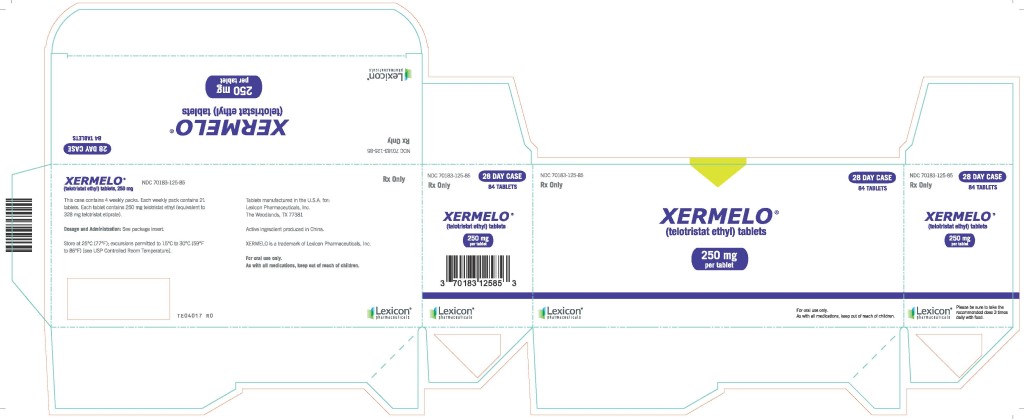
Xermelo telotristat ethyl 250 mg Tablet, 336-count — NDC 70183-125-85 (Billing 70183-0125-85)
This is a package of 336 tablets of Xermelo telotristat ethyl 250 mg Tablet from Lexicon Pharmaceuticals, Inc., no longer marketed (first marketed Mar 2017), no longer in the FDA NDC Directory.
NDC database record
One package, one record: these facts belong to NDC 70183-125-85 alone.
- Record
- FDA NDC Directory package listing · Human prescription drug
- Code segments
- 70183 labeler · 125 product · 85 package
- Listing certified through
- Dec 31, 2026
- Billing quantity
- 336 EA per package
- Barcode (UPC-A, from the NDC)
- 3 7018312585 3
- FDA record last changed
- Jul 24, 2026
Identity & classification
Regulatory identifiers FDA, NLM and CMS codes for this package
Drug-database identifiers Medi-Span GPI and First Databank GCN / HICL / AHFS classification
- GSN (GCN sequence number): 077178
- GCN: 43109
- GPI-14 (Medi-Span): 52570075100330
- HICL (First Databank): 044132
- AHFS class code: 56:08.00.00
- RxCUI (RxNorm): 1872453
Where does this data come from?
- FDA openFDA NDC Directory · synced Oct 8, 2026
- FDA label on DailyMed · label index refreshed Oct 8, 2026
- RxNorm (NLM RxNav) · catalog refreshed Oct 1, 2026
- Medi-Span GPI (licensed)
- First Databank (licensed) · refreshed Oct 8, 2026
Clinical
Telotristat is used in combination with another medication (a somatostatin analog [SSA] such as lanreotide, octreotide, pasireotide) to control diarrhea caused by carcinoid tumors (slow-growing tumors that release natural substances that can cause symptoms like diarrhea) in patients with diarrhea not controlled by a somatostatin analog alone. Telotristat is in a class of medications called antidiarrheal agents. It works by blocking the formation of a certain natural substance in the body that is released by the carcinoid tumors and causes diarrhea.
Read the full MedlinePlus article ↗- Xermelo (telotristat ethyl) is a pill that specifically targets the root cause of your diarrhea — too much serotonin being made in your gut because of your carcinoid tumor. Your ot...
- What exactly is Xermelo and why has my doctor added it to my other carcinoid treatment?
- Always take Xermelo with food — this is important, not just a suggestion. Eating significantly increases how much of the medicine gets into your bloodstream where it can do its job...
- Do I need to take Xermelo with food, or can I take it whenever?
Patient education
Supplement & herbal interactions
Where does this data come from?
- MedlinePlus (NLM) · refreshed Oct 8, 2026
- FDA label on DailyMed · label index refreshed Oct 8, 2026
Ask a licensed pharmacist directly — free, answered by our team.
Pricing
A drug doesn't have one price. Each row is a different public payment system, and none is what you'd pay at the counter — that depends on your insurance. The ⓘ on each row explains what it measures.
| Price system | Per each | Per package |
|---|---|---|
| Retail pharmacies payNADAC · weekly | Not in the retail survey — common for institutional, discontinued, or low-volume packs. | |
| Medicaid paysCMS SDUD · 12 mo | No recent Medicaid claims on file for this NDC — rare and low-volume NDCs are suppressed in the public data. | |
| Medicare drug plans payPart D · quarterly | No Part D plan price is available for this NDC in our data. | |
Where does this data come from?
- CMS NADAC weekly file
- CMS ASP pricing files · refreshed Sep 20, 2026
- CMS Medicaid State Drug Utilization Data · refreshed Oct 8, 2026
- CMS Part D plan pricing files · refreshed Sep 24, 2026
- VA National Acquisition Center price file
Packaging — all sizes for this product
| Package NDC | Description | Marketing start | Marketing end | Status |
|---|---|---|---|---|
| 70183-0125-85 You're viewing this | 4 BOX in 1 CASE / 4 BLISTER PACK in 1 BOX / 21 TABLET in 1 BLISTER PACK | 2021-02-16 | — | Discontinued by firm |
| 70183-0125-84 70183-125-84 Main listing | 4 BOX in 1 CASE / 7 BLISTER PACK in 1 BOX / 3 TABLET in 1 BLISTER PACK | 2017-03-01 | — | Discontinued by firm |
Pack size FAQ
What quantity is in this package?
How does this package differ from NDC 70183-0125-84?
What NDC number is used to bill for this package of Xermelo telotristat ethyl 250 mg Tablet?
Therapeutic equivalents
| Product | Labeler | Pack | NADAC/unit | TE | Status | Price vs. this |
|---|---|---|---|---|---|---|
| Xermelo 250 mg 70720-0125-85 | TerSera | 84 tablets | — | — | FDA listed | — |
| Xermelo 250 mgthis 70183-0125-85 | Lexicon | 336 tablets | — | — | Discontinued | — |
Where does this data come from?
- FDA openFDA NDC Directory · synced Oct 8, 2026
- FDA Orange Book · refreshed Oct 3, 2026
- CMS NADAC weekly file
Availability & generic status
We did not find an FDA-approved generic match for this exact strength, form and route. Patent/protection dates below may affect future generic timing.
Why the date isn’t exact: Generic timing can change because patents may be challenged, settled, licensed, added, removed, or worked around with a narrower label — and FDA approval does not always mean a pharmacy can get the generic today.
🛈 What do these terms mean?
- Patent
- Legal protection listed in the Orange Book that may delay generic approval or launch. Issued by the U.S. Patent & Trademark Office.
- Substance patent
- Covers the active drug molecule itself — the hardest to design around. A generic generally can’t launch until it expires.
- Formulation (product) patent
- Covers a specific formulation or dosage form. A generic can sometimes work around it with a different formulation.
- Method-of-use patent
- A patent covering one specific approved use of the drug — not necessarily the whole molecule. A generic can sometimes launch with a “skinny label” that carves out the protected use and keeps the others.
- Skinny label
- A generic label that omits a still-patented use when the FDA allows it — letting a generic reach the market for the unprotected uses.
- Exclusivity
- FDA-granted marketing protection, separate from patents — e.g. 5-yr new chemical entity, 7-yr orphan drug, or a +6-month pediatric extension.
- Paragraph IV
- A generic applicant’s formal challenge to a listed patent. It can potentially lead to earlier generic entry, but often involves litigation or a settlement.
- RLD / RS
- Reference Listed Drug — the brand product the FDA uses as the reference for generic applications. Reference Standard — the product the FDA expects generics to compare against in bioequivalence testing.
- TE / AB rating
- FDA therapeutic-equivalence rating. An AB rating generally means the FDA considers a generic therapeutically equivalent to — and substitutable for — the brand.
- LOE (loss of exclusivity)
- The latest patent or exclusivity currently listed — the loss-of-exclusivity / latest-listed-protection date shown on this page. Paragraph-IV challenges and settlements can move the real date earlier; FDA approval and a manufacturer’s decision to market can move it later.
Built from the FDA Orange Book. The bars above are scaled to each protection’s expiry; the red LOE marker is the last one to lapse.
| Patent | Type | Use code | Expires |
|---|---|---|---|
| US 7709493 ↗ | Drug substance | U-1979 | Feb 28, 2031 |
| US 7968559 ↗ | Method of use | U-1979 | Dec 11, 2027 |
| US 8653094 ↗ | Method of use | U-1979 | Dec 19, 2028 |
| US 8193204 ↗ | Drug substance | — | Feb 27, 2031 |
| US 7553840 ↗ | Drug substance | — | Dec 11, 2027 |
Is there a generic version of XERMELO 250 MG TABLET?
The FDA approved a generic — why can’t I get it at my pharmacy yet?
Why do different websites show different generic release dates?
What does “FDA listed” mean?
What does a patent or protection date mean here?
What does “current Orange Book estimate” mean?
Can a generic come out before the last patent expires?
Can a generic come out after the listed dates?
What is the difference between patents and exclusivity?
Why are there multiple patent dates?
Where does this data come from?
- FDA Orange Book · refreshed Oct 3, 2026
What it looks like
Where does this data come from?
- FDA label on DailyMed · label index refreshed Oct 8, 2026
Inactive Ingredients / Excipients
Inactive ingredients, also called excipients, are components of the drug product other than the active ingredient. They may include fillers, dyes, coatings, preservatives, flavors, or other formulation ingredients.
🧪 Avoiding an ingredient? See Telotristat Ethyl inactive ingredients by manufacturer: every current product's list side by side, so you can ask your pharmacy for the version that does not list it.
💡 Tap an ingredient (hover on desktop) to see what it is and why it’s used.
-
UNII 3SY5LH9PMK
Anhydrous lactose is a milk sugar with no water content. It acts as a filler and binder in tablets and capsules, adding bulk and helping ingredients stick together.
-
UNII M28OL1HH48
Croscarmellose sodium is a plant-based substance derived from cellulose. It acts as a disintegrant, helping tablets and capsules break down quickly in the digestive system so the medicine can be absorbed.
-
UNII UKE75GEA7F
Hydroxypropyl cellulose is a plant-based polymer used as a binder and thickener. It helps hold tablet ingredients together, controls how fast the medicine dissolves, and improves the texture of liquid formulations.
-
UNII 70097M6I30
Magnesium stearate is a salt made from magnesium and stearic acid, a fatty substance. It's used in tablets and capsules as a lubricant and glidant to help ingredients flow smoothly during manufacturing and prevent sticking.
-
UNII 3WJQ0SDW1A
Polyethylene glycol is a synthetic liquid or solid polymer used in medicines as a solvent, lubricant, and humectant. It helps dissolve active ingredients, reduces friction during manufacturing, and retains moisture in the final product.
-
UNII 532B59J990
Polyvinyl alcohol is a synthetic polymer made from plant-derived materials. It's used as a binder to hold ingredients together, a film-former in coatings, and a thickener in liquid formulations.
-
UNII ETJ7Z6XBU4
Silicon dioxide is a naturally occurring mineral used as a glidant and anti-caking agent. It helps powder ingredients flow smoothly and prevents clumping during manufacturing and storage.
-
UNII 7SEV7J4R1U
A powder made from a naturally occurring mineral. In medicines, talc works as a glidant and anti-caking agent, helping tablets and capsules flow smoothly during manufacturing and preventing clumping.
-
UNII 15FIX9V2JP
Titanium dioxide is a bright white mineral powder commonly used as a colorant and opacifying agent. It makes pills and tablets white or lighter in color and helps make coatings non-transparent.
9 inactive ingredients listed in the exact product block matched to this NDC.
Where does this data come from?
ingredient classCode="IACT" elements from the exact product block matched by this NDC. Label-section narrative from DailyMed / the openFDA label index is shown separately when available.- FDA label on DailyMed · label index refreshed Oct 8, 2026
- FDA openFDA NDC Directory · synced Oct 8, 2026
Inactive ingredient FAQ
Are inactive ingredients the same for every manufacturer?
Why might an inactive ingredient be missing?
Can inactive ingredients matter?
Manufacturer & labeler
More NDCs from Lexicon Pharmaceuticals, Inc. labeler code 70183
Where does this data come from?
- FDA openFDA NDC Directory · synced Oct 8, 2026
- Drugs@FDA
Full prescribing information FDA SPL
🎯 Indications and Usage ▾
1 INDICATIONS AND USAGE Xermelo is indicated for the treatment of carcinoid syndrome diarrhea in combination with somatostatin analog (SSA) therapy in adults inadequately controlled by SSA therapy. Xermelo is a tryptophan hydroxylase inhibitor indicated for the treatment of carcinoid syndrome diarrhea in combination with somatostatin analog (SSA) therapy in adults inadequately controlled by SSA therapy. ( 1 )
⏱️ Dosage and Administration ▾
2 DOSAGE AND ADMINISTRATION The recommended dosage of Xermelo in adult patients is 250 mg three times daily for patients whose diarrhea is inadequately controlled by SSA therapy. Administration Take Xermelo with food [see Clinical Pharmacology ( 12.3 ), Clinical Studies ( 14 )] . When short-acting octreotide is used in combination with Xermelo, administer short-acting octreotide at least 30 minutes after administering Xermelo [see Clinical Pharmacology ( 12.3 ), Clinical Studies ( 14 )] .
If a dose is missed, take the next dose at the regular time. Do not take 2 doses at the same time to make up for a missed dose. Discontinue Xermelo if severe constipation develops [see Warnings and Precautions ( 5.1 )].
The recommended dosage of Xermelo in adult patients is 250 mg three times daily for patients whose diarrhea is inadequately controlled by a SSA therapy. ( 2 ) Take Xermelo with food. ( 2 ) When short-acting octreotide is used in combination with Xermelo, administer short-acting octreotide at least 30 minutes after administering Xermelo.
( 2 , 7.1 ) Discontinue Xermelo if severe constipation develops. ( 2 , 5.1 )
💊 Dosage Forms and Strengths ▾
3 DOSAGE FORMS AND STRENGTHS Tablets: 250 mg telotristat ethyl; white to off-white, coated and oval with “T-E” debossed on one side and “250” debossed on the other side. Tablets: 250 mg telotristat ethyl ( 3 )
⛔ Contraindications ▾
4 CONTRAINDICATIONS None. None. ( 4 )
⚠️ Warnings and Cautions ▾
5 WARNINGS AND PRECAUTIONS Constipation: Xermelo reduces bowel movement frequency; monitor patients for constipation and/or severe persistent or worsening abdominal pain. Discontinue Xermelo if severe constipation or abdominal pain develops. ( 5.1 )
5.1Constipation Xermelo reduces bowel movement frequency. In a 12-week, placebo-controlled trial, in which patients had 4 or greater bowel movements per day, 2 out of 45 patients treated with a higher than recommended dosage of Xermelo reported constipation. In one patient the constipation was serious, resulting in hospitalization.
During the 36-week extension period with higher than the recommended dosage, 10 of 115 patients reported constipation: one developed intestinal perforation and one developed obstruction. In another 12-week, placebo-controlled trial in which patients had less than 4 bowel movements per day, 4 out of 25 patients treated with the recommended dosage of Xermelo reported constipation. Given that patients with metastatic carcinoid tumors may have impaired integrity of the gastrointestinal tract wall, monitor for the development of constipation and/or severe, persistent, or worsening abdominal pain in patients taking Xermelo.
Discontinue Xermelo if severe constipation or severe persistent or worsening abdominal pain develops [see Dosage and Administration ( 2 ), Adverse Reactions ( 6.1 )] .
🤒 Adverse Reactions ▾
6 ADVERSE REACTIONS Most common adverse reactions (≥5%) are nausea, headache, increased GGT, depression, flatulence, decreased appetite, peripheral edema, and pyrexia. ( 6.1 ) To report SUSPECTED ADVERSE REACTIONS, contact TerSera Therapeutics LLC at 1-844-334-4035 or FDA at 1-800-FDA-1088 or www.fda.gov/medwatch
6.1Clinical Trials Experience Because clinical trials are conducted under widely varying conditions, adverse reaction rates observed in the clinical trials of a drug cannot be directly compared to rates in the clinical trials of another drug and may not reflect the rates observed in practice. Xermelo was studied in a double-blind, placebo-controlled clinical trial of 90 patients with metastatic neuroendocrine tumors and carcinoid syndrome diarrhea. Patients reported between 4 to 12 bowel movements daily despite the use of SSA therapy at a stable dose for at least 3 months [see Clinical Studies ( 14 )] .
Placebo or Xermelo 250 mg was administered three times daily for 12 weeks. Concomitant anti-diarrheal medications (e.g., loperamide) were used by 43% (36% and 51% in the placebo and Xermelo group, respectively), pancreatic enzyme replacement medications by 39% (36% and 42% in the placebo and Xermelo group, respectively), and opioid analgesics by 29% (24% and 33% in the placebo and Xermelo group, respectively) of patients during the 12-week double-blind period of the trial. Table 1 below lists adverse reactions occurring at an incidence of at least 5% in the Xermelo group (N=45) and at an incidence greater than placebo (N=45) during the 12-week placebo-controlled period of the trial.
Table 1: Percent Common Adverse Reactions a by Treatment Group at 12-Weeks in a Double-Blind Placebo-Controlled Clinical Trial of Patients with Carcinoid Syndrome Diarrhea a incidence of at least 5% in the Xermelo group and at an incidence greater than placebo b including depression, depressed mood and decreased interest Adverse Reaction Xermelo 250 mg Three Times Daily, N=45 (%) Placebo, N=45 (%) Nausea 13 11 Headache 11 4 Increased gamma-glutamyl-transferase (GGT) 9 0 Depression b 9 7 Peripheral edema 7 2 Flatulence 7 2 Decreased appetite 7 4 Pyrexia 7 4 In another placebo-controlled clinical trial of patients with carcinoid syndrome diarrhea and less than 4 bowel movements per day, the following additional adverse reactions, not listed in Table 1 , of abdominal pain (including upper and lower abdominal pain, abdominal distention and gastrointestinal pain) and constipation were reported in at least 5% of patients in the Xermelo treated group and at an incidence greater than placebo [see Warnings and Precautions ( 5.1 )] .
Less Common Adverse Reactions : The following is a list of adverse reactions occurring in less than 5% of patients receiving Xermelo during the 12-week placebo-controlled period of the clinical trial: Investigations : increased alkaline phosphatase, increased alanine aminotransferase, and increased aspartate aminotransferase. Fecaloma was reported in one patient treated with Xermelo during the 36-week open-label extension period following the 12-week double-blind period of the trial.
🔄 Drug Interactions ▾
7 DRUG INTERACTIONS CYP3A4 Substrates (e.g., midazolam): Efficacy of concomitant drugs may be decreased; monitor for suboptimal efficacy and consider increasing the dose of the concomitant drug. ( 7.1 )
7.1CYP3A4 Substrates Concomitant use of Xermelo may decrease the efficacy of drugs that are CYP3A4 substrates (e.g., midazolam) by decreasing their systemic exposure. Monitor for suboptimal efficacy and consider increasing the dose for concomitant CYP3A4 substrates, if necessary [see Clinical Pharmacology ( 12.3 )] .
7.2Short-Acting Octreotide Concurrent administration of short-acting octreotide with Xermelo significantly decreased the systemic exposure of telotristat ethyl and telotristat, the active metabolite. If treatment with short-acting octreotide is needed in combination with Xermelo, administer short-acting octreotide at least 30 minutes after administration of Xermelo [see Clinical Pharmacology ( 12.3 ), Clinical Studies ( 14 )] .
👥 Use in Specific Populations ▾
8 USE IN SPECIFIC POPULATIONS
8.1Pregnancy Risk Summary There are no human data with Xermelo use in pregnant women to inform a drug-associated risk. In animal reproduction studies, no effects on embryo-fetal development were observed with the administration of oral telotristat ethyl to rats during organogenesis at doses up to 750 mg/kg/day (approximately 9 times the exposure at the RHD [recommended human dose]). Treatment of pregnant rabbits with oral telotristat ethyl during organogenesis produced maternal toxicity and post-implantation loss at doses of 250 mg/kg/day or higher (approximately 15 times the exposure at the RHD), and reduced fetal weight at 500 mg/kg/day (approximately 33 times the exposure at the RHD).
In a pre-/postnatal development study, an increased incidence of mortality in rat offspring was observed during postnatal days 0 to 4 at the maternal oral dose of 500 mg/kg/day (approximately 5 times the exposure at the RHD), given during organogenesis through lactation [see Data ] . The estimated background risk of major birth defects and miscarriage for the indicated population is unknown. All pregnancies have a background risk of birth defect, loss or other adverse outcomes.
In the U.S. general population, the estimated background risk of major birth defects and miscarriage in clinically recognized pregnancies is 2% to 4% and 15% to 20%, respectively. Data Animal data An embryo-fetal development study performed in rats with oral telotristat ethyl at doses up to 750 mg/kg/day (approximately 9 times the AUC [area under the plasma concentration-time curve] for the active metabolite at the RHD) during organogenesis produced no harm to embryo-fetal development. In pregnant rabbits treated orally with telotristat ethyl during organogenesis, an increased incidence of post-implantation loss at doses of 250 and 500 mg/kg/day (approximately 15 times the AUC for the active metabolite at RHD) and a decrease in fetal weight at 500 mg/kg/day (approximately 33 times the AUC for the active metabolite at the RHD) was observed.
The adverse effects on embryo-fetal development were associated with maternal toxicity (impaired weight gain and/or mortality) at 250 and 500 mg/kg/day. No adverse effects on embryo-fetal development were observed at 125 mg/kg/day (approximately 5 times the AUC for the active metabolite at the RHD). A pre-/postnatal development study was conducted in rats using oral administration of 100, 200, and 500 mg/kg/day telotristat ethyl during organogenesis through lactation.
An increased incidence of pup mortality was observed during postnatal days 0 to 4 at the maternal dose of 500 mg/kg/day (approximately 5 times the AUC for the active metabolite at the RHD). No developmental abnormalities or effects on growth, learning and memory, or reproductive performance were observed through maturation of offspring at maternal doses of up to 500 mg/kg/day in surviving offspring.
8.2Lactation Risk Summary There are no data on the presence of telotristat ethyl in human or animal milk, the effects on the breastfed infant, or the effects on milk production. The effects of local gastrointestinal and systemic exposure to telotristat ethyl on breastfed infants are unknown. The developmental and health benefits of breastfeeding should be considered along with the mother's clinical need for Xermelo and any potential adverse effects on the breastfed infant from Xermelo or from the underlying maternal condition.
Clinical Considerations Monitor the breastfed infant for symptoms of constipation.
8.4Pediatric Use The safety and effectiveness of Xermelo in pediatric patients have not been established.
8.5Geriatric Use Of 45 patients in a clinical trial of Xermelo, 19 (42%) patients were 65 years of age and over. No overall differences in safety or effectiveness were observed between these patients and younger patients, and other reported clinical experience has not identified differences in responses between the elderly and younger… [Excerpted — this section continues on DailyMed.]
🤰 Pregnancy ▾
8.1Pregnancy Risk Summary There are no human data with Xermelo use in pregnant women to inform a drug-associated risk. In animal reproduction studies, no effects on embryo-fetal development were observed with the administration of oral telotristat ethyl to rats during organogenesis at doses up to 750 mg/kg/day (approximately 9 times the exposure at the RHD [recommended human dose]). Treatment of pregnant rabbits with oral telotristat ethyl during organogenesis produced maternal toxicity and post-implantation loss at doses of 250 mg/kg/day or higher (approximately 15 times the exposure at the RHD), and reduced fetal weight at 500 mg/kg/day (approximately 33 times the exposure at the RHD).
In a pre-/postnatal development study, an increased incidence of mortality in rat offspring was observed during postnatal days 0 to 4 at the maternal oral dose of 500 mg/kg/day (approximately 5 times the exposure at the RHD), given during organogenesis through lactation [see Data ] . The estimated background risk of major birth defects and miscarriage for the indicated population is unknown. All pregnancies have a background risk of birth defect, loss or other adverse outcomes.
In the U.S. general population, the estimated background risk of major birth defects and miscarriage in clinically recognized pregnancies is 2% to 4% and 15% to 20%, respectively. Data Animal data An embryo-fetal development study performed in rats with oral telotristat ethyl at doses up to 750 mg/kg/day (approximately 9 times the AUC [area under the plasma concentration-time curve] for the active metabolite at the RHD) during organogenesis produced no harm to embryo-fetal development. In pregnant rabbits treated orally with telotristat ethyl during organogenesis, an increased incidence of post-implantation loss at doses of 250 and 500 mg/kg/day (approximately 15 times the AUC for the active metabolite at RHD) and a decrease in fetal weight at 500 mg/kg/day (approximately 33 times the AUC for the active metabolite at the RHD) was observed.
The adverse effects on embryo-fetal development were associated with maternal toxicity (impaired weight gain and/or mortality) at 250 and 500 mg/kg/day. No adverse effects on embryo-fetal development were observed at 125 mg/kg/day (approximately 5 times the AUC for the active metabolite at the RHD). A pre-/postnatal development study was conducted in rats using oral administration of 100, 200, and 500 mg/kg/day telotristat ethyl during organogenesis through lactation.
An increased incidence of pup mortality was observed during postnatal days 0 to 4 at the maternal dose of 500 mg/kg/day (approximately 5 times the AUC for the active metabolite at the RHD). No developmental abnormalities or effects on growth, learning and memory, or reproductive performance were observed through maturation of offspring at maternal doses of up to 500 mg/kg/day in surviving offspring.
🧒 Pediatric Use ▾
8.4Pediatric Use The safety and effectiveness of Xermelo in pediatric patients have not been established.
🧓 Geriatric Use ▾
8.5Geriatric Use Of 45 patients in a clinical trial of Xermelo, 19 (42%) patients were 65 years of age and over. No overall differences in safety or effectiveness were observed between these patients and younger patients, and other reported clinical experience has not identified differences in responses between the elderly and younger patients, but greater sensitivity of some older individuals cannot be ruled out.
🧬 Clinical Pharmacology ▾
12 CLINICAL PHARMACOLOGY
12.1Mechanism of Action Telotristat, the active metabolite of telotristat ethyl, is an inhibitor of tryptophan hydroxylase, which mediates the rate limiting step in serotonin biosynthesis. The in vitro inhibitory potency of telotristat towards tryptophan hydroxylase is 29 times higher than that of telotristat ethyl. Serotonin plays a role in mediating secretion, motility, inflammation, and sensation of the gastrointestinal tract, and is over-produced in patients with carcinoid syndrome.
Through inhibition of tryptophan hydroxylase, telotristat and telotristat ethyl reduce the production of peripheral serotonin, and the frequency of carcinoid syndrome diarrhea.
12.2Pharmacodynamics In healthy subjects, telotristat ethyl 500 mg three times daily (twice the recommended dosage) for 14 days decreased whole blood serotonin and 24-hour urinary 5-hydroxyindolacetic acid (u5-HIAA) from baseline. A decrease in 24-hour u5-HIAA was observed as early as after 5 days of treatment. In patients with metastatic neuroendocrine tumors and carcinoid syndrome diarrhea, 24-hour u5-HIAA decreased from baseline following 6 and 12 weeks of treatment with Xermelo 250 mg three times a day, whereas placebo did not decrease u5-HIAA.
Cardiac Electrophysiology At a dose 6 times the recommended dose of 250 mg, Xermelo does not prolong the QT interval to any clinically relevant extent.
12.3Pharmacokinetics Absorption After a single oral dose of telotristat ethyl to healthy subjects, telotristat ethyl was absorbed and metabolized to its active metabolite, telotristat. Peak plasma concentrations of telotristat ethyl were achieved within 0.5 to 2 hours, and those of telotristat within 1 to 3 hours. Plasma concentrations thereafter declined in a biphasic manner.
Following administration of a single 500 mg dose of telotristat ethyl (twice the recommended dosage) under fasted conditions in healthy subjects, the mean C max and AUC 0-inf were 4.4 ng/mL and 6.23 ng•hr/mL, respectively for telotristat ethyl. The mean C max and AUC 0-inf were 610 ng/mL and 2320 ng•hr/mL, respectively for telotristat. Peak plasma concentrations and AUC of telotristat ethyl and telotristat appeared to be dose proportional following administration of a single dose of telotristat ethyl in the range of 100 mg (0.4 times the lowest recommended dose to 1000 mg [4 times the highest recommended dose]) under fasted conditions.
Following multiple-dose administration of telotristat ethyl 500 mg three times daily, there was negligible accumulation at steady state for both telotristat ethyl and telotristat. In patients with metastatic neuroendocrine tumors and carcinoid syndrome diarrhea treated with SSA therapy, the median T max for telotristat ethyl and telotristat was approximately 1 and 2 hours, respectively. Following administration of 500 mg telotristat ethyl three times daily, with meals in patients, the mean C max and AUC 0-6hr were approximately 7 ng/mL and 22 ng•hr/mL, respectively, for telotristat ethyl.
The mean C max and AUC 0-6hr were approximately 900 ng/mL and 3000 ng•hr/mL, respectively for telotristat. The pharmacokinetic parameters for both telotristat ethyl and telotristat were highly variable with about 55% coefficient of variation. Food Effect Administration of a single 500 mg dose of Xermelo (twice the recommended dose) with food resulted in higher exposure to both telotristat ethyl and telotristat.
The systemic exposure to telotristat ethyl, was significantly increased following administration with a high-fat meal, with C max , and AUC 0-inf being 112%, and 264% higher, respectively compared to the fasted state. Following administration of a single 500 mg dose of telotristat ethyl under the fed conditions in healthy subjects, the mean C max and AUC 0-inf were 10.5 ng/mL and 21.6 ng•hr/mL, respectively for telotristat ethyl. The C max and AUC 0-inf values for telotristat were also increased by 47% and 33%, respectively, with a high-fat meal compared… [Excerpted — this section continues on DailyMed.]
🧬 Mechanism of Action ▾
12.1Mechanism of Action Telotristat, the active metabolite of telotristat ethyl, is an inhibitor of tryptophan hydroxylase, which mediates the rate limiting step in serotonin biosynthesis. The in vitro inhibitory potency of telotristat towards tryptophan hydroxylase is 29 times higher than that of telotristat ethyl. Serotonin plays a role in mediating secretion, motility, inflammation, and sensation of the gastrointestinal tract, and is over-produced in patients with carcinoid syndrome.
Through inhibition of tryptophan hydroxylase, telotristat and telotristat ethyl reduce the production of peripheral serotonin, and the frequency of carcinoid syndrome diarrhea.
📦 How Supplied / Storage and Handling ▾
16 HOW SUPPLIED/STORAGE AND HANDLING How Supplied 250 mg tablet: white to off-white coated oval tablet with “T-E” debossed on one side and “250” debossed on the other side. Xermelo is dispensed in a monthly case for a total of 28 days of therapy. Each monthly case contains four weekly packs.
Each weekly pack contains 21 tablets. NDC 70183-125-85: Monthly case of 84 tablets. Each child resistant weekly pack contains twenty one 250 mg tablets.
Storage Store at 25°C (77°F); excursions permitted to 15°C to 30°C (59°F to 86°F) [see USP Controlled Room Temperature].
📦 Storage and Handling ▾
Storage Store at 25°C (77°F); excursions permitted to 15°C to 30°C (59°F to 86°F) [see USP Controlled Room Temperature].
📋 Description ▾
11 DESCRIPTION Xermelo (telotristat ethyl) tablets contain telotristat ethyl as telotristat etiprate, a tryptophan hydroxylase inhibitor. Telotristat etiprate is the hippurate salt of telotristat ethyl [(S)-ethyl 2-amino-3-(4-(2-amino-6-((R)-1-(4-chloro-2-(3-methyl-1H-pyrazol-1-yl)phenyl)-2,2,2-trifluoroethoxy)pyrimidin-4-yl)phenyl)propanoate], which undergoes hydrolysis to the active metabolite, (S)-2-amino-3-(4-(2-amino-6-((R)-1-(4-chloro-2-(3-methyl-1H-pyrazol-1-yl)phenyl)-2,2,2-trifluoroethoxy)pyrimidin-4-yl)phenyl)propanoic acid.
The molecular formula of telotristat etiprate is C 27 H 26 ClF 3 N 6 O 3 • C 9 H 9 NO 3 and its molecular weight is 754.2. The molecular weight of the free base (telotristat ethyl) is 575.0. Chemical Structure: Telotristat etiprate is a white to off-white solid.
The solubility is a function of pH at 25°C; at pH 1 (0.1N HCl), the solubility is greater than 71 mg/mL, at pH 3 phosphate buffer, the solubility is 0.30 mg/mL, at a pH of 5 to 9, the solubility is negligible. In organic solvents, telotristat etiprate is freely soluble in methanol, soluble in acetone, and sparingly soluble in ethanol. Each Xermelo tablet contains 250 mg of telotristat ethyl (free base) which is equivalent to 328 mg telotristat etiprate.
The inactive ingredients of Xermelo tablets include: colloidal silicon dioxide, croscarmellose sodium, hydroxypropyl cellulose, lactose anhydrous, macrogol/PEG, magnesium stearate, polyvinyl alcohol [part hydrolyzed], talc and titanium dioxide. Chemical Structure
💬 Information for Patients ▾
17 PATIENT COUNSELING INFORMATION Advise patients: If they experience severe constipation or severe persistent or worsening abdominal pain, to discontinue Xermelo and contact their healthcare provider [see Warnings and Precautions ( 5.1 )] . To take Xermelo with food [see Clinical Pharmacology ( 12.3 ), Clinical Studies ( 14 )] . When short-acting octreotide is used in combination with Xermelo, administer short-acting octreotide at least 30 minutes after administering Xermelo [see Clinical Pharmacology ( 12.3 ), Clinical Studies ( 14 )] .
If a dose is missed, take the next dose at the regular time. Do not take 2 doses at the same time to make up for a missed dose. Distributed by: Lexicon Pharmaceuticals, Inc.
The Woodlands, TX 77381
🧬 Pharmacokinetics ▾
12.3Pharmacokinetics Absorption After a single oral dose of telotristat ethyl to healthy subjects, telotristat ethyl was absorbed and metabolized to its active metabolite, telotristat. Peak plasma concentrations of telotristat ethyl were achieved within 0.5 to 2 hours, and those of telotristat within 1 to 3 hours. Plasma concentrations thereafter declined in a biphasic manner.
Following administration of a single 500 mg dose of telotristat ethyl (twice the recommended dosage) under fasted conditions in healthy subjects, the mean C max and AUC 0-inf were 4.4 ng/mL and 6.23 ng•hr/mL, respectively for telotristat ethyl. The mean C max and AUC 0-inf were 610 ng/mL and 2320 ng•hr/mL, respectively for telotristat. Peak plasma concentrations and AUC of telotristat ethyl and telotristat appeared to be dose proportional following administration of a single dose of telotristat ethyl in the range of 100 mg (0.4 times the lowest recommended dose to 1000 mg [4 times the highest recommended dose]) under fasted conditions.
Following multiple-dose administration of telotristat ethyl 500 mg three times daily, there was negligible accumulation at steady state for both telotristat ethyl and telotristat. In patients with metastatic neuroendocrine tumors and carcinoid syndrome diarrhea treated with SSA therapy, the median T max for telotristat ethyl and telotristat was approximately 1 and 2 hours, respectively. Following administration of 500 mg telotristat ethyl three times daily, with meals in patients, the mean C max and AUC 0-6hr were approximately 7 ng/mL and 22 ng•hr/mL, respectively, for telotristat ethyl.
The mean C max and AUC 0-6hr were approximately 900 ng/mL and 3000 ng•hr/mL, respectively for telotristat. The pharmacokinetic parameters for both telotristat ethyl and telotristat were highly variable with about 55% coefficient of variation. Food Effect Administration of a single 500 mg dose of Xermelo (twice the recommended dose) with food resulted in higher exposure to both telotristat ethyl and telotristat.
The systemic exposure to telotristat ethyl, was significantly increased following administration with a high-fat meal, with C max , and AUC 0-inf being 112%, and 264% higher, respectively compared to the fasted state. Following administration of a single 500 mg dose of telotristat ethyl under the fed conditions in healthy subjects, the mean C max and AUC 0-inf were 10.5 ng/mL and 21.6 ng•hr/mL, respectively for telotristat ethyl. The C max and AUC 0-inf values for telotristat were also increased by 47% and 33%, respectively, with a high-fat meal compared to the fasted state.
The mean C max and AUC 0-inf were 908 ng/mL and 2980 ng•hr/mL, respectively for telotristat under the fed condition. [see Dosage and Administration ( 2 )] . Distribution Both telotristat ethyl and telotristat are greater than 99% bound to human plasma proteins. In vitro data suggests that telotristat is a substrate of P-glycoprotein.
Elimination Following a single 500 mg oral dose of telotristat ethyl in healthy subjects, the apparent half-life was approximately 0.6 hours for telotristat ethyl and 5 hours for telotristat. The apparent total clearance at steady state (CL/F ss ) following oral dosing with telotristat ethyl 500 mg three times daily for 14 days (twice the recommended dosage) in healthy subjects was 2.7 and 152 L/hr for telotristat ethyl and telotristat, respectively. Metabolism After oral administration, telotristat ethyl undergoes hydrolysis via carboxylesterases to telotristat, its active metabolite.
Telotristat is further metabolized. Among the metabolites of telotristat, the systemic exposure to an acid metabolite of oxidative deaminated decarboxylated telotristat was about 35% of that of telotristat. In vitro data suggest that telotristat ethyl and telotristat are not substrates for CYP enzymes.
Excretion Following a single 500 mg oral dose of 14 C-telotristat ethyl, 93.2% of the dose was recovered over 240 hours: 92.8% was recovered in the f… [Excerpted — this section continues on DailyMed.]
🧬 Pharmacodynamics ▾
12.2Pharmacodynamics In healthy subjects, telotristat ethyl 500 mg three times daily (twice the recommended dosage) for 14 days decreased whole blood serotonin and 24-hour urinary 5-hydroxyindolacetic acid (u5-HIAA) from baseline. A decrease in 24-hour u5-HIAA was observed as early as after 5 days of treatment. In patients with metastatic neuroendocrine tumors and carcinoid syndrome diarrhea, 24-hour u5-HIAA decreased from baseline following 6 and 12 weeks of treatment with Xermelo 250 mg three times a day, whereas placebo did not decrease u5-HIAA.
Cardiac Electrophysiology At a dose 6 times the recommended dose of 250 mg, Xermelo does not prolong the QT interval to any clinically relevant extent.
🔬 Clinical Studies ▾
14 CLINICAL STUDIES A 12-week double-blind, placebo-controlled, randomized, multicenter trial of Xermelo was conducted in adult patients with a well-differentiated metastatic neuroendocrine tumor and carcinoid syndrome diarrhea who were having between 4 to 12 daily bowel movements despite the use of SSA therapy at a stable dose for at least 3 months. Patients were randomized to placebo or treatment with Xermelo 250 mg three times daily. Study medication was administered within 15 minutes before or within 1 hour after a meal or snack [see Dosage and Administration ( 2 )] .
All patients were required to stay on their baseline SSA regimen and were allowed to use rescue medication (short-acting octreotide) and antidiarrheals (e.g., loperamide) for symptomatic relief. A total of 90 patients were evaluated for efficacy. The mean age of the population was 63 years of age (range 37 to 83 years), 50% were male, and 90% were White.
The primary efficacy endpoint was the change from baseline in the number of daily bowel movements averaged over the 12-week treatment period. The analysis results can be found in Table 2 below. The average was based on the number of days with valid, non-missing data.
When a patient had more than 6 weeks of missing data, the change from baseline was considered equal to zero. A week of missing data was defined as a patient missing at least 4 days of diary data in that week. Table 2: Change from Baseline in Bowel Movements/Day Averaged Over 12 Weeks in Adult Patients with Carcinoid Syndrome Diarrhea Parameter Xermelo 250 mg three times daily Placebo CL=confidence limit; SD=standard deviation. a Baseline Bowel Movements/Day was assessed over the 3-4 week screening/run-in period. b Statistical tests used a blocked 2-sample Wilcoxon Rank Sum statistic (van Elteren test) stratified by the u5-HIAA stratification at randomization.
CLs were based on the Hodges-Lehmann estimator of the median paired difference. c p<0.001 Bowel Movements/Day At Baseline a Number of Patients 45 45 Baseline Mean (SD) Median (Min, Max) 6.1 (2.1) 5.5 (3.5, 13.0) 5.2 (1.4) 5.1 (3.5, 9.0) Change From Baseline In Bowel Movements/Day Averaged Over 12 Weeks Change Averaged over 12 Weeks: Mean (SD) Median (Min, Max) ˗1.4 (1.4) -1.3 (-6.1, 1.6) ˗0.6 (0.8) -0.6 (-2.7, 0.8) Estimate of Treatment Difference (97.5% CL) b ˗0.8 c (˗1.3, ˗0.3) --- In the 12-week study, a difference in average weekly reductions in bowel movement frequency between Xermelo and placebo was observed as early as 1 to 3 weeks, and persisted for the remaining 9 weeks of the study.
To aid in the interpretation of the bowel movement reduction results, the proportion of patients reporting any particular level of reduction in overall average bowel movement frequency is depicted in Figure 1 below. For example, 33% of patients randomized to Xermelo and 4% of patients randomized to placebo experienced a reduction in overall average bowel movements from baseline of at least 2 bowel movements per day. Figure 1: Cumulative Proportion of Patients with Carcinoid Syndrome Diarrhea Reporting Change in Overall Average Bowel Movement Frequency Other symptoms of carcinoid syndrome (abdominal pain or flushing) did not show improvement in the comparison of Xermelo to placebo.
The average number of daily short-acting octreotide injections used for rescue therapy over the 12-week double-blind treatment period was 0.3 and 0.7 in the Xermelo and placebo groups, respectively. In the subgroup of patients who received short-acting octreotide injections, observed reductions in the number of bowel movements per day and treatment differences were generally consistent with the reductions and differences observed in patients who did not receive rescue therapy, and were similar to the overall data presented in Table 2 above [see Dosage and Administration ( 2 ), Drug Interactions ( 7.2 )] .
A third randomized treatment arm of Xermelo 500 mg three times daily did not demonstrate additional treatment benefit on th… [Excerpted — this section continues on DailyMed.]
🧪 Nonclinical Toxicology ▾
13 NONCLINICAL TOXICOLOGY
13.1Carcinogenesis, Mutagenesis, Impairment of Fertility In a 26-week study in transgenic (Tg.rasH2) mice, telotristat ethyl was not tumorigenic at oral doses up to 300 mg/kg/day. Telotristat ethyl was negative in the in vitro Ames test, the in vitro chromosomal aberration test using Chinese hamster ovary cells, and the in vivo rat micronucleus test. Telotristat ethyl at oral doses up to 500 mg/kg/day (approximately 5 times the AUC for the active metabolite at the RHD) was found to have no effect on fertility and reproductive performance of male or female rats.
📄 Carcinogenesis, Mutagenesis, Impairment of Fertility ▾
13.1Carcinogenesis, Mutagenesis, Impairment of Fertility In a 26-week study in transgenic (Tg.rasH2) mice, telotristat ethyl was not tumorigenic at oral doses up to 300 mg/kg/day. Telotristat ethyl was negative in the in vitro Ames test, the in vitro chromosomal aberration test using Chinese hamster ovary cells, and the in vivo rat micronucleus test. Telotristat ethyl at oral doses up to 500 mg/kg/day (approximately 5 times the AUC for the active metabolite at the RHD) was found to have no effect on fertility and reproductive performance of male or female rats.
📄 Package Label / Principal Display Panel ▾
Principal Display Panel - 3x7 weekly pack TO OPEN: 1 Press & hold button 2 Pull out card WEEKLY PACK 21 TABLETS Rx Only XERMELO ® (telotristat ethyl) tablets 250 mg per tablet Lexicon ® pharmaceuticals For oral use only. As with all medications, keep out of reach of children. NDC 70183-125-22 Principal Display Panel - 3x7 weekly pack
Principal Display Panel - 28 Day Case Label NDC 70183-125-85 Rx Only 28 DAY CASE 84 TABLETS XERMELO ® (telotristat ethyl) tablets 250 mg per tablet Lexicon ® pharmaceuticals For oral use only. As with all medications, keep out of reach of children. Principal Display Panel - 28 Day Case Label
Medicare Part D spend CMS · PART D · 2026 (Q1)
About this NDC listing & data coverage
What data is (and isn’t) available for this NDC — tap to expand
| NDC identity (package / product / labeler codes) | ✓ Available |
| Labeler | ✓ Available |
| Product & package description | ✓ Available |
| Marketing category & status | ✓ Available |
| Active ingredient / dosage form / route | ✓ Available |
| FDA label (SPL via DailyMed) | ✓ Available |
| Package photos | ✓ Available |
| Inactive ingredients (structured) | ✓ Available |
| NADAC pharmacy acquisition price (CMS) | — Not published for this NDC CMS publishes NADAC only for NDCs reported in its retail-pharmacy survey. |
| Orange Book / therapeutic-equivalence data | ✓ Available |
| HCPCS J-code billing crosswalk | — Not published for this NDC Most self-administered / retail products have no J-code — that is normal. |
| Medicaid utilization (CMS SDUD) | — Not published for this NDC CMS reports utilization only for NDCs with Medicaid claims above its privacy threshold. |