
Sincalide 5 ug/5mL Injection, Powder, Lyophilized, For Solution — NDC 70511-131-84 (Billing 70511-0131-84)
This is a package of Sincalide 5 ug/5mL Injection, Powder, Lyophilized, For Solution from MAIA Pharmaceuticals, Inc., marketed since Nov 2022 and currently FDA-listed. It is this product's only package size.
Identity & classification
Regulatory identifiers FDA, NLM and CMS codes for this package
- RxCUI (RxNorm): 237982
Where does this data come from?
- FDA openFDA NDC Directory · synced Oct 1, 2026
- FDA label on DailyMed · label index refreshed Oct 1, 2026
- RxNorm (NLM RxNav) · catalog refreshed Oct 1, 2026
- Medi-Span GPI (licensed)
- First Databank (licensed) · refreshed Oct 1, 2026
RxNorm drug class
This medicine belongs to the Cholecystokinin Analog class.
Where does this data come from?
- RxClass (NLM) · catalog refreshed Oct 1, 2026
Clinical
Patient education
Supplement & herbal interactions
Where does this data come from?
- MedlinePlus (NLM) · refreshed Oct 1, 2026
- FDA label on DailyMed · label index refreshed Oct 1, 2026
Ask a licensed pharmacist directly — free, answered by our team.
Pricing
A drug doesn't have one price. Each row is a different public payment system, and none is what you'd pay at the counter — that depends on your insurance. The ⓘ on each row explains what it measures.
| Price system | Per mL | Per package |
|---|---|---|
| Retail pharmacies payNADAC · weekly | Not in the retail survey — common for institutional, discontinued, or low-volume packs. | |
| Medicaid paysCMS SDUD · 12 mo | No recent Medicaid claims on file for this NDC — rare and low-volume NDCs are suppressed in the public data. | |
| Medicare drug plans payPart D · quarterly | No Part D plan price is available for this NDC in our data. | |
Where does this data come from?
- CMS NADAC weekly file
- CMS ASP pricing files · refreshed Sep 20, 2026
- CMS Medicaid State Drug Utilization Data · refreshed Oct 3, 2026
- CMS Part D plan pricing files · refreshed Sep 24, 2026
- VA National Acquisition Center price file
Packaging — all sizes for this product
| Package NDC | Description | Marketing start | Marketing end | Status |
|---|---|---|---|---|
| 70511-0131-84 You're viewing this Main listing | 10 VIAL in 1 PACKAGE / 5 mL in 1 VIAL | 2022-11-25 | — | Active |
Therapeutic equivalents
| Product | Labeler | Pack | NADAC/unit | TE | Status | Price vs. this |
|---|---|---|---|---|---|---|
| Kinevac 5 ug/5mL 00270-0556-15 | Bracco | 10 vials | — | AP | FDA listed | — |
| Sincalide 5 ug/5mL 63323-0579-05 | Fresenius | 10 vials | — | AP | FDA listed | — |
| Sincalide 5 ug/5mLthis 70511-0131-84 | MAIA | 10 vials | — | AP | FDA listed | — |
| Sincalide 5 ug/5mL 72266-0248-05 | FOSUN | 5 vials | — | AP | FDA listed | — |
Where does this data come from?
- FDA openFDA NDC Directory · synced Oct 1, 2026
- FDA Orange Book · refreshed Sep 3, 2026
- CMS NADAC weekly file
Availability & generic status
We did not find an FDA-approved generic match for this exact strength, form and route. Patent/protection dates below may affect future generic timing.
Why the date isn’t exact: Generic timing can change because patents may be challenged, settled, licensed, added, removed, or worked around with a narrower label — and FDA approval does not always mean a pharmacy can get the generic today.
🛈 What do these terms mean?
- Patent
- Legal protection listed in the Orange Book that may delay generic approval or launch. Issued by the U.S. Patent & Trademark Office.
- Substance patent
- Covers the active drug molecule itself — the hardest to design around. A generic generally can’t launch until it expires.
- Formulation (product) patent
- Covers a specific formulation or dosage form. A generic can sometimes work around it with a different formulation.
- Method-of-use patent
- A patent covering one specific approved use of the drug — not necessarily the whole molecule. A generic can sometimes launch with a “skinny label” that carves out the protected use and keeps the others.
- Skinny label
- A generic label that omits a still-patented use when the FDA allows it — letting a generic reach the market for the unprotected uses.
- Exclusivity
- FDA-granted marketing protection, separate from patents — e.g. 5-yr new chemical entity, 7-yr orphan drug, or a +6-month pediatric extension.
- Paragraph IV
- A generic applicant’s formal challenge to a listed patent. It can potentially lead to earlier generic entry, but often involves litigation or a settlement.
- RLD / RS
- Reference Listed Drug — the brand product the FDA uses as the reference for generic applications. Reference Standard — the product the FDA expects generics to compare against in bioequivalence testing.
- TE / AB rating
- FDA therapeutic-equivalence rating. An AB rating generally means the FDA considers a generic therapeutically equivalent to — and substitutable for — the brand.
- LOE (loss of exclusivity)
- The latest patent or exclusivity currently listed — the loss-of-exclusivity / latest-listed-protection date shown on this page. Paragraph-IV challenges and settlements can move the real date earlier; FDA approval and a manufacturer’s decision to market can move it later.
Built from the FDA Orange Book. The bars above are scaled to each protection’s expiry; the red LOE marker is the last one to lapse.
| Patent | Type | Use code | Expires |
|---|---|---|---|
| US 11737983 ↗ | Method of use | U-3482 | Apr 20, 2038 |
| US 11737983 ↗ | Method of use | U-3689 | Apr 20, 2038 |
| US 11318100 ↗ | Method of use | U-3477 | Apr 20, 2038 |
| US 11318100 ↗ | Method of use | U-3478 | Apr 20, 2038 |
| US 11318100 ↗ | Method of use | U-3479 | Apr 20, 2038 |
| US 11318100 ↗ | Method of use | U-3480 | Apr 20, 2038 |
| US 11110063 ↗ | Method of use | U-3481 | Apr 20, 2038 |
| US 11110063 ↗ | Method of use | U-3482 | Apr 20, 2038 |
| US 11110063 ↗ | Method of use | U-3483 | Apr 20, 2038 |
Is there a generic version of this drug?
The FDA approved a generic — why can’t I get it at my pharmacy yet?
Why do different websites show different generic release dates?
What does “FDA listed” mean?
What does a patent or protection date mean here?
What does “current Orange Book estimate” mean?
Can a generic come out before the last patent expires?
Can a generic come out after the listed dates?
What is the difference between patents and exclusivity?
Why are there multiple patent dates?
Where does this data come from?
- FDA Orange Book · refreshed Sep 3, 2026
Inactive Ingredients / Excipients
Inactive ingredients, also called excipients, are components of the drug product other than the active ingredient. They may include fillers, dyes, coatings, preservatives, flavors, or other formulation ingredients.
💡 Tap an ingredient (hover on desktop) to see what it is and why it’s used.
-
30 mg / 5 mL
UNII F7LTH1E20Y
Arginine hydrochloride is an amino acid salt used as a buffer and pH adjuster in medicines. It helps maintain the correct acidity level to keep the drug stable and effective.
-
15 mg / 5 mL
UNII JNJ23Q2COM
Lysine hydrochloride is an amino acid salt used in medicines as a buffer and pH stabilizer. It helps maintain the acidity level of the product to keep the active ingredient stable and effective.
-
170 mg / 5 mL
UNII 3OWL53L36A
A natural sugar alcohol derived from seaweed or synthesized in the lab. It's used as a filler to add bulk, a sweetener in sugar-free formulas, and a disintegrant to help tablets break apart in the stomach.
-
4 mg / 5 mL
UNII AE28F7PNPL
Methionine is an amino acid used as a nutrient supplement and pH buffer in medicines. It helps stabilize the formulation and supports the product's overall composition.
-
2 mg / 5 mL
UNII 7A314HQM0I
Pentetic acid is a chelating agent, a chemical that binds to metals. It's used in some medicines to prevent metal ions from interfering with drug stability or effectiveness.
-
.04 mg / 5 mL
UNII 4VON5FNS3C
Sodium metabisulfite is a preservative derived from sulfur compounds. It prevents microbial growth and oxidation in medicines, helping extend shelf life and maintain product stability.
6 inactive ingredients listed in the exact product block matched to this NDC.
Where does this data come from?
ingredient classCode="IACT" elements from the exact product block matched by this NDC. Label-section narrative from DailyMed / the openFDA label index is shown separately when available.- FDA label on DailyMed · label index refreshed Oct 1, 2026
- FDA openFDA NDC Directory · synced Oct 1, 2026
Inactive ingredient FAQ
Are inactive ingredients the same for every manufacturer?
Why might an inactive ingredient be missing?
Can inactive ingredients matter?
Manufacturer & labeler
Where does this data come from?
- FDA openFDA NDC Directory · synced Oct 1, 2026
- Drugs@FDA
Full prescribing information FDA SPL
🎯 Indications and Usage ▾
1 INDICATIONS AND USAGE Sincalide for Injection is indicated in adults to: stimulate gallbladder contraction, as may be assessed by various methods of diagnostic imaging, or to obtain by duodenal aspiration a sample of concentrated bile for analysis of cholesterol, bile salts, phospholipids, and crystals; stimulate pancreatic secretion in combination with secretin prior to obtaining a duodenal aspirate for analysis of enzyme activity, composition, and cytology; accelerate the transit of a barium meal through the small bowel, thereby decreasing the time and extent of radiation associated with fluoroscopy and x-ray examination of the intestinal tract.
Sincalide for Injection is a cholecystokinin (CCK) analog indicated in adults to: • stimulate gallbladder contraction, as may be assessed by various methods of diagnostic imaging, or to obtain by duodenal aspiration a sample of concentrated bile for analysis of cholesterol, bile salts, phospholipids, and crystals. (1) • stimulate pancreatic secretion in combination with secretin prior to obtaining a duodenal aspirate for analysis of enzyme activity, composition, and cytology. (1) • accelerate the transit of a barium meal through the small bowel, thereby decreasing the time and extent of radiation associated with fluoroscopy and x-ray examination of the intestinal tract.
(1)
⏱️ Dosage and Administration ▾
2 DOSAGE AND ADMINISTRATION Recommended Adult Dosage and Administration by Indication: To Stimulate Contraction of the Gallbladder 0.02 mcg/kg as a single dose over 30 to 60 seconds via intravenous injection. If satisfactory contraction does not occur in 15 minutes, administer a dose of 0.04 mcg/kg over 30 to 60 seconds. (2.1) Alternatively consider an intravenous infusion to reduce gastrointestinal adverse reactions: 0.12 mcg/kg diluted in 100 mL of 0.9% Sodium Chloride Injection USP and infused over 50 minutes at a rate of 2 mL per minute.
(2.1, 2.2, 5.3) To Stimulate Pancreatic Secretion in Combination with Secretin 30 minutes after initiation of secretin for injection, administer 0.02 mcg/kg diluted in 30 mL of 0.9% Sodium Chloride Injection USP and infused over 30 minutes at a rate of 1 mL per minute. (2.1, 2.2) To Accelerate Transit of a Barium Meal Through the Small Intestine: After the barium meal is beyond the proximal jejunum, administer 0.04 mcg/kg over 30 to 60 seconds via intravenous injection. (2.1) If satisfactory transit of the barium meal has not occurred in 30 minutes, administer a second dose of 0.04 mcg/kg over 30 to 60 seconds.
(2.1) Alternatively consider an intravenous infusion to reduce gastrointestinal adverse reactions: 0.12 mcg/kg diluted in 100 mL 0.9% Sodium Chloride Injection USP and infused over 30 minutes. (2.1, 2.2, 5.3)
2.1Recommended Dosage and Administration Instructions The recommended dosage and administration of Sincalide for Injection by indication is shown in Table 1. For preparation instructions see Dosage and Administration (2.2) . Table 1: Recommended Adult Dosage and Administration of Sincalide for Injection by Treatment Indication Indication Recommended Adult Dosage and Administration of Sincalide for Injection To stimulate contraction of the gallbladder Sincalide for Injection 0.02 mcg/kg as a single dose over 30 to 60 seconds via intravenous injection.
If satisfactory contraction does not occur in 15 minutes, administer a dose of 0.04 mcg/kg over 30 to 60 seconds. Alternatively, Consider an Intravenous Infusion to Reduce Gastrointestinal Adverse Reactions [see Warnings and Precautions (5.3)] : 0.12 mcg/kg diluted in 100 mL of 0.9% Sodium Chloride Injection USP and infused over 50 minutes at a rate of 2 mL per minute. To stimulate pancreatic secretion in combination with secretin for injection Secretin for Injection: 0.25 units/kg as intravenous infusion over 60 minutes Sincalide for Injection: 30 minutes after initiation of secretin infusion, administer Sincalide for Injection 0.02 mcg/kg diluted in 30 mL of 0.9% Sodium Chloride Injection USP and infused over 30 minutes at a rate of 1 mL per minute.
To accelerate the transit of a barium meal through the small intestine After the barium meal is beyond the proximal jejunum, administer Sincalide for Injection 0.04 mcg/kg over 30 to 60 seconds via intravenous injection. If satisfactory transit of the barium meal has not occurred in 30 minutes, administer a second dose of 0.04 mcg/kg over 30 to 60 seconds. Alternatively, Consider an Intravenous Infusion to Reduce Gastrointestinal Adverse Reactions [see Warnings and Precautions (5.3)] : 0.12 mcg/kg diluted in 100 mL 0.9% Sodium Chloride Injection USP and infused over 30 minutes.
2.2Preparation Instructions For Intravenous Injection Reconstitute Sincalide for Injection aseptically by adding 5 mL of Sterile Water for Injection USP to the vial. Inspect the reconstituted solution visually for particulate matter and discoloration after reconstitution and prior to administration. Withdraw the prescribed dose of the reconstituted solution from the vial and administer as an intravenous injection over 30 to 60 seconds, as shown in Table 1.
Discard the unused portion. Store the reconstituted solution at room temperature. Discard after 8 hours .
For single use only; discard unused portion. For Intravenous Infusion Reconstitute Sincalide for Injection aseptically by adding 5 mL of Sterile Water… [Excerpted — this section continues on DailyMed.]
💊 Dosage Forms and Strengths ▾
3 DOSAGE FORMS AND STRENGTHS For injection: 5 mcg of sincalide as a lyophilized white to off-white cake or powder for reconstitution in a single-dose vial. For injection: 5 mcg of sincalide as a lyophilized cake or powder in a single-dose vial for reconstitution (3)
⛔ Contraindications ▾
4 CONTRAINDICATIONS Sincalide for Injection is contraindicated in patients with: a history of a hypersensitivity reaction to sulfites or sincalide. Serious hypersensitivity reactions have included anaphylaxis and anaphylactic shock [see Warnings and Precautions (5.1), Adverse Reactions (6)]. intestinal obstruction. History of hypersensitivity to sulfites or sincalide. (4, 5.1) Intestinal obstruction. (4)
⚠️ Warnings and Cautions ▾
5 WARNINGS AND PRECAUTIONS Anaphylaxis, Anaphylactic Shock and Other Serious Hypersensitivity Reactions : Contains sodium metabisulfite. Serious reactions may occur during or soon after administration. If symptoms occur, discontinue the drug.
(4, 5.1) Evacuation of Gallstones : Stimulation of gallbladder contraction in patients with small gallbladder stones could lead to the evacuation of the stones from the gallbladder, resulting in their lodging in the cystic duct or in the common bile duct. (5.2) Gastrointestinal Adverse Reactions with Intravenous Injection : Administration as an intravenous injection may cause transient nausea, vomiting, abdominal pain or cramping, dizziness or flushing. To reduce the risk of adverse reactions when used to simulate contraction of the gallbladder or accelerate transit of a barium meal through the small intestine, administer as an intravenous infusion over 50 or 30 minutes, respectively.
(2.1, 5.3) Preterm Labor or Spontaneous Abortion : Advise pregnant women of the potential risk for preterm labor and spontaneous abortion. (5.4, 8.1)
5.1Anaphylaxis, Anaphylactic Shock and Other Serious Hypersensitivity Reactions Contains sodium metabisulfite [see Description (11)], a sulfite that may cause allergic-type reactions including anaphylactic symptoms and life threatening or less severe asthmatic episodes in certain susceptible people. The overall prevalence of sulfite sensitivity in the general population is unknown and probably low. Sulfite sensitivity is seen more frequently in asthmatic than in nonasthmatic people.
In postmarketing experience, anaphylaxis, anaphylactic shock and other serious hypersensitivity reactions have been reported during and within one hour following administration of sincalide [see Adverse Reactions (6)]. Sincalide for Injection is contraindicated in patients with a history of hypersensitivity to sulfites. Due to the potential for anaphylaxis, appropriate medical support should be readily available when Sincalide for Injection is administered.
If anaphylaxis or other hypersensitivity reactions occur, immediately discontinue the infusion and initiate appropriate medical treatment. Observe patients closely during and after the infusion. Do not reinitiate Sincalide for Injection in patients who have experienced symptoms of hypersensitivity [see Contraindications (4)].
5.2Evacuation of Gallstones Stimulation of gallbladder contraction in patients with small gallbladder stones could lead to the evacuation of the stones from the gallbladder, resulting in their lodging in the cystic duct or in the common bile duct.
5.3Gastrointestinal Adverse Reactions with Intravenous Injection Administration of Sincalide for Injection as an intravenous injection may cause adverse reactions such as nausea, vomiting, abdominal pain or cramping, dizziness, and flushing [see Adverse Reactions (6)] . These reactions are generally transient. To reduce the risk of adverse reactions with intravenous injection when used to simulate contraction of the gallbladder or accelerate transit of a barium meal through the small intestine, administer Sincalide for Injection as an intravenous infusion over 50 or 30 minutes, respectively [see Dosage and Administration (2.1)].
5.4Preterm Labor or Spontaneous Abortion Based on limited human data and mechanism of action, advise pregnant patients that Sincalide for Injection may cause preterm labor or spontaneous abortion [see Use in Specific Populations (8.1)].
🤒 Adverse Reactions ▾
6 ADVERSE REACTIONS The following clinically significant adverse reactions are described elsewhere in labeling: • Anaphylaxis, anaphylactic shock, and other serious hypersensitivity reactions [see Warnings and Precautions (5.1)] • Evacuation of gallstones [see Warnings and Precautions (5.2)] • Adverse reactions with intravenous injection [see Warnings and Precautions (5.3)] • Preterm labor or spontaneous abortion [see Warnings and Precautions (5.4)] The following adverse reactions associated with the use of sincalide were identified in clinical trials or postmarketing reports.
Because these reactions were reported voluntarily from a population of uncertain size, it is not always possible to estimate their frequency, reliably, or to establish a causal relationship to drug exposure. The most frequent adverse reactions (20% or greater) are gastrointestinal: abdominal discomfort or pain, and nausea; these may not necessarily indicate an abnormality of the biliary tract unless there is other clinical or radiologic evidence of disease. Less common adverse reactions include: Hypersensitivity reactions : anaphylaxis and anaphylactic shock, hypotension, throat tightness, bradycardia, shortness of breath, nausea, abdominal cramping, diaphoresis, hives, rash, itching; and numbness of face, lips and eyes [see Contraindications (4)] .
Neurological reactions : seizures, headache. Vasovagal reactions : dizziness, loss of consciousness, nausea, diaphoresis, syncope and hypotension (generally self-limiting). Other : nausea, vomiting, flushing, hypertension, urge to defecate, diarrhea, sneezing.
Most common adverse reactions (≥20%) are: abdominal discomfort or pain, and nausea. (6) To report SUSPECTED ADVERSE REACTIONS, contact MAIA Pharmaceuticals at 1-888-877-9064 or FDA at 1-800-FDA-1088 or www.fda.gov/medwatch.
🔄 Drug Interactions ▾
7 DRUG INTERACTIONS Drugs that Affect Gallbladder Motility or Contractile Response : May interfere with response to sincalide. Consider discontinuing these drugs prior to administration of Sincalide for Injection, when used to stimulate contraction of the gallbladder. (7.1)
7.1Drugs that Affect Gallbladder Motility or Contractile Response Drugs that may stimulate or inhibit gallbladder motility or contractile response, may interfere with the response to sincalide. Consider discontinuing these drugs prior to administration of Sincalide for Injection, when used to simulate contraction of the gallbladder.
👥 Use in Specific Populations ▾
8 USE IN SPECIFIC POPULATIONS
8.1Pregnancy Risk Summary Based on limited human data and mechanism of action, Sincalide for Injection may cause preterm labor or spontaneous abortion [see Warnings and Precautions (5.4)]. Limited available data with Sincalide for Injection are insufficient to inform a drug-associated risk of adverse developmental outcomes. In animal embryo-fetal development studies in which sincalide was administered to hamsters and rats during the period of organogenesis, no effects were seen at doses comparable to the maximum recommended clinical dose on a mg/kg basis.
However, in a prenatal development study in which rats were administered sincalide during organogenesis through parturition, decreased weight gain and developmental delays were observed at a dose 122 times higher than the maximum recommended human dose based on body surface area. The estimated background risk of major birth defects and miscarriage for the indicated population is unknown. All pregnancies have a background risk of birth defect, loss, or other adverse outcomes.
In the U.S. general population, the estimated background risk of major birth defects and miscarriage in clinically recognized pregnancies is 2 to 4% and 15 to 20%, respectively. Data Animal Data There were no effects on embryo-fetal development in hamsters when sincalide was administered subcutaneously at 250 or 750 ng/kg during organogenesis (Gestation Days 7 to 13) at doses up to 0.8 times the maximum recommended dose of 120 ng/kg on a body surface area basis. No effects on embryo-fetal development were observed in Sprague-Dawley rats at subcutaneous doses of 250, 450, or 750 ng/kg from Gestation Days 6 to16, representing 1.0 time the maximum recommended human dose on a body surface area basis.
In a separate study at a higher dose of 90 mcg/kg administered subcutaneously to CFY rats from Gestation Day 10 through parturition (representing 122 times the maximum recommended human dose on a body surface area basis), offspring showed decreased growth, behavioral changes, and developmental delays.
8.2Lactation Risk Summary There are no data regarding the presence of sincalide in human or animal milk, the effects on the breastfed infant, or the effects on milk production. The developmental and health benefits of breastfeeding should be considered along with the mother’s clinical need for Sincalide for Injection and any potential adverse effect on the breastfed infant from Sincalide for Injection or from the underlying condition.
8.4Pediatric Use The safety and effectiveness in pediatric patients have not been established. Animal Data Direct injection of sincalide in neonatal rats reduced milk consumption with the youngest rats exhibiting the greatest sensitivity to this effect. Although safety margins relative to maternal doses cannot be calculated since rat pups were injected directly, the safety margin in the youngest rat pups was less than 0.1 on a body surface area bases compared to the maximum adult clinical dose.
At higher doses administered subcutaneously in neonatal rats, transient behavioral changes and small effects on physical developmental milestones such as ear opening, eye opening, and incisor appearance were observed (at doses 10 to 200-fold higher than the maximum recommended human dose on a body surface area basis).
8.5Geriatric Use Clinical studies of sincalide did not include sufficient numbers of subjects aged 65 and over to determine whether they respond differently from younger subjects.
🤰 Pregnancy ▾
8.1Pregnancy Risk Summary Based on limited human data and mechanism of action, Sincalide for Injection may cause preterm labor or spontaneous abortion [see Warnings and Precautions (5.4)]. Limited available data with Sincalide for Injection are insufficient to inform a drug-associated risk of adverse developmental outcomes. In animal embryo-fetal development studies in which sincalide was administered to hamsters and rats during the period of organogenesis, no effects were seen at doses comparable to the maximum recommended clinical dose on a mg/kg basis.
However, in a prenatal development study in which rats were administered sincalide during organogenesis through parturition, decreased weight gain and developmental delays were observed at a dose 122 times higher than the maximum recommended human dose based on body surface area. The estimated background risk of major birth defects and miscarriage for the indicated population is unknown. All pregnancies have a background risk of birth defect, loss, or other adverse outcomes.
In the U.S. general population, the estimated background risk of major birth defects and miscarriage in clinically recognized pregnancies is 2 to 4% and 15 to 20%, respectively. Data Animal Data There were no effects on embryo-fetal development in hamsters when sincalide was administered subcutaneously at 250 or 750 ng/kg during organogenesis (Gestation Days 7 to 13) at doses up to 0.8 times the maximum recommended dose of 120 ng/kg on a body surface area basis. No effects on embryo-fetal development were observed in Sprague-Dawley rats at subcutaneous doses of 250, 450, or 750 ng/kg from Gestation Days 6 to16, representing 1.0 time the maximum recommended human dose on a body surface area basis.
In a separate study at a higher dose of 90 mcg/kg administered subcutaneously to CFY rats from Gestation Day 10 through parturition (representing 122 times the maximum recommended human dose on a body surface area basis), offspring showed decreased growth, behavioral changes, and developmental delays.
🧒 Pediatric Use ▾
8.4Pediatric Use The safety and effectiveness in pediatric patients have not been established. Animal Data Direct injection of sincalide in neonatal rats reduced milk consumption with the youngest rats exhibiting the greatest sensitivity to this effect. Although safety margins relative to maternal doses cannot be calculated since rat pups were injected directly, the safety margin in the youngest rat pups was less than 0.1 on a body surface area bases compared to the maximum adult clinical dose.
At higher doses administered subcutaneously in neonatal rats, transient behavioral changes and small effects on physical developmental milestones such as ear opening, eye opening, and incisor appearance were observed (at doses 10 to 200-fold higher than the maximum recommended human dose on a body surface area basis).
🧓 Geriatric Use ▾
8.5Geriatric Use Clinical studies of sincalide did not include sufficient numbers of subjects aged 65 and over to determine whether they respond differently from younger subjects.
🆘 Overdosage ▾
10 OVERDOSAGE In the event of an overdose, symptoms related to vagal stimulation, such as gastrointestinal symptoms (abdominal cramps, nausea, vomiting and diarrhea), hypotension with dizziness or fainting may occur. Overdosage symptoms should be treated symptomatically and should be of short duration. A single bolus intravenous injection of 0.05 mcg/kg (approximately 2 to 3 times the human dose of 0.02 mcg/kg), sincalide caused hypotension and bradycardia in dogs.
In addition, higher doses injected intravenously once or repeatedly in dogs caused syncope and ECG changes (approximately 5 times the human dose of 0.02 mcg/kg). These effects were attributed to sincalide-induced vagal stimulation in that all were prevented by pretreatment with atropine or bilateral vagotomy.
🧬 Clinical Pharmacology ▾
12 CLINICAL PHARMACOLOGY
12.1Mechanism of Action When injected intravenously, Sincalide stimulates gallbladder contraction and reduction in size. The evacuation of bile that results is similar to that which occurs physiologically in response to endogenous cholecystokinin. Sincalide also stimulates pancreatic secretion and intestinal motility causing pyloric contraction and slows gastric emptying.
Concurrent administration of sincalide with secretin increases both the volume of pancreatic secretion and the output of bicarbonate and enzymes. This combined effect of secretin and sincalide permits the assessment of specific pancreatic function through measurement and analysis of the duodenal aspirate.
12.2Pharmacodynamics Following an intravenous (bolus) injection of 0.02 mcg/kg sincalide, maximal contraction of the gallbladder occurred in 5 to 15 minutes. Sincalide reduced gallbladder radiographic size by at least 40%, which is generally considered satisfactory contraction.
🧬 Mechanism of Action ▾
12.1Mechanism of Action When injected intravenously, Sincalide stimulates gallbladder contraction and reduction in size. The evacuation of bile that results is similar to that which occurs physiologically in response to endogenous cholecystokinin. Sincalide also stimulates pancreatic secretion and intestinal motility causing pyloric contraction and slows gastric emptying.
Concurrent administration of sincalide with secretin increases both the volume of pancreatic secretion and the output of bicarbonate and enzymes. This combined effect of secretin and sincalide permits the assessment of specific pancreatic function through measurement and analysis of the duodenal aspirate.
📦 How Supplied / Storage and Handling ▾
16 HOW SUPPLIED/STORAGE AND HANDLING Sincalide for Injection is supplied as 5 mcg of sincalide as a lyophilized white to off-white cake or powder for reconstitution in a single-dose vial; in packages of 10 vials (NDC 70511-131-05). Store at 20°C to 25°C (68°F to 77°F); excursions permitted to 15°C to 30°C (59°F to 86°F) [See USP Controlled Room Temperature].
📋 Description ▾
11 DESCRIPTION Sincalide for Injection is a cholecystopancreatic-gastrointestinal hormone for parenteral administration. The agent is a synthetically-prepared C-terminal octapeptide of cholecystokinin. Each single-dose vial of sincalide provides a sterile nonpyrogenic lyophilized white to off-white cake or powder consisting of 5 mcg sincalide with 30 mg arginine hydrochloride, 15 mg lysine hydrochloride,170 mg mannitol, 4 mg methionine, 2 mg pentetic acid, and 0.04 mg sodium metabisulfite.
The pH is adjusted to 6.5 to 7.5 with hydrochloric acid and/or sodium hydroxide prior to lyophilization. Sincalide is designated chemically as L-α-aspartyl-O- sulfo-L-tyrosyl-L-methionylglycyl-L-tryptophyl-L-methionyl- L-α-aspartyl-L-phenylalaninamide. Graphic formula: sincalide-structure
💬 Information for Patients ▾
17 PATIENT COUNSELING INFORMATION Anaphylaxis, Anaphylactic Shock and Other Serious Hypersensitivity Reactions Inform patients serious hypersensitivity reactions, including anaphylaxis and anaphylactic shock have been reported during or following administration of Sincalide for Injection. Advise patients to report immediately to a healthcare provider if they experience symptoms of a hypersensitivity reaction [see Warnings and Precautions (5.1)]. Gastrointestinal Adverse Reactions Advise patients that Sincalide for Injection may cause transient gastrointestinal symptoms [see Warnings and Precautions (5.3)].
Pregnancy Advise pregnant women of the potential risk for preterm labor and spontaneous abortion [see Warnings and Precautions (5.4), Use in Specific Populations (8.1)]. Manufactured for: MAIA Pharmaceuticals, Inc. 707 State Road, Suite #104 Princeton, NJ 08540 USA Manufactured by: Gland Pharma Limited Hyderabad, 500 043, India Manufactured in India
🧬 Pharmacodynamics ▾
12.2Pharmacodynamics Following an intravenous (bolus) injection of 0.02 mcg/kg sincalide, maximal contraction of the gallbladder occurred in 5 to 15 minutes. Sincalide reduced gallbladder radiographic size by at least 40%, which is generally considered satisfactory contraction.
🧪 Nonclinical Toxicology ▾
13 NONCLINICAL TOXICOLOGY
13.1Carcinogenesis, Mutagenesis, Impairment of Fertility Long-term studies in animals have not been performed to evaluate carcinogenic or mutagenic potential, or possible impairment of fertility in males or females.
📄 Carcinogenesis, Mutagenesis, Impairment of Fertility ▾
13.1Carcinogenesis, Mutagenesis, Impairment of Fertility Long-term studies in animals have not been performed to evaluate carcinogenic or mutagenic potential, or possible impairment of fertility in males or females.
📄 Recent Major Changes ▾
Contraindications (4) 10/2023 Warnings and Precautions, Anaphylaxis, Anaphylactic Shock and other Serious Hypersensitvity Reactions (5.1) 10/2023
📄 Package Label / Principal Display Panel ▾
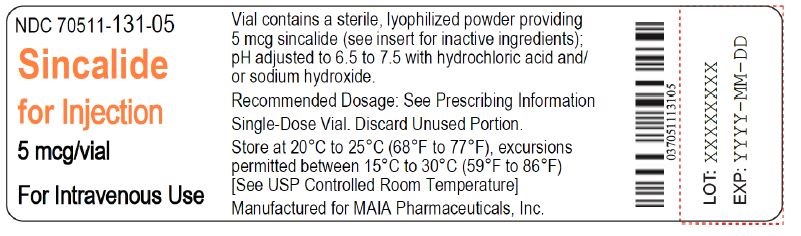
Principal Display Panel NDC 70511-131-05 Sincalide for Injection 5 mcg/vial For Intravenous Use Vial contains a sterile, lyophilized powder providing 5 mcg sincalide (see insert for inactive ingredients); pH adjusted to 6.5 to 7.5 with hydrochloric acid and/or sodium hydroxide. Recommended Dosage: See Prescribing Information Single-Dose Vial. Discard Unused Portion.
Store at 20°C to 25°C (68°F to 77°F), excursions permitted between 15°C to 30°C (59°F to 86°F) [See USP Controlled Room Temperature] Manufactured for MAIA Pharmaceuticals, Inc. vial
About this NDC listing & data coverage
What data is (and isn’t) available for this NDC — tap to expand
| NDC identity (package / product / labeler codes) | ✓ Available |
| Labeler | ✓ Available |
| Product & package description | ✓ Available |
| Marketing category & status | ✓ Available |
| Active ingredient / dosage form / route | ✓ Available |
| FDA label (SPL via DailyMed) | ✓ Available |
| Package photos | ✓ Available |
| Inactive ingredients (structured) | ✓ Available |
| NADAC pharmacy acquisition price (CMS) | — Not published for this NDC CMS publishes NADAC only for NDCs reported in its retail-pharmacy survey. |
| Orange Book / therapeutic-equivalence data | ✓ Available |
| HCPCS J-code billing crosswalk | — Not published for this NDC Most self-administered / retail products have no J-code — that is normal. |
| Medicaid utilization (CMS SDUD) | — Not published for this NDC CMS reports utilization only for NDCs with Medicaid claims above its privacy threshold. |