
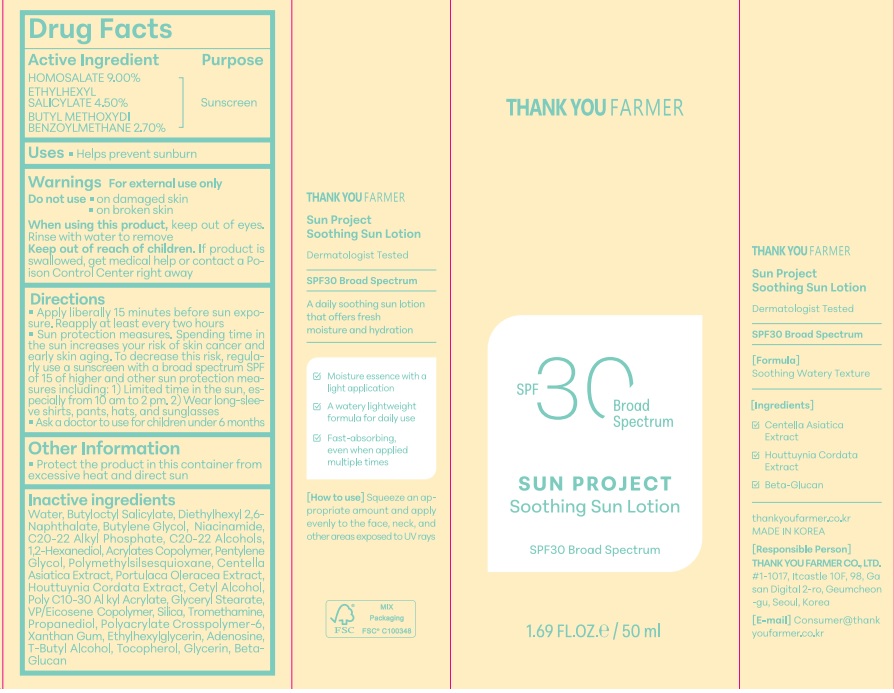
THANK YOU FARMER Sun Project Soothing HOMOSALATE, ETHYLHEXYL SALICYLATE, BUTYL METHOXYDIBENZOYLMETHANE 4.5 g/50mL; 2.25 g/50mL; 1.35 g/50mL Cream
🆔 Identity & classification
Where does this data come from?
🏭 Manufacturer & labeler
Where does this data come from?
🩺 Clinical
This is a topical cream sunscreen marketed under FDA's over-the-counter monograph rules. It contains three active ingredients, avobenzone, homosalate, and octisalate, which are UV filters typically used to protect skin from ultraviolet radiation. These ingredients work together to absorb and scatter UVA and UVB rays when applied to the skin surface.
Patient education
Supplement & herbal interactions
Where does this data come from?
Ask a licensed pharmacist directly — free, answered by our team.
💊 What it looks like
Where does this data come from?
🧪 Inactive Ingredients / Excipients
Inactive ingredients, also called excipients, are components of the drug product other than the active ingredient. They may include fillers, dyes, coatings, preservatives, flavors, or other formulation ingredients.
💡 Tap an ingredient (hover on desktop) to see what it is and why it’s used.
-
UNII TR046Y3K1G
A liquid alcohol derived from petroleum or plant sources. It acts as a solvent and humectant in medicines, helping dissolve active ingredients and retain moisture in the formulation.
-
UNII 4FRY3LJG0V
A fungal protein component used as a binder and structural agent in some pharmaceutical formulations. It helps hold tablet ingredients together and may improve the stability of certain medicine preparations.
-
UNII K72T3FS567
Adenosine is a naturally occurring nucleoside compound. In medicines, it functions as an active pharmaceutical ingredient in some formulations, though when listed as an excipient it may serve as a buffering or stabilizing agent to maintain product stability and pH.
-
UNII KBC00G95HI
A synthetic polymer used primarily as a thickener and stabilizer in topical formulations. It helps create the desired texture and consistency while keeping ingredients evenly distributed throughout the product.
-
UNII D64PM5UT4U
A synthetic plastic-like material made from behenyl acrylate monomers. It's used as a film-former and binder to help hold tablet ingredients together and create protective coatings on medications.
-
UNII JZ1374NL9E
A synthetic polymer made from acrylic compounds that forms a flexible coating. It's used to coat tablets and capsules to control where and how the medicine dissolves in the digestive system, or to protect the ingredient from moisture and stomach acid.
-
UNII 3XUS85K0RA
Butylene glycol is a clear liquid derived from petroleum or plants that acts as a humectant, solvent, and preservative booster in medicines. It helps keep formulations stable, dissolve active ingredients, and maintain moisture in topical products.
-
UNII 2EH13UN8D3
A synthetic compound used as a solvent and penetration enhancer in topical formulations. It helps dissolve active ingredients and allows them to penetrate the skin more effectively.
-
UNII O4M0347C6A
C20-22 alcohols are fatty alcohols derived from natural oils or fats. They act as emulsifiers and thickeners in medicines, helping blend oil and water-based ingredients and give the product its desired texture.
-
UNII L4VKP0Y7RP
A synthetic chemical compound derived from fatty acids with 20-22 carbon atoms, combined with phosphate. It functions as an emulsifier and surfactant to help mix oil and water-based ingredients evenly throughout the medicine.
-
UNII 4YS74Q4G4J
A plant extract from Centella asiatica containing natural compounds called triterpenoids. It's used as an active ingredient in some formulations for its purported skin-supporting properties, though it functions as a botanical additive rather than a structural component of the medicine.
-
UNII 936JST6JCN
Cetyl alcohol is a waxy, fatty substance derived from plant or animal sources. It acts as an emulsifier and thickener in medicines, helping blend oil and water components and giving products a smooth, creamy texture.
-
UNII I0DQJ7YGXM
A synthetic chemical compound used as a plasticizer in pharmaceutical coatings. It makes film coatings more flexible and durable so they don't crack or peel during manufacturing and storage.
-
UNII 147D247K3P
Ethylhexylglycerin is a synthetic preservative used to prevent bacteria and mold from growing in medicines and personal care products. It helps keep the product safe and stable throughout its shelf life.
-
UNII PDC6A3C0OX
Glycerin is a clear, thick liquid derived from plant oils or fats. It acts as a humectant to retain moisture, a sweetener, and a solvent in medications.
-
UNII FCZ5MH785I
A waxy substance made from glycerin and stearic acid. It works as an emulsifier to help mix oil and water ingredients together, and as a thickener to give the medicine its proper texture and consistency.
-
UNII RH041UUZ22
A plant extract from the houttuynia cordata flower, traditionally used in Asian medicine. In formulations, it may serve as a natural flavoring, coloring, or active botanical ingredient carrier.
-
UNII 25X51I8RD4
Niacinamide is a form of vitamin B3, a water-soluble nutrient. In medicines, it may be added as a nutritional supplement or to support skin health, though its primary role here is as an active ingredient rather than a traditional inactive filler.
-
UNII 50C1307PZG
Pentylene glycol is a humectant and preservative helper derived from petroleum or plant sources. It draws moisture into the product and helps prevent bacterial growth, keeping medicines stable during storage.
-
UNII Z570VEV8XK
A synthetic silicone polymer used as a glidant and anti-caking agent. It reduces friction between particles so the medicine flows smoothly during manufacturing and remains free-flowing in the bottle.
-
UNII 5965N8W85T
Propanediol is a clear liquid organic compound derived from vegetable sources or synthesized chemically. It acts as a humectant to retain moisture, a solvent to dissolve active ingredients, and a preservative booster in liquid medications and supplements.
-
UNII M6S840WXG5
Purslane is a plant-derived ingredient used in pharmaceuticals as a natural source of beneficial compounds. It functions as an antioxidant and anti-inflammatory agent to help stabilize the formula and support product shelf life.
-
UNII ETJ7Z6XBU4
Silicon dioxide is a naturally occurring mineral used as a glidant and anti-caking agent. It helps powder ingredients flow smoothly and prevents clumping during manufacturing and storage.
-
UNII MD83SFE959
A volatile organic liquid used as a solvent and preservative in medications. It helps dissolve active ingredients and other components, and can improve product stability and shelf life.
-
UNII R0ZB2556P8
Tocopherol is a form of vitamin E derived from plant oils. It acts as an antioxidant in medicines to prevent oils and fats from breaking down and spoiling during storage.
-
UNII 023C2WHX2V
Tromethamine is a chemical buffer that helps maintain the proper acidity level in liquid medicines. It neutralizes acids and stabilizes the solution so the medication remains effective and safe throughout its shelf life.
-
UNII 035MV9S1C3
A plastic-like polymer made from two chemical compounds joined together. It acts as a binder and film-former in tablets and capsules, helping hold ingredients together and create a protective coating on the medicine's surface.
-
UNII 059QF0KO0R
Water is a liquid solvent that dissolves and mixes ingredients together in liquid medicines, syrups, and injections. It helps distribute the active drug evenly throughout the product.
-
UNII TTV12P4NEE
Xanthan gum is a thickening and stabilizing ingredient made from fermented corn or other sugars. It's added to medicines to improve texture, prevent separation of liquids and solids, and help the product stay consistent.
29 inactive ingredients listed in the exact product block matched to this NDC.
Label-section wording can be broader than the structured product block and may mention additional formulation ingredients.
Where does this data come from?
ingredient classCode="IACT" elements from the exact product block matched by this NDC. Label-section narrative from DailyMed / the openFDA label index is shown separately when available.Inactive ingredient FAQ
Are inactive ingredients the same for every manufacturer?
Why might an inactive ingredient be missing?
Can inactive ingredients matter?
💲 Pricing
A drug doesn't have one price. Each row is a different public payment system, and none is what you'd pay at the counter — that depends on your insurance. The ⓘ on each row explains what it measures.
| Price system | Per g | Per package |
|---|---|---|
| Retail pharmacies payNADAC · weekly | Not in the retail survey — common for institutional, discontinued, or low-volume packs. | |
| Medicaid paysCMS SDUD · 12 mo | No recent Medicaid claims on file for this NDC — rare and low-volume NDCs are suppressed in the public data. | |
| Medicare drug plans payPart D · quarterly | No Part D plan price is available for this NDC in our data. | |
Where does this data come from?
🔁 Therapeutic equivalents
| Product | Labeler | Pack | NADAC/unit | TE | Status | Price vs. this |
|---|---|---|---|---|---|---|
| THANK YOU FARMER Sun Project Soothing 4.5 g/50mL; 2.25 g/50mL; 1.35 g/50mLthis 70618-0030-02 | THANK | 60 tubes | — | — | FDA listed | — |
Where does this data come from?
⏳ Availability & generic status
We did not find an FDA-approved generic match for this exact strength, form and route.
Where does this data come from?
📦 Packaging — all sizes for this product
| Package NDC | Description | Marketing start | Status |
|---|---|---|---|
| 70618-0030-02 You're viewing this | 60 TUBE in 1 CARTON (70618-030-02) / 50 mL in 1 TUBE (70618-030-01) | 2024-09-16 | Active |
🧭 About this NDC listing & data coverage
What data is (and isn’t) available for this NDC — tap to expand
| NDC identity (package / product / labeler codes) | ✓ Available |
| Labeler | ✓ Available |
| Product & package description | ✓ Available |
| Marketing category & status | ✓ Available |
| Active ingredient / dosage form / route | ✓ Available |
| FDA label (SPL via DailyMed) | ✓ Available |
| Package photos | ✓ Available |
| Inactive ingredients (structured) | ✓ Available |
| NADAC pharmacy acquisition price (CMS) | — Not published for this NDC CMS publishes NADAC only for NDCs reported in its retail-pharmacy survey. |
| Orange Book / therapeutic-equivalence data | — Not published for this NDC Applies only to products approved under an NDA/ANDA; many listings are out of scope. |
| HCPCS J-code billing crosswalk | — Not published for this NDC Most self-administered / retail products have no J-code — that is normal. |
| Medicaid utilization (CMS SDUD) | — Not published for this NDC CMS reports utilization only for NDCs with Medicaid claims above its privacy threshold. |
Questions about this listing
Is this NDC FDA-approved?
Why is there no price listed?
Is the NDC printed on the package the same as the 11-digit billing NDC?
What do the three segments of this NDC mean?
Is this package still being marketed?
Who lists this product with the FDA?
Do I need a prescription for this product?
Where does this data come from?
📄 FDA label — Drug Facts FDA SPL
🎯 Indications and Usage ▾
Incations & usage Incations & usage-Helps prevent sunburn
⏱️ Dosage and Administration ▾
Dosage & administration Dosage & administration -Apply liberally 15 minutes before sun exposure. Reapply at least every two hours
⚠️ Warnings ▾
Warning Warning-For external use only
🧪 Active Ingredient ▾
Active Ingredient Active Ingredient-HOMOSALATE 9%, ETHYLHEXYL SALICYLATE-4.5%, BUTYL METHOXYDIBENZOYLMETHANE-2.7%
🧪 Inactive Ingredients ▾
Inactive Ingredients Inactive Ingredients-WATER, BUTYLOCTYL SALICYLATE, DIETHYLHEXYL 2,6-NAPHTHALATE, BUTYLENE GLYCOL,NIACINAMIDE, C20-22 ALKYL PHOSPHATE, C20-22 ALCOHOLS, 1,2-HEXANEDIOL, POLYMETHYLSILSESQUIOXANE, ACRYLATES COPOLYMER, PENTYLENE GLYCOL, CETYL ALCOHOL, POLY C10-30 ALKYL ACRYLATE, SILICA, VP/EICOSENE COPOLYMER, GLYCERYL STEARATE, TROMETHAMINE, PROPANEDIOL, POLYACRYLATE CROSSPOLYMER-6, XANTHAN GUM, ETHYLHEXYLGLYCERIN, ADENOSINE, PORTULACA OLERACEA EXTRACT, CENTELLA ASIATICA EXTRACT, HOUTTUYNIA CORDATA EXTRACT, T-BUTYL ALCOHOL, TOCOPHEROL, GLYCERIN, BETA-GLUCAN
🎯 Purpose ▾
Purpose Purpose-Sunscreen, Uses-Helps prevent sunburn