
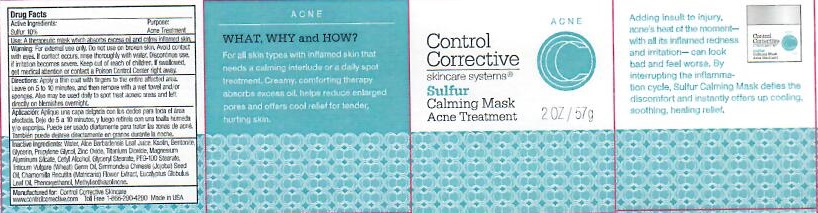
SULFUR CALMING MASK 10 g/100g Cream
🆔 Identity & classification
Where does this data come from?
🏷️ RxNorm drug class
This medicine belongs to the Preparations containing sulfur class.
Where does this data come from?
🏭 Manufacturer & labeler
Where does this data come from?
🩺 Clinical
This is a topical cream containing 10% sulfur, marketed as an over-the-counter monograph product. Sulfur is commonly used in skincare products for its keratolytic and antimicrobial properties, and is typically applied to the skin to help manage conditions such as acne, seborrheic dermatitis, and other inflammatory skin concerns. The product is applied directly to affected areas of the skin as directed on the package label.
Patient education
Supplement & herbal interactions
Where does this data come from?
Ask a licensed pharmacist directly — free, answered by our team.
🧪 Inactive Ingredients / Excipients
Inactive ingredients, also called excipients, are components of the drug product other than the active ingredient. They may include fillers, dyes, coatings, preservatives, flavors, or other formulation ingredients.
💡 Tap an ingredient (hover on desktop) to see what it is and why it’s used.
-
UNII ZY81Z83H0X
Aloe vera leaf is a plant extract derived from the aloe plant. It is used in medicines as a natural moisturizer and skin-soothing agent in topical formulations.
-
UNII A3N5ZCN45C
Bentonite is a naturally occurring clay mineral used in medicines as a binder and absorbent. It helps hold tablet ingredients together and can absorb moisture or unwanted substances in the formulation.
-
UNII 936JST6JCN
Cetyl alcohol is a waxy, fatty substance derived from plant or animal sources. It acts as an emulsifier and thickener in medicines, helping blend oil and water components and giving products a smooth, creamy texture.
-
UNII 2R04ONI662
Eucalyptus oil is a fragrant liquid extracted from eucalyptus tree leaves. It's used in medicines as a flavor, scent, or soothing agent in topical products and cough preparations.
-
UNII PDC6A3C0OX
Glycerin is a clear, thick liquid derived from plant oils or fats. It acts as a humectant to retain moisture, a sweetener, and a solvent in medications.
-
UNII 230OU9XXE4
A waxy substance made from glycerin and stearic acid that acts as an emulsifier to blend oily and watery ingredients together. It also helps thicken and stabilize the medicine's texture.
-
UNII 724GKU717M
Jojoba oil is a natural liquid wax extracted from jojoba plant seeds. It's used in medicines as an emollient and lubricant to soften and smooth the product, and sometimes as a carrier or penetration enhancer.
-
UNII 24H4NWX5CO
Kaolin is a naturally occurring clay mineral. It's used in tablets and capsules as a filler and absorbent to add bulk, improve texture, and help bind ingredients together.
-
UNII 6M3P64V0NC
A fine powder made from magnesium, aluminum, and silicon compounds. It absorbs moisture and helps keep medicine ingredients from clumping or separating, so the product stays stable and flows smoothly during manufacturing.
-
UNII 3VNC7T6Z02
A plant extract from chamomile flowers used as a flavoring and fragrance agent in medicines. It adds taste and aroma to improve how the medicine smells and tastes.
-
UNII 229D0E1QFA
Methylisothiazolinone is a synthetic chemical preservative that prevents bacterial and fungal growth in liquid medicines and topical products. It helps keep the medication safe and extends shelf life during storage.
-
UNII YD01N1999R
A waxy substance made from polyethylene glycol and stearic acid. It helps mix oil and water-based ingredients together and serves as an emulsifier and solubilizer in liquid and semi-solid medicines.
-
UNII HIE492ZZ3T
Phenoxyethanol is a synthetic preservative and antimicrobial agent used to prevent bacterial and fungal growth in medicines and cosmetic products, extending shelf life and maintaining product safety.
-
UNII 6DC9Q167V3
Propylene glycol is a clear liquid derived from petroleum or vegetable sources. It acts as a solvent, humectant, and preservative in medicines, helping dissolve active ingredients and maintain product stability.
-
UNII 15FIX9V2JP
Titanium dioxide is a bright white mineral powder commonly used as a colorant and opacifying agent. It makes pills and tablets white or lighter in color and helps make coatings non-transparent.
-
UNII 059QF0KO0R
Water is a liquid solvent that dissolves and mixes ingredients together in liquid medicines, syrups, and injections. It helps distribute the active drug evenly throughout the product.
-
UNII 14C97E680P
Wheat germ oil is an oil extracted from wheat kernels. It's used in medicines as an emollient and lubricant to improve texture and help ingredients blend smoothly.
-
UNII SOI2LOH54Z
Zinc oxide is a white mineral powder used in medicines as a protective barrier agent and color additive. It helps shield skin in topical products and may also serve as a filler or opacifying ingredient.
18 inactive ingredients listed in the exact product block matched to this NDC.
Label-section wording can be broader than the structured product block and may mention additional formulation ingredients.
Where does this data come from?
ingredient classCode="IACT" elements from the exact product block matched by this NDC. Label-section narrative from DailyMed / the openFDA label index is shown separately when available.Inactive ingredient FAQ
Are inactive ingredients the same for every manufacturer?
Why might an inactive ingredient be missing?
Can inactive ingredients matter?
💲 Pricing
A drug doesn't have one price. Each row is a different public payment system, and none is what you'd pay at the counter — that depends on your insurance. The ⓘ on each row explains what it measures.
| Price system | Per g | Per package |
|---|---|---|
| Retail pharmacies payNADAC · weekly | Not in the retail survey — common for institutional, discontinued, or low-volume packs. | |
| Medicaid paysCMS SDUD · 12 mo | No recent Medicaid claims on file for this NDC — rare and low-volume NDCs are suppressed in the public data. | |
| Medicare drug plans payPart D · quarterly | No Part D plan price is available for this NDC in our data. | |
Where does this data come from?
🔁 Therapeutic equivalents
| Product | Labeler | Pack | NADAC/unit | TE | Status | Price vs. this |
|---|---|---|---|---|---|---|
| Earths Care Acne Spot Treatment 10 g/100g 24286-1557-01 | DLC | 1 tube | — | — | FDA listed | — |
| Anti Acne Natural Volcanic Sulfur 10 g/100g 26050-0101-01 | PT. | 100 g | — | — | FDA listed | — |
| Vivant Sulfur Clay Mask 10 g/100mL 63750-0006-04 | Vivant | 118 ml | — | — | FDA listed | — |
| Sulfur Calming Mask 10 g/100gthis 70764-0103-52 | CONTROL | 1 jar | — | — | FDA listed | — |
| Detoxify Facial Mask 10 g/100g 72957-0007-01 | Private | 85 g | — | — | FDA listed | — |
| Sunday Riley Saturn Sulfur Acne Spot Treatment Mask .1 g/mL 73001-0305-15 | Sunday | 1 tube | — | — | FDA listed | — |
| RoyceDerm Sulfur Soap. 23.2 g/232g 85424-0003-01 | RoyceDerm | 232 g | — | — | FDA listed | — |
| Acne Treatment with Sulfur 10 g/100g 24286-1574-01 | DLC | 74 g | — | — | FDA listed | — |
| Dermaharmony 10% Sulfur 10 g/100g 71819-0014-04 | D3 | 113 g | — | — | FDA listed | — |
| Dermaharmony 10% Sulfur with Tea Tree Oil 10 g/100g 71819-0015-04 | D3 | 113 g | — | — | FDA listed | — |
Where does this data come from?
⏳ Availability & generic status
We did not find an FDA-approved generic match for this exact strength, form and route.
Where does this data come from?
📦 Packaging — all sizes for this product
| Package NDC | Description | Marketing start | Status |
|---|---|---|---|
| 70764-0103-52 You're viewing this | 1 JAR in 1 BOX (70764-103-52) / 57 g in 1 JAR (70764-103-22) | 2018-09-11 | Active |
🧭 About this NDC listing & data coverage
What data is (and isn’t) available for this NDC — tap to expand
| NDC identity (package / product / labeler codes) | ✓ Available |
| Labeler | ✓ Available |
| Product & package description | ✓ Available |
| Marketing category & status | ✓ Available |
| Active ingredient / dosage form / route | ✓ Available |
| FDA label (SPL via DailyMed) | ✓ Available |
| Package photos | ✓ Available |
| Inactive ingredients (structured) | ✓ Available |
| NADAC pharmacy acquisition price (CMS) | — Not published for this NDC CMS publishes NADAC only for NDCs reported in its retail-pharmacy survey. |
| Orange Book / therapeutic-equivalence data | — Not published for this NDC Applies only to products approved under an NDA/ANDA; many listings are out of scope. |
| HCPCS J-code billing crosswalk | — Not published for this NDC Most self-administered / retail products have no J-code — that is normal. |
| Medicaid utilization (CMS SDUD) | — Not published for this NDC CMS reports utilization only for NDCs with Medicaid claims above its privacy threshold. |
Questions about this listing
Is this NDC FDA-approved?
Why is there no price listed?
Is the NDC printed on the package the same as the 11-digit billing NDC?
What do the three segments of this NDC mean?
Is this package still being marketed?
Who lists this product with the FDA?
Do I need a prescription for this product?
Where does this data come from?
📄 FDA label — Drug Facts FDA SPL
🎯 Indications and Usage ▾
USE A THERAPEUTIC MASK WHICH ABSORBS EXCESS OIL AND CALMS INFLAMMED SKIN.
⏱️ Dosage and Administration ▾
DIRECTIONS Apply a thin layer with fingers to the entire affected areas. Leave on 5 to 10 minutes and then remove with a wet towel or sponge. Also may be used daily to spot treat acneic areas or left directly on blemishes overnight.
⚠️ Warnings ▾
WARNINGS FOR EXTERNAL USE ONLY. DO NOT USE ON BROKEN SKIN. AVOID CONTACT WITH EYES. IF CONTACT OCCURS, RINSE THOROUGHLY WITH WATER. DISCONTINUE USE IF IRRITATION BECOMES SEVERE.
🧪 Active Ingredient ▾
ACTIVE INGREDIENTS SULFUR 10%
🧪 Inactive Ingredients ▾
INACTIVE INGREDIENTS WATER, ALOE BARBADENSIS LEAF JUICE, KAOLIN, BENTONITE, GLYCERIN, PROPYLENE GLYCOL, ZINC OXIDE, TITANIUM DIOXIDE, MAGNESIUM ALUMINUM SILICATE, CETYL ALCOHOL, GLYCERYL STEARATE, PEG-100 STEARATE, TRITICUM VULGARE (WHEAT) GERM OIL, SIMMONDSIA CHINENIS (JOJOBA) SEED OIL, CHAMOMILE RECUTITA (MATRICARIA) FLOWER EXTRACT, EUCALYPTUS GLOBULUS LEAF OIL, PHENOXYETHANOL, METHYLISOTHIAZOLINONE.
🎯 Purpose ▾
PURPOSE ACNE TREATMENT