
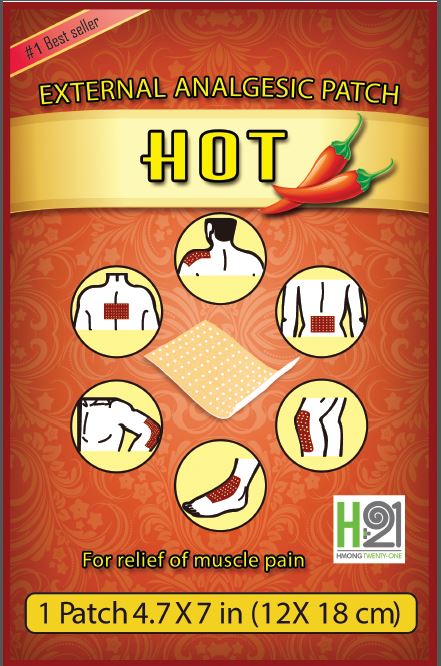
External Analgesic camphor, capsicum, menthol 96 mg/g; .5 mg/g; 78 mg/g Patch, 1 patch — NDC 70927-001-00 (Billing 70927-0001-00)
This is a package of 1 patch of External Analgesic camphor, capsicum, menthol 96 mg/g; .5 mg/g; 78 mg/g Patch from Hmong 21, marketed since Aug 2016 and currently FDA-listed. It is this product's only package size.
Identity & classification
Regulatory identifiers FDA, NLM and CMS codes for this package
- RxCUI (RxNorm): 1807136
Where does this data come from?
- FDA openFDA NDC Directory · synced Oct 1, 2026
- FDA label on DailyMed · label index refreshed Oct 1, 2026
- RxNorm (NLM RxNav) · catalog refreshed Oct 1, 2026
- Medi-Span GPI (licensed)
- First Databank (licensed) · refreshed Oct 1, 2026
Clinical
This is a topical patch marketed as an over-the-counter external analgesic under FDA's OTC monograph rules. The patch contains camphor, capsaicin (derived from hot peppers), and menthol, which are commonly used in pain-relief products applied to the skin. These ingredients are typically included to produce a warming or cooling sensation that may help with minor aches and muscle discomfort in the area where the patch is applied.
Patient education
Supplement & herbal interactions
Where does this data come from?
- MedlinePlus (NLM) · refreshed Oct 1, 2026
- FDA label on DailyMed · label index refreshed Oct 1, 2026
Ask a licensed pharmacist directly — free, answered by our team.
Pricing
A drug doesn't have one price. Each row is a different public payment system, and none is what you'd pay at the counter — that depends on your insurance. The ⓘ on each row explains what it measures.
| Price system | Per each | Per package |
|---|---|---|
| Retail pharmacies payNADAC · weekly | Not in the retail survey — common for institutional, discontinued, or low-volume packs. | |
| Medicaid paysCMS SDUD · 12 mo | No recent Medicaid claims on file for this NDC — rare and low-volume NDCs are suppressed in the public data. | |
| Medicare drug plans payPart D · quarterly | No Part D plan price is available for this NDC in our data. | |
Where does this data come from?
- CMS NADAC weekly file
- CMS ASP pricing files · refreshed Sep 20, 2026
- CMS Medicaid State Drug Utilization Data · refreshed Oct 2, 2026
- CMS Part D plan pricing files · refreshed Sep 24, 2026
- VA National Acquisition Center price file
Packaging — all sizes for this product
| Package NDC | Description | Marketing start | Marketing end | Status |
|---|---|---|---|---|
| 70927-0001-00 You're viewing this Main listing | 4 g in 1 PATCH | 2016-08-25 | — | Active |
Therapeutic equivalents
| Product | Labeler | Pack | NADAC/unit | TE | Status | Price vs. this |
|---|---|---|---|---|---|---|
| External Analgesic 96 mg/g; .5 mg/g; 78 mg/gthis 70927-0001-00 | Hmong | 1 patch | — | — | FDA listed | — |
Where does this data come from?
- FDA openFDA NDC Directory · synced Oct 1, 2026
- FDA Orange Book · refreshed Sep 3, 2026
- CMS NADAC weekly file
Availability & generic status
We did not find an FDA-approved generic match for this exact strength, form and route.
Where does this data come from?
- FDA Orange Book · refreshed Sep 3, 2026
Inactive Ingredients / Excipients
Inactive ingredients, also called excipients, are components of the drug product other than the active ingredient. They may include fillers, dyes, coatings, preservatives, flavors, or other formulation ingredients.
💡 Tap an ingredient (hover on desktop) to see what it is and why it’s used.
-
UNII 5QB0T2IUN0
Aluminum hydroxide is a white powder mineral compound used as an antacid ingredient in some formulations. It works as a buffer and pH regulator to help neutralize stomach acid in the medicine.
-
UNII 00UK7646FG
Capsicum is a natural plant extract from red peppers. It's used as a colorant and flavoring agent to give medicines their red or orange appearance and mild spicy taste.
-
UNII PDC6A3C0OX
Glycerin is a clear, thick liquid derived from plant oils or fats. It acts as a humectant to retain moisture, a sweetener, and a solvent in medications.
-
UNII WC487PR91H
A synthetic plastic polymer used as a film-coating agent. It forms a protective layer around tablets or capsules to control how quickly the medicine dissolves and to improve appearance and stability.
-
UNII W4888I119H
Tartaric acid is a natural organic acid found in grapes and tamarinds. In medicines, it works as a buffer to control acidity, an antioxidant to prevent spoilage, and sometimes a flavoring or binding agent.
-
UNII 059QF0KO0R
Water is a liquid solvent that dissolves and mixes ingredients together in liquid medicines, syrups, and injections. It helps distribute the active drug evenly throughout the product.
6 inactive ingredients listed in the exact product block matched to this NDC.
Label-section wording can be broader than the structured product block and may mention additional formulation ingredients.
Where does this data come from?
ingredient classCode="IACT" elements from the exact product block matched by this NDC. Label-section narrative from DailyMed / the openFDA label index is shown separately when available.- FDA label on DailyMed · label index refreshed Oct 1, 2026
- FDA openFDA NDC Directory · synced Oct 1, 2026
Inactive ingredient FAQ
Are inactive ingredients the same for every manufacturer?
Why might an inactive ingredient be missing?
Can inactive ingredients matter?
Manufacturer & labeler
Where does this data come from?
- FDA openFDA NDC Directory · synced Oct 1, 2026
- Drugs@FDA
FDA label — Drug Facts FDA SPL
🎯 Indications and Usage ▾
Uses For the temporary relief of minor aches and pains of muscles and joints associated with -simple backache -arthritis -strains -bruises -sprains
⏱️ Dosage and Administration ▾
Directions Adults and children 12 years of age and older: -Clean and dry affected area. -Remove from backing film and apply. -Remove from the skin after at most 8 hours' application. -Apply to the affected area not more than 3 times daily. -Children under 12 years of age: Consult a doctor.
⚠️ Warnings ▾
Warnings When using this product -avoid contact with the eyes - do not apply to wounds or damaged skin -do not bandage tightly Stop use and ask a doctor if - condition worsens -if synthoms oersust for more than 7 days or clear up and occur again within a few days If pregnant or breast-feeding, ask a health professional before use.
🧪 Active Ingredient ▾
Active ingredients Camphor 9.6% Capsaicin 0.05% Menthol 7.8%
🧪 Inactive Ingredients ▾
Inactive ingredients Acrylic Acid, Aluminum Hydroxide, Carmellose Sodium, 2-ethylhexylacrylate, Glycerin, Methyl Acrylate, Polyacrylate, polyacrylic Acid, sodium polyacrylatem, Tartaric Acid, Water.
🎯 Purpose ▾
Purpose External Analgesic
📄 Keep Out of Reach of Children ▾
Keep out of reach of children. If Swallowed, get medical help or contact a Poison Control Center right away.
📄 Package Label / Principal Display Panel ▾
Label image description image description
About this NDC listing & data coverage
What data is (and isn’t) available for this NDC — tap to expand
| NDC identity (package / product / labeler codes) | ✓ Available |
| Labeler | ✓ Available |
| Product & package description | ✓ Available |
| Marketing category & status | ✓ Available |
| Active ingredient / dosage form / route | ✓ Available |
| FDA label (SPL via DailyMed) | ✓ Available |
| Package photos | ✓ Available |
| Inactive ingredients (structured) | ✓ Available |
| NADAC pharmacy acquisition price (CMS) | — Not published for this NDC CMS publishes NADAC only for NDCs reported in its retail-pharmacy survey. |
| Orange Book / therapeutic-equivalence data | — Not published for this NDC Applies only to products approved under an NDA/ANDA; many listings are out of scope. |
| HCPCS J-code billing crosswalk | — Not published for this NDC Most self-administered / retail products have no J-code — that is normal. |
| Medicaid utilization (CMS SDUD) | — Not published for this NDC CMS reports utilization only for NDCs with Medicaid claims above its privacy threshold. |