
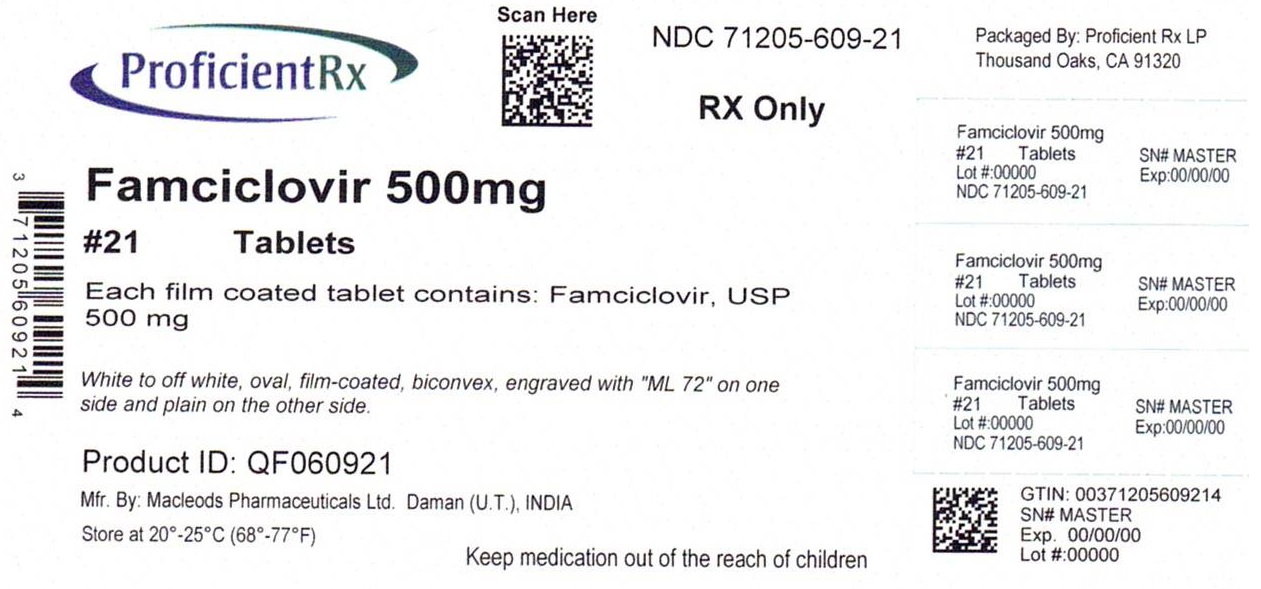
Famciclovir 500 mg Tablet, Film Coated, 21-count — NDC 71205-609-21 (Billing 71205-0609-21)
This is a package of 21 tablets of Famciclovir 500 mg Tablet, Film Coated from Proficient Rx LP, marketed since Jan 2012 and currently FDA-listed. It is the main listing for this product, which comes in 4 package sizes.
NDC database record
One package, one record: these facts belong to NDC 71205-609-21 alone.
- Record
- FDA NDC Directory package listing · Human prescription drug
- Code segments
- 71205 labeler · 609 product · 21 package
- Package marketed since
- Oct 4, 2021
- Sample package
- No — commercial package
- Listing certified through
- Dec 31, 2026
- Billing quantity
- 21 EA per package
- Barcode (UPC)
- 0371205609214
- FDA record last changed
- Jul 24, 2026
Other active recalls for Famciclovir (different manufacturers) — 1 · tap to view
Identity & classification
Regulatory identifiers FDA, NLM and CMS codes for this package
Drug-database identifiers Medi-Span GPI and First Databank GCN / HICL / AHFS classification
- GSN (GCN sequence number): 021995
- GCN: 14108
- GPI-14 (Medi-Span): 12408040000320
- HICL (First Databank): 009007
- AHFS class code: 08:18.32.00
- RxCUI (RxNorm): 198382
Where does this data come from?
- FDA openFDA NDC Directory · synced Oct 1, 2026
- FDA label on DailyMed · label index refreshed Oct 6, 2026
- RxNorm (NLM RxNav) · catalog refreshed Oct 1, 2026
- Medi-Span GPI (licensed)
- First Databank (licensed) · refreshed Oct 1, 2026
RxNorm drug class
This medicine belongs to the Herpes Simplex Virus Nucleoside Analog DNA Polymerase Inhibitor class.
Where does this data come from?
- RxClass (NLM) · catalog refreshed Oct 1, 2026
Clinical
Famciclovir is used to treat herpes zoster (shingles; a rash that can occur in people who have had chickenpox in the past). It is also used to treat repeat outbreaks of herpes virus cold sores or fever blisters in people with a normal immune system. Famciclovir is used to treat repeat outbreaks and to prevent further outbreaks of genital herpes (a herpes virus infection that causes sores to form around the genitals and rectum from time to time) in people with a normal immune system. Famciclovir is also used to treat returning herpes simplex infections of the skin and mucus membranes (mouth, an...
Read the full MedlinePlus article ↗- It is an antiviral for adults with recurrent cold sores, recurrent genital herpes and shingles. It can also be taken daily to help prevent genital herpes outbreaks. In adults with...
- Start as early as you can. For cold sores and genital herpes, take it at the first tingle, itch, burn or pain. For shingles, start as soon as it is diagnosed. Its benefit has not b...
- No. You can take famciclovir tablets with or without food. Follow your prescriber's directions on how many to take and for how long.
- The most common are headache and nausea. Some people also get diarrhea, vomiting, tiredness or stomach pain. Call your doctor for a rash with blistering, swelling of the face or th...
Patient education
Supplement & herbal interactions
Some supplements/herbs that may interact with Famciclovir — tap one for details:
Where does this data come from?
- MedlinePlus (NLM) · refreshed Oct 1, 2026
- FDA label on DailyMed · label index refreshed Oct 6, 2026
Ask a licensed pharmacist directly — free, answered by our team.
Pricing
A drug doesn't have one price. Each row is a different public payment system, and none is what you'd pay at the counter — that depends on your insurance. The ⓘ on each row explains what it measures.
| Price system | Per each | Per package |
|---|---|---|
| Retail pharmacies payNADAC · weekly | Not in the retail survey — common for institutional, discontinued, or low-volume packs. | |
| Medicaid paysCMS SDUD · 12 mo | No recent Medicaid claims on file for this NDC — rare and low-volume NDCs are suppressed in the public data. | |
| Medicare drug plans payPart D · Q2 2026 | $0.4471 | $9.39 / 21 tablets |
Where does this data come from?
- CMS NADAC weekly file
- CMS ASP pricing files · refreshed Sep 20, 2026
- CMS Medicaid State Drug Utilization Data · refreshed Oct 6, 2026
- CMS Part D plan pricing files · refreshed Sep 24, 2026
- VA National Acquisition Center price file
Packaging — all sizes for this product
| Package NDC | Description | Marketing start | Marketing end | Status |
|---|---|---|---|---|
| 71205-0609-21 You're viewing this Main listing | 21 TABLET, FILM COATED in 1 BOTTLE | 2021-10-04 | — | Active |
| 71205-0609-30 71205-609-30 | 30 TABLET, FILM COATED in 1 BOTTLE | 2021-10-04 | — | Active |
| 71205-0609-60 71205-609-60 | 60 TABLET, FILM COATED in 1 BOTTLE | 2021-10-04 | — | Active |
| 71205-0609-90 71205-609-90 | 90 TABLET, FILM COATED in 1 BOTTLE | 2021-10-04 | — | Active |
You're viewing the smallest of 4 pack sizes for this product.
Pack size FAQ
What quantity is in this package?
How does this package differ from NDC 71205-0609-30?
What NDC number is used to bill for this package of Famciclovir 500 mg Tablet, Film Coated?
Therapeutic equivalents
| Product | Labeler | Pack | NADAC/unit | TE | Status | Price vs. this |
|---|---|---|---|---|---|---|
| Famciclovir 500 mg 00093-8119-56 | Teva | 30 tablets | $0.788 | — | Availability likely | — |
| Famciclovir 500 mg 33342-0026-07 | Macleods | 30 tablets | $0.788 | AB | Availability likely | — |
| Famciclovir 500 mg 60505-3247-03 | Apotex | 30 tablets | $0.788 | — | Discontinued | — |
| Famciclovir 500 mg 64980-0351-03 | Rising | 30 tablets | $0.788 | AB | Availability likely | — |
| Famciclovir 500 mg 31722-0708-01 | Camber | 100 tablets | — | AB | FDA listed | — |
| Famciclovir 500 mg 42291-0416-30 | AvKARE | 30 tablets | — | AB | FDA listed | — |
| Famciclovir 500 mg 55289-0168-03 | PD-Rx | 3 tablets | — | AB | FDA listed | — |
| Famciclovir 500 mg 63187-0998-21 | Proficient | 21 tablets | — | AB | FDA listed | — |
| Famciclovir 500 mg 63629-7890-01 | Bryant | 30 tablets | — | AB | FDA listed | — |
| Famciclovir 500 mg 65862-0467-05 | Aurobindo | 500 tablets | — | AB | FDA listed | — |
| Famciclovir 500 mgthis 71205-0609-21 | Proficient | 21 tablets | — | AB | FDA listed | — |
| Famciclovir 500 mg 71335-2936-01 | Bryant | 30 tablets | — | AB | FDA listed | — |
| Famciclovir 500 mg 73190-0093-30 | AvKARE | 30 tablets | — | AB | FDA listed | — |
Where does this data come from?
- FDA openFDA NDC Directory · synced Oct 1, 2026
- FDA Orange Book · refreshed Oct 3, 2026
- CMS NADAC weekly file
Availability & generic status
This product is an FDA-approved generic. Other versions of the same drug are listed under Therapeutic equivalents, least expensive first.
Where does this data come from?
- FDA Orange Book · refreshed Oct 3, 2026
What it looks like
Where does this data come from?
- FDA label on DailyMed · label index refreshed Oct 6, 2026
Inactive Ingredients / Excipients
Inactive ingredients, also called excipients, are components of the drug product other than the active ingredient. They may include fillers, dyes, coatings, preservatives, flavors, or other formulation ingredients.
🧪 Avoiding an ingredient? See Famciclovir inactive ingredients by manufacturer: every current product's list side by side, so you can ask your pharmacy for the version that does not list it.
💡 Tap an ingredient (hover on desktop) to see what it is and why it’s used.
-
UNII 9XZ8H6N6OH
A plant-based cellulose derivative used as a binder to hold tablet ingredients together, a thickener in liquids, and a coating agent to control how fast the medicine dissolves.
-
UNII R75537T0T4
Hypromellose 2910 is a plant-derived thickening agent made from cellulose. It serves as a binder that holds tablet ingredients together, a film-coating for pills, and a viscosity controller in liquids.
-
UNII J2B2A4N98G
Lactose is a natural sugar derived from milk. In medications, it serves as a filler and binder to add bulk and help hold tablet or capsule ingredients together during manufacturing.
-
UNII 2165RE0K14
A plant-based thickener made from cellulose that helps control how quickly the medicine dissolves and releases its active ingredient. It also binds ingredients together and improves the tablet's texture and handling during manufacturing.
-
UNII 70097M6I30
Magnesium stearate is a salt made from magnesium and stearic acid, a fatty substance. It's used in tablets and capsules as a lubricant and glidant to help ingredients flow smoothly during manufacturing and prevent sticking.
-
UNII B697894SGQ
Polyethylene glycol 400 is a clear, thick liquid made from petroleum-derived polymers. It acts as a solvent and humectant in medicines, helping dissolve active ingredients and retain moisture in the formulation.
-
UNII 5856J3G2A2
A starch-based powder made from potatoes and processed with sodium. It acts as a disintegrant, helping the tablet or capsule break apart quickly in the stomach so the medicine can be absorbed.
-
UNII 15FIX9V2JP
Titanium dioxide is a bright white mineral powder commonly used as a colorant and opacifying agent. It makes pills and tablets white or lighter in color and helps make coatings non-transparent.
8 inactive ingredients listed in the exact product block matched to this NDC.
Where does this data come from?
ingredient classCode="IACT" elements from the exact product block matched by this NDC. Label-section narrative from DailyMed / the openFDA label index is shown separately when available.- FDA label on DailyMed · label index refreshed Oct 6, 2026
- FDA openFDA NDC Directory · synced Oct 1, 2026
Inactive ingredient FAQ
Are inactive ingredients the same for every manufacturer?
Why might an inactive ingredient be missing?
Can inactive ingredients matter?
Manufacturer & labeler
More NDCs from Proficient Rx LP labeler code 71205
- Rabeprazole Sodium 20 mg Tablet, Delayed Release NDC 71205-603-30
- IBU Ibuprofen 400 mg Tablet NDC 71205-604-15
- Benzonatate 200 mg Capsule NDC 71205-605-10
- Meclizine HCL 25 mg 25 mg Tablet NDC 71205-606-30
- Verapamil Hydrochloride 180 mg Tablet NDC 71205-607-30
- Pregabalin 150 mg Capsule NDC 71205-608-30
- Doxepin Hydrochloride 25 mg Capsule NDC 71205-610-30
- Banophen Diphenhydramine HCl 25 mg Tablet, Film Coated NDC 71205-611-20
- Omeprazole 20 mg Capsule, Delayed Release NDC 71205-613-06
- Alprazolam 1 mg Tablet NDC 71205-614-02
- Diphenhydramine HCL 25 mg Capsule NDC 71205-615-20
- Oseltamivir Phosphate 75 mg Capsule NDC 71205-617-10
Where does this data come from?
- FDA openFDA NDC Directory · synced Oct 1, 2026
- Drugs@FDA
Full prescribing information FDA SPL
🎯 Indications and Usage ▾
1 INDICATIONS & USAGE Famciclovir, USP a prodrug of penciclovir, is a deoxynucleoside analogue DNA polymerase inhibitor indicated for: Immunocompetent Adult Patients ( 1.1 ) • Herpes labialis (cold sores) o Treatment of recurrent episodes • Genital herpes o Treatment of recurrent episodes o Suppressive therapy of recurrent episodes • Herpes zoster (shingles) Human Immunodeficiency Virus (HIV) -Infected Adult Patients ( 1.2 ) • Treatment of recurrent episodes of orolabial or genital herpes Limitation of Use The efficacy and safety of famciclovir have not been established for: • Patients with first episode of genital herpes • Patients with ophthalmic zoster • Immunocompromised patients other than for the treatment of recurrent episodes of orolabial or genital herpes in HIV- infected patients • Black and African American patients with recurrent genital herpes
1.1Immunocompetent Adult Patient Herpes labialis(cold sores): Famciclovir is indicated for the treatment of recurrent herpes labialis in adult patients. Genital herpes: Recurrent episodes: Famciclovir is indicated for the treatment of recurrent episodes of genital herpes. The efficacy of famciclovir when initiated more than 6 hours after onset of symptoms or lesions has not been established.
Suppressive therapy: Famciclovir is indicated for chronic suppressive therapy of recurrent episodes of genital herpes in adult patients. The efficacy and safety of famciclovir for the suppression of recurrent genital herpes beyond 1 year have not been established. Herpes zoster (shingles): Famciclovir is indicated for the treatment of herpes zoster in adult patients.
The efficacy of famciclovir when initiated more than 72 hours after onset of rash has not been established.
1.2HIV-Infected Adult Patients Recurrent orolabial or genital herpes: Famciclovir, USP is indicated for the treatment of recurrent episodes of orolabial or genital herpes in HIV-infected adults. The efficacy of famciclovir, USP when initiated more than 48 hours after onset of symptoms or lesions has not been established. Limitation of Use The efficacy and safety of famciclovir have not been established for: • Patients with first episode of genital herpes • Patients with ophthalmic zoster • Immunocompromised patients other than for the treatment of recurrent orolabial or genital herpes in HIV-infected patients • Black and African American patients with recurrent genital herpes
⏱️ Dosage and Administration ▾
2 DOSAGE & ADMINISTRATION Famciclovir Tablets may be taken with or without food. Immunocompetent Adult Patients ( 2.1 ) Herpes labialis (cold sores) 1500 mg as a single dose Genital herpes Treatment of recurrent episodes 1000 mg twice daily for 1 day Suppressive therapy 250 mg twice daily Herpes zoster (shingles) 500 mg every 8 hours for 7 days HIV-Infected Adult Patients ( 2.1 ) Recurrent episodes of orolabial or genital herpes 500 mg twice daily for 7 days Patients with renal impairment: Adjust dose based on creatinine clearance.
( 2.3 )
2.1Dosing Recommendation in Immunocompetent Adult Patients Herpes labialis (cold sores): The recommended dosage of famciclovir for the treatment of recurrent herpes labialis is 1500 mg as a single dose. Therapy should be initiated at the first sign or symptom of herpes labialis (e.g., tingling, itching, burning, pain, or lesion). Genital herpes: Recurrent episodes : The recommended dosage of famciclovir for the treatment of recurrent episodes of genital herpes is 1000 mg twice daily for 1 day.
Therapy should be initiated at the first sign or symptom of a recurrent episode (e.g., tingling, itching, burning, pain, or lesion). Suppressive therapy: The recommended dosage of famciclovir for chronic suppressive therapy of recurrent episodes of genital herpes is 250 mg twice daily. Herpes zoster (shingles): The recommended dosage of famciclovir for the treatment of herpes zoster is 500 mg every 8 hours for 7 days.
Therapy should be initiated as soon as herpes zoster is diagnosed.
2.2Dosing Recommendation in HIV-Infected Adult Patients Recurrent orolabial or genital herpes: The recommended dosage of famciclovir for the treatment of recurrent orolabial or genital herpes in HIV-infected patients is 500 mg twice daily for 7 days. Therapy should be initiated at the first sign or symptom of a recurrent episode (e.g., tingling, itching, burning, pain, or lesion).
2.3Dosing Recommendation in Patients with Renal Impairment Dosage recommendations for adult patients with renal impairment are provided in Table 1 [see Use in Specific Populations ( 8.6 ), Clinical Pharmacology ( 12.3 )]. Table 1: Dosage Recommendations for Adult Patients Indication and Normal Dosage Regimen Creatinine Clearance (mL/min.) Adjusted Dosage Regimen Dose (mg) Dosing Interval Single-Day Dosing Regimens Recurrent Genital Herpes 1000 mg every 12 hours for 1 day ≥60 1000 every 12 hours for 1 day 40 to 59 500 every 12 hours for 1 day 20 to 39 500 single dose <20 250 single dose HD* 250 single dose following dialysis Recurrent Herpes Labialis 1500 mg single dose ≥60 1500 single dose 40 to 59 750 single dose 20 to 39 500 single dose <20 250 single dose HD* 250 single dose following dialysis Multiple-Day Dosing Regimens Herpes Zoster 500 mg every 8 hours ≥60 500 every 8 hours 40 to 59 500 every 12 hours 20 to 39 500 every 24 hours <20 250 every 24 hours HD* 250 following each dialysis Suppression of Recurrent Genital Herpes 250 mg every 12 hours ≥40 250 every 12 hours 20 to 39 125 every 12 hours <20 125 every 24 hours HD* 125 following each dialysis Recurrent Orolabial or Genital Herpes in HIV-Infected Patients 500 mg every 12 hours ≥40 500 every 12 hours 20 to 39 500 every 24 hours <20 250 every 24 hours HD* 250 following each dialysis * Hemodialysis
💊 Dosage Forms and Strengths ▾
3 DOSAGE FORMS & STRENGTHS Famciclovir tablets, USP are available in 3 strengths: •25 mg: White to off white, round film-coated, biconvex, engraved with "ML 67" on one side and plain on the other side. •250 mg: White to off white, round film-coated, biconvex, engraved with "ML 70" on one side and plain on the other side. •500 mg: White to off white, oval film-coated, biconvex, engraved with "ML 72" on one side and plain on the other side. Tablets : 125mg, 250mg, 500mg ( 3 )
⛔ Contraindications ▾
4 CONTRAINDICATIONS Famciclovir tablets are contraindicated in patients with known hypersensitivity to the product, its components, or Denavir ® (penciclovir cream). Known hypersensitivity to the product, its components, or Denavir ® (penciclovir cream) ( 4 )
⚠️ Warnings and Cautions ▾
5 WARNINGS AND PRECAUTIONS Acute renal failure: May occur in patients with underlying renal disease who receive higher than recommended doses of famciclovir for their level of renal function. Reduce dosage in patients with renal impairment ( 2.3, 8.6 )
5.1Acute Renal Failure Cases of acute renal failure have been reported in patients with underlying renal disease who have received inappropriately high doses of famciclovir for their level of renal function. Dosage reduction is recommended when administering famciclovir tablets to patients with renal impairment [see Dosage and Administration ( 2.3 ), Use in Specific Populations ( 8.6 )].
🤒 Adverse Reactions ▾
6 ADVERSE REACTIONS Acute renal failure is discussed in greater detail in other sections of the label [see Warnings and Precautions ( 5 )]. The most common adverse events reported in at least 1 indication by greater than 10% of adult patients treated with famciclovir are headache and nausea. The most common adverse events reported in at least 1 indication by greater than 10% of adult patients are headache and nausea.
( 6.1 ) To report SUSPECTED ADVERSE REACTIONS, contact Macleods Pharma USA Inc. at 1-888-943-3210 or 1-855-926-3384 or FDA at 1-800-FDA-1088 or www.fda.gov/medwatch
6.1Clinical Trials Experience in Adult Patient Because clinical trials are conducted under widely varying conditions, adverse reaction rates observed in the clinical trials of a drug cannot be directly compared with rates in the clinical trials of another drug and may not reflect the rates observed in practice. Immunocompetent patients: The safety of famciclovir has been evaluated in active- and placebo-controlled clinical studies involving 816 famciclovir treated patients with herpes zoster (famciclovir , 250 mg three times daily to 750 mg three times daily); 163 famciclovir treated patients with recurrent genital herpes ( famciclovir, 1000 mg twice daily); 1,197 patients with recurrent genital herpes treated with famciclovir as suppressive therapy (125 mg once daily to 250 mg three times daily) of which 570 patients received famciclovir (open-labeled and/or double-blind) for at least 10 months; and 447 famciclovir treated patients with herpes labialis ( famciclovir, 1500 mg once daily or 750 mg twice daily).
Table 2 lists selected adverse events. Table 2: Selected Adverse Events (all grades and without regard to causality) Reported by Greater Than or Equal to 2% of Patients in Placebo-Controlled famciclovir Trials Patients may have entered into more than one clinical trial Incidence Events Herpes Zoster 7 days of treatment Recurrent Genital Herpes 1 day of treatment Genital Herpes- Suppression daily treatment Herpes Labialis Famciclovir (n=273) % Placebo (n=146) % Famciclovir (n=163) % Placebo (n=166) % Famciclovir (n=458) % Placebo (n=63) % Famciclovir (n=447) % Placebo (n=254) % Nervous System Headache 22.7 17.8 13.5 5.4 39.3 42.9 8.5
6.7Paresthesia 2.6 0.0 0.0 0.0 0.9 0.0 0.0
0.0Migraine 0.7 0.7 0.6 0.6 3.1 0.0 0.2
0.0Gastrointestinal Nausea 12.5 11.6 2.5 3.6 7.2 9.5 2.2
3.9Diarrhea 7.7 4.8 4.9 1.2 9.0 9.5 1.6
0.8Vomiting 4.8 3.4 1.2 0.6 3.1 1.6 0.7
0.0Flatulence 1.5 0.7 0.6 0.0 4.8 1.6 0.2
0.0Abdominal Pain 1.1 3.4 0.0 1.2 7.9 7.9 0.2
0.4Body as a Whole Fatigue 4.4 3.4 0.6 0.0 4.8 3.2 1.6
0.4Skin and Appendages Pruritus 3.7 2.7 0.0 0.6 2.2 0.0 0.0
0.0Rash 0.4 0.7 0.0 0.0 3.3 1.6 0.0
0.0Reproductive Female Dysmenorrhea 0.0 0.7 1.8 0.6 7.6 6.3 0.4
0.0Table 3: selected laboratory abnormalities in genital herpes suppression trials Table 3 Selected Laboratory Abnormalities in Genital Herpes Suppression Studies Percentage of patients with laboratory abnormalities that were increased or decreased from baseline and were outside of specified ranges. Parameter Famciclovir (n = 660) n values represent the minimum number of patients assessed for each laboratory parameter. % Placebo (n = 210) % Anemia (<0.8 x NRL) 0.1
0.0Leukopenia (<0.75 x NRL) 1.3
0.9Neutropenia (<0.8 x NRL) 3.2
1.5AST (SGOT) (>2 x NRH) 2.3
1.2ALT (SGPT) (>2 x NRH) 3.2
1.5Total Bilirubin (>1.5 x NRH) 1.9
1.2Serum Creatinine (>1.5 x NRH) 0.2
0.3Amylase (>1.5 x NRH) 1.5
1.9Lipase (>1.5 x NRH) 4.9
4.7NRH = Normal Range High. NRL = Normal Range Low. HIV-infected patients: In HIV-infected patients, the most frequently reported adverse events for famciclovir (500 mg twice daily; n=150) and acyclovir (400 mg, 5x/day; n=143), respectively, were headache (17% vs. 15%), nausea (11% vs. 13%), diarrhea (7% vs. 11%), vomiting (5% vs. 4%), fatigue (4% vs. 2%), and abdominal pain (3% vs. 6%).
6.2Postmarketing Experience The adverse events listed below have been reported during post-… [Excerpted — this section continues on DailyMed.]
🔄 Drug Interactions ▾
7 DRUG INTERACTIONS Probenecid: May increase penciclovir levels. Monitor for evidence of penciclovir toxicity ( 7.2 )
7.1Potential for famciclovir to Affect Other Drugs The steady-state pharmacokinetics of digoxin were not altered by concomitant administration of multiple doses of famciclovir (500 mg three times daily). No clinically significant effect on the pharmacokinetics of zidovudine, its metabolite zidovudine glucuronide, or emtricitabine was observed following a single oral dose of 500 mg famciclovir coadministered with zidovudine or emtricitabine. An in vitro study using human liver microsomes suggests that famciclovir is not an inhibitor of CYP3A4 enzymes.
7.2Potential for Other Drugs to Affect Penciclovir No clinically significant alterations in penciclovir pharmacokinetics were observed following single-dose administration of 500 mg famciclovir after pretreatment with multiple doses of allopurinol, cimetidine, theophylline, zidovudine, promethazine, when given shortly after an antacid (magnesium and aluminum hydroxide), or concomitantly with emtricitabine. No clinically significant effect on penciclovir pharmacokinetics was observed following multiple-dose (three times daily) administration of famciclovir (500 mg) with multiple doses of digoxin.
Concurrent use with probenecid or other drugs significantly eliminated by active renal tubular secretion may result in increased plasma concentrations of penciclovir. The conversion of 6-deoxy penciclovir to penciclovir is catalyzed by aldehyde oxidase. Interactions with other drugs metabolized by this enzyme and/or inhibiting this enzyme could potentially occur.
Clinical interaction studies of famciclovir with cimetidine and promethazine, in vitro inhibitors of aldehyde oxidase, did not show relevant effects on the formation of penciclovir. Raloxifene, a potent aldehyde oxidase inhibitor in vitro, could decrease the formation of penciclovir. However, a clinical drug-drug interaction study to determine the magnitude of interaction between penciclovir and raloxifene has not been conducted.
👥 Use in Specific Populations ▾
8 USE IN SPECIFIC POPULATIONS
8.1Pregnancy Risk Summary Available data from pharmacovigilance reports with famciclovir use in pregnant women have not identified a drug-associated risk of major birth defects, miscarriage or adverse maternal or fetal outcomes. There are risks to the fetus associated with untreated herpes simplex virus during pregnancy ( see Clinical Considerations ). After oral administration, famciclovir (prodrug) is converted to penciclovir (active drug).
In animal reproduction studies with famciclovir, no evidence of adverse developmental outcomes was observed at systemic exposures of penciclovir (AUC) slightly higher than those at the maximum recommended human dose (MRHD) of famciclovir ( see Data ). The estimated background risk of major birth defects and miscarriage for the indicated population is unknown. All pregnancies have a background risk of birth defect, loss, or other adverse outcomes.
In the U.S. general population, the estimated background risk of major birth defects and miscarriage in clinically recognized pregnancies is 2-4% and 15- 20%, respectively. Clinical Considerations Disease-associated maternal and/or embryo-fetal risk The risk of neonatal herpes infection varies from 30% to 50% for genital herpes simplex virus (HSV) infections that occur in late pregnancy (third trimester), whereas in early pregnancy, infection carries a risk of about 1%. A primary herpes outbreak during the first trimester of pregnancy has been associated with neonatal chorioretinitis, microcephaly and, in rare cases, skin lesions.
In very rare cases, transplacental transmission can occur resulting in congenital infection, including microcephaly, hepatosplenomegaly, intrauterine growth restriction and stillbirth. Co-infection with HSV increases the risk of perinatal HIV transmission in women who had a clinical diagnosis of genital herpes during pregnancy. Data Animal Data Famciclovir was administered orally to pregnant rats and rabbits (up to 1000 mg/kg/day) on gestation Day(s) 6 to 15, and to rats on gestation Day 15 to lactation/post-partum Day 25.
No adverse effects on embryo-fetal (rats and rabbits) or pre/post-natal (rats) development were observed up to the highest dose tested. During organogenesis, systemic exposures of penciclovir (active metabolite) were 3.4 times (rats) and 1.6 times (rabbits) the human systemic exposure of penciclovir based on AUC at the MRHD.
8.2Lactation Risk Summary There are no data on the presence of famciclovir (prodrug) or penciclovir (active drug) in human milk, the effects on the breastfed infant, or the effects on milk production. Animal data indicate that penciclovir is present in the milk of lactating rats (see Data). The developmental and health benefits of breastfeeding should be considered along with the mother’s clinical need for famciclovir and any potential adverse effects on the breastfed infant from famciclovir or from the underlying maternal condition.
Data Penciclovir was the primary drug-related component excreted into the milk of lactating rats following a single oral dose of 40 mg per kg on lactation Day 12, with milk concentrations of up to approximately 8 times that of maternal plasma concentrations observed 0.5 hours postdose.
8.3Females and males of Reproductive Potential Infertility Decreased fertility, due to testicular toxicity, was observed in male animals following repeated administration of famciclovir or penciclovir [ see Nonclinical Toxicology ( 13.1 )]. In two placebo-controlled studies, 130 men with a history of recurrent genital herpes received either oral famciclovir (250 mg twice daily; n=66) or placebo (n=64) therapy for 18 weeks. The men were otherwise healthy and had a normal sperm profile prior to treatment.
There was no evidence of significant effects on sperm count, motility or morphology during famciclovir treatment or during an 8-week follow-up.
8.4Pediatric Use The efficacy of famciclovir tablets has not been established in pediatric pa… [Excerpted — this section continues on DailyMed.]
🤰 Pregnancy ▾
8.1Pregnancy Risk Summary Available data from pharmacovigilance reports with famciclovir use in pregnant women have not identified a drug-associated risk of major birth defects, miscarriage or adverse maternal or fetal outcomes. There are risks to the fetus associated with untreated herpes simplex virus during pregnancy ( see Clinical Considerations ). After oral administration, famciclovir (prodrug) is converted to penciclovir (active drug).
In animal reproduction studies with famciclovir, no evidence of adverse developmental outcomes was observed at systemic exposures of penciclovir (AUC) slightly higher than those at the maximum recommended human dose (MRHD) of famciclovir ( see Data ). The estimated background risk of major birth defects and miscarriage for the indicated population is unknown. All pregnancies have a background risk of birth defect, loss, or other adverse outcomes.
In the U.S. general population, the estimated background risk of major birth defects and miscarriage in clinically recognized pregnancies is 2-4% and 15- 20%, respectively. Clinical Considerations Disease-associated maternal and/or embryo-fetal risk The risk of neonatal herpes infection varies from 30% to 50% for genital herpes simplex virus (HSV) infections that occur in late pregnancy (third trimester), whereas in early pregnancy, infection carries a risk of about 1%. A primary herpes outbreak during the first trimester of pregnancy has been associated with neonatal chorioretinitis, microcephaly and, in rare cases, skin lesions.
In very rare cases, transplacental transmission can occur resulting in congenital infection, including microcephaly, hepatosplenomegaly, intrauterine growth restriction and stillbirth. Co-infection with HSV increases the risk of perinatal HIV transmission in women who had a clinical diagnosis of genital herpes during pregnancy. Data Animal Data Famciclovir was administered orally to pregnant rats and rabbits (up to 1000 mg/kg/day) on gestation Day(s) 6 to 15, and to rats on gestation Day 15 to lactation/post-partum Day 25.
No adverse effects on embryo-fetal (rats and rabbits) or pre/post-natal (rats) development were observed up to the highest dose tested. During organogenesis, systemic exposures of penciclovir (active metabolite) were 3.4 times (rats) and 1.6 times (rabbits) the human systemic exposure of penciclovir based on AUC at the MRHD.
🧒 Pediatric Use ▾
8.4Pediatric Use The efficacy of famciclovir tablets has not been established in pediatric patients. The pharmacokinetic profile and safety of famciclovir (experimental granules mixed with OraSweet ® or tablets) were studied in 2 open-label studies. Study 1 was a single-dose pharmacokinetic and safety study in infants 1 month to less than 1 year of age who had an active herpes simplex virus (HSV) infection or who were at risk for HSV infection.
Eighteen subjects were enrolled and received a single dose of famciclovir experimental granules mixed with OraSweet based on the patient’s body weight (doses ranged from 25 mg to 175 mg). These doses were selected to provide penciclovir systemic exposures similar to the penciclovir systemic exposures observed in adults after administration of 500 mg famciclovir. The efficacy and safety of famciclovir have not been established as suppressive therapy in infants following neonatal HSV infections.
In addition, the efficacy cannot be extrapolated from adults to infants because there is no similar disease in adults. Therefore, famciclovir is not recommended in infants. Study 2 was an open-label, single-dose pharmacokinetic, multiple-dose safety study of famciclovir experimental granules mixed with OraSweet in children 1 to less than 12 years of age with clinically suspected HSV or varicella zoster virus (VZV) infection.
Fifty-one subjects were enrolled in the pharmacokinetic part of the study and received a single body weight adjusted dose of famciclovir (doses ranged from 125 mg to 500 mg). These doses were selected to provide penciclovir systemic exposures similar to the penciclovir systemic exposures observed in adults after administration of 500 mg famciclovir. Based on the pharmacokinetic data observed with these doses in children, a new weight-based dosing algorithm was designed and used in the multiple-dose safety part of the study.
Pharmacokinetic data were not obtained with the revised weight-based dosing algorithm. A total of 100 patients were enrolled in the multiple-dose safety part of the study; 47 subjects with active or latent HSV infection and 53 subjects with chickenpox. Patients with active or latent HSV infection received famciclovir twice a day for 7 days.
The daily dose of famciclovir ranged from 150 mg to 500 mg twice daily depending on the patient’s body weight. Patients with chickenpox received famciclovir three times daily for 7 days. The daily dose of famciclovir ranged from 150 mg to 500 mg three times daily depending on the patient’s body weight.
The clinical adverse events and laboratory test abnormalities observed in this study were similar to these seen in adults. The available data are insufficient to support the use of famciclovir for the treatment of children 1 to less than 12 years of age with chickenpox or infections due to HSV for the following reasons: Chickenpox: The efficacy of famciclovir for the treatment of chickenpox has not been established in either pediatric or adult patients. Famciclovir is approved for the treatment of herpes zoster in adult patients.
However, extrapolation of efficacy data from adults with herpes zoster to children with chickenpox would not be appropriate. Although chickenpox and herpes zoster are caused by the same virus, the diseases are different. Genital herpes: Clinical information on genital herpes in children is limited.
Therefore, efficacy data from adults cannot be extrapolated to this population. Further, famciclovir has not been studied in children 1 to less than 12 years of age with recurrent genital herpes. None of the children in Study 2 had genital herpes.
Herpes labialis: There are no pharmacokinetic and safety data in children 1 to <12 years of age to support a famciclovir dose that provides penciclovir systemic exposures comparable to the penciclovir systemic exposures in adults after a single dose administration of 1500 mg. Moreover, no efficacy data have been obtained in children 1 to less than 12 years of… [Excerpted — this section continues on DailyMed.]
🧓 Geriatric Use ▾
8.5Geriatric Use Of 816 patients with herpes zoster in clinical studies who were treated with famciclovir, 248 (30.4%) were greater than or equal to 65 years of age and 103 (13%) were greater than or equal to 75 years of age. No overall differences were observed in the incidence or types of adverse events between younger and older patients. Of 610 patients with recurrent herpes simplex (type 1 or type 2) in clinical studies who were treated with famciclovir, 26 (4.3%) were greater than 65 years of age and 7 (1.1%) were greater than 75 years of age.
Clinical studies of famciclovir in patients with recurrent genital herpes did not include sufficient numbers of subjects aged 65 years and over to determine whether they respond differently compared to younger subjects. No famciclovir dosage adjustment based on age is recommended unless renal function is impaired [see Dosage and Administration ( 2.3 ), Clinical Pharmacology ( 12.3 )]. In general, appropriate caution should be exercised in the administration and monitoring of famciclovir in elderly patients reflecting the greater frequency of decreased renal function and concomitant use of other drugs.
🆘 Overdosage ▾
10 OVERDOSAGE Appropriate symptomatic and supportive therapy should be given. Penciclovir is removed by hemodialysis
🧬 Clinical Pharmacology ▾
12 CLINICAL PHARMACOLOGY
12.1Mechanism of Action Famciclovir is an orally administered prodrug of the anti-alpha herpes viral agent penciclovir [ see Microbiology ( 12.4 )].
12.3Pharmacokinetics Famciclovir is the diacetyl 6-deoxy analog of the active antiviral compound penciclovir. Following oral administration famciclovir undergoes rapid and extensive metabolism to penciclovir and little or no famciclovir is detected in plasma or urine. Penciclovir is predominantly eliminated unchanged by the kidney.
Therefore, the dose of famciclovir needs to be adjusted in patients with different degrees of renal impairment [see Dosage and Administration ( 2.3 )]. Pharmacokinetics in adults: Absorption and Bioavailability: The absolute bioavailability of penciclovir is 77 ± 8% as determined following the administration of a 500 mg famciclovir oral dose and a 400 mg penciclovir intravenous dose to 12 healthy male subjects. Penciclovir concentrations increased in proportion to dose over a famciclovir dose range of 125 mg to 1000 mg administered as a single dose.
Table 5 shows the mean pharmacokinetic parameters of penciclovir after single administration of famciclovir to healthy male volunteers. Table 1: Mean Pharmacokinetic Parameters of Penciclovir in Healthy Adult Subjects Based on pharmacokinetic data from 17 studies Dose AUC (0-inf) (mcg hr/mL) AUC (0-inf) (mcg hr/mL)=area under the plasma concentration-time profile extrapolated to infinity. C max (mcg/mL) Cmax (mcg/mL)=maximum observed plasma concentration.
T max (h) Tmax (h)= time to Cmax. 125 mg 2.24 0.8 0.9 250 mg 4.48 1.6 0.9 500 mg 8.95 3.3 0.9 1000 mg 17.9 6.6
0.9Following oral single-dose administration of 500 mg famciclovir to 7 patients with herpes zoster, the AUC (mean ± SD), C max , and t max were 12.1±1.7 mcg hr/mL, 4.0±0.7 mcg/mL, and 0.7±0.2 hours, respectively. The AUC of penciclovir was approximately 35% greater in patients with herpes zoster as compared to healthy volunteers. Some of this difference may be due to differences in renal function between the 2 groups.
There is no accumulation of penciclovir after the administration of 500 mg famciclovir three times daily for 7 days. Penciclovir C max decreased approximately 50% and t max was delayed by 1.5 hours when a capsule formulation of famciclovir was administered with food (nutritional content was approximately 910 Kcal and 26% fat). There was no effect on the extent of availability (AUC) of penciclovir.
There was an 18% decrease in C max and a delay in t max of about 1 hour when famciclovir was given 2 hours after a meal as compared to its administration 2 hours before a meal. Because there was no effect on the extent of systemic availability of penciclovir, famciclovir can be taken without regard to meals. Distribution: The volume of distribution (Vdβ) was 1.08±0.17 L/kg in 12 healthy male subjects following a single intravenous dose of penciclovir at 400 mg administered as a 1-hour intravenous infusion.
Penciclovir is less than 20% bound to plasma proteins over the concentration range of 0.1 to 20 mcg/mL. The blood/plasma ratio of penciclovir is approximately 1. Metabolism: Following oral administration, famciclovir is deacetylated and oxidized to form penciclovir.
Metabolites that are inactive include 6-deoxy penciclovir, monoacetylated penciclovir, and 6-deoxy monoacetylated penciclovir (5%, less than 0.5% and less than 0.5% of the dose in the urine, respectively). Little or no famciclovir is detected in plasma or urine. An in vitro study using human liver microsomes demonstrated that cytochrome P450 does not play an important role in famciclovir metabolism.
The conversion of 6-deoxy penciclovir to penciclovir is catalyzed by aldehyde oxidase. Cimetidine and promethazine, in vitro inhibitors of aldehyde oxidase, did not show relevant effects on the formation of penciclovir in vivo [see Drug Interactions ( 7.2 )]. Elimination: Approximately 94% of administered radioactivity was recovered in urine over 24 hour… [Excerpted — this section continues on DailyMed.]
🧬 Mechanism of Action ▾
12.1Mechanism of Action Famciclovir is an orally administered prodrug of the anti-alpha herpes viral agent penciclovir [ see Microbiology ( 12.4 )].
📦 How Supplied / Storage and Handling ▾
16 HOW SUPPLIED/STORAGE AND HANDLING Famciclovir tablets, USP are supplied as film-coated tablets as follows: 500 mg in bottles of 21, 30, 60, and 90 tablets. • Famciclovir tablets, USP 500 mg: White to off white, oval film-coated, biconvex, engraved with "ML 72" on one side and plain on the other side. 500 mg 21's .....................................NDC 71205-609-21 500 mg 30's .....................................NDC 71205-609-30 500 mg 60's .....................................NDC 71205-609-60 500 mg 90's .....................................NDC 71205-609-90 Store at 20° - 25°C (68°-77°F); excursions permitted to 15°-30°C (59°-86°F) [see USP Controlled Room Temperature].
Preserve in tight containers. Store at controlled room temperature.
📋 Description ▾
11 DESCRIPTION The active ingredient in famciclovir tablets, USP is famciclovir, USP an orally administered prodrug of the antiviral agent penciclovir. Chemically, famciclovir is known as 2-[2-(2-amino-9 H -purin-9-yl)ethyl]-1,3-propanediol diacetate. Its molecular formula is C 14 H 19 N 5 O 4 ; its molecular weight is 321.3.
It is a synthetic acyclic guanine derivative and has the following structure: Famciclovir, USP is a white to pale yellow solid. It is freely soluble in acetone and methanol, and sparingly soluble in ethanol and isopropanol. At 25°C famciclovir, USP is freely soluble (greater than 25% w/v) in water initially, but rapidly precipitates as the sparingly soluble (2% to 3% w/v) monohydrate.
Famciclovir, USP is not hygroscopic below 85% relative humidity. Partition coefficients are: octanol/water (pH 4.8) P=1.09 and octanol/phosphate buffer (pH 7.4) P=2.08. Famciclovir tablets contain 125 mg, 250 mg, or 500 mg of famciclovir, USP together with the following inactive ingredients: hydroxypropyl cellulose, hypromellose, anhydrous lactose, magnesium stearate, polyethylene glycols, sodium starch glycolate and titanium dioxide.
Meets USP Dissolution Test 2. 123
💬 Information for Patients ▾
17 PATIENT COUNSELING INFORMATION Advise the patient to read the FDA-approved patient labeling (Patient information) There is no evidence that famciclovir will affect the ability of a patient to drive or to use machines. However, patients who experience dizziness, somnolence, confusion or other central nervous system disturbances while taking famciclovir tablets should refrain from driving or operating machinery. Because famciclovir tablets contains lactose (Famciclovir 125 mg, 250 mg and 500 mg tablets contain lactose 25.97 mg, 51.95 mg and 103.90 mg, respectively), patients with rare hereditary problems of galactose intolerance, a severe lactase deficiency or glucose-galactose malabsorption should be advised to discuss with their healthcare provider before taking famciclovir tablets.
Herpes Labialis (Cold Sores) Patients should be advised to initiate treatment at the earliest sign or symptom of a recurrence of cold sores (e.g., tingling, itching, burning, pain, or lesion). Patients should be instructed that treatment for cold sores should not exceed 1 dose. Patients should be informed that famciclovir tablets are not a cure for cold sores.
Genital Herpes Patients should be informed that famciclovir tablets are not a cure for genital herpes. There are no data evaluating whether famciclovir tablets will prevent transmission of infection to others. Because genital herpes is a sexually transmitted disease, patients should avoid contact with lesions or intercourse when lesions and/or symptoms are present to avoid infecting partners.
Genital herpes is frequently transmitted in the absence of symptoms through asymptomatic viral shedding. Therefore, patients should be counseled to use safer sex practices. If episodic therapy for recurrent genital herpes is indicated, patients should be advised to initiate therapy at the first sign or symptom of an episode.
There are no data on safety or effectiveness of chronic suppressive therapy of longer than 1-year duration. Herpes Zoster (Shingles) There are no data on treatment initiated more than 72 hours after onset of zoster rash. Patients should be advised to initiate treatment as soon as possible after a diagnosis of herpes zoster.
All brand names listed are the registered trademarks of their respective owners and are not trademarks of the Macleods Pharmaceutical Ltd. Manufactured for Macleods Pharma USA, INC, Plainsboro, NJ 08536 Manufactured by: Macleods Pharmaceutical Limited Daman (U.T.), INDIA Repackaged by: Proficient Rx LP Thousand Oaks, CA 91320 Revised: July 2020 .
🧬 Pharmacokinetics ▾
12.3Pharmacokinetics Famciclovir is the diacetyl 6-deoxy analog of the active antiviral compound penciclovir. Following oral administration famciclovir undergoes rapid and extensive metabolism to penciclovir and little or no famciclovir is detected in plasma or urine. Penciclovir is predominantly eliminated unchanged by the kidney.
Therefore, the dose of famciclovir needs to be adjusted in patients with different degrees of renal impairment [see Dosage and Administration ( 2.3 )]. Pharmacokinetics in adults: Absorption and Bioavailability: The absolute bioavailability of penciclovir is 77 ± 8% as determined following the administration of a 500 mg famciclovir oral dose and a 400 mg penciclovir intravenous dose to 12 healthy male subjects. Penciclovir concentrations increased in proportion to dose over a famciclovir dose range of 125 mg to 1000 mg administered as a single dose.
Table 5 shows the mean pharmacokinetic parameters of penciclovir after single administration of famciclovir to healthy male volunteers. Table 1: Mean Pharmacokinetic Parameters of Penciclovir in Healthy Adult Subjects Based on pharmacokinetic data from 17 studies Dose AUC (0-inf) (mcg hr/mL) AUC (0-inf) (mcg hr/mL)=area under the plasma concentration-time profile extrapolated to infinity. C max (mcg/mL) Cmax (mcg/mL)=maximum observed plasma concentration.
T max (h) Tmax (h)= time to Cmax. 125 mg 2.24 0.8 0.9 250 mg 4.48 1.6 0.9 500 mg 8.95 3.3 0.9 1000 mg 17.9 6.6
0.9Following oral single-dose administration of 500 mg famciclovir to 7 patients with herpes zoster, the AUC (mean ± SD), C max , and t max were 12.1±1.7 mcg hr/mL, 4.0±0.7 mcg/mL, and 0.7±0.2 hours, respectively. The AUC of penciclovir was approximately 35% greater in patients with herpes zoster as compared to healthy volunteers. Some of this difference may be due to differences in renal function between the 2 groups.
There is no accumulation of penciclovir after the administration of 500 mg famciclovir three times daily for 7 days. Penciclovir C max decreased approximately 50% and t max was delayed by 1.5 hours when a capsule formulation of famciclovir was administered with food (nutritional content was approximately 910 Kcal and 26% fat). There was no effect on the extent of availability (AUC) of penciclovir.
There was an 18% decrease in C max and a delay in t max of about 1 hour when famciclovir was given 2 hours after a meal as compared to its administration 2 hours before a meal. Because there was no effect on the extent of systemic availability of penciclovir, famciclovir can be taken without regard to meals. Distribution: The volume of distribution (Vdβ) was 1.08±0.17 L/kg in 12 healthy male subjects following a single intravenous dose of penciclovir at 400 mg administered as a 1-hour intravenous infusion.
Penciclovir is less than 20% bound to plasma proteins over the concentration range of 0.1 to 20 mcg/mL. The blood/plasma ratio of penciclovir is approximately 1. Metabolism: Following oral administration, famciclovir is deacetylated and oxidized to form penciclovir.
Metabolites that are inactive include 6-deoxy penciclovir, monoacetylated penciclovir, and 6-deoxy monoacetylated penciclovir (5%, less than 0.5% and less than 0.5% of the dose in the urine, respectively). Little or no famciclovir is detected in plasma or urine. An in vitro study using human liver microsomes demonstrated that cytochrome P450 does not play an important role in famciclovir metabolism.
The conversion of 6-deoxy penciclovir to penciclovir is catalyzed by aldehyde oxidase. Cimetidine and promethazine, in vitro inhibitors of aldehyde oxidase, did not show relevant effects on the formation of penciclovir in vivo [see Drug Interactions ( 7.2 )]. Elimination: Approximately 94% of administered radioactivity was recovered in urine over 24 hours (83% of the dose was excreted in the first 6 hours) after the administration of 5 mg/kg radiolabeled penciclovir as a 1-hour infusion to 3 healthy male volunteers.
Penciclov… [Excerpted — this section continues on DailyMed.]
🔬 Clinical Studies ▾
14 CLINICAL STUDIES
14.1Herpes Labialis (Cold Sores) A randomized, double-blind, placebo-controlled trial was conducted in 701 immunocompetent adults with recurrent herpes labialis. Patients self-initiated therapy within 1 hour of first onset of signs or symptoms of a recurrent herpes labialis episode with famciclovir 1500 mg as a single dose (n=227), famciclovir 750 mg twice daily (n=220) or placebo (n=254) for 1 day. The median time to healing among patients with non-aborted lesions (progressing beyond the papule stage) was 4.4 days in the famciclovir 1500 mg single-dose group (n=152) as compared to 6.2 days in the placebo group (n=168).
The median difference in time to healing between the placebo and famciclovir 1500 mg treated groups was 1.3 days (95% CI: 0.6 – 2.0). No differences in proportion of patients with aborted lesions (not progressing beyond the papule stage) were observed between patients receiving famciclovir or placebo: 33% for famciclovir 1500 mg single dose and 34% for placebo. The median time to loss of pain and tenderness was 1.7 days in famciclovir 1500 mg single dose-treated patients vs.
2.9days in placebo-treated patients.
14.2Genital Herpes Recurrent episodes: A randomized, double-blind, placebo-controlled trial was conducted in 329 immunocompetent adults with recurrent genital herpes. Patients self-initiated therapy within 6 hours of the first sign or symptom of a recurrent genital herpes episode with either famciclovir 1000 mg twice daily (n=163) or placebo (n=166) for 1 day. The median time to healing among patients with non-aborted lesions (progressing beyond the papule stage) was 4.3 days in famciclovir-treated patients (n=125) as compared to 6.1 days in placebo-treated patients (n=145).
The median difference in time to healing between the placebo and famciclovir-treated groups was 1.2 days (95% CI: 0.5 to 2.0). Twenty-three percent of famciclovir-treated patients had aborted lesions (no lesion development beyond erythema) vs. 13% in placebo-treated patients.
The median time to loss of all symptoms (e.g., tingling, itching, burning, pain, or tenderness) was 3.3 days in famciclovir-treated patients vs. 5.4 days in placebo-treated patients. A randomized (2:1), double-blind, placebo-controlled trial was conducted in 304 immunocompetent black and African American adults with recurrent genital herpes.
Patients self-initiated therapy within 6 hours of the first sign or symptom of a recurrent genital herpes episode with either famciclovir 1000 mg twice daily (n=206) or placebo (n=98) for 1 day. The median time to healing among patients with non-aborted lesions was 5.4 days in famciclovir-treated patients (n=152) as compared to 4.8 days in placebo-treated patients (n=78). The median difference in time to healing between the placebo and famciclovir-treated groups was -0.26 days (95% CI: -0.98 to 0.40).
Suppressive therapy: Two randomized, double-blind, placebo-controlled, 12-month trials were conducted in 934 immunocompetent adults with a history of 6 or more recurrences of genital herpes episodes per year. Comparisons included famciclovir 125 mg three times daily, 250 mg twice daily, 250 mg three times daily, and placebo. At 12 months, 60% to 65% of patients were still receiving famciclovir and 25% were receiving placebo treatment.
Recurrence rates at 6 and 12 months in patients treated with the 250 mg twice daily dose are shown in Table 6. Table 8 : Recurrence Rates at 6 and 12 Months in Adults with Recurrent Genital Herpes on Suppressive Therapy Recurrence Rates at 6 Months Recurrence Rates at 12months Famciclovir 250 mg twice daily (n=236) Placebo (n=233 ) famciclovir 250 mg twice daily (n=236) Placebo (n=233) Recurrence-free 39% 10% 29% 6% Recurrences Based on patient reported data; not necessarily confirmed by a physician. 47% 74% 53% 78% Lost to follow-up Patients recurrence-free at time of last contact prior to withdrawal.
14% 16% 17% 16% Famciclovir-treated patients had approximately one-fifth… [Excerpted — this section continues on DailyMed.]
🧪 Nonclinical Toxicology ▾
13 NONCLINICAL TOXICOLOGY
13.1Carcinogenesis & Mutagenesis & Impairment Of Fertility Carcinogenesis: Two-year dietary carcinogenicity studies with famciclovir were conducted in rats and mice. An increase in the incidence of mammary adenocarcinoma (a common tumor in animals of this strain) was seen in female rats receiving the high dose of 600 mg/kg/day (1.1 to 4.5x the human systemic exposure at the recommended total daily oral dose ranging between 500 mg and 2000 mg, based on area under the plasma concentration curve comparisons [24 hr AUC] for penciclovir).
No increases in tumor incidence were reported in male rats treated at doses up to 240 mg/kg/day (0.7 to 2.7x the human AUC), or in male and female mice at doses up to 600 mg/kg/day (0.3 to 1.2x the human AUC). Mutagenesis: Famciclovir and penciclovir (the active metabolite of famciclovir) were tested for genotoxic potential in a battery of in vitro and in vivo assays. Famciclovir and penciclovir were negative in in vitro tests for gene mutations in bacteria ( S. typhimurium and E. coli ) and unscheduled DNA synthesis in mammalian HeLa 83 cells (at doses up to 10,000 and 5,000 mcg/plate, respectively).
Famciclovir was also negative in the L5178Y mouse lymphoma assay (5000 mcg/mL), the in vivo mouse micronucleus test (4800 mg/kg), and rat dominant lethal study (5000 mg/kg). Famciclovir induced increases in polyploidy in human lymphocytes in vitro in the absence of chromosomal damage (1200 mcg/mL). Penciclovir was positive in the L5178Y mouse lymphoma assay for gene mutation/chromosomal aberrations, with and without metabolic activation (1000 mcg/mL).
In human lymphocytes, penciclovir caused chromosomal aberrations in the absence of metabolic activation (250 mcg/mL). Penciclovir caused an increased incidence of micronuclei in mouse bone marrow in vivo when administered intravenously at doses highly toxic to bone marrow (500 mg/kg), but not when administered orally. Impairment of fertility: Testicular toxicity was observed in rats, mice, and dogs following repeated administration of famciclovir or penciclovir.
Testicular changes included atrophy of the seminiferous tubules, reduction in sperm count, and/or increased incidence of sperm with abnormal morphology or reduced motility. The degree of toxicity to male reproduction was related to dose and duration of exposure. In male rats, decreased fertility was observed after 10 weeks of dosing at 500 mg/kg/day (1.4 to 5.7x the human AUC).
The no observable effect level for sperm and testicular toxicity in rats following chronic administration (26 weeks) was 50 mg/kg/day (0.15 to 0.6x the human systemic exposure based on AUC comparisons). Testicular toxicity was observed following chronic administration to mice (104 weeks) and dogs (26 weeks) at doses of 600 mg/kg/day (0.3 to 1.2x the human AUC) and 150 mg/kg/day (1.3 to 5.1x the human AUC), respectively. Famciclovir had no effect on general reproductive performance or fertility in female rats at doses up to 1000 mg/kg/day (2.7 to 10.8x the human AUC).
📄 Carcinogenesis, Mutagenesis, Impairment of Fertility ▾
13.1Carcinogenesis & Mutagenesis & Impairment Of Fertility Carcinogenesis: Two-year dietary carcinogenicity studies with famciclovir were conducted in rats and mice. An increase in the incidence of mammary adenocarcinoma (a common tumor in animals of this strain) was seen in female rats receiving the high dose of 600 mg/kg/day (1.1 to 4.5x the human systemic exposure at the recommended total daily oral dose ranging between 500 mg and 2000 mg, based on area under the plasma concentration curve comparisons [24 hr AUC] for penciclovir).
No increases in tumor incidence were reported in male rats treated at doses up to 240 mg/kg/day (0.7 to 2.7x the human AUC), or in male and female mice at doses up to 600 mg/kg/day (0.3 to 1.2x the human AUC). Mutagenesis: Famciclovir and penciclovir (the active metabolite of famciclovir) were tested for genotoxic potential in a battery of in vitro and in vivo assays. Famciclovir and penciclovir were negative in in vitro tests for gene mutations in bacteria ( S. typhimurium and E. coli ) and unscheduled DNA synthesis in mammalian HeLa 83 cells (at doses up to 10,000 and 5,000 mcg/plate, respectively).
Famciclovir was also negative in the L5178Y mouse lymphoma assay (5000 mcg/mL), the in vivo mouse micronucleus test (4800 mg/kg), and rat dominant lethal study (5000 mg/kg). Famciclovir induced increases in polyploidy in human lymphocytes in vitro in the absence of chromosomal damage (1200 mcg/mL). Penciclovir was positive in the L5178Y mouse lymphoma assay for gene mutation/chromosomal aberrations, with and without metabolic activation (1000 mcg/mL).
In human lymphocytes, penciclovir caused chromosomal aberrations in the absence of metabolic activation (250 mcg/mL). Penciclovir caused an increased incidence of micronuclei in mouse bone marrow in vivo when administered intravenously at doses highly toxic to bone marrow (500 mg/kg), but not when administered orally. Impairment of fertility: Testicular toxicity was observed in rats, mice, and dogs following repeated administration of famciclovir or penciclovir.
Testicular changes included atrophy of the seminiferous tubules, reduction in sperm count, and/or increased incidence of sperm with abnormal morphology or reduced motility. The degree of toxicity to male reproduction was related to dose and duration of exposure. In male rats, decreased fertility was observed after 10 weeks of dosing at 500 mg/kg/day (1.4 to 5.7x the human AUC).
The no observable effect level for sperm and testicular toxicity in rats following chronic administration (26 weeks) was 50 mg/kg/day (0.15 to 0.6x the human systemic exposure based on AUC comparisons). Testicular toxicity was observed following chronic administration to mice (104 weeks) and dogs (26 weeks) at doses of 600 mg/kg/day (0.3 to 1.2x the human AUC) and 150 mg/kg/day (1.3 to 5.1x the human AUC), respectively. Famciclovir had no effect on general reproductive performance or fertility in female rats at doses up to 1000 mg/kg/day (2.7 to 10.8x the human AUC).
📄 Patient Package Insert ▾
SPL PATIENT PACKAGE INSERT SECTION .
📄 Package Label / Principal Display Panel ▾
PACKAGE LABEL.PRINCIPAL DISPLAY PANEL PRINCIPAL DISPLAY PANEL Package Label – 500 mg Rx Only NDC 71205-609-21 Famciclovir Tablets, USP 500 mg per tablet 21 Tablets 71205-609-21
Medicare Part D spend CMS · PART D · 2026 (Q1)
About this NDC listing & data coverage
What data is (and isn’t) available for this NDC — tap to expand
| NDC identity (package / product / labeler codes) | ✓ Available |
| Labeler | ✓ Available |
| Product & package description | ✓ Available |
| Marketing category & status | ✓ Available |
| Active ingredient / dosage form / route | ✓ Available |
| FDA label (SPL via DailyMed) | ✓ Available |
| Package photos | ✓ Available |
| Inactive ingredients (structured) | ✓ Available |
| NADAC pharmacy acquisition price (CMS) | — Not published for this NDC CMS publishes NADAC only for NDCs reported in its retail-pharmacy survey. |
| Orange Book / therapeutic-equivalence data | ✓ Available |
| HCPCS J-code billing crosswalk | — Not published for this NDC Most self-administered / retail products have no J-code — that is normal. |
| Medicaid utilization (CMS SDUD) | — Not published for this NDC CMS reports utilization only for NDCs with Medicaid claims above its privacy threshold. |