
Citalopram Hydrobromide 40 mg Tablet, 60-count — NDC 71205-764-60 (Billing 71205-0764-60)
This is a package of 60 tablets of Citalopram Hydrobromide 40 mg Tablet from Proficient Rx LP, marketed since Oct 2007 and currently FDA-listed.
NDC database record
One package, one record: these facts belong to NDC 71205-764-60 alone.
- Record
- FDA NDC Directory package listing · Human prescription drug
- Code segments
- 71205 labeler · 764 product · 60 package
- Package marketed since
- Feb 14, 2023
- Sample package
- No — commercial package
- Listing certified through
- Dec 31, 2027
- Barcode (UPC)
- 0371205764302
- FDA record last changed
- Oct 8, 2026
Identity & classification
Regulatory identifiers FDA, NLM and CMS codes for this package
Drug-database identifiers Medi-Span GPI and First Databank GCN / HICL / AHFS classification
- GSN (GCN sequence number): 046204
- GCN: 16343
- HICL (First Databank): 010321
- AHFS class code: 28:16.04.20
- RxCUI (RxNorm): 309314
Where does this data come from?
- FDA openFDA NDC Directory · synced Oct 8, 2026
- FDA label on DailyMed · label index refreshed Oct 8, 2026
- RxNorm (NLM RxNav) · catalog refreshed Oct 1, 2026
- Medi-Span GPI (licensed)
- First Databank (licensed) · refreshed Oct 8, 2026
RxNorm drug class
This medicine belongs to the Serotonin Reuptake Inhibitor class.
Where does this data come from?
- RxClass (NLM) · catalog refreshed Oct 1, 2026
Clinical
Citalopram is used to treat depression. Citalopram is in a class of antidepressants called selective serotonin reuptake inhibitors (SSRIs). It works by increasing the amount of serotonin, a natural substance in the brain that helps maintain mental balance.
Read the full MedlinePlus article ↗- It treats depression. Newer labels specify major depressive disorder in adults. It's an SSRI, which works on serotonin in the brain.
- Take it by mouth once a day, with or without food. Follow your prescriber's directions and don't change your dose on your own. If you need to stop, your doctor will lower it gradua...
- Sexual side effects such as delayed ejaculation, lower sex drive, erectile problems or delayed orgasm are the most notable. Weakness can also occur. Tell your prescriber if any bot...
- Call right away for suicidal thoughts or unusual mood changes, fainting, dizziness or a pounding heartbeat, unusual bleeding, seizures, confusion, or signs of serotonin syndrome li...
Patient education
Supplement & herbal interactions
Citalopram may be associated with lower levels of 1 nutrient — worth a chat with your pharmacist, not a cause for alarm.
Where does this data come from?
- MedlinePlus (NLM) · refreshed Oct 8, 2026
- FDA label on DailyMed · label index refreshed Oct 8, 2026
Ask a licensed pharmacist directly — free, answered by our team.
Pricing
A drug doesn't have one price. Each row is a different public payment system, and none is what you'd pay at the counter — that depends on your insurance. The ⓘ on each row explains what it measures.
| Price system | Per each | Per package |
|---|---|---|
| Retail pharmacies payNADAC · weekly | Not in the retail survey — common for institutional, discontinued, or low-volume packs. | |
| Medicaid paysCMS SDUD · 12 mo | No recent Medicaid claims on file for this NDC — rare and low-volume NDCs are suppressed in the public data. | |
| Medicare drug plans payPart D · Q2 2026 | $0.1027 | $6.16 / 60 tablets |
Where does this data come from?
- CMS NADAC weekly file
- CMS ASP pricing files · refreshed Sep 20, 2026
- CMS Medicaid State Drug Utilization Data · refreshed Oct 8, 2026
- CMS Part D plan pricing files · refreshed Sep 24, 2026
- VA National Acquisition Center price file
Packaging — all sizes for this product
| Package NDC | Description | Marketing start | Marketing end | Status |
|---|---|---|---|---|
| 71205-0764-30 71205-764-30 Main listing | 30 TABLET in 1 BOTTLE | 2023-02-14 | — | Active |
| 71205-0764-60 You're viewing this | 60 TABLET in 1 BOTTLE | 2023-02-14 | — | Active |
| 71205-0764-90 71205-764-90 | 90 TABLET in 1 BOTTLE | 2023-02-14 | — | Active |
You're viewing one of 3 pack sizes for this product.
Pack size FAQ
What quantity is in this package?
How does this package differ from NDC 71205-0764-30?
What NDC number is used to bill for this package of Citalopram Hydrobromide 40 mg Tablet?
Therapeutic equivalents
| Product | Labeler | Pack | NADAC/unit | TE | Status | Price vs. this |
|---|---|---|---|---|---|---|
| Citalopram 40 mg 00378-6233-01 | Mylan | 100 tablets | $0.041 | AB | Availability likely | — |
| Citalopram 40 mg 13668-0011-01 | Torrent | 100 tablets | $0.041 | AB | Availability likely | — |
| Citalopram Hydrobromide 40 mg 65862-0007-01 | Aurobindo | 100 tablets | $0.041 | — | Availability likely | — |
| Citalopram 40 mg 82009-0108-05 | QUALLENT | 500 tablets | $0.041 | AB | Availability likely | — |
| Citalopram 40 mg 42806-0021-01 | Epic | 100 tablets | $0.042 | AB | Availability likely | — |
| Celexa 40 mg 00456-4040-01 | Allergan, | 100 tablets | $9.469 | AB | Availability likely | — |
| Citalopram 40 mg 00615-8141-39 | NCS | 30 tablets | — | AB | FDA listed | — |
| Citalopram 40 mg 43063-0670-30 | PD-Rx | 30 tablets | — | AB | FDA listed | — |
| Citalopram Hydrobromide 40 mg 43353-0112-15 | Aphena | 15 tablets | — | AB | FDA listed | — |
| Citalopram 40 mg 50090-3136-00 | A-S | 30 tablets | — | AB | FDA listed | — |
| Citalopram Hydrobromide 40 mg 50090-3208-00 | A-S | 30 tablets | — | AB | FDA listed | — |
| Citalopram 40 mg 50090-5175-00 | A-S | 30 tablets | — | AB | FDA listed | — |
| Citalopram Hydrobromide 40 mg 50090-6947-00 | A-S | 90 tablets | — | AB | FDA listed | — |
| Citalopram 40 mg 50090-7039-00 | A-S | 90 tablets | — | AB | FDA listed | — |
| Citalopram 40 mg 51655-0209-26 | Northwind | 90 tablets | — | AB | FDA listed | — |
| Citalopram 40 mg 60429-0175-10 | Golden | 1000 tablets | — | AB | FDA listed | — |
| Citalopram 40 mg 63187-0140-30 | Proficient | 30 tablets | — | AB | FDA listed | — |
| Citalopram 40 mg 65162-0054-03 | Amneal | 30 tablets | — | — | FDA listed | — |
| Citalopram 40 mg 67046-0113-03 | Coupler | 30 tablets | — | AB | FDA listed | — |
| Citalopram 40 mg 68071-3357-01 | NuCare | 15 tablets | — | AB | FDA listed | — |
| Citalopram Hydrobromide 40 mg 68071-3384-01 | NuCare | 100 tablets | — | AB | FDA listed | — |
| Citalopram 40 mg 68071-3558-01 | NuCare | 100 tablets | — | AB | FDA listed | — |
| Citalopram Hydrobromide 40 mg 68788-8962-01 | Preferred | 100 tablets | — | AB | FDA listed | — |
| Citalopram 40 mg 69097-0824-02 | Cipla | 30 tablets | — | AB | FDA listed | — |
| Citalopram 40 mg 70518-2228-00 | REMEDYREPACK | 30 tablets | — | AB | FDA listed | — |
| Citalopram 40 mg 70518-2601-00 | REMEDYREPACK | 90 tablets | — | AB | Discontinued | — |
| Citalopram 40 mg 70518-4334-00 | REMEDYREPACK | 1 tablet | — | AB | FDA listed | — |
| Citalopram Hydrobromide 40 mgthis 71205-0764-60 | Proficient | 60 tablets | — | AB | FDA listed | — |
| Citalopram Hydrobromide 40 mg 71335-0480-01 | Bryant | 30 tablets | — | AB | Discontinued | — |
| Citalopram 40 mg 71335-2232-01 | Bryant | 30 tablets | — | AB | FDA listed | — |
| Citalopram 40 mg 71610-0412-60 | Aphena | 90 tablets | — | AB | FDA listed | — |
| Citalopram 40 mg 71610-0413-60 | Aphena | 90 tablets | — | AB | FDA listed | — |
| Citalopram 40 mg 71610-0422-45 | Aphena | 45 tablets | — | AB | FDA listed | — |
| Citalopram Hydrobromide 40 mg 72657-0111-01 | Glenmark | 100 tablets | — | — | Discontinued | — |
| Citalopram 40 mg 72789-0071-30 | PD-Rx | 30 tablets | — | AB | FDA listed | — |
| Citalopram Hydrobromide 40 mg 76282-0208-05 | Exelan | 500 tablets | — | AB | FDA listed | — |
| Citalopram 40 mg 87063-0221-01 | ASCLEMED | 100 tablets | — | AB | FDA listed | — |
Where does this data come from?
- FDA openFDA NDC Directory · synced Oct 8, 2026
- FDA Orange Book · refreshed Oct 3, 2026
- CMS NADAC weekly file
Availability & generic status
This product is an FDA-approved generic. Other versions of the same drug are listed under Therapeutic equivalents, least expensive first.
Where does this data come from?
- FDA Orange Book · refreshed Oct 3, 2026
What it looks like
Where does this data come from?
- FDA label on DailyMed · label index refreshed Oct 8, 2026
Inactive Ingredients / Excipients
Inactive ingredients, also called excipients, are components of the drug product other than the active ingredient. They may include fillers, dyes, coatings, preservatives, flavors, or other formulation ingredients.
🧪 Avoiding an ingredient? See Citalopram inactive ingredients by manufacturer: every current product's list side by side, so you can ask your pharmacy for the version that does not list it.
Where does this data come from?
IACT rows and label-wide narrative are kept separate; availability and product-level specificity depend on the submitted label.- FDA label on DailyMed · label index refreshed Oct 8, 2026
- FDA openFDA NDC Directory · synced Oct 8, 2026
Inactive ingredient FAQ
Are inactive ingredients the same for every manufacturer?
Why might an inactive ingredient be missing?
Can inactive ingredients matter?
Manufacturer & labeler
More NDCs from Proficient Rx LP labeler code 71205
- Minoxidil 2.5 mg Tablet NDC 71205-757-30
- Phentermine Hydrochloride 30 mg Tablet NDC 71205-758-14
- Propranolol Hydrochloride 60 mg Capsule, Extended Release NDC 71205-760-30
- Propranolol Hydrochloride 120 mg Capsule, Extended Release NDC 71205-761-30
- Meclizine HCL 12.5 mg 12.5 mg Tablet NDC 71205-762-10
- Lisinopril and Hydrochlorothiazide 20 mg; 12.5 mg Tablet NDC 71205-763-30
- Atorvastatin calcium 40 mg Tablet, Film Coated NDC 71205-765-30
- Gabapentin 300 mg Capsule NDC 71205-766-14
- Finasteride 5 mg Tablet, Film Coated NDC 71205-767-30
- Nortriptyline Hydrochloride 10 mg Capsule NDC 71205-770-30
- Menthozen Cream METHYL SALICYLATE, MENTHOL, CAPSAICIN 200 mg/mL; 50 mg/mL; .375 mg/mL Cream NDC 71205-771-72
- Spironolactone 25 mg Tablet NDC 71205-772-30
Where does this data come from?
- FDA openFDA NDC Directory · synced Oct 8, 2026
- Drugs@FDA
Full prescribing information FDA SPL
🚨 Boxed Warning ▾
WARNING: SUICIDAL THOUGHTS AND BEHAVIORS Antidepressants increased the risk of suicidal thoughts and behaviors in pediatric and young adult patients in short- term studies. Closely monitor all antidepressant-treated patients for clinical worsening, and for emergence of suicidal thoughts and behaviors [see Warnings and Precautions ( 5.1 )] . Citalopram tablets are not approved for use in pediatric patients [see Use in Specific Populations ( 8.4 )] .
WARNING: SUICIDAL THOUGHTS AND BEHAVIORS See full prescribing information for complete boxed warning . • Increased risk of suicidal thoughts and behavior in pediatric and young adult patients taking antidepressants. Closely monitor all antidepressant-treated patients for clinical worsening and emergence of suicidal thoughs and behaviors ( 5.1 ) . • Citalopram tablets are not approved for use in pediatric patients ( 8.4 ) .
🎯 Indications and Usage ▾
1 INDICATIONS AND USAGE Citalopram tablets are indicated for the treatment of major depressive disorder (MDD) in adults [see Clinical Studies ( 14 )] . Citalopram is a selective serotonin reuptake inhibitor (SSRI) indicated for the treatment of major depressive disorder (MDD) in adults ( 1 ) .
⏱️ Dosage and Administration ▾
2 DOSAGE AND ADMINISTRATION • Administer once daily with or without food ( 2 ) . • Initial dosage is 20 mg once daily; after one week may increase to maximum dosage of 40 mg once daily ( 2.1 ) . • Patients greater than 60 years of age, patients with hepatic impairment, and CYP2C19 poor metabolizers: maximum recommended dosage is 20 mg once daily ( 2.2 ) . • When discontinuing citalopram tablets, reduce dosage gradually ( 2.4 , 5.6 ) .
💊 Dosage Forms and Strengths ▾
3 DOSAGE FORMS AND STRENGTHS Citalopram tablets, USP are available as: • 40 mg: Tan coloured, oval shaped, biconvex film coated tablets with ‘4│0’ debossed (‘4’ on left side and ‘0’ on right side of the break line) on one side and ‘1011’ on the other side Tablets: 40 mg, scored ( 3 )
⛔ Contraindications ▾
4 CONTRAINDICATIONS Citalopram tablets are contraindicated in patients: • taking, or within 14 days of stopping, MAOIs (including MAOIs such as linezolid or intravenous methylene blue) because of an increased risk of serotonin syndrome [see Warnings and Precautions ( 5.3 ), Drug Interactions ( 7 )] . • taking pimozide because of risk of QT prolongation [see Drug Interactions ( 7 )] . • with known hypersensitivity to citalopram or any of the inactive ingredients in citalopram tablets. Reactions have included angioedema and anaphylaxis [see Adverse Reactions ( 6.2 )] . • Concomitant use of monoamine oxidase inhibitors (MAOIs) or use within 14 days of discontinuing a MAOI ( 4 ) . • Concomiant use of pimozide ( 4 ) . • Known hypersensitivity to citalopram or any of the inactive ingredients of citalopram tablets ( 4 ) .
⚠️ Warnings and Cautions ▾
5 WARNINGS AND PRECAUTIONS • QT-Prolongation and Torsade de Pointes: Dose-dependent QTc prolongation, Torsade de pointes, ventricular tachycardia, and sudden death have occurred. Avoid use of citalopram tablets in patients with congenital long QT syndrome, bradycardia, hypokalemia or hypomagnesemia, recent acute myocardial infarction, or uncompensated heart failure and patients taking other drugs that prolong the QTc interval. Monitor electrolytes in patients at high risk for hypokalemia or hypomagnesemia.
Discontinue citalopram tablets in patients with persistent QTc measurements > 500 ms ( 5.2 , 7 ) . • Serotonin Syndrome: Increased risk when co-administered with other serotonergic agents (e.g., SSRI, SNRI, triptans), but also when taken alone. If occurs, discontinue citalopram tablets and initiate supportive measures ( 5.3 ) . • Increased Risk of Bleeding: Concomitant use of aspirin, nonsteroidal anti- inflammatory drugs, other antiplatelet drugs, warfarin and other anticoagulants may increase this risk ( 5.4 ) . • Activation of Mania/Hypomania: Screen patients for bipolar disorder ( 5.5 ) . • Seizures: Use with caution in patients with seizure disorder ( 5.7 ) . • Angle-Closure Glaucoma: Avoid use of citalopram tablets in patients with untreated anatomically narrow angles ( 5.8 ) . • Hyponatremia: Can occur in association with syndrome of inappropriate antidiuretic hormone secretion ( 5.9 ) . • Sexual Dysfunction: Citalopram tablets may cause symptoms of sexual dysfunction.
( 5.10 ) .
🤒 Adverse Reactions ▾
6 ADVERSE REACTIONS The following adverse reactions are discussed in greater detail in other sections of the labeling: • Hypersensitivity reactions [see Contraindications ( 4 )] • Suicidal thoughts and behaviors in adolescents and young adults [see Warnings and Precautions ( 5.1 )] • QT-prolongation and torsade de pointes [see Warnings and Precautions ( 5.2 )] • Serotonin syndrome [see Warnings and Precautions ( 5.3 )] • Increased risk of bleeding [see Warnings and Precautions ( 5.4 )] • Activation of mania or hypomania [see Warnings and Precautions ( 5.5 )] • Discontinuation syndrome [see Warnings and Precautions ( 5.6 )] • Seizures [see Warnings and Precautions ( 5.7 )] • Angle-closure glaucoma [see Warnings and Precautions ( 5.8 )] • Hyponatremia [see Warnings and Precautions ( 5.9 )] • Sexual Dysfunction [see Warnings and Precautions ( 5.10 )] Most common adverse reaction (incidence ≥ 5% and twice placebo) is ejaculation disorder (primarily ejaculation delay) ( 6.1 ) .
To report SUSPECTED ADVERSE REACTIONS, contact Torrent Pharma Inc . at 1-800-912-9561 or FDA at 1-800-FDA-1088 or www.fda.gov/medwatch.
🔄 Drug Interactions ▾
7 DRUG INTERACTIONS Table 5 presents clinically important drug interactions with citalopram. Table 5: Clinically Important Drug Interactions with Citalopram Monoamine Oxidase Inhibitors (MAOIs) Clinical Impact Concomitant use of SSRIs, including citalopram, and MAOIs increases the risk of serotonin syndrome. Intervention Citalopram is contraindicated in patients taking MAOIs, including MAOIs such as linezolid or intravenous methylene blue [see Dosage and Administration ( 2.5 ), Contraindications ( 4 ), Warnings and Precautions ( 5.3 )] .
Pimozide Clinical Impact: Concomitant use of citalopram with pimozide increases plasma concentrations of pimozide, a drug with a narrow therapeutic index, and may increase the risk of QT prolongation and/or ventricular arrhythmias compared to use of citalopram alone [see Clinical Pharmacology ( 12.2 )]. Intervention: Citalopram is contraindicated in patients taking pimozide [see Contraindications ( 4 ), Warnings and Precautions ( 5.2 )]. Drugs that Prolong the QTc Interval Clinical Impact: Concomitant use of citalopram with drugs that prolong QT can cause additional QT prolongation compared to the use of citalopram alone [see Clinical Pharmacology ( 12.2 )].
Intervention: Avoid concomitant use of citalopram with drugs that prolong the QT interval (citalopram is contraindicated in patients taking pimozide) [see Contraindications ( 4 ), Warnings and Precautions ( 5.2 )]. CYP2C19 Inhibitors Clinical Impact: Concomitant use of citalopram with CYP2C19 inhibitors increases the risk of QT prolongation and/or ventricular arrhythmias compared to the use of citalopram alone [see Clinical Pharmacology ( 12.2 )]. Intervention: The maximum recommended dosage of citalopram is 20 mg daily when used concomitantly with a CYP2C19 inhibitor [see Dosage and Administration ( 2.4 ), Warnings and Precautions ( 5.2 )].
Serotonergic Drugs Clinical Impact: Concomitant use of citalopram and other serotonergic drugs increases the risk of serotonin syndrome. Intervention: Monitor patients for signs and symptoms of serotonin syndrome, particularly during citalopram initiation and dosage increases. If serotonin syndrome occurs, consider discontinuation of citalopram and/or concomitant serotonergic drugs [see Warning and Precautions ( 5.3 )].
Drugs That Interfere With Hemostasis (antiplatelet agents and anticoagulants) Clinical Impact: Concomitant use of citalopram and an antiplatelet or anticoagulant may potentiate the risk of bleeding. Intervention: Inform patients of the increased risk of bleeding associated with the concomitant use of citalopram and antiplatelet agents and anticoagulants. For patients taking warfarin, carefully monitor the international normalized ratio [see Warning and Precautions ( 5.4 )].
CYP2C19 Inhibitors : Citalopram tablets 20 mg daily is the maximum recommended dosage for patients taking concomitant CYP2C19 inhibitors ( 5.2 , 7 ) .
👥 Use in Specific Populations ▾
8 USE IN SPECIFIC POPULATIONS • Pregnancy: SSRI use, particularly late in pregnancy, may increase the risk for persistent pulmonary hypertension and symptoms of poor adaptation (respiratory distress, temperature instability, feeding difficulties, hypotonia, tremor, irritability) in the neonate. ( 8.1 ).
🆘 Overdosage ▾
10 OVERDOSAGE The following have been reported with citalopram tablet overdosage: • Seizures, which may be delayed, and altered mental status including coma. • Cardiovascular toxicity, which may be delayed, including QRS and QTc interval prolongation, wide complex tachyarrhythmias, and torsade de pointes. Hypertension most commonly seen, but rarely can see hypotension alone or with co‐ingestants including alcohol. • Serotonin syndrome (patients with a multiple drug overdosage with other proserotonergic drugs may have a higher risk).
Prolonged cardiac monitoring is recommended in citalopram overdosage ingestions due to the arrhythmia risk. Gastrointestinal decontamination with activated charcoal should be considered in patients who present early after a citalopram overdose. Consider contacting a Poison Center (1‐800‐221‐2222) or a medical toxicologist for additional overdosage management recommendations.
🧬 Clinical Pharmacology ▾
12 CLINICAL PHARMACOLOGY
📦 How Supplied / Storage and Handling ▾
16 HOW SUPPLIED/STORAGE AND HANDLING Citalopram Tablets, USP contain citalopram hydrobromide USP, equivalent to 40 mg citalopram base. Citalopram Tablets, USP 40 mg Bottle of 30 NDC 71205-764-30 Bottle of 60 NDC 71205-764-60 Bottle of 90 NDC 71205-764-90 Tan coloured, oval shaped, biconvex film coated tablets with ‘4│0’ debossed (‘4’ on left side and ‘0’ on right side of the break line) on one side and ‘1011’ on the other side. Store at 20° to 25°C (68° to 77°F); excursions permitted to 15° to 30°C (59° to 86°F) [see USP Controlled Room Temperature].
📋 Description ▾
11 DESCRIPTION Citalopram tablets, USP contain citalopram, a selective serotonin reuptake inhibitor (SSRI). Citalopram hydrobromide is a racemic bicyclic phthalane structure and is designated (±)-1-(3-dimethylaminopropyl)-1-(4-fluorophenyl)-1,3‑dihydroisobenzofuran-5-carbonitrile hydrobromide with the following structural formula: The molecular formula is C 20 H 22 BrFN 2 O and its molecular weight is 405.35. Citalopram hydrobromide, USP occurs as a fine, white to off-white powder.
Citalopram hydrobromide is sparingly soluble in water and soluble in ethanol. Citalopram, USP 10 mg tablets are film-coated, round shaped tablets containing citalopram hydrobromide in strengths equivalent to 10 mg citalopram base. Citalopram hydrobromide, USP 20 mg and 40 mg tablets are film-coated, oval shaped, scored tablets containing citalopram hydrobromide, in strengths equivalent to 20 mg or 40 mg citalopram base.
The tablets also contain the following inactive ingredients: copovidone, croscarmellose sodium, ferric oxide red, ferric oxide yellow, glycerin, hypromellose, lactose monohydrate, magnesium stearate, microcrystalline cellulose, polyethylene glycol, starch, and titanium dioxide. image description
💬 Information for Patients ▾
17 PATIENT COUNSELING INFORMATION Advise the patient to read the FDA-approved patient labeling (Medication Guide). Suicidal Thoughts and Behaviors Advise patients and caregivers to look for the emergence of suicidality, especially early during treatment and when the dosage is adjusted up or down, and instruct them to report such symptoms to the healthcare provider [see Boxed Warning, Warnings and Precautions ( 5.1 )] . QT Prolongation and Torsade de Pointes Advise patients to consult their health care provider immediately if they feel faint, lose consciousness, or have heart palpitations.
Instruct patients to inform their health care provider that they are taking citalopram before taking any new medications [see Warnings and Precautions ( 5.2 ), Drug Interactions ( 7 )] . Serotonin Syndrome Caution patients about the risk of serotonin syndrome, particularly with the concomitant use of citalopram with other serotonergic drugs including triptans, tricyclic antidepressants, fentanyl, lithium, tramadol, tryptophan, buspirone, amphetamines, St. John’s Wort, and with drugs that impair metabolism of serotonin (in particular, MAOIs, both those intended to treat psychiatric disorders and also others, such as linezolid).
Instruct patients to contact their health care provider or report to the emergency room if they experience signs or symptoms of serotonin syndrome [see Warnings and Precautions ( 5.3 ), Drug Interactions ( 7 )] . Increased Risk of Bleeding Inform patients about the concomitant use of citalopram with aspirin, NSAIDs, other antiplatelet drugs, warfarin, or other anticoagulants because the combined use has been associated with an increased risk of bleeding. Advise patients to inform their health care providers if they are taking or planning to take any prescription or over-the counter medications that increase the risk of bleeding [see Warnings and Precautions ( 5.4 )] .
Activation of Mania or Hypomania Advise patients and their caregivers to observe for signs of activation of mania/hypomania and instruct them to report such symptoms to the healthcare provider [see Warnings and Precautions ( 5.5 )] . Discontinuation Syndrome Advise patients not to abruptly discontinue citalopram and to discuss any tapering regimen with their healthcare provider. Inform patients that adverse reactions can occur when citalopram is discontinued [See Warnings and Precautions ( 5.6 )] .
Sexual Dysfunction Advise patients that use of citalopram may cause symptoms of sexual dysfunction in both male and female patients. Inform patients that they should discuss any changes in sexual function and potential management strategies with their healthcare provider [see Warnings and Precautions ( 5.10 )] . Pregnancy • Advise patients to notify their healthcare provider if they become pregnant or intend to become pregnant during treatment with citalopram [see Use in Specific Populations ( 8.1 )] . • Advise patients that citalopram use late in pregnancy may lead to an increased risk for neonatal complications requiring prolonged hospitalization, respiratory support, tube feeding, and/or persistent pulmonary hypertension of the newborn (PPHN) [see Use in Specific Populations ( 8.1 )] . • Advise women that there is a pregnancy exposure registry that monitors pregnancy outcomes in women exposed to citalopram during pregnancy [see Use in Specific Populations ( 8.1 )] .
Lactation Advise breastfeeding women to monitor infants for excess sedation, restlessness, agitation, poor feeding and poor weight gain and to seek medical care if they notice these signs [see Use in Specific Populations ( 8.2 )] . Manufactured by: TORRENT PHARMACEUTICALS LTD., INDIA. Manufactured for: TORRENT PHARMA INC., Basking Ridge, NJ 07920 Repackaged by: PROFICIENT RX LP Thousand Oaks, CA 91320 8088041 Revised July 2022 image description
💬 Medication Guide ▾
MEDICATION GUIDE CITALOPRAM (si TAL o pram), USP (Citalopram) Tablets, for oral use What is the most important information I should know about citalopram tablets? Citalopram tablets may cause serious side effects, including: • Increased risk of suicidal thoughts and actions. Citalopram tablets and other antidepressant medicines may increase suicidal thoughts and actions in some children, adolescents, and young adults especially within the first few months of treatment or when the dose is changed.
Citalopram tablets are not for use in children. ° Depression and other mental illnesses are the most important causes of suicidal thoughts and actions. How can I watch for and try to prevent suicidal thoughts and actions in myself or a family member? • Pay close attention to any changes, especially sudden changes in mood, behavior, thoughts, or feelings, or if you develop suicidal thoughts or actions. This is very important when an antidepressant medicine is started or when the dose is changed. • Call your healthcare provider right away to report new or sudden changes in mood, behavior, thoughts, or feelings. • Keep all follow-up visits with your healthcare provider as scheduled.
Call your healthcare provider between visits as needed, especially if you have concerns about symptoms. Call your healthcare provider or get emergency medical help right away if you or your family member have any of the following symptoms, especially if they are new, worse, or worry you: • thoughts about suicide or dying • attempts to commit suicide • new or worse depression • new or worse anxiety • feeling very agitated or restless • acting on dangerous impulses • trouble sleeping (insomnia) • panic attacks • acting aggressive, being angry, or violent • new or worse irritability • an extreme increase in activity or talking (mania) • other unusual changes in behavior or mood What are citalopram tablets?
Citalopram tablets are a prescription medicine used to treat a certain type of depression called Major Depressive Disorder (MDD) in adults. It is not known if citalopram tablets are safe and effective for use in children. Who should not take citalopram tablets?
Do not take citalopram tablets if you: • take a Monoamine Oxidase Inhibitor (MAOI) • have stopped taking an MAOI in the last 14 days • are being treated with the antibiotic linezolid or intravenous methylene blue • take pimozide • are allergic to citalopram or any of the ingredients in citalopram tablets. See the end of this Medication Guide for a complete list of ingredients in citalopram tablets. Ask your healthcare provider or pharmacist if you are not sure if you take an MAOI, including MAOIs such as linezolid or intravenous methylene blue.
Do not start taking an MAOI for at least 14 days after you stop treatment with citalopram tablets. Before taking citalopram tablets, tell your healthcare provider about all your medical conditions, including if you: • have or have a family history of suicide, depression, bipolar disorder, mania or hypomania • have an abnormal heart rhythm called QT prolongation • have or had heart problems, including a heart attack, heart failure, abnormal heart rhythm, or long QT syndrome • have low potassium, magnesium, or sodium levels in your blood • have or had bleeding problems • have or had seizures (convulsions) • have high pressure in the eye (glaucoma) • have or had kidney or liver problems • are pregnant or plan to become pregnant.
Citalopram tablets may harm your unborn baby. Taking citalopram tablets late in pregnancy may lead to an increased risk of certain problems in your newborn. Talk to your healthcare provider about the risks and benefits of treating depression during pregnancy. o Tell your healthcare provider right away if you become pregnant or think you may be pregnant during treatment with citalopram tablets. o There is a pregnancy registry for females who are exposed to citalopram during pregnancy.
The purpose of the registry is to collect information abou… [Excerpted — this section continues on DailyMed.]
🔬 Clinical Studies ▾
14 CLINICAL STUDIES The efficacy of citalopram as a treatment for major depressive disorder was established in two placebo-controlled studies (of 4 to 6 weeks duration) in adult outpatients (ages 18 to 66) meeting DSM-III or DSM-III-R criteria for major depressive disorder (MDD) (Studies 1 and 2). Study 1, a 6-week trial in which patients received fixed citalopram doses of 10 mg, 20 mg, 40 mg, and 60 mg daily, showed that citalopram 40 daily and 60 mg daily (1.5 times the maximum recommended daily dosage) was effective as measured by the Hamilton Depression Rating Scale (HAMD) total score, the primary efficacy endpoint.
The HAMD-17 is a 17-item, clinician-rated scale used to assess severity of depressive symptoms. Scores on the HAMD-17 range from 0 to 52, with higher scores indicating more severe depression. This study showed no clear effect of the 10 mg and 20 mg daily doses, and the 60 mg daily dose was not more effective than the 40 mg daily dose.
Due to the risk of QTc prolongation and ventricular arrhythmias, the maximum recommended dosage of citalopram is 40 mg once daily. In study 2, a 4-week, placebo-controlled trial in patients with MDD, the initial dose was 20 mg daily, followed by titration to the maximum tolerated dose or a maximum dose of 80 mg daily (2 times the maximum recommended daily dosage). Patients treated with citalopram showed statistically significantly greater improvement than placebo patients on the HAMD total score, the primary efficacy endpoint.
In three additional placebo-controlled trials in patients with MDD, the difference in response to treatment between patients receiving citalopram and patients receiving placebo was not statistically significant. In two long-term studies, patients with MDD who had responded to citalopram during an initial 6 or 8 weeks of acute treatment were randomized to continuation of citalopram or placebo. In one study, patients received fixed doses of citalopram 20 mg or 40 mg daily and in the second study, patients received flexible doses of citalopram 20 mg daily to 60 mg daily (1.5 times the maximum recommended daily dosage).
In both studies, patients receiving continued citalopram treatment experienced statistically significantly lower relapse rates over the subsequent 6 months compared to those receiving placebo. In the fixed-dose study, the decreased rate of depression relapse was similar in patients receiving 20 mg or 40 mg daily of citalopram. Due to the risk of QTc prolongation and ventricular arrhythmias, the maximum recommended dosage of citalopram is 40 mg once daily.
Analyses of the relationship between treatment outcome and age, gender, and race did not suggest any differential responsiveness on the basis of these patient characteristics.
🔒 Drug Abuse and Dependence ▾
9 DRUG ABUSE AND DEPENDENCE
🧪 Nonclinical Toxicology ▾
13 NONCLINICAL TOXICOLOGY
📄 Package Label / Principal Display Panel ▾
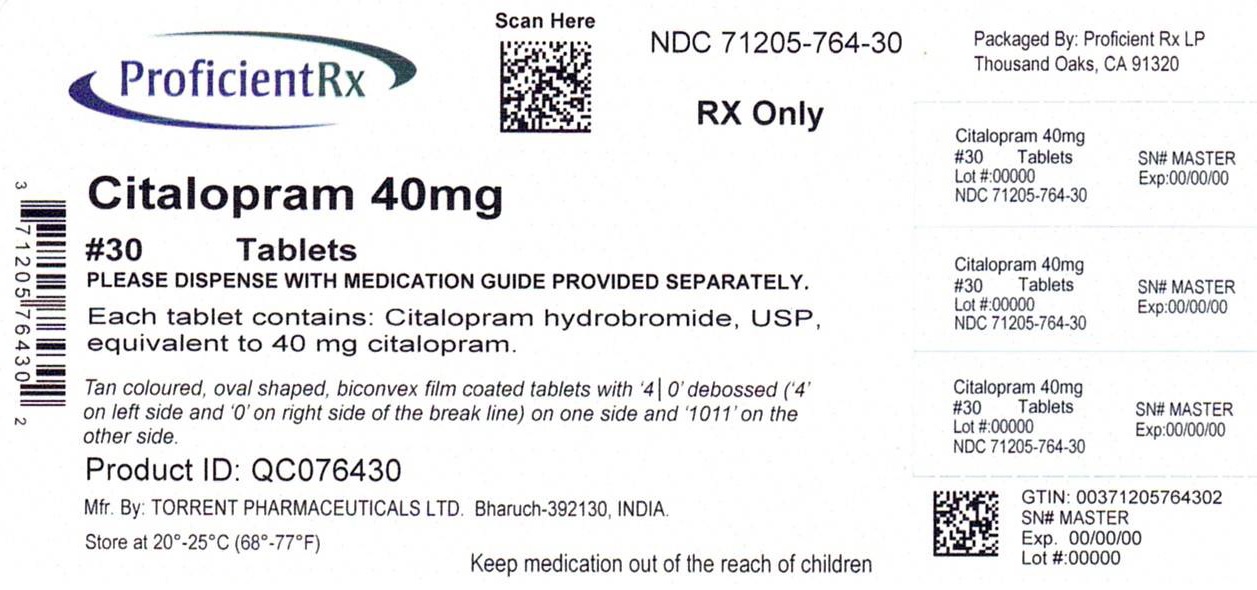
CITALOPRAM TABLETS 40 MG 71205-764-30
Medicare Part D spend CMS · PART D · 2026 (Q1)
About this NDC listing & data coverage
What data is (and isn’t) available for this NDC — tap to expand
| NDC identity (package / product / labeler codes) | ✓ Available |
| Labeler | ✓ Available |
| Product & package description | ✓ Available |
| Marketing category & status | ✓ Available |
| Active ingredient / dosage form / route | ✓ Available |
| FDA label (SPL via DailyMed) | ✓ Available |
| Package photos | ✓ Available |
| Inactive ingredients (structured) | — Not published for this NDC The labeler did not submit a structured excipient list, or no SPL is available. |
| NADAC pharmacy acquisition price (CMS) | — Not published for this NDC CMS publishes NADAC only for NDCs reported in its retail-pharmacy survey. |
| Orange Book / therapeutic-equivalence data | ✓ Available |
| HCPCS J-code billing crosswalk | — Not published for this NDC Most self-administered / retail products have no J-code — that is normal. |
| Medicaid utilization (CMS SDUD) | — Not published for this NDC CMS reports utilization only for NDCs with Medicaid claims above its privacy threshold. |