
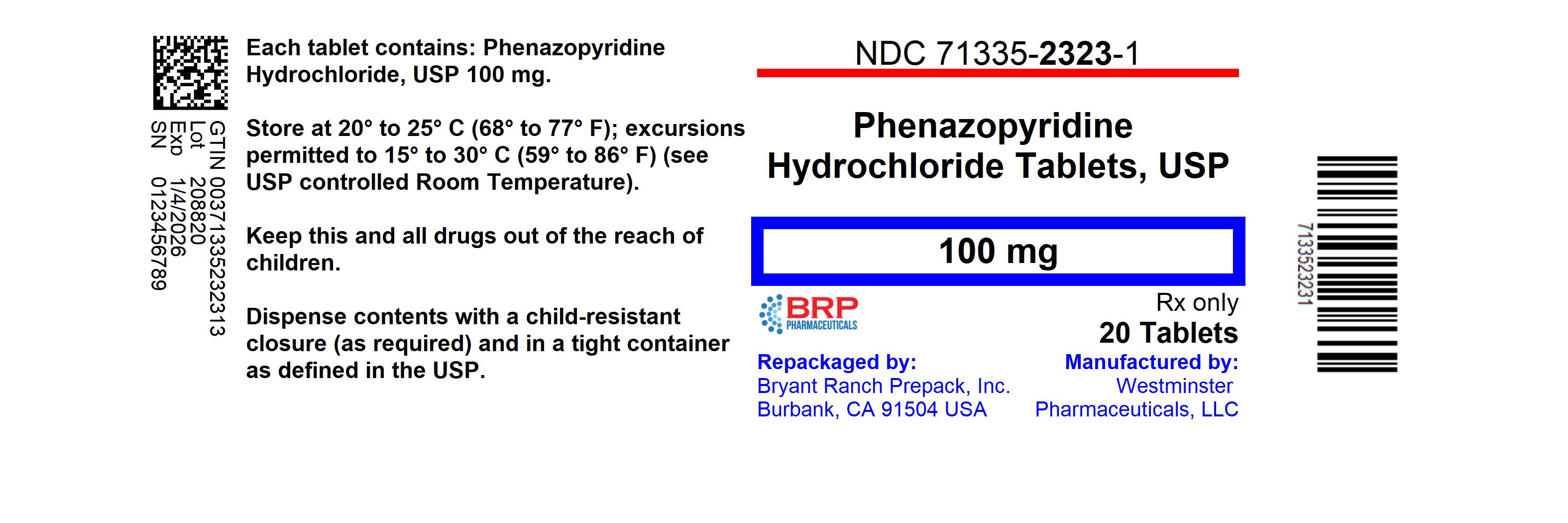
Phenazopyridine Hydrochloride 100 mg Tablet, 21-count — NDC 71335-2323-8 (Billing 71335-2323-08)
This is a package of 21 tablets of Phenazopyridine Hydrochloride 100 mg Tablet from Bryant Ranch Prepack, marketed since Oct 2023 and currently FDA-listed.
NDC database record
One package, one record: these facts belong to NDC 71335-2323-8 alone.
- Record
- FDA NDC Directory package listing · Human prescription drug
- Code segments
- 71335 labeler · 2323 product · 8 package
- Package marketed since
- Jan 4, 2024
- Sample package
- No — commercial package
- Listing certified through
- Dec 31, 2026
- Barcode (UPC-A, from the NDC)
- 3 7133523238 2
- FDA record last changed
- Jul 24, 2026
Identity & classification
Regulatory identifiers FDA, NLM and CMS codes for this package
- RxCUI (RxNorm): 1094107
Where does this data come from?
- FDA openFDA NDC Directory · synced Oct 1, 2026
- FDA label on DailyMed · label index refreshed Oct 6, 2026
- RxNorm (NLM RxNav) · catalog refreshed Oct 1, 2026
- Medi-Span GPI (licensed)
- First Databank (licensed) · refreshed Oct 1, 2026
RxNorm drug class
This medicine belongs to the Other urologicals class.
Where does this data come from?
- RxClass (NLM) · catalog refreshed Oct 1, 2026
Clinical
Phenazopyridine relieves urinary tract pain, burning, irritation, and discomfort, as well as urgent and frequent urination caused by urinary tract infections, surgery, injury, or examination procedures. However, phenazopyridine is not an antibiotic; it does not cure infections.
Read the full MedlinePlus article ↗- It only helps with the pain — it doesn't kill the bacteria causing the infection. Think of it as taking the edge off while your antibiotic does the real work. If you have a UTI, yo...
- Does phenazopyridine actually treat my UTI, or does it just help with the pain?
- That's completely expected with phenazopyridine — it's one of the most common things people notice. The drug itself has an orange-red dye, and it passes into your urine, which is w...
- Why is my urine turning orange or red? Should I be worried?
Patient education
Supplement & herbal interactions
Where does this data come from?
- MedlinePlus (NLM) · refreshed Oct 1, 2026
- FDA label on DailyMed · label index refreshed Oct 6, 2026
Ask a licensed pharmacist directly — free, answered by our team.
Pricing
A drug doesn't have one price. Each row is a different public payment system, and none is what you'd pay at the counter — that depends on your insurance. The ⓘ on each row explains what it measures.
| Price system | Per each | Per package |
|---|---|---|
| Retail pharmacies payNADAC · weekly | Not in the retail survey — common for institutional, discontinued, or low-volume packs. | |
| Medicaid paysCMS SDUD · 12 mo | No recent Medicaid claims on file for this NDC — rare and low-volume NDCs are suppressed in the public data. | |
| Medicare drug plans payPart D · quarterly | No Part D plan price is available for this NDC in our data. | |
Where does this data come from?
- CMS NADAC weekly file
- CMS ASP pricing files · refreshed Sep 20, 2026
- CMS Medicaid State Drug Utilization Data · refreshed Oct 6, 2026
- CMS Part D plan pricing files · refreshed Sep 24, 2026
- VA National Acquisition Center price file
Packaging — all sizes for this product
| Package NDC | Description | Marketing start | Marketing end | Status |
|---|---|---|---|---|
| 71335-2323-01 71335-2323-1 Main listing | 20 TABLET in 1 BOTTLE | 2024-01-04 | — | Active |
| 71335-2323-02 71335-2323-2 | 12 TABLET in 1 BOTTLE | 2024-01-04 | — | Active |
| 71335-2323-03 71335-2323-3 | 9 TABLET in 1 BOTTLE | 2024-01-04 | — | Active |
| 71335-2323-04 71335-2323-4 | 10 TABLET in 1 BOTTLE | 2024-01-04 | — | Active |
| 71335-2323-05 71335-2323-5 | 15 TABLET in 1 BOTTLE | 2024-01-04 | — | Active |
| 71335-2323-06 71335-2323-6 | 100 TABLET in 1 BOTTLE | 2024-01-04 | — | Active |
| 71335-2323-07 71335-2323-7 | 6 TABLET in 1 BOTTLE | 2024-01-04 | — | Active |
| 71335-2323-08 You're viewing this | 21 TABLET in 1 BOTTLE | 2024-01-04 | — | Active |
| 71335-2323-09 71335-2323-9 | 30 TABLET in 1 BOTTLE | 2024-01-04 | — | Active |
You're viewing one of 9 pack sizes for this product.
Pack size FAQ
What quantity is in this package?
How does this package differ from NDC 71335-2323-07?
What NDC number is used to bill for this package of Phenazopyridine Hydrochloride 100 mg Tablet?
Therapeutic equivalents
| Product | Labeler | Pack | NADAC/unit | TE | Status | Price vs. this |
|---|---|---|---|---|---|---|
| Phenazopyridine Hydrochloride 100 mg 65162-0681-10 | Amneal | 100 tablets | $0.154 | — | Availability likely | — |
| Phenazopyridine Hydrochloride 100 mg 69367-0611-01 | Westminster | 100 tablets | $0.154 | — | Availability likely | — |
| Phenazopyridine Hydrochloride 100 mg 75826-0114-10 | Winder | 100 tablets | $0.154 | — | Availability likely | — |
| Phenazopyridine Hydrochloride 100 mg 50090-6442-00 | A-S | 10 tablets | — | — | FDA listed | — |
| Phenazopyridine Hydrochloride 100 mg 50090-7291-00 | A-S | 10 tablets | — | — | FDA listed | — |
| Phenazopyridine Hydrochloride 100 mg 51655-0007-27 | Northwind | 12 tablets | — | — | FDA listed | — |
| Pyridium 100 mg 60846-0501-01 | Amneal | 100 tablets | — | — | FDA listed | — |
| Phenazopyridine Hydrochloride 100 mg 62135-0403-60 | Chartwell | 60 tablets | — | — | FDA listed | — |
| Phenazopyridine Hydrochloride 100 mg 64950-0550-01 | Genus | 100 tablets | — | — | FDA listed | — |
| Phenazopyridine Hydrochloride 100 mg 67296-2206-06 | Redpharm | 6 tablets | — | — | FDA listed | — |
| Phenazopyridine Hydrochloride 100 mg 68071-2357-02 | NuCare | 12 tablets | — | — | FDA listed | — |
| Phenazopyridine Hydrochloride 100 mg 68071-5302-04 | NuCare | 4 tablets | — | — | FDA listed | — |
| Phenazopyridine Hydrochloride 100 mg 68788-7981-01 | Preferred | 15 tablets | — | — | FDA listed | — |
| Phenazopyridine Hydrochloride 100 mg 68788-8668-01 | Preferred | 15 tablets | — | — | FDA listed | — |
| Phenazopyridine Hydrochloride 100 mg 70518-0218-00 | REMEDYREPACK | 6 tablets | — | — | FDA listed | — |
| Phenazopyridine Hydrochloride 100 mg 70518-3443-00 | REMEDYREPACK | 30 tablets | — | — | Discontinued | — |
| Phenazopyridine Hydrochloride 100 mg 70518-3986-00 | REMEDYREPACK | 30 tablets | — | — | FDA listed | — |
| Phenazopyridine Hydrochloride 100 mgthis 71335-2323-08 | Bryant | 21 tablets | — | — | FDA listed | — |
| Phenazopyridine Hydrochloride 100 mg 71335-9712-01 | Bryant | 20 tablets | — | — | FDA listed | — |
| Phenazopyridine HCL 100 mg 72189-0534-06 | Direct_Rx | 6 tablets | — | — | FDA listed | — |
| Phenazopyridine Hydrochloride 100 mg 72789-0362-06 | PD-Rx | 6 tablets | — | — | FDA listed | — |
| Phenazopyridine Hydrochloride 100 mg 82804-0047-06 | Proficient | 6 tablets | — | — | FDA listed | — |
| Phenazopyridine Hydrochloride 100 mg 82804-0192-12 | Proficient | 12 tablets | — | — | FDA listed | — |
| Phenazopyridine Hydrochloride 100 mg 82804-0994-00 | Proficient | 100 tablets | — | — | FDA listed | — |
| Phenazopyridine Hydrochloride 100 mg 68071-5309-06 | NuCare | 6 tablets | — | — | FDA listed | — |
Where does this data come from?
- FDA openFDA NDC Directory · synced Oct 1, 2026
- FDA Orange Book · refreshed Oct 3, 2026
- CMS NADAC weekly file
Availability & generic status
We did not find an FDA-approved generic match for this exact strength, form and route.
Where does this data come from?
- FDA Orange Book · refreshed Oct 3, 2026
What it looks like
Where does this data come from?
- FDA label on DailyMed · label index refreshed Oct 6, 2026
Inactive Ingredients / Excipients
Inactive ingredients, also called excipients, are components of the drug product other than the active ingredient. They may include fillers, dyes, coatings, preservatives, flavors, or other formulation ingredients.
🧪 Avoiding an ingredient? See Phenazopyridine inactive ingredients by manufacturer: every current product's list side by side, so you can ask your pharmacy for the version that does not list it.
💡 Tap an ingredient (hover on desktop) to see what it is and why it’s used.
-
UNII M28OL1HH48
Croscarmellose sodium is a plant-based substance derived from cellulose. It acts as a disintegrant, helping tablets and capsules break down quickly in the digestive system so the medicine can be absorbed.
-
UNII 35SW5USQ3G
A synthetic yellow dye used to color medicines. It helps make tablets, capsules, and liquids visually distinct so patients can easily identify their medication.
-
UNII H3R47K3TBD
FD&C Blue No. 1 is a synthetic blue dye approved for use in foods and medicines. It serves as a colorant to give the medication its distinctive appearance and help with product identification.
-
UNII WZB9127XOA
A synthetic red dye used to color medications and make them easier to identify. It serves as a colorant in tablets, capsules, and liquid formulations.
-
UNII H77VEI93A8
A synthetic yellow dye used to color medications. It helps identify the drug and make it visually distinctive, with no effect on how the medicine works.
-
UNII 70097M6I30
Magnesium stearate is a salt made from magnesium and stearic acid, a fatty substance. It's used in tablets and capsules as a lubricant and glidant to help ingredients flow smoothly during manufacturing and prevent sticking.
-
UNII OP1R32D61U
Microcrystalline cellulose is a purified form of cellulose, a natural fiber from plant sources. It acts as a binder and filler in tablets and capsules, helping hold ingredients together and give the medicine its shape and size.
-
UNII 3WJQ0SDW1A
Polyethylene glycol is a synthetic liquid or solid polymer used in medicines as a solvent, lubricant, and humectant. It helps dissolve active ingredients, reduces friction during manufacturing, and retains moisture in the final product.
-
UNII 532B59J990
Polyvinyl alcohol is a synthetic polymer made from plant-derived materials. It's used as a binder to hold ingredients together, a film-former in coatings, and a thickener in liquid formulations.
-
UNII FZ989GH94E
Povidone is a synthetic polymer made from a plastic-like material. It acts as a binder to hold tablet ingredients together and as a disintegrant to help the tablet break apart in your stomach so the medicine can be absorbed.
-
UNII ETJ7Z6XBU4
Silicon dioxide is a naturally occurring mineral used as a glidant and anti-caking agent. It helps powder ingredients flow smoothly and prevents clumping during manufacturing and storage.
-
UNII O8232NY3SJ
A plant-based carbohydrate derived from corn kernels. It acts as a filler to add bulk, a binder to hold ingredients together, and a disintegrant to help the tablet break apart in your stomach for absorption.
-
UNII 7SEV7J4R1U
A powder made from a naturally occurring mineral. In medicines, talc works as a glidant and anti-caking agent, helping tablets and capsules flow smoothly during manufacturing and preventing clumping.
-
UNII 15FIX9V2JP
Titanium dioxide is a bright white mineral powder commonly used as a colorant and opacifying agent. It makes pills and tablets white or lighter in color and helps make coatings non-transparent.
14 inactive ingredients listed in the exact product block matched to this NDC.
Where does this data come from?
ingredient classCode="IACT" elements from the exact product block matched by this NDC. Label-section narrative from DailyMed / the openFDA label index is shown separately when available.- FDA label on DailyMed · label index refreshed Oct 6, 2026
- FDA openFDA NDC Directory · synced Oct 1, 2026
Inactive ingredient FAQ
Are inactive ingredients the same for every manufacturer?
Why might an inactive ingredient be missing?
Can inactive ingredients matter?
Manufacturer & labeler
More NDCs from Bryant Ranch Prepack labeler code 71335
- Furosemide 40 mg Tablet NDC 71335-2317-1
- topiramate 100 mg Tablet, Film Coated NDC 71335-2318-1
- Furosemide 20 mg Tablet NDC 71335-2319-0
- Nitrofurantoin 25 mg; 75 mg Capsule NDC 71335-2320-0
- Phenazopyridine Hydrochloride 200 mg Tablet NDC 71335-2321-1
- Doxazosin 4 mg Tablet NDC 71335-2322-1
- Tizanidine 4 mg Tablet NDC 71335-2325-0
- Cevimeline Hydrochloride 30 mg Capsule NDC 71335-2326-1
- Meloxicam 15 mg Tablet NDC 71335-2327-0
- Lamotrigine 100 mg Tablet NDC 71335-2328-1
- Moxifloxacin Hydrochloride 400 mg Tablet, Film Coated NDC 71335-2329-1
- Oxybutynin Chloride Extended Release 5 mg Tablet, Extended Release NDC 71335-2330-1
Where does this data come from?
- FDA openFDA NDC Directory · synced Oct 1, 2026
- Drugs@FDA
Full prescribing information FDA SPL
🎯 Indications and Usage ▾
INDICATIONS AND USAGE Phenazopyridine Hydrochloride is indicated for the symptomatic relief of pain, burning, urgency frequency, and other discomforts arising from irritation of the mucosa of the lower urinary tract caused by infection, trauma, surgery, endoscopic procedures, or the passage of sounds or catheters. The use of Phenazopyridine Hydrochloride for relief of symptoms should not delay definitive diagnosis and treatment of causative conditions. The drug should be used for symptomatic relief of pain and not as a substitute for specific surgery or antimicrobial therapy.
Phenazopyridine Hydrochloride is compatible with antimicrobial therapy and can help relieve pain and discomfort during the interval before antimicrobial therapy controls the infection. Treatment of a urinary tract infection with Phenazopyridine Hydrochloride should not exceed 2 days. There is no evidence that the combined administration of Phenazopyridine Hydrochloride and an antimicrobial provides greater benefit than administration of the antimicrobial alone after 2 days.
(See Dosage and Administration .)
⏱️ Dosage and Administration ▾
DOSAGE AND ADMINISTRATION 100 mg Tablets: Average adult dosage is two tablets 3 times a day after meals. 200 mg Tablets: Average adult dosage is one tablet 3 times a day after meals. When used concomitantly with an antibacterial agent for the treatment of a urinary tract infection, the administration of Phenazopyridine Hydrochloride should not exceed 2 days.
⛔ Contraindications ▾
CONTRAINDICATIONS Phenazopyridine Hydrochloride should not be used in patients who are hypersensitive to the drug or its ingredients. Phenazopyridine Hydrochloride is contraindicated in patients with renal insufficiency, severe liver disease, severe hepatitis or pyelonephritis of pregnancy. It should be used cautiously in the presence of GI disturbances.
⚠️ Warnings ▾
WARNINGS Phenazopyridine Hydrochloride is reasonably anticipated to be a human carcinogen based on sufficient evidence of carcinogenicity in experimental animals (IARC 1980, 1982, 1987, NCI 1978). When administered in the diet, Phenazopyridine hydrochloride increased the incidences of hepatocellular adenomas and carcinomas in female mice and adenomas and adenocarcinomas of the colon and rectum in rats of both sexes. There is inadequate evidence for the carcinogenicity of Phenazopyridine hydrochloride in humans (TARC 1987).
In one limited epidemiological study, no significant excess of any cancer was observed among 2,214 patients who received Phenazopyridine hydrochloride and were followed for a minimum of 3 years.
🤒 Adverse Reactions ▾
ADVERSE REACTIONS The following adverse events have been reported: CNS: headache. Gastrointestinal: nausea, vomiting and diarrhea. Dermatologic and Hypersensitivity: rash, pruritus, discoloration, anaphylactoid-like reaction and hypersensitivity hepatitis.
Hematologic: methemoglobinemia, hemolytic anemia, potential hemolytic agent in G-6-PD deficiency, sulfhemoglobinemia. Other: visual disturbances, renal and hepatic toxicity usually associated with overdose, renal calculi, jaundice, discoloration of body fluids and aseptic meningitis.
🔄 Drug Interactions ▾
Drug Interactions The interaction of Phenazopyridine Hydrochloride with other drugs has not been studied in a systematic manner. However, the medical literature to date suggests that no significant interactions have been reported.
🤰 Pregnancy ▾
Pregnancy Category B Reproductive studies with Phenazopyridine Hydrochloride (in combination with sulfacytine) in rats given up to 110 mg/kg/day and in rabbits given up to 39 mg/kg/day during organogenesis revealed no evidence of harm to offspring. One prospective study in humans demonstrated that Phenazopyridine Hydrochloride traverses the placenta into the fetal compartment. There are no adequate and well-controlled studies in pregnant women.
Therefore, Phenazopyridine Hydrochloride should be used in pregnant women only if the benefit clearly outweighs the risk.
🧒 Pediatric Use ▾
Children Adequate and well-controlled studies have not been performed in the pediatric population. No pediatric-specific problems have been documented.
🧬 Clinical Pharmacology ▾
CLINICAL PHARMACOLOGY Phenazopyridine hydrochloride is excreted in the urine where it exerts a topical analgesic effect on the mucosa of the urinary tract. This action helps to relieve pain, burning, urgency and frequency. The precise mechanism of action is unknown.
PHARMACOKINETICS The pharmacokinetic properties of Phenazopyridine hydrochloride have not been determined. Phenazopyridine Hydrochloride and its metabolites are rapidly excreted by the kidneys. In a small number of healthy subjects, 90% of a 600 mg/day oral dose of Phenazopyridine hydrochloride was eliminated in the urine in 24 hours, 41% as unchanged drug and 49% as metabolites.
📦 How Supplied / Storage and Handling ▾
HOW SUPPLIED 100 mg Tablets: Appearance: Dark brown coated, round standard cup tablet, debossed "611" on one side and plain on the other. NDC: 71335-2323-1: 20 Tablets in a BOTTLE NDC: 71335-2323-2: 12 Tablets in a BOTTLE NDC: 71335-2323-3: 9 Tablets in a BOTTLE NDC: 71335-2323-4: 10 Tablets in a BOTTLE NDC: 71335-2323-5: 15 Tablets in a BOTTLE NDC: 71335-2323-6: 100 Tablets in a BOTTLE NDC: 71335-2323-7: 6 Tablets in a BOTTLE NDC: 71335-2323-8: 21 Tablets in a BOTTLE NDC: 71335-2323-9: 30 Tablets in a BOTTLE STORE at 20° to 25°C (68° to 77°F) with excursions permitted to 15° to 30°C (59° to 86°F) [See USP Controlled Room Temperature].
Repackaged/Relabeled by: Bryant Ranch Prepack, Inc. Burbank, CA 91504
📋 Description ▾
DESCRIPTION Phenazopyridine Hydrochloride is a reddish-brown, odorless, slightly bitter, crystalline powder. It has a specific local analgesic effect in the urinary tract, promptly relieving burning and pain. Following is the structural formula: C 11 H 11 N 5 ∙ HCl M.W.
249.70 Phenazopyridine Hydrochloride oral tablets contain the following inactive ingredients: Croscarmellose Sodium, D&C Yellow #10 Aluminum Lake, FD&C Blue #1 Aluminum Lake, FD&C Red #40 Aluminum Lake, FD&C Yellow #6 Aluminum Lake, Magnesium Stearate, Microcrystalline Cellulose, Polyethylene Glycol, Polyvinyl Alcohol, Povidone, Pregelatinized Starch, Talc, and Titanium Dioxide.
💬 Information for Patients ▾
Information for Patients The patient should be advised to take Phenazopyridine Hydrochloride with or following food or after eating a snack to reduce stomach upset. The patients should be aware that Phenazopyridine Hydrochloride causes a reddish orange discoloration of the urine and feces, and may stain clothing. Phenazopyridine Hydrochloride may cause discoloration of body fluids and staining of contact lenses has been reported.
There have been reports of teeth discoloration when the product has been broken or held in the mouth prior to swallowing. Patients should be instructed to take Phenazopyridine Hydrochloride for only 2 days if an antibacterial agent is administered concurrently for the treatment of a urinary tract infection. If symptoms persist beyond those 2 days, the patient should be instructed to contact his or her physician.
⚠️ Precautions ▾
PRECAUTIONS General The patient should be advised that Phenazopyridine Hydrochloride produces an orange to red color in the urine and feces, and may cause staining. Phenazopyridine Hydrochloride may cause discoloration of body fluids and staining of contact lenses has been reported. A yellowish color of the skin or sclera may indicate accumulation of Phenazopyridine Hydrochloride resulting from impaired renal function and necessitates discontinuance of the drug.
It should be noted that a decline in renal function is common in elderly patients. Phenazopyridine Hydrochloride may mask pathological conditions and interfere with laboratory test values using colorimetric, spectrophotometric or fluorometric analysis methods. Cautious use in patients with G-6-PD deficiency is advised since these patients are susceptible to oxidative hemolysis and may have greater potential to develop hemolytic anemia.
Information for Patients The patient should be advised to take Phenazopyridine Hydrochloride with or following food or after eating a snack to reduce stomach upset. The patients should be aware that Phenazopyridine Hydrochloride causes a reddish orange discoloration of the urine and feces, and may stain clothing. Phenazopyridine Hydrochloride may cause discoloration of body fluids and staining of contact lenses has been reported.
There have been reports of teeth discoloration when the product has been broken or held in the mouth prior to swallowing. Patients should be instructed to take Phenazopyridine Hydrochloride for only 2 days if an antibacterial agent is administered concurrently for the treatment of a urinary tract infection. If symptoms persist beyond those 2 days, the patient should be instructed to contact his or her physician.
Laboratory Tests Phenazopyridine Hydrochloride may interfere with laboratory test values using colorimetric, photometric or fluorometric analysis methods. Altered urine laboratory test values may include ketone (sodium nitroprusside) bilirubin (foam test, talc-disk-Fouchet-spot test, Franklin's tablet-Fouchet test, p-nitrobenzene diazonium p-toluene sulfonate reagent), diacetic acid (Gerhardt ferric chloride test), free hydrochloric acid, glucose (glucose oxidase tests), 17-hydroxycorticosteroids (modified Glenn-Nelson), 17-ketosteroids (Holtorff Koch modification of Zimmerman), porphyrins, albumin (discolors bromophenol blue test areas of commercial reagent strips, nitric acid ring test), phenolsulfophthalein, urobilinogen (color interference with Ehrlich's reagent), and urinalysis (spectrophotometric or color-based tests).
Phenazopyridine Hydrochloride also imparts an orange-red color to stools which may interfere with color tests. Drug Interactions The interaction of Phenazopyridine Hydrochloride with other drugs has not been studied in a systematic manner. However, the medical literature to date suggests that no significant interactions have been reported.
Carcinogenesis, Mutagenesis, Impairment of Fertility Long-term administration of Phenazopyridine Hydrochloride has been associated with tumors of the large intestine in rats and of the liver in mice. Available epidemiological data are insufficient to evaluate the carcinogenicity of Phenazopyridine Hydrochloride in humans. In vitro studies indicate that Phenazopyridine Hydrochloride in the presence of metabolic activation is mutagenic in bacteria and mutagenic and clastogenic in mammalian cells.
Pregnancy Category B Reproductive studies with Phenazopyridine Hydrochloride (in combination with sulfacytine) in rats given up to 110 mg/kg/day and in rabbits given up to 39 mg/kg/day during organogenesis revealed no evidence of harm to offspring. One prospective study in humans demonstrated that Phenazopyridine Hydrochloride traverses the placenta into the fetal compartment. There are no adequate and well-controlled studies in pregnant women.
Therefore, Phenazopyridine Hydrochloride should be used in pregnant women only if the benefit clearly outweighs the… [Excerpted — this section continues on DailyMed.]
🍼 Nursing Mothers ▾
Nursing Mothers It is not known whether Phenazopyridine Hydrochloride or its metabolites are excreted in human milk. Because many drugs are excreted in human milk, a decision should be made to discontinue nursing or to discontinue the drug, taking into account the importance of drug therapy to the mother.
🧬 Pharmacokinetics ▾
PHARMACOKINETICS The pharmacokinetic properties of Phenazopyridine hydrochloride have not been determined. Phenazopyridine Hydrochloride and its metabolites are rapidly excreted by the kidneys. In a small number of healthy subjects, 90% of a 600 mg/day oral dose of Phenazopyridine hydrochloride was eliminated in the urine in 24 hours, 41% as unchanged drug and 49% as metabolites.
📄 Carcinogenesis, Mutagenesis, Impairment of Fertility ▾
Carcinogenesis, Mutagenesis, Impairment of Fertility Long-term administration of Phenazopyridine Hydrochloride has been associated with tumors of the large intestine in rats and of the liver in mice. Available epidemiological data are insufficient to evaluate the carcinogenicity of Phenazopyridine Hydrochloride in humans. In vitro studies indicate that Phenazopyridine Hydrochloride in the presence of metabolic activation is mutagenic in bacteria and mutagenic and clastogenic in mammalian cells.
📄 Package Label / Principal Display Panel ▾
Phenazopyridine Hcl 100mg Tablet Label
Reported adverse events (FAERS)
Top reported reactions
Age at onset
Reporter sex
Serious outcomes
Where does this data come from?
About this NDC listing & data coverage
Listed without an FDA application
This product's marketing category indicates it is marketed without an approved FDA application (no NDA, ANDA, or BLA on file). Having an NDC does not by itself establish FDA approval — the NDC Directory is a listing system, not an approval decision. Approval-linked data such as Orange Book therapeutic-equivalence ratings therefore does not apply.
What data is (and isn’t) available for this NDC — tap to expand
| NDC identity (package / product / labeler codes) | ✓ Available |
| Labeler | ✓ Available |
| Product & package description | ✓ Available |
| Marketing category & status | ✓ Available |
| Active ingredient / dosage form / route | ✓ Available |
| FDA label (SPL via DailyMed) | ✓ Available |
| Package photos | ✓ Available |
| Inactive ingredients (structured) | ✓ Available |
| NADAC pharmacy acquisition price (CMS) | — Not published for this NDC CMS publishes NADAC only for NDCs reported in its retail-pharmacy survey. |
| Orange Book / therapeutic-equivalence data | — Not published for this NDC Applies only to products approved under an NDA/ANDA; many listings are out of scope. |
| HCPCS J-code billing crosswalk | — Not published for this NDC Most self-administered / retail products have no J-code — that is normal. |
| Medicaid utilization (CMS SDUD) | — Not published for this NDC CMS reports utilization only for NDCs with Medicaid claims above its privacy threshold. |