
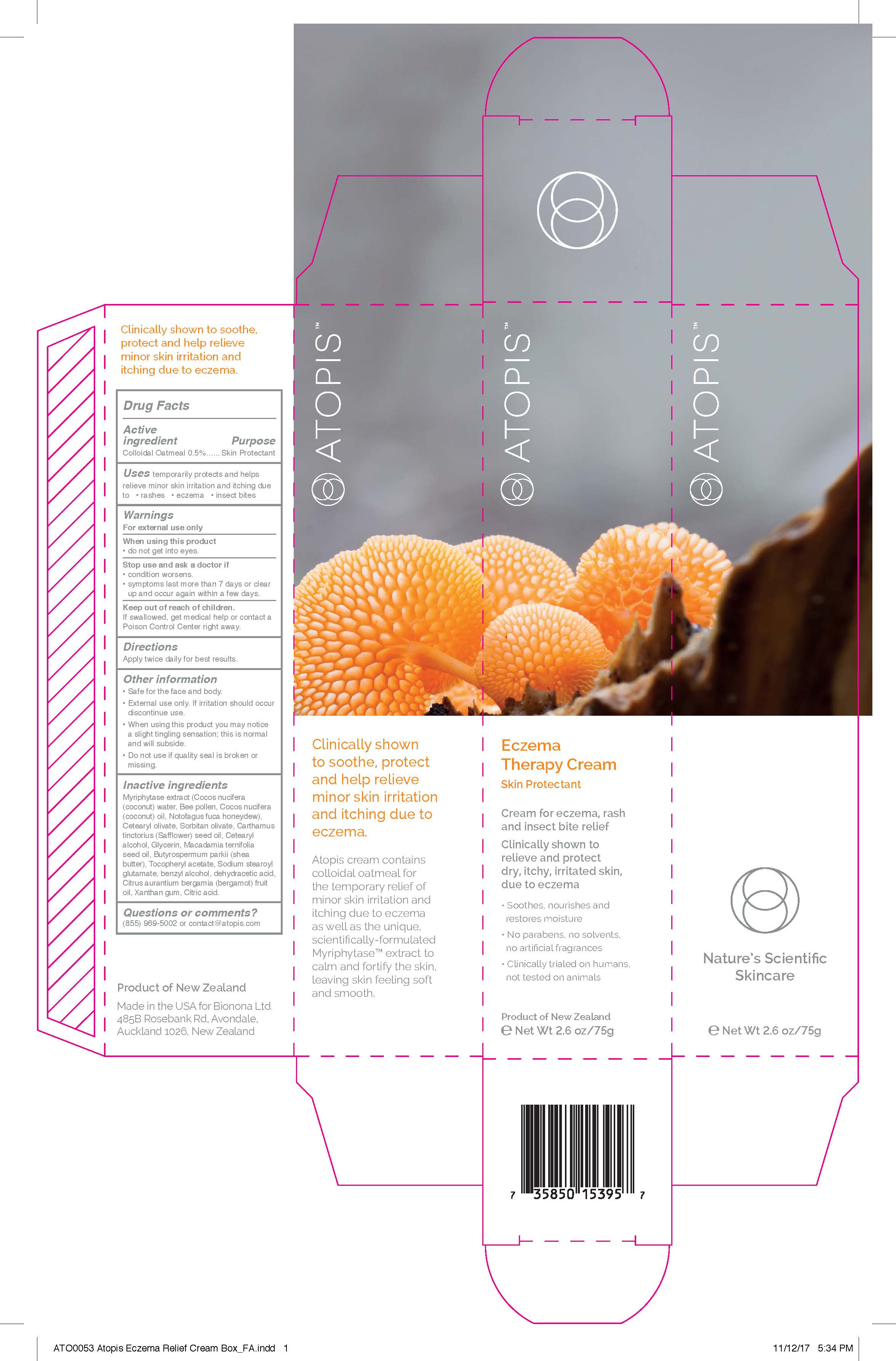
Atopis Eczema Therapy Cream Colloidal Oatmeal .5 g/100g Cream — NDC 71570-001-01 (Billing 71570-0001-01)
This is a package of Atopis Eczema Therapy Cream Colloidal Oatmeal .5 g/100g Cream from Bionona Limited, marketed since Jul 2019 and currently FDA-listed. It is this product's only package size.
NDC database record
One package, one record: these facts belong to NDC 71570-001-01 alone.
- Record
- FDA NDC Directory package listing · Human OTC drug
- Code segments
- 71570 labeler · 001 product · 01 package
- Package marketed since
- Jul 15, 2019
- Sample package
- No — commercial package
- Listing certified through
- Dec 31, 2026
- Barcode (UPC)
- 0735850153957
- FDA record last changed
- Jul 24, 2026
Identity & classification
Regulatory identifiers FDA, NLM and CMS codes for this package
- RxCUI (RxNorm): 1654149
Where does this data come from?
- FDA openFDA NDC Directory · synced Oct 8, 2026
- FDA label on DailyMed · label index refreshed Oct 8, 2026
- RxNorm (NLM RxNav) · catalog refreshed Oct 1, 2026
- Medi-Span GPI (licensed)
- First Databank (licensed) · refreshed Oct 8, 2026
RxNorm drug class
This medicine belongs to the Non-Standardized Food Allergenic Extract class.
Where does this data come from?
- RxClass (NLM) · catalog refreshed Oct 1, 2026
Clinical
Atopis Eczema Therapy Cream is a topical over-the-counter cream containing colloidal oatmeal as its active ingredient. Colloidal oatmeal is commonly used in skin care products to help soothe and moisturize irritated or dry skin. This product is marketed as an OTC monograph drug, meaning it follows established FDA guidelines for its ingredient category rather than undergoing individual product review. The cream is applied directly to the skin to address eczema-related dryness and irritation.
Patient education
Supplement & herbal interactions
Where does this data come from?
- MedlinePlus (NLM) · refreshed Oct 8, 2026
- FDA label on DailyMed · label index refreshed Oct 8, 2026
Ask a licensed pharmacist directly — free, answered by our team.
Pricing
A drug doesn't have one price. Each row is a different public payment system, and none is what you'd pay at the counter — that depends on your insurance. The ⓘ on each row explains what it measures.
| Price system | Per g | Per package |
|---|---|---|
| Retail pharmacies payNADAC · weekly | Not in the retail survey — common for institutional, discontinued, or low-volume packs. | |
| Medicaid paysCMS SDUD · 12 mo | No recent Medicaid claims on file for this NDC — rare and low-volume NDCs are suppressed in the public data. | |
| Medicare drug plans payPart D · quarterly | No Part D plan price is available for this NDC in our data. | |
Where does this data come from?
- CMS NADAC weekly file
- CMS ASP pricing files · refreshed Sep 20, 2026
- CMS Medicaid State Drug Utilization Data · refreshed Oct 8, 2026
- CMS Part D plan pricing files · refreshed Sep 24, 2026
- VA National Acquisition Center price file
Packaging — all sizes for this product
| Package NDC | Description | Marketing start | Marketing end | Status |
|---|---|---|---|---|
| 71570-0001-01 You're viewing this Main listing | 1 BOTTLE in 1 CARTON / 75 g in 1 BOTTLE | 2019-07-15 | — | Active |
Therapeutic equivalents
Where does this data come from?
- FDA openFDA NDC Directory · synced Oct 8, 2026
- FDA Orange Book · refreshed Oct 3, 2026
- CMS NADAC weekly file
Availability & generic status
We did not find an FDA-approved generic match for this exact strength, form and route.
Where does this data come from?
- FDA Orange Book · refreshed Oct 3, 2026
Inactive Ingredients / Excipients
Inactive ingredients, also called excipients, are components of the drug product other than the active ingredient. They may include fillers, dyes, coatings, preservatives, flavors, or other formulation ingredients.
💡 Tap an ingredient (hover on desktop) to see what it is and why it’s used.
-
UNII 9E8X80D2L0
A synthetic form of vitamin E used as an antioxidant and preservative in medications. It helps prevent the active ingredients from degrading when exposed to oxygen or light.
-
UNII XF417D3PSL
Anhydrous citric acid is a sour, crystalline powder derived from citric acid with water removed. In medicines, it acts as a buffer to control pH, adds tartness to improve taste, and helps tablets disintegrate.
-
UNII 3729L8MA2C
Bee pollen is a granular mixture collected by honeybees from flowers. It's used in medicines as a natural filler and binder to help hold tablet or capsule ingredients together and add bulk to the formulation.
-
UNII LKG8494WBH
Benzyl alcohol is a clear liquid used as a preservative and solvent in medicines. It helps prevent bacterial and fungal growth and dissolves other ingredients to create uniform liquid formulations.
-
UNII 39W1PKE3JI
Bergamot oil is a citrus extract from bergamot orange peel. It's used as a flavoring and fragrance agent to improve taste and aroma in medicines.
-
UNII 58B69Q84JO
A plant-derived emulsifier made from olive oil and fatty alcohols. It helps blend oil and water ingredients together and stabilizes the product's texture in creams, lotions, and similar formulations.
-
UNII 2DMT128M1S
A waxy solid derived from plant or animal sources. It acts as an emulsifier to blend oil and water components, and also thickens the medicine to give it the right texture and consistency.
-
UNII Q9L0O73W7L
Coconut oil is a natural fat extracted from coconut fruit. It's used in medicines as a lubricant, emollient, or carrier to help dissolve or deliver active ingredients smoothly through the formulation.
-
UNII 267F5Y81NT
Coconut water is a natural liquid from inside coconut fruits. It's used in medicines as a vehicle or solvent to help dissolve and deliver active ingredients, and sometimes as a flavor or sweetening agent.
-
UNII 2KAG279R6R
Dehydroacetic acid is a synthetic preservative that prevents mold, yeast, and bacterial growth in medicines. It extends shelf life by protecting the product from spoilage during storage and use.
-
UNII PDC6A3C0OX
Glycerin is a clear, thick liquid derived from plant oils or fats. It acts as a humectant to retain moisture, a sweetener, and a solvent in medications.
-
UNII RN8P45F92A
A natural fruit extract from honeydew melon, used primarily as a flavoring agent to make the medicine taste more pleasant and improve palatability for patients.
-
UNII 515610SU8C
Macadamia oil is a plant-derived oil extracted from macadamia nuts. In medicines, it serves as an emollient and solvent to help dissolve or suspend active ingredients and improve product texture and absorption.
-
UNII 65UEH262IS
Safflower oil is a plant-based oil extracted from safflower seeds. It's used in medicines as a solvent and carrier to help dissolve or suspend active ingredients, and sometimes as an emollient to improve texture.
-
UNII K49155WL9Y
Shea butter is a fat extracted from shea tree nuts. It's used in medicines as an emollient and lubricant to soften the product, improve texture, and help ingredients blend smoothly together.
-
UNII 65A9F4P024
A synthetic compound derived from the amino acid glutamate and stearic acid. It acts as an emulsifier and surfactant to help mix oil and water-based ingredients, keeping the medicine uniform throughout.
-
UNII MDL271E3GR
Sorbitan olivate is an emulsifier derived from sorbitol and olive oil. It helps blend water and oil ingredients together to maintain consistent texture and appearance throughout the medicine.
-
UNII TTV12P4NEE
Xanthan gum is a thickening and stabilizing ingredient made from fermented corn or other sugars. It's added to medicines to improve texture, prevent separation of liquids and solids, and help the product stay consistent.
18 inactive ingredients listed in the exact product block matched to this NDC.
Label-section wording can be broader than the structured product block and may mention additional formulation ingredients.
Where does this data come from?
ingredient classCode="IACT" elements from the exact product block matched by this NDC. Label-section narrative from DailyMed / the openFDA label index is shown separately when available.- FDA label on DailyMed · label index refreshed Oct 8, 2026
- FDA openFDA NDC Directory · synced Oct 8, 2026
Inactive ingredient FAQ
Are inactive ingredients the same for every manufacturer?
Why might an inactive ingredient be missing?
Can inactive ingredients matter?
Manufacturer & labeler
Where does this data come from?
- FDA openFDA NDC Directory · synced Oct 8, 2026
- Drugs@FDA
FDA label — Drug Facts FDA SPL
🎯 Indications and Usage ▾
temporarily protects and helps relieve minor skin irritation and itching due to • rashes • eczema • insect bites
⏱️ Dosage and Administration ▾
Apply twice daily for best results.
⚠️ Warnings ▾
For external use only When using this product • do not get into eyes. Stop use and ask a doctor if • condition worsens. • symptoms last more than 7 days or clear up and occur again within a few days. Keep out of reach of children. If swallowed, get medical help or contact a Poison Control Center right away.
📦 Storage and Handling ▾
• Safe for the face and body. • External use only. If irritation should occur discontinue use. • When using this product you may notice a slight tingling sensation; this is normal and will subside. • Do not use if quality seal is broken or missing.
🧪 Active Ingredient ▾
Colloidal Oatmeal 0.5%
🧪 Inactive Ingredients ▾
Myriphytase extract (Cocos nucifera (coconut) water, Bee pollen, Cocos nucifera coconut) oil, Notofagus fuca honeydew), Cetearyl olivate, Sorbitan olivate, Carthamus tinctorius (Safflower) seed oil, Cetearyl alcohol, Glycerin, Macadamia ternifolia seed oil, Butyrospermum parkii (shea butter), Tocopheryl acetate, Sodium stearoyl glutamate, benzyl alcohol, dehydracetic acid, Citrus aurantium bergamia (bergamot) fruit oil, Xanthan gum, Citric acid.
🎯 Purpose ▾
Colloidal Oatmeal 0.5%...... Skin Protectant
📄 When Using This Product ▾
When using this product • do not get into eyes.
📄 Stop Use and Ask a Doctor If ▾
Stop use and ask a doctor if • condition worsens. • symptoms last more than 7 days or clear up and occur again within a few days.
📄 Keep Out of Reach of Children ▾
Keep out of reach of children. If swallowed, get medical help or contact a Poison Control Center right away.
📄 Questions or Comments ▾
(855) 969-5002 or [email protected]
📄 Package Label / Principal Display Panel ▾
ATOPIS Eczema Therapy Cream Skin Protectant Cream for eczema, rash and insect bite relief Clinically shown to relieve and protect dry, itchy, irritated skin, due to eczema • Soothes, nourishes and restores moisture • No parabens, no solvents, no artificial fragrances • Clinically trialed on humans, not tested on animals Product of New Zealand E Net Wt 2.6 oz/75g Atopis
Reported adverse events (FAERS)
Top reported reactions
Age at onset
Reporter sex
Serious outcomes
Where does this data come from?
About this NDC listing & data coverage
What data is (and isn’t) available for this NDC — tap to expand
| NDC identity (package / product / labeler codes) | ✓ Available |
| Labeler | ✓ Available |
| Product & package description | ✓ Available |
| Marketing category & status | ✓ Available |
| Active ingredient / dosage form / route | ✓ Available |
| FDA label (SPL via DailyMed) | ✓ Available |
| Package photos | ✓ Available |
| Inactive ingredients (structured) | ✓ Available |
| NADAC pharmacy acquisition price (CMS) | — Not published for this NDC CMS publishes NADAC only for NDCs reported in its retail-pharmacy survey. |
| Orange Book / therapeutic-equivalence data | — Not published for this NDC Applies only to products approved under an NDA/ANDA; many listings are out of scope. |
| HCPCS J-code billing crosswalk | — Not published for this NDC Most self-administered / retail products have no J-code — that is normal. |
| Medicaid utilization (CMS SDUD) | — Not published for this NDC CMS reports utilization only for NDCs with Medicaid claims above its privacy threshold. |