
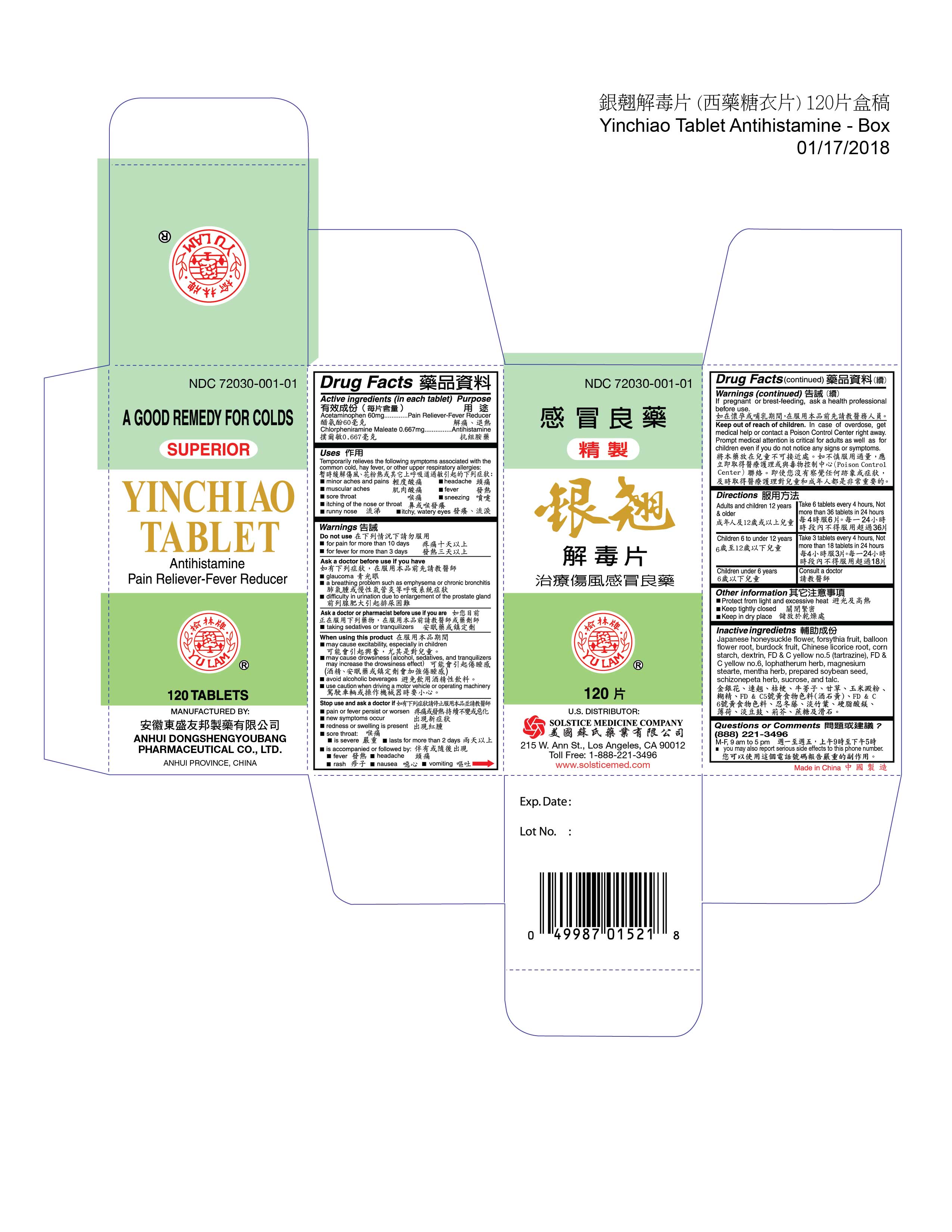
Yinchiao Acetaminophen and Chlorpheniramine Maleate 60 mg; .667 mg Tablet, Coated, 120-count — NDC 72030-001-01 (Billing 72030-0001-01)
This is a package of 120 tablets of Yinchiao Acetaminophen and Chlorpheniramine Maleate 60 mg; .667 mg Tablet, Coated from ANHUI DONGSHENGYOUBANG PHARMACEUTICAL CO., LTD., marketed since Jan 2018 and currently FDA-listed, this package's marketing is listed to end Jul 2028. It is this product's only package size.
NDC database record
One package, one record: these facts belong to NDC 72030-001-01 alone.
- Record
- FDA NDC Directory package listing · Human OTC drug
- Code segments
- 72030 labeler · 001 product · 01 package
- Package marketed since
- Jan 18, 2018
- Package marketing ended
- Jul 31, 2028
- Sample package
- No — commercial package
- Barcode (UPC)
- 0049987015218
- FDA record last changed
- Jul 24, 2026
Identity & classification
Regulatory identifiers FDA, NLM and CMS codes for this package
- RxCUI (RxNorm): 1599133
Where does this data come from?
- FDA openFDA NDC Directory · synced Oct 8, 2026
- FDA label on DailyMed · label index refreshed Oct 8, 2026
- RxNorm (NLM RxNav) · catalog refreshed Oct 8, 2026
- Medi-Span GPI (licensed)
- First Databank (licensed) · refreshed Oct 8, 2026
RxNorm drug class
This medicine belongs to the Anilides class.
Where does this data come from?
- RxClass (NLM) · catalog refreshed Oct 8, 2026
Clinical
Yinchiao is an over-the-counter coated tablet taken by mouth that combines acetaminophen and chlorpheniramine maleate. Acetaminophen is typically used to reduce fever and relieve minor aches and pains. Chlorpheniramine maleate is an antihistamine commonly used to help reduce allergy symptoms such as sneezing, runny nose, and itchy eyes. This product is marketed under the FDA's over-the-counter monograph rules for cold and allergy relief products.
Patient education
Supplement & herbal interactions
Where does this data come from?
- MedlinePlus (NLM) · refreshed Oct 8, 2026
- FDA label on DailyMed · label index refreshed Oct 8, 2026
Ask a licensed pharmacist directly — free, answered by our team.
Pricing
A drug doesn't have one price. Each row is a different public payment system, and none is what you'd pay at the counter — that depends on your insurance. The ⓘ on each row explains what it measures.
| Price system | Per each | Per package |
|---|---|---|
| Retail pharmacies payNADAC · weekly | Not in the retail survey — common for institutional, discontinued, or low-volume packs. | |
| Medicaid paysCMS SDUD · 12 mo | No recent Medicaid claims on file for this NDC — rare and low-volume NDCs are suppressed in the public data. | |
| Medicare drug plans payPart D · quarterly | No Part D plan price is available for this NDC in our data. | |
Where does this data come from?
- CMS NADAC weekly file
- CMS ASP pricing files · refreshed Sep 20, 2026
- CMS Medicaid State Drug Utilization Data · refreshed Oct 9, 2026
- CMS Part D plan pricing files · refreshed Sep 24, 2026
- VA National Acquisition Center price file
Packaging — all sizes for this product
| Package NDC | Description | Marketing start | Marketing end | Status |
|---|---|---|---|---|
| 72030-0001-01 You're viewing this Main listing | 120 TABLET, COATED in 1 BOTTLE | 2018-01-18 | Jul 31, 2028 | Active |
Therapeutic equivalents
| Product | Labeler | Pack | NADAC/unit | TE | Status | Price vs. this |
|---|---|---|---|---|---|---|
| Yinchiao 60 mg/1; .667 mgthis 72030-0001-01 | ANHUI | 120 tablets | — | — | FDA listed | — |
| Ganmaoling 60 mg/1; .667 mg 72030-0002-01 | ANHUI | 120 tablets | — | — | FDA listed | — |
Where does this data come from?
- FDA openFDA NDC Directory · synced Oct 8, 2026
- FDA Orange Book · refreshed Oct 3, 2026
- CMS NADAC weekly file
Availability & generic status
We did not find an FDA-approved generic match for this exact strength, form and route.
Where does this data come from?
- FDA Orange Book · refreshed Oct 3, 2026
Inactive Ingredients / Excipients
Inactive ingredients, also called excipients, are components of the drug product other than the active ingredient. They may include fillers, dyes, coatings, preservatives, flavors, or other formulation ingredients.
💡 Tap an ingredient (hover on desktop) to see what it is and why it’s used.
-
UNII EA541308MV
Arctium lappa fruit, also known as burdock root, is a plant-derived ingredient used as a natural flavoring agent or botanical extract in some formulations to add taste or aroma to the medicine.
-
UNII 89B2BSF9I3
A synthetic compound made by chemically combining corn dextrin (a starch derivative) with palmitic acid. It acts as a binder and flow agent, helping hold tablet ingredients together and improve powder handling during manufacturing.
-
UNII I753WB2F1M
FD&C Yellow No. 5 is a synthetic yellow colorant approved by the FDA. It is added to medicines to make pills, tablets, or liquids visually distinct and easier to identify.
-
UNII H77VEI93A8
A synthetic yellow dye used to color medications. It helps identify the drug and make it visually distinctive, with no effect on how the medicine works.
-
UNII P4793M1ES5
A plant extract from forsythia fruit used as a natural coloring agent or flavor component in medicines. It may help give the product its color or taste.
-
UNII 8XW1DS8UIR
A plant extract from licorice root, used as a natural sweetener, flavoring agent, and to help soothe and coat the throat or digestive tract in some formulations.
-
UNII 4465L2WS4Y
A plant extract from Japanese honeysuckle flowers used as a natural flavoring and fragrance ingredient in medicines. It may also help preserve the product and add pleasant taste or aroma.
-
UNII 55LAO8VLS9
A plant extract from lophatherum gracile grass used in traditional medicine formulations. It may function as a natural flavoring agent, preservative, or active botanical ingredient in herbal preparations.
-
UNII 70097M6I30
Magnesium stearate is a salt made from magnesium and stearic acid, a fatty substance. It's used in tablets and capsules as a lubricant and glidant to help ingredients flow smoothly during manufacturing and prevent sticking.
-
UNII FV98Z8GITP
A natural flavoring from mint plants. It's added to medicines to mask bitter tastes and improve how the medicine tastes, making it easier to take.
-
UNII 2DF0NS0O2Z
A plant extract from platycodon grandiflorum root, used in traditional herbal preparations. It may function as a flavoring agent, natural thickener, or botanical active support ingredient in formulations.
-
UNII 2FN3BA1MZE
Nepeta tenuifolia flowering top is a plant extract used in herbal formulations. It may serve as a flavoring agent, natural color, or botanical active support ingredient in the product.
-
UNII L7HT8F1ZOD
A plant-based oil extracted from soybeans. It's used as an emulsifier and lubricant to help mix ingredients evenly and prevent sticking during tablet or capsule manufacturing.
-
UNII O8232NY3SJ
A plant-based carbohydrate derived from corn kernels. It acts as a filler to add bulk, a binder to hold ingredients together, and a disintegrant to help the tablet break apart in your stomach for absorption.
-
UNII C151H8M554
A natural sugar derived from sugar cane or sugar beets. It's used as a sweetener, filler, and binder to improve taste, add bulk, and help hold tablet or capsule ingredients together.
-
UNII 7SEV7J4R1U
A powder made from a naturally occurring mineral. In medicines, talc works as a glidant and anti-caking agent, helping tablets and capsules flow smoothly during manufacturing and preventing clumping.
16 inactive ingredients listed in the exact product block matched to this NDC.
Label-section wording can be broader than the structured product block and may mention additional formulation ingredients.
Where does this data come from?
ingredient classCode="IACT" elements from the exact product block matched by this NDC. Label-section narrative from DailyMed / the openFDA label index is shown separately when available.- FDA label on DailyMed · label index refreshed Oct 8, 2026
- FDA openFDA NDC Directory · synced Oct 8, 2026
Inactive ingredient FAQ
Are inactive ingredients the same for every manufacturer?
Why might an inactive ingredient be missing?
Can inactive ingredients matter?
Manufacturer & labeler
More NDCs from ANHUI DONGSHENGYOUBANG PHARMACEUTICAL CO., LTD. labeler code 72030
Where does this data come from?
- FDA openFDA NDC Directory · synced Oct 8, 2026
- Drugs@FDA
FDA label — Drug Facts FDA SPL
🎯 Indications and Usage ▾
Uses Temporarily relieves the following symptoms associated with the common cold, hay fever, or other upper respiratory allergies: minor aches and pains headache muscular aches fever sore throat sneezing itching of the nose or throat runny nose itchy, watery eyes
⏱️ Dosage and Administration ▾
Directions adults and children 12 years of age and older: Take 6 tablets every 4 hours, not more than 36 tablets in 24 hours children 6 to under 12 years of age: Take 3 tablets every 4 hours, not more than 18 tablets in 24 hours children under 6 years: consult a doctor
⚠️ Warnings ▾
Warnings
📦 Storage and Handling ▾
Other information protect from light our excessive heat keep tightly closed keep in dry place
🧪 Active Ingredient ▾
Active ingredient (in each tablet) Acetaminophen 60 mg Chlorpheniramine maleate 0.667 mg
🧪 Inactive Ingredients ▾
Inactive ingredients Japanese honeysuckle flower, forsythia fruit, balloon flower root, burdock fruit, Chinese licorice root, corn starch, dextrin, FD&C yellow no.5 (tartrazine), FD&C yellow no.6, lophatherum herb, magnesium stearte, mentha herb, prepared soybean seed, schizonepeta herb, sucrose, and talc.
🎯 Purpose ▾
Purpose Pain reliever-fever reducer Antihistamine
📄 Do Not Use ▾
Do not use for pain for more than 10 days for fever for more than 3 days
📄 Ask a Doctor Before Use If ▾
Ask a doctor before use if the user has glaucoma a breathing problem such as emphysema or chronic bronchitis difficulty in urination due to enlargement of the prostate gland
📄 Ask a Doctor or Pharmacist Before Use If ▾
Ask a doctor or pharmacist before use if you are taking sedatives or tranquilizers
📄 When Using This Product ▾
When using this product may cause excitability especially in children may cause drowsiness (alcohol, sedatives, and tranquilizers may increase the drowsiness effect) avoid alcoholic beverages use caution when driving a motor vehicle or operating machinery
📄 Stop Use and Ask a Doctor If ▾
Stop use and ask a doctor if pain or fever persists or worsen new symptoms occur redness or swelling is present sore throat: is severe last for more than 2 days is accompanied or followed by: fever headache rash nausea vomiting
🤰 If Pregnant or Breast-Feeding ▾
If pregnant or breast-feeding, ask a health professional before use.
📄 Keep Out of Reach of Children ▾
Keep out of reach of children. In case of overdose, get medical help or contact a Poison Control Center right away. Prompt medical attention is critical for adults as well as for children even if you do not notice any signs or symptoms.
📄 Questions or Comments ▾
Questions or Comments? (888) 221-3496 M-F 9 am to 5 pm you may also use this number to report serious adverse events associated with the use of this product
📄 Package Label / Principal Display Panel ▾
YINCHIAO TABLET, NDC 72030-001-01, Antihistamine, Pain Reliever-Fever Reducer, 120 Tablets Image of carton
Reported adverse events (FAERS)
Top reported reactions
Reporter sex
Serious outcomes
Where does this data come from?
About this NDC listing & data coverage
What data is (and isn’t) available for this NDC — tap to expand
| NDC identity (package / product / labeler codes) | ✓ Available |
| Labeler | ✓ Available |
| Product & package description | ✓ Available |
| Marketing category & status | ✓ Available |
| Active ingredient / dosage form / route | ✓ Available |
| FDA label (SPL via DailyMed) | ✓ Available |
| Package photos | ✓ Available |
| Inactive ingredients (structured) | ✓ Available |
| NADAC pharmacy acquisition price (CMS) | — Not published for this NDC CMS publishes NADAC only for NDCs reported in its retail-pharmacy survey. |
| Orange Book / therapeutic-equivalence data | — Not published for this NDC Applies only to products approved under an NDA/ANDA; many listings are out of scope. |
| HCPCS J-code billing crosswalk | — Not published for this NDC Most self-administered / retail products have no J-code — that is normal. |
| Medicaid utilization (CMS SDUD) | — Not published for this NDC CMS reports utilization only for NDCs with Medicaid claims above its privacy threshold. |