
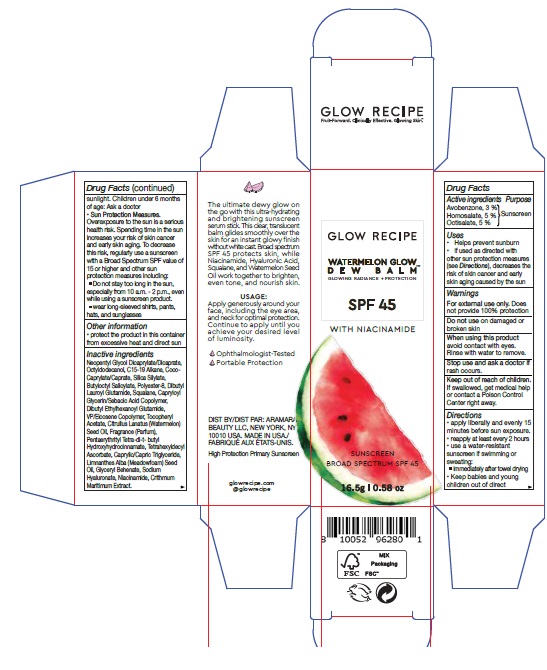
GLOW RECIPE WATERMELON GLOW DEW BALM SPF 45 AVOBENZONE, HOMOSALATE, OCTISALATE 50 mg/g; 50 mg/g; 30 mg/g Stick, 1 tube
🆔 Identity & classification
Where does this data come from?
🏭 Manufacturer & labeler
Where does this data come from?
🩺 Clinical
Glow Recipe Watermelon Glow Dew Balm SPF 45 is a topical stick sunscreen product marketed as an over-the-counter monograph drug. It contains three active ingredients: avobenzone, homosalate, and octisalate, which are ultraviolet light absorbers commonly used together in sunscreen formulations to help protect skin from UVA and UVB radiation. This stick format is typically applied directly to the skin for sun protection purposes.
Patient education
Supplement & herbal interactions
Where does this data come from?
Ask a licensed pharmacist directly — free, answered by our team.
🧪 Inactive Ingredients / Excipients
Inactive ingredients, also called excipients, are components of the drug product other than the active ingredient. They may include fillers, dyes, coatings, preservatives, flavors, or other formulation ingredients.
💡 Tap an ingredient (hover on desktop) to see what it is and why it’s used.
-
UNII A7E6112E4N
A form of vitamin E used as an antioxidant in medicines. It prevents oils and fats in the product from breaking down, helping maintain stability and shelf life.
-
UNII 2EH13UN8D3
A synthetic compound used as a solvent and penetration enhancer in topical formulations. It helps dissolve active ingredients and allows them to penetrate the skin more effectively.
-
UNII CI87N1IM01
A mixture of liquid hydrocarbons derived from petroleum, used as a lubricant and glidant to help the medicine flow smoothly during manufacturing and ensure even tablet coating or capsule filling.
-
UNII N7YC58165T
A synthetic polymer made from glycerin and sebacic acid, used as a film-former and binder in medications. It helps hold tablet or capsule ingredients together and may coat the product for controlled release.
-
UNII 8D9H4QU99H
A synthetic fatty acid ester derived from coconut oil, used as an emulsifier and solubilizer to help mix oil and water-based ingredients and improve how the body absorbs certain drugs.
-
UNII J7IHY79BKY
A plant extract from glasswort, a coastal herb. It's used in formulations as a humectant to help retain moisture and may serve as a skin-conditioning agent in topical products.
-
UNII 0IAF2L30VS
A synthetic chemical compound used as a plasticizer and conditioning agent in topical formulations. It helps soften and improve the flexibility of film coatings and suspensions applied to skin.
-
UNII 3V7K3IA58X
A synthetic compound derived from glutamic acid, used as an emulsifier and skin-conditioning agent in topical formulations to help blend oil and water components and improve product texture and spreadability.
-
UNII XQQ9MKE2BJ
Eicosyl povidone is a synthetic polymer derived from povidone with added long-chain fatty components. It functions as a solubilizer and absorption enhancer to help the medicine dissolve better and be absorbed more effectively by the body.
-
UNII A626UU0W2A
Glyceryl monobehenate is a waxy substance made from glycerin and behenic acid. It's used as a binder and lubricant to help hold tablet ingredients together and improve how smoothly the medicine flows during manufacturing.
-
UNII YSE9PPT4TH
Hyaluronate sodium is a natural carbohydrate that holds moisture. It's used in medicines as a lubricant, thickener, and moisture-retaining agent to improve texture and delivery of the active ingredient.
-
UNII 412ZHA4T4Y
A plant-derived oil extracted from meadowfoam seeds. It acts as an emollient and skin-conditioning agent, helping soften and smooth the product texture while improving how it spreads on skin.
-
UNII C9H2L21V7U
A fat derived from coconut or palm oil containing shorter fatty acid chains. It serves as a solvent and carrier to help dissolve or suspend active ingredients, improving absorption and stability in liquid formulations.
-
UNII VLW429K27K
A synthetic oily liquid made from neopentyl glycol and medium-chain fatty acids. Used in medicines as an emollient and solubilizer to help dissolve active ingredients and improve how the body absorbs them.
-
UNII 25X51I8RD4
Niacinamide is a form of vitamin B3, a water-soluble nutrient. In medicines, it may be added as a nutritional supplement or to support skin health, though its primary role here is as an active ingredient rather than a traditional inactive filler.
-
UNII 461N1O614Y
A synthetic oily liquid used as an emollient and solvent in medications. It helps dissolve active ingredients and improves how the medicine spreads or absorbs through the skin.
-
UNII 255PIF62MS
A synthetic antioxidant compound used to prevent oils and fats in medications from breaking down or becoming rancid during storage. It helps maintain the medicine's stability and shelf life.
-
UNII T9296U138P
A synthetic polymer derived from polyester chemistry, modified with a cyanodiphenylpropenoyl cap. It serves as a film-former and binder in pharmaceutical formulations, helping create protective coatings on tablets or improving product consistency.
-
UNII GW89575KF9
Squalane is a lightweight oil derived from plant sources or synthesized. It acts as an emollient and lubricant in formulations, helping ingredients blend smoothly and improving product texture and spreadability.
-
UNII 9LBV3F07AZ
A synthetic, oil-soluble form of vitamin C used as an antioxidant to prevent degradation of the medicine and maintain its stability during storage.
-
UNII L33J06UQTT
A plant-derived oil from watermelon seeds used as an emollient and skin-conditioning agent in topical formulations. It helps soften the product texture and improve how it spreads on skin.
21 inactive ingredients listed in the exact product block matched to this NDC.
Label-section wording can be broader than the structured product block and may mention additional formulation ingredients.
Where does this data come from?
ingredient classCode="IACT" elements from the exact product block matched by this NDC. Label-section narrative from DailyMed / the openFDA label index is shown separately when available.Inactive ingredient FAQ
Are inactive ingredients the same for every manufacturer?
Why might an inactive ingredient be missing?
Can inactive ingredients matter?
💲 Pricing
A drug doesn't have one price. Each row is a different public payment system, and none is what you'd pay at the counter — that depends on your insurance. The ⓘ on each row explains what it measures.
| Price system | Per each | Per package |
|---|---|---|
| Retail pharmacies payNADAC · weekly | Not in the retail survey — common for institutional, discontinued, or low-volume packs. | |
| Medicaid paysCMS SDUD · 12 mo | No recent Medicaid claims on file for this NDC — rare and low-volume NDCs are suppressed in the public data. | |
| Medicare drug plans payPart D · quarterly | No Part D plan price is available for this NDC in our data. | |
Where does this data come from?
🔁 Therapeutic equivalents
| Product | Labeler | Pack | NADAC/unit | TE | Status | Price vs. this |
|---|---|---|---|---|---|---|
| Glow Recipe Watermelon Glow Dew Balm Spf 45 50 mg/g; 50 mg/g; 30 mg/gthis 72156-0003-01 | Aramara | 1 tube | — | — | FDA listed | — |
Where does this data come from?
⏳ Availability & generic status
We did not find an FDA-approved generic match for this exact strength, form and route.
Where does this data come from?
🔬 Reported adverse events (FAERS)
Top reported reactions
Age at onset
Reporter sex
Serious outcomes
Where does this data come from?
📦 Packaging — all sizes for this product
| Package NDC | Description | Marketing start | Status |
|---|---|---|---|
| 72156-0003-01 You're viewing this | 1 TUBE in 1 CARTON (72156-003-01) / 16.5 g in 1 TUBE | 2024-05-01 | Active |
🧭 About this NDC listing & data coverage
What data is (and isn’t) available for this NDC — tap to expand
| NDC identity (package / product / labeler codes) | ✓ Available |
| Labeler | ✓ Available |
| Product & package description | ✓ Available |
| Marketing category & status | ✓ Available |
| Active ingredient / dosage form / route | ✓ Available |
| FDA label (SPL via DailyMed) | ✓ Available |
| Package photos | ✓ Available |
| Inactive ingredients (structured) | ✓ Available |
| NADAC pharmacy acquisition price (CMS) | — Not published for this NDC CMS publishes NADAC only for NDCs reported in its retail-pharmacy survey. |
| Orange Book / therapeutic-equivalence data | — Not published for this NDC Applies only to products approved under an NDA/ANDA; many listings are out of scope. |
| HCPCS J-code billing crosswalk | — Not published for this NDC Most self-administered / retail products have no J-code — that is normal. |
| Medicaid utilization (CMS SDUD) | — Not published for this NDC CMS reports utilization only for NDCs with Medicaid claims above its privacy threshold. |
Questions about this listing
Is this NDC FDA-approved?
Why is there no price listed?
Is the NDC printed on the package the same as the 11-digit billing NDC?
What do the three segments of this NDC mean?
Is this package still being marketed?
Who lists this product with the FDA?
Do I need a prescription for this product?
Where does this data come from?
📄 FDA label — Drug Facts FDA SPL
🎯 Indications and Usage ▾
Uses Helps prevent sunburn if used as directed with other sun protection measures (see Directions), decreases the risk of skin cancer and early skin aging caused by the sun
⏱️ Dosage and Administration ▾
Directions apply liberally and evenly 15 minutes before sun exposure. reapply at least every 2 hours use a water-resistant sunscreen if swimming or sweating: immediately after towel drying Keep babies and young children out of direct sunlight. Children under 6 months of age: Ask a doctor Sun Protection Measures. Overexposure to the sun is a serious health risk.
Spending time in the sun increases your risk of skin cancer and early skin aging. To decrease this risk, regularly use a sunscreen with a Broad Spectrum SPF value of 15 or higher and other sun protection measures including: Do not stay too long in the sun, especially from 10 a.m. - 2 p.m., even while using a sunscreen product. wear long-sleeved shirts, pants, hats, and sunglasses
⚠️ Warnings ▾
Warnings For external use only . Does not provide 100% protection Do not use on damaged or broken skin When using this product avoid contact with eyes. Rinse with water to remove. Stop use and ask a doctor if rash occurs. Keep out of reach of children. If swallowed, get medical help or contact a Poison Control Center right away.
🧪 Active Ingredient ▾
Active ingredients Avobenzone, 3 % Homosalate, 5 % Octisalate, 5 %
🧪 Inactive Ingredients ▾
Inactive ingredients Neopentyl Glycol Dicaprylate/Dicaprate, Octyldodecanol, C15-19 Alkane, Coco-Caprylate/Caprate, Silica Silylate,Butyloctyl Salicylate, Polyester-8, Dibutyl Lauroyl Glutamide, Squalane, Capryloyl Glycerin/Sebacic Acid Copolymer, Dibutyl Ethylhexanoyl Glutamide, VP/Eicosene Copolymer, Tocopheryl Acetate, Citrullus Lanatus (Watermelon) Seed Oil, Fragrance (Parfum), Pentaerythrityl Tetra-di-t- butyl Hydroxyhydrocinnamate, Tetrahexyldecyl Ascorbate, Caprylic/Capric Triglyceride, Limnanthes Alba (Meadowfoam) Seed Oil, Glyceryl Behenate, Sodium Hyaluronate, Niacinamide, Crithmum Maritimum Extract.
🎯 Purpose ▾
Purpose Sunscreen