
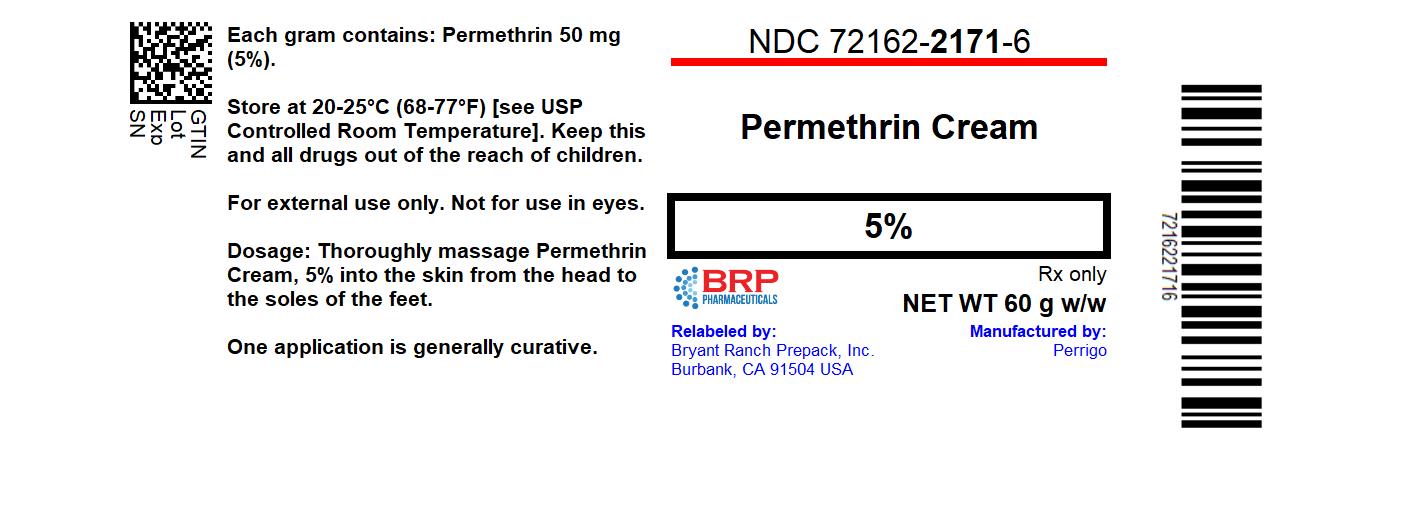
Permethrin 50 mg/g Cream — NDC 72162-2171-6 (Billing 72162-2171-06)
This is a package of Permethrin 50 mg/g Cream from Bryant Ranch Prepack, marketed since Aug 2006 and currently FDA-listed. It is this product's only package size.
NDC database record
One package, one record: these facts belong to NDC 72162-2171-6 alone.
- Record
- FDA NDC Directory package listing · Human prescription drug
- Code segments
- 72162 labeler · 2171 product · 6 package
- Package marketed since
- Dec 7, 2023
- Sample package
- No — commercial package
- Listing certified through
- Dec 31, 2026
- Barcode (UPC-A, from the NDC)
- 3 7216221716 0
- FDA record last changed
- Jul 24, 2026
Identity & classification
Regulatory identifiers FDA, NLM and CMS codes for this package
Drug-database identifiers Medi-Span GPI and First Databank GCN / HICL / AHFS classification
- GSN (GCN sequence number): 013631
- GCN: 44370
- HICL (First Databank): 021814
- AHFS class code: 84:04.12.00
- RxCUI (RxNorm): 106387
Where does this data come from?
- FDA openFDA NDC Directory · synced Oct 1, 2026
- FDA label on DailyMed · label index refreshed Oct 3, 2026
- RxNorm (NLM RxNav) · catalog refreshed Oct 1, 2026
- Medi-Span GPI (licensed)
- First Databank (licensed) · refreshed Oct 1, 2026
RxNorm drug class
This medicine belongs to the Pyrethroid class.
Where does this data come from?
- RxClass (NLM) · catalog refreshed Oct 1, 2026
Clinical
Permethrin is used to treat scabies ('mites that attach themselves to the skin) in adults and children 2 months of age and older. Over-the-counter permethrin is used to treat lice (small insects that attach themselves to the skin on the head) in adults and children 2 months of age and older. Permethrin is in a class of medications called scabicides and pediculicides. It works by killing lice and mites.
Read the full MedlinePlus article ↗- Elimite 5% Cream treats scabies, which is caused by a tiny mite. The lice creme rinse products are used when lice or nits are found in the hair. Make sure you use the right product...
- Wash your hair with a shampoo that has no conditioner, then rinse and towel dry until damp. Saturate the hair and scalp, keep it out of your eyes, and leave it on for 10 minutes on...
- If you see live lice seven days or more after the first treatment, you should do a second treatment. Check the head daily and keep combing out any nits you missed.
- Burning, stinging, itching and redness where it was applied are the most common. These are usually mild and short-lived. Call your doctor if irritation keeps going, an infection de...
Patient education
Supplement & herbal interactions
Where does this data come from?
- MedlinePlus (NLM) · refreshed Oct 1, 2026
- FDA label on DailyMed · label index refreshed Oct 3, 2026
Ask a licensed pharmacist directly — free, answered by our team.
Pricing
A drug doesn't have one price. Each row is a different public payment system, and none is what you'd pay at the counter — that depends on your insurance. The ⓘ on each row explains what it measures.
| Price system | Per g | Per package |
|---|---|---|
| Retail pharmacies payNADAC · weekly | Not in the retail survey — common for institutional, discontinued, or low-volume packs. | |
| Medicaid paysCMS SDUD · 12 mo | No recent Medicaid claims on file for this NDC — rare and low-volume NDCs are suppressed in the public data. | |
| Medicare drug plans payPart D · Q2 2026 | $0.4108 | $24.65 / 60 g |
Where does this data come from?
- CMS NADAC weekly file
- CMS ASP pricing files · refreshed Sep 20, 2026
- CMS Medicaid State Drug Utilization Data · refreshed Oct 4, 2026
- CMS Part D plan pricing files · refreshed Sep 24, 2026
- VA National Acquisition Center price file
Packaging — all sizes for this product
| Package NDC | Description | Marketing start | Marketing end | Status |
|---|---|---|---|---|
| 72162-2171-06 You're viewing this Main listing | 1 TUBE in 1 CARTON / 60 g in 1 TUBE | 2023-12-07 | — | Active |
Therapeutic equivalents
| Product | Labeler | Pack | NADAC/unit | TE | Status | Price vs. this |
|---|---|---|---|---|---|---|
| Permethrin 50 mg/g 00472-0242-60 | Actavis | 1 tube | $0.224 | AB | Discontinued | — |
| Permethrin 50 mg/g 16714-0897-01 | Northstar | 1 tube | $0.229 | AB | Availability likely | — |
| Permethrin 50 mg/g 21922-0021-07 | Encube | 1 tube | $0.229 | AB | Availability likely | — |
| Permethrin 50 mg/g 45802-0269-37 | Padagis | 1 tube | $0.229 | AB | Availability likely | — |
| Permethrin 50 mg/g 84386-0073-60 | Aurobindo | 1 tube | $0.229 | AB | Availability likely | — |
| Permethrin 50 mg/g 50090-5888-00 | A-S | 1 tube | — | AB | FDA listed | — |
| Elimite 50 mg/g 59651-0834-60 | Aurobindo | 1 tube | — | AB | FDA listed | — |
| Permethrin 50 mg/g 68788-8439-06 | Preferred | 1 tube | — | AB | FDA listed | — |
| Permethrin 50 mg/g 70518-2945-00 | REMEDYREPACK | 1 tube | — | AB | FDA listed | — |
| Permethrin 50 mg/g 71335-2899-01 | Bryant | 1 tube | — | AB | FDA listed | — |
| Permethrin 50 mg/gthis 72162-2171-06 | Bryant | 1 tube | — | AB | FDA listed | — |
Where does this data come from?
- FDA openFDA NDC Directory · synced Oct 1, 2026
- FDA Orange Book · refreshed Oct 3, 2026
- CMS NADAC weekly file
Availability & generic status
This product is an FDA-approved generic. Other versions of the same drug are listed under Therapeutic equivalents, least expensive first.
Where does this data come from?
- FDA Orange Book · refreshed Oct 3, 2026
Inactive Ingredients / Excipients
Inactive ingredients, also called excipients, are components of the drug product other than the active ingredient. They may include fillers, dyes, coatings, preservatives, flavors, or other formulation ingredients.
💡 Tap an ingredient (hover on desktop) to see what it is and why it’s used.
-
UNII 1P9D0Z171K
BHT is a synthetic antioxidant that prevents fats and oils in medicines from breaking down and becoming rancid. It helps keep the product stable and effective during storage.
-
UNII HHT01ZNK31
Carbomer Homopolymer Type B is a synthetic polymer made from acrylic acid. It absorbs water and forms a gel, so it's used in medicines as a thickener, suspending agent, and to help create a smooth texture in creams, gels, and lotions.
-
UNII I835H2IHHX
A waxy substance derived from plant oils, used as an emulsifier and solubilizer to help mix oil and water ingredients together and keep them blended throughout the product's shelf life.
-
UNII 1HG84L3525
Formaldehyde is a preservative chemical that prevents bacterial and fungal growth in medicines. It keeps the product safe and stable during storage by stopping contamination.
-
UNII PDC6A3C0OX
Glycerin is a clear, thick liquid derived from plant oils or fats. It acts as a humectant to retain moisture, a sweetener, and a solvent in medications.
-
UNII 230OU9XXE4
A waxy substance made from glycerin and stearic acid that acts as an emulsifier to blend oily and watery ingredients together. It also helps thicken and stabilize the medicine's texture.
-
UNII 0RE8K4LNJS
Isopropyl myristate is an oily liquid made from coconut or palm oil. It's used in medicines as an emollient and penetration enhancer to help the medicine absorb through skin or improve spreadability in topical products.
-
UNII 884C3FA9HE
Lanolin alcohol is a waxy substance derived from sheep's wool. It functions as an emollient and emulsifier in medicines, helping blend oil and water-based ingredients while softening the product's texture.
-
UNII C9H2L21V7U
A fat derived from coconut or palm oil containing shorter fatty acid chains. It serves as a solvent and carrier to help dissolve or suspend active ingredients, improving absorption and stability in liquid formulations.
-
UNII T5L8T28FGP
Mineral oil is a clear, odorless liquid derived from crude oil. It acts as a lubricant and emollient in medications, helping pills slide smoothly during manufacturing and aiding moisture retention in topical products.
-
UNII 55X04QC32I
A strong alkaline chemical used to adjust and maintain the pH balance of liquid medicines. It helps keep the medicine stable and ensures it stays effective during storage.
-
UNII 059QF0KO0R
Water is a liquid solvent that dissolves and mixes ingredients together in liquid medicines, syrups, and injections. It helps distribute the active drug evenly throughout the product.
12 inactive ingredients listed in the exact product block matched to this NDC.
Where does this data come from?
ingredient classCode="IACT" elements from the exact product block matched by this NDC. Label-section narrative from DailyMed / the openFDA label index is shown separately when available.- FDA label on DailyMed · label index refreshed Oct 3, 2026
- FDA openFDA NDC Directory · synced Oct 1, 2026
Inactive ingredient FAQ
Are inactive ingredients the same for every manufacturer?
Why might an inactive ingredient be missing?
Can inactive ingredients matter?
Manufacturer & labeler
More NDCs from Bryant Ranch Prepack labeler code 72162
- Proctosol-HC Hydrocortisone 25 mg/g Cream NDC 72162-2165-2
- Dorzolamide Hydrochloride and Timolol Maleate 20 mg/mL; 5 mg/mL Solution/ Drops NDC 72162-2166-2
- Hydroxyzine Hydrochloride 50 mg Tablet, Film Coated NDC 72162-2167-0
- Ursodiol 300 mg Capsule NDC 72162-2168-1
- Ramelteon 8 mg Tablet NDC 72162-2169-3
- Fenofibrate 160 mg Tablet, Film Coated NDC 72162-2170-9
- Polyethylene Glycol 3350 3350 17 g/17g Powder, For Solution NDC 72162-2172-2
- cetirizine hydrochloride 10 mg Tablet, Film Coated NDC 72162-2173-2
- Methotrexate 2.5 mg Tablet NDC 72162-2174-1
- Celecoxib 200 mg Capsule NDC 72162-2175-3
- Ramelteon 8 mg Tablet, Film Coated NDC 72162-2176-1
- Bisoprolol 5 mg Tablet, Film Coated NDC 72162-2177-1
Where does this data come from?
- FDA openFDA NDC Directory · synced Oct 1, 2026
- Drugs@FDA
Full prescribing information FDA SPL
🎯 Indications and Usage ▾
INDICATIONS AND USAGE Permethrin Cream, 5% is indicated for the treatment of infestation with Sarcoptes scabiei (scabies).
⏱️ Dosage and Administration ▾
DOSAGE AND ADMINISTRATION Adults and children – Thoroughly massage Permethrin Cream, 5% into the skin from the head to the soles of the feet. Scabies rarely infests the scalp of adults, although the hairline, neck, temple, and forehead may be infested in infants and geriatric patients. Usually 30 grams is sufficient for an average adult.
The cream should be removed by washing (shower or bath) after 8 to 14 hours. Infants should be treated on the scalp, temple, and forehead. ONE APPLICATION IS GENERALLY CURATIVE .
⛔ Contraindications ▾
CONTRAINDICATIONS Permethrin Cream, 5% is contraindicated in patients with known hypersensitivity to any of its components, to any synthetic pyrethroid or pyrethrin.
⚠️ Warnings ▾
WARNINGS If hypersensitivity to Permethrin Cream, 5% occurs, discontinue use.
🤒 Adverse Reactions ▾
ADVERSE REACTIONS In clinical trials, generally mild and transient burning and stinging followed application with permethrin cream, 5% in 10% of patients and was associated with the severity of infestation. Pruritus was reported in 7% of patients at various times post-application. Erythema, numbness, tingling, and rash were reported in 1 to 2% or less of patients (see PRECAUTIONS-General).
Other adverse events reported since marketing permethrin cream, 5% include: headache, fever, dizziness, abdominal pain, diarrhea and nausea and/or vomiting. Although extremely uncommon and not expected when used as directed (see DOSAGE AND ADMINISTRATION), rare occurrences of seizure have been reported. None have been medically confirmed as associated with Permethrin Cream, 5% treatment.
🤰 Pregnancy ▾
Pregnancy: Teratogenic Effects: Pregnancy Category B - Reproduction studies have been performed in mice, rats, and rabbits (200 to 400 mg/kg/day orally) and have revealed no evidence of impaired fertility or harm to the fetus due to permethrin. There are, however, no adequate and well-controlled studies in pregnant women. Because animal reproduction studies are not always predictive of human response, this drug should be used during pregnancy only if clearly needed.
🧒 Pediatric Use ▾
Pediatric Use - Permethrin Cream, 5% is safe and effective in pediatric patients two months of age and older. Safety and effectiveness in infants less than two months of age have not been established.
🧓 Geriatric Use ▾
Geriatric Use - Clinical studies of permethrin cream, 5% did not identify sufficient numbers of subjects aged 65 and over to allow a definitive statement regarding whether elderly subjects respond differently from younger subjects. Other reported clinical experience has not identified differences in responses between the elderly and younger patients. This drug is known to be substantially excreted by the kidney.
However, since topical permethrin is metabolized in the liver and excreted in the urine as inactive metabolites, there does not appear to be an increased risk of toxic reactions in patients with impaired renal function when used as labeled.
🆘 Overdosage ▾
OVERDOSAGE No instance of accidental ingestion of Permethrin Cream, 5% has been reported. If ingested, gastric lavage and general supportive measures should be employed. Excessive topical use (see DOSAGE AND ADMINISTRATION ) may result in increased irritation and erythema.
🧬 Clinical Pharmacology ▾
CLINICAL PHARMACOLOGY Permethrin, a pyrethroid, is active against a broad range of pests including lice, ticks, fleas, mites, and other arthropods. It acts on the nerve cell membrane to disrupt the sodium channel current by which the polarization of the membrane is regulated. Delayed repolarization and paralysis of the pests are the consequences of this disturbance.
Permethrin is rapidly metabolized by ester hydrolysis to inactive metabolites which are excreted primarily in the urine. Although the amount of permethrin absorbed after a single application of the 5% cream has not been determined precisely, data from studies with 14 C-labeled permethrin and absorption studies of the cream applied to patients with moderate to severe scabies indicate it is 2% or less of the amount applied.
📦 How Supplied / Storage and Handling ▾
HOW SUPPLIED Permethrin Cream, 5% (w/w) is available as follows: NDC: 72162-2171-6: 60 g in a TUBE Repackaged/Relabeled by: Bryant Ranch Prepack, Inc. Burbank, CA 91504
📦 Storage and Handling ▾
STORAGE Store at 20-25°C (68-77°F) [see USP Controlled Room Temperature]. Manufactured by Perrigo Bronx, NY 10457 Distributed By Perrigo® Allegan, MI 49010 • www.perrigo.com Rev 08-15 : 1T600 RC JX1
📋 Description ▾
DESCRIPTION Permethrin Cream, 5% is a topical scabicidal agent for the treatment of infestation with Sarcoptes scabiei (scabies). It is available in an off-white, vanishing cream base. Permethrin Cream, 5% is for topical use only.
Chemical Name – The permethrin used is an approximate 1:3 mixture of the cis and trans isomers of the pyrethroid 3-(2,2-dichloroethenyl)-2,2-dimethylcyclopropanecarboxylic acid, (3-phenoxyphenyl) methyl ester. Permethrin has a molecular formula of C 21 H 20 Cl 2 O 3 and a molecular weight of 391.29. It is a yellow to light orange-brown, low melting solid or viscous liquid.
Active Ingredient – Each gram contains permethrin 50 mg (5%). Inactive Ingredients – Butylated hydroxytoluene, carbomer homopolymer type B, fractionated coconut oil, glycerin, glyceryl monostearate, isopropyl myristate, lanolin alcohols, mineral oil, polyoxyethylene cetyl ethers, purified water, and sodium hydroxide. Formaldehyde 1 mg (0.1%) is added as a preservative.
💬 Information for Patients ▾
Information for Patients - Patients with scabies should be advised that itching, mild burning and/or stinging may occur after application of Permethrin Cream, 5%. In clinical trials, approximately 75% of patients treated with permethrin cream, 5% who continued to manifest pruritus at 2 weeks had cessation by 4 weeks. If irritation persists, they should consult their physician.
Permethrin Cream, 5% may be very mildly irritating to the eyes. Patients should be advised to avoid contact with eyes during application and to flush with water immediately if Permethrin Cream, 5% gets in the eyes.
⚠️ Precautions ▾
PRECAUTIONS General - Scabies infestation is often accompanied by pruritus, edema, and erythema. Treatment with Permethrin Cream, 5% may temporarily exacerbate these conditions. Information for Patients - Patients with scabies should be advised that itching, mild burning and/or stinging may occur after application of Permethrin Cream, 5%.
In clinical trials, approximately 75% of patients treated with permethrin cream, 5% who continued to manifest pruritus at 2 weeks had cessation by 4 weeks. If irritation persists, they should consult their physician. Permethrin Cream, 5% may be very mildly irritating to the eyes.
Patients should be advised to avoid contact with eyes during application and to flush with water immediately if Permethrin Cream, 5% gets in the eyes. Carcinogenesis, Mutagenesis, Impairment of Fertility - Six carcinogenicity bioassays were evaluated with permethrin, three each in rats and mice. No tumorigenicity was seen in the rat studies.
However, species-specific increases in pulmonary adenomas, a common benign tumor of mice of high spontaneous background incidence, were seen in the three mouse studies. In one of these studies there was an increased incidence of pulmonary alveolar-cell carcinomas and benign liver adenomas only in female mice when permethrin was given in their food at a concentration of 5000 ppm. Mutagenicity assays, which give useful correlative data for interpreting results from carcinogenicity bioassays in rodents, were negative.
Permethrin showed no evidence of mutagenic potential in a battery of in vitro and in vivo genetic toxicity studies. Permethrin did not have any adverse effect on reproductive function at a dose of 180 mg/kg/day orally in a three-generation rat study. Pregnancy: Teratogenic Effects: Pregnancy Category B - Reproduction studies have been performed in mice, rats, and rabbits (200 to 400 mg/kg/day orally) and have revealed no evidence of impaired fertility or harm to the fetus due to permethrin.
There are, however, no adequate and well-controlled studies in pregnant women. Because animal reproduction studies are not always predictive of human response, this drug should be used during pregnancy only if clearly needed. Nursing Mothers - It is not known whether this drug is excreted in human milk.
Because many drugs are excreted in human milk and because of the evidence for tumorigenic potential of permethrin in animal studies, consideration should be given to discontinuing nursing temporarily or withholding the drug while the mother is nursing. Pediatric Use - Permethrin Cream, 5% is safe and effective in pediatric patients two months of age and older. Safety and effectiveness in infants less than two months of age have not been established.
Geriatric Use - Clinical studies of permethrin cream, 5% did not identify sufficient numbers of subjects aged 65 and over to allow a definitive statement regarding whether elderly subjects respond differently from younger subjects. Other reported clinical experience has not identified differences in responses between the elderly and younger patients. This drug is known to be substantially excreted by the kidney.
However, since topical permethrin is metabolized in the liver and excreted in the urine as inactive metabolites, there does not appear to be an increased risk of toxic reactions in patients with impaired renal function when used as labeled.
🍼 Nursing Mothers ▾
Nursing Mothers - It is not known whether this drug is excreted in human milk. Because many drugs are excreted in human milk and because of the evidence for tumorigenic potential of permethrin in animal studies, consideration should be given to discontinuing nursing temporarily or withholding the drug while the mother is nursing.
📄 Carcinogenesis, Mutagenesis, Impairment of Fertility ▾
Carcinogenesis, Mutagenesis, Impairment of Fertility - Six carcinogenicity bioassays were evaluated with permethrin, three each in rats and mice. No tumorigenicity was seen in the rat studies. However, species-specific increases in pulmonary adenomas, a common benign tumor of mice of high spontaneous background incidence, were seen in the three mouse studies.
In one of these studies there was an increased incidence of pulmonary alveolar-cell carcinomas and benign liver adenomas only in female mice when permethrin was given in their food at a concentration of 5000 ppm. Mutagenicity assays, which give useful correlative data for interpreting results from carcinogenicity bioassays in rodents, were negative. Permethrin showed no evidence of mutagenic potential in a battery of in vitro and in vivo genetic toxicity studies.
Permethrin did not have any adverse effect on reproductive function at a dose of 180 mg/kg/day orally in a three-generation rat study.
📄 Package Label / Principal Display Panel ▾
Permethrin 5% Cream #60 Label
Medicare Part D spend CMS · PART D · 2026 (Q1)
About this NDC listing & data coverage
What data is (and isn’t) available for this NDC — tap to expand
| NDC identity (package / product / labeler codes) | ✓ Available |
| Labeler | ✓ Available |
| Product & package description | ✓ Available |
| Marketing category & status | ✓ Available |
| Active ingredient / dosage form / route | ✓ Available |
| FDA label (SPL via DailyMed) | ✓ Available |
| Package photos | ✓ Available |
| Inactive ingredients (structured) | ✓ Available |
| NADAC pharmacy acquisition price (CMS) | — Not published for this NDC CMS publishes NADAC only for NDCs reported in its retail-pharmacy survey. |
| Orange Book / therapeutic-equivalence data | ✓ Available |
| HCPCS J-code billing crosswalk | — Not published for this NDC Most self-administered / retail products have no J-code — that is normal. |
| Medicaid utilization (CMS SDUD) | — Not published for this NDC CMS reports utilization only for NDCs with Medicaid claims above its privacy threshold. |