
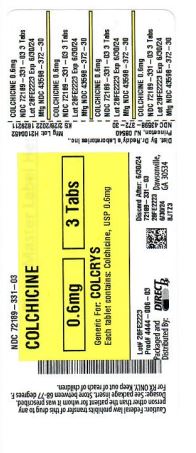
COLCHICINE .6 mg Tablet, 3-count
🆔 Identity & classification
Where does this data come from?
🏷️ RxNorm drug class
This medicine belongs to the Alkaloid class.
Where does this data come from?
🏭 Manufacturer & labeler
Where does this data come from?
🩺 Clinical
- It depends on the product. Most colchicine products — tablets, capsules, and the liquid Gloperba — are used to prevent gout flares in adults. Colcrys tablets and generic colchicine...
- Diarrhea is the most common side effect and it's a real nuisance for many people. Colchicine affects the lining of the gut, and nausea, cramping, and loose stools often come with i...
- Why does colchicine cause so much diarrhea?
- This is one of the most important questions you can ask. Colchicine has some serious drug interactions that have caused deaths — not just discomfort. Certain antibiotics (like clar...
Patient education
Supplement & herbal interactions
Some supplements/herbs that may interact with Colchicine — tap one for details:
Colchicine may be associated with lower levels of 2 nutrients — worth a chat with your pharmacist, not a cause for alarm.
Where does this data come from?
Ask a licensed pharmacist directly — free, answered by our team.
🧪 Inactive Ingredients / Excipients
Inactive ingredients, also called excipients, are components of the drug product other than the active ingredient. They may include fillers, dyes, coatings, preservatives, flavors, or other formulation ingredients.
💡 Tap an ingredient (hover on desktop) to see what it is and why it’s used.
-
UNII OP1R32D61U
Microcrystalline cellulose is a purified form of cellulose, a natural fiber from plant sources. It acts as a binder and filler in tablets and capsules, helping hold ingredients together and give the medicine its shape and size.
-
UNII L06K8R7DQK
A synthetic blue dye approved by the FDA for use in medications and foods. It serves as a colorant to make pills and liquids visually distinct and easier to identify.
-
UNII WZB9127XOA
A synthetic red dye used to color medications and make them easier to identify. It serves as a colorant in tablets, capsules, and liquid formulations.
-
UNII B1QE5P712K
Hypromellose 2208 is a plant-derived thickening agent that dissolves in water. It's used as a binder to help hold tablet ingredients together and as a coating on pills to control how quickly the medicine releases in your body.
-
UNII EWQ57Q8I5X
Lactose monohydrate is a natural sugar derived from milk. It serves as a filler and binder in tablets and capsules, helping create the proper size, texture, and consistency of the medicine.
-
UNII 70097M6I30
Magnesium stearate is a salt made from magnesium and stearic acid, a fatty substance. It's used in tablets and capsules as a lubricant and glidant to help ingredients flow smoothly during manufacturing and prevent sticking.
-
UNII VH2XOU12IE
Polydextrose is a synthetic polymer made from dextrose (sugar) that acts as a bulking agent and filler in medicines. It helps give tablets and capsules proper volume and texture while often adding slight sweetness.
-
UNII 3WJQ0SDW1A
Polyethylene glycol is a synthetic liquid or solid polymer used in medicines as a solvent, lubricant, and humectant. It helps dissolve active ingredients, reduces friction during manufacturing, and retains moisture in the final product.
-
UNII AG9B65PV6B
A starch derivative made from corn that helps tablets and capsules break apart quickly when swallowed. It acts as a disintegrant, allowing the medicine to dissolve and be absorbed in your stomach and intestines.
-
UNII O8232NY3SJ
A plant-based carbohydrate derived from corn kernels. It acts as a filler to add bulk, a binder to hold ingredients together, and a disintegrant to help the tablet break apart in your stomach for absorption.
-
UNII 15FIX9V2JP
Titanium dioxide is a bright white mineral powder commonly used as a colorant and opacifying agent. It makes pills and tablets white or lighter in color and helps make coatings non-transparent.
-
UNII XHX3C3X673
Triacetin is a clear, oily liquid made from glycerin and acetic acid. It works as a plasticizer and solvent in medicines, helping soften coatings and improve how liquids mix together in formulations.
12 inactive ingredients listed in the exact product block matched to this NDC.
Where does this data come from?
ingredient classCode="IACT" elements from the exact product block matched by this NDC. Label-section narrative from DailyMed / the openFDA label index is shown separately when available.Inactive ingredient FAQ
Are inactive ingredients the same for every manufacturer?
Why might an inactive ingredient be missing?
Can inactive ingredients matter?
💲 Pricing
A drug doesn't have one price. Each row is a different public payment system, and none is what you'd pay at the counter — that depends on your insurance. The ⓘ on each row explains what it measures.
| Price system | Per each | Per package |
|---|---|---|
| Retail pharmacies payNADAC · weekly | Not in the retail survey — common for institutional, discontinued, or low-volume packs. | |
| Medicaid paysCMS SDUD · 12 mo | No recent Medicaid claims on file for this NDC — rare and low-volume NDCs are suppressed in the public data. | |
| Medicare drug plans payPart D · Q2 2026 | $0.3755 | $1.13 / 3 tablets |
Where does this data come from?
🔁 Therapeutic equivalents
| Product | Labeler | Pack | NADAC/unit | TE | Status | Price vs. this |
|---|---|---|---|---|---|---|
| Colchicine .6 mg 00904-7120-04 | Major | 1 tablet | $0.118 | AB | Availability likely | — |
| Colchicine .6 mg 16714-0039-01 | Northstar | 30 tablets | $0.118 | — | Availability likely | — |
| Colchicine .6 mg 23155-0855-01 | Heritage | 100 tablets | $0.118 | AB | Discontinued | — |
| Colchicine .6 mg 31722-0899-01 | Camber | 100 tablets | $0.118 | AB | Availability likely | — |
| colchicine .6 mg 43598-0372-01 | Dr.Reddys | 100 tablets | $0.118 | AB | Availability likely | — |
| Colchicine .6 mg 49884-0171-01 | Par | 100 tablets | $0.118 | AB | Availability likely | — |
| Colchicine .6 mg 50268-0187-15 | AvPAK | 50 tablets | $0.118 | AB | Availability likely | — |
| Colchicine .6 mg 59651-0455-01 | Aurobindo | 100 tablets | $0.118 | AB | Availability likely | — |
| Colchicine .6 mg 60687-0727-21 | American | 1 tablet | $0.118 | AB | Availability likely | — |
| Colchicine .6 mg 62135-0789-30 | Chartwell | 30 tablets | $0.118 | AB | Availability likely | — |
| Colchicine .6 mg 65162-0710-03 | Amneal | 30 tablets | $0.118 | AB | Availability likely | — |
| colchicine .6 mg 67877-0589-01 | Ascend | 100 tablets | $0.118 | AB | Availability likely | — |
| Colchicine .6 mg 70010-0002-01 | Granules | 100 tablets | $0.118 | AB | Availability likely | — |
| Colchicine .6 mg 70710-1351-01 | Zydus | 100 tablets | $0.118 | — | Availability likely | — |
| Colchicine .6 mg 64380-0796-04 | Strides | 30 tablets | $0.134 | AB | Discontinued | — |
| Colchicine .6 mg 00378-1086-01 | Mylan | 100 tablets | $0.287 | AB | FDA listed | — |
| Colchicine .6 mg 33342-0341-07 | Macleods | 30 tablets | — | AB | FDA listed | — |
| Colchicine .6 mg 50090-7205-07 | A-S | 4 tablets | — | — | FDA listed | — |
| Colchicine .6 mg 51407-0082-01 | Golden | 100 tablets | — | AB | FDA listed | — |
| colchicine .6 mg 60760-0839-10 | ST. | 10 tablets | — | AB | FDA listed | — |
| Colcrys .6 mg 63187-0292-03 | Proficient | 3 tablets | — | — | FDA listed | — |
| Colchicine .6 mg 63629-2166-01 | Bryant | 100 tablets | — | — | FDA listed | — |
| Colchicine .6 mg 63629-2167-01 | Bryant | 30 tablets | — | — | FDA listed | — |
| colchicine .6 mg 63629-8362-01 | Bryant | 30 tablets | — | AB | FDA listed | — |
| colchicine .6 mg 63629-8766-01 | Bryant | 100 tablets | — | AB | FDA listed | — |
| colchicine .6 mg 68071-2567-09 | NuCare | 90 tablets | — | AB | FDA listed | — |
| Colchicine .6 mg 70518-3851-00 | REMEDYREPACK | 9 tablets | — | AB | Discontinued | — |
| colchicine .6 mg 70518-4000-01 | REMEDYREPACK | 9 tablets | — | AB | FDA listed | — |
| colchicine .6 mg 71205-0687-10 | Proficient | 10 tablets | — | AB | FDA listed | — |
| colchicine .6 mg 71335-1738-01 | Bryant | 30 tablets | — | AB | FDA listed | — |
| Colchicine .6 mg 71335-1802-01 | Bryant | 30 tablets | — | — | FDA listed | — |
| Colchicine .6 mg 71335-2791-01 | Bryant | 30 tablets | — | AB | FDA listed | — |
| Colchicine .6 mg 71610-0494-03 | Aphena | 9 tablets | — | AB | FDA listed | — |
| colchicine .6 mg 72162-1855-01 | Bryant | 100 tablets | — | AB | FDA listed | — |
| Colchicine .6 mg 72189-0249-03 | direct | 3 tablets | — | — | FDA listed | — |
| Colchicine .6 mgthis 72189-0331-03 | Direct | 3 tablets | — | AB | FDA listed | — |
| Colchicine .6 mg 72789-0572-30 | PD-Rx | 30 tablets | — | AB | FDA listed | — |
| colchicine .6 mg 50090-8014-07 | A-S | 4 tablets | — | AB | FDA listed | — |
| Colchicine .6 mg 72189-0687-03 | Direct_Rx | 3 tablets | — | AB | FDA listed | — |
Where does this data come from?
⏳ Availability & generic status
This product is an FDA-approved generic. Other versions of the same drug are listed under Therapeutic equivalents, least expensive first.
Where does this data come from?
📊 Medicare Part D spend CMS · PART D · 2026 (Q1)
📦 Packaging — all sizes for this product
| Package NDC | Description | Marketing start | Status |
|---|---|---|---|
| 72189-0331-03 You're viewing this | 3 TABLET in 1 BOTTLE (72189-331-03) | 2022-03-01 | Active |
🧭 About this NDC listing & data coverage
What data is (and isn’t) available for this NDC — tap to expand
| NDC identity (package / product / labeler codes) | ✓ Available |
| Labeler | ✓ Available |
| Product & package description | ✓ Available |
| Marketing category & status | ✓ Available |
| Active ingredient / dosage form / route | ✓ Available |
| FDA label (SPL via DailyMed) | ✓ Available |
| Package photos | ✓ Available |
| Inactive ingredients (structured) | ✓ Available |
| NADAC pharmacy acquisition price (CMS) | — Not published for this NDC CMS publishes NADAC only for NDCs reported in its retail-pharmacy survey. |
| Orange Book / therapeutic-equivalence data | ✓ Available |
| HCPCS J-code billing crosswalk | — Not published for this NDC Most self-administered / retail products have no J-code — that is normal. |
| Medicaid utilization (CMS SDUD) | — Not published for this NDC CMS reports utilization only for NDCs with Medicaid claims above its privacy threshold. |
Questions about this listing
Why is there no price listed?
Is the NDC printed on the package the same as the 11-digit billing NDC?
What do the three segments of this NDC mean?
Is this package still being marketed?
Who lists this product with the FDA?
Do I need a prescription for this product?
Where does this data come from?
📄 Full prescribing information FDA SPL
🎯 Indications and Usage ▾
1.1Gout Flares Colchicine tablets are indicated for prophylaxis and the treatment of acute gout flares. • Prophylaxis of Gout Flares: Colchicine tablets are indicated for prophylaxis of gout flares. • Treatment of Gout Flares: Colchicine tablets are indicated for treatment of acute gout flares when taken at the first sign of a flare.
1.2Familial Mediterranean Fever (FMF) Colchicine tablets are indicated in adults and children four years or older for treatment of familial Mediterranean fever (FMF).
⏱️ Dosage and Administration ▾
The long-term use of colchicine is established for FMF and the prophylaxis of gout flares, but the safety and efficacy of repeat treatment for gout flares has not been evaluated. The dosing regimens for colchicine tablets are different for each indication and must be individualized. The recommended dosage of colchicine tablets depends on the patient’s age, renal function, hepatic function and use of coadministered drugs [see DOSAGE AND ADMINISTRATION (2.4, 2.5, 2.6)].
Colchicine tablets are administered orally without regard to meals. Colchicine tablets are not an analgesic medication and should not be used to treat pain from other causes.
2.1Gout Flares Prophylaxis of Gout Flares The recommended dosage of colchicine tablets for prophylaxis of gout flares for adults and adolescents older than 16 years of age is 0.6 mg once or twice daily. The maximum recommended dose for prophylaxis of gout flares is 1.2 mg/day. An increase in gout flares may occur after initiation of uric acid-lowering therapy, including pegloticase, febuxostat and allopurinol, due to changing serum uric acid levels resulting in mobilization of urate from tissue deposits.
Colchicine tablets are recommended upon initiation of gout flare prophylaxis with uric acid-lowering therapy. Prophylactic therapy may be beneficial for at least the first six months of uric acid-lowering therapy. Treatment of Gout Flares The recommended dose of colchicine tablets for treatment of a gout flare is 1.2 mg (two tablets) at the first sign of the flare followed by 0.6 mg (one tablet) one hour later.
Higher doses have not been found to be more effective. The maximum recommended dose for treatment of gout flares is 1.8 mg over a 1-hour period. Colchicine tablets may be administered for treatment of a gout flare during prophylaxis at doses not to exceed 1.2 mg (two tablets) at the first sign of the flare followed by 0.6 mg (one tablet) one hour later.
Wait 12 hours and then resume the prophylactic dose.
2.2FMF The recommended dosage of colchicine tablets for FMF in adults is 1.2 mg to 2.4 mg daily. Colchicine tablets should be increased as needed to control disease and as tolerated in increments of 0.3 mg/day to a maximum recommended daily dose. If intolerable side effects develop, the dose should be decreased in increments of 0.3 mg/day. The total daily colchicine tablets dose may be administered in one to two divided doses.
2.3Recommended Pediatric Dosage Prophylaxis and Treatment of Gout Flares Colchicine tablets are not recommended for pediatric use in prophylaxis or treatment of gout flares. FMF The recommended dosage of colchicine tablets for FMF in pediatric patients 4 years of age and older is based on age. The following daily doses may be given as a single or divided dose twice daily: • Children 4 to 6 years: 0.3 mg to 1.8 mg daily • Children 6 to 12 years: 0.9 mg to 1.8 mg daily • Adolescents older than 12 years: 1.2 mg to 2.4 mg daily
2.4Dose Modification for Coadministration of Interacting Drugs Concomitant Therapy Coadministration of colchicine tablets with drugs known to inhibit CYP3A4 and/or P-glycoprotein (P-gp) increases the risk of colchicine-induced toxic effects (Table 1). If patients are taking or have recently completed treatment with drugs listed in Table 1 within the prior 14 days, the dose adjustments are as shown in the table below [see DRUG INTERACTIONS (7)]. Table 1.
Colchicine Tablets Dose Adjustment for Coadministration with Interacting Drugs if No Alternative Available* * For magnitude of effect on colchicine plasma concentrations [see CLINICAL PHARMACOLOGY (12.3)] † Patients with renal or hepatic impairment should not be given colchicine tablets in conjunction with strong CYP3A4 or P-gp inhibitors [see CONTRAINDICATIONS (4)] ‡ When used in combination with Ritonavir, see dosing recommendations for strong CYP3A4 inhibitors [see CONTRAINDICATIONS (4)] Strong CYP3A4 Inhibitors† Gout Flares Noted or Anticipated Outcome Prophylaxis of Gout Flares Treat…
💊 Dosage Forms and Strengths ▾
Colchicine Tablets USP, 0.6 mg — purple color, film-coated, capsule shaped tablets debossed with ‘ [logo] 372’ on one side and score line on the other side of the tablet.
⛔ Contraindications ▾
Patients with renal or hepatic impairment should not be given colchicine tablets in conjunction with P-gp or strong CYP3A4 inhibitors (this includes all protease inhibitors except fosamprenavir). In these patients, life-threatening and fatal colchicine toxicity has been reported with colchicine taken in therapeutic doses.
📦 How Supplied / Storage and Handling ▾
16.1How Supplied Colchicine Tablets USP, 0.6 mg are purple colored, film-coated, capsule shaped tablets debossed with ‘Stylized Y 372’ on one side and score line on the other side of the tablet. Bottles of 30 NDC 43598-372-30 Bottles of 100 NDC 43598-372-01 Bottles of 1,000 NDC 43598-372-10
16.2Storage Store at 20° to 25°C (68° to 77°F) [See USP Controlled Room Temperature]. Protect from light. DISPENSE IN TIGHT, LIGHT-RESISTANT CONTAINER.
💬 Medication Guide ▾
Colchicine Tablets, USP (KOL-chi-seen) for oral use Read the Medication Guide that comes with colchicine tablets before you start taking it and each time you get a refill. There may be new information. This Medication Guide does not take the place of talking to your healthcare provider about your medical condition or treatment.
You and your healthcare provider should talk about colchicine tablets when you start taking it and at regular checkups. What is the most important information that I should know about colchicine tablets? Colchicine tablets can cause serious side effects or death if levels of colchicine are too high in your body. • Taking certain medicines with colchicine tablets can cause your level of colchicine to be too high, especially if you have kidney or liver problems. • Tell your healthcare provider about all your medical conditions, including if you have kidney or liver problems.
Your dose of colchicine tablets may need to be changed. • Tell your healthcare provider about all the medicines you take, including prescription and nonprescription medicines, vitamins and herbal supplements. • Even medicines that you take for a short period of time, such as antibiotics, can interact with colchicine tablets and cause serious side effects or death. • Talk to your healthcare provider or pharmacist before taking any new medicine. • Especially tell your healthcare provider if you take: • atazanavir sulfate (Reyataz) • cyclosporine (Neoral, Gengraf, Sandimmune) • fosamprenavir (Lexiva) with ritonavir • indinavir (Crixivan) • ketoconazole (Nizoral) • nefazodone (Serzone) • ritonavir (Norvir) • telithromycin (Ketek) • clarithromycin (Biaxin) • darunavir (Prezista) • fosamprenavir (Lexiva) • itraconazole (Sporanox) • lopinavir/ritonavir (Kaletra) • nelfinavir mesylate (Viracept) • saquinavir mesylate (Invirase) • tipranavir (Aptivus) Ask your healthcare provider or pharmacist if you are not sure if you take any of the medicines listed above.
This is not a complete list of all the medicines that can interact with colchicine tablets. • Know the medicines you take. Keep a list of them and show it to your healthcare provider and pharmacist when you get a new medicine. • Keep colchicine tablets out of the reach of children. What are colchicine tablets?
Colchicine tablets are a prescription medicine used to: • prevent and treat gout flares in adults • treat familial Mediterranean fever (FMF) in adults and children age 4 or older Colchicine tablets are not a pain medicine, and it should not be taken to treat pain related to other conditions unless specifically prescribed for those conditions. Who should not take colchicine tablets? Do not take colchicine tablets if you have liver or kidney problems and you take certain other medicines.
Serious side effects, including death, have been reported in these patients even when taken as directed. See “What is the most important information that I should know about colchicine tablets?” What should I tell my healthcare provider before starting colchicine tablets? See “What is the most important information that I should know about colchicine tablets?” Before you take colchicine tablets, tell your healthcare provider about all your medical conditions, including if you: • have liver or kidney problems. • are pregnant or plan to become pregnant.
It is not known if colchicine tablets will harm your unborn baby. Talk to your healthcare provider if you are pregnant or plan to become pregnant. • are a male with a female partner who can become pregnant. Receiving treatment with colchicine tablets may be related to infertility in some men that is reversible when treatment is stopped. • are breastfeeding or plan to breastfeed.
Colchicine passes into your breast milk. You and your healthcare provider should decide if you will take colchicine tablets while breastfeeding. If you take colchicine tablets and breastfeed, you should talk to your child’s healthcare provider about how to watch for side effects…