
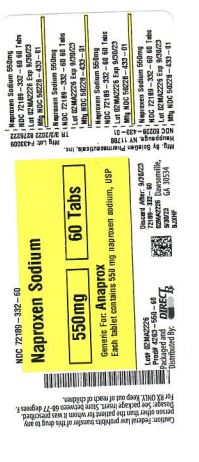
Naproxen Sodium 550 mg Tablet, 60-count — NDC 72189-332-60 (Billing 72189-0332-60)
This is a package of 60 tablets of Naproxen Sodium 550 mg Tablet from Direct Rx, marketed since Mar 2022 and currently FDA-listed. It is this product's only package size.
Other active recalls for Naproxen Sodium (different manufacturers) — 2 · tap to view
Identity & classification
Regulatory identifiers FDA, NLM and CMS codes for this package
Drug-database identifiers Medi-Span GPI and First Databank GCN / HICL / AHFS classification
- GSN (GCN sequence number): 008358
- GCN: 47131
- GPI-14 (Medi-Span): 66100060100310
- HICL (First Databank): 003726
- AHFS class code: 28:08.04.04
- RxCUI (RxNorm): 849431
Where does this data come from?
- FDA openFDA NDC Directory · synced Oct 1, 2026
- FDA label on DailyMed · label index refreshed Oct 1, 2026
- RxNorm (NLM RxNav) · catalog refreshed Oct 1, 2026
- Medi-Span GPI (licensed)
- First Databank (licensed) · refreshed Oct 1, 2026
RxNorm drug class
This medicine belongs to the Nonsteroidal Anti-inflammatory Drug class.
Where does this data come from?
- RxClass (NLM) · catalog refreshed Oct 1, 2026
Clinical
Prescription naproxen is used to relieve pain, tenderness, swelling, and stiffness caused by osteoarthritis (arthritis caused by a breakdown of the lining of the joints), rheumatoid arthritis (arthritis caused by swelling of the lining of the joints), juvenile arthritis (a form of joint disease in children), and ankylosing spondylitis (arthritis that mainly affects the spine). Prescription naproxen tablets, extended-release tablets, and suspension are also used to relieve shoulder pain caused by bursitis (inflammation of a fluid-filled sac in the shoulder joint), tendinitis (inflammation of th...
Read the full MedlinePlus article ↗- It relieves pain, inflammation and fever. Prescription versions treat arthritis, tendonitis, bursitis, acute gout and painful periods. Over-the-counter versions handle minor aches...
- Take it by mouth with a full glass of water. Over-the-counter products are taken every 8 to 12 hours while symptoms last, and you should use the smallest dose that works. For presc...
- Headache, indigestion, heartburn, nausea and swelling are common. Call your doctor if you have black stools, vomit blood, a rash, yellow skin or eyes, or chest pain.
- Usually not. Combining naproxen with other NSAIDs or aspirin raises bleeding risk with little added benefit. Naproxen can also interfere with low-dose aspirin taken for your heart,...
Patient education
Supplement & herbal interactions
Some supplements/herbs that may interact with Naproxen Sodium — tap one for details:
Naproxen Sodium may be associated with lower levels of 1 nutrient — worth a chat with your pharmacist, not a cause for alarm.
Where does this data come from?
- MedlinePlus (NLM) · refreshed Oct 1, 2026
- FDA label on DailyMed · label index refreshed Oct 1, 2026
Ask a licensed pharmacist directly — free, answered by our team.
Pricing
A drug doesn't have one price. Each row is a different public payment system, and none is what you'd pay at the counter — that depends on your insurance. The ⓘ on each row explains what it measures.
| Price system | Per each | Per package |
|---|---|---|
| Retail pharmacies payNADAC · weekly | Not in the retail survey — common for institutional, discontinued, or low-volume packs. | |
| Medicaid paysCMS SDUD · 12 mo | No recent Medicaid claims on file for this NDC — rare and low-volume NDCs are suppressed in the public data. | |
| Medicare drug plans payPart D · Q2 2026 | $0.1293 | $7.76 / 60 tablets |
Where does this data come from?
- CMS NADAC weekly file
- CMS ASP pricing files · refreshed Sep 20, 2026
- CMS Medicaid State Drug Utilization Data · refreshed Oct 2, 2026
- CMS Part D plan pricing files · refreshed Sep 24, 2026
- VA National Acquisition Center price file
Packaging — all sizes for this product
| Package NDC | Description | Marketing start | Marketing end | Status |
|---|---|---|---|---|
| 72189-0332-60 You're viewing this Main listing | 60 TABLET in 1 BOTTLE | 2022-03-03 | — | Active |
Therapeutic equivalents
| Product | Labeler | Pack | NADAC/unit | TE | Status | Price vs. this |
|---|---|---|---|---|---|---|
| Naproxen sodium 550 mg 43598-0495-01 | Dr. | 100 tablets | $0.225 | AB | Availability likely | — |
| Naproxen Sodium 550 mg 50228-0433-01 | ScieGen | 100 tablets | $0.225 | AB | Availability likely | — |
| Naproxen Sodium 550 mg 65862-0516-01 | Aurobindo | 100 tablets | $0.225 | — | Availability likely | — |
| Naproxen Sodium 550 mg 68462-0179-01 | Glenmark | 100 tablets | $0.225 | AB | Availability likely | — |
| Naproxen sodium 550 mg 50090-5238-03 | A-S | 20 tablets | — | AB | FDA listed | — |
| Naproxen sodium 550 mg 55700-0625-60 | Quality | 60 tablets | — | AB | FDA listed | — |
| Naproxen Sodium 550 mg 60760-0801-14 | ST. | 14 tablets | — | AB | FDA listed | — |
| Naproxen Sodium 550 mg 63629-8516-01 | Bryant | 500 tablets | — | AB | FDA listed | — |
| Naproxen Sodium 550 mg 63629-8517-01 | Bryant | 100 tablets | — | AB | FDA listed | — |
| Naproxen Sodium 550 mg 68071-2333-02 | NuCare | 21 tablets | — | AB | FDA listed | — |
| Naproxen Sodium 550 mg 68788-7800-01 | Preferred | 100 tablets | — | AB | FDA listed | — |
| Naproxen Sodium 550 mg 71205-0479-15 | Proficient | 15 tablets | — | AB | FDA listed | — |
| Naproxen Sodium 550 mg 71205-0631-15 | Proficient | 15 tablets | — | AB | FDA listed | — |
| Naproxen Sodium 550 mg 71335-0822-00 | Bryant | 6 tablets | — | AB | FDA listed | — |
| Naproxen sodium 550 mg 71335-1650-00 | Bryant | 6 tablets | — | AB | FDA listed | — |
| Naproxen Sodium 550 mg 71335-2294-01 | Bryant | 500 tablets | — | AB | FDA listed | — |
| Naproxen Sodium 550 mg 71335-3075-00 | Bryant | 6 tablets | — | AB | FDA listed | — |
| Naproxen Sodium 550 mg 71335-9663-00 | Bryant | 6 tablets | — | AB | FDA listed | — |
| Naproxen Sodium 550 mgthis 72189-0332-60 | Direct | 60 tablets | — | AB | FDA listed | — |
| Naproxen Sodium 550 mg 72789-0389-60 | PD-Rx | 60 tablets | — | AB | FDA listed | — |
| Naproxen Sodium 550 mg 76420-0627-01 | Asclemed | 100 tablets | — | AB | FDA listed | — |
| Naproxen Sodium 550 mg 80425-0531-01 | Advanced | 30 tablets | — | AB | FDA listed | — |
| Naproxen Sodium 550 mg 80425-0532-01 | Advanced | 30 tablets | — | AB | FDA listed | — |
| Naproxen Sodium 550 mg 80425-0574-01 | Advanced | 30 tablets | — | AB | FDA listed | — |
| Naproxen sodium 550 mg 85509-1495-03 | PHOENIX | 30 tablets | — | AB | FDA listed | — |
Where does this data come from?
- FDA openFDA NDC Directory · synced Oct 1, 2026
- FDA Orange Book · refreshed Sep 3, 2026
- CMS NADAC weekly file
Availability & generic status
This product is an FDA-approved generic. Other versions of the same drug are listed under Therapeutic equivalents, least expensive first.
Where does this data come from?
- FDA Orange Book · refreshed Sep 3, 2026
What it looks like
Where does this data come from?
- FDA label on DailyMed · label index refreshed Oct 1, 2026
Inactive Ingredients / Excipients
Inactive ingredients, also called excipients, are components of the drug product other than the active ingredient. They may include fillers, dyes, coatings, preservatives, flavors, or other formulation ingredients.
💡 Tap an ingredient (hover on desktop) to see what it is and why it’s used.
-
UNII OP1R32D61U
Microcrystalline cellulose is a purified form of cellulose, a natural fiber from plant sources. It acts as a binder and filler in tablets and capsules, helping hold ingredients together and give the medicine its shape and size.
-
UNII 3NXW29V3WO
Hypromellose is a plant-based thickener made from cellulose. It's used in medicines as a binder to hold ingredients together, a coating for tablets, and a thickener for liquids.
-
UNII 70097M6I30
Magnesium stearate is a salt made from magnesium and stearic acid, a fatty substance. It's used in tablets and capsules as a lubricant and glidant to help ingredients flow smoothly during manufacturing and prevent sticking.
-
UNII B697894SGQ
Polyethylene glycol 400 is a clear, thick liquid made from petroleum-derived polymers. It acts as a solvent and humectant in medicines, helping dissolve active ingredients and retain moisture in the formulation.
-
UNII FZ989GH94E
Povidone is a synthetic polymer made from a plastic-like material. It acts as a binder to hold tablet ingredients together and as a disintegrant to help the tablet break apart in your stomach so the medicine can be absorbed.
-
UNII 7SEV7J4R1U
A powder made from a naturally occurring mineral. In medicines, talc works as a glidant and anti-caking agent, helping tablets and capsules flow smoothly during manufacturing and preventing clumping.
-
UNII 15FIX9V2JP
Titanium dioxide is a bright white mineral powder commonly used as a colorant and opacifying agent. It makes pills and tablets white or lighter in color and helps make coatings non-transparent.
7 inactive ingredients listed in the exact product block matched to this NDC.
Where does this data come from?
ingredient classCode="IACT" elements from the exact product block matched by this NDC. Label-section narrative from DailyMed / the openFDA label index is shown separately when available.- FDA label on DailyMed · label index refreshed Oct 1, 2026
- FDA openFDA NDC Directory · synced Oct 1, 2026
Inactive ingredient FAQ
Are inactive ingredients the same for every manufacturer?
Why might an inactive ingredient be missing?
Can inactive ingredients matter?
Manufacturer & labeler
Where does this data come from?
- FDA openFDA NDC Directory · synced Oct 1, 2026
- Drugs@FDA
Full prescribing information FDA SPL
🎯 Indications and Usage ▾
Naproxen sodium tablets are non-steroidal anti-inflammatory drugs indicated for: the relief of the signs and symptoms of: rheumatoid arthritis osteoarthritis ankylosing spondylitis polyarticular juvenile idiopathic arthritis Naproxen sodium tablets are also indicated for: the relief of the signs and symptoms of: tendonitis bursitis acute gout the management of: pain primary dysmenorrhea
⏱️ Dosage and Administration ▾
2.1General Dosing Instructions Carefully consider the potential benefits and risks of naproxen sodium tablets and other treatment options before deciding to use naproxen sodium tablets. Use the lowest effective dose for the shortest duration consistent with individual patient treatment goals [ see WARNINGS AND PRECAUTIONS (5)]. After observing the response to initial therapy with naproxen sodium tablets, the dose and frequency should be adjusted to suit an individual patient’s needs.
Naproxen-containing products such as naproxen sodium tablets, and other naproxen products should not be used concomitantly since they all circulate in the plasma as the naproxen anion.
2.2Rheumatoid Arthritis, Osteoarthritis and Ankylosing Spondylitis The recommended dosages of naproxen sodium tablets are shown in Table 1. Table 1: Recommended dosages for naproxen sodium tablets Naproxen sodium tablets 275 mg (naproxen 250 mg with 25 mg sodium) 550 mg (naproxen 500 mg with 50 mg sodium) twice daily During long-term administration, the dose of naproxen may be adjusted up or down depending on the clinical response of the patient. A lower daily dose may suffice for long-term administration.
The morning and evening doses do not have to be equal in size and the administration of the drug more frequently than twice daily is not necessary. The morning and evening doses do not have to be equal in size and administration of the drug more frequently than twice daily does not generally make a difference in response. In patients who tolerate lower doses well, the dose may be increased to naproxen 1500 mg/day for limited periods of up to 6 months when a higher level of anti-inflammatory/analgesic activity is required.
When treating such patients with naproxen 1500 mg/day, the physician should observe sufficient increased clinical benefits to offset the potential increased risk.
2.3Polyarticular Juvenile Idiopathic Arthritis Naproxen solid-oral dosage forms may not allow for the flexible dose titration needed in pediatric patients with polyarticular juvenile idiopathic arthritis. A liquid formulation may be more appropriate for weight-based dosing and due to the need for dose flexibility in children. In pediatric patients, doses of 5 mg/kg/day produced plasma levels of naproxen similar to those seen in adults taking 500 mg of naproxen [ see CLINICAL PHARMACOLOGY (12)].
The recommended total daily dose of naproxen is approximately 10 mg/kg given in 2 divided doses. Dosing with naproxen tablets is not appropriate for children weighing less than 50 kilograms.
2.4Management of Pain, Primary Dysmenorrhea, and Acute Tendonitis and Bursitis The recommended starting dose of naproxen sodium tablets is 550 mg followed by 550 mg every 12 hours or 275 mg every 6 to 8 hours as required. The initial total daily dose should not exceed 1375 mg of naproxen sodium. Thereafter, the total daily dose should not exceed 1100 mg of naproxen sodium.
Because the sodium salt of naproxen is more rapidly absorbed, naproxen sodium tablets are recommended for the management of acute painful conditions when prompt onset of pain relief is desired.
2.5Acute Gout Naproxen sodium tablets may also be used at a starting dose of 825 mg followed by 275 mg every 8 hours.
2.6Non-Interchangeability with Other Formulations of Naproxen Different dose strengths and formulations (e.g., tablets, suspension) of naproxen are not interchangeable. This difference should be taken into consideration when changing strengths or formulations.
🆘 Overdosage ▾
Symptoms following acute NSAID overdosages have been typically limited to lethargy, drowsiness, nausea, vomiting, and epigastric pain, which have been generally reversible with supportive care. Gastrointestinal bleeding has occurred. Hypertension, acute renal failure, respiratory depression, and coma have occurred, but were rare [ see Warnings and Precautions ( 5.1, 5.2) ].Because naproxen sodium may be rapidly absorbed, high and early blood levels should be anticipated.
A few patients have experienced convulsions, but it is not clear whether or not these were drug-related. It is not known what dose of the drug would be life threatening. [ see Warnings and Precautions ( 5.1, 5.2, 5.4, 5.6)]. Manage patients with symptomatic and supportive care following an NSAID overdosage.
There are no specific antidotes. Consider emesis and/or activated charcoal (60 to 100 grams in adults, 1 to 2 grams per kg of body weight in pediatric patients) and/or osmotic cathartic in symptomatic patients seen within four hours of ingestion or in patients with a large overdosage (5 to 10 times the recommended dosage). Forced diuresis, alkalinization of urine, hemodialysis, or hemoperfusion may not be useful due to high protein binding.
For additional information about overdosage treatment contact a poison control center (1-800-222-1222).
📦 How Supplied / Storage and Handling ▾
Naproxen Sodium Tablets USP, 275 mg are white, capsule-shaped, film coated tablets debossed with “432” on one side and “SG” on other side. Bottles of 30 NDC 50228-432-30 Bottles of 100 NDC 50228-432-01 Bottles of 500 NDC 50228-432-05 Bottles of 1,000 NDC 50228-432-10 Naproxen Sodium Tablets USP, 550 mg are white, capsule-shaped, film coated tablets, debossed with “433” on one side and “S & G” on either side of functional scoreline on the other side. Bottles of 30 NDC 50228-433-30 Bottles of 100 NDC 50228-433-01 Bottles of 500 NDC 50228-433-05 Bottles of 1,000 NDC 50228-433-10 Store at 15° to 30°C (59° to 86°F) in well-closed containers.
📋 Description ▾
Naproxen sodium tablets, USP are nonsteroidal anti-inflammatory drugs and available as white capsule-shape tablets, containing 275 mg or 550 mg of naproxen sodium for oral administration. Naproxen sodium is a member of the arylacetic acid group of nonsteroidal anti-inflammatory drugs. The chemical name for naproxen sodium is (S)-6-methoxy-α-methyl-2-naphthaleneacetic acid, sodium salt.
Naproxen sodium has a molecular weight of 252.25 and a molecular formula of C 14H 13NaO 3. It has the following structural formula: [Structural Formula] Naproxen is white to creamy crystalline powder. It is soluble in water and methanol, practically insoluble in chloroform, toluene and acetone, sparingly soluble in alcohol.
Each naproxen sodium tablet, USP contains the following inactive ingredients: hypromellose, magnesium stearate, microcrystalline cellulose, polyethylene glycol 400, povidone, talc, and titanium dioxide.
💬 Medication Guide ▾
Medication Guide for Nonsteroidal Anti-inflammatory Drugs (NSAIDs) This Medication Guide has been approved by the U.S. Food and Drug Administration. Revised: 5/2021 What is the most important information I should know about medicines called Nonsteroidal Anti-inflammatory Drugs (NSAIDs)?
NSAIDs can cause serious side effects, including: Increased risk of a heart attack or stroke that can lead to death. This risk may happen early in treatment and may increase: with increasing doses of NSAIDs with longer use of NSAIDs Do not take NSAIDs right before or after a heart surgery called a “coronary artery bypass graft (CABG)." Avoid taking NSAIDs after a recent heart attack, unless your healthcare provider tells you to. You may have an increased risk of another heart attack if you take NSAIDs after a recent heart attack.
Increased risk of bleeding, ulcers, and tears (perforation) of the esophagus (tube leading from the mouth to the stomach), stomach and intestines: anytime during use without warning symptoms that may cause death The risk of getting an ulcer or bleeding increases with: past history of stomach ulcers, or stomach or intestinal bleeding with use of NSAIDs taking medicines called “corticosteroids”, “anticoagulants”, “SSRIs”, or “SNRIs” increasing doses of NSAIDs longer use of NSAIDs smoking drinking alcohol older age poor health advanced liver disease bleeding problems NSAIDs should only be used: exactly as prescribed at the lowest dose possible for your treatment for the shortest time needed What are NSAIDs?
NSAIDs are used to treat pain and redness, swelling, and heat (inflammation) from medical conditions such as different types of arthritis, menstrual cramps, and other types of short-term pain. Who should not take NSAIDs? Do not take NSAIDs: if you have had an asthma attack, hives, or other allergic reaction with aspirin or any other NSAIDs. right before or after heart bypass surgery.
Before taking NSAIDs, tell your healthcare provider about all of your medical conditions, including if you: have liver or kidney problems have high blood pressure have asthma are pregnant or plan to become pregnant. Taking NSAIDs at about 20 weeks of pregnancy or later may harm your unborn baby. If you need to take NSAIDs for more than 2 days when you are between 20 and 30 weeks of pregnancy, your healthcare provider may need to monitor the amount of fluid in your womb around your baby.
You should not take NSAIDs after about 30 weeks of pregnancy. are breastfeeding or plan to breast feed. Tell your healthcare provider about all of the medicines you take, including prescription or over-the-counter medicines, vitamins or herbal supplements. NSAIDs and some other medicines can interact with each other and cause serious side effects.
Do not start taking any new medicine without talking to your healthcare provider first. What are the possible side effects of NSAIDs? NSAIDs can cause serious side effects, including: See “What is the most important information I should know about medicines called Nonsteroidal Anti-inflammatory Drugs (NSAIDs)?” new or worse high blood pressure heart failure liver problems including liver failure kidney problems including kidney failure low red blood cells (anemia) life-threatening skin reactions life-threatening allergic reactions Other side effects of NSAIDs include: stomach pain, constipation, diarrhea, gas, heartburn, nausea, vomiting, and dizziness.
Get emergency help right away if you get any of the following symptoms: • shortness of breath or trouble breathing • slurred speech • chest pain • swelling of the face or throat • weakness in one part or side of your body Stop taking your NSAID and call your healthcare provider right away if you get any of the following symptoms: nausea more tired or weaker than usual diarrhea itching your skin or eyes look yellow indigestion or stomach pain flu-like symptoms vomit blood there is blood in your bowel movement or it is black and sticky like tar unusual weight gain sk… [Excerpted — this section continues on DailyMed.]
🔬 Clinical Studies ▾
Naproxen has been studied in patients with rheumatoid arthritis, osteoarthritis, polyarticular juvenile idiopathic arthritis, ankylosing spondylitis, tendonitis and bursitis, and acute gout. Improvement in patients treated for rheumatoid arthritis was demonstrated by a reduction in joint swelling, a reduction in duration of morning stiffness, a reduction in disease activity as assessed by both the investigator and patient, and by increased mobility as demonstrated by a reduction in walking time. Generally, response to naproxen has not been found to be dependent on age, sex, severity or duration of rheumatoid arthritis.
In patients with osteoarthritis, the therapeutic action of naproxen has been shown by a reduction in joint pain or tenderness, an increase in range of motion in knee joints, increased mobility as demonstrated by a reduction in walking time, and improvement in capacity to perform activities of daily living impaired by the disease. In a clinical trial comparing standard formulations of naproxen 375 mg twice a day (750 mg a day) vs 750 mg twice a day (1500 mg/day), 9 patients in the 750 mg group terminated prematurely because of adverse events.
Nineteen patients in the 1500 mg group terminated prematurely because of adverse events. Most of these adverse events were gastrointestinal events. In clinical studies in patients with rheumatoid arthritis, osteoarthritis, and polyarticular juvenile idiopathic arthritis, naproxen has been shown to be comparable to aspirin and indomethacin in controlling the aforementioned measures of disease activity, but the frequency and severity of the milder gastrointestinal adverse effects (nausea, dyspepsia, heartburn) and nervous system adverse effects (tinnitus, dizziness, lightheadedness) were less in naproxen-treated patients than in those treated with aspirin or indomethacin.
In patients with ankylosing spondylitis, naproxen has been shown to decrease night pain, morning stiffness and pain at rest. In double-blind studies the drug was shown to be as effective as aspirin, but with fewer side effects. In patients with acute gout, a favorable response to naproxen was shown by significant clearing of inflammatory changes (e.g., decrease in swelling, heat) within 24 to 48 hours, as well as by relief of pain and tenderness.
Naproxen has been studied in patients with mild to moderate pain secondary to postoperative, orthopedic, postpartum episiotomy and uterine contraction pain and dysmenorrhea. Onset of pain relief can begin within 1 hour in patients taking naproxen and within 30 minutes in patients taking naproxen sodium. Analgesic effect was shown by such measures as reduction of pain intensity scores, increase in pain relief scores, decrease in numbers of patients requiring additional analgesic medication, and delay in time to remedication.
The analgesic effect has been found to last for up to 12 hours. Naproxen may be used safely in combination with gold salts and/or corticosteroids; however, in controlled clinical trials, when added to the regimen of patients receiving corticosteroids, it did not appear to cause greater improvement over that seen with corticosteroids alone. Whether naproxen has a “steroid-sparing” effect has not been adequately studied.
When added to the regimen of patients receiving gold salts, naproxen did result in greater improvement. Its use in combination with salicylates is not recommended because there is evidence that aspirin increases the rate of excretion of naproxen and data are inadequate to demonstrate that naproxen and aspirin produce greater improvement over that achieved with aspirin alone. In addition, as with other NSAIDs, the combination may result in higher frequency of adverse events than demonstrated for either product alone.
In 51Cr blood loss and gastroscopy studies with normal volunteers, daily administration of 1100 mg of naproxen sodium has been demonstrated to cause statistically significantly less gastric bleeding and erosion than 3250… [Excerpted — this section continues on DailyMed.]
📄 Package Label / Principal Display Panel ▾
fhtyfgh
Medicare Part D spend CMS · PART D · 2026 (Q1)
About this NDC listing & data coverage
What data is (and isn’t) available for this NDC — tap to expand
| NDC identity (package / product / labeler codes) | ✓ Available |
| Labeler | ✓ Available |
| Product & package description | ✓ Available |
| Marketing category & status | ✓ Available |
| Active ingredient / dosage form / route | ✓ Available |
| FDA label (SPL via DailyMed) | ✓ Available |
| Package photos | ✓ Available |
| Inactive ingredients (structured) | ✓ Available |
| NADAC pharmacy acquisition price (CMS) | — Not published for this NDC CMS publishes NADAC only for NDCs reported in its retail-pharmacy survey. |
| Orange Book / therapeutic-equivalence data | ✓ Available |
| HCPCS J-code billing crosswalk | — Not published for this NDC Most self-administered / retail products have no J-code — that is normal. |
| Medicaid utilization (CMS SDUD) | — Not published for this NDC CMS reports utilization only for NDCs with Medicaid claims above its privacy threshold. |