
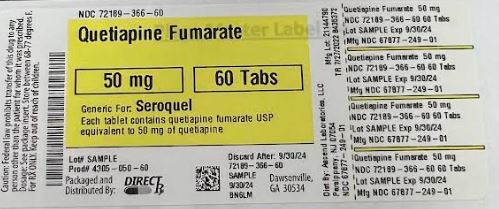
Quetiapine Fumarate 50 mg Tablet, Film Coated, 60-count — NDC 72189-366-60 (Billing 72189-0366-60)
This is a package of 60 tablets of Quetiapine Fumarate 50 mg Tablet, Film Coated from Direct_Rx, marketed since Jul 2022 and currently FDA-listed.
NDC database record
One package, one record: these facts belong to NDC 72189-366-60 alone.
- Record
- FDA NDC Directory package listing · Human prescription drug
- Code segments
- 72189 labeler · 366 product · 60 package
- Package marketed since
- Jul 27, 2022
- Sample package
- No — commercial package
- Listing certified through
- Dec 31, 2026
- Billing quantity
- 60 EA per package
- Barcode (UPC-A, from the NDC)
- 3 7218936660 5
- FDA record last changed
- Jul 24, 2026
Identity & classification
Regulatory identifiers FDA, NLM and CMS codes for this package
Drug-database identifiers Medi-Span GPI and First Databank GCN / HICL / AHFS classification
- GSN (GCN sequence number): 060292
- GCN: 26409
- HICL (First Databank): 014015
- AHFS class code: 28:16.08.04
- RxCUI (RxNorm): 616487
Where does this data come from?
- FDA openFDA NDC Directory · synced Oct 8, 2026
- FDA label on DailyMed · label index refreshed Oct 8, 2026
- RxNorm (NLM RxNav) · catalog refreshed Oct 1, 2026
- Medi-Span GPI (licensed)
- First Databank (licensed) · refreshed Oct 8, 2026
RxNorm drug class
This medicine belongs to the Atypical Antipsychotic class.
Where does this data come from?
- RxClass (NLM) · catalog refreshed Oct 1, 2026
Clinical
Quetiapine is used to treat schizophrenia (a mental illness that affects how a person thinks, feels and behaves), bipolar disorder (a disease that causes depression, mania, and other abnormal moods) and major depressive disorder. Quetiapine is in a class of medications called atypical antipsychotics. It works by changing the activity of certain natural substances in the brain.
Read the full MedlinePlus article ↗- It treats schizophrenia and bipolar disorder, including manic and depressive episodes. Extended-release versions can also be added to an antidepressant for major depressive disorde...
- Regular tablets can be taken with or without food. Extended-release tablets are taken once daily, usually in the evening, without food or with a light meal, and must be swallowed w...
- Sleepiness, dry mouth, dizziness, constipation, increased appetite and weight gain are the most common. Many people notice these early on. Tell your doctor if they bother you.
- Call right away for suicidal thoughts, worsening mood, fever with stiff muscles and confusion, uncontrolled movements, fainting, seizures, signs of infection, or high blood sugar s...
Patient education
Supplement & herbal interactions
Where does this data come from?
- MedlinePlus (NLM) · refreshed Oct 8, 2026
- FDA label on DailyMed · label index refreshed Oct 8, 2026
Ask a licensed pharmacist directly — free, answered by our team.
Pricing
A drug doesn't have one price. Each row is a different public payment system, and none is what you'd pay at the counter — that depends on your insurance. The ⓘ on each row explains what it measures.
| Price system | Per each | Per package |
|---|---|---|
| Retail pharmacies payNADAC · weekly | Not in the retail survey — common for institutional, discontinued, or low-volume packs. | |
| Medicaid paysCMS SDUD · 12 mo | No recent Medicaid claims on file for this NDC — rare and low-volume NDCs are suppressed in the public data. | |
| Medicare drug plans payPart D · Q2 2026 | $0.1085 | $6.51 / 60 tablets |
Where does this data come from?
- CMS NADAC weekly file
- CMS ASP pricing files · refreshed Sep 20, 2026
- CMS Medicaid State Drug Utilization Data · refreshed Oct 8, 2026
- CMS Part D plan pricing files · refreshed Sep 24, 2026
- VA National Acquisition Center price file
Packaging — all sizes for this product
| Package NDC | Description | Marketing start | Marketing end | Status |
|---|---|---|---|---|
| 72189-0366-60 You're viewing this | 60 TABLET in 1 BOTTLE | 2022-07-27 | — | Active |
| 72189-0366-30 72189-366-30 Main listing | 30 TABLET, FILM COATED in 1 BOTTLE | 2022-07-27 | — | Active |
You're viewing the largest of 2 pack sizes for this product.
Pack size FAQ
What quantity is in this package?
How does this package differ from NDC 72189-0366-30?
What NDC number is used to bill for this package of Quetiapine Fumarate 50 mg Tablet, Film Coated?
Therapeutic equivalents
| Product | Labeler | Pack | NADAC/unit | TE | Status | Price vs. this |
|---|---|---|---|---|---|---|
| Quetiapine 50 mg 00093-8166-01 | Teva | 100 tablets | $0.028 | AB | Discontinued | — |
| Quetiapine 50 mg 00904-6639-61 | Major | 100 tablets | $0.028 | AB | Availability likely | — |
| Quetiapine Fumarate 50 mg 16571-0718-01 | Rising | 100 tablets | $0.028 | AB | Availability likely | — |
| Quetiapine Fumarate 50 mg 16714-0376-01 | NorthStar | 100 tablets | $0.028 | AB | Availability likely | — |
| Quetiapine Fumarate 50 mg 29300-0148-01 | Unichem | 100 tablets | $0.028 | AB | Availability likely | — |
| Quetiapine Fumarate 50 mg 31722-0765-01 | Camber | 100 tablets | $0.028 | AB | Availability likely | — |
| Quetiapine 50 mg 43547-0519-10 | Solco | 100 tablets | $0.028 | AB | Availability likely | — |
| Quetiapine Fumarate 50 mg 50268-0631-15 | AvPAK | 50 tablets | $0.028 | AB | Availability likely | — |
| Quetiapine fumarate 50 mg 60687-0338-01 | American | 100 tablets | $0.028 | AB | Availability likely | — |
| Quetiapine Fumarate 50 mg 65862-0490-01 | Aurobindo | 100 tablets | $0.028 | AB | Availability likely | — |
| Quetiapine 50 mg 67877-0249-01 | Ascend | 100 tablets | $0.028 | AB | Availability likely | — |
| Quetiapine fumarate 50 mg 68001-0180-00 | BluePoint | 100 tablets | $0.028 | AB | Availability likely | — |
| Quetiapine fumarate 50 mg 68180-0446-01 | Lupin | 100 tablets | $0.028 | AB | Availability likely | — |
| Quetiapine fumarate 50 mg 82009-0096-10 | Quallent | 1000 tablets | $0.028 | AB | Availability likely | — |
| Quetiapine fumarate 50 mg 47335-0903-18 | Sun | 1000 tablets | $0.028 | AB | Discontinued | — |
| Quetiapine 50 mg 16729-0146-01 | Accord | 100 tablets | $0.030 | — | Availability likely | — |
| Quetiapine fumarate 50 mg 33342-0100-11 | Macleods | 100 tablets | $0.042 | AB | FDA listed | — |
| Seroquel 50 mg 00310-0278-10 | AstraZeneca | 100 tablets | $6.092 | AB | Availability likely | — |
| Quetiapine Fumarate 50 mg 00054-0229-20 | Hikma | 100 tablets | — | AB | FDA listed | — |
| Quetiapine Fumarate 50 mg 00615-8471-05 | NCS | 15 tablets | — | AB | FDA listed | — |
| Quetiapine Fumarate 50 mg 46708-0135-10 | Alembic | 100 tablets | — | — | FDA listed | — |
| Quetiapine Fumarate 50 mg 50090-3342-00 | A-S | 60 tablets | — | AB | Discontinued | — |
| Quetiapine Fumarate 50 mg 51407-0067-01 | Golden | 100 tablets | — | AB | FDA listed | — |
| Quetiapine 50 mg 55154-8092-00 | Cardinal | 10 tablets | — | AB | FDA listed | — |
| Seroquel 50 mg 61269-0251-10 | H2-Pharma, | 100 tablets | — | AB | FDA listed | — |
| Quetiapine fumarate 50 mg 63187-0219-30 | Proficient | 30 tablets | — | AB | FDA listed | — |
| Quetiapine Fumarate 50 mg 63629-4841-01 | Bryant | 30 tablets | — | AB | FDA listed | — |
| Quetiapine Fumarate 50 mg 67046-1649-03 | Coupler | 30 tablets | — | AB | FDA listed | — |
| Quetiapine Fumarate 50 mg 68788-7813-01 | Preferred | 100 tablets | — | AB | FDA listed | — |
| Quetiapine fumarate 50 mg 68788-8778-01 | Preferred | 100 tablets | — | AB | FDA listed | — |
| Quetiapine Fumarate 50 mg 70518-2175-00 | REMEDYREPACK | 30 tablets | — | AB | FDA listed | — |
| Quetiapine fumarate 50 mg 70518-2901-00 | REMEDYREPACK | 30 tablets | — | AB | FDA listed | — |
| Quetiapine Fumarate 50 mg 71205-0788-30 | Proficient | 30 tablets | — | AB | FDA listed | — |
| Quetiapine Fumarate 50 mg 71335-0926-01 | Bryant | 30 tablets | — | AB | FDA listed | — |
| Quetiapine Fumarate 50 mg 71335-1353-01 | Bryant | 30 tablets | — | AB | FDA listed | — |
| Quetiapine fumarate 50 mg 71335-2176-01 | Bryant | 30 tablets | — | AB | FDA listed | — |
| Quetiapine fumarate 50 mg 71335-2422-01 | Bryant | 30 tablets | — | AB | FDA listed | — |
| Quetiapine Fumarate 50 mg 71335-2691-01 | Bryant | 30 tablets | — | AB | FDA listed | — |
| Quetiapine Fumarate 50 mgthis 72189-0366-60 | Direct_Rx | 60 tablets | — | AB | FDA listed | — |
| Quetiapine 50 mg 72789-0266-07 | PD-Rx | 7 tablets | — | AB | FDA listed | — |
| Quetiapine Fumarate 50 mg 72865-0265-01 | XLCare | 100 tablets | — | AB | FDA listed | — |
| Quetiapine 50 mg 76420-0513-01 | ASCLEMED | 100 tablets | — | AB | FDA listed | — |
| Quetiapine Fumarate 50 mg 80425-0184-03 | Advanced | 90 tablets | — | AB | FDA listed | — |
| Quetiapine Fumarate 50 mg 80425-0186-03 | Advanced | 90 tablets | — | AB | FDA listed | — |
| Quetiapine Fumarate 50 mg 67046-1588-03 | Coupler | 30 tablets | — | AB | FDA listed | — |
Where does this data come from?
- FDA openFDA NDC Directory · synced Oct 8, 2026
- FDA Orange Book · refreshed Oct 3, 2026
- CMS NADAC weekly file
Availability & generic status
This product is an FDA-approved generic. Other versions of the same drug are listed under Therapeutic equivalents, least expensive first.
Where does this data come from?
- FDA Orange Book · refreshed Oct 3, 2026
What it looks like
Where does this data come from?
- FDA label on DailyMed · label index refreshed Oct 8, 2026
Inactive Ingredients / Excipients
Inactive ingredients, also called excipients, are components of the drug product other than the active ingredient. They may include fillers, dyes, coatings, preservatives, flavors, or other formulation ingredients.
🧪 Avoiding an ingredient? See Quetiapine inactive ingredients by manufacturer: every current product's list side by side, so you can ask your pharmacy for the version that does not list it.
💡 Tap an ingredient (hover on desktop) to see what it is and why it’s used.
-
UNII O7TSZ97GEP
A mineral compound that serves as a filler and binding agent in tablets and capsules. It adds bulk to the medicine and helps hold ingredients together during manufacturing.
-
UNII R75537T0T4
Hypromellose 2910 is a plant-derived thickening agent made from cellulose. It serves as a binder that holds tablet ingredients together, a film-coating for pills, and a viscosity controller in liquids.
-
UNII EWQ57Q8I5X
Lactose monohydrate is a natural sugar derived from milk. It serves as a filler and binder in tablets and capsules, helping create the proper size, texture, and consistency of the medicine.
-
UNII 70097M6I30
Magnesium stearate is a salt made from magnesium and stearic acid, a fatty substance. It's used in tablets and capsules as a lubricant and glidant to help ingredients flow smoothly during manufacturing and prevent sticking.
-
UNII OP1R32D61U
Microcrystalline cellulose is a purified form of cellulose, a natural fiber from plant sources. It acts as a binder and filler in tablets and capsules, helping hold ingredients together and give the medicine its shape and size.
-
UNII B697894SGQ
Polyethylene glycol 400 is a clear, thick liquid made from petroleum-derived polymers. It acts as a solvent and humectant in medicines, helping dissolve active ingredients and retain moisture in the formulation.
-
UNII U725QWY32X
Povidone K30 is a synthetic polymer made from petroleum. It acts as a binder to hold tablet ingredients together and as a disintegrant to help the tablet break apart in the stomach so the medicine can be absorbed.
-
UNII 5856J3G2A2
A starch-based powder made from potatoes and processed with sodium. It acts as a disintegrant, helping the tablet or capsule break apart quickly in the stomach so the medicine can be absorbed.
-
UNII 15FIX9V2JP
Titanium dioxide is a bright white mineral powder commonly used as a colorant and opacifying agent. It makes pills and tablets white or lighter in color and helps make coatings non-transparent.
9 inactive ingredients listed in the exact product block matched to this NDC.
Where does this data come from?
ingredient classCode="IACT" elements from the exact product block matched by this NDC. Label-section narrative from DailyMed / the openFDA label index is shown separately when available.- FDA label on DailyMed · label index refreshed Oct 8, 2026
- FDA openFDA NDC Directory · synced Oct 8, 2026
Inactive ingredient FAQ
Are inactive ingredients the same for every manufacturer?
Why might an inactive ingredient be missing?
Can inactive ingredients matter?
Manufacturer & labeler
More NDCs from Direct_Rx labeler code 72189
- Gentamicin Sulfate Opth Solution 3 mg/mL Solution/ Drops NDC 72189-359-05
- Celecoxib 200 mg Capsule NDC 72189-360-10
- Cyclobenzaprine HCL ER 15 mg Capsule, Extended Release NDC 72189-362-60
- Venlafaxine HCL ER 37.5 mg Capsule, Extended Release NDC 72189-363-30
- Ropinirole .25 mg Tablet, Film Coated NDC 72189-364-30
- Phentermine HCL C-IV 15 mg Capsule NDC 72189-365-30
- Amoxicillin/Clav Pot Oral Susp 400 mg/5mL; 57 mg/5mL Powder, For Suspension NDC 72189-367-32
- Oxycodone and Acetaminophen 7.5 mg; 325 mg Tablet NDC 72189-368-30
- Ramelteon 8 mg Tablet, Film Coated NDC 72189-369-30
- Lansoprazole DR 30 mg Capsule, Delayed Release NDC 72189-370-30
- Carvedilol 12.5 mg Tablet, Film Coated NDC 72189-372-30
- Olmesartan Medoxomil 5 mg Tablet, Film Coated NDC 72189-373-90
Where does this data come from?
- FDA openFDA NDC Directory · synced Oct 8, 2026
- Drugs@FDA
Full prescribing information FDA SPL
🎯 Indications and Usage ▾
1.1Schizophrenia Quetiapine is indicated for the treatment of schizophrenia. The efficacy of quetiapine in schizophrenia was established in three 6-week trials in adults and one 6-week trial in adolescents (13 to 17 years). The effectiveness of quetiapine for the maintenance treatment of schizophrenia has not been systematically evaluated in controlled clinical trials [see CLINICAL STUDIES (14.1)].
1.2Bipolar Disorder Quetiapine is indicated for the acute treatment of manic episodes associated with bipolar I disorder, both as monotherapy and as an adjunct to lithium or divalproex. Efficacy was established in two 12-week monotherapy trials in adults, in one 3-week adjunctive trial in adults, and in one 3-week monotherapy trial in pediatric patients (10 to 17 years) [see CLINICAL STUDIES (14.2)]. Quetiapine is indicated as monotherapy for the acute treatment of depressive episodes associated with bipolar disorder.
Efficacy was established in two 8-week monotherapy trials in adult patients with bipolar I and bipolar II disorder [see CLINICAL STUDIES (14.2)]. Quetiapine is indicated for the maintenance treatment of bipolar I disorder, as an adjunct to lithium or divalproex. Efficacy was established in two maintenance trials in adults.
The effectiveness of quetiapine as monotherapy for the maintenance treatment of bipolar disorder has not been systematically evaluated in controlled clinical trials [see CLINICAL STUDIES (14.2)].
1.3Special Considerations in Treating Pediatric Schizophrenia and Bipolar I Disorder Pediatric schizophrenia and bipolar I disorder are serious mental disorders, however, diagnosis can be challenging. For pediatric schizophrenia, symptom profiles can be variable, and for bipolar I disorder, patients may have variable patterns of periodicity of manic or mixed symptoms. It is recommended that medication therapy for pediatric schizophrenia and bipolar I disorder be initiated only after a thorough diagnostic evaluation has been performed and careful consideration given to the risks associated with medication treatment.
Medication treatment for both pediatric schizophrenia and bipolar I disorder is indicated as part of a total treatment program that often includes psychological, educational and social interventions.
⏱️ Dosage and Administration ▾
2.1Important Administration Instructions Quetiapine tablets, USP can be taken with or without food.
2.2Recommended Dosing The recommended initial dose, titration, dose range and maximum quetiapine dose for each approved indication is displayed in Table 1. After initial dosing, adjustments can be made upwards or downwards, if necessary, depending upon the clinical response and tolerability of the patient [see Clinical Studies (14.1 and 14.2)]. Table 1: Recommended Dosing for quetiapine Indication Initial Dose and Titration Recommended Dose Maximum Dose Schizophrenia-Adults Day 1: 25 mg twice daily.
Increase in increments of 25 mg-50 mg divided two or three times on Days 2 and 3 to range of 300 to 400 mg by Day 4 Further adjustments can be made in increments of 25 to 50 mg twice a day, in intervals of not less than 2 days. 150 to 750 mg/day 750 mg/day Schizophrenia- Adolescents (13 to 17 years) Day 1: 25 mg twice daily. Day 2: Twice daily dosing totaling 100 mg.
Day 3: Twice daily dosing totaling 200 mg. Day 4: Twice daily dosing totaling 300 mg. Day 5: Twice daily dosing totaling 400 mg.
Further adjustments should be in increments no greater than 100 mg/day within the recommended dose range of 400-800 mg/day. Based on response and tolerability, may be administered three times daily. 400 to 800 mg/day 800 mg/day Schizophrenia-Maintenance Not applicable 400 to 800 mg/day 800 mg/day Bipolar Mania- Adults Monotherapy or as an adjunct to lithium or divalproex Day 1: Twice daily dosing totaling 100 mg.
Day 2: Twice daily dosing totaling 200 mg. Day 3: Twice daily dosing totaling 300 mg. Day 4: Twice daily dosing totaling 400 mg.
Further dosage adjustments up to 800 mg/day by Day 6 should be in increments of no greater than 200 mg/day. 400 to 800 mg/day 800 mg/day Bipolar Mania- Children and Adolescents (10 to 17 years), Monotherapy Day 1: 25 mg twice daily. Day 2: Twice daily dosing totaling 100 mg.
Day 3: Twice daily dosing totaling 200 mg. Day 4: Twice daily dosing totaling 300 mg. Day 5: Twice daily dosing totaling 400 mg.
Further adjustments should be in increments no greater than 100 mg/day within the recommended dose range of 400-600 mg/day. Based on response and tolerability, may be administered three times daily. 400 to 600 mg/day 600 mg/day Bipolar Depression- Adults Administer once daily at bedtime.
Day 1: 50 mg Day 2: 100 mg Day 3: 200 mg Day 4: 300 mg 300 mg/day 300 mg/day Bipolar I Disorder Maintenance Therapy- Adults Administer twice daily totaling 400-800 mg/day as adjunct to lithium or divalproex. Generally, in the maintenance phase, patients continued on the same dose on which they were stabilized. 400 to 800 mg/day 800 mg/day Maintenance Treatment for Schizophrenia and Bipolar I Disorder Maintenance Treatment–Patients should be periodically reassessed to determine the need for maintenance treatment and the appropriate dose for such treatment [see CLINICAL STUDIES (14.2)].
2.3Dose Modifications in Elderly Patients Consideration should be given to a slower rate of dose titration and a lower target dose in the elderly and in patients who are debilitated or who have a predisposition to hypotensive reactions [see CLINICAL PHARMACOLOGY (12.3)]. When indicated, dose escalation should be performed with caution in these patients. Elderly patients should be started on quetiapine 50 mg/day and the dose can be increased in increments of 50 mg/day depending on the clinical response and tolerability of the individual patient.
2.4Dose Modifications in Hepatically Impaired Patients Patients with hepatic impairment should be started on 25 mg/day. The dose should be increased daily in increments of 25 mg/day - 50 mg/day to an effective dose, depending on the clinical response and tolerability of the patient.
2.5Dose Modifications when used with CYP3A4 Inhibitors Quetiapine dose should be reduced to one sixth of original dose when co-medicated with a potent CYP3A4 inhibitor (e.g., ketoconazole, itraconazole, indinavir, ritonavir,… [Excerpted — this section continues on DailyMed.]
💊 Dosage Forms and Strengths ▾
25 mg tablets are Peach coloured, film coated, round shape, biconvex tablets, debossed with "262" on other side and plain on other side 50 mg tablets are White coloured, film coated, round shape, biconvex tablets, debossed with"337" on one side and plain on other side 100 mg tablets are Yellow coloured film coated, round shape, biconvex tablets, debossed with "261" on one side and plain on other side 150 mg tablets are Off white to light yellow coloured, film coated, round shape, biconvex tablets, debossed with "353" on one side and plain on other side 200 mg tablets are White coloured, film coated, round shape, biconvex tablets, debossed with "260" on one side and plain on other side 300 mg tablets are White coloured, film coated, capsule shaped, biconvex tablets, debossed with "259" on one side and plain on other side 400 mg tablets are Yellow coloured, film coated, capsule shaped, biconvex tablets, debossed with ''336'' on one side and plain on other side
⛔ Contraindications ▾
Hypersensitivity to quetiapine or to any excipients in the quetiapine formulation. Anaphylactic reactions have been reported in patients treated with quetiapine.
⚠️ Warnings and Cautions ▾
5.1Increased Mortality in Elderly Patients with Dementia-Related Psychosis Elderly patients with dementia-related psychosis treated with antipsychotic drugs are at an increased risk of death. Analysis of 17 placebo-controlled trials (modal duration of 10 weeks), largely in patients taking atypical antipsychotic drugs, revealed a risk of death in drug-treated patients of between 1.6 to 1.7 times the risk of death in placebo-treated patients. Over the course of a typical 10-week controlled trial, the rate of death in drug-treated patients was about 4.5%, compared to a rate of about 2.6% in the placebo group.
Although the causes of death were varied, most of the deaths appeared to be either cardiovascular (e.g., heart failure, sudden death) or infectious (e.g., pneumonia) in nature. Observational studies suggest that, similar to atypical antipsychotic drugs, treatment with conventional antipsychotic drugs may increase mortality. The extent to which the findings of increased mortality in observational studies may be attributed to the antipsychotic drug as opposed to some characteristic(s) of the patients is not clear. quetiapine is not approved for the treatment of patients with dementia-related psychosis [see BOXED WARNING].
5.2Suicidal Thoughts and Behaviors in Adolescents and Young Adults Patients with major depressive disorder (MDD), both adult and pediatric, may experience worsening of their depression and/or the emergence of suicidal ideation and behavior (suicidality) or unusual changes in behavior, whether or not they are taking antidepressant medications, and this risk may persist until significant remission occurs. Suicide is a known risk of depression and certain other psychiatric disorders, and these disorders themselves are the strongest predictors of suicide.
There has been a long-standing concern, however, that antidepressants may have a role in inducing worsening of depression and the emergence of suicidality in certain patients during the early phases of treatment. Pooled analyses of short-term placebo-controlled trials of antidepressant drugs (SSRIs and others) showed that these drugs increase the risk of suicidal thinking and behavior (suicidality) in children, adolescents, and young adults (ages 18 to 24) with major depressive disorder (MDD) and other psychiatric disorders.
Short-term studies did not show an increase in the risk of suicidality with antidepressants compared to placebo in adults beyond age 24; there was a reduction with antidepressants compared to placebo in adults aged 65 and older. The pooled analyses of placebo-controlled trials in children and adolescents with MDD, obsessive compulsive disorder (OCD), or other psychiatric disorders included a total of 24 short-term trials of 9 antidepressant drugs in over 4400 patients. The pooled analyses of placebo-controlled trials in adults with MDD or other psychiatric disorders included a total of 295 short-term trials (median duration of 2 months) of 11 antidepressant drugs in over 77,000 patients.
There was considerable variation in risk of suicidality among drugs, but a tendency toward an increase in the younger patients for almost all drugs studied. There were differences in absolute risk of suicidality across the different indications, with the highest incidence in MDD. The risk differences (drug vs. placebo), however, were relatively stable within age strata and across indications.
These risk differences (drug-placebo difference in the number of cases of suicidality per 1000 patients treated) are provided in Table 2. Table 2: Drug-Placebo Difference in Number of Cases of Suicidality per 1000 Patients Treated Age Range Drug - Placebo Difference in Number of Cases of Suicidality per 1000 Patients Treated Increases Compared to Placebo <18 14 additional cases 18 to 24 5 additional cases Decreases Compared to Placebo 25 to 64 1 fewer case ≥65 6 fewer cases No suicides occurred in any of the pediatric trials.
There were suicides in the adult trials, b… [Excerpted — this section continues on DailyMed.]
🤒 Adverse Reactions ▾
The following adverse reactions are discussed in more detail in other sections of the labeling: Increased mortality in elderly patients with dementia-related psychosis [see WARNINGS AND PRECAUTIONS (5.1) Suicidal thoughts and behaviors in adolescents and young adults [see WARNINGS AND PRECAUTIONS (5.2)] Cerebrovascular adverse reactions, including stroke in elderly patients with dementia-related psychosis [see WARNINGS AND PRECAUTIONS (5.3)] Neuroleptic Malignant Syndrome (NMS) [see WARNINGS AND PRECAUTIONS (5.4)] Metabolic changes (hyperglycemia, dyslipidemia, weight gain) [see WARNINGS AND PRECAUTIONS (5.5)] Tardive dyskinesia [see WARNINGS AND PRECAUTIONS (5.6)] Hypotension [see WARNINGS AND PRECAUTIONS (5.7)] Falls [see WARNINGS AND PRECAUTIONS (5.8)] Increases in blood pressure (children and adolescents) [see Warnings and Precautions (5.9)] Leukopenia, neutropenia and agranulocytosis [see Warnings and Precautions (5.10)] Cataracts [see Warnings and Precautions (5.11)] QT Prolongation [see Warnings and Precautions (5.12)] Seizures [see Warnings and Precautions (5.13] Hypothyroidism [see Warnings and Precautions ( 5.14)] Hyperprolactinemia [see Warnings and Precautions (5.15)] Potential for cognitive and motor impairment [see Warnings and Precautions (5.16)] Body temperature regulation [see Warnings and Precautions (5.17)] Dysphagia [see Warnings and Precautions (5.18]) Discontinuation Syndrome [see Warnings and Precautions (5.19)] Anticholinergic (antimuscarinic) Effects [see Warnings and Precautions (5.20)]
6.1Clinical Study Experience Because clinical studies are conducted under widely varying conditions, adverse reaction rates observed in the clinical studies of a drug cannot be directly compared to rates in the clinical studies of another drug and may not reflect the rates observed in practice. Adults: The information below is derived from a clinical trial database for quetiapine consisting of over 4,300 patients. This database includes 698 patients exposed to quetiapine for the treatment of bipolar depression, 405 patients exposed to quetiapine for the treatment of acute bipolar mania (monotherapy and adjunct therapy), 646 patients exposed to quetiapine for the maintenance treatment of bipolar I disorder as adjunct therapy, and approximately 2,600 patients and/or normal subjects exposed to 1 or more doses of quetiapine for the treatment of schizophrenia.
Of these approximately 4300 subjects, approximately 4,000 (2,300 in schizophrenia, 405 in acute bipolar mania, 698 in bipolar depression, and 646 for the maintenance treatment of bipolar I disorder) were patients who participated in multiple dose effectiveness trials, and their experience corresponded to approximately 2,400 patient-years. The conditions and duration of treatment with quetiapine varied greatly and included (in overlapping categories) open-label and double-blind phases of studies, inpatients and outpatients, fixed-dose and dose-titration studies, and short-term or longer-term exposure.
Adverse reactions were assessed by collecting adverse reactions, results of physical examinations, vital signs, weights, laboratory analyses, ECGs, and results of ophthalmologic examinations. The stated frequencies of adverse reactions represent the proportion of individuals who experienced, at least once, an adverse reaction of the type listed. Adverse Reactions Associated with Discontinuation of Treatment in Short-Term, Placebo-Controlled Trials Schizophrenia: Overall, there was little difference in the incidence of discontinuation due to adverse reactions (4% for quetiapine vs.
3% for placebo) in a pool of controlled trials. However, discontinuations due to somnolence (0.8% quetiapine vs. 0% placebo) and hypotension (0.4% quetiapine vs.
0% placebo) were considered to be drug related [see Warnings and Precautions (5.7 and 5.19)]. Bipolar Disorder: Mania: Overall, discontinuations due to adverse reactions were 5.7% for quetiapine vs. 5.1% for placebo in monotherapy and… [Excerpted — this section continues on DailyMed.]
🔄 Drug Interactions ▾
7.1Effect of Other Drugs on quetiapine The risks of using quetiapine in combination with other drugs have not been extensively evaluated in systematic studies. Given the primary CNS effects of quetiapine, caution should be used when it is taken in combination with other centrally acting drugs. Quetiapine potentiated the cognitive and motor effects of alcohol in a clinical trial in subjects with selected psychotic disorders, and alcoholic beverages should be limited while taking quetiapine.
Quetiapine exposure is increased by the prototype CYP3A4 inhibitors (e.g., ketoconazole, itraconazole, indinavir, ritonavir, nefazodone, etc.) and decreased by the prototype CYP3A4 inducers (e.g., phenytoin, carbamazepine, rifampin, avasimibe, St. John’s wort etc.). Dose adjustment of quetiapine will be necessary if it is co-administered with potent CYP3A4 inducers or inhibitors.
CYP3A4 inhibitors: Coadministration of ketoconazole, a potent inhibitor of cytochrome CYP3A4, resulted in significant increase in quetiapine exposure. The dose of quetiapine should be reduced to one sixth of the original dose if co-administered with a strong CYP3A4 inhibitor [see Dosage and Administration (2.5) and Clinical Pharmacology (12.3)]. CYP3A4 inducers: Coadministration of quetiapine and phenytoin, a CYP3A4 inducer increased the mean oral clearance of quetiapine by 5- fold.
Increased doses of quetiapine up to 5 fold may be required to maintain control of symptoms of schizophrenia in patients receiving quetiapine and phenytoin, or other known potent CYP3A4 inducers [see Dosage and Administration (2.6) and Clinical Pharmacology (12.3)]. When the CYP3A4 inducer is discontinued, the dose of quetiapine should be reduced to the original level within 7-14 days [see Dosage and Administration (2.6)]. Anticholinergic Drugs: Concomitant treatment with quetiapine and other drugs with anticholinergic activity can increase the risk for severe gastrointestinal adverse reactions related to hypomotility.
Quetiapine should be used with caution in patients receiving medications having anticholinergic (antimuscarinic) effects [see Warnings and Precautions (5.20)]. The potential effects of several concomitant medications on quetiapine pharmacokinetics were studied [see Clinical Pharmacology (12.3)].
7.2Effect of Quetiapine on Other Drugs Because of its potential for inducing hypotension, Quetiapine may enhance the effects of certain antihypertensive agents. Quetiapine may antagonize the effects of levodopa and dopamine agonists. There are no clinically relevant pharmacokinetic interactions of quetiapine on other drugs based on the CYP pathway. Quetiapine and its metabolites are non-inhibitors of major metabolizing CYP’s (1A2, 2C9, 2C19, 2D6 and 3A4).
👥 Use in Specific Populations ▾
8.1Pregnancy Pregnancy Exposure Registry There is a pregnancy exposure registry that monitors pregnancy outcomes in women exposed to atypical antipsychotics, including quetiapine tablets, during pregnancy. Healthcare providers are encouraged to register patients by contacting the National Pregnancy Registry for Atypical Antipsychotics at 1-866-961-2388 or online at http://womensmentalhealth.org/clinical-and-research-programs/pregnancyregistry/. Risk Summary Neonates exposed to antipsychotic drugs ( including quetiapine tablet) during the third trimester are at risk for extrapyramidal and/or withdrawal symptoms following delivery (see Clinical Considerations).
Overall available data from published epidemiologic studies of pregnant women exposed to quetiapine have not established a drug-associated risk of major birth defects, miscarriage, or adverse maternal or fetal outcomes (see Data). There are risks to the mother associated with untreated schizophrenia, bipolar I, or major depressive disorder, and with exposure to antipsychotics, including, quetiapine tablet during pregnancy (see Clinical Considerations). In animal studies, embryo-fetal toxicity occurred including delays in skeletal ossification at approximately 1 and 2 times the maximum recommended human dose (MRHD) of 800 mg/day in both rats and rabbits, and an increased incidence of carpal/tarsal flexure (minor soft tissue anomaly) in rabbit fetuses at approximately 2 times the MRHD.
In addition, fetal weights were decreased in both species. Maternal toxicity (observed as decreased body weights and/or death) occurred at 2 times the MRHD in rats and approximately 1-2 times the MRHD in rabbits. The estimated background risk of major birth defects and miscarriage for the indicated populations is unknown.
All pregnancies have a background risk of birth defect, loss, or other adverse outcomes. In the U.S. general population, the estimated background risk of major birth defects and miscarriage in clinically recognized pregnancies is 2 to 4% and 15 to 20%, respectively. Clinical Considerations Disease-associated maternal and/or fetal risk There is a risk to the mother from untreated schizophrenia, or bipolar I disorder, including increased risk of relapse, hospitalization, and suicide.
Schizophrenia and bipolar I disorder are associated with increased adverse perinatal outcomes, including preterm birth. It is not known if this is a direct result of the illness or other comorbid factors. A prospective, longitudinal study followed 201 pregnant women with a history of major depressive disorder who were euthymic and taking antidepressants at the beginning of pregnancy.
The women who discontinued antidepressants during pregnancy were more likely to experience a relapse of major depression than women who continued antidepressants. Consider the risk of untreated depression when discontinuing or changing treatment with antidepressant medication during pregnancy and postpartum. Fetal/neonatal adverse reactions Extrapyramidal and/or withdrawal symptoms, including agitation, hypertonia, hypotonia, tremor, somnolence, respiratory distress, and feeding disorder have been reported in neonates who were exposed to antipsychotic drugs, including quetiapine tablets, during the third trimester of pregnancy.
These symptoms varied in severity. Monitor neonates for extrapyramidal and/or withdrawal symptoms and manage symptoms appropriately. Some neonates recovered within hours or days without specific treatment; others required prolonged hospitalization.
Data Human Data Published data from observational studies, birth registries, and case reports on the use of atypical antipsychotics during pregnancy do not report a clear association with antipsychotics and major birth defects. A retrospective cohort study from a Medicaid database of 9258 women exposed to antipsychotics during pregnancy did not indicate an overall increased risk of major birth defects. Animal Data When pregnant rats and rabbits were… [Excerpted — this section continues on DailyMed.]
🆘 Overdosage ▾
10.1Human Experience In clinical trials, survival has been reported in acute overdoses of up to 30 grams of quetiapine. Most patients who overdosed experienced no adverse reactions or recovered fully from the reported reactions. Death has been reported in a clinical trial following an overdose of 13.6 grams of quetiapine alone.
In general, reported signs and symptoms were those resulting from an exaggeration of the drug’s known pharmacological effects, i.e., drowsiness, sedation, tachycardia, hypotension, and anticholinergic toxicity including coma and delirium. Patients with pre-existing severe cardiovascular disease may be at an increased risk of the effects of overdose [see Warnings and Precautions (5.12)]. One case, involving an estimated overdose of 9,600 mg, was associated with hypokalemia and first- degree heart block.
In post-marketing experience, there were cases reported of QT prolongation with overdose.
10.2Management of Overdosage Establish and maintain an airway and ensure adequate oxygenation and ventilation. Cardiovascular monitoring should commence immediately and should include continuous electrocardiographic monitoring to detect possible arrhythmias. Appropriate supportive measures are the mainstay of management.
For the most up-to-date information on the management of quetiapine overdosage, contact a certified Regional Poison Control Center (1-800-222-1222).
🧬 Clinical Pharmacology ▾
12.1Mechanism of Action The mechanism of action of quetiapine in the listed indications is unclear. However, the efficacy of quetiapine in these indications could be mediated through a combination of dopamine type 2 (D2) and serotonin type 2 (5HT2) antagonism. The active metabolite, N-desalkyl quetiapine (norquetiapine), has similar activity at D2, but greater activity at 5HT2A receptors, than the parent drug (quetiapine).
12.2Pharmacodynamics Quetiapine and its metabolite, norquetiapine, have affinity for multiple neurotransmitter receptors with norquetiapine binding with higher affinity than quetiapine in general. The Ki values for quetiapine and norquetiapine at the dopamine D1 are 428/99.8 nM, at D2 626/489nM, at serotonin 5HT1A 1040/191 nM at 5HT2A 38/2.9 nM, at histamine H1 4.4/1.1 nM, at muscarinic M1 1086/38.3 nM, and at adrenergic α1b 14.6/46.4 nM and, at α2 receptors 617/1290 nM, respectively. Quetiapine and norquetiapine lack appreciable affinity to the benzodiazepine receptors.
Effect on QT Interval In clinical trials quetiapine was not associated with a persistent increase in QT intervals. However, the QT effect was not systematically evaluated in a thorough QT study. In post marketing experience there were cases reported of QT prolongation in patients who overdosed on quetiapine [see Overdosage (10.1)], in patients with concomitant illness, and in patients taking medicines known to cause electrolyte imbalance or increase QT interval.
12.3Pharmacokinetics Adults Quetiapine activity is primarily due to the parent drug. The multiple-dose pharmacokinetics of quetiapine are dose-proportional within the proposed clinical dose range, and quetiapine accumulation is predictable upon multiple dosing. Elimination of quetiapine is mainly via hepatic metabolism with a mean terminal half-life of about 6 hours within the proposed clinical dose range.
Steady-state concentrations are expected to be achieved within two days of dosing. Quetiapine is unlikely to interfere with the metabolism of drugs metabolized by cytochrome P450 enzymes. Children and Adolescents At steady-state the pharmacokinetics of the parent compound, in children and adolescents (10-17 years of age), were similar to adults.
However, when adjusted for dose and weight, AUC and Cmax of the parent compound were 41% and 39% lower, respectively, in children and adolescents than in adults. For the active metabolite, norquetiapine, AUC and Cmax were 45% and 31% higher, respectively, in children and adolescents than in adults. When adjusted for dose and weight, the pharmacokinetics of the metabolite, norquetiapine, was similar between children and adolescents and adults [see USE IN SPECIFIC POPULATIONS (8.4)].
Absorption Quetiapine is rapidly absorbed after oral administration, reaching peak plasma concentrations in 1.5 hours. The tablet formulation is 100% bioavailable relative to solution. The bioavailability of quetiapine is marginally affected by administration with food, with Cmax and AUC values increased by 25% and 15%, respectively.
Distribution Quetiapine is widely distributed throughout the body with an apparent volume of distribution of 10±4 L/kg. It is 83% bound to plasma proteins at therapeutic concentrations. In vitro, quetiapine did not affect the binding of warfarin or diazepam to human serum albumin.
In turn, neither warfarin nor diazepam altered the binding of quetiapine. Metabolism and Elimination Following a single oral dose of 14C-quetiapine, less than 1% of the administered dose was excreted as unchanged drug, indicating that quetiapine is highly metabolized. Approximately 73% and 20% of the dose was recovered in the urine and feces, respectively.
Quetiapine is extensively metabolized by the liver. The major metabolic pathways are sulfoxidation to the sulfoxide metabolite and oxidation to the parent acid metabolite; both metabolites are pharmacologically inactive. In vitro studies using human liver microsomes revealed that the cytochrome P450 3A… [Excerpted — this section continues on DailyMed.]
📦 How Supplied / Storage and Handling ▾
Quetiapine tablets, USP 25 mg Peach coloured, film coated, round shape, biconvex tablets, debossed with "262” on one side and plain on other side. Bottles of 100 tablets NDC 67877-242-01 Bottles of 1000 tablets NDC 67877-242-10 Carton pack of 100 tablets (10 x 10’s blister pack) NDC 67877-242-38 Blister pack of 10 tablets NDC 67877-242-33 Quetiapine tablets, USP 50 mg White coloured, film coated, round shape, biconvex tablets, debossed with"337" on one side and plain on other side. Bottles of 30 tablets NDC 72189-366-30 Bottles of 1000 tablets NDC 67877-249-10 Carton pack of 100 tablets (10 x 10’s blister pack) NDC 67877-249-38 Carton pack of 10 tablets (1 x 10’s blister pack) NDC 67877-249-33 Quetiapine tablets, USP 100 mg Yellow coloured, film coated, round shape, biconvex tablets, debossed with "261" on one side and plain on other side.
Bottles of 100 tablets NDC 67877-250-01 Bottles of 1000 tablets NDC 67877-250-10 Carton pack of 100 tablets (10 x 10’s blister pack) NDC 67877-250-38 Carton pack of 10 tablets (1 x 10's blister pack) NDC 67877-250-33 Quetiapine tablets, USP 150 mg Off white to light yellow coloured, film coated, round shape, biconvex tablets, debossed with "353" on one side and plain on other side. Bottles of 100 tablets NDC 67877-245- 01 Carton pack of 100 tablets (10 x 10's blister pack) NDC 67877-245-38 Carton pack of 10 tablets (1 x 10's blister pack) NDC 67877-245-33 Quetiapine tablets, USP 200 mg White coloured, film coated, round shape, biconvex tablets, debossed with "260" on one side and plain on other side.
Bottles of 100 tablets NDC 67877-246- 01 Bottles of 1000 tablets NDC 67877-246-10 Carton pack of 100 tablets (10 x 10's blister pack) NDC 67877-246-38 Carton pack of 10 tablets (1 x 10's blister pack) NDC 67877-246-33 Quetiapine tablets, USP 300 mg White coloured, film coated, capsule shaped, biconvex tablets, debossed with "259" on one side and plain on other side. Bottles of 60 tablets NDC 67877-247- 60 Bottles of 1000 tablets NDC 67877-247-10 Carton pack of 100 tablets (10 x 10's blister pack) NDC 67877-247-38 Carton pack of 10 tablets (1 x 10's blister pack) NDC 67877-247-33 Quetiapine tablets, USP 400 mg Yellow coloured, film coated, capsule shaped, biconvex tablets, debossed with "336" on one side and plain on other side.
Bottles of 100 tablets NDC 67877-248- 01 Bottles of 1000 tablets NDC 67877-248-10 Carton pack of 100 tablets (10 x 10's blister pack) NDC 67877-248-38 Carton pack of 10 tablets (1 x 10's blister pack) NDC 67877-248-33
📦 Storage and Handling ▾
Store at 20° to 25°C (68° to 77°F); excursions permitted to 15° to 30°C (59° to 86°F) [see USP Controlled Room Temperature].
📋 Description ▾
Quetiapine is an atypical antipsychotic belonging to a chemical class, the dibenzothiazepine derivatives. The chemical designation is 2-[2-(4-dibenzo [b,f] [1,4]thiazepin-11-yl-1-piperazinyl) ethoxy]-ethanol fumarate (2:1) (salt). It is present in tablets as the fumarate salt.
All doses and tablet strengths are expressed as milligrams of base, not as fumarate salt. Its molecular formula is C42H50N6O4S2•C4H4O4 and it has a molecular weight of 883.11 (fumarate salt). The structural formula is: [Structure] Quetiapine fumarate is a white to off-white crystalline powder which is moderately soluble in water.
Quetiapine tablets, USP is supplied for oral administration as 25 mg (round peach), 50 mg (round, white), 100 mg (round yellow), 150 mg (round, off white to light yellow), 200 mg (round, white), 300 mg (capsule-shaped, white), and 400 mg (capsule-shaped, yellow) tablets. Inactive ingredients are povidone, dibasic dicalcium phosphate dihydrate, microcrystalline cellulose, sodium starch glycolate, lactose monohydrate, magnesium stearate, hypromellose, polyethylene glycol and titanium dioxide. The 25 mg tablets contain red iron oxide and yellow iron oxide and the 100 mg, 150 mg and 400 mg tablets contain only yellow iron oxide.
Each 25 mg tablet contains 28.78 mg of quetiapine fumarate equivalent to 25 mg quetiapine. Each 50 mg tablet contains 57.56 mg of quetiapine fumarate equivalent to 50 mg quetiapine. Each 100 mg tablet contains 115.13 mg of quetiapine fumarate equivalent to 100 mg quetiapine.
Each 150 mg tablet contains 172.70 mg of quetiapine fumarate equivalent to 150 mg quetiapine. Each 200 mg tablet contains 230.27 mg of quetiapine fumarate equivalent to 200 mg quetiapine. Each 300 mg tablet contains 345.40 mg of quetiapine fumarate equivalent to 300 mg quetiapine.
Each 400 mg tablet contains 460.54 mg of quetiapine fumarate equivalent to 400 mg quetiapine. The USP dissolution test is pending.
💬 Medication Guide ▾
Quetiapine Tablets (kwe-TYE-a-peen) Read this Medication Guide before you start taking quetiapine tablets and each time you get a refill. There may be new information. This information does not take the place of talking to your healthcare provider about your medical condition or your treatment.
What is the most important information I should know about quetiapine? Quetiapine may cause serious side effects, including: 1. risk of death in the elderly with dementia. Medicines like quetiapine can increase the risk of death in elderly people who have memory loss (dementia).
Quetiapine is not for treating psychosis in the elderly with dementia. 2. risk of suicidal thoughts or actions (antidepressant medicines, depression and other serious mental illnesses, and suicidal thoughts or actions). Talk to your or your family member’s healthcare provider about: all risks and benefits of treatment with antidepressant medicines. all treatment choices for depression or other serious mental illness Antidepressant medications may increase suicidal thoughts or actions in some children, teenagers, and young adults within the first few months of treatment.
Depression and other serious mental illnesses are the most important causes of suicidal thoughts and actions. Some people may have a particularly high risk of having suicidal thoughts or actions. These include people who have (or have a family history of) depression, bipolar illness (also called manic-depressive illness), or suicidal thoughts or actions.
How can I watch for and try to prevent suicidal thoughts and actions in myself or a family member? Pay close attention to any changes, especially sudden changes, in mood, behaviors, thoughts, or feelings. This is very important when an antidepressant medicine is started or when the dose is changed.
Call the healthcare provider right away to report new or sudden changes in mood, behavior, thoughts, or feelings. Keep all follow-up visits with the healthcare provider as scheduled. Call the healthcare provider between visits as needed, especially if you have concerns about symptoms.
Call a healthcare provider right away if you or your family member has any of the following symptoms, especially if they are new, worse, or worry you: thoughts about suicide or dying attempts to commit suicide new or worse depression new or worse anxiety feeling very agitated or restless panic attacks trouble sleeping (insomnia) new or worse irritability acting aggressive, being angry, or violent acting on dangerous impulses an extreme increase in activity and talking (mania) other unusual changes in behavior or mood What else do I need to know about antidepressant medicines?
Never stop an antidepressant medicine without first talking to your healthcare provider. Stopping an antidepressant medicine suddenly can cause other symptoms. Antidepressants are medicines used to treat depression and other illnesses.
It is important to discuss all the risks of treating depression, and also the risks of not treating it. Patients and their families or other caregivers should discuss all treatment choices with the healthcare provider, not just the use of antidepressants. Antidepressant medicines have other side effects.
Talk to the healthcare provider about the side effects of the medicine prescribed for you or your family member. Antidepressant medicines can interact with other medicines. Know all of the medicines that you or your family member take.
Keep a list of all medicines to show the healthcare provider. Do not start new medicines without first checking with your healthcare provider. Not all antidepressant medicines prescribed for children are FDA approved for use in children.
Talk to your child’s healthcare provider for more information. What is quetiapine? Quetiapine is a prescription medicine used to treat: schizophrenia in people 13 years of age or older bipolar disorder in adults, including: depressive episodes associated with bipolar disorder manic episodes associated wi… [Excerpted — this section continues on DailyMed.]
🔬 Clinical Studies ▾
14.1Schizophrenia Short-term Trials-Adults The efficacy of quetiapine in the treatment of schizophrenia was established in 3 short-term (6-week) controlled trials of inpatients with schizophrenia who met DSM III-R criteria for schizophrenia. Although a single fixed dose haloperidol arm was included as a comparative treatment in one of the three trials, this single haloperidol dose group was inadequate to provide a reliable and valid comparison of quetiapine and haloperidol. Several instruments were used for assessing psychiatric signs and symptoms in these studies, among them the Brief Psychiatric Rating Scale (BPRS), a multi-item inventory of general psychopathology traditionally used to evaluate the effects of drug treatment in schizophrenia.
The BPRS psychosis cluster (conceptual disorganization, hallucinatory behavior, suspiciousness, and unusual thought content) is considered a particularly useful subset for assessing actively psychotic schizophrenic patients. A second traditional assessment, the Clinical Global Impression (CGI), reflects the impression of a skilled observer, fully familiar with the manifestations of schizophrenia, about the overall clinical state of the patient. The results of the trials follow: 1.
In a 6-week, placebo-controlled trial (n=361) (Study 1) involving 5 fixed doses of quetiapine (75 mg/day, 150 mg/day, 300 mg/day, 600 mg/day and 750 mg/day given in divided doses three times per day), the 4 highest doses of quetiapine were generally superior to placebo on the BPRS total score, the BPRS psychosis cluster and the CGI severity score, with the maximal effect seen at 300 mg/day, and the effects of doses of 150 mg/day to 750 mg/day were generally indistinguishable. 2. In a 6-week, placebo-controlled trial (n=286) (Study 2) involving titration of quetiapine in high (up to 750 mg/day given in divided doses three times per day) and low (up to 250 mg/day given in divided doses three times per day) doses, only the high dose quetiapine group (mean dose, 500 mg/day) was superior to placebo on the BPRS total score, the BPRS psychosis cluster, and the CGI severity score.
3. In a 6-week dose and dose regimen comparison trial (n=618) (Study 3) involving two fixed doses of quetiapine (450 mg/day given in divided doses both twice daily and three times daily and 50 mg/day given in divided doses twice daily), only the 450 mg/day (225 mg given twice daily) dose group was superior to the 50 mg/day (25 mg given twice daily) quetiapine dose group on the BPRS total score, the BPRS psychosis cluster, and the CGI severity score. The primary efficacy results of these three studies in the treatment of schizophrenia in adults is presented in Table 19.
Examination of population subsets (race, gender, and age) did not reveal any differential responsiveness on the basis of race or gender, with an apparently greater effect in patients under the age of 40 years compared to those older than 40. The clinical significance of this finding is unknown. Adolescents (ages 13 to 17) The efficacy of quetiapine in the treatment of schizophrenia in adolescents (13 to 17 years of age) was demonstrated in a 6-week, double-blind, placebo-controlled trial (Study 4).
Patients who met DSM-IV diagnostic criteria for schizophrenia were randomized into one of three treatment groups: Quetiapine 400 mg/day (n = 73), Quetiapine 800 mg/day (n = 74), or placebo (n = 75). Study medication was initiated at 50 mg/day and on day 2 increased to 100 mg/per day (divided and given two or three times per day). Subsequently, the dose was titrated to the target dose of 400 mg/day or 800 mg/day using increments of 100 mg/day, divided and given two or three times daily.
The primary efficacy variable was the mean change from baseline in total Positive and Negative Syndrome Scale (PANSS). Quetiapine at 400 mg/day and 800 mg/day was superior to placebo in the reduction of PANSS total score. The primary efficacy results of this study in the treatment of schizophrenia in… [Excerpted — this section continues on DailyMed.]
🔒 Drug Abuse and Dependence ▾
9.1Controlled Substance Quetiapine is not a controlled substance.
9.2Abuse Quetiapine has not been systematically studied, in animals or humans, for its potential for abuse, tolerance or physical dependence. While the clinical trials did not reveal any tendency for any drug-seeking behavior, these observations were not systematic and it is not possible to predict on the basis of this limited experience the extent to which a CNS-active drug will be misused, diverted, and/or abused once marketed. Consequently, patients should be evaluated carefully for a history of drug abuse, and such patients should be observed closely for signs of misuse or abuse of quetiapine, e.g., development of tolerance, increases in dose, drug-seeking behavior.
🧪 Nonclinical Toxicology ▾
13.1Carcinogenesis, Mutagenesis, Impairment of Fertility Carcinogenesis Carcinogenicity studies were conducted in C57BL mice and Wistar rats. Quetiapine was administered in the diet to mice at doses of 20, 75, 250, and 750 mg/kg and to rats by gavage at doses of 25, 75, and 250 mg/kg for two years. These doses are equivalent to 0.1, 0.5, 1.5, and 4.5 times the MRHD of 800 mg/day based on mg/m2 body surface area (mice) or 0.3, 1, and 3 times the MRHD based on mg/m2 body surface area (rats).
There were statistically significant increases in thyroid gland follicular adenomas in male mice at doses 1.5 and 4.5 times the MRHD on mg/m2 body surface area and in male rats at a dose of 3 times the MRHD on mg/m2 body surface area. Mammary gland adenocarcinomas were statistically significantly increased in female rats at all doses tested (0.3, 1, and 3 times the MRHD based on mg/m2 body surface area). Thyroid follicular cell adenomas may have resulted from chronic stimulation of the thyroid gland by thyroid stimulating hormone (TSH) resulting from enhanced metabolism and clearance of thyroxine by rodent liver.
Changes in TSH, thyroxine, and thyroxine clearance consistent with this mechanism were observed in subchronic toxicity studies in rat and mouse and in a 1-year toxicity study in rat; however, the results of these studies were not definitive. The relevance of the increases in thyroid follicular cell adenomas to human risk, through whatever mechanism, is unknown. Antipsychotic drugs have been shown to chronically elevate prolactin levels in rodents.
Serum measurements in a 1-year toxicity study showed that quetiapine increased median serum prolactin levels a maximum of 32- and 13-fold in male and female rats, respectively. Increases in mammary neoplasms have been found in rodents after chronic administration of other antipsychotic drugs and are considered to be prolactin-mediated. The relevance of this increased incidence of prolactin-mediated mammary gland tumors in rats to human risk is unknown [see Warnings and Precautions (5.15)].
Mutagenesis Quetiapine was not mutagenic or clastogenic in standard genotoxicity tests. The mutagenic potential of quetiapine was tested in the in vitro Ames bacterial gene mutation assay and in the in vitro mammalian gene mutation assay in Chinese Hamster Ovary cells. The clastogenic potential of quetiapine was tested in the in vitro chromosomal aberration assay in cultured human lymphocytes and in the in vivo bone marrow micronucleus assay in rats up to 500 mg/kg, which is 6 times the MRHD based on mg/m2 body surface area.
Impairment of Fertility Quetiapine decreased mating and fertility in male Sprague-Dawley rats at oral doses of 50 and 150 mg/kg or approximately 1 and 3 times the MRHD of 800 mg/day based on mg/m2 body surface area. Drug- related effects included increases in interval to mate and in the number of matings required for successful impregnation. These effects continued to be observed at 3 times the MRHD even after a two-week period without treatment.
The no- effect dose for impaired mating and fertility in male rats was 25 mg/kg, or 0.3 times the MRHD based on mg/m2 body surface area. Quetiapine adversely affected mating and fertility in female Sprague-Dawley rats at an oral dose approximately 1 times the MRHD of 800 mg/day based on mg/m2 body surface area. Drug-related effects included decreases in matings and in matings resulting in pregnancy, and an increase in the interval to mate.
An increase in irregular estrus cycles was observed at doses of 10 and 50 mg/kg, or approximately 0.1 and 1 times the MRHD of 800 mg/day based on mg/m2 body surface area. The no-effect dose in female rats was 1 mg/kg, or 0.01 times the MRHD of 800 mg/day based on mg/m2 body surface area.
13.2Animal Toxicology and/or Pharmacology Quetiapine caused a dose-related increase in pigment deposition in thyroid gland in rat toxicity studies which were 4 weeks in duration or longer and in a mouse 2-year carcinogen… [Excerpted — this section continues on DailyMed.]
📄 Package Label / Principal Display Panel ▾
72189-366-60
72189-366-30
Medicare Part D spend CMS · PART D · 2026 (Q1)
About this NDC listing & data coverage
What data is (and isn’t) available for this NDC — tap to expand
| NDC identity (package / product / labeler codes) | ✓ Available |
| Labeler | ✓ Available |
| Product & package description | ✓ Available |
| Marketing category & status | ✓ Available |
| Active ingredient / dosage form / route | ✓ Available |
| FDA label (SPL via DailyMed) | ✓ Available |
| Package photos | ✓ Available |
| Inactive ingredients (structured) | ✓ Available |
| NADAC pharmacy acquisition price (CMS) | — Not published for this NDC CMS publishes NADAC only for NDCs reported in its retail-pharmacy survey. |
| Orange Book / therapeutic-equivalence data | ✓ Available |
| HCPCS J-code billing crosswalk | — Not published for this NDC Most self-administered / retail products have no J-code — that is normal. |
| Medicaid utilization (CMS SDUD) | — Not published for this NDC CMS reports utilization only for NDCs with Medicaid claims above its privacy threshold. |