
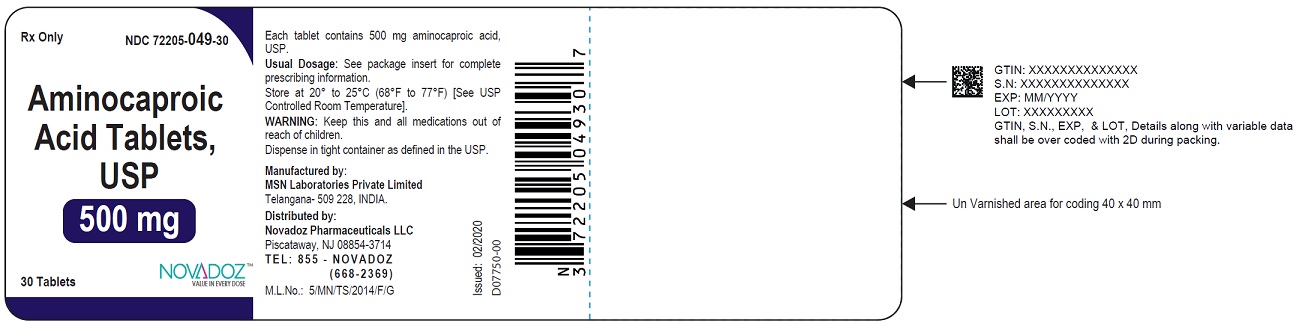
Aminocaproic acid 500 mg Tablet, 30-count — NDC 72205-049-30 (Billing 72205-0049-30)
This is a package of 30 tablets of Aminocaproic acid 500 mg Tablet from Novadoz Pharmaceuticals LLC, marketed since Dec 2020 and currently FDA-listed; retail pharmacies pay about $2.52 per tablet (NADAC). It is this product's only package size.
NDC database record
One package, one record: these facts belong to NDC 72205-049-30 alone.
- Record
- FDA NDC Directory package listing · Human prescription drug
- Code segments
- 72205 labeler · 049 product · 30 package
- Package marketed since
- Dec 10, 2020
- Sample package
- No — commercial package
- Listing certified through
- Dec 31, 2026
- Billing quantity
- 30 EA per package
- Barcode (UPC)
- 0372205049307, 0372205286306
- Medicaid fills, this package
- 37 prescriptions in the last four reported quarters
- FDA record last changed
- Jul 24, 2026
Other active recalls for Aminocaproic Acid (different manufacturers) — 1 · tap to view
Identity & classification
Regulatory identifiers FDA, NLM and CMS codes for this package
Drug-database identifiers Medi-Span GPI and First Databank GCN / HICL / AHFS classification
- GSN (GCN sequence number): 006504
- GCN: 25590
- GPI-14 (Medi-Span): 84100010000305
- HICL (First Databank): 002801
- AHFS class code: 20:28.16.00
- RxCUI (RxNorm): 197351
Where does this data come from?
- FDA openFDA NDC Directory · synced Oct 1, 2026
- FDA label on DailyMed · label index refreshed Oct 5, 2026
- RxNorm (NLM RxNav) · catalog refreshed Oct 1, 2026
- Medi-Span GPI (licensed)
- First Databank (licensed) · refreshed Oct 1, 2026
RxNorm drug class
This medicine belongs to the Antifibrinolytic Agent class.
Where does this data come from?
- RxClass (NLM) · catalog refreshed Oct 1, 2026
Clinical
- It helps control bleeding when your body is breaking down clots too fast. This can happen after heart surgery, with some liver, blood or cancer conditions, and with certain urinary...
- It comes as an IV infusion given by a healthcare professional, or as tablets or an oral solution taken by mouth. It is usually a larger amount in the first hour, then a steady hour...
- Some people get nausea, vomiting, diarrhea, stomach pain, headache or dizziness. Rash and itching can happen too. Tell your care team if these bother you.
- Call for muscle pain or weakness, signs of an allergic reaction, shortness of breath, seizures, confusion or stroke symptoms. Also call if you pass little urine. These can be serio...
Patient education
Supplement & herbal interactions
Where does this data come from?
- MedlinePlus (NLM) · refreshed Oct 1, 2026
- FDA label on DailyMed · label index refreshed Oct 5, 2026
Ask a licensed pharmacist directly — free, answered by our team.
Pricing
A drug doesn't have one price. Each row is a different public payment system, and none is what you'd pay at the counter — that depends on your insurance. The ⓘ on each row explains what it measures.
| Price system | Per ea | Per package |
|---|---|---|
| Retail pharmacies payNADAC · weekly | $2.524 | $75.71 / 30 tablets |
| Medicaid paysCMS SDUD · 12 mo | $3.32 | $99.61 / 30 tablets |
| Medicare drug plans payPart D · quarterly | No Part D plan price is available for this NDC in our data. | |
Where does this data come from?
- CMS NADAC weekly file · file of Sep 30, 2026
- CMS ASP pricing files · refreshed Sep 20, 2026
- CMS Medicaid State Drug Utilization Data · through Q1 2026
- CMS Part D plan pricing files · refreshed Sep 24, 2026
- VA National Acquisition Center price file
Packaging — all sizes for this product
| Package NDC | Description | Marketing start | Marketing end | Status |
|---|---|---|---|---|
| 72205-0049-30 You're viewing this Main listing | 30 TABLET in 1 BOTTLE | 2020-12-10 | — | Active |
Therapeutic equivalents
| Product | Labeler | Pack | NADAC/unit | TE | Status | Price vs. this |
|---|---|---|---|---|---|---|
| Aminocaproic acid 500 mg 00904-7165-07 | Major | 30 tablets | $2.524 | AB | Availability likely | — |
| Aminocaproic Acid 500 mg 24658-0798-30 | PURACAP | 30 tablets | $2.524 | AB | Availability likely | — |
| Aminocaproic Acid 500 mg 60687-0739-25 | American | 30 tablets | $2.524 | AB | Availability likely | — |
| Aminocaproic acid 500 mg 69238-1637-03 | Amneal | 30 tablets | $2.524 | AB | Availability likely | — |
| Aminocaproic Acid 500 mg 70377-0102-11 | Biocon | 30 tablets | $2.524 | AB | Availability likely | — |
| Aminocaproic acid 500 mgthis 72205-0049-30 | Novadoz | 30 tablets | $2.524 | AB | Availability likely | — |
| Aminocaproic Acid 500 mg 69680-0115-00 | Vitruvias | 100 tablets | — | AB | FDA listed | — |
| Aminocaproic Acid 500 mg 80005-0128-08 | Carnegie | 30 tablets | — | AB | FDA listed | — |
Where does this data come from?
- FDA openFDA NDC Directory · synced Oct 1, 2026
- FDA Orange Book · refreshed Oct 3, 2026
- CMS NADAC weekly file · file of Sep 30, 2026
Availability & generic status
This product is an FDA-approved generic. Other versions of the same drug are listed under Therapeutic equivalents, least expensive first.
Where does this data come from?
- FDA Orange Book · refreshed Oct 3, 2026
What it looks like
Where does this data come from?
- FDA label on DailyMed · label index refreshed Oct 5, 2026
Inactive Ingredients / Excipients
Inactive ingredients, also called excipients, are components of the drug product other than the active ingredient. They may include fillers, dyes, coatings, preservatives, flavors, or other formulation ingredients.
🧪 Avoiding an ingredient? See Aminocaproic Acid inactive ingredients by manufacturer: every current product's list side by side, so you can ask your pharmacy for the version that does not list it.
💡 Tap an ingredient (hover on desktop) to see what it is and why it’s used.
-
UNII OP1R32D61U
Microcrystalline cellulose is a purified form of cellulose, a natural fiber from plant sources. It acts as a binder and filler in tablets and capsules, helping hold ingredients together and give the medicine its shape and size.
-
UNII 68401960MK
Crospovidone is a synthetic polymer made from polyvinylpyrrolidone. It acts as a disintegrant, helping tablets break apart quickly in the stomach so the medicine dissolves and absorbs into the body.
-
UNII 70097M6I30
Magnesium stearate is a salt made from magnesium and stearic acid, a fatty substance. It's used in tablets and capsules as a lubricant and glidant to help ingredients flow smoothly during manufacturing and prevent sticking.
-
UNII U725QWY32X
Povidone K30 is a synthetic polymer made from petroleum. It acts as a binder to hold tablet ingredients together and as a disintegrant to help the tablet break apart in the stomach so the medicine can be absorbed.
-
UNII ETJ7Z6XBU4
Silicon dioxide is a naturally occurring mineral used as a glidant and anti-caking agent. It helps powder ingredients flow smoothly and prevents clumping during manufacturing and storage.
-
UNII 4ELV7Z65AP
Stearic acid is a fatty acid derived from plant or animal sources. It acts as a binder and lubricant in tablets and capsules, helping them hold together and flow smoothly during manufacturing.
6 inactive ingredients listed in the exact product block matched to this NDC.
Where does this data come from?
ingredient classCode="IACT" elements from the exact product block matched by this NDC. Label-section narrative from DailyMed / the openFDA label index is shown separately when available.- FDA label on DailyMed · label index refreshed Oct 5, 2026
- FDA openFDA NDC Directory · synced Oct 1, 2026
Inactive ingredient FAQ
Are inactive ingredients the same for every manufacturer?
Why might an inactive ingredient be missing?
Can inactive ingredients matter?
Manufacturer & labeler
More NDCs from Novadoz Pharmaceuticals LLC labeler code 72205
- Oseltamivir phosphate 45 mg Capsule NDC 72205-043-11
- Oseltamivir phosphate 75 mg Capsule NDC 72205-044-11
- Thiotepa 15 mg Injection, Powder, Lyophilized, For Solution NDC 72205-045-01
- Thiotepa 100 mg Injection, Powder, Lyophilized, For Solution NDC 72205-046-01
- Clobazam 10 mg Tablet NDC 72205-047-91
- Clobazam 20 mg Tablet NDC 72205-048-91
- toremifene citrate 60 mg Tablet NDC 72205-050-30
- Albendazole 200 mg Tablet NDC 72205-051-08
- Doxepin hydrochloride 3 mg Tablet NDC 72205-052-05
- Doxepin hydrochloride 6 mg Tablet NDC 72205-053-05
- Fosaprepitant 150 mg/5mL Injection, Powder, Lyophilized, For Solution NDC 72205-054-01
- Bumetanide .5 mg Tablet NDC 72205-056-91
Where does this data come from?
- FDA openFDA NDC Directory · synced Oct 1, 2026
- Drugs@FDA
Full prescribing information FDA SPL
🎯 Indications and Usage ▾
INDICATIONS AND USAGE Aminocaproic acid tablets, USP is useful in enhancing hemostasis when fibrinolysis contributes to bleeding. In life-threatening situations, transfusion of appropriate blood products and other emergency measures may be required. Fibrinolytic bleeding may frequently be associated with surgical complications following heart surgery (with or without cardiac bypass procedures) and portacaval shunt; hematological disorders such as amegakaryocytic thrombocytopenia (accompanying aplastic anemia); acute and life-threatening abruptio placentae; hepatic cirrhosis; and neoplastic disease such as carcinoma of the prostate, lung, stomach, and cervix.
Urinary fibrinolysis, usually a normal physiological phenomenon, may contribute to excessive urinary tract fibrinolytic bleeding associated with surgical hematuria (following prostatectomy and nephrectomy) or nonsurgical hematuria (accompanying polycystic or neoplastic diseases of the genitourinary system). (See WARNINGS.)
⏱️ Dosage and Administration ▾
DOSAGE AND ADMINISTRATION An identical dosage regimen may be followed by administering aminocaproic acid Tablets, USP as follows: For the treatment of acute bleeding syndromes due to elevated fibrinolytic activity, it is suggested that 5 aminocaproic acid 1,000 mg tablets or 10 aminocaproic acid 500 mg tablets (5 g) be administered during the first hour of treatment, followed by a continuing rate of 1 aminocaproic acid 1,000 mg tablet or 2 aminocaproic acid 500 mg tablets (1 g) per hour. This method of treatment would ordinarily be continued for about 8 hours or until the bleeding situation has been controlled.
⛔ Contraindications ▾
CONTRAINDICATIONS Aminocaproic acid should not be used when there is evidence of an active intravascular clotting process. When there is uncertainty as to whether the cause of bleeding is primary fibrinolysis or disseminated intrvascular coagulation (DIC), this distinction must be made before administering aminocaproic acid. The following tests can be applied to differentiate the two conditions: • Platelet count is usually decreased in DIC but normal in primary fibrinolysis. • Protamine paracoagulation test is positive in DIC; a precipitate forms when protamine sulfate is dropped into citrated plasma.
The test is negative in the presence of primary fibrinolysis. • The euglobulin clot lysis test is abnormal in primary fibrinolysis but normal in DIC. Aminocaproic acid must not be used in the presence of DIC without concomitant heparin.
⚠️ Warnings ▾
WARNINGS In patients with upper urinary tract bleeding, aminocaproic acid administration has been known to cause intrarenal obstruction in the form of glomerular capillary thrombosis or clots in the renal pelvis and ureters. For this reason, aminocaproic acid should not be used in hematuria of upper urinary tract origin, unless the possible benefits outweigh the risk. Subendocardial hemorrhages have been observed in dogs given intravenous infusions of 0.2 times the maximum human therapeutic dose of aminocaproic acid and in monkeys given 8 times the maximum human therapeutic dose of aminocaproic acid.
Fatty degeneration of the myocardium has been reported in dogs given intravenous doses of aminocaproic acid at 0.8 to 3.3 times the maximum human therapeutic dose and in monkeys given intravenous doses of aminocaproic acid at 6 times the maximum human therapeutic dose. Rarely, skeletal muscle weakness with necrosis of muscle fibers has been reported following prolonged administration. Clinical presentation may range from mild myalgias with weakness and fatigue to a severe proximal myopathy with rhabdomyolysis, myoglobinuria, and acute renal failure.
Muscle enzymes, especially creatine phosphokinase (CPK) are elevated. CPK levels should be monitored in patients on long-term therapy. Aminocaproic acid administration should be stopped if a rise in CPK is noted.
Resolution follows discontinuation of aminocaproic acid; however, the syndrome may recur if aminocaproic acid is restarted. The possibility of cardiac muscle damage should also be considered when skeletal myopathy occurs. One case of cardiac and hepatic lesions observed in man has been reported.
The patient received 2 g of aminocaproic acid every 6 hours for a total dose of 26 g. Death was due to continued cerebrovascular hemorrhage. Necrotic changes in the heart and liver were noted at autopsy.
🤒 Adverse Reactions ▾
ADVERSE REACTIONS Aminocaproic acid is generally well tolerated. The following adverse experiences have been reported: General: Edema, headache, malaise. Hypersensitivity Reactions: Allergic and anaphylactoid reactions, anaphylaxis.
Cardiovascular: Bradycardia, hypotension, peripheral ischemia, thrombosis. Gastrointestinal : Abdominal pain, diarrhea, nausea, vomiting. Hematologic: Agranulocytosis, coagulation disorder, leukopenia, thrombocytopenia.
Musculoskeletal: CPK increased, muscle weakness, myalgia, myopathy (see WARNINGS ), myositis, rhabdomyolysis. Neurologic: Confusion, convulsions, delirium, dizziness, hallucinations, intracranial hypertension, stroke, syncope. Respiratory: Dyspnea, nasal congestion, pulmonary embolism.
Skin: Pruritis, rash. Special Senses: Tinnitus, vision decreased, watery eyes. Urogenital : BUN increased, renal failure.
There have been some reports of dry ejaculation during the period of aminocaproic acid treatment. These have been reported to date only in hemophilia patients who received the drug after undergoing dental surgical procedures. However, this symptom resolved in all patients within 24 to 48 hours of completion of therapy.
🔄 Drug / Laboratory Test Interactions ▾
Drug Laboratory Test Interactions Prolongation of the template bleeding time has been reported during continuous intravenous infusion of aminocaproic acid at dosages exceeding 24 g/day. Platelet function studies in these patients have not demonstrated any significant platelet dysfunction. However, in vitro studies have shown that at high concentrations (7.4 mMol/L or 0.97 mg/mL and greater) aminocaproic acid inhibits ADP and collagen- induced platelet aggregation, the release of ATP and serotonin, and the binding of fibrinogen to the platelets in a concentration-response manner.
Following a 10 g bolus of aminocaproic acid, transient peak plasma concentrations of 4.6 mMol/L or 0.60 mg/mL have been obtained. The concentration of aminocaproic acid necessary to maintain inhibition of fibrinolysis is 0.99 mMol/L or 0.13 mg/mL. Administration of a 5 g bolus followed by 1 to 1.25 g/hr should achieve and sustain plasma levels of 0.13 mg/mL.
Thus, concentrations which have been obtained in vivo clinically in patients with normal renal function are considerably lower than the in vitro concentrations found to induce abnormalities in platelet function tests. However, higher plasma concentrations of aminocaproic acid may occur in patients with severe renal failure.
🤰 Pregnancy ▾
Pregnancy Animal reproduction studies have not been conducted with aminocaproic acid. It is also not known whether aminocaproic acid can cause fetal harm when administered to a pregnant woman or can affect reproduction capacity. Aminocaproic acid should be given to a pregnant woman only if clearly needed.
🧒 Pediatric Use ▾
Pediatric Use Safety and effectiveness in pediatric patients have not been established.
🆘 Overdosage ▾
OVERDOSAGE A few cases of acute overdosage with aminocaproic acid administered intravenously have been reported. The effects have ranged from no reaction to transient hypotension to severe acute renal failure leading to death. One patient with a history of brain tumor and seizures experienced seizures after receiving an 8 gram bolus injection of aminocaproic acid.
The single dose of aminocaproic acid causing symptoms of overdosage or considered to be life-threatening is unknown. Patients have tolerated doses as high as 100 grams while acute renal failure has been reported following a dose of 12 grams. The intravenous and oral LD 50 of aminocaproic acid were 3.0 and 12.0 g/kg, respectively, in the mouse and 3.2 and 16.4 g/kg, respectively, in the rat.
An intravenous infusion dose of 2.3 g/kg was lethal in the dog. On intravenous administration, tonic-clonic convulsions were observed in dogs and mice. No treatment for overdosage is known, although evidence exists that aminocaproic acid is removed by hemodialysis and may be removed by peritoneal dialysis.
Pharmacokinetic studies have shown that total body clearance of aminocaproic acid is markedly decreased in patients with severe renal failure.
🧬 Clinical Pharmacology ▾
CLINICAL PHARMACOLOGY The fibrinolysis-inhibitory effects of aminocaproic acid appear to be exerted principally via inhibition of plasminogen activators and to a lesser degree through antiplasmin activity. In adults, oral absorption appears to be a zero-order process with an absorption rate of 5.2 g/hr. The mean lag time in absorption is 10 minutes.
After a single oral dose of 5 g, absorption was complete (F=1). Mean ± SD peak plasma concentrations (164 ± 28 mcg/mL) were reached within 1.2 ± 0.45 hours. After oral administration, the apparent volume of distribution was estimated to be 23.1 ±
6.6L (mean ± SD). Correspondingly, the volume of distribution after intravenous administration has been reported to be 30.0 ±
8.2L. After prolonged administration, aminocaproic acid has been found to distribute throughout extravascular and intravascular compartments of the body, penetrating human red blood cells as well as other tissue cells. Renal excretion is the primary route of elimination.
Sixty-five percent of the dose is recovered in the urine as unchanged drug and 11% of the dose appears as the metabolite adipic acid. Renal clearance (116 mL/min) approximates endogenous creatinine clearance. The total body clearance is 169 mL/min.
The terminal elimination half-life for aminocaproic acid is approximately 2 hours.
📦 How Supplied / Storage and Handling ▾
HOW SUPPLIED: Aminocaproic acid Tablets USP, 500 mg Each white to off white colored, round shaped, uncoated tablets with break line debossed with “MA” and “17“ on one side and plain on other side, contains 500 mg of aminocaproic acid. Bottle of 30 – NDC 72205-049-30 Aminocaproic acid Tablets USP, 1,000 mg Each white to off white colored, capsule shaped, uncoated tablets with break line debossed with “MA” and “16“ on one side and plain on other side, contains 1,000 mg of aminocaproic acid. Bottle of 30 – NDC 72205-286-30 Store at 20° to 25°C (68° to 77°F) [see USP Controlled Room Temperature]; Dispense in Tight Containers; Do Not Freeze.
📋 Description ▾
DESCRIPTION Aminocaproic acid USP is 6-aminohexanoic acid, which acts as an inhibitor of fibrinolysis. Its chemical structure is: Aminocaproic acid is freely soluble in water; it is slightly soluble in methanol and practically insoluble in chloroform and diethyl ether. Each aminocaproic acid tablet, for oral administration contains 500 mg or 1,000 mg of aminocaproic acid, USP and the following inactive ingredients: colloidal silicon dioxide, crospovidone, magnesium stearate, microcrystalline cellulose, povidone and stearic acid.
The FDA approved dissolution acceptance criterion differs from that in the USP for Aminocaproic Acid Tablets. dtructure
⚠️ Precautions ▾
PRECAUTIONS General Aminocaproic acid inhibits both the action of plasminogen activators and to a lesser degree, plasmin activity. The drug should NOT be administered without a definite diagnosis and/or laboratory finding indicative of hyperfibrinolysis (hyperplasminemia). 1 Inhibition of fibrinolysis by aminocaproic acid may theoretically result in clotting or thrombosis.
However, there is no definite evidence that administration of aminocaproic acid has been responsible for the few reported cases of intravascular clotting which followed this treatment. Rather, it appears that such intravascular clotting was most likely due to the patient's preexisting clinical condition, e.g., the presence of DIC. It has been postulated that extravascular clots formed in vivo may not undergo spontaneous lysis as do normal clots.
Reports have appeared in the literature of an increased incidence of certain neurological deficits such as hydrocephalus, cerebral ischemia, or cerebral vasospasm associated with the use of antifibrinolytic agents in the treatment of subarachnoid hemorrhage (SAH). All of these events have also been described as part of the natural course of SAH, or as a consequence of diagnostic procedures such as angiography. Drug relatedness remains unclear.
Aminocaproic acid should not be administered with Factor IX Complex concentrates or Anti-Inhibitor Coagulant concentrates, as the risk of thrombosis may be increased. Laboratory Tests The use of aminocaproic acid should be accompanied by tests designed to determine the amount of fibrinolysis present. There are presently available: (a) general tests such as those for the determination of the lysis of a clot of blood or plasma; and (b) more specific tests for the study of various phases of the fibrinolytic mechanisms.
These latter tests include both semiquantitative and quantitative techniques for the determination of profibrinolysin, fibrinolysin, and antifibrinolysin. Drug Laboratory Test Interactions Prolongation of the template bleeding time has been reported during continuous intravenous infusion of aminocaproic acid at dosages exceeding 24 g/day. Platelet function studies in these patients have not demonstrated any significant platelet dysfunction.
However, in vitro studies have shown that at high concentrations (7.4 mMol/L or 0.97 mg/mL and greater) aminocaproic acid inhibits ADP and collagen- induced platelet aggregation, the release of ATP and serotonin, and the binding of fibrinogen to the platelets in a concentration-response manner. Following a 10 g bolus of aminocaproic acid, transient peak plasma concentrations of 4.6 mMol/L or 0.60 mg/mL have been obtained. The concentration of aminocaproic acid necessary to maintain inhibition of fibrinolysis is 0.99 mMol/L or 0.13 mg/mL.
Administration of a 5 g bolus followed by 1 to 1.25 g/hr should achieve and sustain plasma levels of 0.13 mg/mL. Thus, concentrations which have been obtained in vivo clinically in patients with normal renal function are considerably lower than the in vitro concentrations found to induce abnormalities in platelet function tests. However, higher plasma concentrations of aminocaproic acid may occur in patients with severe renal failure.
Carcinogenesis, Mutagenesis, Impairment of Fertility Long-term studies in animals to evaluate the carcinogenic potential of aminocaproic acid and studies to evaluate its mutagenic potential have not been conducted. Dietary administration of an equivalent of the maximum human therapeutic dose of aminocaproic acid to rats of both sexes impaired fertility as evidenced by decreased implantations, litter sizes and number of pups born. Pregnancy Animal reproduction studies have not been conducted with aminocaproic acid.
It is also not known whether aminocaproic acid can cause fetal harm when administered to a pregnant woman or can affect reproduction capacity. Aminocaproic acid should be given to a pregnant woman only if clearly needed. Nursing Mothers It is not known whe… [Excerpted — this section continues on DailyMed.]
🍼 Nursing Mothers ▾
Nursing Mothers It is not known whether this drug is excreted in human milk. Because many drugs are excreted in human milk, caution should be exercised when aminocaproic acid is administered to a nursing woman.
📄 Carcinogenesis, Mutagenesis, Impairment of Fertility ▾
Carcinogenesis, Mutagenesis, Impairment of Fertility Long-term studies in animals to evaluate the carcinogenic potential of aminocaproic acid and studies to evaluate its mutagenic potential have not been conducted. Dietary administration of an equivalent of the maximum human therapeutic dose of aminocaproic acid to rats of both sexes impaired fertility as evidenced by decreased implantations, litter sizes and number of pups born.
📚 References ▾
REFERENCE 1 Stefanini M, Dameshek W: The Hemorrhagic Disorders, Ed. 2, New York, Grune and Stratton; 1962:510-514. Manufactured by: MSN Laboratories Private Limited Telangana – 509 228, INDIA Distributed by: Novadoz Pharmaceuticals LLC Piscataway, NJ 08854-3714 Issued on: 09/2023
📄 Package Label / Principal Display Panel ▾
PACKAGE LABEL.PRINCIPAL DISPLAY PANEL Aminocaproic acid-500 mg-30s container label Aminocaproic acid-1,000 mg-30s container label aminocaproic-acid-500mg aminocaproic-acid-1000mg