
Thiamine 100 mg/mL Injection, Solution — NDC 72485-507-25 (Billing 72485-0507-25)
This is a package of Thiamine 100 mg/mL Injection, Solution from Armas Pharmaceuticals Inc., marketed since May 2023 and currently FDA-listed; retail pharmacies pay about $2.25 per mL (NADAC). It is this product's only package size.
Identity & classification
Regulatory identifiers FDA, NLM and CMS codes for this package
Drug-database identifiers Medi-Span GPI and First Databank GCN / HICL / AHFS classification
- GSN (GCN sequence number): 002446
- GCN: 95021
- GPI-14 (Medi-Span): 77101010102005
- HICL (First Databank): 001075
- AHFS class code: 88:08.00.00
- RxCUI (RxNorm): 313324
Where does this data come from?
- FDA openFDA NDC Directory · synced Oct 1, 2026
- FDA label on DailyMed · label index refreshed Oct 1, 2026
- RxNorm (NLM RxNav) · catalog refreshed Oct 1, 2026
- Medi-Span GPI (licensed)
- First Databank (licensed) · refreshed Oct 1, 2026
RxNorm drug class
This medicine belongs to the Vitamin B1, plain class.
Where does this data come from?
- RxClass (NLM) · catalog refreshed Oct 1, 2026
Clinical
- Great question. The injection is used when your body needs thiamine restored quickly, or when you can't absorb it properly through the gut — for example, if you're dealing with sev...
- Why am I getting a vitamin B1 shot instead of just taking a pill?
- Most people do fine, but you should stay in the clinic or medical setting for at least 30 minutes after your injection so staff can watch for any reaction. The most serious concern...
- What should I watch out for after getting the injection?
Patient education
Supplement & herbal interactions
Where does this data come from?
- MedlinePlus (NLM) · refreshed Oct 1, 2026
- FDA label on DailyMed · label index refreshed Oct 1, 2026
Ask a licensed pharmacist directly — free, answered by our team.
Pricing
A drug doesn't have one price. Each row is a different public payment system, and none is what you'd pay at the counter — that depends on your insurance. The ⓘ on each row explains what it measures.
| Price system | Per mL | Per package |
|---|---|---|
| Retail pharmacies payNADAC · weekly | $2.247 | $112.34 / 50 ml |
| Medicaid paysCMS SDUD · 12 mo | $4.31 | $215.58 / 50 ml |
| Medicare drug plans payPart D · quarterly | No Part D plan price is available for this NDC in our data. | |
| Medicare Part B allowsASP · J3411 | $1.596 / J3411 unit | — |
Where does this data come from?
- CMS NADAC weekly file · file of Sep 30, 2026
- CMS ASP pricing files · refreshed Sep 20, 2026
- CMS Medicaid State Drug Utilization Data · through Q1 2026
- CMS Part D plan pricing files · refreshed Sep 24, 2026
- VA National Acquisition Center price file
Billing & reimbursement
Where does this data come from?
- CMS ASP NDC-HCPCS crosswalk · refreshed Sep 22, 2026
- DMEPDAC NDC-HCPCS crosswalk
- openFDA NSDE billing units · refreshed Sep 7, 2026
Packaging — all sizes for this product
| Package NDC | Description | Marketing start | Marketing end | Status |
|---|---|---|---|---|
| 72485-0507-25 You're viewing this Main listing | 25 VIAL, MULTI-DOSE in 1 CARTON / 2 mL in 1 VIAL, MULTI-DOSE | 2023-05-22 | — | Active |
Therapeutic equivalents
| Product | Labeler | Pack | NADAC/unit | TE | Status | Price vs. this |
|---|---|---|---|---|---|---|
| Thiamine Hydrochloride 100 mg/mL 00641-6228-25 | Hikma | 25 vials | $2.247 | AP | Availability likely | — |
| Thiamine Hydrochloride 100 mg/mL 23155-0933-41 | Heritage | 25 vials | $2.247 | AP | Availability likely | — |
| thiamine hydrochloride 100 mg/mL 25021-0500-02 | Sagent | 25 vials | $2.247 | AP | Availability likely | — |
| Thiamine Hydrochloride 100 mg/mL 31722-0363-32 | Camber | 25 vials | $2.247 | AP | Availability likely | — |
| Thiamine Hydrochloride 100 mg/mL 43598-0050-25 | Dr. | 25 vials | $2.247 | AP | Availability likely | — |
| Thiamine Hydrochloride 200 mg/2mL 55150-0273-25 | Eugia | 25 vials | $2.247 | AP | Availability likely | — |
| Thiamine 100 mg/mL 63323-0013-26 | Fresenius | 25 vials | $2.247 | AP | Availability likely | — |
| Thiamine 100 mg/mL 65145-0129-25 | Caplin | 25 vials | $2.247 | AP | Availability likely | — |
| Thiamine Hydrochloride 100 mg/mL 67457-0196-02 | Mylan | 25 vials | $2.247 | AP | Availability likely | — |
| Thiamine Hydrochloride 100 mg/mL 72266-0260-25 | Fosun | 25 vials | $2.247 | AP | Availability likely | — |
| Thiamine 100 mg/mLthis 72485-0507-25 | Armas | 25 vials | $2.247 | AP | Availability likely | — |
| Thiamine 100 mg/mL 72603-0139-25 | NorthStar | 25 vials | $2.247 | AP | Availability likely | — |
| Thiamine Hydrochloride 100 mg/mL 00404-9799-20 | Henry | 1 vial | — | AP | FDA listed | — |
| Thiamine Hydrochloride 100 mg/mL 00404-9963-02 | Henry | 1 vial | — | AP | FDA listed | — |
| THIAMINE HCl 100 mg/mL 51662-1523-01 | HF | 2 ml | — | AP | FDA listed | — |
| THIAMINE HYDROCHLORIDE injection, solution 100 mg/mL 51662-1635-01 | HF | 2 ml | — | AP | FDA listed | — |
| thiamine hydrochloride 200 mg/2mL 68083-0567-25 | Gland | 25 vials | — | AP | FDA listed | — |
| Thiamine Hydrochloride 100 mg/mL 70518-4230-00 | REMEDYREPACK | 25 vials | — | AP | FDA listed | — |
| Thiamine Hydrochloride 100 mg/mL 83270-0004-03 | ONESOURCE | 25 vials | — | AP | FDA listed | — |
Where does this data come from?
- FDA openFDA NDC Directory · synced Oct 1, 2026
- FDA Orange Book · refreshed Sep 3, 2026
- CMS NADAC weekly file · file of Sep 30, 2026
Availability & generic status
This product is an FDA-approved generic. Other versions of the same drug are listed under Therapeutic equivalents, least expensive first.
Where does this data come from?
- FDA Orange Book · refreshed Sep 3, 2026
Inactive Ingredients / Excipients
Inactive ingredients, also called excipients, are components of the drug product other than the active ingredient. They may include fillers, dyes, coatings, preservatives, flavors, or other formulation ingredients.
💡 Tap an ingredient (hover on desktop) to see what it is and why it’s used.
-
UNII 3X4P6271OX
A preservative derived from chloroform that prevents bacterial and fungal growth in liquid medicines. It's commonly used in eye drops and injectable solutions to extend shelf life.
-
UNII AAO1P0WSXJ
Monothioglycerol is a clear liquid derived from glycerin with a sulfur-containing group added. It works as an antioxidant and reducing agent in medicines, helping prevent degradation of active ingredients during storage.
-
UNII 55X04QC32I
A strong alkaline chemical used to adjust and maintain the pH balance of liquid medicines. It helps keep the medicine stable and ensures it stays effective during storage.
3 inactive ingredients listed in the exact product block matched to this NDC.
Where does this data come from?
ingredient classCode="IACT" elements from the exact product block matched by this NDC. Label-section narrative from DailyMed / the openFDA label index is shown separately when available.- FDA label on DailyMed · label index refreshed Oct 1, 2026
- FDA openFDA NDC Directory · synced Oct 1, 2026
Inactive ingredient FAQ
Are inactive ingredients the same for every manufacturer?
Why might an inactive ingredient be missing?
Can inactive ingredients matter?
Manufacturer & labeler
Where does this data come from?
- FDA openFDA NDC Directory · synced Oct 1, 2026
- Drugs@FDA
Full prescribing information FDA SPL
🎯 Indications and Usage ▾
INDICATIONS & USAGE Thiamine hydrochloride injection is effective for the treatment of thiamine deficiency or beriberi whether of the dry (major symptoms related to the nervous system) or wet (major symptoms related to the cardiovascular system) variety. Thiamine hydrochloride injection should be used where rapid restoration of thiamine is necessary, as in Wernicke’s encephalopathy, infantile beriberi with acute collapse, cardiovascular disease due to thiamine deficiency, or neuritis of pregnancy if vomiting is severe.
It is also indicated when giving IV dextrose to individuals with marginal thiamine status to avoid precipitation of heart failure. Thiamine hydrochloride injection is also indicated in patients with established thiamine deficiency who cannot take thiamine orally due to coexisting severe anorexia, nausea, vomiting, or malabsorption. Thiamine hydrochloride injection is not usually indicated for conditions of decreased oral intake or decreased gastrointestinal absorption, because multiple vitamins should usually be given.
⏱️ Dosage and Administration ▾
DOSAGE & ADMINISTRATION “Wet” beriberi with myocardial failure must be treated as an emergency cardiac condition, and thiamine must be administered slowly by the IV route in this situation (see WARNINGS ). In the treatment of beriberi, 10 to 20 mg of thiamine hydrochloride are given IM three times daily for as long as two weeks. (See WARNINGS regarding repeated injections of thiamine.) An oral therapeutic multivitamin preparation containing 5 to 10 mg thiamine, administered daily for one month, is recommended to achieve body tissue saturation.
Infantile beriberi that is mild may respond to oral therapy, but if collapse occurs, doses of 25 mg may cautiously be given IV. Poor dietary habits should be corrected and an abundant and well-balanced dietary intake should be prescribed. Patients with neuritis of pregnancy in whom vomiting is severe enough to preclude adequate oral therapy should receive 5 to 10 mg of thiamine hydrochloride IM daily.
In the treatment of Wernicke-Korsakoff syndrome, thiamine hydrochloride has been administered IV in an initial dose of 100 mg, followed by IM doses of 50 to 100 mg daily until the patient is consuming a regular, balanced diet. (See WARNINGS regarding repeated injections of thiamine.) Patients with marginal thiamine status to whom dextrose is being administered should receive 100 mg thiamine hydrochloride in each of the first few liters of IV fluid to avoid precipitating heart failure. Parenteral drug products should be inspected visually for particulate matter and discoloration prior to administration, whenever solution and container permit.
⛔ Contraindications ▾
CONTRAINDICATIONS A history of sensitivity to thiamine or to any of the ingredients in this drug is a contraindication. (See WARNINGS for further information.)
⚠️ Warnings ▾
WARNINGS WARNING: This product contains aluminum that may be toxic. Aluminum may reach toxic levels with prolonged parenteral administration if kidney function is impaired. Premature neonates are particularly at risk because their kidneys are immature, and they require large amounts of calcium and phosphate solutions, which contain aluminum.
Research indicates that patients with impaired kidney function, including premature neonates, who receive parenteral levels of aluminum at greater than 4 to 5 mcg/kg/day accumulate aluminum at levels associated with central nervous system and bone toxicity. Tissue loading may occur at even lower rates of administration. Serious hypersensitivity/anaphylactic reactions can occur, especially after repeated administration.
Deaths have resulted from IV or IM administration of thiamine (see ADVERSE REACTIONS ). Routine testing for hypersensitivity, in many cases, may not detect hypersensitivity. Nevertheless, a skin test should be performed on patients who are suspected of drug allergies or previous reactions to thiamine, and any positive responders should not receive thiamine by injection.
If hypersensitivity to thiamine is suspected (based on history of drug allergy or occurrence of adverse reactions after thiamine administration), administer one-hundredth of the dose intradermally and observe for 30 minutes. If no reaction occurs, full dose can be given; the patient should be observed for at least 30 minutes after injection. Be prepared to treat anaphylactic reactions regardless of the precautions taken.
Treatment of anaphylactic reactions includes maintaining a patent airway and the use of epinephrine, oxygen, vasopressors, steroids and antihistamines.
🤒 Adverse Reactions ▾
ADVERSE REACTIONS To report SUSPECTED ADVERSE REACTIONS, contact Caplin Steriles Limited at 1-866-978-6111 or FDA at 1-800-FDA-1088 or www.fda.gov/medwatch. An occasional individual may develop a hypersensitivity or life-threatening anaphylactic reaction to thiamine, especially after repeated injections. Collapse and death have been reported.
A feeling of warmth, pruritus, urticaria, weakness, sweating, nausea, restlessness, tightness of the throat, angioneurotic edema, cyanosis, pulmonary edema, and hemorrhage into the gastrointestinal tract have also been reported. Some tenderness and induration may follow IM use (see WARNINGS ).
🤰 Pregnancy ▾
USAGE IN PREGNANCY Pregnancy Category A –Studies in pregnant women have not shown that thiamine hydrochloride increases the risk of fetal abnormalities if administered during pregnancy. If the drug is used during pregnancy, the possibility of fetal harm appears remote. Because studies cannot rule out the possibility of harm however, thiamine hydrochloride should be used during pregnancy only if clearly needed.
🆘 Overdosage ▾
OVERDOSAGE Parenteral doses of 100 to 500 mg singly have been administered without toxic effects. However, dosages exceeding 30 mg three times a day are not utilized effectively. When the body tissues are saturated with thiamine, it is excreted in the urine as pyrimidine. As the intake of thiamine is further increased, it appears unchanged in the urine.
🧬 Clinical Pharmacology ▾
CLINICAL PHARMACOLOGY The water soluble vitamins are widely distributed in both plants and animals. They are absorbed in man by both diffusion and active transport mechanisms. These vitamins are structurally diverse (derivatives of sugar, pyridine, purines, pyrimidine, organic acid complexes and nucleotide complex) and act as coenzymes, as oxidation-reduction agents, possibly as mitochondrial agents.
Metabolism is rapid, and the excess is excreted in the urine. Thiamine is distributed in all tissues. The highest concentrations occur in liver, brain, kidney and heart.
When thiamine intake is greatly in excess of need, tissue stores increase two to three times. If intake is insufficient, tissues become depleted of their vitamin content. Absorption of thiamine following IM administration is rapid and complete.
Thiamine combines with adenosine triphosphate (ATP) to form thiamine pyrophosphate, also known as cocarboxylase, a coenzyme. Its role in carbohydrate metabolism is the decarboxylation of pyruvic acid in the blood and α-ketoacids to acetaldehyde and carbon dioxide. Increased levels of pyruvic acid in the blood indicate vitamin B1 deficiency.
The requirement for thiamine is greater when the carbohydrate content of the diet is raised. Body depletion of vitamin B1 can occur after approximately three weeks of total absence of thiamine in the diet.
📦 How Supplied / Storage and Handling ▾
HOW SUPPLIED Thiamine Hydrochloride Injection, USP is a sterile, nonpyrogenic clear colorless to pale yellow color solution supplied in multiple dose vials as follows: NDC Strength of Product Package Factor 72485- 507-25 200 mg per 2 mL Multiple Dose Vial 25 Vials per Carton Storage Conditions Store at 20° to 25°C (68° to 77° F) [see USP Controlled Room Temperature]. PROTECT FROM LIGHT. Use only if solution is clear and seal intact.
Distributed by: Armas Pharmaceuticals, Inc. Freehold, NJ 07728 (USA) Manufactured by: Caplin Steriles Limited, Gummidipoondi - 601 201, INDIA. Code: TN/Drugs/TN00003457 January 2023 22200516
📋 Description ▾
DESCRIPTION Thiamine Hydrochloride Injection, USP is a sterile solution of thiamine hydrochloride in Water for Injection for intramuscular (IM) or slow intravenous (IV) administration. Each mL contains: Thiamine hydrochloride 100 mg; chlorobutanol anhydrous (chloral derivative) 0.5%; monothioglycerol 0.5%; water for injection, q.s. Sodium hydroxide may have been added for pH adjustment (2.5 to 4.5).
Thiamine hydrochloride, or vitamin B1, occurs as white crystals or crystalline powder that usually has a slight characteristic odor. Freely soluble in water; soluble in glycerin; slightly soluble in alcohol; insoluble in ether and benzene. Thiamine is rapidly destroyed in neutral or alkaline solutions but is stable in the dry state.
It is reasonably stable to heat in acid solution. The chemical name of thiamine hydrochloride is thiazolium,3-[(4-amino-2-methyl-5-pyrimidinyl)methyl]-5-(2-hydroxyethyl)-4-methylchloride, monohydrochloride and it has the following structural formula: thiamine-spl-structure
💬 Information for Patients ▾
INFORMATION FOR PATIENTS The patient should be advised as to proper dietary habits during treatment so that relapses will be less likely to occur with reduction in dosage or cessation of injection therapy.
⚠️ Precautions ▾
PRECAUTIONS GENERAL Simple vitamin B 1 deficiency is rare. Multiple vitamin deficiencies should be suspected in any case of dietary inadequacy. INFORMATION FOR PATIENTS The patient should be advised as to proper dietary habits during treatment so that relapses will be less likely to occur with reduction in dosage or cessation of injection therapy.
USAGE IN PREGNANCY Pregnancy Category A –Studies in pregnant women have not shown that thiamine hydrochloride increases the risk of fetal abnormalities if administered during pregnancy. If the drug is used during pregnancy, the possibility of fetal harm appears remote. Because studies cannot rule out the possibility of harm however, thiamine hydrochloride should be used during pregnancy only if clearly needed.
NURSING MOTHERS It is not known whether this drug is excreted in human milk. Because many drugs are excreted in human milk, caution should be exercised when thiamine hydrochloride is administered to a nursing mother.
🍼 Nursing Mothers ▾
NURSING MOTHERS It is not known whether this drug is excreted in human milk. Because many drugs are excreted in human milk, caution should be exercised when thiamine hydrochloride is administered to a nursing mother.
📄 Package Label / Principal Display Panel ▾
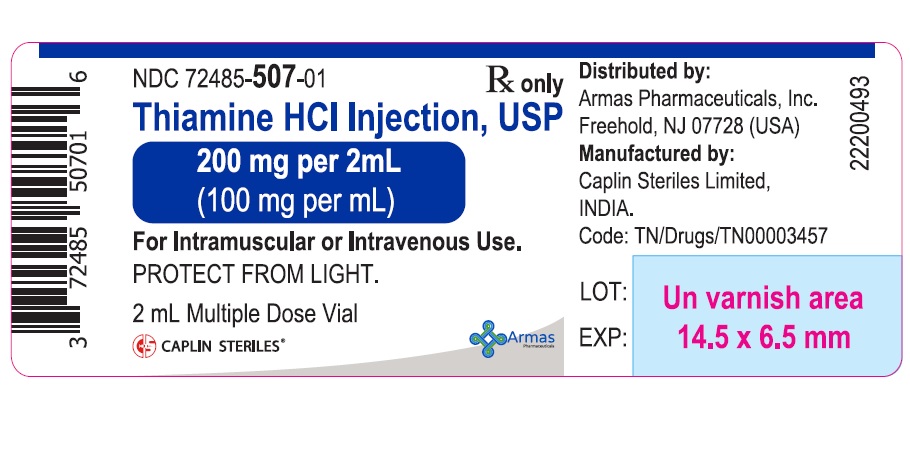
PACKAGE LABEL.PRINCIPAL DISPLAY PANEL Thiamine Hydrochloride Injection USP - 2 mL Multiple Dose Vial Label Rx Only NDC 72485-507-01 Thiamine Hydrochloride Injection USP, 200 mg/2 mL (100 mg/mL) For Intramuscular or Intravenous use. PROTECT FROM LIGHT. Thiamine Hydrochloride Injection USP - 2 mL Multiple Dose Carton Label Rx Only NDC 72485-507-25 25 × 2 mL Multiple-Dose Carton Thiamine Hydrochloride Injection USP, 200 mg/2 mL (100 mg/mL) For Intramuscular or Intravenous use.
PROTECT FROM LIGHT. Vial Carton