
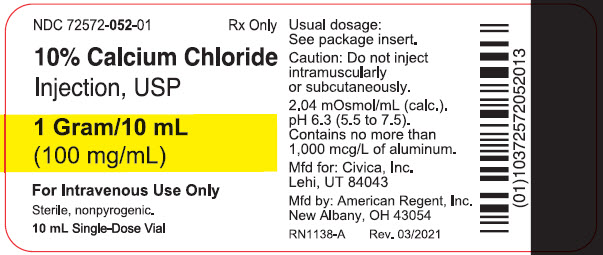
Calcium Chloride 100 mg/mL Injection, Solution — NDC 72572-052-10 (Billing 72572-0052-10)
This is a package of Calcium Chloride 100 mg/mL Injection, Solution from Civica, Inc., marketed since Apr 2021 and currently FDA-listed. It is this product's only package size.
Identity & classification
Regulatory identifiers FDA, NLM and CMS codes for this package
Drug-database identifiers Medi-Span GPI and First Databank GCN / HICL / AHFS classification
- GSN (GCN sequence number): 001350
- GCN: 03760
- GPI-14 (Medi-Span): 79100010002010
- HICL (First Databank): 000582
- AHFS class code: 40:12.00.00
- RxCUI (RxNorm): 828525
Where does this data come from?
- FDA openFDA NDC Directory · synced Oct 1, 2026
- FDA label on DailyMed · label index refreshed Oct 1, 2026
- RxNorm (NLM RxNav) · catalog refreshed Oct 1, 2026
- Medi-Span GPI (licensed)
- First Databank (licensed) · refreshed Oct 1, 2026
RxNorm drug class
This medicine belongs to the Calcium class.
Where does this data come from?
- RxClass (NLM) · catalog refreshed Oct 1, 2026
Clinical
Calcium injection is used in children and adults to treat low levels of calcium in the body. Calcium is in a class of medications called minerals. It works by increasing the supply of calcium necessary for many of the body's functions.
Read the full MedlinePlus article ↗- When your calcium level drops to a dangerous level very quickly, your body needs calcium delivered directly into the bloodstream right away — there's no time to wait for a pill to...
- Why am I getting calcium chloride through an IV instead of just taking a calcium pill?
- Many people feel a warm or flushing sensation, a tingling (especially if it goes in a little fast), or notice a chalky or metallic taste. Some feel mild pressure or a burning sensa...
- This is a really important thing for your care team to know. Calcium chloride and digoxin together can cause dangerous heart rhythm problems, so your team will generally try to avo...
Patient education
Supplement & herbal interactions
Where does this data come from?
- MedlinePlus (NLM) · refreshed Oct 1, 2026
- FDA label on DailyMed · label index refreshed Oct 1, 2026
Ask a licensed pharmacist directly — free, answered by our team.
Pricing
A drug doesn't have one price. Each row is a different public payment system, and none is what you'd pay at the counter — that depends on your insurance. The ⓘ on each row explains what it measures.
| Price system | Per mL | Per package |
|---|---|---|
| Retail pharmacies payNADAC · weekly | Not in the retail survey — common for institutional, discontinued, or low-volume packs. | |
| Medicaid paysCMS SDUD · 12 mo | No recent Medicaid claims on file for this NDC — rare and low-volume NDCs are suppressed in the public data. | |
| Medicare drug plans payPart D · quarterly | No Part D plan price is available for this NDC in our data. | |
| Medicare Part B allowsASP · J0618 | No ASP payment limit on file for J0618 this quarter. | |
Where does this data come from?
- CMS NADAC weekly file
- CMS ASP pricing files · refreshed Sep 20, 2026
- CMS Medicaid State Drug Utilization Data · refreshed Oct 3, 2026
- CMS Part D plan pricing files · refreshed Sep 24, 2026
- VA National Acquisition Center price file
Billing & reimbursement
Where does this data come from?
- CMS ASP NDC-HCPCS crosswalk · refreshed Sep 22, 2026
- DMEPDAC NDC-HCPCS crosswalk
- openFDA NSDE billing units · refreshed Sep 7, 2026
Packaging — all sizes for this product
| Package NDC | Description | Marketing start | Marketing end | Status |
|---|---|---|---|---|
| 72572-0052-10 You're viewing this Main listing | 10 VIAL, GLASS in 1 BOX / 10 mL in 1 VIAL, GLASS | 2021-04-02 | — | Active |
Therapeutic equivalents
| Product | Labeler | Pack | NADAC/unit | TE | Status | Price vs. this |
|---|---|---|---|---|---|---|
| Calcium Chloride 100 mg/mL 00404-9830-10 | Henry | 1 syringe | — | AP | FDA listed | — |
| Calcium Chloride 100 mg/mL 00517-6710-10 | American | 10 vials | — | AP | FDA listed | — |
| Calcium Chloride Dihydrate 100 mg/mL 70069-0773-10 | Somerset | 10 vials | — | AP | FDA listed | — |
| calcium chloride 100 mg/mL 70121-2309-07 | Amneal | 10 vials | — | AP | FDA listed | — |
| Calcium Chloride 100 mg/mLthis 72572-0052-10 | Civica, | 10 vials | — | AP | FDA listed | — |
| Calcium Chloride 100 mg/mL 75907-0223-10 | Dr. | 10 vials | — | AP | FDA listed | — |
| calcium chloride 100 mg/mL 76483-0108-02 | SQUARE | 10 vials | — | AP | FDA listed | — |
| Calcium Chloride 100 mg/mL 71872-7045-01 | Medical | 1 syringe | — | AP | FDA listed | — |
| Calcium Chloride 100 mg/mL 00409-1631-10 | Hospira, | 1 syringe | — | AP | FDA listed | — |
| calcium chloride 100 mg/mL 70121-2308-04 | Amneal | 1 syringe | — | AP | FDA listed | — |
| Calcium Chloride 100 mg/mL 51662-1452-01 | HF | 1 syringe | — | AP | FDA listed | — |
| calcium chloride 100 mg/mL 00121-1099-02 | PAI | 10 vials | — | AP | FDA listed | — |
| calcium chloride 100 mg/mL 72658-1879-02 | Eskayef | 10 vials | — | AP | FDA listed | — |
Where does this data come from?
- FDA openFDA NDC Directory · synced Oct 1, 2026
- FDA Orange Book · refreshed Sep 3, 2026
- CMS NADAC weekly file
Availability & generic status
This product is an FDA-approved generic. Other versions of the same drug are listed under Therapeutic equivalents, least expensive first.
Where does this data come from?
- FDA Orange Book · refreshed Sep 3, 2026
Inactive Ingredients / Excipients
Inactive ingredients, also called excipients, are components of the drug product other than the active ingredient. They may include fillers, dyes, coatings, preservatives, flavors, or other formulation ingredients.
💡 Tap an ingredient (hover on desktop) to see what it is and why it’s used.
-
UNII QTT17582CB
A strong acid used to adjust and maintain the proper pH level in liquid medicines, ensuring stability and preventing breakdown of active ingredients.
-
UNII 55X04QC32I
A strong alkaline chemical used to adjust and maintain the pH balance of liquid medicines. It helps keep the medicine stable and ensures it stays effective during storage.
-
UNII 059QF0KO0R
Water is a liquid solvent that dissolves and mixes ingredients together in liquid medicines, syrups, and injections. It helps distribute the active drug evenly throughout the product.
3 inactive ingredients listed in the exact product block matched to this NDC.
Where does this data come from?
ingredient classCode="IACT" elements from the exact product block matched by this NDC. Label-section narrative from DailyMed / the openFDA label index is shown separately when available.- FDA label on DailyMed · label index refreshed Oct 1, 2026
- FDA openFDA NDC Directory · synced Oct 1, 2026
Inactive ingredient FAQ
Are inactive ingredients the same for every manufacturer?
Why might an inactive ingredient be missing?
Can inactive ingredients matter?
Manufacturer & labeler
Where does this data come from?
- FDA openFDA NDC Directory · synced Oct 1, 2026
- Drugs@FDA
Full prescribing information FDA SPL
🎯 Indications and Usage ▾
1 INDICATIONS AND USAGE Calcium Chloride Injection is indicated for the treatment of adult and pediatric patients with acute symptomatic hypocalcemia. Limitations of Use The safety and effectiveness of Calcium Chloride Injection for long-term use has not been established. Calcium Chloride Injection is a form of calcium indicated for the treatment of adult and pediatric and patients with acute symptomatic hypocalcemia.
( 1 ) Limitations of Use : The safety and effectiveness of Calcium Chloride Injection for long-term use has not been established
⏱️ Dosage and Administration ▾
2 DOSAGE AND ADMINISTRATION Administer Calcium Chloride Injection by slow intravenous infusion (not to exceed 1 mL/minute), in a central or deep vein. ( 2.1 ) Do not use intramuscularly or subcutaneously. ( 2.1 ) Do not administer unless solution is clear and seal is intact.
( 2.1 ) Stop the administration if the patient complains of any administration- related discomfort, it may be resumed when symptoms disappear. ( 2. 1) The recommended adult dose is from 200 mg to 1,000 mg.
( 2. 2) The recommended pediatric dose is from 2.7 to 5 mg/kg of calcium chloride. ( 2.2 ) Repeated injections may be required because of rapid calcium excretion.
( 2.2 ) See the full prescribing information for the recommended starting dose in patients with renal impairment. ( 2.3 ) Do not mix Calcium Chloride Injection with ceftriaxone or administer these products simultaneously via a Y-site because concurrent use can lead to the formation of ceftriaxone-calcium precipitates. ( 2.4 )
2.1Important Administration Instructions Administer Calcium Chloride Injection by slow intravenous infusion in a central or deep vein in adults and pediatric patients (with or without renal impairment); do not administer by bolus [see Warnings and Precautions ( 5.2 , 5.4 )] . The maximum recommended infusion rate is 1 mL/minute (100 mg/minute). Additional important administration instructions regarding Calcium Chloride Injection are as follows: Do not use intramuscularly or subcutaneously to avoid tissue necrosis calcinosis cutis [see Warnings and Precautions ( 5.4 )] .
Visually inspect for particulate matter and discoloration prior to administration (the solution is clear, and the seal is intact). Do not administer if the solution is unclear or the seal is not intact. Stop the administration if the patient complains of any administration-related discomfort; administration may be resumed when symptoms disappear.
Discard the unused portion. If time permits, allow the solution to warm to body temperature.
2.2Recommended Dosage and Administration The recommended dose range of Calcium Chloride Injection in: Adults is from 200 mg to 1,000 mg. Pediatric patients is from 2.7 to 5 mg/kg of calcium chloride. Dosing of this Calcium Chloride Injection product is not possible in patients who require doses less than 200 mg because the recommended dose cannot be achieved with the supplied vial.
For patients who require doses less than 200 mg, use another calcium chloride injection product that allows dosing of less than 200 mg. Individualize the dose for a patient within these dose ranges depending on serum ionized calcium level, severity of hypocalcemia symptoms, and the acuity of hypocalcemia onset. Repeated injections may be required because of rapid excretion of calcium.
2.3Recommended Starting Dose in Patients with Renal Impairment The recommended starting dose of Calcium Chloride Injection in [see Use in Specific Populations ( 8.6) ] : Adults with renal impairment is 200 mg. Pediatric patients is 2.7 mg/kg of calcium chloride.
2.4Drug Incompatibilities Do not mix Calcium Chloride Injection with other drugs simultaneously. Do not mix Calcium Chloride Injection with ceftriaxone or administer these products simultaneously via a Y-site because concurrent use can lead to the formation of ceftriaxone-calcium precipitates [see Warnings and Precautions ( 5.1 )]: In neonates (28 days of age or younger), concomitant use of Calcium Chloride Injection and ceftriaxone is contraindicated [see Contraindications ( 4 )] . In patients older than 28 days of age, ceftriaxone and calcium-containing products may be administered sequentially, provided the infusion lines are thoroughly flushed between infusions with a compatible fluid.
💊 Dosage Forms and Strengths ▾
3 DOSAGE FORMS AND STRENGTHS Calcium Chloride Injection, USP (single-dose) supplied as: 10% 1 gram/10 mL (100 mg/mL) in a glass vial. The 100 mg/mL concentration represents 27 mg or 1.4 mEq of elemental calcium per mL of solution. Calcium Chloride Injection, USP (single-dose) is supplied as: ( 3 ) 10% (1 gram /10 mL) (100 mg/mL) in a glass vial. The 100 mg/mL concentration represents 27 mg or 1.4 mEq of elemental calcium per mL of solution. ( 3 )
⛔ Contraindications ▾
4 CONTRAINDICATIONS Calcium Chloride Injection is contraindicated in: Patients with ventricular fibrillation Patients with asystole and electromechanical dissociation Newborns (up to 28 days of age) if they require (or are expected to require) ceftriaxone intravenous treatment because of the risk of precipitation of ceftriaxone-calcium, regardless of whether these products would be received at different times or through separate intravenous lines [see Warnings and Precautions ( 5.1 )] . Calcium Chloride Injection is contraindicated in: Patients with ventricular fibrillation.
( 4 ) Patients with asystole and electromechanical dissociation. ( 4 ) Newborns (up to 28 days of age) if they require (or are expected to require) ceftriaxone intravenous treatment, regardless of whether these products would be received at different times or through separate intravenous lines ( 4 , 5.1 )] .
⚠️ Warnings and Cautions ▾
5 WARNINGS AND PRECAUTIONS End-Organ Damage due to Intravascular Ceftriaxone-Calcium Precipitates: Calcium Chloride Injection is contraindicated in newborns (up to 28 days of age) if they require (or are expected to require) ceftriaxone intravenous treatment. In patients older than 28 days of age, do not mix or administer simultaneously with ceftriaxone intravenous solutions, even via different infusion lines or at different infusion sites as it can lead to precipitation of ceftriaxone-calcium. ( 5.1 ) Hypotension, Bradycardia, Arrhythmias, and Syncope with Rapid Administration: Too rapid an injection exceeding 1 mL/minute may lead to hypotension and syncope.
( 2.1 , 5.2 ) Arrhythmias with Concomitant Digoxin Use: Avoid use of Calcium Chloride Injection in patients receiving digoxin. Closely monitor ECG and calcium levels if concomitant therapy is necessary. ( 5.3 , 7.1 ) Tissue Necrosis and Calcinosis: Administer Calcium Chloride Injection slowly through a small needle into a large vein to minimize the risk of tissue necrosis, ulceration and calcinosis.
Avoid extravasation or accidental injection into perivascular tissues. Immediately discontinue administration should perivascular infiltration occur. ( 2.1 , 5.4 ) Aluminum Toxicity: Risk of toxicity with prolonged administration if kidney function is impaired.
Premature neonates are particularly at risk. When prescribing Calcium Chloride Injection in patients receiving parenteral nutrition solutions, limit the total daily patient exposure to aluminum to no more than 5 mcg/kg/day. ( 5.5 )
5.1End-Organ Damage due to Intravascular Ceftriaxone-Calcium Precipitates The use of Calcium Chloride Injection is contraindicated in newborns (up to 28 days of age) if they require (or are expected to require) ceftriaxone intravenous treatment because of the risk of precipitation of ceftriaxone-calcium, regardless of whether these products would be received at different times or through separate intravenous lines [see Contraindications (4)]. Cases of fatal reactions with calcium-ceftriaxone precipitates in lungs and kidneys in premature and full-term newborns aged less than 1 month have occurred when ceftriaxone and calcium were administered either simultaneously or non-simultaneously and through different intravenous lines.
In-vitro studies demonstrated that neonates have an increased risk of precipitation of ceftriaxone-calcium compared to other age groups. In patients older than 28 days of age, Calcium Chloride Injection and ceftriaxone intravenous solutions may be administered sequentially one after another if infusion lines at different sites are used, infusion lines are replaced, or infusion lines are thoroughly flushed between infusions with physiological salt solution to avoid precipitation. Do not mix or administer Calcium Chloride Injection simultaneously with ceftriaxone, even if using different infusion lines or different infusion sites as it can lead to precipitation of ceftriaxone-calcium [see Dosage and Administration ( 2.4 )] .
5.2Hypotension, Bradycardia, Arrhythmias, and Syncope with Rapid Administration Rapid injection of Calcium Chloride Injection may cause vasodilation, decreased blood pressure, bradycardia, arrhythmias, syncope, and cardiac arrest. It is particularly important to prevent a high concentration of calcium from reaching the heart because of the risk of syncope. Too rapid an injection exceeding 1 mL/minute may lead to hypotension and cardiac syncope [see Dosage and Administration ( 2.1 )].
5.3Arrhythmias with Concomitant Digoxin Use Arrhythmias may occur if Calcium Chloride Injection and digoxin are administered together. Hypercalcemia resulting from an overdose of Calcium Chloride Injection increases the risk of digoxin toxicity. Avoid the use of Calcium Chloride Injection in patients receiving digoxin. If concomitant therapy is necessary, closely monitor ECG and calcium levels [see Drug Interactions ( 7.1 )] .
5.4Tissue Necrosis and Calcinosis Administ… [Excerpted — this section continues on DailyMed.]
🤒 Adverse Reactions ▾
6 ADVERSE REACTIONS The following serious adverse reactions are also described elsewhere in the labeling: • End-Organ Damage due to Intravascular Ceftriaxone-Calcium Precipitates [see Warnings and Precautions ( 5.1 )] • Hypotension, Bradycardia, Arrhythmias, and Syncope with Rapid Administration [see Warnings and Precautions ( 5.2 )] • Arrhythmias with Concomitant Digoxin Use [see Warnings and Precautions ( 5.3 )] • Tissue Necrosis and Calcinosis [see Warnings and Precautions ( 5.4 )] • Aluminum toxicity [see Warnings and Precautions ( 5.5 )] The following adverse reactions have been identified in literature and postmarketing reports of calcium chloride.
Because some of these reactions were reported voluntarily from a population of uncertain size, it is not always possible to reliably estimate their frequency or establish a causal relationship to drug exposure: • Nervous system disorders: Paraesthesia (upon rapid injection), calcium taste • General disorders and administration site conditions: Sense of oppression, sense of “heat wave”, local burning sensation, injection site extravasation, injection site reactions • Cardiovascular disorders: Peripheral vasodilatation, decreased blood pressure Adverse reactions have included paraesthesia (upon rapid injection), calcium taste, sense of oppression, sense of “heat wave”, local burning sensation, injection site extravasation, injection site reactions, peripheral vasodilatation, and decreased blood pressure.
(6) To report SUSPECTED ADVERSE REACTIONS, contact American Regent, Inc. at 1-800-734-9236or FDA at 1-800-FDA-1088 or www.fda.gov/medwatch .
🔄 Drug Interactions ▾
7 DRUG INTERACTIONS Digoxin: Avoid concomitant use with Calcium Chloride Injection. If concomitant use is unavoidable, monitor ECG closely during administration of Calcium Chloride Injection. ( 5.3 , 7.1 ) Calcium Channel Blockers: Avoid concomitant use with Calcium Chloride Injection.
If concomitant use is unavoidable, monitor blood pressure closely during administration of Calcium Chloride Injection. ( 7.2 ) Drugs That Increase the Risk of Hypercalcemia: Increase the frequency of calcium concentration monitoring in patients taking Calcium Chloride Injection concomitantly with other drugs that increase the risk of hypercalcemia. ( 7.3 )
7.1Digoxin Avoid the concomitant use of Calcium Chloride Injection with digoxin. If concomitant use is unavoidable, monitor ECG closely during administration of Calcium Chloride Injection. Synergistic arrhythmias may occur with concomitant use. The use of Calcium Chloride Injection may result in hypercalcemia which increases the risk of digoxin toxicity [see Warnings and Precautions ( 5.3 )] .
7.2Calcium Channel Blockers Concomitant use of Calcium Chloride Injection and calcium channel blockers may reduce the response to calcium channel blockers. Avoid concomitant use. If concomitant use is unavoidable, monitor blood pressure closely during administration of Calcium Chloride Injection.
7.3Drugs That Increase the Risk of Hypercalcemia Increase frequency of monitoring of calcium concentrations in patients taking concomitant Calcium Chloride Injection and other drugs that increase the risk of hypercalcemia (e.g., calcipotriene, estrogen, lithium, parathyroid hormone, teriparatide, thiazide diuretics, Vitamin A, and Vitamin D).
👥 Use in Specific Populations ▾
8 USE IN SPECIFIC POPULATIONS
8.1Pregnancy Risk Summary Administration of Calcium Chloride Injection for the treatment of acute symptomatic hypocalcemia during pregnancy is not expected to cause major birth defects, miscarriage, or adverse maternal or fetal outcomes. There are risks to the mother and the fetus associated with development of hypocalcemia during pregnancy (see Clinical Considerations). Animal reproduction studies have not been conducted with Calcium Chloride Injection.
The estimated background risk of major birth defects and miscarriage for the indicated populations are unknown. All pregnancies have a background risk of birth defect, loss, or other adverse outcomes. In the U.S. general population, the estimated background risk of major birth defects and miscarriage in clinically recognized pregnancies is 2 to 4% and 15 to 20%, respectively.
Clinical Considerations Disease-associated Maternal and/or Embryo/Fetal/Neonatal Risk Maternal hypocalcemia can result in an increased rate of spontaneous abortion, premature and dysfunctional labor, and possibly preeclampsia. Infants born to mothers with hypocalcemia can develop fetal and neonatal hyperparathyroidism, which in turn can cause fetal and neonatal skeletal demineralization, subperiosteal bone resorption, osteitis fibrosa cystica and neonatal seizures.
8.2Lactation Risk Summary Calcium is present in human milk. Administration of the approved recommended dose of Calcium Chloride Injection to the mother is not expected to cause harm to a breastfed infant. There is no information on the effects of Calcium Chloride Injection on the breastfed infant or on milk production.
The developmental and health benefits of breastfeeding should be considered along with the mother’s clinical need for Calcium Chloride Injection and any potential adverse effects on the breastfed infant from Calcium Chloride Injection or from the underlying maternal condition.
8.4Pediatric Use The safety and effectiveness of Calcium Chloride Injection for the treatment of acute symptomatic hypocalcemia have been established in pediatric patients. The use of Calcium Chloride Injection is contraindicated in newborns if they require (or are expected to require) ceftriaxone intravenous treatment because of the risk of precipitation of ceftriaxone-calcium, regardless of whether these products would be received at different times or through separate intravenous lines [see Contraindications (4) and Warnings and Precautions ( 5.1 )].
In pediatric patients older than 28 days of age, Calcium Chloride Injection and ceftriaxone intravenous solutions may be administered sequentially one after another if infusion lines at different sites are used, infusion lines are replaced, or infusion lines are thoroughly flushed between infusions with physiological salt solution to avoid precipitation. Do not mix or administer Calcium Chloride Injection simultaneously with ceftriaxone, even if using different infusion lines or different infusion sites as it can lead to precipitation of ceftriaxone-calcium.
Calcium Chloride Injection contains aluminum that may be associated with central nervous system and bone toxicity. Because of immature renal function, preterm infants receiving prolonged parenteral nutrition treatment with Calcium Chloride Injection may be at higher risk of aluminum toxicity [see Warnings and Precautions ( 5.2 )].
8.5Geriatric Use Clinical studies of Calcium Chloride Injection did not include sufficient numbers of patients 65 years of age and older to determine whether they respond differently from younger adult patients.
8.6Renal Impairment The use of Calcium Chloride Injection in patients with renal impairment may increase the risk of a higher calcium-phosphorus product. For patients with renal impairment, initiate Calcium Chloride Injection at the lowest recommended dose within the recommended dose range [see Dosage and Administration ( 2.2 )] . Monitor serum calcium levels frequently based on the se… [Excerpted — this section continues on DailyMed.]
🤰 Pregnancy ▾
8.1Pregnancy Risk Summary Administration of Calcium Chloride Injection for the treatment of acute symptomatic hypocalcemia during pregnancy is not expected to cause major birth defects, miscarriage, or adverse maternal or fetal outcomes. There are risks to the mother and the fetus associated with development of hypocalcemia during pregnancy (see Clinical Considerations). Animal reproduction studies have not been conducted with Calcium Chloride Injection.
The estimated background risk of major birth defects and miscarriage for the indicated populations are unknown. All pregnancies have a background risk of birth defect, loss, or other adverse outcomes. In the U.S. general population, the estimated background risk of major birth defects and miscarriage in clinically recognized pregnancies is 2 to 4% and 15 to 20%, respectively.
Clinical Considerations Disease-associated Maternal and/or Embryo/Fetal/Neonatal Risk Maternal hypocalcemia can result in an increased rate of spontaneous abortion, premature and dysfunctional labor, and possibly preeclampsia. Infants born to mothers with hypocalcemia can develop fetal and neonatal hyperparathyroidism, which in turn can cause fetal and neonatal skeletal demineralization, subperiosteal bone resorption, osteitis fibrosa cystica and neonatal seizures.
🧒 Pediatric Use ▾
8.4Pediatric Use The safety and effectiveness of Calcium Chloride Injection for the treatment of acute symptomatic hypocalcemia have been established in pediatric patients. The use of Calcium Chloride Injection is contraindicated in newborns if they require (or are expected to require) ceftriaxone intravenous treatment because of the risk of precipitation of ceftriaxone-calcium, regardless of whether these products would be received at different times or through separate intravenous lines [see Contraindications (4) and Warnings and Precautions ( 5.1 )].
In pediatric patients older than 28 days of age, Calcium Chloride Injection and ceftriaxone intravenous solutions may be administered sequentially one after another if infusion lines at different sites are used, infusion lines are replaced, or infusion lines are thoroughly flushed between infusions with physiological salt solution to avoid precipitation. Do not mix or administer Calcium Chloride Injection simultaneously with ceftriaxone, even if using different infusion lines or different infusion sites as it can lead to precipitation of ceftriaxone-calcium.
Calcium Chloride Injection contains aluminum that may be associated with central nervous system and bone toxicity. Because of immature renal function, preterm infants receiving prolonged parenteral nutrition treatment with Calcium Chloride Injection may be at higher risk of aluminum toxicity [see Warnings and Precautions ( 5.2 )].
🧓 Geriatric Use ▾
8.5Geriatric Use Clinical studies of Calcium Chloride Injection did not include sufficient numbers of patients 65 years of age and older to determine whether they respond differently from younger adult patients.
🆘 Overdosage ▾
10 OVERDOSAGE Overdosage of Calcium Chloride Injection may lead to hypercalcemia. Symptoms of hypercalcemia typically develop when the total serum calcium concentration is ≥12 mg/dL, and include shortening of QT interval, bradycardia, hypertension, anorexia, nausea, vomiting, bowel hypomotility and constipation, muscle weakness, bone pain, decreased concentration, depression, weakness, fatigue, confusion, hallucinations, disorientation, hypotonicity, seizures, and coma. Hypercalcemia effects on kidney include diminished ability to concentrate urine and diuresis.
In the event of overdosage, promptly discontinue Calcium Chloride Injection, the patient should be re- evaluated and appropriate countermeasures should be instituted, if necessary [see Warnings and Precautions ( 5 ), Adverse Reactions ( 6 )] .
🧬 Clinical Pharmacology ▾
12 CLINICAL PHARMACOLOGY
12.1Mechanism of Action Intravenous administration of calcium chloride increases serum ionized calcium concentration. Calcium chloride dissociates into ionized calcium in plasma.
12.2Pharmacodynamics The exposure-response relationship and time course of pharmacodynamic response for the safety and effectiveness of Calcium Chloride Injection have not been fully characterized.
12.3Pharmacokinetics Absorption Calcium Chloride Injection is 100% bioavailable following intravenous injection. Distribution Calcium in the body is distributed mainly in skeleton (99%) and 1% is distributed within the extracellular fluids and soft tissues. About 50% of total serum calcium is in the ionized form and represents the biologically active part; 8% to 10% serum calcium is bound to organic and inorganic acid, respectively; and approximately 40% is protein-bound (primarily to albumin).
Elimination Metabolism Calcium itself does not undergo direct metabolism. Excretion Calcium is excreted by the kidney through a combination of glomerular filtration and tubular reabsorption. A significant increase in urinary excretion of calcium was observed during and after intravenous infusion of calcium chloride.
Specific Populations The effect of age, sex, race, ethnicity, renal or hepatic impairment on the pharmacokinetics of calcium have not been evaluated in clinical studies.
🧬 Mechanism of Action ▾
12.1Mechanism of Action Intravenous administration of calcium chloride increases serum ionized calcium concentration. Calcium chloride dissociates into ionized calcium in plasma.
📦 How Supplied / Storage and Handling ▾
16 HOW SUPPLIED/STORAGE AND HANDLING Calcium Chloride Injection, USP (clear solution) is supplied in single-dose vials as follows: Unit of Sale and Product Description Strength NDC Each carton contains 10 single-dose vials. 10% (1,000 mg/10 mL) (100 mg/mL) 72572- 052 -10 The 100 mg/mL concentration represents 27 mg or 1.4 mEq of elemental calcium per mL of solution. Store at 20°C to 25°C (68°F to 77°F); excursions permitted between 15°C and 30°C (59°F and 86°F). [See USP Controlled Room Temperature.]
📋 Description ▾
11 DESCRIPTION 10% Calcium Chloride Injection, USP is a sterile, nonpyrogenic, hypertonic solution for single administration only. Each mL contains 100 mg (1.4 mEq/mL) of calcium chloride, dihydrate (1.4 mEq each of Ca ++ and Cl - ) in water for injection. It is provided in a 10 mL single-dose vial for intravenous injection.
The solution contains no bacteriostat, antimicrobial agent or added buffer. The pH of 10% Calcium Chloride Injection, USP is 6.3 (5.5 to 7.5) when diluted with water for injection to make a 5% solution. May contain hydrochloric acid and/or sodium hydroxide for pH adjustment.
The osmolar concentration is 2.04 mOsmol/mL (calc.). 10% Calcium Chloride Injection, USP is oxygen sensitive. Calcium Chloride, USP dihydrate is chemically designated CaCl 2 • 2H 2 O (dihydrate) and is described as white, odorless fragments or granules freely soluble in water.
Calcium Chloride Injection, USP contains no more than 1,000 mcg/L of aluminum [see Warnings and Precautions ( 5.2 )].
💬 Information for Patients ▾
17 PATIENT COUNSELING INFORMATION Inform patients or caregivers of the following risks of Calcium Chloride Injection: Arrhythmias with Concomitant Digoxin Use Arrhythmias may occur if Calcium Chloride Injection and Digoxin are administered together [see Warnings and Precautions ( 5.3 )]. Tissue Necrosis and Calcinosis Administration of Calcium Chloride Injection may result in calcinosis cutis including tissue necrosis, ulceration, and secondary infection. [see Warnings and Precautions ( 5.4 )] . Aluminum Toxicity Calcium Chloride Injection contains aluminum that may be toxic [see Warnings and Precautions ( 5.5 )].
Mfd for: Civica, Inc. Lehi, Utah 84043 Mfd by: American Regent, Inc. New Albany, OH 43054 RQ1098-B Revised 03/2024 civicacompanylogo
🧬 Pharmacokinetics ▾
12.3Pharmacokinetics Absorption Calcium Chloride Injection is 100% bioavailable following intravenous injection. Distribution Calcium in the body is distributed mainly in skeleton (99%) and 1% is distributed within the extracellular fluids and soft tissues. About 50% of total serum calcium is in the ionized form and represents the biologically active part; 8% to 10% serum calcium is bound to organic and inorganic acid, respectively; and approximately 40% is protein-bound (primarily to albumin).
Elimination Metabolism Calcium itself does not undergo direct metabolism. Excretion Calcium is excreted by the kidney through a combination of glomerular filtration and tubular reabsorption. A significant increase in urinary excretion of calcium was observed during and after intravenous infusion of calcium chloride.
Specific Populations The effect of age, sex, race, ethnicity, renal or hepatic impairment on the pharmacokinetics of calcium have not been evaluated in clinical studies.
🧬 Pharmacodynamics ▾
12.2Pharmacodynamics The exposure-response relationship and time course of pharmacodynamic response for the safety and effectiveness of Calcium Chloride Injection have not been fully characterized.
🧪 Nonclinical Toxicology ▾
13 NONCLINICAL TOXICOLOGY
13.1Carcinogenesis, Mutagenesis, Impairment of Fertility Carcinogenicity, mutagenicity, and fertility have not been assessed with Calcium Chloride Injection.
📄 Carcinogenesis, Mutagenesis, Impairment of Fertility ▾
13.1Carcinogenesis, Mutagenesis, Impairment of Fertility Carcinogenicity, mutagenicity, and fertility have not been assessed with Calcium Chloride Injection.
📄 Package Label / Principal Display Panel ▾
PRINCIPAL DISPLAY PANEL - Container Label NDC 72572- 052 -10 Rx Only 10% Calcium Chloride Injection, USP 1 Gram/10 mL (100 mg/mL) For Intravenous Use Only Sterile, nonpyrogenic. 10 mL Single-dose Vial vial label
PRINCIPAL DISPLAY PANEL - Carton Labeling NDC 72572-052-10 Rx Only 10% Calcium Chloride Injection, USP 1 Gram/10 mL (100 mg/mL) Represents 27 mg (1.4 mEq) Ca**/mL For Intravenous Use Only 10 x 10 mL Single-dose Vials Mfd for: Civica, Inc., Lehi, UT 84043 Mfd by: American Regent, Inc. New Albany, OH 43054 carton10ml
About this NDC listing & data coverage
What data is (and isn’t) available for this NDC — tap to expand
| NDC identity (package / product / labeler codes) | ✓ Available |
| Labeler | ✓ Available |
| Product & package description | ✓ Available |
| Marketing category & status | ✓ Available |
| Active ingredient / dosage form / route | ✓ Available |
| FDA label (SPL via DailyMed) | ✓ Available |
| Package photos | ✓ Available |
| Inactive ingredients (structured) | ✓ Available |
| NADAC pharmacy acquisition price (CMS) | — Not published for this NDC CMS publishes NADAC only for NDCs reported in its retail-pharmacy survey. |
| Orange Book / therapeutic-equivalence data | ✓ Available |
| HCPCS J-code billing crosswalk | ✓ Available |
| Medicaid utilization (CMS SDUD) | — Not published for this NDC CMS reports utilization only for NDCs with Medicaid claims above its privacy threshold. |