
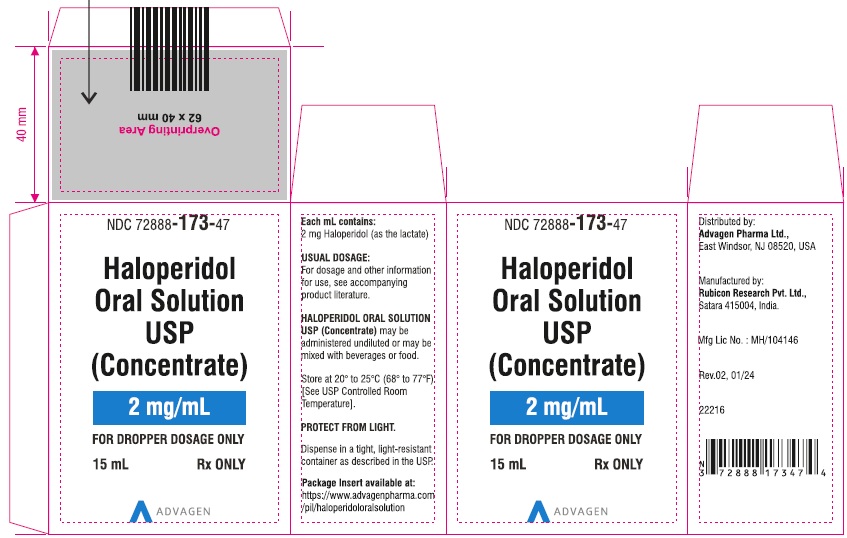
Haloperidol 2 mg/mL Solution, Concentrate, 15 mL — NDC 72888-173-47 (Billing 72888-0173-47)
This is a package of 15 mL of Haloperidol 2 mg/mL Solution, Concentrate from Advagen Pharma Ltd, marketed since Jan 2024 and currently FDA-listed; retail pharmacies pay about $0.6752 per mL (NADAC).
Identity & classification
Regulatory identifiers FDA, NLM and CMS codes for this package
Drug-database identifiers Medi-Span GPI and First Databank GCN / HICL / AHFS classification
- GSN (GCN sequence number): 003971
- GCN: 15520
- GPI-14 (Medi-Span): 59100010201305
- HICL (First Databank): 001661
- AHFS class code: 28:16.08.08
- RxCUI (RxNorm): 141935
Where does this data come from?
- FDA openFDA NDC Directory · synced Oct 1, 2026
- FDA label on DailyMed · label index refreshed Oct 1, 2026
- RxNorm (NLM RxNav) · catalog refreshed Oct 1, 2026
- Medi-Span GPI (licensed)
- First Databank (licensed) · refreshed Oct 1, 2026
RxNorm drug class
This medicine belongs to the Typical Antipsychotic class.
Where does this data come from?
- RxClass (NLM) · catalog refreshed Oct 1, 2026
Clinical
Haloperidol is used to manage psychotic disorders (mental illness that cause disturbed or unusual thinking, loss of interest in life, and strong or inappropriate emotions). It is also used to control motor tics (uncontrollable need to repeat certain body movements) and verbal tics (uncontrollable need to repeat sounds or words) in people who have Tourette's disorder (condition characterized by motor or verbal tics). Haloperidol is in a group of medications called antipsychotics. It works by changing the activity of certain natural substances.
Read the full MedlinePlus article ↗- It treats schizophrenia and other psychotic disorders. The tablets and oral solution are also used for Tourette’s tics and for certain severe behavior problems in children. Your pr...
- Tablets and oral solution are taken by mouth as your prescriber directs. Injections are given into a muscle by a healthcare provider, and Haldol Decanoate is given every 4 weeks. N...
- Movement-related effects are the most common, such as stiffness, tremor, restlessness, or slowed movement. Headache and stomach pain can also happen. Tell us about any new movement...
- Call for fever with severe stiffness and confusion, fainting or a racing or irregular heartbeat, seizures, or swelling and trouble breathing. These can be serious.
Patient education
Supplement & herbal interactions
Some supplements/herbs that may interact with Haloperidol — tap one for details:
Where does this data come from?
- MedlinePlus (NLM) · refreshed Oct 1, 2026
- FDA label on DailyMed · label index refreshed Oct 1, 2026
Ask a licensed pharmacist directly — free, answered by our team.
Pricing
A drug doesn't have one price. Each row is a different public payment system, and none is what you'd pay at the counter — that depends on your insurance. The ⓘ on each row explains what it measures.
| Price system | Per mL | Per package |
|---|---|---|
| Retail pharmacies payNADAC · weekly | $0.675 | $10.13 / 15 ml |
| Medicaid paysCMS SDUD · 12 mo | $0.5594 | $8.39 / 15 ml |
| Medicare drug plans payPart D · Q2 2026 | $0.2822 | $4.23 / 15 ml |
Where does this data come from?
- CMS NADAC weekly file · file of Sep 30, 2026
- CMS ASP pricing files · refreshed Sep 20, 2026
- CMS Medicaid State Drug Utilization Data · through Q1 2026
- CMS Part D plan pricing files · refreshed Sep 24, 2026
- VA National Acquisition Center price file
Packaging — all sizes for this product
| Package NDC | Description | Per unit | Per pack | Marketing start | Marketing end | Status |
|---|---|---|---|---|---|---|
| 72888-0173-47 You're viewing this | 15 mL in 1 BOTTLE | $0.6752 / mL | $10.13 | 2024-01-31 | — | Active |
| 72888-0173-48 72888-173-48 Main listing | 120 mL in 1 BOTTLE | $0.1775 / mL | $21.30 | 2024-01-31 | — | Active |
You're viewing the smallest of 2 pack sizes for this product.
Per mL, this pack runs about 280% above the cheapest pack (120 mL, $0.1775 vs $0.6752 NADAC).
This pack accounts for about 13% of this product's recent Medicaid fills; most go to the 120 ml pack. See all packs ↓
Pack size FAQ
What quantity is in this package?
How does this package differ from NDC 72888-0173-48?
What NDC number is used to bill for this package of Haloperidol 2 mg/mL Solution, Concentrate?
Prices are the latest CMS NADAC pharmacy acquisition cost per NDC; per-pack figures are per-unit × pack quantity, shown only when the pack is denominated in the same measure NADAC prices.
Therapeutic equivalents
| Product | Labeler | Pack | NADAC/unit | TE | Status | Price vs. this |
|---|---|---|---|---|---|---|
| Haloperidol 2 mg/mL 00121-0581-04 | PAI | 120 ml | $0.178 | AA | Availability likely | save 74% |
| Haloperidol 2 mg/mL 54838-0501-15 | Lannett | 15 ml | $0.675 | AA | Availability likely | — |
| Haloperidol 2 mg/mLthis 72888-0173-47 | Advagen | 15 ml | $0.675 | AA | Availability likely | — |
| Haloperidol 2 mg/mL 60687-0799-17 | American | 10 cups | — | AA | FDA listed | — |
Where does this data come from?
- FDA openFDA NDC Directory · synced Oct 1, 2026
- FDA Orange Book · refreshed Oct 3, 2026
- CMS NADAC weekly file · file of Sep 30, 2026
Availability & generic status
This product is an FDA-approved generic. Other versions of the same drug are listed under Therapeutic equivalents, least expensive first.
Where does this data come from?
- FDA Orange Book · refreshed Oct 3, 2026
What it looks like
Where does this data come from?
- FDA label on DailyMed · label index refreshed Oct 1, 2026
Inactive Ingredients / Excipients
Inactive ingredients, also called excipients, are components of the drug product other than the active ingredient. They may include fillers, dyes, coatings, preservatives, flavors, or other formulation ingredients.
💡 Tap an ingredient (hover on desktop) to see what it is and why it’s used.
-
UNII 33X04XA5AT
Lactic acid is a naturally occurring organic acid derived from milk or plant sources. It lowers and maintains pH in formulations, helps preserve the product, and can enhance ingredient stability and absorption.
-
UNII A2I8C7HI9T
Methylparaben is a preservative derived from benzoic acid that prevents growth of bacteria, fungi, and mold in medicines. It extends the product's shelf life and maintains safety during storage.
-
UNII 6DC9Q167V3
Propylene glycol is a clear liquid derived from petroleum or vegetable sources. It acts as a solvent, humectant, and preservative in medicines, helping dissolve active ingredients and maintain product stability.
-
UNII Z8IX2SC1OH
Propylparaben is a chemical preservative used to prevent bacterial and fungal growth in medicines and personal care products. It helps extend shelf life and maintain product safety during storage.
-
UNII 059QF0KO0R
Water is a liquid solvent that dissolves and mixes ingredients together in liquid medicines, syrups, and injections. It helps distribute the active drug evenly throughout the product.
5 inactive ingredients listed in the exact product block matched to this NDC.
Where does this data come from?
ingredient classCode="IACT" elements from the exact product block matched by this NDC. Label-section narrative from DailyMed / the openFDA label index is shown separately when available.- FDA label on DailyMed · label index refreshed Oct 1, 2026
- FDA openFDA NDC Directory · synced Oct 1, 2026
Inactive ingredient FAQ
Are inactive ingredients the same for every manufacturer?
Why might an inactive ingredient be missing?
Can inactive ingredients matter?
Manufacturer & labeler
Where does this data come from?
- FDA openFDA NDC Directory · synced Oct 1, 2026
- Drugs@FDA
Full prescribing information FDA SPL
🚨 Boxed Warning ▾
WARNING Increased Mortality in Elderly Patients With Dementia-Related Psychosis Elderly patients with dementia-related psychosis treated with antipsychotic drugs are at an increased risk of death. Analyses of seventeen placebo-controlled trials (modal duration of 10 weeks), largely in patients taking atypical antipsychotic drugs, revealed a risk of death in drug-treated patients of between 1.6 to 1.7 times the risk of death in placebo-treated patients. Over the course of a typical 10 week controlled trial, the rate of death in drug-treated patients was about 4.5%, compared to a rate of about 2.6% in the placebo group.
Although the causes of death were varied, most of the deaths appeared to be either cardiovascular (e.g., heart failure, sudden death) or infectious (e.g., pneumonia) in nature. Observational studies suggest that, similar to atypical antipsychotic drugs, treatment with conventional antipsychotic drugs may increase mortality. The extent to which the findings of increased mortality in observational studies may be attributed to the antipsychotic drug as opposed to some characteristic(s) of the patients is not clear.
Haloperidol is not approved for the treatment of patients with dementia- related psychosis (see WARNINGS ).
🎯 Indications and Usage ▾
INDICATIONS AND USAGE Haloperidol oral solution is indicated for use in the management of manifestations of psychotic disorders. Haloperidol oral solution is indicated for the control of tics and vocal utterances of Tourette's Disorder in children and adults. Haloperidol oral solution is effective for the treatment of severe behavior problems in children of combative, explosive hyperexcitability (which cannot be accounted for by immediate provocation).
Haloperidol is also effective in the short-term treatment of hyperactive children who show excessive motor activity with accompanying conduct disorders consisting of some or all of the following symptoms: impulsivity, difficulty sustaining attention, aggressivity, mood lability and poor frustration tolerance. Haloperidol should be reserved for these two groups of children only after failure to respond to psychotherapy or medications other than antipsychotics.
⏱️ Dosage and Administration ▾
DOSAGE AND ADMINISTRATION There is considerable variation from patient to patient in the amount of medication required for treatment. As with all antipsychotic drugs, dosage should be individualized according to the needs and response of each patient. Dosage adjustments, either upward or downward, should be carried out as rapidly as practicable to achieve optimum therapeutic control.
To determine the initial dosage, consideration should be given to the patient's age, severity of illness, previous response to other antipsychotic drugs, and any concomitant medication or disease state. Children, debilitated or geriatric patients, as well as those with a history of adverse reactions to antipsychotic drugs, may require less haloperidol. The optimal response in such patients is usually obtained with more gradual dosage adjustments and at lower dosage levels, as recommended below.
Clinical experience suggests the following recommendations: Initial Dosage Range Adults Moderate Symptomatology 0.5 mg to 2 mg b.i.d. or t.i.d. Severe Symptomatology 3 mg to 5 mg b.i.d. or t.i.d. To achieve prompt control, higher doses may be required in some cases.
Geriatric or Debilitated Patients 0.5 mg to 2 mg b.i.d. or t.i.d. Chronic or Resistant Patients 3 mg to 5 mg b.i.d. or t.i.d. Patients who remain severely disturbed or inadequately controlled may require dosage adjustment.
Daily dosages up to 100 mg may be necessary in some cases to achieve an optimal response. Infrequently, haloperidol has been used in doses above 100 mg for severely resistant patients; however, the limited clinical usage has not demonstrated the safety of prolonged administration of such doses. Children The following recommendations apply to children between the ages of 3 and 12 years (weight range 15 to 40 kg).
Haloperidol is not intended for children under 3 years old. Therapy should begin at the lowest dose possible (0.5 mg per day). If required, the dose should be increased by an increment of 0.5 mg at 5 to 7 day intervals until the desired therapeutic effect is obtained (see chart below).
The total dose may be divided, to be given b.i.d. or t.i.d. Psychotic Disorders 0.05 mg/kg/day to 0.15 mg/kg/day Non-Psychotic Behavior 0.05 mg/kg/day to 0.075 mg/kg/day Disorders and Tourette's Disorder Severely disturbed psychotic children may require higher doses. In severely disturbed, non-psychotic children or in hyperactive children with accompanying conduct disorders, who have failed to respond to psychotherapy or medications other than antipsychotics, it should be noted that since these behaviours may be short-lived, short-term administration of haloperidol may suffice.
There is no evidence establishing a maximum effective dosage. There is little evidence that behaviour improvement is further enhanced in dosages beyond 6 mg per day. Maintenance Dosage Upon achieving a satisfactory therapeutic response, dosage should then be gradually reduced to the lowest effective maintenance level.
Intramuscular Administration Adults Parenteral medication, administered intramuscularly in doses of 2 to 5 mg, is utilized for prompt control of acutely agitated patient with moderately severe to very severe symptoms. Depending on the response of the patient, subsequent doses may be given, administered as often as every hour, although 4 to 8 hour intervals may be satisfactory. Controlled trials to establish the safety and effectiveness of intramuscular administration in children have not been conducted.
Parenteral drug products should be inspected visually for particulate matter and discoloration prior to administration, whenever solution and container permit. Switchover Procedure (From Intramuscular Administration) The oral form should supplant the injectable as soon as practicable. In the absence of bioavailability studies establishing bioequivalence between these two dosage forms the following guidelines for dosage are suggested.
For an initial approximation of the total daily dose required, the p… [Excerpted — this section continues on DailyMed.]
⚠️ Warnings ▾
WARNINGS Increased Mortality in Elderly Patients With Dementia-Related Psychosis Elderly patients with dementia-related psychosis treated with antipsychotic drugs are at an increased risk of death. Haloperidol is not approved for the treatment of patients with dementia-related psychosis (see BOXED WARNING ). Tardive Dyskinesia A syndrome consisting of potentially irreversible, involuntary, dyskinetic movements may develop in patients treated with antipsychotic drugs.
Although the prevalence of the syndrome appears to be highest among the elderly, especially elderly women, it is impossible to rely upon prevalence estimates to predict, at the inception of antipsychotic treatment, which patients are likely to develop the syndrome. Whether antipsychotic drug products differ in their potential to cause tardive dyskinesia is unknown. Both the risk of developing tardive dyskinesia and the likelihood that it will become irreversible are believed to increase as the duration of treatment and the total cumulative dose of antipsychotic drugs administered to the patient increase.
However, the syndrome can develop, although much less commonly, after relatively brief treatment periods at low doses. There is no known treatment for established cases of tardive dyskinesia, although the syndrome may remit, partially or completely, if antipsychotic treatment is withdrawn. Antipsychotic treatment, itself, however, may suppress (or partially suppress) the signs and symptoms of the syndrome and thereby may possibly mask the underlying process.
The effect that symptomatic suppression has upon the long-term course of the syndrome is unknown. Given these considerations, antipsychotic drugs should be prescribed in a manner that is most likely to minimize the occurrence of tardive dyskinesia. Chronic antipsychotic treatment should generally be reserved for patients who suffer from a chronic illness that, 1) is known to respond to antipsychotic drugs, and, 2) for whom alternative, equally effective, but potentially less harmful treatments are not available or appropriate.
In patients who do require chronic treatment, the smallest dose and the shortest duration of treatment producing a satisfactory clinical response should be sought. The need for continued treatment should be reassessed periodically. If signs and symptoms of tardive dyskinesia appear in a patient on antipsychotics, drug discontinuation should be considered.
However, some patients may require treatment despite the presence of the syndrome. (For further information about the description of tardive dyskinesia and its clinical detection, please refer to ADVERSE REACTIONS .) Neuroleptic Malignant Syndrome (NMS) A potentially fatal symptom complex sometimes referred to as Neuroleptic Malignant Syndrome (NMS) has been reported in association with antipsychotic drugs. Clinical manifestations of NMS are hyperpyrexia, muscle rigidity, altered mental status (including catatonic signs) and evidence of autonomic instability (irregular pulse or blood pressure, tachycardia, diaphoresis, and cardiac dysrhythmias).
Additional signs may include elevated creatine phosphokinase, myoglobinuria (rhabdomyolysis) and acute renal failure. The diagnostic evaluation of patients with this syndrome is complicated. In arriving at a diagnosis, it is important to identify cases where the clinical presentation includes both serious medical illness (e.g., pneumonia, systemic infection, etc.) and untreated or inadequately treated extrapyramidal signs and symptoms (EPS).
Other important considerations in the differential diagnosis include central anticholinergic toxicity, heat stroke, drug fever and primary central nervous system (CNS) pathology. The management of NMS should include 1) immediate discontinuation of antipsychotic drugs and other drugs not essential to concurrent therapy, 2) intensive symptomatic treatment and medical monitoring, and 3) treatment of any concomitant serious medical problems for which specific tr… [Excerpted — this section continues on DailyMed.]
🤒 Adverse Reactions ▾
ADVERSE REACTIONS CNS Effects Extrapyramidal Symptoms (EPS) EPS during the administration of haloperidol have been reported frequently, often during the first few days of treatment. EPS can be categorized generally as Parkinson-like symptoms, akathisia, or dystonia (including opisthotonos and oculogyric crisis). While all can occur at relatively low doses, they occur more frequently and with greater severity at higher doses.
The symptoms may be controlled with dose reductions or administration of antiparkinson drugs such as benztropine mesylate USP or trihexyphenidyl hydrochloride USP. It should be noted that persistent EPS have been reported; the drug may have to be discontinued in such cases. Withdrawal Emergent Neurological Signs Generally, patients receiving short term therapy experience no problems with abrupt discontinuation of antipsychotic drugs.
However, some patients on maintenance treatment experience transient dyskinetic signs after abrupt withdrawal. In certain of these cases the dyskinetic movements are indistinguishable from the syndrome described below under "Tardive Dyskinesia" except for duration. It is not known whether gradual withdrawal of antipsychotic drugs will reduce the rate of occurrence of withdrawal emergent neurological signs but until further evidence becomes available, it seems reasonable to gradually withdraw use of haloperidol.
Tardive Dyskinesia As with all antipsychotic agents haloperidol has been associated with persistent dyskinesias. Tardive dyskinesia, a syndrome consisting of potentially irreversible, involuntary dyskinetic movements, may appear in some patients on long-term therapy or may occur after drug therapy has been discontinued. The risk appears to be greater in elderly patients on high-dose therapy, especially females.
The symptoms are persistent and in some patients appear irreversible. The syndrome is characterized by rhythmical involuntary movements of tongue, face, mouth or jaw (e.g., protrusion of tongue, puffing of cheeks, puckering of mouth, chewing movements). Sometimes these may be accompanied by involuntary movements of extremities and the trunk.
There is no known effective treatment for tardive dyskinesia; antiparkinson agents usually do not alleviate the symptoms of this syndrome. It is suggested that all antipsychotic agents be discontinued if these symptoms appear. Should it be necessary to reinstitute treatment, or increase the dosage of the agent, or switch to a different antipsychotic agent, this syndrome may be masked.
It has been reported that fine vermicular movement of the tongue may be an early sign of tardive dyskinesia and if the medication is stopped at that time the full syndrome may not develop. Tardive Dystonia Tardive dystonia, not associated with the above syndrome, has also been reported. Tardive dystonia is characterized by delayed onset of choreic or dystonic movements, is often persistent, and has the potential of becoming irreversible.
Dystonia Class effect Symptoms of dystonia, prolonged abnormal contractions of muscle groups, may occur in susceptible individuals during the first few days of treatment. Dystonic symptoms include: spasm of the neck muscles, sometimes progressing to tightness of the throat, swallowing difficulty, difficulty breathing, and/or protrusion of the tongue. While these symptoms can occur at low doses, they occur more frequently and with greater severity with high potency and at higher doses of first generation antipsychotic drugs.
An elevated risk of acute dystonia is observed in males and younger age groups. Other CNS Effects Insomnia, restlessness, anxiety, euphoria, agitation, drowsiness, depression, lethargy, headache, confusion, vertigo, grand mal seizures, exacerbation of psychotic symptoms including hallucinations, and catatonic-like behavioural states which may be responsive to drug withdrawal and/or treatment with anticholinergic drugs. Body as a Whole Neuroleptic malignant syndrome (NMS), hyperpyrexia and hea… [Excerpted — this section continues on DailyMed.]
🆘 Overdosage ▾
OVERDOSAGE Manifestations In general, the symptoms of overdosage would be an exaggeration of known pharmacologic effects and adverse reactions, the most prominent of which would be: 1) severe extrapyramidal reactions, 2) hypotension, or 3) sedation. The patient would appear comatose with respiratory depression and hypotension which could be severe enough to produce a shock-like state. The extrapyramidal reaction would be manifested by muscular weakness or rigidity and a generalized or localized tremor as demonstrated by the akinetic or agitans types respectively.
With accidental overdosage, hypertension rather than hypotension occurred in a two-year old child. The risk of ECG changes associated with torsade de pointes should be considered. (For further information regarding torsade de pointes, please refer to ADVERSE REACTIONS .) Treatment Gastric lavage or induction of emesis should be carried out immediately followed by administration of activated charcoal.
Since there is no specific antidote, treatment is primarily supportive. A patent airway must be established by use of an oropharyngeal airway or endotracheal tube or, in prolonged cases of coma, by tracheostomy. Respiratory depression may be counteracted by artificial respiration and mechanical respirators.
Hypotension and circulatory collapse may be counteracted by use of intravenous fluids, plasma, or concentrated albumin, and vasopressor agents such as metaraminol, phenylephrine and norepinephrine. Epinephrine should not be used. In case of severe extrapyramidal reactions, anti-parkinson medication should be administered.
ECG and vital signs should be monitored especially for signs of Q-T prolongation or dysrhythmias and monitoring should continue until the ECG is normal. Severe arrhythmias should be treated with appropriate anti-arrhythmic measures.
🧬 Clinical Pharmacology ▾
CLINICAL PHARMACOLOGY The precise mechanism of action has not been clearly established.
📦 How Supplied / Storage and Handling ▾
HOW SUPPLIED Haloperidol oral solution USP (concentrate), 2 mg per mL (as the lactate) is a clear, colorless solution, free from any visible foreign and particulate matter, free of precipitation and hazy mass is available in the following oral dosage forms: NDC 72888-173-47: 15 mL Bottle with an accompanying dropper calibrated at 0.5 mg and 1.0 mg. NDC 72888-173-48: 4 fl oz (120 mL) Bottle: with an accompanying dropper calibrated at 1.0 mg, 1.5 mg, 2.0 mg, 3.0 mg, 4.0 mg and 5.0 mg Store at 20° to 25°C (68° to 77°F) [See USP Controlled Room Temperature].
Protect from freezing. Protect from light. Dispense in a tight, light-resistant container as described in the USP.
Distributed by: Advagen Pharma Ltd., East Windsor, NJ 08520, USA Manufactured by: Rubicon Research Limited Satara 415004, India. Rev. 12/2025
📋 Description ▾
DESCRIPTION Haloperidol is the first of the butyrophenone series of major tranquilizers. The chemical designation is 4-[4-(p-chlorophenyl)-4-hydroxy-piperidino]-4'-fluorobutyrophenone and it has the following structural formula: Haloperidol oral solution USP (concentrate) contains 2 mg per mL haloperidol (as the lactate). Inactive ingredients: Lactic acid, methylparaben, propylparaben, propylene glycol, and purified water. image description
⚠️ Precautions ▾
PRECAUTIONS Haloperidol should be administered cautiously to patients: with severe cardiovascular disorders, because of the possibility of transient hypotension and/or precipitation of anginal pain. Should hypotension occur and a vasopressor be required, epinephrine should not be used since haloperidol may block its vasopressor activity and paradoxical further lowering of the blood pressure may occur. Instead, metaraminol, phenylephrine or norepinephrine should be used. receiving anticonvulsant medications, with a history of seizures, or with EEG abnormalities, because haloperidol may lower the convulsive threshold.
If indicated, adequate anticonvulsant therapy should be concomitantly maintained. with known allergies, or with a history of allergic reactions to drugs. receiving anticoagulants, since an isolated instance of interference occurred with the effects of one anticoagulant (phenindione). If concomitant anti-parkinson medication is required, it may have to be continued after haloperidol is discontinued because of the difference in excretion rates. If both are discontinued simultaneously, extrapyramidal symptoms may occur.
The physician should keep in mind the possible increase in intraocular pressure when anticholinergic drugs, including anti-parkinson agents, are administered concomitantly with haloperidol. As with other antipsychotic agents, it should be noted that haloperidol may be capable of potentiating CNS depressants such as anesthetics, opiates, and alcohol. When haloperidol is used to control mania in cyclic disorders, there may be a rapid mood swing to depression.
Severe neurotoxicity (rigidity, inability to walk or talk) may occur in patients with thyrotoxicosis who are also receiving antipsychotic medication, including haloperidol. No mutagenic potential of haloperidol was found in the Ames Salmonella microsomal activation assay. Negative or inconsistent positive findings have been obtained in in vitro and in vivo studies of effects of haloperidol on chromosome structure and number.
The available cytogenetic evidence is considered too inconsistent to be conclusive at this time. Carcinogenicity studies using oral haloperidol were conducted in Wistar rats (dosed at up to 5 mg/kg daily for 24 months) and in Albino Swiss mice (dosed at up to 5 mg/kg daily for 18 months). In the rat study, survival was less than optimal in all dose groups, reducing the number of rats at risk for developing tumors.
However, although a relatively greater number of rats survived to the end of the study in high dose male and female groups, these animals did not have a greater incidence of tumors than control animals. Therefore, although not optimal, this study does suggest the absence of a haloperidol related increase in the incidence of neoplasia in rats at doses up to 20 times the usual daily human dose for chronic or resistant patients. In female mice at 5 and 20 times the highest initial daily dose for chronic or resistant patients, there was a statistically significant increase in mammary gland neoplasia and total tumor incidence; at 20 times the same daily dose there was a statistically significant increase in pituitary gland neoplasia.
In male mice, no statistically significant differences in incidences of total tumors or specific tumor types were noted. Antipsychotic drugs elevate prolactin levels; the elevation persists during chronic administration. Tissue culture experiments indicate that approximately one-third of human breast cancers are prolactin dependent in vitro , a factor of potential importance if the prescription of these drugs is contemplated in a patient with a previously detected breast cancer.
Although disturbances such as galactorrhea, amenorrhea, gynecomastia, and impotence have been reported, the clinical significance of elevated serum prolactin levels is unknown for most patients. An increase in mammary neoplasms has been found in rodents after chronic administration of antipsychotic drugs. Neither clinic… [Excerpted — this section continues on DailyMed.]
📄 Package Label / Principal Display Panel ▾
Haloperidol Oral Solution, USP 2 mg per mL-NDC 72888-173-47-15ml Carton Label Haloperidol Oral Solution, USP 2 mg per mL-NDC 72888-173-47-15ml Container Label Haloperidol Oral Solution, USP 2 mg per mL-NDC 72888-173-48-120ml Carton Label Haloperidol Oral Solution, USP 2 mg per mL-NDC 72888-173-48-120ml Container Label image description image description image description image description