
Niacin 500 mg Tablet, 90-count — NDC 72919-420-90 (Billing 72919-0420-90)
This is a package of 90 tablets of Niacin 500 mg Tablet from Emerald Therapeutics, LLC, marketed since May 2000 and currently FDA-listed. It is this product's only package size.
NDC database record
One package, one record: these facts belong to NDC 72919-420-90 alone.
- Record
- FDA NDC Directory package listing · Human prescription drug
- Code segments
- 72919 labeler · 420 product · 90 package
- Package marketed since
- Mar 31, 2021
- Sample package
- No — commercial package
- Listing certified through
- Dec 31, 2026
- Barcode (UPC)
- 0372919420904
- FDA record last changed
- Jul 24, 2026
Other active recalls for Niacin (different manufacturers) — 4 · tap to view
Identity & classification
Regulatory identifiers FDA, NLM and CMS codes for this package
- RxCUI (RxNorm): 198024
Where does this data come from?
- FDA openFDA NDC Directory · synced Oct 8, 2026
- FDA label on DailyMed · label index refreshed Oct 8, 2026
- RxNorm (NLM RxNav) · catalog refreshed Oct 1, 2026
- Medi-Span GPI (licensed)
- First Databank (licensed) · refreshed Oct 8, 2026
RxNorm drug class
This medicine belongs to the Nicotinic Acid class.
Where does this data come from?
- RxClass (NLM) · catalog refreshed Oct 1, 2026
Clinical
- You're right that niacin is a B vitamin, but at prescription doses it works as a medicine to improve your blood fat levels. It can lower LDL (bad cholesterol) and triglycerides, an...
- Why did my doctor prescribe niacin — isn't that just a vitamin?
- That warmth, redness, and tingling — especially on your face and neck — is the most common side effect of niacin and is called flushing. It can feel alarming the first few times, b...
- What's that hot, red, flushing feeling — is something wrong?
Patient education
Supplement & herbal interactions
Some supplements/herbs that may interact with Niacin (prescription drug) — tap one for details:
Niacin (prescription drug) may be associated with lower levels of 1 nutrient — worth a chat with your pharmacist, not a cause for alarm.
Where does this data come from?
- MedlinePlus (NLM) · refreshed Oct 8, 2026
- FDA label on DailyMed · label index refreshed Oct 8, 2026
Ask a licensed pharmacist directly — free, answered by our team.
Pricing
A drug doesn't have one price. Each row is a different public payment system, and none is what you'd pay at the counter — that depends on your insurance. The ⓘ on each row explains what it measures.
| Price system | Per each | Per package |
|---|---|---|
| Retail pharmacies payNADAC · weekly | Not in the retail survey — common for institutional, discontinued, or low-volume packs. | |
| Medicaid paysCMS SDUD · 12 mo | No recent Medicaid claims on file for this NDC — rare and low-volume NDCs are suppressed in the public data. | |
| Medicare drug plans payPart D · Q2 2026 | $6.84 | $615.85 / 90 tablets |
Where does this data come from?
- CMS NADAC weekly file
- CMS ASP pricing files · refreshed Sep 20, 2026
- CMS Medicaid State Drug Utilization Data · refreshed Oct 8, 2026
- CMS Part D plan pricing files · refreshed Sep 24, 2026
- VA National Acquisition Center price file
Packaging — all sizes for this product
| Package NDC | Description | Marketing start | Marketing end | Status |
|---|---|---|---|---|
| 72919-0420-90 You're viewing this Main listing | 90 TABLET in 1 BOTTLE | 2021-03-31 | — | Active |
Therapeutic equivalents
| Product | Labeler | Pack | NADAC/unit | TE | Status | Price vs. this |
|---|---|---|---|---|---|---|
| Niacin 500 mg 33342-0187-10 | Macleods | 90 tablets | $0.193 | AB | Availability likely | — |
| Niacor 500 mg 71740-0001-10 | Avondale | 100 tablets | — | — | FDA listed | — |
| Niacin 500 mg 71741-0020-90 | Redmont | 90 tablets | — | — | FDA listed | — |
| Niacin 500 mgthis 72919-0420-90 | Emerald | 90 tablets | — | — | FDA listed | — |
Where does this data come from?
- FDA openFDA NDC Directory · synced Oct 8, 2026
- FDA Orange Book · refreshed Oct 3, 2026
- CMS NADAC weekly file
Availability & generic status
This product is an FDA-approved generic. Other versions of the same drug are listed under Therapeutic equivalents, least expensive first.
Where does this data come from?
- FDA Orange Book · refreshed Oct 3, 2026
What it looks like
Where does this data come from?
- FDA label on DailyMed · label index refreshed Oct 8, 2026
Inactive Ingredients / Excipients
Inactive ingredients, also called excipients, are components of the drug product other than the active ingredient. They may include fillers, dyes, coatings, preservatives, flavors, or other formulation ingredients.
🧪 Avoiding an ingredient? See Niacin inactive ingredients by manufacturer: every current product's list side by side, so you can ask your pharmacy for the version that does not list it.
💡 Tap an ingredient (hover on desktop) to see what it is and why it’s used.
-
UNII M28OL1HH48
Croscarmellose sodium is a plant-based substance derived from cellulose. It acts as a disintegrant, helping tablets and capsules break down quickly in the digestive system so the medicine can be absorbed.
-
UNII A2M91M918C
A plant-based oil derived from soybeans that has been chemically hardened to make it solid or semi-solid at room temperature. It acts as a binder, filler, and lubricant to help hold the tablet together and allow it to move smoothly during manufacturing and packaging.
-
UNII 70097M6I30
Magnesium stearate is a salt made from magnesium and stearic acid, a fatty substance. It's used in tablets and capsules as a lubricant and glidant to help ingredients flow smoothly during manufacturing and prevent sticking.
-
UNII OP1R32D61U
Microcrystalline cellulose is a purified form of cellulose, a natural fiber from plant sources. It acts as a binder and filler in tablets and capsules, helping hold ingredients together and give the medicine its shape and size.
4 inactive ingredients listed in the exact product block matched to this NDC.
Where does this data come from?
ingredient classCode="IACT" elements from the exact product block matched by this NDC. Label-section narrative from DailyMed / the openFDA label index is shown separately when available.- FDA label on DailyMed · label index refreshed Oct 8, 2026
- FDA openFDA NDC Directory · synced Oct 8, 2026
Inactive ingredient FAQ
Are inactive ingredients the same for every manufacturer?
Why might an inactive ingredient be missing?
Can inactive ingredients matter?
Manufacturer & labeler
More NDCs from Emerald Therapeutics, LLC labeler code 72919
Where does this data come from?
- FDA openFDA NDC Directory · synced Oct 8, 2026
- Drugs@FDA
Full prescribing information FDA SPL
🎯 Indications and Usage ▾
INDICATIONS AND USAGE I. Therapy with lipid-altering agents should be only one component of multiple risk factor intervention in those individuals at significantly increased risk for atherosclerotic vascular disease due to hypercholesterolemia. Nicotinic acid, alone or in combination with a bile-acid binding resin, is indicated as an adjunct to diet for the reduction of elevated total and LDL cholesterol levels in patients with primary hypercholesterolemia (Types IIa and IIb) † , when the response to a diet restricted in saturated fat and cholesterol and other nonpharmacologic measures alone has been inadequate (see also the NCEP treatment guidelines 6 ).
Prior to initiating therapy with nicotinic acid, secondary causes for hypercholesterolemia (e.g., poorly controlled diabetes mellitus, hypothyroidism, nephrotic syndrome, dysproteinemias, obstructive liver disease, other drug therapy, alcoholism) should be excluded, and a lipid profile performed to measure total cholesterol, HDL cholesterol, and triglycerides. II. Nicotinic acid is also indicated as adjunctive therapy for the treatment of adult patients with very high serum triglyceride levels (Types IV and V hyperlipidemia)† who present a risk of pancreatitis and who do not respond adequately to a determined dietary effort to control them.
Such patients typically have serum triglyceride levels over 2,000 mg/dL and have elevations of VLDL cholesterol as well as fasting chylomicrons (Type V hyperlipidemia) † . Subjects who consistently have total serum or plasma triglycerides below 1,000 mg/dL are unlikely to develop pancreatitis. Therapy with nicotinic acid may be considered for those subjects with triglyceride elevations between 1,000 and 2,000 mg/dL who have a history of pancreatitis or of recurrent abdominal pain typical of pancreatitis.
Some Type IV patients with triglycerides under 1,000 mg/dL may, through dietary or alcoholic indiscretion, convert to a Type V pattern with massive triglyceride elevations accompanying fasting chylomicronemia, but the influence of nicotinic acid therapy on the risk of pancreatitis in such situations has not been adequately studied. Drug therapy is not indicated for patients with Type I hyperlipoproteinemia, who have elevations of chylomicrons and plasma triglycerides, but who have normal levels of VLDL. Inspection of plasma refrigerated for 14 hours is helpful in distinguishing Types I, IV, and V hyperlipoproteinemia 7 . † Classification of Hyperlipoproteinemias Lipoproteins Lipid Elevations Type Elevated Major Minor C = cholesterol, TG = triglycerides LDL = low-density lipoprotein VLDL = very low-density lipoprotein IDL = intermediate-density lipoprotein I (rare) Chylomicrons TG ↑→ C IIa LDL C .....
IIb LDL, VLDL C TG III (rare) IDL C/TG ..... IV VLDL TG ↑→ C V (rare) Chylomicrons, VLD TG ↑→ C
⏱️ Dosage and Administration ▾
DOSAGE AND ADMINISTRATION The usual adult dosage of nicotinic acid is 1 to 2 grams two or three times a day. Doses should be individualized according to the patient's response. Start with one-half tablet (250 mg) as a single daily dose following the evening meal.
The frequency of dosing and total daily dose can be increased every four to seven days until the desired LDL cholesterol and/or triglyceride level is achieved or the first-level therapeutic dose of 1.5 to 2 grams/day is reached. If the patient's hyperlipidemia is not adequately controlled after 2 months at this level, the dosage can then be increased at two to four week intervals to 3 grams/day (1 gram three times per day). In patients with marked lipid abnormalities, a higher dose is occasionally required, but generally should not exceed 6 grams/day.
Flushing of the skin appears frequently and can be minimized by pretreatment with aspirin or non-steroidal anti-inflammatory drugs. Tolerance to this flushing develops rapidly over the course of several weeks. Flushing, pruritus, and gastrointestinal distress are also greatly reduced by slowly increasing the dose of nicotinic acid and avoiding administration on an empty stomach.
Sustained-release (modified-release, timed-release) nicotinic acid preparations should not be substituted for equivalent doses of immediate-release (crystalline) nicotinic acid.
⛔ Contraindications ▾
CONTRAINDICATIONS Nicotinic acid is contraindicated in patients with a known hypersensitivity to any component of this medication; significant or unexplained hepatic dysfunction; active peptic ulcer disease; or arterial bleeding.
⚠️ Warnings ▾
WARNINGS Liver Dysfunction Cases of severe hepatic toxicity, including fulminant hepatic necrosis have occurred in patients who have substituted sustained-release (modified-release, timed-release) nicotinic acid products for immediate-release (crystalline) nicotinic acid at equivalent doses. Liver function tests should be performed on all patients during therapy with nicotinic acid. Serum transaminase levels, including ALT (SGPT), should be monitored before treatment begins, every six weeks to twelve weeks for the first year, and periodically thereafter (e.g., at approximately 6 month intervals).
Special attention should be paid to patients who develop elevated serum transaminase levels, and in these patients, measurements should be repeated promptly and then performed more frequently. If the transaminase levels show evidence of progression, particularly if they rise to three times the upper limit of normal and are persistent, the drug should be discontinued. Liver biopsy should be considered if elevations persist beyond discontinuation of the drug.
Nicotinic acid should be used with caution in patients who consume substantial quantities of alcohol and/or have a past history of liver disease. Active liver diseases or unexplained transaminase elevations are contraindications to the use of nicotinic acid. Skeletal Muscle Rare cases of rhabdomyolysis have been associated with concomitant administration of lipid-altering doses (≥1 g/day) of nicotinic acid and HMG-CoA reductase inhibitors.
Physicians contemplating combined therapy with HMG-CoA reductase inhibitors and nicotinic acid should carefully weigh the potential benefits and risks and should carefully monitor patients for any signs and symptoms of muscle pain, tenderness, or weakness, particularly during the initial months of therapy and during any periods of upward dosage titration of either drug. Periodic serum creatine phosphokinase (CPK) and potassium determinations should be considered in such situations, but there is no assurance that such monitoring will prevent the occurrence of severe myopathy.
🤒 Adverse Reactions ▾
ADVERSE REACTIONS Cardiovascular: Atrial fibrillation and other cardiac arrhythmias, orthostasis, hypotension. Gastrointestinal: Dyspepsia, vomiting, diarrhea, peptic ulceration, jaundice, abnormal liver function tests. Skin: Mild to severe cutaneous flushing, pruritus, hyperpigmentation, acanthosis nigricans, dry skin.
Metabolic: Decreased glucose tolerance, hyperuricemia, gout. Eye: Toxic amblyopia, cystoid macular edema. Nervous System / Psychiatric: Headache.
🔄 Drug Interactions ▾
Drug Interactions HMG-CoA Reductase Inhibitors See WARNINGS, Skeletal Muscle . Antihypertensive Therapy Nicotinic acid may potentiate the effects of ganglionic blocking agents and vasoactive drugs resulting in postural hypotension. Aspirin Concomitant aspirin may decrease the metabolic clearance of nicotinic acid.
The clinical relevance of this finding is unclear. Other Concomitant alcohol or hot drinks may increase the side effects of flushing and pruritus and should be avoided at the time of drug ingestion.
🤰 Pregnancy ▾
Pregnancy Animal reproduction studies have not been conducted with nicotinic acid. It is also not known whether nicotinic acid at doses typically used for lipid disorders can cause fetal harm when administered to pregnant women or whether it can affect reproductive capacity. If a woman receiving nicotinic acid for primary hypercholesterolemia (Types IIa or IIb) becomes pregnant, the drug should be discontinued.
If a woman being treated with nicotinic acid for hypertriglyceridemia (Types IV or V) conceives, the benefits and risks of continued drug therapy should be assessed on an individual basis.
🧒 Pediatric Use ▾
Pediatric Use Safety and effectiveness in children and adolescents have not been established.
🆘 Overdosage ▾
OVERDOSAGE Supportive measures should be undertaken in the event of an overdose.
🧬 Clinical Pharmacology ▾
CLINICAL PHARMACOLOGY The role of low-density lipoprotein (LDL) cholesterol in atherogenesis is supported by pathological observations, clinical studies, and many animal experiments. Observational epidemiological studies have clearly established that high total or LDL cholesterol and low high-density lipoprotein (HDL) cholesterol are risk factors for coronary heart disease. The Coronary Drug Project 1 , completed in 1975, was designed to assess the safety and efficacy of nicotinic acid and other lipid-altering drugs in men 30 to 64 years old with a history of myocardial infarction (MI).
Over an observation period of five years, nicotinic acid showed a statistically significant benefit in decreasing nonfatal, recurrent myocardial infarctions. The incidence of definite, nonfatal MI was 8.9% for the 1,119 patients randomized to nicotinic acid versus 12.2% for the 2,789 patients who received placebo (p< 0.004). Though total mortality was similar in the two groups at five years (24.4% with nicotinic acid versus 25.4% with placebo; p=N.S.), in a fifteen year cumulative follow-up there were 11% (69) fewer deaths in the nicotinic acid group compared to the placebo cohort (52.0% versus 58.2%; p=0.0004) 2 .
The Cholesterol-Lowering Atherosclerosis Study (CLAS) was a randomized, placebo-controlled, angiographic trial testing combined colestipol and nicotinic acid therapy in 162 non-smoking males with previous coronary bypass surgery 3 . The primary, per subject cardiac endpoint was global coronary artery change score. After two years, 61% of patients in the placebo cohort showed disease progression by global change score (N=82), compared with only 38.8% of drug-treated subjects (N=80), when both native arteries and grafts were considered (p<0.005).
In a follow-up to this trial in a subgroup of 103 patients treated for four years, again, significantly fewer patients in the drug-treated group demonstrated progression than in the placebo cohort (48% versus 85%, respectively; p< 0.0001) 4 . The Familial Atherosclerosis Treatment Study (FATS) in 146 men ages 62 and younger with apolipoprotein B levels ≥125 mg/dL, established coronary artery disease, and family histories of vascular disease, assessed change in severity of disease in the proximal coronary arteries by quantitative arteriography 5 .
Patients were given dietary counseling and randomized to treatment with either conventional therapy with double placebo (or placebo plus colestipol if the LDL cholesterol was elevated); lovastatin plus colestipol; or nicotinic acid plus colestipol. In the conventional therapy group, 46% of patients had disease progression (and no regression) in at least one of nine proximal coronary segments. In contrast, progression (as the only change) was seen in only 25% in the nicotinic acid plus colestipol group.
Though not an original endpoint of the trial, clinical events (death, myocardial infarction, or revascularization for worsening angina) occurred in 10 of 52 patients who received conventional therapy, compared with 2 of 48 who received nicotinic acid plus colestipol. Nicotinic acid (but not nicotinamide) in gram doses produces an average 10% to 20% reduction in total and LDL cholesterol, a 30% to 70% reduction in triglycerides, and an average 20% to 35% increase in HDL cholesterol. The magnitude of individual lipid and lipoprotein responses may be influenced by the severity and type of underlying lipid abnormality.
The increase in total HDL is associated with a shift in the distribution of HDL sub-fractions (as defined by ultra-centrifugation) with an increase in the HDL2:HDL3 ratio and an increase in apolipoprotein A-I content. The mechanism by which nicotinic acid exerts these effects is not entirely understood, but may involve several actions, including a decrease in esterification of hepatic triglycerides. Nicotinic acid treatment also decreases the serum levels of apolipoprotein B-100 (apo B), the major protein component of the very low-density lip… [Excerpted — this section continues on DailyMed.]
📦 How Supplied / Storage and Handling ▾
HOW SUPPLIED Niacin Tablets, USP 500 mg. Each tablet is a white, capsule-shaped, scored, uncoated tablet, debossed "A2" to the left and "01" to the right of the score, with "A" on the unscored side. Niacin is available in bottles of 90 tablets (NDC 72919-420-90).
Dispense in a tight container as defined in the USP with a child-resistant closure. Store at 20° to 25°C (68° to 77°F); excursions permitted to 15° to 30°C (59° to 86°F) [See USP Controlled Room Temperature].
📦 Storage and Handling ▾
Dispense in a tight container as defined in the USP with a child-resistant closure. Store at 20° to 25°C (68° to 77°F); excursions permitted to 15° to 30°C (59° to 86°F) [See USP Controlled Room Temperature].
📋 Description ▾
DESCRIPTION Niacin or nicotinic acid, a water-soluble B-complex vitamin and antihyperlipidemic agent, is 3-pyridinecarboxylic acid. It is a white, crystalline powder, sparingly soluble in water. It has the following structural formula: MW=123.11 C 6 H 5 NO 2 Each Niacin Tablet, for oral administration, contains 500 mg of nicotinic acid.
In addition, each tablet contains the following inactive ingredients: croscarmellose sodium, hydrogenated vegetable oil, magnesium stearate and microcrystalline cellulose. Chemical Structure
⚠️ Precautions ▾
PRECAUTIONS General Before instituting therapy with nicotinic acid, an attempt should be made to control hyperlipidemia with appropriate diet, exercise, and weight reduction in obese patients, and to treat other underlying medical problems [see INDICATIONS AND USAGE ]. Patients with a past history of jaundice, hepatobiliary disease, or peptic ulcer should be observed closely during nicotinic acid therapy. Frequent monitoring of liver function tests and blood glucose should be performed to ascertain that the drug is producing no adverse effects on these organ systems.
Diabetic patients may experience a dose-related rise in glucose intolerance, the clinical significance of which is unclear. Diabetic or potentially diabetic patients should be observed closely. Adjustment of diet and/or hypoglycemic therapy may be necessary.
Caution should also be used when nicotinic acid is used in patients with unstable angina or in the acute phase of myocardial infarction, particularly when such patients are also receiving vasoactive drugs such as nitrates, calcium channel blockers, or adrenergic blocking agents. Elevated uric acid levels have occurred with nicotinic acid therapy, therefore use with caution in patients predisposed to gout. Drug Interactions HMG-CoA Reductase Inhibitors See WARNINGS, Skeletal Muscle .
Antihypertensive Therapy Nicotinic acid may potentiate the effects of ganglionic blocking agents and vasoactive drugs resulting in postural hypotension. Aspirin Concomitant aspirin may decrease the metabolic clearance of nicotinic acid. The clinical relevance of this finding is unclear.
Other Concomitant alcohol or hot drinks may increase the side effects of flushing and pruritus and should be avoided at the time of drug ingestion. Carcinogenesis, Mutagenesis, Impairment of Fertility Nicotinic acid administered to mice for a lifetime as a 1% solution in drinking water was not carcinogenic. The mice in this study received approximately 6 to 8 times a human dose of 3,000 milligrams/day as determined on a milligram/square meter basis.
Nicotinic acid was negative for mutagenicity in the Ames test. No studies on impairment of fertility have been performed. Pregnancy Animal reproduction studies have not been conducted with nicotinic acid.
It is also not known whether nicotinic acid at doses typically used for lipid disorders can cause fetal harm when administered to pregnant women or whether it can affect reproductive capacity. If a woman receiving nicotinic acid for primary hypercholesterolemia (Types IIa or IIb) becomes pregnant, the drug should be discontinued. If a woman being treated with nicotinic acid for hypertriglyceridemia (Types IV or V) conceives, the benefits and risks of continued drug therapy should be assessed on an individual basis.
Nursing Mothers It is not known whether this drug is excreted in human milk. Because many drugs are excreted in human milk and because of the potential for serious adverse reactions in nursing infants from lipid-altering doses of nicotinic acid, a decision should be made whether to discontinue nursing or to discontinue the drug, taking into account the importance of the drug to the mother. Pediatric Use Safety and effectiveness in children and adolescents have not been established.
🍼 Nursing Mothers ▾
Nursing Mothers It is not known whether this drug is excreted in human milk. Because many drugs are excreted in human milk and because of the potential for serious adverse reactions in nursing infants from lipid-altering doses of nicotinic acid, a decision should be made whether to discontinue nursing or to discontinue the drug, taking into account the importance of the drug to the mother.
🧬 Pharmacokinetics ▾
Pharmacokinetics Following an oral dose, the pharmacokinetic profile of nicotinic acid is characterized by rapid absorption from the gastrointestinal tract and a short plasma elimination half-life. At a 1 gram dose, peak plasma concentrations of 15 to 30 µg/mL are reached within 30 to 60 minutes. Approximately 88% of an oral pharmacologic dose is eliminated by the kidneys as unchanged drug and nicotinuric acid, its primary metabolite.
The plasma elimination half-life of nicotinic acid ranges from 20 to 45 minutes.
📄 Carcinogenesis, Mutagenesis, Impairment of Fertility ▾
Carcinogenesis, Mutagenesis, Impairment of Fertility Nicotinic acid administered to mice for a lifetime as a 1% solution in drinking water was not carcinogenic. The mice in this study received approximately 6 to 8 times a human dose of 3,000 milligrams/day as determined on a milligram/square meter basis. Nicotinic acid was negative for mutagenicity in the Ames test. No studies on impairment of fertility have been performed.
📚 References ▾
REFERENCES The Coronary Drug Project Research Group. Clofibrate and Niacin in Coronary Heart Disease. JAMA 1975; 231:360–81.
Canner PL et al. Fifteen Year Mortality in Coronary Drug Project Patients: Long-Term Benefit with Niacin. JACC 1986; 8(6):1245–55.
Blankenhorn DH et al. Beneficial Effects of Combined Colestipol-Niacin Therapy on Coronary Atherosclerosis and Coronary Venous Bypass Grafts. JAMA 1987; 257(23):3233–40.
Cashin-Hemphill et al. Beneficial Effects of Colestipol-Niacin on Coronary Atherosclerosis. JAMA 1990; 264(23):3013–17.
Brown G et al. Regression of Coronary Artery Disease as a Result of Intensive Lipid-Lowering Therapy in Men with High Levels of Apolipoprotein B. NEJM 1990; 323:1289–98.
Report of the National Cholesterol Education Program Expert Panel on Detection, Evaluation, and Treatment of High Blood Cholesterol. Arch Int Med 1988; 148:36–69. Nikkila EA: Familial lipoprotein lipase deficiency and related disorders of chylomicron metabolism.
In Stanbury JB et al. (eds.): The Metabolic Basis of Inherited Disease , 5th ed., McGraw-Hill, 1983, Chap. 30, pp.
622–642.
📄 Package Label / Principal Display Panel ▾
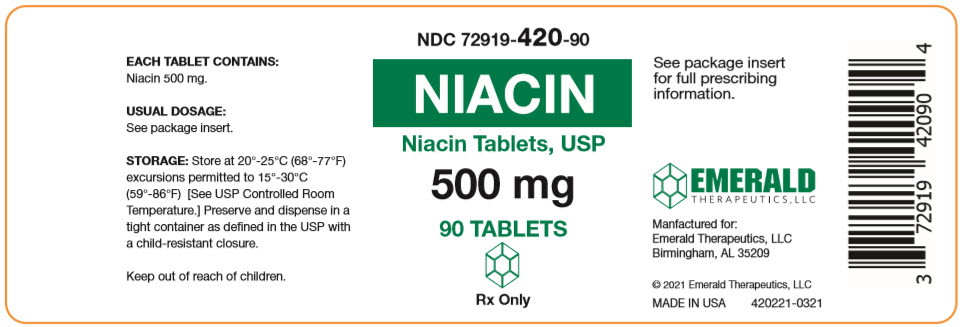
PRINCIPAL DISPLAY PANEL - 500 mg Tablet Bottle Label NDC 72919-420-90 NIACIN Niacin Tablets, USP 500 mg 90 TABLETS Rx Only PRINCIPAL DISPLAY PANEL - 500 mg Tablet Bottle Label
Medicare Part D spend CMS · PART D · 2026 (Q1)
About this NDC listing & data coverage
What data is (and isn’t) available for this NDC — tap to expand
| NDC identity (package / product / labeler codes) | ✓ Available |
| Labeler | ✓ Available |
| Product & package description | ✓ Available |
| Marketing category & status | ✓ Available |
| Active ingredient / dosage form / route | ✓ Available |
| FDA label (SPL via DailyMed) | ✓ Available |
| Package photos | ✓ Available |
| Inactive ingredients (structured) | ✓ Available |
| NADAC pharmacy acquisition price (CMS) | — Not published for this NDC CMS publishes NADAC only for NDCs reported in its retail-pharmacy survey. |
| Orange Book / therapeutic-equivalence data | — Not published for this NDC Applies only to products approved under an NDA/ANDA; many listings are out of scope. |
| HCPCS J-code billing crosswalk | — Not published for this NDC Most self-administered / retail products have no J-code — that is normal. |
| Medicaid utilization (CMS SDUD) | — Not published for this NDC CMS reports utilization only for NDCs with Medicaid claims above its privacy threshold. |