
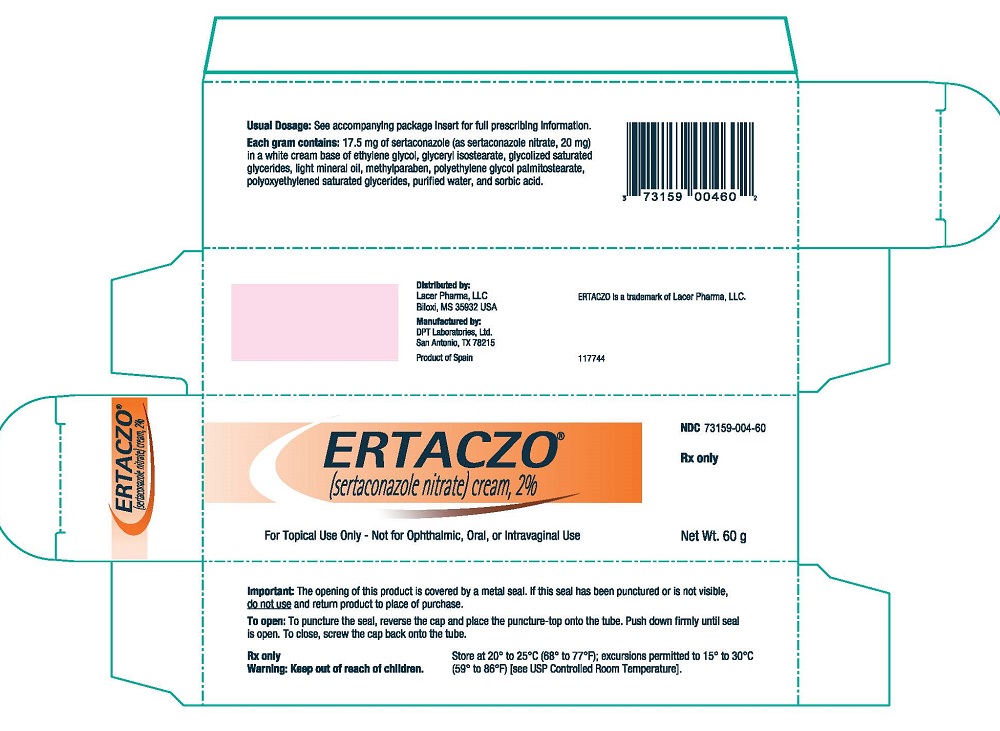
Ertaczo Sertaconazole Nitrate 20 mg/g Cream — NDC 73159-004-60 (Billing 73159-0004-60)
This is a package of Ertaczo Sertaconazole Nitrate 20 mg/g Cream from Lacer Pharma, LLC, marketed since Nov 2024 and currently FDA-listed. It is this product's only package size.
NDC database record
One package, one record: these facts belong to NDC 73159-004-60 alone.
- Record
- FDA NDC Directory package listing · Human prescription drug
- Code segments
- 73159 labeler · 004 product · 60 package
- Package marketed since
- Nov 26, 2024
- Sample package
- No — commercial package
- Listing certified through
- Dec 31, 2026
- Barcode (UPC-A, from the NDC)
- 3 7315900460 2
- Medicaid fills, this package
- 18,267 prescriptions in the last four reported quarters
- FDA record last changed
- Jul 24, 2026
Identity & classification
Regulatory identifiers FDA, NLM and CMS codes for this package
Drug-database identifiers Medi-Span GPI and First Databank GCN / HICL / AHFS classification
- GSN (GCN sequence number): 030866
- GCN: 43590
- GPI-14 (Medi-Span): 90154070103720
- HICL (First Databank): 012849
- AHFS class code: 84:04.08.08
- RxCUI (RxNorm): 250511
Where does this data come from?
- FDA openFDA NDC Directory · synced Oct 8, 2026
- FDA label on DailyMed · label index refreshed Oct 8, 2026
- RxNorm (NLM RxNav) · catalog refreshed Oct 8, 2026
- Medi-Span GPI (licensed)
- First Databank (licensed) · refreshed Oct 8, 2026
RxNorm drug class
This medicine belongs to the Azole Antifungal class.
Where does this data come from?
- RxClass (NLM) · catalog refreshed Oct 8, 2026
Clinical
Sertaconazole is used to treat tinea pedis (athlete's foot; fungal infection of the skin on the feet and between the toes). Sertaconazole is in a class of medications called imidazoles. It works by slowing the growth of fungi that cause infection.
Read the full MedlinePlus article ↗- It treats athlete’s foot between the toes (interdigital tinea pedis). Ertaczo is approved for healthy adults and children 12 and older when certain fungi cause the infection.
- Apply it twice a day for 4 weeks. Cover the area between your toes and the healthy skin around it. If you just bathed, dry your feet well first. Wash your hands afterward and skip...
- Please finish the full course your prescriber recommends. Symptoms can improve before the infection is fully treated.
- Some people get skin irritation, dryness, burning, or tenderness where they apply it. If irritation develops, stop using it and call your doctor.
Patient education
Supplement & herbal interactions
Where does this data come from?
- MedlinePlus (NLM) · refreshed Oct 8, 2026
- FDA label on DailyMed · label index refreshed Oct 8, 2026
Ask a licensed pharmacist directly — free, answered by our team.
Pricing
A drug doesn't have one price. Each row is a different public payment system, and none is what you'd pay at the counter — that depends on your insurance. The ⓘ on each row explains what it measures.
| Price system | Per g | Per package |
|---|---|---|
| Retail pharmacies payNADAC · weekly | Not in the retail survey — common for institutional, discontinued, or low-volume packs. | |
| Medicaid paysCMS SDUD · 12 mo | $15.15 | $908.98 / 60 g |
| Medicare drug plans payPart D · Q2 2026 | $15.64 | $938.61 / 60 g |
Where does this data come from?
- CMS NADAC weekly file
- CMS ASP pricing files · refreshed Sep 20, 2026
- CMS Medicaid State Drug Utilization Data · through Q1 2026
- CMS Part D plan pricing files · refreshed Sep 24, 2026
- VA National Acquisition Center price file
Packaging — all sizes for this product
| Package NDC | Description | Marketing start | Marketing end | Status |
|---|---|---|---|---|
| 73159-0004-60 You're viewing this Main listing | 1 TUBE in 1 CARTON / 60 g in 1 TUBE | 2024-11-26 | — | Active |
Therapeutic equivalents
| Product | Labeler | Pack | NADAC/unit | TE | Status | Price vs. this |
|---|---|---|---|---|---|---|
| Ertaczo 20 mg/gthis 73159-0004-60 | Lacer | 1 tube | — | — | FDA listed | — |
| Ertaczo 20 mg/g 85437-0004-60 | Coral | 1 tube | — | — | FDA listed | — |
Where does this data come from?
- FDA openFDA NDC Directory · synced Oct 8, 2026
- FDA Orange Book · refreshed Oct 3, 2026
- CMS NADAC weekly file
Availability & generic status
We did not find an FDA-approved generic match for this exact strength, form and route.
Where does this data come from?
- FDA Orange Book · refreshed Oct 3, 2026
Inactive Ingredients / Excipients
Inactive ingredients, also called excipients, are components of the drug product other than the active ingredient. They may include fillers, dyes, coatings, preservatives, flavors, or other formulation ingredients.
🧪 Avoiding an ingredient? See Sertaconazole Topical inactive ingredients by manufacturer: every current product's list side by side, so you can ask your pharmacy for the version that does not list it.
💡 Tap an ingredient (hover on desktop) to see what it is and why it’s used.
-
UNII FC72KVT52F
A clear, viscous liquid derived from petroleum or plant sources. It acts as a solvent and humectant in medicines, helping dissolve active ingredients and retain moisture in formulations like syrups, gels, and topical products.
-
UNII HYE7O27HAO
Glyceryl isostearate is a fatty substance derived from vegetable oils or animal fats. In medicines, it acts as an emulsifier to blend water and oil components together, and helps form a smooth texture in creams, ointments, and other topical products.
-
UNII 0324G66D0E
Glycol stearate is a waxy compound made by combining stearic acid with ethylene glycol. It acts as an emulsifier and thickener, helping keep oil and water mixed together smoothly in liquid or semi-solid medicines.
-
UNII N6K5787QVP
Light mineral oil is a clear, odorless liquid derived from petroleum. In medicines, it acts as a lubricant and emollient to help the product spread smoothly and improve texture.
-
UNII A2I8C7HI9T
Methylparaben is a preservative derived from benzoic acid that prevents growth of bacteria, fungi, and mold in medicines. It extends the product's shelf life and maintains safety during storage.
-
UNII 33GX5WQC0M
PEG-32 stearate is a synthetic compound made by combining polyethylene glycol (PEG) with stearic acid. It acts as an emulsifier and surfactant to help mix oil and water-based ingredients, and may also serve as a solubilizer to improve how the active drug dissolves in the formulation.
-
UNII 8LQC57C6B0
A synthetic compound made by combining polyethylene glycol with stearic acid. It acts as an emulsifier and surfactant to help mix oil and water-based ingredients together, and also serves as a thickener in creams and lotions.
-
UNII X045WJ989B
Sorbic acid is a preservative derived from berries that prevents mold, yeast, and bacterial growth in medicines. It keeps the product stable and safe during storage.
-
UNII 059QF0KO0R
Water is a liquid solvent that dissolves and mixes ingredients together in liquid medicines, syrups, and injections. It helps distribute the active drug evenly throughout the product.
9 inactive ingredients listed in the exact product block matched to this NDC.
Where does this data come from?
ingredient classCode="IACT" elements from the exact product block matched by this NDC. Label-section narrative from DailyMed / the openFDA label index is shown separately when available.- FDA label on DailyMed · label index refreshed Oct 8, 2026
- FDA openFDA NDC Directory · synced Oct 8, 2026
Inactive ingredient FAQ
Are inactive ingredients the same for every manufacturer?
Why might an inactive ingredient be missing?
Can inactive ingredients matter?
Manufacturer & labeler
More NDCs from Lacer Pharma, LLC labeler code 73159
Where does this data come from?
- FDA openFDA NDC Directory · synced Oct 8, 2026
- Drugs@FDA
Full prescribing information FDA SPL
🎯 Indications and Usage ▾
1 INDICATIONS AND USAGE ERTACZO ® cream, 2%, is indicated for the topical treatment of interdigital tinea pedis in immunocompetent adult and pediatric patients 12 years of age and older caused by Trichophyton rubrum , Trichophyton mentagrophytes, and Epidermophyton floccosum . ERTACZO cream, 2% is an azole antifungal indicated for the topical treatment of interdigital tinea pedis in immunocompetent adult and pediatric patients 12 years of age and older caused by Trichophyton rubrum, Trichophyton mentagrophytes , and Epidermophyton floccosum .
( 1 )
⏱️ Dosage and Administration ▾
2 DOSAGE AND ADMINISTRATION Apply ERTACZO cream, 2% twice daily for 4 weeks. Apply a sufficient amount of ERTACZO cream, 2% to cover both the affected areas between the toes and the immediately surrounding healthy skin. Use ERTACZO cream, 2% for the full treatment time recommended by the physician, even though symptoms may have improved.
Dry the affected area(s) thoroughly before application, if using ERTACZO cream, 2% after bathing. Wash hands after use. Avoid the use of occlusive dressings or wrappings.
For topical use. Not for ophthalmic, oral, or intravaginal use. Apply ERTACZO cream, 2% to the affected and immediate surrounding area(s) twice daily for 4 weeks.
( 2 ) Not for ophthalmic, oral, or intravaginal use. ( 2 )
💊 Dosage Forms and Strengths ▾
3 DOSAGE FORMS AND STRENGTHS Cream, 2%. Each gram of ERTACZO cream, 2%, contains 17.5 mg of sertaconazole (as sertaconazole nitrate, 20 mg) in a white cream base. Cream, 2%. ( 3 )
⛔ Contraindications ▾
4 CONTRAINDICATIONS None. None. ( 4 )
⚠️ Warnings and Cautions ▾
5 WARNINGS AND PRECAUTIONS
5.1Local Adverse Reactions If irritation develops, discontinue treatment and institute appropriate therapy. Physicians should exercise caution when prescribing ERTACZO cream, 2%, to patients known to be sensitive to azole antifungals since cross-reactivity may occur.
🤒 Adverse Reactions ▾
6 ADVERSE REACTIONS Most common adverse reactions observed in clinical trials (incidence >2%) were contact dermatitis, dry skin, burning skin, application site skin tenderness. ( 6.1 ) To report SUSPECTED ADVERSE REACTIONS, contact Lacer Pharma, LLC at 1-888-403-8874 or FDA at 1-800-FDA-1088 or www.fda.gov/medwatch.
6.1Clinical Trials Experience Because clinical trials are conducted under widely varying conditions, adverse reaction rates observed in the clinical trials of a drug cannot be directly compared to rates in the clinical trials of another drug and may not reflect the rates observed in practice. In clinical trials, cutaneous adverse events occurred in 7 of 297 (2%) subjects (2 of them severe) receiving ERTACZO cream, 2%, and in 7 of 291 (2%) subjects (2 of them severe) receiving vehicle. These reported cutaneous adverse events included contact dermatitis, dry skin, burning skin, and application site skin tenderness.
In a dermal sensitization trial, 8 of 202 evaluable subjects tested with ERTACZO cream, 2%, and 4 of 202 evaluable subjects tested with vehicle exhibited a erythematous reaction in the challenge phase. There was no evidence of cumulative irritation or contact sensitization in a repeated insult patch test involving 202 healthy volunteers.
6.2Postmarketing Experience The following adverse reactions have been identified during post-approval use of ERTACZO cream, 2%. Because these reactions are reported voluntarily from a population of uncertain size, it is not always possible to reliably estimate their frequency or establish a causal relationship to drug exposure. Cutaneous adverse events: erythema, pruritus, vesiculation, desquamation, and hyperpigmentation.
👥 Use in Specific Populations ▾
8 USE IN SPECIFIC POPULATIONS
8.1Pregnancy Risk Summary There are no available data on ERTACZO cream, 2% use in pregnant women to evaluate for a drug-associated risk of major birth defects, miscarriage, or adverse maternal or fetal outcomes. In animal reproduction studies, there were no adverse developmental effects observed with oral administration of sertaconazole nitrate to pregnant rats and rabbits during organogenesis at doses 40 and 80 times, respectively, the maximum recommended human dose (MRHD) based on body surface area (BSA) comparison.
In rats, when maternal dosing was continued until weaning, a reduction in live birth indices and an increase in the number of still-born pups was observed at doses 20 and 40 times the MRHD based on BSA comparison ( see Data ). The background risk of major birth defects and miscarriage for the indicated population is unknown. All pregnancies have a background risk of major birth defects, loss and other adverse outcomes.
In the U.S. general population, the estimated background risk of major birth defects and miscarriage in clinically recognized pregnancies is 2-4% and 15-20%, respectively. Data Animal Data Animal embryofetal development studies have not been conducted with ERTACZO cream, 2%. Embryofetal development studies performed in pregnant rats and rabbits administered oral doses of sertaconzaole nitrate up to 160 mg/kg/day (40 times [rats] and 80 times [rabbits] the MRHD based on a BSA comparison) during the period of organogenesis revealed no malformations or embryofetal developmental toxicity.
In a pre- and postnatal development study, pregnant rats were administered oral doses of sertaconazole nitrate from pregnancy day 6 to lactation day 20. A reduction in live birth indices and an increase in the number of still-born pups were seen at doses 20 and 40 times the MRHD based on BSA comparison.
8.2Lactation Risk Summary There are no data available on the presence of sertaconazole in human or animal milk, its effects on the breastfed infant, or its effects on milk production. The developmental and health benefits of breastfeeding should be considered along with the mother’s clinical need for ERTACZO cream, 2% and any potential adverse effects on the breastfed infant from ERTACZO cream, 2% or from the underlying maternal condition.
8.4Pediatric Use The safety and effectiveness of ERTACZO cream, 2%, have not been established in pediatric patients younger than 12 years of age.
8.5Geriatric Use Clinical trials of ERTACZO cream, 2%, did not include sufficient numbers of subjects aged 65 and over to determine whether they respond differently from younger subjects.
🤰 Pregnancy ▾
8.1Pregnancy Risk Summary There are no available data on ERTACZO cream, 2% use in pregnant women to evaluate for a drug-associated risk of major birth defects, miscarriage, or adverse maternal or fetal outcomes. In animal reproduction studies, there were no adverse developmental effects observed with oral administration of sertaconazole nitrate to pregnant rats and rabbits during organogenesis at doses 40 and 80 times, respectively, the maximum recommended human dose (MRHD) based on body surface area (BSA) comparison.
In rats, when maternal dosing was continued until weaning, a reduction in live birth indices and an increase in the number of still-born pups was observed at doses 20 and 40 times the MRHD based on BSA comparison ( see Data ). The background risk of major birth defects and miscarriage for the indicated population is unknown. All pregnancies have a background risk of major birth defects, loss and other adverse outcomes.
In the U.S. general population, the estimated background risk of major birth defects and miscarriage in clinically recognized pregnancies is 2-4% and 15-20%, respectively. Data Animal Data Animal embryofetal development studies have not been conducted with ERTACZO cream, 2%. Embryofetal development studies performed in pregnant rats and rabbits administered oral doses of sertaconzaole nitrate up to 160 mg/kg/day (40 times [rats] and 80 times [rabbits] the MRHD based on a BSA comparison) during the period of organogenesis revealed no malformations or embryofetal developmental toxicity.
In a pre- and postnatal development study, pregnant rats were administered oral doses of sertaconazole nitrate from pregnancy day 6 to lactation day 20. A reduction in live birth indices and an increase in the number of still-born pups were seen at doses 20 and 40 times the MRHD based on BSA comparison.
🧒 Pediatric Use ▾
8.4Pediatric Use The safety and effectiveness of ERTACZO cream, 2%, have not been established in pediatric patients younger than 12 years of age.
🧓 Geriatric Use ▾
8.5Geriatric Use Clinical trials of ERTACZO cream, 2%, did not include sufficient numbers of subjects aged 65 and over to determine whether they respond differently from younger subjects.
🧬 Clinical Pharmacology ▾
12 CLINICAL PHARMACOLOGY
12.1Mechanism of Action Sertaconazole nitrate is an azole antifungal [see Clinical Pharmacology (12.4) ] .
12.2Pharmacokinetics In a multiple-dose pharmacokinetic trial that included 5 male subjects with interdigital tinea pedis (range of diseased area, 42 - 140 cm 2 ; mean, 93 cm 2 ), ERTACZO cream, 2%, was topically applied every 12 hours for a total of 13 doses to the diseased skin (0.5 g sertaconazole nitrate per 100 cm 2 ). Sertaconazole concentrations in plasma measured by serial blood sampling for 72 hours after the thirteenth dose were below the limit of quantitation (2.5 ng/mL) of the analytical method used.
12.3Microbiology Mechanism of Action Sertaconazole, an azole antifungal agent, inhibits fungal cytochrome P-450-mediated 14 alpha-lanosterol demethylase enzyme. This enzyme functions to convert lanosterol to ergosterol. Ergosterol is a key component of fungal cell membranes and lack of this component leads to fungal cell injury by leakage of key constituents in the cytoplasm from the cell.
Activity In Vitro and in Clinical Infections Sertaconazole nitrate has been shown to be active against isolates of the following microorganisms in clinical infections [see Indications and Usage (1) ] : Trichophyton rubrum Trichophyton mentagrophytes Epidermophyton floccosum
🧬 Mechanism of Action ▾
12.1Mechanism of Action Sertaconazole nitrate is an azole antifungal [see Clinical Pharmacology (12.4) ] .
📦 How Supplied / Storage and Handling ▾
16 HOW SUPPLIED/STORAGE AND HANDLING ERTACZO cream, 2%, is white in color and supplied in tubes in the following size: 60-gram tube NDC 73159-004-60 Store at 20° to 25°C (68° to 77°F); excursions permitted to 15° to 30°C (59° to 86°F) [see USP Controlled Room Temperature].
📋 Description ▾
11 DESCRIPTION ERTACZO (sertaconazole nitrate) cream, 2%, is for topical application. It contains the azole antifungal, sertaconazole nitrate. Sertaconazole nitrate contains one asymmetric carbon atom and exists as a racemic mixture of equal amounts of R and S enantiomers.
Sertaconazole nitrate is designated chemically as (±)-1-[2,4-dichloro-β-[(7-chlorobenzo-[ b ]thien-3-yl)methoxy]phenethyl]imidazole nitrate. It has a molecular weight of 500.8. The molecular formula is C 20 H 15 Cl 3 N 2 OS ● HNO 3 , and the structural formula is as follows: Sertaconazole nitrate is a white or almost white powder.
It is practically insoluble in water, soluble in methanol, and sparingly soluble in alcohol and in methylene chloride. Each gram of ERTACZO cream, 2%, contains 17.5 mg of sertaconazole (as sertaconazole nitrate, 20 mg) in a white cream base of ethylene glycol, glyceryl isostearate, glycolized saturated glycerides, light mineral oil, methylparaben, polyethylene glycol palmitostearate, polyoxyethylened saturated glycerides, purified water, and sorbic acid. Sertaconzole nitrate chemical structure
💬 Information for Patients ▾
17 PATIENT COUNSELING INFORMATION Advise the patient to read the FDA-approved patient labeling (Patient Information). Instruct the patient of the following: Administration Instructions ERTACZO cream, 2% is for topical use only. Avoid contact with the eyes, mouth, vagina, and other mucous membranes.
Dry the affected area(s) thoroughly before application, if using ERTACZO cream, 2% after bathing. Wash hands after use. Use the medication for the full treatment time recommended by the physician, even though symptoms may have improved.
Avoid the use of occlusive dressings unless otherwise directed by the physician [see Dosage and Administration ( 2 )] . Local Adverse Reactions Inform the physician if the area of application shows signs of increased irritation, redness, itching, burning, blistering, swelling, or oozing [see Warnings and Precautions ( 5.1 )] . Distributed by: Lacer Pharma, LLC Biloxi, MS 39532 USA Manufactured by: DPT Laboratories, Ltd.
San Antonio, TX 78215 ERTACZO is a trademark of Lacer Pharma, LLC 141329
🧬 Pharmacokinetics ▾
12.2Pharmacokinetics In a multiple-dose pharmacokinetic trial that included 5 male subjects with interdigital tinea pedis (range of diseased area, 42 - 140 cm 2 ; mean, 93 cm 2 ), ERTACZO cream, 2%, was topically applied every 12 hours for a total of 13 doses to the diseased skin (0.5 g sertaconazole nitrate per 100 cm 2 ). Sertaconazole concentrations in plasma measured by serial blood sampling for 72 hours after the thirteenth dose were below the limit of quantitation (2.5 ng/mL) of the analytical method used.
🔬 Clinical Studies ▾
14 CLINICAL STUDIES In two randomized, double-blind clinical trials, subjects 12 years and older with interdigital tinea pedis applied either ERTACZO cream, 2%, or vehicle, twice daily for 4 weeks. Subjects with moccasin-type (plantar) tinea pedis and/or onychomycosis were excluded from the trial. Two weeks after completion of therapy (6 weeks after beginning therapy), subjects were evaluated for signs and symptoms related to interdigital tinea pedis.
Treatment outcomes are summarized in the table below. Treatment Outcomes as Percent (%) of Total Subjects with Interdigital Tinea Pedis Trial 1 Trial 2 Sertaconazole Vehicle Sertaconazole Vehicle Complete Cure* (Primary Efficacy Variable) 13/99 (13.1%) 3/92 (3.3%) 28/103 (27.2%) 5/103 (4.9%) Effective Treatment** 32/99 (32.3%) 11/92 (12.0%) 52/103 (50.5%) 16/103 (15.5%) Mycological Cure*** 49/99 (49.5%) 18/92 (19.6%) 71/103 (68.9%) 20/103 (19.4%) * Complete Cure – Patients who had complete clearing of signs and symptoms and Mycological Cure. ** Effective Treatment – Patients who had minimal residual signs and symptoms of interdigital tinea pedis and Mycological Cure. *** Mycological Cure – Patients who had both negative microscopic KOH preparation and negative fungal culture.
In clinical trials, complete cure in ERTACZO cream, 2%-treated subjects was achieved in 32 of 160 (20%) subjects with Trichophyton rubrum , in 7 of 28 (25%) subjects with Trichophyton mentagrophytes , and in 1 of 13 (15%) subjects with Epidermophyton floccosum .
🧪 Nonclinical Toxicology ▾
13 NONCLINICAL TOXICOLOGY
13.1Carcinogenesis, Mutagenesis, Impairment of Fertility In a 2-year rat dermal carcinogenicity study, topical administration of sertaconazole nitrate cream did not increase the number of neoplastic lesions compared to control animals, at sertaconazole nitrate doses of up to 800 mg/kg/day (200 times the MRHD based on a BSA comparison). No clastogenic potential was observed in a mouse micronucleus test. Sertaconazole nitrate was nonclastogenic in the in vivo mouse sister chromatid exchange assay.
There was no evidence that sertaconazole nitrate induced unscheduled DNA synthesis in primary rat hepatocyte cultures. Rats treated orally with up to 160 mg/kg/day of sertaconazole nitrate (40 times the MRHD based on a BSA comparison), exhibited no toxicity or adverse effects on reproductive performance or fertility in male or female rats.
📄 Carcinogenesis, Mutagenesis, Impairment of Fertility ▾
13.1Carcinogenesis, Mutagenesis, Impairment of Fertility In a 2-year rat dermal carcinogenicity study, topical administration of sertaconazole nitrate cream did not increase the number of neoplastic lesions compared to control animals, at sertaconazole nitrate doses of up to 800 mg/kg/day (200 times the MRHD based on a BSA comparison). No clastogenic potential was observed in a mouse micronucleus test. Sertaconazole nitrate was nonclastogenic in the in vivo mouse sister chromatid exchange assay.
There was no evidence that sertaconazole nitrate induced unscheduled DNA synthesis in primary rat hepatocyte cultures. Rats treated orally with up to 160 mg/kg/day of sertaconazole nitrate (40 times the MRHD based on a BSA comparison), exhibited no toxicity or adverse effects on reproductive performance or fertility in male or female rats.
📄 Patient Package Insert ▾
Patient Package Insert PATIENT INFORMATION ERTACZO ® (er-tack-zo) (sertaconazole nitrate) cream Important information: ERTACZO cream is for use on skin only. Do not use ERTACZO cream in your eyes, mouth, or vagina. What is ERTACZO cream?
ERTACZO cream is a prescription medicine used on the skin (topical) to treat athlete’s foot that is between the toes (interdigital tinea pedis) in adults and children 12 years of age and older with normal immune systems. It is not known if ERTACZO cream is safe and effective in children younger than 12 years of age. Before using ERTACZO cream, tell your healthcare provider about all of your medical conditions, including if you: have any allergies are pregnant or plan to become pregnant.
It is not known if ERTACZO cream will harm your unborn baby. are breastfeeding or plan to breastfeed. It is not known if ERTACZO cream passes into your breast milk. Talk to your healthcare provider about the best way to feed your baby if you use ERTACZO cream.
Tell your healthcare provider about all of the medicines you take, including prescription and over-the-counter medicines, vitamins, and herbal supplements. How should I use ERTACZO cream? Use ERTACZO cream exactly as your healthcare provider tells you to use it.
Use ERTACZO cream for the full treatment time, even if your symptoms improve. If you take a bath or shower, dry the affected skin areas well before you apply ERTACZO cream. Apply ERTACZO cream 2 times a day for 4 weeks to the affected skin areas between your toes and to the healthy skin around the affected areas.
Wash your hands after you apply ERTACZO cream. Do not cover the treated skin areas with bandages unless your healthcare provider tells you to. What are the possible side effects of ERTACZO cream?
The most common side effects of ERTACZO cream include: redness, itching, dry skin, burning, blistering, swelling, drainage, and skin tenderness at the treated skin areas. Tell your healthcare provider if you have any of these skin reactions. These are not all the possible side effects of ERTACZO cream.
Call your doctor for medical advice about side effects. You may report side effects to FDA at 1-800-FDA-1088. How should I store ERTACZO cream?
Store ERTACZO cream at room temperature between 68°F to 77°F (20°C to 25°C). Keep ERTACZO cream and all medicines out of reach of children. General information about the safe and effective use of ERTACZO cream Medicines are sometimes prescribed for purposes other than those listed in a Patient Information leaflet.
Do not use ERTACZO cream for a condition for which it was not prescribed. Do not give ERTACZO cream to other people, even if they have the same symptoms you have. It may harm them.
You can ask your healthcare provider or pharmacist for information about ERTACZO cream that is written for health professionals. What are the ingredients in ERTACZO cream? Active ingredient: sertaconazole nitrate Inactive ingredients: ethylene glycol, glyceryl isostearate, glycolized saturated glycerides, light mineral oil, methylparaben, polyethylene glycol palmitostearate, polyoxyethylened saturated glycerides, purified water, and sorbic acid Distributed by: Lacer Pharma, LLC Biloxi, MS 39532 USA Manufactured by: DPT Laboratories, Ltd.
San Antonio, TX 78215 ERTACZO is a trademark of Lacer Pharma, LLC 141329 This Patient Information has been approved by the U.S. Food and Drug Administration. Revised: 04/2024
📄 Package Label / Principal Display Panel ▾
PACKAGE/LABEL PRINCIPAL DISPLAY PANEL – 60 g Carton NDC 0187-5115-60 ERTACZO ® (sertaconazole nitrate) cream, 2% Rx only For Topical Use Only - Not for Ophthalmic, Oral, or Intravaginal Use Net Wt. 60 g Tube Image Carton Image
Medicaid utilization & spend
Medicare Part D spend CMS · PART D · 2026 (Q1)
Reported adverse events (FAERS)
Top reported reactions
Age at onset
Reporter sex
Serious outcomes
Where does this data come from?
About this NDC listing & data coverage
What data is (and isn’t) available for this NDC — tap to expand
| NDC identity (package / product / labeler codes) | ✓ Available |
| Labeler | ✓ Available |
| Product & package description | ✓ Available |
| Marketing category & status | ✓ Available |
| Active ingredient / dosage form / route | ✓ Available |
| FDA label (SPL via DailyMed) | ✓ Available |
| Package photos | ✓ Available |
| Inactive ingredients (structured) | ✓ Available |
| NADAC pharmacy acquisition price (CMS) | — Not published for this NDC CMS publishes NADAC only for NDCs reported in its retail-pharmacy survey. |
| Orange Book / therapeutic-equivalence data | — Not published for this NDC Applies only to products approved under an NDA/ANDA; many listings are out of scope. |
| HCPCS J-code billing crosswalk | — Not published for this NDC Most self-administered / retail products have no J-code — that is normal. |
| Medicaid utilization (CMS SDUD) | ✓ Available |