
SCENESSE afamelanotide 16 mg/16mg Implant, 1 vial
🆔 Identity & classification
Where does this data come from?
🏷️ RxNorm drug class
This medicine belongs to the Protectives against UV-radiation for systemic use class.
Where does this data come from?
🏭 Manufacturer & labeler
Where does this data come from?
🩺 Clinical
Patient education
Supplement & herbal interactions
Where does this data come from?
Ask a licensed pharmacist directly — free, answered by our team.
💊 What it looks like
Where does this data come from?
🧪 Inactive Ingredients / Excipients
Inactive ingredients, also called excipients, are components of the drug product other than the active ingredient. They may include fillers, dyes, coatings, preservatives, flavors, or other formulation ingredients.
Where does this data come from?
IACT rows and label-wide narrative are kept separate; availability and product-level specificity depend on the submitted label.Inactive ingredient FAQ
Are inactive ingredients the same for every manufacturer?
Why might an inactive ingredient be missing?
Can inactive ingredients matter?
💲 Pricing
A drug doesn't have one price. Each row is a different public payment system, and none is what you'd pay at the counter — that depends on your insurance. The ⓘ on each row explains what it measures.
| Price system | Per each | Per package |
|---|---|---|
| Retail pharmacies payNADAC · weekly | Not in the retail survey — common for institutional, discontinued, or low-volume packs. | |
| Medicaid paysCMS SDUD · 12 mo | No recent Medicaid claims on file for this NDC — rare and low-volume NDCs are suppressed in the public data. | |
| Medicare drug plans payPart D · quarterly | No Part D plan price is available for this NDC in our data. | |
Where does this data come from?
🔁 Therapeutic equivalents
| Product | Labeler | Pack | NADAC/unit | TE | Status | Price vs. this |
|---|---|---|---|---|---|---|
| Scenesse 16 mg/16mgthis 73372-0116-01 | CLINUVEL | 1 vial | — | — | FDA listed | — |
Where does this data come from?
⏳ Availability & generic status
We did not find an FDA-approved generic match for this exact strength, form and route. Patent/protection dates below may affect future generic timing.
Why the date isn’t exact: Generic timing can change because patents may be challenged, settled, licensed, added, removed, or worked around with a narrower label — and FDA approval does not always mean a pharmacy can get the generic today.
🛈 What do these terms mean?
- Patent
- Legal protection listed in the Orange Book that may delay generic approval or launch. Issued by the U.S. Patent & Trademark Office.
- Substance patent
- Covers the active drug molecule itself — the hardest to design around. A generic generally can’t launch until it expires.
- Formulation (product) patent
- Covers a specific formulation or dosage form. A generic can sometimes work around it with a different formulation.
- Method-of-use patent
- A patent covering one specific approved use of the drug — not necessarily the whole molecule. A generic can sometimes launch with a “skinny label” that carves out the protected use and keeps the others.
- Skinny label
- A generic label that omits a still-patented use when the FDA allows it — letting a generic reach the market for the unprotected uses.
- Exclusivity
- FDA-granted marketing protection, separate from patents — e.g. 5-yr new chemical entity, 7-yr orphan drug, or a +6-month pediatric extension.
- Paragraph IV
- A generic applicant’s formal challenge to a listed patent. It can potentially lead to earlier generic entry, but often involves litigation or a settlement.
- RLD / RS
- Reference Listed Drug — the brand product the FDA uses as the reference for generic applications. Reference Standard — the product the FDA expects generics to compare against in bioequivalence testing.
- TE / AB rating
- FDA therapeutic-equivalence rating. An AB rating generally means the FDA considers a generic therapeutically equivalent to — and substitutable for — the brand.
- LOE (loss of exclusivity)
- The latest patent or exclusivity currently listed — the loss-of-exclusivity / latest-listed-protection date shown on this page. Paragraph-IV challenges and settlements can move the real date earlier; FDA approval and a manufacturer’s decision to market can move it later.
Built from the FDA Orange Book. The bars above are scaled to each protection’s expiry; the red LOE marker is the last one to lapse.
| Patent | Type | Use code | Expires |
|---|---|---|---|
| US 8334265 ↗ | Method of use | U-2638 | Jan 20, 2033 |
| Code | What it grants | Expires |
|---|---|---|
| ODE-270 | Orphan Drug Exclusivity (7-year) | Oct 8, 2026 |
Is there a generic version of SCENESSE 16 MG IMPLANT?
The FDA approved a generic — why can’t I get it at my pharmacy yet?
Why do different websites show different generic release dates?
What does “FDA listed” mean?
What does a patent or protection date mean here?
What does “current Orange Book estimate” mean?
Can a generic come out before the last patent expires?
Can a generic come out after the listed dates?
What is the difference between patents and exclusivity?
Why are there multiple patent dates?
Where does this data come from?
📦 Packaging — all sizes for this product
| Package NDC | Description | Marketing start | Status |
|---|---|---|---|
| 73372-0116-01 You're viewing this | 1 VIAL, GLASS in 1 CARTON (73372-0116-1) / 1 mg in 1 VIAL, GLASS | 2019-12-31 | Active |
🧭 About this NDC listing & data coverage
What data is (and isn’t) available for this NDC — tap to expand
| NDC identity (package / product / labeler codes) | ✓ Available |
| Labeler | ✓ Available |
| Product & package description | ✓ Available |
| Marketing category & status | ✓ Available |
| Active ingredient / dosage form / route | ✓ Available |
| FDA label (SPL via DailyMed) | ✓ Available |
| Package photos | ✓ Available |
| Inactive ingredients (structured) | — Not published for this NDC The labeler did not submit a structured excipient list, or no SPL is available. |
| NADAC pharmacy acquisition price (CMS) | — Not published for this NDC CMS publishes NADAC only for NDCs reported in its retail-pharmacy survey. |
| Orange Book / therapeutic-equivalence data | ✓ Available |
| HCPCS J-code billing crosswalk | — Not published for this NDC Most self-administered / retail products have no J-code — that is normal. |
| Medicaid utilization (CMS SDUD) | — Not published for this NDC CMS reports utilization only for NDCs with Medicaid claims above its privacy threshold. |
Questions about this listing
Why is there no price listed?
Is the NDC printed on the package the same as the 11-digit billing NDC?
What do the three segments of this NDC mean?
Is this package still being marketed?
Who lists this product with the FDA?
Do I need a prescription for this product?
Where does this data come from?
📄 Full prescribing information FDA SPL
🎯 Indications and Usage ▾
SCENESSE ® is indicated to increase pain free light exposure in adult patients with a history of phototoxic reactions from erythropoietic protoporphyria (EPP). SCENESSE is a melanocortin 1 receptor (MC1-R) agonist indicated to increase pain free light exposure in adult patients with a history of phototoxic reactions from erythropoietic protoporphyria (EPP)
⏱️ Dosage and Administration ▾
Important Dosage and Administration Information SCENESSE should be administered by a health care professional. All healthcare professionals should be proficient in the subcutaneous implantation procedure and have completed the training program provided by CLINUVEL prior to administration of the SCENESSE implant [ see Dosage and Administration ]. Additional information, including a video, is available at http://www.clinuvel.com/US-HCP.
The additional information has not been evaluated or approved by the FDA. Insert a single SCENESSE implant subcutaneously above the anterior supra-iliac crest every 2 months. Use the SFM Implantation Cannula to implant SCENESSE.
Maintain sun and light protection measures during treatment with SCENESSE to prevent phototoxic reactions related to EPP. SCENESSE should be administered by a healthcare professional who is proficient in the subcutaneous implantation procedure and has completed training prior to administration . Insert a single implant, containing 16 mg of afamelanotide, using an Cannula .
Administer SCENESSE subcutaneously every 2 months . See Full Prescribing Information for instructions for removal of SCENESSE . Instructions for Implantation of SCENESSE Insert a single SCENESSE implant (containing 16 mg of afamelanotide) subcutaneously above the anterior supra-iliac crest.
Implant SCENESSE observing an aseptic technique. The following equipment is needed for the implant insertion: SCENESSE implant SFM Implantation Cannula; use of a device that has not been determined to be suitable could result in damage to the SCENESSE implant [ see Dosage and Administration ]. Sterile gloves Local anesthetic, needle and syringe Blunt forceps suitable for removing the SCENESSE implant from the glass vial and placement of the SCENESSE implant Sterile gauze, adhesive bandage, pressure bandage Step 1 Take the carton containing SCENESSE out of the refrigerator to allow the product to gradually warm up to ambient temperature.
Remove the seal and stopper from the glass vial containing SCENESSE. Remove the implant from the vial using the blunt forceps under aseptic conditions and place the implant on a sterile gauze. Step 2 Put the patient in a comfortable reclined supine position.
Identify the insertion site 3-4 cm above the anterior supra-iliac crest and disinfect the skin surface. Step 3 (optional) Anesthetize the area of insertion (puncture) if deemed necessary and in consultation with the patient. Step 4 While pinching the skin of the insertion site, insert the cannula with the bevel facing upwards (away from the abdomen) at a 30-45° angle into the subcutaneous layer.
Advance the cannula 2 cm into the subcutaneous layer. Step 5 Remove the stylet (obturator) from the cannula maintaining aseptic precautions. Load the implant into the cannula.
Using the stylet (obturator) gently push the implant down the full length of the cannula’s shaft. Step 6 Apply pressure to the site of the implant while removing the stylet (obturator) and the cannula. Verify that no implant or implant portion remains in the cannula.
Step 7 Verify the correct insertion and placement of the implant by palpating the skin overlying the implant. Step 8 Apply dressing to the insertion site. Leave dressing in place for 24 hours.
Step 9 Monitor the patient for 30 minutes after the implant administration. Step 2 Step 3 Step 4 Step 5 Step 6 Step 7 Step 8 Step 9 Instructions for Removal of SCENESSE In case a clinical necessity arises to remove the implant, follow the procedure described below: • palpate the area of implant insertion • locate the position of the implant (*Note that the implant is resorbable and may not be able to be located from 10 days after insertion) • inject local anesthetic at the site of foreseen puncture • wait for the local anesthetic to take effect • puncture the dermis at the site of previous insertion • digitally locate the trajectory of the implant • put digital pressure on the dermis– at the distal end of the impla…
💊 Dosage Forms and Strengths ▾
Implant: 16 mg of afamelanotide as a solid white to off-white, bioresorbable, sterile rod approximately 1.7 cm in length and 1.45 mm in diameter. Implant: 16 mg of afamelanotide .
⛔ Contraindications ▾
CONTRAINDICATIONS SCENESSE is contraindicated in patients with a history of severe hypersensitivity reaction to afamelanotide or to any of the excipients in SCENESSE . Known hypersensitivity to afamelanotide or to any of the excipients in SCENESSE .
⚠️ Warnings and Cautions ▾
Hypersensitivity Skin Monitoring Serious hypersensitivity reactions, including anaphylaxis, have been reported with postmarket use of SCENESSE. Warn patients of the risk of hypersensitivity reactions, including anaphylaxis. If a serious hypersensitivity reaction occurs, initiate appropriate therapy and remove the SCENESSE implant if needed [ see Dosage and Administration ].
The patient should not receive any further treatment with SCENESSE. [ see Contraindications ]. SCENESSE may lead to generalized increased skin pigmentation and darkening of pre-existing nevi and ephelides because of its pharmacologic effect. A full body skin examination (twice yearly) is recommended to monitor pre-existing and new skin pigmentary lesions.
Hypersensitivity: Serious hypersensitivity reactions, including anaphylaxis, have been reported. If a serious hypersensitivity reaction occurs, initiate appropriate therapy and remove the SCENESSE implant if needed. The patient should not receive any further treatment with SCENESSE .
Skin Monitoring: May induce darkening of pre-existing nevi and ephelides due to its pharmacological effect. A full body skin examination (twice yearly) is recommended to monitor pre-existing nevi and new skin pigmentary lesions .
🤒 Adverse Reactions ▾
Clinical Trials Experience Because clinical trials are conducted under widely varying conditions, adverse reaction rates observed in the clinical trials of a drug cannot be directly compared to rates in the clinical trials of another drug and may not reflect the rates observed in practice. The safety of SCENESSE was evaluated in 3 randomized, multicenter, prospective, vehicle controlled clinical trials (Study CUV029, Study CUV030, and Study CUV039) involving 244 adult subjects with erythropoietic protoporphyria (EPP) without significant liver involvement.
Subjects received subcutaneous SCENESSE implants containing 16 mg of afamelanotide every 2 months. A total of 125 subjects received SCENESSE and 119 subjects received vehicle implants. Table 1 summarizes the adverse reactions that occurred in more than 2% of subjects.
Table 1: Adverse Reactions Occurring in More Than 2% of Subjects with EPP Through Month 6 (Studies CUV039, CUV030, and CUV029). Table 1: Adverse Reactions Occurring in More Than 2% of Subjects with EPP Through Month 6 (Studies CUV039, CUV030, and CUV029) Adverse Reaction SCENESSE n (%) N = 125 Vehicle n (%) N = 119 Implant site reaction 1 26 (21%) 12 (10%) Nausea 24 (19%) 17 (14%) Oropharyngeal pain 9 (7%) 6 (5%) Cough 8 (6%) 4 (3%) Fatigue 7 (6%) 3 (3%) Skin hyperpigmentation 2 5 (4%) 0 (0%) Dizziness 5 (4%) 4 (3%) Melanocytic nevus 5 (4%) 2 (2%) Respiratory tract infection 5 (4%) 3 (3%) Somnolence 3 (2%) 1 (1%) Non-acute porphyria 2 (2%) 0 (0%) Skin irritation 2 (2%) 0 (0%) 1 : Implant site reaction includes: implant site bruising, discoloration, erythema, hemorrhage, hypertrophy, irritation, nodule, pain, pruritus, swelling; injection site bruising and erythema; and expelled implant.
2 : Skin hyperpigmentation includes skin hyperpigmentation, pigmentation lip (subject also had skin hyperpigmentation), and pigmentation disorder. Specific Adverse Reactions Implant Site Reactions : Implant site reactions were more common in the SCENESSE group (21%) compared to the vehicle group (10%). In the SCENESSE group, the most common implant site reaction was implant site discoloration (10%).
The most common adverse reactions (incidence > 2%) are implant site reaction, nausea, oropharyngeal pain, cough, fatigue, dizziness, skin hyperpigmentation, somnolence, melanocytic nevus, respiratory tract infection, non-acute porphyria, and skin irritation . To report SUSPECTED ADVERSE REACTIONS, contact CLINUVEL INC. at 1-888-288-2031 or FDA at 1-800-FDA-1088 or www.fda.gov/medwatch. See PATIENT COUNSELING INFORMATION .
Postmarketing Experience The following adverse reactions have been identified during post-approval use of SCENESSE. Because these reactions are reported voluntarily from a population of uncertain size, it is not always possible to reliably estimate their frequency or establish a causal relationship to drug exposure. Immune System Disorders: hypersensitivity (urticaria, angioedema, and anaphylaxis) [ see Warnings and Precautions ].
Postmarketing Experience The following adverse reactions have been identified during post-approval use of SCENESSE. Because these reactions are reported voluntarily from a population of uncertain size, it is not always possible to reliably estimate their frequency or establish a causal relationship to drug exposure. Immune System Disorders: hypersensitivity (urticaria, angioedema, and anaphylaxis) [ see Warnings and Precautions ].
👥 Use in Specific Populations ▾
Pregnancy Risk Summary There are no data on SCENESSE use in pregnant women to evaluate for any drug associated risk of major birth defects, miscarriage, or adverse maternal or fetal outcome. In animal reproductive and development toxicity studies, no adverse developmental effects were observed with afamelanotide administration during the period of organogenesis to pregnant rats at subcutaneous doses up to 12 times the maximum recommended human dose (MRHD) ( see Data ). All pregnancies have a background risk of birth defect, loss, or other adverse outcomes.
The estimated background risk of major birth defects and miscarriage for the indicated population is unknown. In the U.S. general population, the estimated background risk of major birth defects and miscarriage in clinically recognized pregnancies is 2% to 4% and 15% to 20%, respectively. Data Animal Data In embryofetal development studies in Sprague Dawley and Lister Hooded rats, afamelanotide was administered subcutaneously to pregnant rats at doses of 0.2, 2, or 20 mg/kg/day throughout the period of organogenesis.
No adverse embryofetal developmental effects were observed at doses up to 20 mg/kg/day (12 times the MRHD, based on a body surface area comparison). In a pre- and post-natal development study in Sprague Dawley rats, afamelanotide was administered subcutaneously at doses of 0.2, 2, or 20 mg/kg/day during the period of organogenesis through lactation. No treatment-related effects were observed at doses up to 20 mg/kg/day (12 times the MRHD, based on a body surface area comparison).
Lactation Risk Summary There are no data on the presence of afamelanotide or any of its metabolites in human or animal milk, the effects on the breastfed infant, or the effect on milk production. The developmental and health benefits of breastfeeding should be considered along with the mother’s clinical need for SCENESSE and any potential adverse effects on the breastfed infant from SCENESSE or from the underlying maternal condition. Pediatric Use The safety and effectiveness of SCENESSE have not been established in pediatric patients.
Geriatric Use There were 10 subjects 65 years old and over in the clinical studies for EPP [ see Clinical Studies ]. Of the 125 subjects treated with SCENESSE in these studies, 4 (3%) were 65 years of age and older. Clinical studies of SCENESSE did not include sufficient numbers of subjects aged 65 and over to determine whether they respond differently from younger subjects.
Other reported clinical experience has not identified differences in responses between the elderly and younger patients.
Lactation Risk Summary There are no data on the presence of afamelanotide or any of its metabolites in human or animal milk, the effects on the breastfed infant, or the effect on milk production. The developmental and health benefits of breastfeeding should be considered along with the mother’s clinical need for SCENESSE and any potential adverse effects on the breastfed infant from SCENESSE or from the underlying maternal condition.
Pediatric Use The safety and effectiveness of SCENESSE have not been established in pediatric patients.
Geriatric Use There were 10 subjects 65 years old and over in the clinical studies for EPP [ see Clinical Studies ]. Of the 125 subjects treated with SCENESSE in these studies, 4 (3%) were 65 years of age and older. Clinical studies of SCENESSE did not include sufficient numbers of subjects aged 65 and over to determine whether they respond differently from younger subjects.
Other reported clinical experience has not identified differences in responses between the elderly and younger patients.
🧬 Clinical Pharmacology ▾
Mechanism of Action Afamelanotide is a synthetic tridecapeptide and a structural analog of α-melanocyte stimulating hormone (α-MSH). Afamelanotide is a melanocortin receptor agonist and binds predominantly to MC1-R. Pharmacodynamics Afamelanotide increases production of eumelanin in the skin independently of exposure to sunlight or artificial UV light sources.
Pharmacokinetics The pharmacokinetics of afamelanotide following administration of a single subcutaneous implant of SCENESSE were evaluated in 12 healthy adults. High variability was observed in the plasma concentrations of afamelanotide and for most subjects (9 out of 12), the last measurable afamelanotide concentration was at 96 hours post-dose. The mean ± SD C max and AUC 0-inf were 3.7 ± 1.3 ng/mL and 138.9 ± 42.6 hr*ng/mL, respectively.
Absorption The median T max was 36 hr. Elimination The apparent half-life of afamelanotide is approximately 15 hr when administered subcutaneously in a controlled release implant. Metabolism Afamelanotide may undergo hydrolysis.
However, its metabolic profile has not been fully characterized. Specific Populations The effect of renal or hepatic impairment on the pharmacokinetics of afamelanotide is unknown. Drug Interaction Studies No drug interaction studies were conducted with afamelanotide.
Pharmacodynamics Afamelanotide increases production of eumelanin in the skin independently of exposure to sunlight or artificial UV light sources.
Pharmacokinetics The pharmacokinetics of afamelanotide following administration of a single subcutaneous implant of SCENESSE were evaluated in 12 healthy adults. High variability was observed in the plasma concentrations of afamelanotide and for most subjects (9 out of 12), the last measurable afamelanotide concentration was at 96 hours post-dose. The mean ± SD C max and AUC 0-inf were 3.7 ± 1.3 ng/mL and 138.9 ± 42.6 hr*ng/mL, respectively.
Absorption The median T max was 36 hr. Elimination The apparent half-life of afamelanotide is approximately 15 hr when administered subcutaneously in a controlled release implant. Metabolism Afamelanotide may undergo hydrolysis.
However, its metabolic profile has not been fully characterized. Specific Populations The effect of renal or hepatic impairment on the pharmacokinetics of afamelanotide is unknown. Drug Interaction Studies No drug interaction studies were conducted with afamelanotide.
📦 How Supplied / Storage and Handling ▾
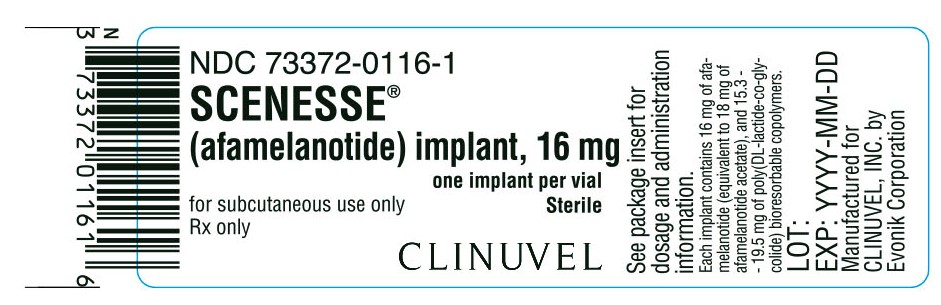
SCENESSE (afamelanotide) implant, 16 mg, for subcutaneous administration (NDC 73372-0116-1) is supplied in a Type I amber glass vial sealed with a PTFE coated rubber stopper. Each vial contains one afamelanotide implant and is packaged individually in a cardboard box. SCENESSE implant is a solid white to off-white, bioresorbable and sterile rod approximately 1.7 cm in length and 1.45 mm in diameter.
Store in a refrigerator at 2°C – 8°C (36°F-46°F). Protect from light. SCENESSE implants are not supplied with an implantation device for subcutaneous administration [ see Dosage and Administration ].
📦 Storage and Handling ▾
Store in a refrigerator at 2°C – 8°C (36°F-46°F). Protect from light. SCENESSE implants are not supplied with an implantation device for subcutaneous administration [ see Dosage and Administration ].
📋 Description ▾
Descripton SCENESSE (afamelanotide) implant is a controlled-release dosage form for subcutaneous administration. Afamelanotide is a melanocortin 1 receptor (MC1-R) agonist. The active ingredient afamelanotide acetate is a synthetic peptide containing 13 amino acids with molecular formula C 78 H 111 N 21 O 19 •xC 2 H 4 O 2 (3 ≤ x ≤ 4).
The molecular weight of afamelanotide is 1646.85 (anhydrous free base). Afamelanotide acetate has the following structure: Ac-Ser-Tyr-Ser-Nle-Glu-His-(D)Phe-Arg-Trp-Gly-Lys-Pro-Val-NH 2 • xCH 3 COOH. Afamelanotide is a white to off-white powder, freely soluble in water.
Each SCENESSE implant contains 16 mg of afamelanotide (equivalent to 18 mg of afamelanotide acetate), and 15.3-19.5 mg of poly (DL-lactide-co-glycolide). SCENESSE implant is a single, solid white to off-white, bioresorbable and sterile rod approximately 1.7 cm in length and 1.45 mm in diameter. The implant core comprises of the drug substance admixed with a poly (DL-lactide-co-glycolide) bioresorbable copolymer.