
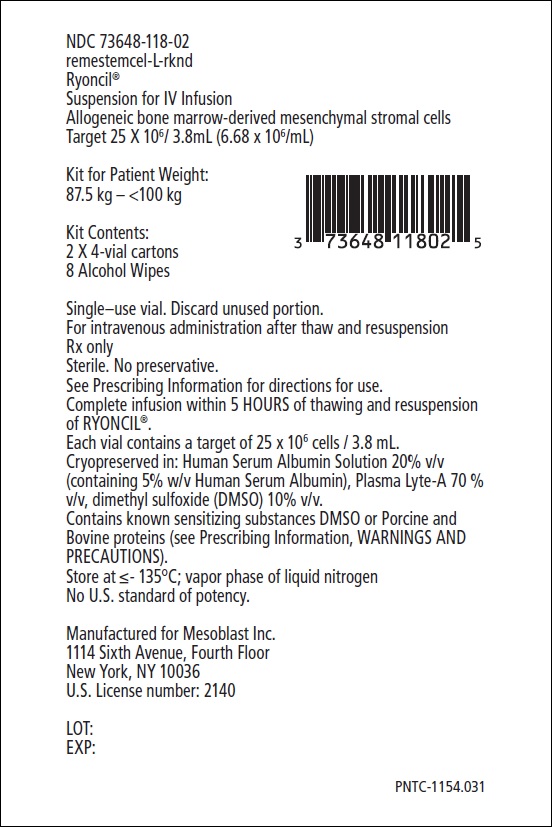
RYONCIL remestemcel-l-rknd Kit — NDC 73648-118-02 (Billing 73648-0118-02)
This is a package of RYONCIL remestemcel-l-rknd Kit from Mesoblast, marketed since Mar 2025 and currently FDA-listed. It is this product's only package size.
NDC database record
One package, one record: these facts belong to NDC 73648-118-02 alone.
- Record
- FDA NDC Directory package listing · Human prescription drug
- Code segments
- 73648 labeler · 118 product · 02 package
- Package marketed since
- Mar 17, 2025
- Sample package
- No — commercial package
- Listing certified through
- Dec 31, 2026
- Barcode (UPC-A, from the NDC)
- 3 7364811802 5
- FDA record last changed
- Oct 1, 2026
Identity & classification
Regulatory identifiers FDA, NLM and CMS codes for this package
Drug-database identifiers Medi-Span GPI and First Databank GCN / HICL / AHFS classification
- GSN (GCN sequence number): 087387
- GCN: 57285
- GPI-14 (Medi-Span): 99393670726424
- HICL (First Databank): 050113
- AHFS class code: 26:04.00.00
- RxCUI (RxNorm): 797544
Where does this data come from?
- FDA openFDA NDC Directory · synced Oct 1, 2026
- FDA label on DailyMed · label index refreshed Oct 5, 2026
- RxNorm (NLM RxNav) · catalog refreshed Oct 1, 2026
- Medi-Span GPI (licensed)
- First Databank (licensed) · refreshed Oct 1, 2026
RxNorm drug class
This medicine belongs to the Other antiseptics and disinfectants class.
Where does this data come from?
- RxClass (NLM) · catalog refreshed Oct 1, 2026
Clinical
Remestemcel-l-rknd injection is used to treat a certain type of acute graft versus host disease (aGVHD; a life-threatening complication that can happen after a stem-cell transplant). Remestemcel-l-rknd is in a class of medications called cellular therapy. It works by slowing down the immune system and decreasing inflammation.
Read the full MedlinePlus article ↗- Ryoncil treats steroid-refractory acute graft versus host disease in children 2 months and older. That means the condition has not gotten better with steroid treatment.
- It is given by IV infusion in a clinical setting, usually twice a week for 4 weeks. Your team checks how you are doing around day 28 and decides if more treatment is needed. You wi...
- Infections, fever, bleeding, swelling, belly pain, and high blood pressure were the most common in the study. Serious side effects can happen too, so keep your care team informed a...
- Tell your team immediately about fever, trouble breathing, or signs of low blood pressure during or after an infusion. These can be signs of a serious allergic reaction. Report sig...
Patient education
Supplement & herbal interactions
Where does this data come from?
- MedlinePlus (NLM) · refreshed Oct 1, 2026
- FDA label on DailyMed · label index refreshed Oct 5, 2026
Ask a licensed pharmacist directly — free, answered by our team.
Pricing
A drug doesn't have one price. Each row is a different public payment system, and none is what you'd pay at the counter — that depends on your insurance. The ⓘ on each row explains what it measures.
| Price system | Per each | Per package |
|---|---|---|
| Retail pharmacies payNADAC · weekly | Not in the retail survey — common for institutional, discontinued, or low-volume packs. | |
| Medicaid paysCMS SDUD · 12 mo | No recent Medicaid claims on file for this NDC — rare and low-volume NDCs are suppressed in the public data. | |
| Medicare drug plans payPart D · quarterly | No Part D plan price is available for this NDC in our data. | |
| Medicare Part B allowsASP · J3402 | $203,659.763 / J3402 unit | — |
Where does this data come from?
- CMS NADAC weekly file
- CMS ASP pricing files · refreshed Sep 20, 2026
- CMS Medicaid State Drug Utilization Data · refreshed Oct 5, 2026
- CMS Part D plan pricing files · refreshed Sep 24, 2026
- VA National Acquisition Center price file
Billing & reimbursement
Where does this data come from?
- CMS ASP NDC-HCPCS crosswalk · refreshed Sep 22, 2026
- DMEPDAC NDC-HCPCS crosswalk
- openFDA NSDE billing units · refreshed Sep 7, 2026
Packaging — all sizes for this product
| Package NDC | Description | Marketing start | Marketing end | Status |
|---|---|---|---|---|
| 73648-0118-02 You're viewing this Main listing | 1 KIT in 1 CARTON * 4 VIAL, PLASTIC in 1 CARTON / 3.8 mL in 1 VIAL, PLASTIC * 1 mL in 1 POUCH * 4 VIAL, PLASTIC in 1 CARTON / 3.8 mL in 1 VIAL, PLASTIC | 2025-03-17 | — | Active |
Therapeutic equivalents
| Product | Labeler | Pack | NADAC/unit | TE | Status | Price vs. this |
|---|---|---|---|---|---|---|
| Ryoncilthis 73648-0118-02 | Mesoblast | 1 kit | — | — | FDA listed | — |
| Ryoncil 73648-0112-02 | Mesoblast | 1 kit | — | — | FDA listed | — |
| Ryoncil 73648-0114-01 | Mesoblast | 1 kit | — | — | FDA listed | — |
| Ryoncil 73648-0119-03 | Mesoblast | 1 kit | — | — | FDA listed | — |
| Ryoncil 73648-0116-03 | Mesoblast | 1 kit | — | — | FDA listed | — |
| Ryoncil 73648-0113-03 | Mesoblast | 1 kit | — | — | FDA listed | — |
| Ryoncil 73648-0120-04 | Mesoblast | 1 kit | — | — | FDA listed | — |
| Ryoncil 73648-0111-01 | Mesoblast | 1 kit | — | — | FDA listed | — |
| Ryoncil 73648-0117-04 | Mesoblast | 1 kit | — | — | FDA listed | — |
| Ryoncil 73648-0121-05 | Mesoblast | 1 kit | — | — | FDA listed | — |
| Ryoncil 73648-0122-03 | Mesoblast | 1 kit | — | — | FDA listed | — |
| Ryoncil 73648-0115-02 | Mesoblast | 1 kit | — | — | FDA listed | — |
Where does this data come from?
- FDA openFDA NDC Directory · synced Oct 1, 2026
- FDA Purple Book · refreshed Oct 5, 2026
- CMS NADAC weekly file
Availability & biosimilar status
Biologics have no small-molecule generics; biosimilar competition is tracked in the FDA Purple Book.
Why the date isn’t exact: Biosimilar timing can change because patents may be challenged, settled, licensed, added or removed, and litigation can move the real date earlier or later.
🛈 What do these terms mean?
- Biologic patent
- A patent the reference product’s maker has publicly listed. A biosimilar generally can’t launch until these expire — unless they’re invalidated or resolved in a settlement.
- Reference-product exclusivity
- A flat 12 years of FDA market protection from the biologic’s first licensure (the BPCIA). No biosimilar can be licensed before it ends, regardless of patents.
- Interchangeable exclusivity
- The first interchangeable biosimilar can earn a period as the only interchangeable version (pharmacists can substitute it without the prescriber).
- Earliest biosimilar (LOE)
- The latest of all the dates above — the soonest a biosimilar can realistically reach the market. Litigation and settlements can move it earlier.
Biologics have no small-molecule “generics” — competition comes from FDA-licensed biosimilars, tracked in the FDA Purple Book.
| Code | What it grants | Expires |
|---|---|---|
| RefProduct | Reference-product exclusivity (12-year, BPCIA) — no biosimilar can be licensed before this date | Dec 18, 2036 |
Is there a biosimilar for RYONCIL 87.5KG-LESS THAN 100KG?
Why do different websites show different biosimilar dates?
Can a biosimilar launch before the last patent expires?
What does “current Purple Book estimate” mean?
What does “FDA listed” mean?
What does a patent or protection date mean here?
Where does this data come from?
- FDA Purple Book · refreshed Oct 5, 2026
Inactive Ingredients / Excipients
Inactive ingredients, also called excipients, are components of the drug product other than the active ingredient. They may include fillers, dyes, coatings, preservatives, flavors, or other formulation ingredients.
🧪 Avoiding an ingredient? See Remestemcel-L-Rknd inactive ingredients by manufacturer: every current product's list side by side, so you can ask your pharmacy for the version that does not list it.
Where does this data come from?
IACT rows and label-wide narrative are kept separate; availability and product-level specificity depend on the submitted label.- FDA label on DailyMed · label index refreshed Oct 5, 2026
- FDA openFDA NDC Directory · synced Oct 1, 2026
Inactive ingredient FAQ
Are inactive ingredients the same for every manufacturer?
Why might an inactive ingredient be missing?
Can inactive ingredients matter?
Manufacturer & labeler
More NDCs from Mesoblast labeler code 73648
- RYONCIL remestemcel-l-rknd Kit NDC 73648-112-02
- RYONCIL remestemcel-l-rknd Kit NDC 73648-113-03
- RYONCIL remestemcel-l-rknd Kit NDC 73648-114-01
- RYONCIL remestemcel-l-rknd Kit NDC 73648-115-02
- RYONCIL remestemcel-l-rknd Kit NDC 73648-116-03
- RYONCIL remestemcel-l-rknd Kit NDC 73648-117-04
- RYONCIL remestemcel-l-rknd Kit NDC 73648-119-03
- RYONCIL remestemcel-l-rknd Kit NDC 73648-120-04
- RYONCIL remestemcel-l-rknd Kit NDC 73648-121-05
- RYONCIL remestemcel-l-rknd Kit NDC 73648-122-03
Where does this data come from?
- FDA openFDA NDC Directory · synced Oct 1, 2026
- Drugs@FDA
Full prescribing information FDA SPL
🎯 Indications and Usage ▾
1 INDICATIONS AND USAGE RYONCIL is indicated for the treatment of steroid refractory acute graft versus host disease (SR-aGvHD) in pediatric patients 2 months of age and older. RYONCIL is an allogeneic bone marrow-derived mesenchymal stromal cell (MSC) therapy indicated for the treatment of steroid-refractory acute graft versus host disease (SR-aGvHD) in pediatric patients 2 months of age and older.
⏱️ Dosage and Administration ▾
2 DOSAGE AND ADMINISTRATION For intravenous use only. For intravenous use only. The recommended dosage of RYONCIL is 2 × 10 6 MSC/kg body weight per intravenous infusion given twice per week for 4 consecutive weeks.
Infusions should be administered at least 3 days apart. Assess response 28 ± 2 days after the first dose and administer further treatment as appropriate as described in the table below. Recommended Treatment Based on Day 28 Response Response Recommendation Complete Response (CR) No further treatment with RYONCIL Partial or Mixed Response Repeat administration of RYONCIL once a week for additional 4 weeks (4 infusions total) No Response Consider alternative treatments Recurrence of GvHD after CR Repeat administration of RYONCIL twice a week for an additional 4 consecutive weeks (8 infusions total)
2.1Recommended Dosage The recommended dosage of RYONCIL is 2 × 10 6 mesenchymal stromal cells (MSC)/kg body weight per intravenous infusion given twice a week for 4 consecutive weeks for a total of 8 infusions. Administer infusions at least 3 days apart. Assess response 28 ± 2 days after the first dose and administer further treatment as appropriate as described in Table 1 based on Day 28 response.
Table 1: Recommended Treatment based on Day 28 Response Response Recommendation Complete Response No further treatment with RYONCIL Partial or Mixed Response Partial response defined as organ improvement of at least one stage without worsening in any other organ, whereas mixed response was defined as improvement of at least one evaluable organ with worsening in another organ as per International Blood and Marrow Transplantation Registry Severity Index Criteria grading system. Repeat administration of RYONCIL once a week for additional 4 weeks (4 infusions total) No Response Consider alternative treatments Recurrence of GvHD after complete response Repeat administration of RYONCIL twice a week for an additional 4 consecutive weeks (8 infusions total)
2.2Preparation and Administration Instructions Receipt and Storage of RYONCIL RYONCIL is shipped directly to the clinical facility in a liquid nitrogen dry shipper maintained at a temperature of ≤ -135°C. RYONCIL must remain frozen at ≤ -135°C in liquid nitrogen vapor phase until thawed immediately prior to administration [see How Supplied/Storage and Handling (16) ] . Preparation RYONCIL and Plasma-Lyte ® A should be prepared following aseptic technique in a Biological Safety Cabinet (BSC).
Spray and wipe down the following materials with 70% alcohol prior to transferring them into the BSC preparation area. All materials should remain in the BSC preparation area unless discarded. Prepare a sterile water bath to a minimum depth of 4 inches and warm to 37°C (± 2°C) at least 30 minutes prior for thawing.
Supplies needed for preparation of RYONCIL and Plasma-Lyte ® A RYONCIL vials Plasma-Lyte ® A Infusion bag Interlink blood bag spikes (2) Interlink threaded lock cannula (1 per syringe) 60 mL luer-lock syringe (1) 5 mL luer-lock syringe (1 per each thawed vial) 18-gauge needle (1 per each thawed vial) Note: Use a 1mL syringe if volume to be removed from vial is less than 1mL Airtight zip seal plastic bag(s) (1 per each vial for thaw) Water bath Alcohol wipes Note: Plasma-Lyte ® A may be substituted by Plasma-Lyte ® 148 (pH 7.4 with no glucose).
Preparation of Plasma-Lyte ® A 1- Insert the Interlink blood bag spike into the Plasma-Lyte ® A bag. 2- Aseptically attach the threaded lock cannula to a 60 mL syringe. 3- Use an alcohol wipe to scrub the membrane of the Plasma-Lyte ® A bag interlink spike injection site.
4- Attach the threaded lock cannula/syringe assembly to the Plasma-Lyte ® A bag to the injection site. 5- Measure and withdraw 40 mL of Plasma-Lyte ® A from the bag Note: DO NOT remove the syringe containing Plasma-Lyte ® A from the Plasma-Lyte ® A bag. Set aside for later use.
Preparation of RYONCIL 1. Prior to RYONCIL thaw, verify that the pre-arranged time for the RYONCIL a… [Excerpted — this section continues on DailyMed.]
💊 Dosage Forms and Strengths ▾
3 DOSAGE FORMS AND STRENGTHS RYONCIL is available as a cell suspension for intravenous infusion in a target concentration of
6.68X 10 6 MSCs per mL in 3.8 mL at cryopreservation contained in a 6 mL cryovial. Each 6 mL cryovial contains approximately 25 x 10 6 MSCs. Cryopreserved MSCs are combined with Plasma-Lyte ® A for administration. RYONCIL is available as a cell suspension for intravenous infusion in a target concentration of
6.68X 10 6 MSCs per mL in 3.8 mL contained in a 6 mL cryovial.
⛔ Contraindications ▾
4 CONTRAINDICATIONS Do not use RYONCIL in patients with known hypersensitivity to dimethyl sulfoxide (DMSO) or porcine and bovine proteins. Known hypersensitivity to dimethyl sulfoxide (DMSO) or Porcine and Bovine proteins. ( 4 )
⚠️ Warnings and Cautions ▾
5 WARNINGS AND PRECAUTIONS Hypersensitivity/Acute Infusion reactions : Monitor for hypersensitivity reactions during infusion and premedicate with corticosteroids and antihistamines. ( 5.1 ) Transmission of Infectious Agents: RYONCIL may transmit infectious agents. ( 5.2 ) Ectopic Tissue Formation: Ectopic tissue formation may occur following treatment with RYONCIL. ( 5.3 )
5.1Hypersensitivity and Acute Infusion Reactions Hypersensitivity reactions including acute infusion reactions have occurred with RYONCIL administration [see Adverse Reactions (6.1) ] . Serious hypersensitivity reactions, including anaphylaxis, may occur due to DMSO and trace amounts of porcine or bovine proteins. Signs and symptoms may include fever, dyspnea, and hypotension during or after RYONCIL infusion.
Premedicate patients with antihistamine and corticosteroids and monitor closely for signs and symptoms of hypersensitivity or acute infusion reactions. If a hypersensitivity or infusion reaction occurs, interrupt RYONCIL infusion. Do not administer RYONCIL in patients who experience serious or life-threatening reactions.
5.2Transmission of Infectious Agents Transmission of infectious disease or agents may occur with RYONCIL administration because it contains cells from human donors and is manufactured using human, porcine and bovine-derived reagents. Donors are screened and tested for Human Immune-deficiency Virus 1 (HIV-1); Human Immune-deficiency Virus 2 (HIV-2); Hepatitis B Virus (HBV); Hepatitis C Virus (HCV); Human T-cell Leukemia-lymphoma Virus 1 (HTLV-1); Human T-cell Leukemia-lymphoma Virus 2 (HTLV-2); West Nile Virus (WNV); Cytomegalovirus (CMV); Epstein-Barr Virus (EBV); and Syphilis ( Treponema pallidum ).
Only screening was performed for Creutzfeldt-Jakob disease (CJD) and communicable disease risks associated with xenotransplantation. RYONCIL cell banks are tested for human and animal viruses, retroviruses, bacteria, fungi, yeast, and mycoplasma. Human and animal-derived reagents are tested for human and animal viruses, bacteria, fungi, and mycoplasma before use.
These measures do not eliminate the risk of transmitting these or other infectious diseases or agents.
5.3Ectopic Tissue Formation Ectopic tissue formation may occur following treatment with RYONCIL due to the ability of human mesenchymal stromal cells to differentiate into mesenchymal lineage cells such as bone, cartilage and fat cells.
🤒 Adverse Reactions ▾
6 ADVERSE REACTIONS The most common non-laboratory adverse reactions (incidence ≥20%) are: viral infectious disorders, bacterial infectious disorders, infection – pathogen unspecified, pyrexia, hemorrhage, edema, abdominal pain and hypertension ( 6.1 ). To report SUSPECTED ADVERSE REACTIONS, contact Mesoblast at toll-free phone #1-844-889-MESO (6376) or FDA at 1-800-FDA-1088 or www.fda.gov/medwatch .
6.1Clinical Trials Experience Because clinical studies are conducted under widely varying conditions, adverse reaction rates observed in the clinical studies of a drug cannot be directly compared to rates in the clinical studies of another drug and may not reflect the rates observed in practice. The safety data described in this section reflect exposure to RYONCIL in 54 patients in Study MSB-GVHD001 for the treatment of SR-aGvHD. Patients received intravenous infusion of RYONCIL at a dosage of 2 x 10 6 MSCs/kg twice a week for four consecutive weeks, for a total of eight infusions.
Patients with partial or mixed response at Day 28 received additional infusions of RYONCIL 2 x 10 6 MSCs/kg once a week for an additional four weeks [see Clinical Studies (14) ] . The median number of doses administered were 10 (range 1 to 16), and the treatment was administered over a median of 43 days (range 1 to 104 days). Serious adverse reactions occurred in 35 patients (65%) including pyrexia (n=5;9%), respiratory failure (n=5;9%), pneumatosis intestinalis (n=4;7%) and staphylococcal bacteremia (n=2;<5%).
Eight patients had discontinuation of RYONCIL treatment due to the following: acute infusion reactions (n=3), hypotension (n=1), gastroenteritis (n=1), and death (n=3). Table 2 summarizes most common adverse reactions that occurred in ≥10% patients in Study MSB-GVHD001. Table 2: Adverse Reactions** Occurring in ≥10% of Patients in Study MSB-GVHD001 (N=54) a Based on National Cancer Institute Adverse Event Common Toxicity Criteria version 4.03 b No grade 4 or 5 adverse reactions occurred in the study *Is a composite that includes multiple related terms **Includes adverse reactions up to 100 days following RYONCIL treatment Adverse Reactions All Grades a n (%) Grade 3 b n (%) Viral infectious disorders* 30 (56) 8 (15) Bacterial infectious disorders* 24 (44) 10 (19) Infections - pathogen unspecified* 22 (41) 8 (15) Pyrexia 19 (35) 2 (4) Hemorrhage* 15 (28) 4 (7) Edema* 12 (22) 1 (2) Abdominal pain 11 (20) 4 (7) Hypertension 11 (20) 3 (6) Vomiting 10 (19) 3 (6) Arrhythmia* 9 (17) 2 (4) Diarrhea 9 (17) 1 (2) Rash* 9 (17) 0 (0) Arthralgia 8 (15) 0 (0) Fungal infectious disorders* 8 (15) 2 (4) Hypotension 8 (15) 2 (4) Cough 7 (13) 0 (0) Respiratory Failure 6 (11) 6 (11) Table 3 presents the most common grade 3 or 4 laboratory abnormalities that worsened from baseline in ≥10% of patients Table 3: Grade 3 or 4 Laboratory Abnormalities that Worsened from Baseline in ≥ 10% of Patients in Study MSB-GVHD001 (N=54) Laboratory Parameter Grade 3 or higher a % a Based on National Cancer Institute Adverse Event Common Toxicity Criteria version
4.03Gamma-glutamyl transferase increased 32 Thrombocytopenia 28 Blood bilirubin increased 11
👥 Use in Specific Populations ▾
8 USE IN SPECIFIC POPULATIONS
8.1Pregnancy Risk Summary There are no available data for RYONCIL use in pregnant women. No animal reproductive and developmental toxicity studies have been conducted with RYONCIL to assess whether it can cause fetal harm when administered to a pregnant woman. It is not known if RYONCIL has the potential to be transferred to the fetus.
Therefore, RYONCIL is not recommended for women who are pregnant. In the U.S. general population, the estimated background risk of major birth defects and miscarriage in clinically recognized pregnancies is 2-4% and 10-20%, respectively.
8.2Lactation Risk Summary There is no information regarding the presence of RYONCIL in human milk, the effect on the breastfed infant, and the effects on milk production. The developmental and health benefits of breastfeeding should be considered along with the mother’s clinical need for RYONCIL and any potential adverse effects on the breastfed infant from RYONCIL or from the underlying maternal condition.
8.4Pediatric Use The safety and effectiveness of RYONCIL for treatment of SR-GvHD have been established in pediatric patients 2 months of age and older. The use of RYONCIL in these age groups is supported by evidence from an adequate and well-controlled trial [see Adverse Reactions (6) and Clinical Studies (14) ] .
🤰 Pregnancy ▾
8.1Pregnancy Risk Summary There are no available data for RYONCIL use in pregnant women. No animal reproductive and developmental toxicity studies have been conducted with RYONCIL to assess whether it can cause fetal harm when administered to a pregnant woman. It is not known if RYONCIL has the potential to be transferred to the fetus.
Therefore, RYONCIL is not recommended for women who are pregnant. In the U.S. general population, the estimated background risk of major birth defects and miscarriage in clinically recognized pregnancies is 2-4% and 10-20%, respectively.
🧒 Pediatric Use ▾
8.4Pediatric Use The safety and effectiveness of RYONCIL for treatment of SR-GvHD have been established in pediatric patients 2 months of age and older. The use of RYONCIL in these age groups is supported by evidence from an adequate and well-controlled trial [see Adverse Reactions (6) and Clinical Studies (14) ] .
🧬 Clinical Pharmacology ▾
12 CLINICAL PHARMACOLOGY
12.1Mechanism of Action The mechanism of action for RYONCIL is not clear but may be related to immunomodulatory effects. Data from in vitro studies demonstrate that MSCs inhibit T cell activation as measured by proliferation and secretion of pro-inflammatory cytokines. Acute GvHD occurs when alloreactive donor-derived T cells within the donated tissue (graft) trigger an immunological response, and alloreactive donor-derived T cells play a role in mediating the systemic inflammation, cytotoxicity and potential end organ damage associated with aGvHD.
12.2Pharmacodynamics Human pharmacodynamic data were obtained from analysis of blood samples in pediatric subjects with SR-aGvHD (n=40; age range 0.6-17 years) following treatment with RYONCIL at a dose of 2x10 6 cells/kg. At Baseline, elevated levels of tumor necrosis factor receptor type I (TNFR1) and suppressor of tumorigenicity 2 (ST2) were observed consistent with the inflammatory state of aGvHD. Treatment with RYONCIL reduced the levels of TNFR1 and ST2 by 79% and 75%, respectively, at Day 180 as compared to baseline values.
Further, the circulating levels of CD3+CD4+CD25+HLA-DR+ T cells, which represent activated T cells, were reduced by 64% at Day 180 following treatment with RYONCIL as compared to the baseline values.
12.3Pharmacokinetics No studies have been performed to evaluate the pharmacokinetics of RYONCIL.
🧬 Mechanism of Action ▾
12.1Mechanism of Action The mechanism of action for RYONCIL is not clear but may be related to immunomodulatory effects. Data from in vitro studies demonstrate that MSCs inhibit T cell activation as measured by proliferation and secretion of pro-inflammatory cytokines. Acute GvHD occurs when alloreactive donor-derived T cells within the donated tissue (graft) trigger an immunological response, and alloreactive donor-derived T cells play a role in mediating the systemic inflammation, cytotoxicity and potential end organ damage associated with aGvHD.
📦 How Supplied / Storage and Handling ▾
16 HOW SUPPLIED/STORAGE AND HANDLING RYONCIL is supplied as a sterile, cryopreserved cell suspension of ex-vivo culture-expanded allogeneic bone marrow-derived mesenchymal stromal cells (MSC) in vials. RYONCIL is provided as a customized kit to meet dosing requirements for a single dose for each patient [see Dosage and Administration (2.1) ] , with each kit containing: Cartons containing sufficient RYONCIL for one infusion based on the patient weight (see Table 5 ) Sufficient alcohol wipes for preparation of the RYONCIL infusions.
Kit sizes and National Drug Codes (NDC) are provided in Table 5. Table 5: RYONCIL Kit Sizes Patient weight (kg) Kit contents (single infusion) Number of kits needed for: 4-vial cartons 1-vial cartons Total cartons Number of alcohol wipes NDC Number Initial course 2 nd course Relapse after CR <12.5 0 1 1 1 73648-111-01 8 4 8 12.5-<25 0 2 2 2 73648-112-02 25-<37.5 0 3 3 3 73648-113-03 37.5-<50 1 0 1 4 73648-114-01 50-<62.5 1 1 2 5 73648-115-02 62.5-<75 1 2 3 6 73648-116-03 75-<87.5 1 3 4 7 73648-117-04 87.5-<100 2 0 2 8 73648-118-02 100-<112.5 2 1 3 9 73648-119-03 112.5-<125 2 2 4 10 73648-120-04 125-<137.5 2 3 5 11 73648-121-05 137.5-<150 3 0 3 12 73648-122-03 RYONCIL is shipped to the clinical facility in a liquid nitrogen dry shipper maintained at a temperature of ≤ -135°C.
Storage conditions : RYONCIL must remain frozen at ≤ -135°C in liquid nitrogen vapor phase until thawed immediately prior to administration. Handling : Restrict preparation and administration of RYONCIL to a medical facility in which the medical personnel are trained in aseptic technique. Disposal: Dispose empty or partially used RYONCIL vials according to the institutional guidelines for disposal of biohazard materials.
Do not save thawed RYONCIL vials for future use.
📋 Description ▾
11 DESCRIPTION RYONCIL is provided as a frozen cell suspension in a cryogenic vial. The active ingredient in RYONCIL is comprised of culture-expanded mesenchymal stromal cells (MSCs) isolated from the bone marrow of healthy human adult donors. Each cryovial contains nominally 25 x 10 6 MSCs in 3.8 mL (a target concentration 6.68 x 10 6 cells/mL) formulated in Plasma Lyte ® -A (70% v/v), Human Serum Albumin (HSA) Solution (25%) (20% v/v) and Dimethyl sulfoxide (DMSO) (10% v/v).
The product is thawed and combined with Plasma-Lyte ® A prior to intravenous administration.
💬 Information for Patients ▾
17 PATIENT COUNSELING INFORMATION Discuss the following with patients and/or caregivers. Hypersensitivity and Acute infusion reactions: Inform patients and/or caregivers that hypersensitivity and acute infusion reactions due to the presence of porcine and bovine protein, and DMSO may occur with RYONCIL infusion. Advise patients and/or caregivers to seek immediate medical evaluation if any signs and symptoms of hypersensitivity or acute infusion reactions occur, such as fever, rash or hives, low blood pressure, breathing problems [see Warnings and Precautions (5.1 ] .
Transmission of Infectious Agents: Inform patients and/or caregivers about the possible risk of transmission of infectious agents with RYONCIL administration [see Warnings and Precautions (5.2) ] . Ectopic Tissue Formation: Inform patients and/or caregivers about the possible risk of ectopic tissue formation with RYONCIL administration [see Warnings and Precautions (5.3) ] . Manufactured for: Mesoblast, Inc.
1114 Sixth Avenue, Fourth Floor New York, NY 10036 US License number: 2140 RYONCIL is a registered trademark of Mesoblast. All rights reserved. ©2024 Mesoblast, Inc. All rights Reserved V 3
🧬 Pharmacokinetics ▾
12.3Pharmacokinetics No studies have been performed to evaluate the pharmacokinetics of RYONCIL.
🧬 Pharmacodynamics ▾
12.2Pharmacodynamics Human pharmacodynamic data were obtained from analysis of blood samples in pediatric subjects with SR-aGvHD (n=40; age range 0.6-17 years) following treatment with RYONCIL at a dose of 2x10 6 cells/kg. At Baseline, elevated levels of tumor necrosis factor receptor type I (TNFR1) and suppressor of tumorigenicity 2 (ST2) were observed consistent with the inflammatory state of aGvHD. Treatment with RYONCIL reduced the levels of TNFR1 and ST2 by 79% and 75%, respectively, at Day 180 as compared to baseline values.
Further, the circulating levels of CD3+CD4+CD25+HLA-DR+ T cells, which represent activated T cells, were reduced by 64% at Day 180 following treatment with RYONCIL as compared to the baseline values.
🔬 Clinical Studies ▾
14 CLINICAL STUDIES The efficacy of RYONCIL was evaluated in a multicenter, prospective, single-arm study (MSB-GVHD 001; NCT02336230). The study enrolled pediatric patients with SR-GvHD Grade B to D (excluding Grade B skin alone) as per International Blood and Marrow Transplantation Registry Severity Index Criteria (IBMTR) after receiving allogeneic hematopoietic stem cell transplantation (HSCT). SR-aGvHD was defined as aGvHD that progressed within 3 days or did not improve within 7 consecutive days of treatment with methylprednisolone 2 mg/kg/day or equivalent.
Patients who received a second line therapy for aGvHD prior to screening were excluded. RYONCIL was administered by intravenous infusion at a dosage of 2 x 10 6 MSCs/kg twice a week for four consecutive weeks, for a total of eight infusions. Patients with partial or mixed response at Day 28 received additional infusions of RYONCIL 2 x 10 6 MSCs/kg once a week for an additional four consecutive weeks.
Patients with complete response at Day 28 who experienced recurrence of aGvHD received infusions of RYONCIL 2 x 10 6 MSCs/kg twice a week for an additional four consecutive weeks. A total of 55 patients were enrolled, and 54 were treated with RYONCIL. Among the treated patients (n=54), the demographic characteristics were as follows: median age was 7 years (range: 7 months to 17 years); 36% were females; 56% were White, 19% reported “other” race, 15% were Black, 6% were Asian, 6% American Indian or Alaska Native, 33% were Hispanic and 65% were non-Hispanic.
Among enrolled patients, hematologic malignancies (67%) and non-malignant diseases (33%) were the underlying reasons for allogenic HSCT. SR-GvHD severity was as follows at baseline: Grade B (11%), Grade C (43%), Grade D (46%). Organ involvement at baseline were as follows: skin alone (26%), lower gastrointestinal tract only (39%), multi-organ involvement (35%).
The median duration of prior corticosteroid treatment at baseline was 8 days (range: 2 to 46 days). The main efficacy outcome measures were Day-28 overall response rate (complete response rate and partial response rate) and the duration of response. The efficacy results are summarized in Table 4.
Table 4: Efficacy Results for Study MSB-GVHD001 Response at Day 28 N=54 CI=confidence interval a Two-sided exact binomial confidence interval at the 95% level b Duration of response was calculated from Day-28 response to either progression (worsening by one stage in any organ without improvement in other organs in comparison to prior response assessment), new systemic therapy for aGvHD or death from any cause. c Complete response was defined as resolution of aGvHD in all involved organs as per IBMTR grading system. d Partial response was defined as organ improvement of at least one stage without worsening of any other organ as per IBMTR grading system.
Overall Response Rate n (%) 95% CI a 38 (70%) 56.4,
82.0Duration b (days) Median (range) 54 (7, 159+) Complete Response Rate c n (%) 95% CI a 16 (30%) 18.0,
43.6Partial Response Rate d n (%) 95% CI a 22 (41%) 27.6,
55.0Overall response rate at Day 28 by baseline disease severity is as follows: Grade B (3/6; 50%), Grade C (16/23; 70%), and Grade D (19/25; 76%). Among the 38 responders, the median time from Day-28 response to either death or need for systemic therapy for aGvHD (non-RYONCIL systemic therapy for aGvHD or increase in the dose of corticosteroids to methylprednisolone 2 mg/kg or equivalent) was 111.5 days (range 9, 182+).
🧪 Nonclinical Toxicology ▾
13 NONCLINICAL TOXICOLOGY
13.1Carcinogenesis, Mutagenesis, Impairment of Fertility No animal studies have been performed to evaluate the effects of RYONCIL on carcinogenesis, mutagenesis or impairment of fertility.
📄 Carcinogenesis, Mutagenesis, Impairment of Fertility ▾
13.1Carcinogenesis, Mutagenesis, Impairment of Fertility No animal studies have been performed to evaluate the effects of RYONCIL on carcinogenesis, mutagenesis or impairment of fertility.
📄 Recent Major Changes ▾
How Supplied/Storage and Handling ( 16 ) 09/2025
📄 Package Label / Principal Display Panel ▾
PACKAGE/LABEL PRINCIPAL DISPLAY PANEL remestemcel-L-rknd Ryoncil ® Target 25 X 10 6 / 3.8mL (6.68 x 10 6 /mL) For intravenous administration after thaw and resuspension See Prescribing Information for directions for use. Store at ≤ -135°C Single–use vial Discard unused portion Manufactured for Mesoblast Inc. Rx only 1 mg vial
PACKAGE/LABEL PRINCIPAL DISPLAY PANEL NDC 73648- 154 -01 remestemcel-L-rknd Ryoncil ® Suspension for IV Infusion Allogeneic bone marrow-derived mesenchymal stromal cells Target 25 X 10 6 / 3.8mL (6.68 x 10 6 /mL) Single–use vial. Discard unused portion. For intravenous administration after thaw and resuspension Rx only Sterile. No preservative. 1 vial
PACKAGE/LABEL PRINCIPAL DISPLAY PANEL NDC 73648- 154 -04 remestemcel-L-rknd Ryoncil ® Suspension for IV Infusion Allogeneic bone marrow-derived mesenchymal stromal cells Target 25 X 10 6 / 3.8mL (6.68 x 10 6 /mL) Single–use vial. Discard unused portion. For intravenous administration after thaw and resuspension Rx only Sterile. No preservative. 4 vials
PACKAGE/LABEL PRINCIPAL DISPLAY PANEL NDC 73648-111-01 remestemcel-L-rknd Ryoncil ® Suspension for IV Infusion Allogeneic bone marrow-derived mesenchymal stromal cells Target 25 X 10 6 / 3.8mL (6.68 x 10 6 /mL) Kit for Patient Weight: <12.5 kg Kit Contents: 1 X single vial carton 1 Alcohol Wipe Single–use vial. Discard unused portion. For intravenous administration after thaw and resuspension Rx only Sterile.
No preservative. See Prescribing Information for directions for use. Complete infusion within 5 HOURS of thawing and resuspension of RYONCIL ® .
Each vial contains a target of 25 x 10 6 cells / 3.8 mL. Cryopreserved in: Human Serum Albumin Solution 20% v/v (containing 5% w/v Human Serum Albumin), Plasma Lyte-A 70 % v/v, dimethyl sulfoxide (DMSO) 10% v/v. Contains known sensitizing substances DMSO or Porcine and Bovine proteins (see Prescribing Information, WARNINGS AND PRECAUTIONS).
Store at ≤- 135°C; vapor phase of liquid nitrogen No U.S. standard of potency. Manufactured for Mesoblast Inc. 1114 Sixth Avenue, Fourth Floor New York, NY 10036 U.S.
License number: 2140 GTIN: XXXXXXXXXXXXXX SN: XXXXXXXXXXXX LOT: XXXXXXX EXP: MMMYYYY PNTC-1154.024 1 vial
PACKAGE/LABEL PRINCIPAL DISPLAY PANEL NDC 73648-112-02 remestemcel-L-rknd Ryoncil ® Suspension for IV Infusion Allogeneic bone marrow-derived mesenchymal stromal cells Target 25 X 10 6 / 3.8mL (6.68 x 10 6 /mL) Kit for Patient Weight: 12.5 kg – <25 kg Kit Contents: 2 X single vial cartons 2 Alcohol Wipes Single–use vial. Discard unused portion. For intravenous administration after thaw and resuspension Rx only Sterile.
No preservative. See Prescribing Information for directions for use. Complete infusion within 5 HOURS of thawing and resuspension of RYONCIL ® .
Each vial contains a target of 25 x 10 6 cells / 3.8 mL. Cryopreserved in: Human Serum Albumin Solution 20% v/v (containing 5% w/v Human Serum Albumin), Plasma Lyte-A 70 % v/v, dimethyl sulfoxide (DMSO) 10% v/v. Contains known sensitizing substances DMSO or Porcine and Bovine proteins (see Prescribing Information, WARNINGS AND PRECAUTIONS).
Store at ≤- 135°C; vapor phase of liquid nitrogen No U.S. standard of potency. Manufactured for Mesoblast Inc. 1114 Sixth Avenue, Fourth Floor New York, NY 10036 U.S.
License number: 2140 GTIN: XXXXXXXXXXXXXX SN: XXXXXXXXXXXX LOT: XXXXXXX EXP: MMMYYYY PNTC-1154.025 2 vial
PACKAGE/LABEL PRINCIPAL DISPLAY PANEL NDC 73648-113-03 remestemcel-L-rknd Ryoncil ® Suspension for IV Infusion Allogeneic bone marrow-derived mesenchymal stromal cells Target 25 X 10 6 / 3.8mL (6.68 x 10 6 /mL) Kit for Patient Weight: 25 kg – <37.5 kg Kit Contents: 3 X single vial cartons 3 Alcohol Wipes Single–use vial. Discard unused portion. For intravenous administration after thaw and resuspension Rx only Sterile.
No preservative. See Prescribing Information for directions for use. Complete infusion within 5 HOURS of thawing and resuspension of RYONCIL ® .
Each vial contains a target of 2… [Excerpted — this section continues on DailyMed.]
About this NDC listing & data coverage
Kit / multi-component package
This NDC identifies a kit — a package containing more than one component. Structured data (pricing, ingredients, equivalents) is often reported per component rather than for the kit NDC itself, which can make this page look thinner than the components' own pages.
What data is (and isn’t) available for this NDC — tap to expand
| NDC identity (package / product / labeler codes) | ✓ Available |
| Labeler | ✓ Available |
| Product & package description | ✓ Available |
| Marketing category & status | ✓ Available |
| Active ingredient / dosage form / route | ✓ Available |
| FDA label (SPL via DailyMed) | ✓ Available |
| Package photos | ✓ Available |
| Inactive ingredients (structured) | — Not published for this NDC The labeler did not submit a structured excipient list, or no SPL is available. |
| NADAC pharmacy acquisition price (CMS) | — Not published for this NDC CMS publishes NADAC only for NDCs reported in its retail-pharmacy survey. |
| Orange Book / therapeutic-equivalence data | ✓ Available |
| HCPCS J-code billing crosswalk | ✓ Available |
| Medicaid utilization (CMS SDUD) | — Not published for this NDC CMS reports utilization only for NDCs with Medicaid claims above its privacy threshold. |