
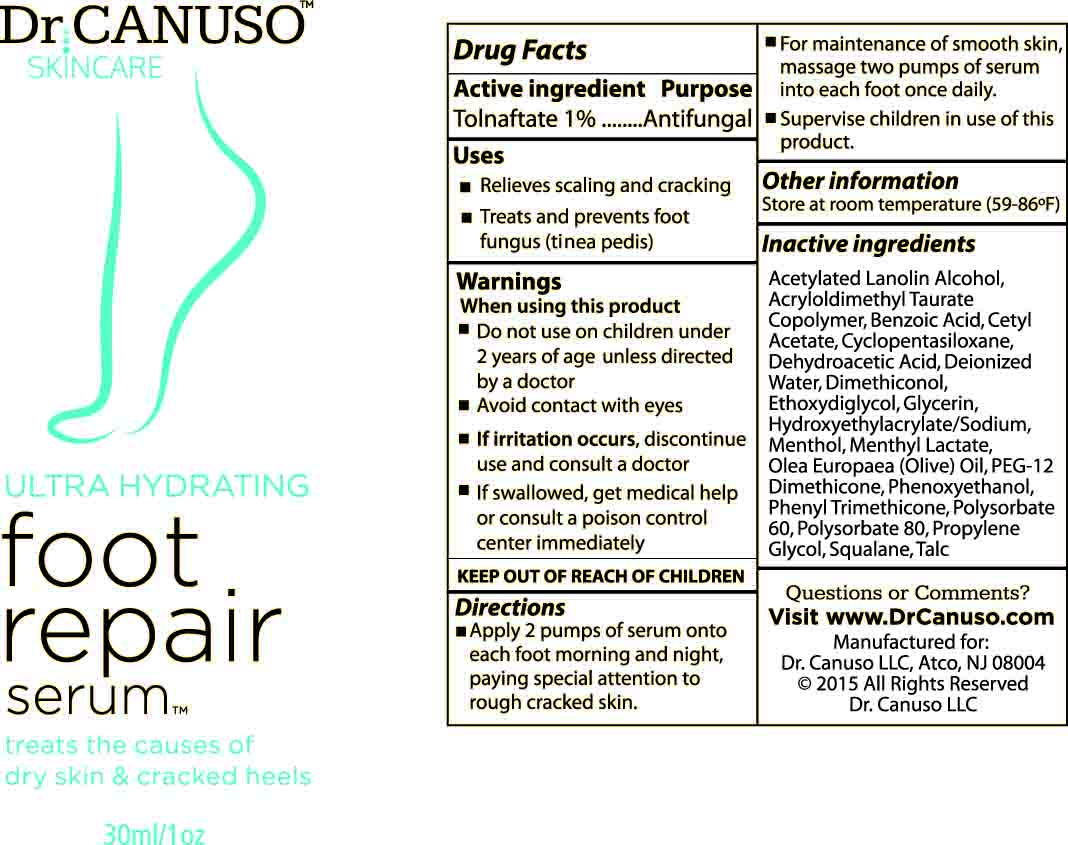
Dr. Canuso foot repair serum Tolnaftate .3 g/28g Lotion
🆔 Identity & classification
Where does this data come from?
🏷️ RxNorm drug class
This medicine belongs to the Other antifungals for topical use class.
Where does this data come from?
🏭 Manufacturer & labeler
Where does this data come from?
🩺 Clinical
Tolnaftate stops the growth of fungi that cause skin infections, including athlete's foot, jock itch, and ringworm. This medication is sometimes prescribed for other uses; ask your doctor or pharmacist for more information.
Read the full MedlinePlus article ↗- It depends on what you're treating. For athlete's foot and ringworm, plan on using it daily for about 4 weeks. For jock itch, 2 weeks is the usual course. Some products mention you...
- How long does it take for tolnaftate to work?
- Tolnaftate is not effective for treating infections on the scalp or on the nails themselves — most products say so right on the label. Some liquid and patch products are designed t...
- Stop applying the product and let your doctor know. A little initial sensitivity can happen, but worsening irritation is a sign that you should get it checked out. Don't push throu...
Patient education
Supplement & herbal interactions
Where does this data come from?
Ask a licensed pharmacist directly — free, answered by our team.
💊 What it looks like
Where does this data come from?
🧪 Inactive Ingredients / Excipients
Inactive ingredients, also called excipients, are components of the drug product other than the active ingredient. They may include fillers, dyes, coatings, preservatives, flavors, or other formulation ingredients.
💡 Tap an ingredient (hover on desktop) to see what it is and why it’s used.
-
UNII 25GT92NY0C
A synthetic polymer made from acrylic compounds. It's used in tablet coatings and film formulations to help protect the medicine and control how quickly it dissolves in the body.
-
UNII SNN716810P
A waxy substance derived from lanolin, an oil from sheep's wool, that has been chemically modified. It acts as an emulsifier and thickener to help blend water and oil-based ingredients together and improve texture.
-
UNII 8SKN0B0MIM
Benzoic acid is a naturally occurring organic acid used as a preservative in medicines and foods. It helps prevent bacterial and fungal growth to extend shelf life and maintain product stability.
-
UNII 4Q43814HXS
Cetyl acetate is a waxy compound made by combining cetyl alcohol with acetic acid. It works as a binder and thickener in medicines, helping to hold ingredients together and give the product a smooth, creamy texture.
-
UNII 0THT5PCI0R
A silicone-based liquid that helps distribute active ingredients evenly throughout topical products. It acts as a solvent and emollient, allowing medicines to spread smoothly on skin while improving texture and absorption.
-
UNII 2KAG279R6R
Dehydroacetic acid is a synthetic preservative that prevents mold, yeast, and bacterial growth in medicines. It extends shelf life by protecting the product from spoilage during storage and use.
-
UNII A1A1I8X02B
A clear liquid solvent derived from ethylene glycol. It helps dissolve active ingredients and improve how the medicine flows and mixes in liquid formulations.
-
UNII 92RU3N3Y1O
Dimethicone is a silicone-based oil that acts as an anti-foaming agent and lubricant in medicines. It reduces gas bubbles in liquid formulations and helps coat and protect the stomach lining when ingested.
-
UNII PDC6A3C0OX
Glycerin is a clear, thick liquid derived from plant oils or fats. It acts as a humectant to retain moisture, a sweetener, and a solvent in medications.
-
UNII L7T10EIP3A
A cooling compound from mint plants used as a flavoring agent and to create a fresh sensation in medicines. It helps mask bitter tastes and improve how the product feels in the mouth.
-
UNII 2BF9E65L7I
A chemical compound combining menthol with lactic acid. It's used in medicines as a flavoring agent and to provide a cooling or soothing sensation on the skin or mouth.
-
UNII 6UYK2W1W1E
A natural oil extracted from olives. It acts as an emollient and lubricant in formulations, helping to soften ingredients and improve how the medicine spreads or flows.
-
UNII ZEL54N6W95
A silicone-based compound that helps oils and water mix together. Used in medicines as an emulsifier and anti-foaming agent to improve texture and prevent bubbles in liquids and creams.
-
UNII HIE492ZZ3T
Phenoxyethanol is a synthetic preservative and antimicrobial agent used to prevent bacterial and fungal growth in medicines and cosmetic products, extending shelf life and maintaining product safety.
-
UNII DR0K5NOJ4R
Phenyl trimethicone is a silicone-based lubricant and glidant. It helps powder particles flow smoothly and reduces friction during tablet or capsule manufacturing and filling.
-
UNII CAL22UVI4M
A synthetic emulsifier derived from sorbitol and fatty acids. It helps mix oil and water-based ingredients together and improves the texture and stability of the medicine.
-
UNII 6OZP39ZG8H
Polysorbate 80 is a synthetic emulsifier derived from sorbitol and oleic acid. It helps mix oil and water-based ingredients together in medications and improves how the product disperses in the body.
-
UNII 6DC9Q167V3
Propylene glycol is a clear liquid derived from petroleum or vegetable sources. It acts as a solvent, humectant, and preservative in medicines, helping dissolve active ingredients and maintain product stability.
-
UNII 2T9Q6EKI0G
A synthetic polymer derived from acrylic acid, sodium acryloyldimethyltaurate functions as a thickener and stabilizer in liquid formulations. It helps maintain consistent texture and prevents separation of ingredients in creams, gels, and lotions.
-
UNII GW89575KF9
Squalane is a lightweight oil derived from plant sources or synthesized. It acts as an emollient and lubricant in formulations, helping ingredients blend smoothly and improving product texture and spreadability.
-
UNII 7SEV7J4R1U
A powder made from a naturally occurring mineral. In medicines, talc works as a glidant and anti-caking agent, helping tablets and capsules flow smoothly during manufacturing and preventing clumping.
-
UNII 059QF0KO0R
Water is a liquid solvent that dissolves and mixes ingredients together in liquid medicines, syrups, and injections. It helps distribute the active drug evenly throughout the product.
22 inactive ingredients listed in the exact product block matched to this NDC.
Label-section wording can be broader than the structured product block and may mention additional formulation ingredients.
Where does this data come from?
ingredient classCode="IACT" elements from the exact product block matched by this NDC. Label-section narrative from DailyMed / the openFDA label index is shown separately when available.Inactive ingredient FAQ
Are inactive ingredients the same for every manufacturer?
Why might an inactive ingredient be missing?
Can inactive ingredients matter?
💲 Pricing
A drug doesn't have one price. Each row is a different public payment system, and none is what you'd pay at the counter — that depends on your insurance. The ⓘ on each row explains what it measures.
| Price system | Per g | Per package |
|---|---|---|
| Retail pharmacies payNADAC · weekly | Not in the retail survey — common for institutional, discontinued, or low-volume packs. | |
| Medicaid paysCMS SDUD · 12 mo | No recent Medicaid claims on file for this NDC — rare and low-volume NDCs are suppressed in the public data. | |
| Medicare drug plans payPart D · quarterly | No Part D plan price is available for this NDC in our data. | |
Where does this data come from?
🔁 Therapeutic equivalents
| Product | Labeler | Pack | NADAC/unit | TE | Status | Price vs. this |
|---|---|---|---|---|---|---|
| Signature Black Bottle Tea Tree Antifungal Foot and Body Wash 10 mg/mL 69882-0726-01 | Restoration | 266.16 ml | — | — | FDA listed | — |
| HomeHealth Antifungal 10 mg/mL 76020-0100-04 | Home | 118 ml | — | — | FDA listed | — |
| Dr. Canuso foot repair serum .3 g/28gthis 76348-0409-02 | Renu | 1 bottle | — | — | FDA listed | — |
Where does this data come from?
⏳ Availability & generic status
We did not find an FDA-approved generic match for this exact strength, form and route.
Where does this data come from?
📦 Packaging — all sizes for this product
| Package NDC | Description | Marketing start | Status |
|---|---|---|---|
| 76348-0409-02 You're viewing this | 1 BOTTLE, PUMP in 1 BOX (76348-409-02) / 28 g in 1 BOTTLE, PUMP | 2015-08-20 | Active |
🧭 About this NDC listing & data coverage
What data is (and isn’t) available for this NDC — tap to expand
| NDC identity (package / product / labeler codes) | ✓ Available |
| Labeler | ✓ Available |
| Product & package description | ✓ Available |
| Marketing category & status | ✓ Available |
| Active ingredient / dosage form / route | ✓ Available |
| FDA label (SPL via DailyMed) | ✓ Available |
| Package photos | ✓ Available |
| Inactive ingredients (structured) | ✓ Available |
| NADAC pharmacy acquisition price (CMS) | — Not published for this NDC CMS publishes NADAC only for NDCs reported in its retail-pharmacy survey. |
| Orange Book / therapeutic-equivalence data | — Not published for this NDC Applies only to products approved under an NDA/ANDA; many listings are out of scope. |
| HCPCS J-code billing crosswalk | — Not published for this NDC Most self-administered / retail products have no J-code — that is normal. |
| Medicaid utilization (CMS SDUD) | — Not published for this NDC CMS reports utilization only for NDCs with Medicaid claims above its privacy threshold. |
Questions about this listing
Is this NDC FDA-approved?
Why is there no price listed?
Is the NDC printed on the package the same as the 11-digit billing NDC?
What do the three segments of this NDC mean?
Is this package still being marketed?
Who lists this product with the FDA?
Do I need a prescription for this product?
Where does this data come from?
📄 FDA label — Drug Facts FDA SPL
🎯 Indications and Usage ▾
Directions Apply two pumps of serum onto each foot morning and night, paying special attention to rough cracked skin. For maintenance of smooth skin, massage two pumps of serum into each foot once daily. Supervise children in the use of this product.
⏱️ Dosage and Administration ▾
Directions Apply two pumps of serum onto each fot morning and night, paying special attention to rough cracked skin.
⚠️ Warnings ▾
When using this product Do not use on children under 2 years of age unless directed by a doctor Avoid contact with eyes If irritation occurs, discontinue use and consult a doctor If swallowed, get medical help or consult a poison control center immediately
📦 Storage and Handling ▾
Other Information Store at room temperature (59-86º F)
🧪 Active Ingredient ▾
Tolnaftate 1%
🧪 Inactive Ingredients ▾
Inactive Ingredients Acetylated Lanolin Alcohol, Acryloyldimethyl Taurate Copolymer, Benzoic Acid, Cetyl Acetate, Cyclopentasiloxane, Dehydroacetic Acid, Deionized Water, Dimethiconol, Ethoxydiglycol, Glycerin, Menthol, Menthyl Lactate, Olea Europaea (Olive Oil), PEG-12 Dimethicone, Phenoxyethanol, Phenyl Trimethicone, Polysorbate 60, Polysorbate 80, Propylene Glycol, Squalane, Talc.
🎯 Purpose ▾
Antifungal