
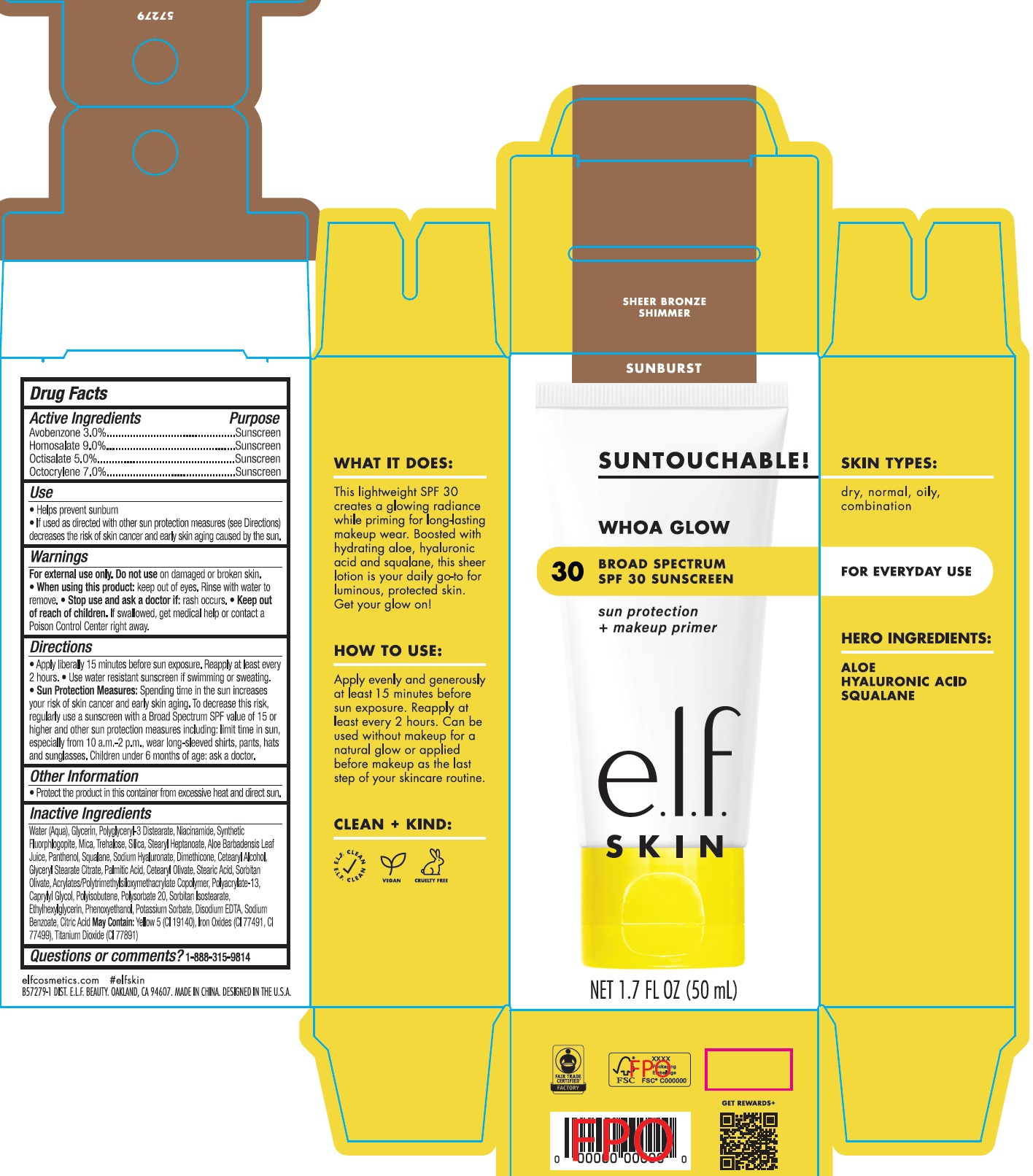
Whoa Glow broad spectrum spf 30 sunscreen Sheer Bronze shimmer AVOBENZONE, HOMOSALATE, OCTISALATE, OCTOCRYLENE 30 mg/mL; 90 mg/mL; 50 mg/mL; 70 mg/mL Cream — NDC 76354-445-01 (Billing 76354-0445-01)
This is a package of Whoa Glow broad spectrum spf 30 sunscreen Sheer Bronze shimmer AVOBENZONE, HOMOSALATE, OCTISALATE, OCTOCRYLENE 30 mg/mL; 90 mg/mL; 50 mg/mL; 70 mg/mL Cream from e.l.f. Cosmetics, Inc, marketed since May 2023 and currently FDA-listed. It is this product's only package size.
NDC database record
One package, one record: these facts belong to NDC 76354-445-01 alone.
- Record
- FDA NDC Directory package listing · Human OTC drug
- Code segments
- 76354 labeler · 445 product · 01 package
- Package marketed since
- May 15, 2023
- Sample package
- No — commercial package
- Listing certified through
- Dec 31, 2026
- Barcode (UPC-A, from the NDC)
- 3 7635444501 0
- FDA record last changed
- Jul 24, 2026
Identity & classification
Regulatory identifiers FDA, NLM and CMS codes for this package
Where does this data come from?
- FDA openFDA NDC Directory · synced Oct 8, 2026
- FDA label on DailyMed · label index refreshed Oct 8, 2026
- RxNorm (NLM RxNav) · catalog refreshed Oct 1, 2026
- Medi-Span GPI (licensed)
- First Databank (licensed) · refreshed Oct 8, 2026
Clinical
Whoa Glow is a topical cream sunscreen product marketed as an over-the-counter monograph drug. It contains four UV-filtering ingredients: avobenzone, homosalate, octisalate, and octocrylene, which are commonly used together in sunscreen formulations to absorb and scatter ultraviolet light from the sun. The product is labeled as broad spectrum SPF 30 and includes a shimmer additive for cosmetic effect. This type of cream is typically applied to exposed skin to help reduce sun exposure.
Patient education
Supplement & herbal interactions
Where does this data come from?
- MedlinePlus (NLM) · refreshed Oct 8, 2026
- FDA label on DailyMed · label index refreshed Oct 8, 2026
Ask a licensed pharmacist directly — free, answered by our team.
Pricing
A drug doesn't have one price. Each row is a different public payment system, and none is what you'd pay at the counter — that depends on your insurance. The ⓘ on each row explains what it measures.
| Price system | Per g | Per package |
|---|---|---|
| Retail pharmacies payNADAC · weekly | Not in the retail survey — common for institutional, discontinued, or low-volume packs. | |
| Medicaid paysCMS SDUD · 12 mo | No recent Medicaid claims on file for this NDC — rare and low-volume NDCs are suppressed in the public data. | |
| Medicare drug plans payPart D · quarterly | No Part D plan price is available for this NDC in our data. | |
Where does this data come from?
- CMS NADAC weekly file
- CMS ASP pricing files · refreshed Sep 20, 2026
- CMS Medicaid State Drug Utilization Data · refreshed Oct 8, 2026
- CMS Part D plan pricing files · refreshed Sep 24, 2026
- VA National Acquisition Center price file
Packaging — all sizes for this product
| Package NDC | Description | Marketing start | Marketing end | Status |
|---|---|---|---|---|
| 76354-0445-01 You're viewing this Main listing | 1 TUBE in 1 CARTON / 50 mL in 1 TUBE | 2023-05-15 | — | Active |
Therapeutic equivalents
| Product | Labeler | Pack | NADAC/unit | TE | Status | Price vs. this |
|---|---|---|---|---|---|---|
| Whoa Glow broad spectrum spf 30 sunscreen Sheer Bronze shimmer 30 mg/mL; 90 mg/mL; 50 mg/mL; 70 mg/mLthis 76354-0445-01 | e.l.f. | 1 tube | — | — | FDA listed | — |
| Whoa Glow broad spectrum spf 30 sunscreen Sheer Champagne shimmer sunlight 30 mg/mL; 90 mg/mL; 50 mg/mL; 70 mg/mL 76354-0446-01 | e.l.f. | 1 tube | — | — | FDA listed | — |
| Keys Soulcare Daily Moisturizer Broad Spectrum Spf30 Sunscreen 30 mg/mL; 90 mg/mL; 50 mg/mL; 70 mg/mL 76354-0442-01 | e.l.f. | 1 bottle | — | — | FDA listed | — |
Where does this data come from?
- FDA openFDA NDC Directory · synced Oct 8, 2026
- FDA Orange Book · refreshed Oct 3, 2026
- CMS NADAC weekly file
Availability & generic status
We did not find an FDA-approved generic match for this exact strength, form and route.
Where does this data come from?
- FDA Orange Book · refreshed Oct 3, 2026
Inactive Ingredients / Excipients
Inactive ingredients, also called excipients, are components of the drug product other than the active ingredient. They may include fillers, dyes, coatings, preservatives, flavors, or other formulation ingredients.
💡 Tap an ingredient (hover on desktop) to see what it is and why it’s used.
-
UNII ZY81Z83H0X
Aloe vera leaf is a plant extract derived from the aloe plant. It is used in medicines as a natural moisturizer and skin-soothing agent in topical formulations.
-
UNII 00YIU5438U
Caprylyl glycol is a clear liquid derived from coconut oil. In medicines, it acts as a humectant to retain moisture, a preservative booster to prevent microbial growth, and a solvent to help dissolve or mix other ingredients.
-
UNII 58B69Q84JO
A plant-derived emulsifier made from olive oil and fatty alcohols. It helps blend oil and water ingredients together and stabilizes the product's texture in creams, lotions, and similar formulations.
-
UNII 2DMT128M1S
A waxy solid derived from plant or animal sources. It acts as an emulsifier to blend oil and water components, and also thickens the medicine to give it the right texture and consistency.
-
UNII 2968PHW8QP
A weak organic acid derived from citrus fruits or made through fermentation. It works as a buffer to control pH, a preservative to extend shelf life, and a flavoring agent in medications.
-
UNII 92RU3N3Y1O
Dimethicone is a silicone-based oil that acts as an anti-foaming agent and lubricant in medicines. It reduces gas bubbles in liquid formulations and helps coat and protect the stomach lining when ingested.
-
UNII 8NLQ36F6MM
Edetate disodium anhydrous is a chemical compound that binds to metal ions in a medicine. It's used as a stabilizer to prevent unwanted chemical reactions and help keep the drug product effective during storage.
-
UNII 147D247K3P
Ethylhexylglycerin is a synthetic preservative used to prevent bacteria and mold from growing in medicines and personal care products. It helps keep the product safe and stable throughout its shelf life.
-
UNII PDC6A3C0OX
Glycerin is a clear, thick liquid derived from plant oils or fats. It acts as a humectant to retain moisture, a sweetener, and a solvent in medications.
-
UNII WH8T92A065
A fatty acid derivative made by combining stearic acid with glycerin and citric acid. It acts as an emulsifier to help mix oil and water-based ingredients, and also serves as a thickener in the medicine formulation.
-
UNII YSE9PPT4TH
Hyaluronate sodium is a natural carbohydrate that holds moisture. It's used in medicines as a lubricant, thickener, and moisture-retaining agent to improve texture and delivery of the active ingredient.
-
UNII V8A1AW0880
Mica is a naturally occurring mineral that's ground into fine powder. It's used in medicines as a colorant and anti-caking agent to improve appearance and prevent clumping in tablets or powders.
-
UNII 25X51I8RD4
Niacinamide is a form of vitamin B3, a water-soluble nutrient. In medicines, it may be added as a nutritional supplement or to support skin health, though its primary role here is as an active ingredient rather than a traditional inactive filler.
-
UNII 2V16EO95H1
Palmitic acid is a saturated fatty acid derived from plant and animal sources. It serves as an emulsifier and lubricant in medicines, helping ingredients mix smoothly and preventing sticking during manufacturing.
-
UNII WV9CM0O67Z
Panthenol is a humectant and skin-conditioning agent derived from pantothenic acid. It's added to medicines to help retain moisture and soothe skin irritation.
-
UNII HIE492ZZ3T
Phenoxyethanol is a synthetic preservative and antimicrobial agent used to prevent bacterial and fungal growth in medicines and cosmetic products, extending shelf life and maintaining product safety.
-
UNII FS2D4T67EA
Polyacrylate-13 is a synthetic polymer used as a film-coating agent. It forms a protective layer around tablets or capsules to control how quickly the medicine dissolves and is absorbed in the body.
-
UNII ZI1LK470XV
A synthetic emulsifier made from glycerin and stearic acid. It helps keep oil and water mixed together in the product and improves texture and stability.
-
UNII 7T1F30V5YH
A synthetic emulsifier derived from sorbitol and oleic acid. It helps mix oil and water-based ingredients together and keeps them from separating in liquid formulations.
-
UNII 1VPU26JZZ4
Potassium sorbate is a salt derived from sorbic acid, a naturally occurring preservative. It prevents growth of mold, yeast, and some bacteria, extending the medicine's shelf life.
-
UNII ETJ7Z6XBU4
Silicon dioxide is a naturally occurring mineral used as a glidant and anti-caking agent. It helps powder ingredients flow smoothly and prevents clumping during manufacturing and storage.
-
UNII OJ245FE5EU
Sodium benzoate is a salt derived from benzoic acid, a preservative. It's added to medicines to prevent growth of bacteria, fungi, and other microorganisms that could spoil the product.
-
UNII 01S2G2C1E4
Sorbitan isostearate is an emulsifier derived from sorbitol and isostearic acid. It helps mix oil and water-based ingredients together and keeps them blended throughout the medicine's shelf life.
-
UNII MDL271E3GR
Sorbitan olivate is an emulsifier derived from sorbitol and olive oil. It helps blend water and oil ingredients together to maintain consistent texture and appearance throughout the medicine.
-
UNII GW89575KF9
Squalane is a lightweight oil derived from plant sources or synthesized. It acts as an emollient and lubricant in formulations, helping ingredients blend smoothly and improving product texture and spreadability.
-
UNII 4ELV7Z65AP
Stearic acid is a fatty acid derived from plant or animal sources. It acts as a binder and lubricant in tablets and capsules, helping them hold together and flow smoothly during manufacturing.
-
UNII 2M4UGL1NCN
Stearyl heptanoate is a waxy ester made by combining stearyl alcohol and heptanoic acid. It's used in medicines as a lubricant and thickening agent to improve texture and help the product flow smoothly during manufacturing.
-
UNII B8WCK70T7I
Trehalose is a natural sugar made from two glucose molecules linked together. It's used in medicines as a filler to add bulk, a sweetener for taste, and a stabilizer to help keep active ingredients effective during storage.
-
UNII 059QF0KO0R
Water is a liquid solvent that dissolves and mixes ingredients together in liquid medicines, syrups, and injections. It helps distribute the active drug evenly throughout the product.
29 inactive ingredients listed in the exact product block matched to this NDC.
Label-section wording can be broader than the structured product block and may mention additional formulation ingredients.
Where does this data come from?
ingredient classCode="IACT" elements from the exact product block matched by this NDC. Label-section narrative from DailyMed / the openFDA label index is shown separately when available.- FDA label on DailyMed · label index refreshed Oct 8, 2026
- FDA openFDA NDC Directory · synced Oct 8, 2026
Inactive ingredient FAQ
Are inactive ingredients the same for every manufacturer?
Why might an inactive ingredient be missing?
Can inactive ingredients matter?
Manufacturer & labeler
More NDCs from e.l.f. Cosmetics, Inc labeler code 76354
- Blemish Control Basics Kit SALICYLIC ACID Kit NDC 76354-417-01
- e.l.f Skin Acne-Treating Body Mist SALICYLIC ACID 20 mg/mL Liquid NDC 76354-418-01
- e.l.f. PLZ Clarify Facial Oil SALICYLIC ACID 20 mg/mL Liquid NDC 76354-419-01
- e.l.f. Holy Hydration Face Cream SPF 30 Sunscreen AVOBENZONE, HOMOSALATE, OCTISALATE, OCTOCRYLENE 30 mg/g; 90 mg/g; 50 mg/g; 70 mg/g Cream NDC 76354-441-50
- KEYS SOULCARE DAILY MOISTURIZER BROAD SPECTRUM SPF30 SUNSCREEN AVOBENZONE, HOMOSALATE, OCTISALATE, OCTOCRYLENE 30 mg/mL; 90 mg/mL; 50 mg/mL; 70 mg/mL Cream NDC 76354-442-01
- e.l.f Invisible Sunscreen SPF 35 AVOBENZONE, OCTISALATE, OCTOCRYLENE, HOMOSALATE 30 mg/mL; 50 mg/mL; 80 mg/mL; 70 mg/mL Cream NDC 76354-444-01
- Whoa Glow broad spectrum spf 30 sunscreen Sheer Champagne shimmer sunlight AVOBENZONE, HOMOSALATE, OCTISALATE, OCTOCRYLENE 30 mg/mL; 90 mg/mL; 50 mg/mL; 70 mg/mL Cream NDC 76354-446-01
- e l f Holy Hydration Face SPF 30 Sunscreen, AVOBENZONE, HOMOSALATE, OCTISALATE, OCTOCRYLENE 30 mg/g; 73 mg/g; 40 mg/g; 85 mg/g Cream NDC 76354-447-01
- e l f Whoa Glow Broad Spectrum SPF 30 Sunscreen Sheer Peach Shimmer Sunbeam AVOBENZONE, HOMOSALATE, OCTISALATE, OCTOCRYLENE 30 mg/mL; 73 mg/mL; 40 mg/mL; 85 mg/mL Cream NDC 76354-448-01
- e l f Whoa Glow Broad Spectrum SPF 30 Sunscreen Sheer Champagne Shimmer Sunlight AVOBENZONE, HOMOSALATE, OCTISALATE, OCTOCRYLENE 30 mg/mL; 73 mg/mL; 40 mg/mL; 85 mg/mL Cream NDC 76354-449-01
- e l f Whoa Glow Broad Spectrum SPF 30 Sunscreen Sheer Bronze Shimmer Sunburst AVOBENZONE, HOMOSALATE, OCTISALATE, OCTOCRYLENE 30 mg/mL; 73 mg/mL; 40 mg/mL; 85 mg/mL Cream NDC 76354-451-01
- e.l.f. Suntouchable Invisi SPF 50 OCTOCRYLENE, HOMOSALATE, OCTISALATE, AVOBENZONE 100 mg/g; 73 mg/g; 50 mg/g; 30 mg/g Stick NDC 76354-452-01
Where does this data come from?
- FDA openFDA NDC Directory · synced Oct 8, 2026
- Drugs@FDA
FDA label — Drug Facts FDA SPL
🎯 Indications and Usage ▾
Use Helps prevent sunburn If used as directed with other sun protection measures (see Directions) decreases the risk of skin cancer and early skin aging caused by the sun.
⏱️ Dosage and Administration ▾
Directions Apply liberally 15 minutes before sun exposure. Reapply at least every 2 hours. Use water resistant sunscreen if swimming or sweating.
Spending time in the sun increases your risk of skin cancer and early skin aging. To decrease this risk, regularly use a sunscreen with a Broad Spectrum SPF value of 15 or higher and other sun protection measures including: limit time in sun, especially from 10 a.m.-2 p.m., wear long-sleeved shirts, pants, hats and sunglasses. Children under 6 months of age: ask a doctor.
Sun Protection Measures:
⚠️ Warnings ▾
Warnings For external use only. Do not use on damaged or broken skin. When using thsi product: keep out of eyes. Rinse with water to remove. Stop use and ask a doctor if: rash occurs. Keep out of reach of children. If swallowed, get medical help or contact a Poison Control Center right away.
🧪 Active Ingredient ▾
Active Ingredients Avobenzone 3.0% Homosalate 9.0% Octisalate 5.0% Octocrylene 7.0% Purpose Sunscreen
🧪 Inactive Ingredients ▾
Inactive Ingredients Water (Aqua), Glycerin, Polyglyceryl-3 Distearate, Niacinamide, Synthetic Fluorphlogopite, Mica, Trehalose, Silica, Stearyl Heptanoate, Aloe Barbadensis Leaf Juice, Panthenol, Squalane, Sodium Hyaluronate, Dimethicone, Cetearyl Alcohol, Glyceryl Stearate Citrate, Palmitic Acid, Cetearyl Olivate, Stearic Acid, Sorbitan Olivate, Acrylates/Polytrimethylsiloxymethacrylate Copolymer, Polyacrylate-13, Caprylyl Glycol, Polyisobutene, Polysorbate 20, Sorbitan Isostearate, Ethylhexylglycerin, Phenoxyethanol, Potassium Sorbate, Disodium EDTA, Sodium Benzoate, Citric Acid May Contain: Yellow 5 (CI 19140), Iron Oxides (CI 77491), CI 77499), Titanium Dioxide (CI 77891)
🎯 Purpose ▾
Purpose Sunscreen
📄 Do Not Use ▾
Do not use on damaged or broken skin.
📄 When Using This Product ▾
When using thsi product: keep out of eyes. Rinse with water to remove.
📄 Stop Use and Ask a Doctor If ▾
Stop use and ask a doctor if: rash occurs.
📄 Keep Out of Reach of Children ▾
Keep out of reach of children. If swallowed, get medical help or contact a Poison Control Center right away.
📄 Questions or Comments ▾
Questions or comments? 1-888-315-9814
📄 Package Label / Principal Display Panel ▾
Package Labeling: Outer Package Inner Package
About this NDC listing & data coverage
What data is (and isn’t) available for this NDC — tap to expand
| NDC identity (package / product / labeler codes) | ✓ Available |
| Labeler | ✓ Available |
| Product & package description | ✓ Available |
| Marketing category & status | ✓ Available |
| Active ingredient / dosage form / route | ✓ Available |
| FDA label (SPL via DailyMed) | ✓ Available |
| Package photos | ✓ Available |
| Inactive ingredients (structured) | ✓ Available |
| NADAC pharmacy acquisition price (CMS) | — Not published for this NDC CMS publishes NADAC only for NDCs reported in its retail-pharmacy survey. |
| Orange Book / therapeutic-equivalence data | — Not published for this NDC Applies only to products approved under an NDA/ANDA; many listings are out of scope. |
| HCPCS J-code billing crosswalk | — Not published for this NDC Most self-administered / retail products have no J-code — that is normal. |
| Medicaid utilization (CMS SDUD) | — Not published for this NDC CMS reports utilization only for NDCs with Medicaid claims above its privacy threshold. |