
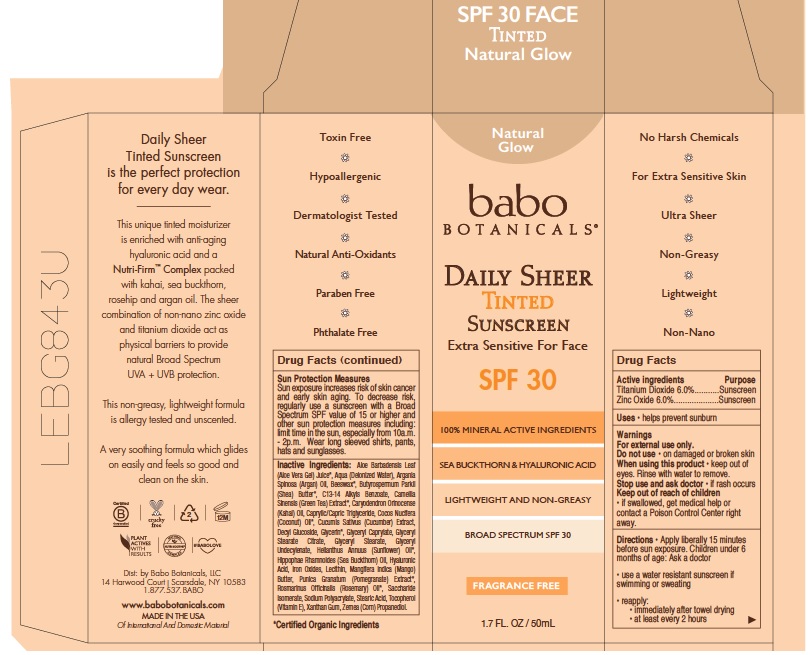
Babo Botanicals SPF 30 Daily Sheer Tinted Sunscreen - Natural Glow Mineral 3000 mg/100mL; 3000 mg/100mL Lotion
🆔 Identity & classification
Where does this data come from?
🏭 Manufacturer & labeler
Where does this data come from?
🩺 Clinical
Babo Botanicals SPF 30 Daily Sheer Tinted Sunscreen is a lotion applied to the skin to help protect against sun damage. It contains two mineral sun filters, titanium dioxide and zinc oxide, which work by reflecting and scattering ultraviolet rays away from the skin. This is an over-the-counter monograph sunscreen product marketed under FDA's established rule-book for the sunscreen category rather than through individual product review.
Patient education
Supplement & herbal interactions
Where does this data come from?
Ask a licensed pharmacist directly — free, answered by our team.
🧪 Inactive Ingredients / Excipients
Inactive ingredients, also called excipients, are components of the drug product other than the active ingredient. They may include fillers, dyes, coatings, preservatives, flavors, or other formulation ingredients.
💡 Tap an ingredient (hover on desktop) to see what it is and why it’s used.
-
5.5 mL / 100 mL
UNII A9EJ3J61HQ
A synthetic liquid derived from benzoic acid and long-chain alcohols. It functions as a solvent and penetration enhancer in topical formulations, helping active ingredients dissolve and absorb into the skin.
-
10 mL / 100 mL
UNII ZY81Z83H0X
Aloe vera leaf is a plant extract derived from the aloe plant. It is used in medicines as a natural moisturizer and skin-soothing agent in topical formulations.
-
0.1 mL / 100 mL
UNII H4N855PNZ1
Alpha-tocopherol is a form of vitamin E, a fat-soluble antioxidant derived from natural or synthetic sources. In medicines, it prevents oils and fats from breaking down and becoming rancid, protecting the product's stability and shelf life.
-
0.2 mL / 100 mL
UNII 4V59G5UW9X
Argan oil is a plant-derived oil from argan tree kernels. It's used in medicines as an emollient and skin-conditioning agent to help soften and moisturize the product's texture.
-
0.1 mL / 100 mL
UNII J2T2D81BHU
A plant-derived substance from the Caryodendron orinocense tree, used as a natural binding and thickening agent to help hold tablet ingredients together and improve product texture.
-
3 mL / 100 mL
UNII Q9L0O73W7L
Coconut oil is a natural fat extracted from coconut fruit. It's used in medicines as a lubricant, emollient, or carrier to help dissolve or deliver active ingredients smoothly through the formulation.
-
0.2 mL / 100 mL
UNII BT3S9L53JK
A plant-derived oil extracted from cucumber seeds. It's used as an emollient and skin-conditioning agent to help soften the product texture and improve how it feels on skin in topical formulations.
-
8.7 mL / 100 mL
UNII Z17H97EA6Y
A plant-derived mild cleanser made from natural sugars and oils. It acts as an emulsifier and surfactant to help mix water and oil-based ingredients together in the medicine.
-
1.547 mL / 100 mL
UNII 1K09F3G675
Ferric oxide red is an inorganic iron compound used as a colorant in medicines. It gives tablets, capsules, or other dosage forms a red or reddish tint for identification and appearance.
-
1 mL / 100 mL
UNII PDC6A3C0OX
Glycerin is a clear, thick liquid derived from plant oils or fats. It acts as a humectant to retain moisture, a sweetener, and a solvent in medications.
-
0.45 mL / 100 mL
UNII B68LJT9544
A fatty acid derivative used as a preservative and antimicrobial agent in topical medicines. It helps prevent bacterial and fungal growth to maintain product stability and safety.
-
0.45 mL / 100 mL
UNII TM2TZD4G4A
A plant-derived oily substance used as an emulsifier and solubilizer in medicines. It helps blend water and oil-based ingredients together and improves how the body absorbs certain active drugs.
-
2 mL / 100 mL
UNII 230OU9XXE4
A waxy substance made from glycerin and stearic acid that acts as an emulsifier to blend oily and watery ingredients together. It also helps thicken and stabilize the medicine's texture.
-
1.5 mL / 100 mL
UNII WH8T92A065
A fatty acid derivative made by combining stearic acid with glycerin and citric acid. It acts as an emulsifier to help mix oil and water-based ingredients, and also serves as a thickener in the medicine formulation.
-
0.2 mL / 100 mL
UNII W2ZU1RY8B0
A plant extract from green tea leaves. It's used as an antioxidant ingredient to help preserve the medicine and maintain its stability during storage.
-
0.2 mL / 100 mL
UNII T53SBG6741
A plant-based oil extracted from sea buckthorn seeds. It's used as an emollient and skin-conditioning agent to soften the medicine's texture and improve how it feels or spreads on skin.
-
0.1 mL / 100 mL
UNII S270N0TRQY
Hyaluronic acid is a naturally occurring substance found in skin and joints. In medicines, it acts as a moisturizer and thickening agent to improve texture and help the product spread smoothly.
-
3.5 mL / 100 mL
UNII 834K0WOS5G
A natural fat extracted from sunflower seeds. It acts as an emulsifier and lubricant in medicines, helping mix ingredients that don't normally blend together and allowing the product to flow smoothly during manufacturing.
-
0.25 mL / 100 mL
UNII I629I3NR86
A natural flavoring derived from mango fruit, used to add taste and aroma to medicines. It helps mask bitter or unpleasant flavors, making the medication more pleasant to take.
-
5.5 mL / 100 mL
UNII C9H2L21V7U
A fat derived from coconut or palm oil containing shorter fatty acid chains. It serves as a solvent and carrier to help dissolve or suspend active ingredients, improving absorption and stability in liquid formulations.
-
0.2 mL / 100 mL
UNII 56687D1Z4D
A natural plant extract from pomegranate fruit, used as a flavor and color ingredient to enhance taste and appearance in medicines.
-
10 mL / 100 mL
UNII 5965N8W85T
Propanediol is a clear liquid organic compound derived from vegetable sources or synthesized chemically. It acts as a humectant to retain moisture, a solvent to dissolve active ingredients, and a preservative booster in liquid medications and supplements.
-
0.05 mL / 100 mL
UNII IJ67X351P9
A natural plant extract from rosemary leaves used as a preservative to help prevent oils and fats in the medicine from spoiling or becoming rancid during storage.
-
0.15 mL / 100 mL
UNII W8K377W98I
A mixture of sugars made by rearranging glucose molecules. It acts as a sweetener and filler to improve taste and add bulk to the medicine while helping it hold together.
-
1 mL / 100 mL
UNII K49155WL9Y
Shea butter is a fat extracted from shea tree nuts. It's used in medicines as an emollient and lubricant to soften the product, improve texture, and help ingredients blend smoothly together.
-
0.2 mL / 100 mL
UNII 285CYO341L
Sodium polyacrylate is a synthetic polymer that absorbs and holds water. In medicines, it acts as a disintegrant, helping tablets break apart quickly in the stomach, and as a binder, holding tablet ingredients together.
-
1 mL / 100 mL
UNII 4ELV7Z65AP
Stearic acid is a fatty acid derived from plant or animal sources. It acts as a binder and lubricant in tablets and capsules, helping them hold together and flow smoothly during manufacturing.
-
3 mL / 100 mL
UNII 3W1JG795YI
Sunflower oil is a natural vegetable oil derived from sunflower seeds. It serves as a solvent, lubricant, and carrier in medicines, helping dissolve active ingredients and improve how the medication flows and absorbs in the body.
-
27.803 mL / 100 mL
UNII 059QF0KO0R
Water is a liquid solvent that dissolves and mixes ingredients together in liquid medicines, syrups, and injections. It helps distribute the active drug evenly throughout the product.
-
0.05 mL / 100 mL
UNII TTV12P4NEE
Xanthan gum is a thickening and stabilizing ingredient made from fermented corn or other sugars. It's added to medicines to improve texture, prevent separation of liquids and solids, and help the product stay consistent.
-
0.05 mL / 100 mL
UNII 2ZA36H0S2V
Beeswax is a natural wax produced by honeybees. In medicines, it works as a coating agent and thickener to control how fast the drug dissolves and improve the product's texture and appearance.
31 inactive ingredients listed in the exact product block matched to this NDC.
Label-section wording can be broader than the structured product block and may mention additional formulation ingredients.
Where does this data come from?
ingredient classCode="IACT" elements from the exact product block matched by this NDC. Label-section narrative from DailyMed / the openFDA label index is shown separately when available.Inactive ingredient FAQ
Are inactive ingredients the same for every manufacturer?
Why might an inactive ingredient be missing?
Can inactive ingredients matter?
💲 Pricing
A drug doesn't have one price. Each row is a different public payment system, and none is what you'd pay at the counter — that depends on your insurance. The ⓘ on each row explains what it measures.
| Price system | Per g | Per package |
|---|---|---|
| Retail pharmacies payNADAC · weekly | Not in the retail survey — common for institutional, discontinued, or low-volume packs. | |
| Medicaid paysCMS SDUD · 12 mo | No recent Medicaid claims on file for this NDC — rare and low-volume NDCs are suppressed in the public data. | |
| Medicare drug plans payPart D · quarterly | No Part D plan price is available for this NDC in our data. | |
Where does this data come from?
🔁 Therapeutic equivalents
| Product | Labeler | Pack | NADAC/unit | TE | Status | Price vs. this |
|---|---|---|---|---|---|---|
| Babo Botanicals SPF 30 Daily Sheer Tinted Sunscreen - Natural Glow 3000 mg/100mL; 3000 mg/100mLthis 79265-8072-00 | Babo | 1 tube | — | — | FDA listed | — |
Where does this data come from?
⏳ Availability & generic status
We did not find an FDA-approved generic match for this exact strength, form and route.
Where does this data come from?
📦 Packaging — all sizes for this product
| Package NDC | Description | Marketing start | Status |
|---|---|---|---|
| 79265-8072-00 You're viewing this | 1 TUBE in 1 BOX (79265-8072-0) / 50 mL in 1 TUBE (79265-8072-1) | 2020-07-24 | Active |
🧭 About this NDC listing & data coverage
What data is (and isn’t) available for this NDC — tap to expand
| NDC identity (package / product / labeler codes) | ✓ Available |
| Labeler | ✓ Available |
| Product & package description | ✓ Available |
| Marketing category & status | ✓ Available |
| Active ingredient / dosage form / route | ✓ Available |
| FDA label (SPL via DailyMed) | ✓ Available |
| Package photos | ✓ Available |
| Inactive ingredients (structured) | ✓ Available |
| NADAC pharmacy acquisition price (CMS) | — Not published for this NDC CMS publishes NADAC only for NDCs reported in its retail-pharmacy survey. |
| Orange Book / therapeutic-equivalence data | — Not published for this NDC Applies only to products approved under an NDA/ANDA; many listings are out of scope. |
| HCPCS J-code billing crosswalk | — Not published for this NDC Most self-administered / retail products have no J-code — that is normal. |
| Medicaid utilization (CMS SDUD) | — Not published for this NDC CMS reports utilization only for NDCs with Medicaid claims above its privacy threshold. |
Questions about this listing
Is this NDC FDA-approved?
Why is there no price listed?
Is the NDC printed on the package the same as the 11-digit billing NDC?
What do the three segments of this NDC mean?
Is this package still being marketed?
Who lists this product with the FDA?
Do I need a prescription for this product?
Where does this data come from?
📄 FDA label — Drug Facts FDA SPL
🎯 Indications and Usage ▾
Uses Uses • Helps prevent sunburn.
⏱️ Dosage and Administration ▾
Directions Apply liberally15 minutes before sun exposure. Children under 6 months of age: Ask a doctor. • use a water resistant sunscreen if swimming or sweating• reapply: • immediately after towel drying • at least every 2 hours Sun Protection Measures Sun exposure increases risk of skin cancer and early skin aging. To decrease risk, regularly use a sunscreen with a Broad Spectrum SPF value of 15 or higher and other sun protection measures including: limit time in the sun, especially from 10a.m. - 2p.m.
Wear long sleeved shirts, pants, hats and sunglasses.
⚠️ Warnings ▾
Warnings For external use only.
🧪 Active Ingredient ▾
Active Ingredient(s) Zinc Oxide 6% Purpose: Sunscreen Titanium Dioxide 6% Purpose: Sunscreen
🧪 Inactive Ingredients ▾
Inactive ingredients Aloe Barbadensis Leaf (Aloe Vera Gel) Juice*, Aqua (Deionized Water), Argania Spinosa (Argan) Oil, Beeswax*, Butyrospermum Parkii (Shea) Butter*, C13-14 Alkyls Benzoate, Camellia Sinensis (Green Tea) Extract*, Caryodendron Orinocense (Kahai) Oil, Caprylic/Capric Triglyceride, Cocos Nucifera (Coconut) Oil*, Cucumis Sativus (Cucumber) Extract, Decyl Glucoside, Glycerin*, Glyceryl Caprylate, Glyceryl Stearate Citrate, Glyceryl Stearate, Glyceryl Undecylenate, Helianthus Annuus (Sunflower) Oil*, Hippophae Rhamnoides (Sea Buckthorn) Oil, Hyaluronic Acid, Iron Oxides, Lecithin, Mangifera Indica (Mango) Butter, Punica Granatum (Pomegranate) Extract*, Rosmarinus Officinalis (Rosemary) Oil*, Saccharide Isomerate, Sodium Polyacrylate, Stearic Acid, Tocopherol (Vitamin E), Xanthan Gum, Zemea (Corn) Propanediol. *Certified Organic ingredients
🎯 Purpose ▾
Purpose Sunscreen