
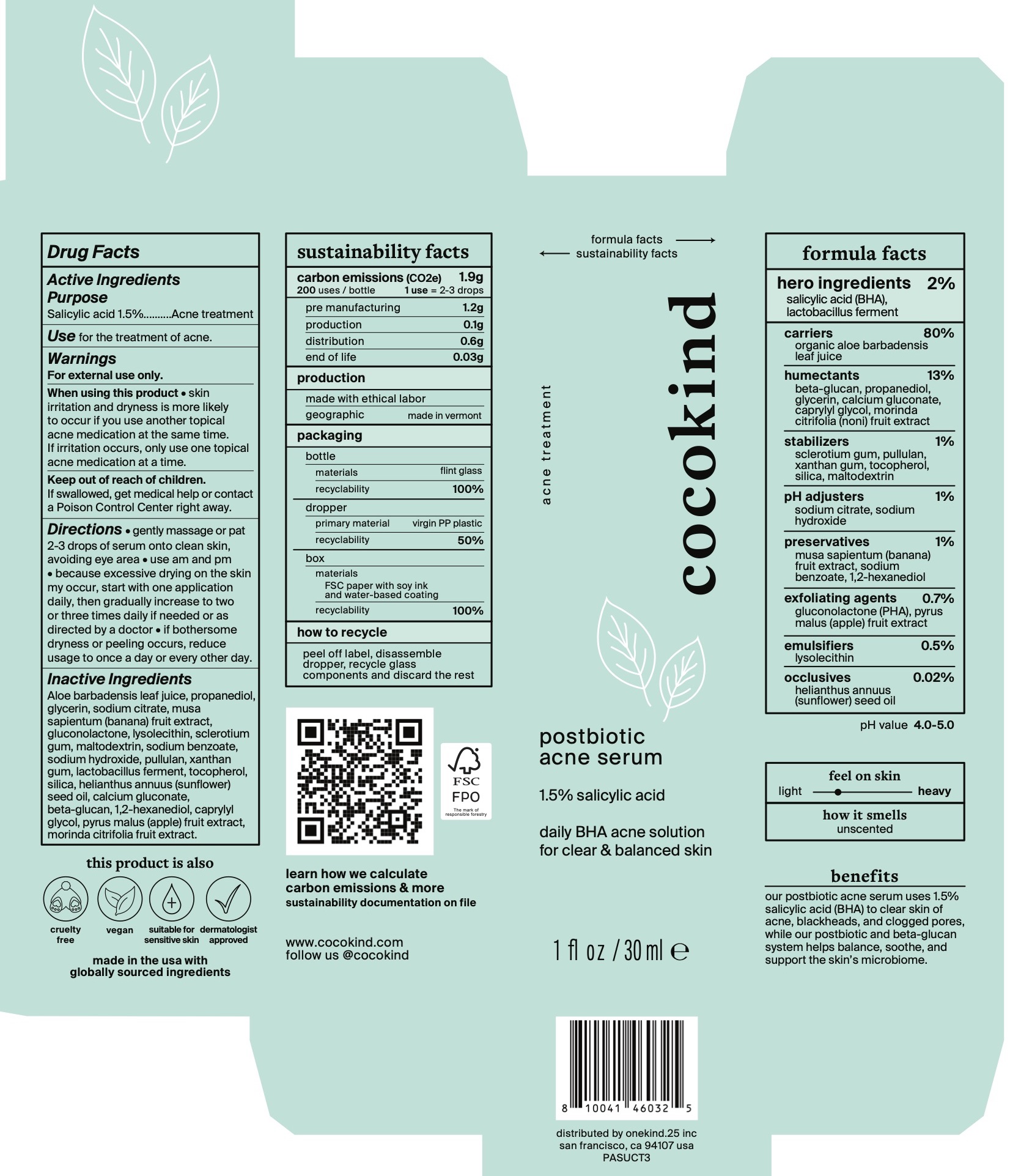
Cocokind postbiotic acne serum Salicylic Acid 1.5% 1.5 g/100mL Liquid
🆔 Identity & classification
Where does this data come from?
🏷️ RxNorm drug class
This medicine belongs to the Salicylic acid and derivatives class.
Where does this data come from?
🏭 Manufacturer & labeler
Where does this data come from?
🩺 Clinical
Topical salicylic acid is used to help clear and prevent pimples and skin blemishes in people who have acne. Topical salicylic acid is also used to treat skin conditions that involve scaling or overgrowth of skin cells such as psoriasis (a skin disease in which red, scaly patches form on some areas of the body), ichthyoses (inborn conditions that cause skin dryness and scaling), dandruff, corns, calluses, and warts on the hands or feet. Topical salicylic acid should not be used to treat genital warts, warts on the face, warts with hair growing from them, warts in the nose or mouth, moles, or b...
Read the full MedlinePlus article ↗- It's designed to treat acne. Salicylic acid helps by loosening and removing dead skin cells that clog pores — the buildup that leads to breakouts. The multi-step system on this lab...
- What is this salicylic acid product actually supposed to do for my skin?
- Some mild tingling, stinging, and peeling is actually expected — that's the salicylic acid doing its job by clearing away dead skin cells. But if the burning or peeling feels exces...
- My skin feels like it's burning and peeling. Is that normal?
Patient education
Supplement & herbal interactions
Where does this data come from?
Ask a licensed pharmacist directly — free, answered by our team.
🧪 Inactive Ingredients / Excipients
Inactive ingredients, also called excipients, are components of the drug product other than the active ingredient. They may include fillers, dyes, coatings, preservatives, flavors, or other formulation ingredients.
💡 Tap an ingredient (hover on desktop) to see what it is and why it’s used.
-
UNII TR046Y3K1G
A liquid alcohol derived from petroleum or plant sources. It acts as a solvent and humectant in medicines, helping dissolve active ingredients and retain moisture in the formulation.
-
UNII ZY81Z83H0X
Aloe vera leaf is a plant extract derived from the aloe plant. It is used in medicines as a natural moisturizer and skin-soothing agent in topical formulations.
-
UNII B423VGH5S9
A natural fruit ingredient derived from apples, used as a flavoring agent and sweetener to improve taste and palatability of the medicine.
-
UNII 4AJZ4765R9
A flavoring agent derived from bananas that gives medicine a banana taste. It's added to make oral medications more palatable, especially for children.
-
UNII 2X51AD1X3T
A fermented grain-derived polysaccharide used as a thickening and stabilizing agent in liquid formulations to improve texture and help maintain consistent suspension of active ingredients.
-
UNII SQE6VB453K
A calcium salt derived from gluconic acid. It acts as a buffer and mineral supplement in formulations, helping maintain stable pH and adding nutritional calcium content to the product.
-
UNII 00YIU5438U
Caprylyl glycol is a clear liquid derived from coconut oil. In medicines, it acts as a humectant to retain moisture, a preservative booster to prevent microbial growth, and a solvent to help dissolve or mix other ingredients.
-
UNII WQ29KQ9POT
Gluconolactone is a mild organic acid derived from glucose. It functions as a buffer and pH regulator in medicines, helping maintain stable acidity levels and improve product stability.
-
UNII PDC6A3C0OX
Glycerin is a clear, thick liquid derived from plant oils or fats. It acts as a humectant to retain moisture, a sweetener, and a solvent in medications.
-
UNII 2C1F12C6AP
A beneficial live bacterium used as a probiotic ingredient. It's included to support the product's probiotic function by promoting beneficial microorganisms in the digestive system.
-
UNII CQD833204Z
A natural lipid derived from soybean used to help dissolve, stabilize, and improve absorption of active ingredients in medicines. It acts as an emulsifier and solubilizing agent in liquid or injectable formulations.
-
UNII 7CVR7L4A2D
A starch-derived carbohydrate produced by breaking down corn, potato, or tapioca starch. It functions as a filler and binder to give the medicine bulk and texture, and sometimes as a mild sweetener or texture enhancer in powders and tablets.
-
UNII 7829X3G2X5
A plant extract from the morinda citrifolia fruit, used as a natural flavoring agent and colorant in medicines. It may also provide antioxidant properties to help preserve the product's stability.
-
UNII 5965N8W85T
Propanediol is a clear liquid organic compound derived from vegetable sources or synthesized chemically. It acts as a humectant to retain moisture, a solvent to dissolve active ingredients, and a preservative booster in liquid medications and supplements.
-
UNII 8ZQ0AYU1TT
Pullulan is a natural polysaccharide, a type of carbohydrate made from yeast. It acts as a binder and film-former to hold tablet ingredients together and create protective coatings on capsules.
-
UNII ETJ7Z6XBU4
Silicon dioxide is a naturally occurring mineral used as a glidant and anti-caking agent. It helps powder ingredients flow smoothly and prevents clumping during manufacturing and storage.
-
UNII OJ245FE5EU
Sodium benzoate is a salt derived from benzoic acid, a preservative. It's added to medicines to prevent growth of bacteria, fungi, and other microorganisms that could spoil the product.
-
UNII 2YGO1190AP
A plant-derived carbohydrate from yeast or fungi, chemically modified to carry sodium and carboxyl groups. It acts as a thickener, stabilizer, and binder in medications to improve texture, consistency, and shelf life.
-
UNII 1Q73Q2JULR
Sodium citrate is a salt derived from citric acid. It works as a buffer to maintain the medicine's pH level and may also help improve taste or act as a preservative in the formulation.
-
UNII 55X04QC32I
A strong alkaline chemical used to adjust and maintain the pH balance of liquid medicines. It helps keep the medicine stable and ensures it stays effective during storage.
-
UNII 3W1JG795YI
Sunflower oil is a natural vegetable oil derived from sunflower seeds. It serves as a solvent, lubricant, and carrier in medicines, helping dissolve active ingredients and improve how the medication flows and absorbs in the body.
-
UNII R0ZB2556P8
Tocopherol is a form of vitamin E derived from plant oils. It acts as an antioxidant in medicines to prevent oils and fats from breaking down and spoiling during storage.
-
UNII TTV12P4NEE
Xanthan gum is a thickening and stabilizing ingredient made from fermented corn or other sugars. It's added to medicines to improve texture, prevent separation of liquids and solids, and help the product stay consistent.
23 inactive ingredients listed in the exact product block matched to this NDC.
Label-section wording can be broader than the structured product block and may mention additional formulation ingredients.
Where does this data come from?
ingredient classCode="IACT" elements from the exact product block matched by this NDC. Label-section narrative from DailyMed / the openFDA label index is shown separately when available.Inactive ingredient FAQ
Are inactive ingredients the same for every manufacturer?
Why might an inactive ingredient be missing?
Can inactive ingredients matter?
💲 Pricing
A drug doesn't have one price. Each row is a different public payment system, and none is what you'd pay at the counter — that depends on your insurance. The ⓘ on each row explains what it measures.
| Price system | Per mL | Per package |
|---|---|---|
| Retail pharmacies payNADAC · weekly | Not in the retail survey — common for institutional, discontinued, or low-volume packs. | |
| Medicaid paysCMS SDUD · 12 mo | No recent Medicaid claims on file for this NDC — rare and low-volume NDCs are suppressed in the public data. | |
| Medicare drug plans payPart D · quarterly | No Part D plan price is available for this NDC in our data. | |
Where does this data come from?
🔁 Therapeutic equivalents
| Product | Labeler | Pack | NADAC/unit | TE | Status | Price vs. this |
|---|---|---|---|---|---|---|
| La Roche Posay Laboratoire Dermatologique Effaclar Pore Refining Acne Treatment 15 mg/mL 49967-0529-01 | L'Oreal | 1 bottle | — | — | FDA listed | — |
| La Roche Posay Laboratoire Dermatologique Effaclar AntiAcne Pore Refining Acne Treatment 15 mg/mL 69625-0528-01 | COSMETIQUE | 1 bottle | — | — | FDA listed | — |
| Rael Beauty Miracle Clear Complete Acne Serum 15 mg/mL 72863-0109-01 | Rael, | 1 bottle | — | — | FDA listed | — |
| Cocokind postbiotic acne serum 1.5 g/100mLthis 79356-0210-10 | Onekind.25 | 1 bottle | — | — | FDA listed | — |
| MEOLY Wart Corn Remover 1.5 g/100mL 83818-0006-01 | Shenzhen | 30 ml | — | — | FDA listed | — |
| Goodnites skin tag remover 1.5 g/100mL 85578-0002-01 | Zhengzhou | 30 ml | — | — | FDA listed | — |
| Aemerry WART, CORN AND CALLUS REMOVER .45 g/30g 87615-0001-01 | Da | 30 g | — | — | FDA listed | — |
Where does this data come from?
⏳ Availability & generic status
We did not find an FDA-approved generic match for this exact strength, form and route.
Where does this data come from?
🔬 Reported adverse events (FAERS)
Top reported reactions
Reporter sex
Where does this data come from?
📦 Packaging — all sizes for this product
| Package NDC | Description | Marketing start | Status |
|---|---|---|---|
| 79356-0210-10 You're viewing this | 1 BOTTLE in 1 CARTON (79356-210-10) / 30 mL in 1 BOTTLE | 2022-01-10 | Active |
🧭 About this NDC listing & data coverage
What data is (and isn’t) available for this NDC — tap to expand
| NDC identity (package / product / labeler codes) | ✓ Available |
| Labeler | ✓ Available |
| Product & package description | ✓ Available |
| Marketing category & status | ✓ Available |
| Active ingredient / dosage form / route | ✓ Available |
| FDA label (SPL via DailyMed) | ✓ Available |
| Package photos | ✓ Available |
| Inactive ingredients (structured) | ✓ Available |
| NADAC pharmacy acquisition price (CMS) | — Not published for this NDC CMS publishes NADAC only for NDCs reported in its retail-pharmacy survey. |
| Orange Book / therapeutic-equivalence data | — Not published for this NDC Applies only to products approved under an NDA/ANDA; many listings are out of scope. |
| HCPCS J-code billing crosswalk | — Not published for this NDC Most self-administered / retail products have no J-code — that is normal. |
| Medicaid utilization (CMS SDUD) | — Not published for this NDC CMS reports utilization only for NDCs with Medicaid claims above its privacy threshold. |
Questions about this listing
Is this NDC FDA-approved?
Why is there no price listed?
Is the NDC printed on the package the same as the 11-digit billing NDC?
What do the three segments of this NDC mean?
Is this package still being marketed?
Who lists this product with the FDA?
Do I need a prescription for this product?
Where does this data come from?
📄 FDA label — Drug Facts FDA SPL
🎯 Indications and Usage ▾
Use For the treatment of acne.
⏱️ Dosage and Administration ▾
• Gently massage or pat 2-3 drops of serum onto clean skin, avoiding eye area • Use am and pm. • Because excessive drying of the skin may occur, start with one application daily, then gradually increase to two to three times daily if needed or as directed by a doctor. • If bothersome dryness or peeling occurs, reduce application to once a day or every other day.
⚠️ Warnings ▾
Warnings For external use only.
🧪 Active Ingredient ▾
Active ingredient Salicylic acid 1.5%.
🧪 Inactive Ingredients ▾
Inactive ingredients Aloe barbadensis leaf juice, propanediol, glycerin, sodium citrate, musa sapientum (banana) fruit extract, gluconolactone, lysolecithin, sclerotium gum, maltodextrin, sodium benzoate, sodium hydroxide, pullulan, xanthan gum, lactobacillus ferment, tocopherol, silica, helianthus annuus (sunflower) seed oil, calcium gluconate, beta-glucan, 1,2-hexanediol, caprylyl glycol, pyrus malus (apple) fruit extract, morinda citrifolia fruit extract.
🎯 Purpose ▾
Purpose Acne treatment