
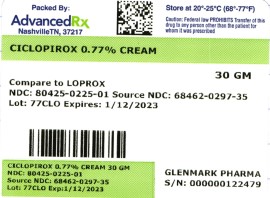
Ciclopirox Olamine 7.7 mg/g Cream, 30 g — NDC 80425-0225-1 (Billing 80425-0225-01)
This is a package of 30 g of Ciclopirox Olamine 7.7 mg/g Cream from Advanced Rx Pharmacy of Tennessee, LLC, marketed since Jan 2023 and currently FDA-listed. It is this product's only package size.
NDC database record
One package, one record: these facts belong to NDC 80425-0225-1 alone.
- Record
- FDA NDC Directory package listing · Human prescription drug
- Code segments
- 80425 labeler · 0225 product · 1 package
- Package marketed since
- Jan 9, 2023
- Sample package
- No — commercial package
- Listing certified through
- Dec 31, 2026
- Billing quantity
- 30 g per package
- Barcode (UPC-A, from the NDC)
- 3 8042502251 2
- FDA record last changed
- Jul 24, 2026
Identity & classification
Regulatory identifiers FDA, NLM and CMS codes for this package
- RxCUI (RxNorm): 309289
Where does this data come from?
- FDA openFDA NDC Directory · synced Oct 8, 2026
- FDA label on DailyMed · label index refreshed Oct 8, 2026
- RxNorm (NLM RxNav) · catalog refreshed Oct 1, 2026
- Medi-Span GPI (licensed)
- First Databank (licensed) · refreshed Oct 8, 2026
RxNorm drug class
This medicine belongs to the Other antifungals for topical use class.
Where does this data come from?
- RxClass (NLM) · catalog refreshed Oct 1, 2026
Clinical
- It's treating a fungal infection living inside your nail. Ciclodan (the 8% nail lacquer solution) works specifically on onychomycosis — a fungal infection of the nail plate caused...
- What is this medicine actually treating — my nail or a skin infection?
- Nail infections are slow to treat because nails grow slowly. Clinical studies used ciclopirox nail lacquer for 48 weeks — that's nearly a year. Even then, complete clearing of the...
- How long will I have to use this before I see results?
Patient education
Supplement & herbal interactions
Where does this data come from?
- MedlinePlus (NLM) · refreshed Oct 8, 2026
- FDA label on DailyMed · label index refreshed Oct 8, 2026
Ask a licensed pharmacist directly — free, answered by our team.
Pricing
A drug doesn't have one price. Each row is a different public payment system, and none is what you'd pay at the counter — that depends on your insurance. The ⓘ on each row explains what it measures.
| Price system | Per g | Per package |
|---|---|---|
| Retail pharmacies payNADAC · weekly | Not in the retail survey — common for institutional, discontinued, or low-volume packs. | |
| Medicaid paysCMS SDUD · 12 mo | No recent Medicaid claims on file for this NDC — rare and low-volume NDCs are suppressed in the public data. | |
| Medicare drug plans payPart D · Q2 2026 | $0.3074 | $9.22 / 30 g |
Where does this data come from?
- CMS NADAC weekly file
- CMS ASP pricing files · refreshed Sep 20, 2026
- CMS Medicaid State Drug Utilization Data · refreshed Oct 8, 2026
- CMS Part D plan pricing files · refreshed Sep 24, 2026
- VA National Acquisition Center price file
Packaging — all sizes for this product
| Package NDC | Description | Marketing start | Marketing end | Status |
|---|---|---|---|---|
| 80425-0225-01 You're viewing this Main listing | 30 g in 1 CARTON | 2023-01-09 | — | Active |
Therapeutic equivalents
| Product | Labeler | Pack | NADAC/unit | TE | Status | Price vs. this |
|---|---|---|---|---|---|---|
| Ciclopirox olamine 7.7 mg/g 45802-0138-11 | Padagis | 1 tube | $0.169 | AB | Availability likely | — |
| Ciclopirox Olamine 7.7 mg/g 00713-0638-15 | Cosette | 1 tube | $0.208 | AB | Availability likely | — |
| Ciclopirox Olamine 7.7 mg/g 51672-1318-01 | Sun | 1 tube | $0.208 | AB | Availability likely | — |
| Ciclopirox Olamine 7.7 mg/g 68462-0297-17 | Glenmark | 15 g | $0.208 | AB | Availability likely | — |
| Ciclopirox Olamine 7.7 mg/g 63629-8624-01 | Bryant | 1 tube | — | AB | FDA listed | — |
| Ciclopirox Olamine 7.7 mg/g 63629-8625-01 | Bryant | 1 tube | — | AB | FDA listed | — |
| Ciclopirox olamine 7.7 mg/g 63629-8626-01 | Bryant | 1 tube | — | AB | FDA listed | — |
| Ciclopirox olamine 7.7 mg/g 71335-2865-01 | Bryant | 1 tube | — | AB | FDA listed | — |
| Ciclopirox Olamine 7.7 mg/g 72162-1397-02 | Bryant | 1 tube | — | AB | FDA listed | — |
| Ciclopirox Olamine 7.7 mg/gthis 80425-0225-01 | Advanced | 30 g | — | AB | FDA listed | — |
Where does this data come from?
- FDA openFDA NDC Directory · synced Oct 8, 2026
- FDA Orange Book · refreshed Oct 3, 2026
- CMS NADAC weekly file
Availability & generic status
This product is an FDA-approved generic. Other versions of the same drug are listed under Therapeutic equivalents, least expensive first.
Where does this data come from?
- FDA Orange Book · refreshed Oct 3, 2026
Inactive Ingredients / Excipients
Inactive ingredients, also called excipients, are components of the drug product other than the active ingredient. They may include fillers, dyes, coatings, preservatives, flavors, or other formulation ingredients.
🧪 Avoiding an ingredient? See Ciclopirox Topical inactive ingredients by manufacturer: every current product's list side by side, so you can ask your pharmacy for the version that does not list it.
Where does this data come from?
IACT rows and label-wide narrative are kept separate; availability and product-level specificity depend on the submitted label.- FDA label on DailyMed · label index refreshed Oct 8, 2026
- FDA openFDA NDC Directory · synced Oct 8, 2026
Inactive ingredient FAQ
Are inactive ingredients the same for every manufacturer?
Why might an inactive ingredient be missing?
Can inactive ingredients matter?
Manufacturer & labeler
More NDCs from Advanced Rx Pharmacy of Tennessee, LLC labeler code 80425
- Azithromycin 250 mg Tablet, Film Coated NDC 80425-0219-1
- Azithromycin Dihydrate 500 mg Tablet, Film Coated NDC 80425-0220-1
- Silver Sulfadiazine 10 mg/g Cream NDC 80425-0221-1
- Ondansetron 8 mg Tablet, Orally Disintegrating NDC 80425-0222-1
- Betalido Kit Betamethasone Sodium Phosphate, Betamethasone Acetate, Lidocaine, Povidine Iodine Kit NDC 80425-0223-1
- Sumatriptan 100 mg Tablet NDC 80425-0224-1
- Multi-Specialty Kit Depo-Medrol, Lidocaine, Isopropyl Alcohol Kit NDC 80425-0226-1
- Ondansetron 8 mg Tablet, Orally Disintegrating NDC 80425-0227-1
- Ondansetron 4 mg Tablet, Orally Disintegrating NDC 80425-0228-1
- NEOMYCIN AND POLYMYXIN B SULFATES AND DEXAMETHASONE 3.5 mg/g; 10000 [USP'U]/g; 1 mg/g Ointment NDC 80425-0229-1
- Methylprednisolone 4 mg Tablet NDC 80425-0230-1
- Methylprednisolone 4 mg Tablet NDC 80425-0231-1
Where does this data come from?
- FDA openFDA NDC Directory · synced Oct 8, 2026
- Drugs@FDA
Full prescribing information FDA SPL
🎯 Indications and Usage ▾
Indications and Usage Ciclopirox olamine cream is indicated for the topical treatment of the following dermal infections: tinea pedis, tinea cruris, and tinea corporis due to Trichophyton rubrum, Trichophyton mentagrophytes, Epidermophyton floccosum, and Microsporum canis; candidiasis (moniliasis) due to Candida albicans; and tinea (pityriasis) versicolor due to Malassezia furfur.
⏱️ Dosage and Administration ▾
Dosage and Administration Gently massage ciclopirox olamine cream into the affected and surrounding skin areas twice daily, in the morning and evening. Clinical improvement with relief of pruritus and other symptoms usually occurs within the first week of treatment. If a patient shows no clinical improvement after four weeks of treatment with ciclopirox olamine cream, the diagnosis should be redetermined.
Patients with tinea versicolor usually exhibit clinical and mycological clearing after two weeks of treatment.
⛔ Contraindications ▾
Contraindications Ciclopirox olamine cream is contraindicated in individuals who have shown hypersensitivity to any of its components.
⚠️ Warnings and Cautions ▾
Warnings and Precautions Ciclopirox olamine cream is not for ophthalmic use. Keep out of reach of children. If a reaction suggesting sensitivity or chemical irritation should occur with the use of ciclopirox olamine cream, treatment should be discontinued and appropriate therapy instituted.
Information for Patients The patient should be told to: 1 Use the medication for the full treatment time even though symptoms may have improved and notify the physician if there is no improvement after four weeks. 2 Inform the physician if the area of application shows signs of increased irritation (redness, itching, burning, blistering, swelling, or oozing) indicative of possible sensitization. 3 Avoid the use of occlusive wrappings or dressings.
Carcinogenesis, Mutagenesis, Impairment of Fertility A 104-week dermal carcinogenicity study in mice was conducted with ciclopirox cream applied at doses up to 1.93% (100 mg/kg/day or 300 mg/m2/day). No increase in drug related neoplasms was noted when compared to control. The following in vitro genotoxicity tests have been conducted with ciclopirox: evaluation of gene mutation in the Ames Salmonella and E. coli assays (negative); chromosome aberration assays in V79 Chinese hamster lung fibroblast cells, with and without metabolic activation (positive); chromosome aberration assays in V79 Chinese hamster lung fibroblast cells in the presence of supplemental Fe3+, with and without metabolic activation (negative); gene mutation assays in the HGPRT-test with V79 Chinese hamster lung fibroblast cells (negative); and a primary DNA damage assay (i.e., unscheduled DNA synthesis assay in A549 human cells) (negative).
An in vitro cell transformation assay in BALB/c 3T3 cells was negative for cell transformation. In an in vivo Chinese hamster bone marrow cytogenetic assay, ciclopirox was negative for chromosome aberrations at a dosage of 5000 mg/kg body weight. A combined oral fertility and embryofetal developmental study was conducted in rats with ciclopirox olamine.
No effect on fertility or reproductive performance was noted at the highest dose tested of 3.85 mg/kg/day ciclopirox (approximately 1.2 times the maximum recommended human dose based on body surface area comparisons). Pregnancy Teratogenic Effects: Pregnancy Category B There are no adequate or well-controlled studies in pregnant women. Therefore, ciclopirox cream should be used during pregnancy only if the potential benefit justifies the potential risk to the fetus.
Oral embryofetal developmental studies were conducted in mice, rats, rabbits and monkeys. Ciclopirox or ciclopirox olamine was orally administered during the period of organogenesis. No maternal toxicity, embryotoxicity or teratogenicity were noted at the highest doses of 77, 125, 80 and 38.5 mg/kg/day ciclopirox in mice, rats, rabbits and monkeys, respectively (approximately 11, 37, 51 and 24 times the maximum recommended human dose based on body surface area comparisons, respectively).
Dermal embryofetal developmental studies were conducted in rats and rabbits with ciclopirox olamine dissolved in PEG 400. Ciclopirox olamine was topically administered during the period of organogenesis. No maternal toxicity, embryotoxicity or teratogenicity were noted at the highest doses of 92 mg/kg/day and 77 mg/kg/day ciclopirox in rats and rabbits, respectively (approximately 27 and 49 times the maximum recommended human dose based on body surface area comparisons, respectively).
Nursing Mothers It is not known whether this drug is excreted in human milk. Because many drugs are excreted in human milk, caution should be exercised when ciclopirox olamine cream is administered to a nursing woman. Pediatric Use Safety and effectiveness in pediatric patients below the age of 10 years have not been established.
🤒 Adverse Reactions ▾
Adverse Reactions In all controlled clinical studies with 514 patients using ciclopirox olamine cream and in 296 patients using the vehicle cream, the incidence of adverse reactions was low. This included pruritus at the site of application in one patient and worsening of the clinical signs and symptoms in another patient using ciclopirox olamine cream and burning in one patient and worsening of the clinical signs and symptoms in another patient using the vehicle cream.
🧬 Clinical Pharmacology ▾
Clinical Pharmacology Mechanism of Action Ciclopirox is a hydroxypyridone antifungal agent that acts by chelation of polyvalent cations (Fe3+ or Al3+), resulting in the inhibition of the metal-dependent enzymes that are responsible for the degradation of peroxides within the fungal cell. Pharmacokinetics Pharmacokinetic studies in men with tagged ciclopirox solution in polyethylene glycol 400 showed an average of 1.3% absorption of the dose when it was applied topically to 750 cm2 on the back followed by occlusion for 6 hours.
The biological half-life was 1.7 hours and excretion occurred via the kidney. Two days after application only 0.01% of the dose applied could be found in the urine. Fecal excretion was negligible.
Penetration studies in human cadaverous skin from the back, with ciclopirox olamine cream with tagged ciclopirox showed the presence of 0.8 to 1.6% of the dose in the stratum corneum 1.5 to 6 hours after application. The levels in the dermis were still 10 to 15 times above the minimum inhibitory concentrations. Autoradiographic studies with human cadaverous skin showed that ciclopirox penetrates into the hair and through the epidermis and hair follicles into the sebaceous glands and dermis, while a portion of the drug remains in the stratum corneum.
Draize Human Sensitization Assay, 21-Day Cumulative Irritancy study, Phototoxicity study, and Photo-Draize study conducted in a total of 142 healthy male subjects showed no contact sensitization of the delayed hypersensitivity type, no irritation, no phototoxicity, and no photo-contact sensitization due to ciclopirox olamine cream.
📦 How Supplied / Storage and Handling ▾
How Supplied/Storage and Handling Ciclopirox olamine cream USP, 0.77% is supplied in 30g tubes NDC: 80425-0225-01 Store at 20°C to 25°C (68°F to 77°F) [see USP Controlled Room Temperature].
📋 Description ▾
Description Ciclopirox olamine cream, USP, 0.77% is for topical use. Each gram of ciclopirox olamine cream, USP contains 7.70 mg of ciclopirox (as ciclopirox olamine USP) in a water miscible vanishing cream base consisting of benzyl alcohol (1%) as preservative, cetyl alcohol, lactic acid, light mineral oil, myristyl alcohol, octyldodecanol, polysorbate 60, purified water, sorbitan monostearate and stearyl alcohol. Ciclopirox olamine cream, USP contains a synthetic, broad-spectrum, antifungal agent ciclopirox (as ciclopirox olamine USP).
The chemical name is 6-cyclohexyl-1-hydroxy-4-methyl-2(1H)-pyridone, 2 -aminoethanol salt. The CAS Registry Number is 41621-49-2. The chemical structure is: Description
📄 Package Label / Principal Display Panel ▾
Principal Display Panel label 1
Medicare Part D spend CMS · PART D · 2026 (Q1)
Reported adverse events (FAERS)
Top reported reactions
Age at onset
Reporter sex
Serious outcomes
Where does this data come from?
About this NDC listing & data coverage
What data is (and isn’t) available for this NDC — tap to expand
| NDC identity (package / product / labeler codes) | ✓ Available |
| Labeler | ✓ Available |
| Product & package description | ✓ Available |
| Marketing category & status | ✓ Available |
| Active ingredient / dosage form / route | ✓ Available |
| FDA label (SPL via DailyMed) | ✓ Available |
| Package photos | ✓ Available |
| Inactive ingredients (structured) | — Not published for this NDC The labeler did not submit a structured excipient list, or no SPL is available. |
| NADAC pharmacy acquisition price (CMS) | — Not published for this NDC CMS publishes NADAC only for NDCs reported in its retail-pharmacy survey. |
| Orange Book / therapeutic-equivalence data | ✓ Available |
| HCPCS J-code billing crosswalk | — Not published for this NDC Most self-administered / retail products have no J-code — that is normal. |
| Medicaid utilization (CMS SDUD) | — Not published for this NDC CMS reports utilization only for NDCs with Medicaid claims above its privacy threshold. |