
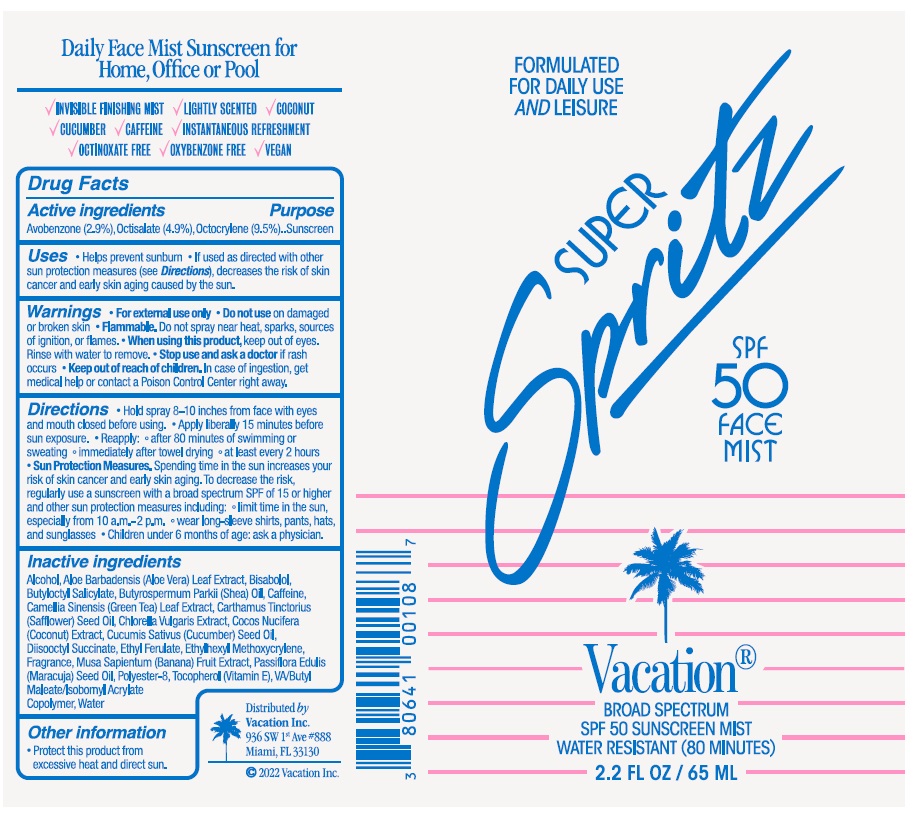
Vacation SPF 50 Super Spritz Face Mist Avobenzone, Octisalate, Octocrylene 9.5 g/100mL; 4.9 g/100mL; 2.9 g/100mL Spray
🆔 Identity & classification
Where does this data come from?
🏭 Manufacturer & labeler
Where does this data come from?
🩺 Clinical
This is an over-the-counter sunscreen spray mist marketed under FDA's monograph rules for sunscreen products. It contains three active ingredients: avobenzone, octisalate, and octocrylene, which are ultraviolet light filters commonly used together in sunscreens to help protect skin from UVA and UVB radiation. The product is applied topically to the face as a spray and is labeled SPF 50. As with all sunscreen products, effectiveness depends on proper and regular application.
Patient education
Supplement & herbal interactions
Where does this data come from?
Ask a licensed pharmacist directly — free, answered by our team.
🧪 Inactive Ingredients / Excipients
Inactive ingredients, also called excipients, are components of the drug product other than the active ingredient. They may include fillers, dyes, coatings, preservatives, flavors, or other formulation ingredients.
💡 Tap an ingredient (hover on desktop) to see what it is and why it’s used.
-
UNII 3K9958V90M
A liquid solvent derived from fermentation or chemical synthesis. In medicines, alcohol dissolves active ingredients, helps preserve the product, and improves how the body absorbs certain drugs.
-
UNII ZY81Z83H0X
Aloe vera leaf is a plant extract derived from the aloe plant. It is used in medicines as a natural moisturizer and skin-soothing agent in topical formulations.
-
UNII 4AJZ4765R9
A flavoring agent derived from bananas that gives medicine a banana taste. It's added to make oral medications more palatable, especially for children.
-
UNII 2EH13UN8D3
A synthetic compound used as a solvent and penetration enhancer in topical formulations. It helps dissolve active ingredients and allows them to penetrate the skin more effectively.
-
UNII 3G6A5W338E
Caffeine is a natural stimulant compound commonly extracted from coffee beans and tea leaves. In medicines, it serves as an active booster in pain relievers and cold products to enhance alertness and improve the effectiveness of other ingredients.
-
UNII RYQ4R60M02
A green algae ingredient used as a natural colorant and nutritional filler in supplements and medications. It adds color and bulk to tablets and capsules.
-
UNII 3RT3536DHY
A natural plant material derived from coconut that serves as a filler and texturizing agent in medicines. It helps give the product structure and consistency.
-
UNII AKP926H71P
A plant-derived oil extracted from cucumber seeds, used primarily as an emollient and skin-conditioning agent. It helps soften and smooth the product's texture while providing moisturizing properties to topical formulations.
-
UNII 4X371TMK9K
Dibutyl maleate is a synthetic chemical compound used as a plasticizer and solvent in pharmaceutical formulations. It helps soften and improve the flexibility of coatings and film-forming ingredients in medicines.
-
UNII 5B8915UELW
A plant-derived compound used as an antioxidant in medicines. It helps prevent spoilage and degradation of active ingredients during storage by protecting them from oxidative damage.
-
UNII S3KFG6Q5X8
An organic chemical compound used as a UV filter in topical formulations. It helps protect the medicine or product from degradation caused by sunlight exposure during storage and use.
-
UNII W2ZU1RY8B0
A plant extract from green tea leaves. It's used as an antioxidant ingredient to help preserve the medicine and maintain its stability during storage.
-
UNII IX0PRH184P
A synthetic compound made from borneol and acrylic acid, used as a film-forming agent and binder in pharmaceutical coatings and adhesive formulations to help create protective layers on tablets or control drug release.
-
UNII 24WE03BX2T
Levomenol is a naturally derived alcohol compound used as a skin-conditioning and anti-inflammatory agent in topical formulations. It helps soothe and protect the skin while improving product texture and absorption.
-
UNII F3VOA31UHQ
A natural oil extracted from passion fruit seeds. It serves as an emollient and skin-conditioning agent in topical products, helping to soften and moisturize the formulation while improving texture and spreadability.
-
UNII T9296U138P
A synthetic polymer derived from polyester chemistry, modified with a cyanodiphenylpropenoyl cap. It serves as a film-former and binder in pharmaceutical formulations, helping create protective coatings on tablets or improving product consistency.
-
UNII 65UEH262IS
Safflower oil is a plant-based oil extracted from safflower seeds. It's used in medicines as a solvent and carrier to help dissolve or suspend active ingredients, and sometimes as an emollient to improve texture.
-
UNII O88E196QRF
Sheanut oil is a natural fat extracted from shea nuts grown in Africa. It's used in medicines as an emollient, lubricant, and binding agent to improve texture, help ingredients mix smoothly, and keep the product stable.
-
UNII AB6MNQ6J6L
Succinic acid is an organic acid derived from natural sources or chemical synthesis. In medications, it functions as a buffer to help maintain the proper pH level and may also serve as a preservative or flavor enhancer in formulations.
-
UNII R0ZB2556P8
Tocopherol is a form of vitamin E derived from plant oils. It acts as an antioxidant in medicines to prevent oils and fats from breaking down and spoiling during storage.
-
UNII L9MK238N77
Vinyl acetate is a synthetic polymer used primarily as a film-coating agent in tablets and capsules. It helps create a smooth, protective outer layer that controls how quickly the medicine dissolves and improves appearance.
-
UNII 059QF0KO0R
Water is a liquid solvent that dissolves and mixes ingredients together in liquid medicines, syrups, and injections. It helps distribute the active drug evenly throughout the product.
22 inactive ingredients listed in the exact product block matched to this NDC.
Label-section wording can be broader than the structured product block and may mention additional formulation ingredients.
Where does this data come from?
ingredient classCode="IACT" elements from the exact product block matched by this NDC. Label-section narrative from DailyMed / the openFDA label index is shown separately when available.Inactive ingredient FAQ
Are inactive ingredients the same for every manufacturer?
Why might an inactive ingredient be missing?
Can inactive ingredients matter?
💲 Pricing
A drug doesn't have one price. Each row is a different public payment system, and none is what you'd pay at the counter — that depends on your insurance. The ⓘ on each row explains what it measures.
| Price system | Per mL | Per package |
|---|---|---|
| Retail pharmacies payNADAC · weekly | Not in the retail survey — common for institutional, discontinued, or low-volume packs. | |
| Medicaid paysCMS SDUD · 12 mo | No recent Medicaid claims on file for this NDC — rare and low-volume NDCs are suppressed in the public data. | |
| Medicare drug plans payPart D · quarterly | No Part D plan price is available for this NDC in our data. | |
Where does this data come from?
🔁 Therapeutic equivalents
| Product | Labeler | Pack | NADAC/unit | TE | Status | Price vs. this |
|---|---|---|---|---|---|---|
| Vacation SPF 50 Super Spritz Face Mist 9.5 g/100mL; 4.9 g/100mL; 2.9 g/100mLthis 80641-0010-02 | Vacation | 1 bottle | — | — | FDA listed | — |
Where does this data come from?
⏳ Availability & generic status
We did not find an FDA-approved generic match for this exact strength, form and route.
Where does this data come from?
🔬 Reported adverse events (FAERS)
Top reported reactions
Reporter sex
Serious outcomes
Where does this data come from?
📦 Packaging — all sizes for this product
| Package NDC | Description | Marketing start | Status |
|---|---|---|---|
| 80641-0010-01 | 65 mL in 1 BOTTLE, PLASTIC (80641-010-01) | 2023-02-01 | Active |
| 80641-0010-02 You're viewing this | 1 BOTTLE, PLASTIC in 1 KIT (80641-010-02) / 30 mL in 1 BOTTLE, PLASTIC (80641-010-03) | 2023-02-01 | Active |
Pack size FAQ
What quantity is in NDC 80641-0010-02?
What NDC number is used to bill for this package of Vacation SPF 50 Super Spritz Face Mist Avobenzone, Octisalate, Octocrylene 9.5 g/100mL; 4.9 g/100mL; 2.9 g/100mL Spray?
🧭 About this NDC listing & data coverage
Kit / multi-component package
This NDC identifies a kit — a package containing more than one component. Structured data (pricing, ingredients, equivalents) is often reported per component rather than for the kit NDC itself, which can make this page look thinner than the components' own pages.
What data is (and isn’t) available for this NDC — tap to expand
| NDC identity (package / product / labeler codes) | ✓ Available |
| Labeler | ✓ Available |
| Product & package description | ✓ Available |
| Marketing category & status | ✓ Available |
| Active ingredient / dosage form / route | ✓ Available |
| FDA label (SPL via DailyMed) | ✓ Available |
| Package photos | ✓ Available |
| Inactive ingredients (structured) | ✓ Available |
| NADAC pharmacy acquisition price (CMS) | — Not published for this NDC CMS publishes NADAC only for NDCs reported in its retail-pharmacy survey. |
| Orange Book / therapeutic-equivalence data | — Not published for this NDC Applies only to products approved under an NDA/ANDA; many listings are out of scope. |
| HCPCS J-code billing crosswalk | — Not published for this NDC Most self-administered / retail products have no J-code — that is normal. |
| Medicaid utilization (CMS SDUD) | — Not published for this NDC CMS reports utilization only for NDCs with Medicaid claims above its privacy threshold. |
Questions about this listing
Is this NDC FDA-approved?
Why is there no price listed?
Is the NDC printed on the package the same as the 11-digit billing NDC?
What do the three segments of this NDC mean?
Is this package still being marketed?
Does this product come in other package sizes?
Who lists this product with the FDA?
Do I need a prescription for this product?
Where does this data come from?
📄 FDA label — Drug Facts FDA SPL
🎯 Indications and Usage ▾
Uses • Helps prevent sunburn • If used as directed with other sun protection measures (see Directions ), decreases the risk of skin cancer and early skin aging caused by the sun.
⏱️ Dosage and Administration ▾
Directions • Hold spray 8-10 inches from face with eyes and mouth closed before using • Apply liberally 15 minutes before sun exposure. • Reapply: • after 80 minutes of swimming or sweating. • immediately after towel drying • at least every 2 hours • Sun Protection Measures. Spending time in the sun increases your risk of skin cancer and early skin aging. To decrease the risk, regularly use a sunscreen with a broad spectrum SPF of 15 or higher and other sun protection measures including: limit time in the sun, especially from 10 a.m. - 2 p.m. wear long-sleeve shirts, pants, hats, and sunglasses • Children under 6 months of age: ask a physician.
⚠️ Warnings ▾
• For external use only • Do not use on damaged or broken skin • Flammable. Do not spray near heat, sparks, sources of ignition, or flames. • When using this product, keep out of eyes. Rinse with water to remove. • Stop use and ask a doctor if rash occurs
🧪 Active Ingredient ▾
Avobenzone (2.9%) Homosalate (4.9%) Octocrylene (9.5%)
🧪 Inactive Ingredients ▾
Alcohol, Aloe Barbadensis (Aloe Vera) Leaf Extract, Bisabolol, Butyloctyl Salicylate, Butyrospermum Parkii (Shea) Oil, Caffeine, Camellia Sinensis (Green Tea) Leaf Extract, Carthamus Tinctorius (Safflower) Seed Oil, Chlorella Vulgaris Extract, Cocos Nucifera (Coconut) Extract, Cucumis Sativus (Cucumber) Seed Oil, Diisooctyl Succinate, Ethyl Ferulate, Ethylhexyl Methoxycrylene, Fragrance, Musa Sapientum (Banana) Fruit Extract, Passiflora Edulis Seed Oil, Polyester-8, Tocopherol (Vitamin E), VA/Butyl Maleate/Isobornyl Acrylate Copolymer, Water
🎯 Purpose ▾
Sunscreen