
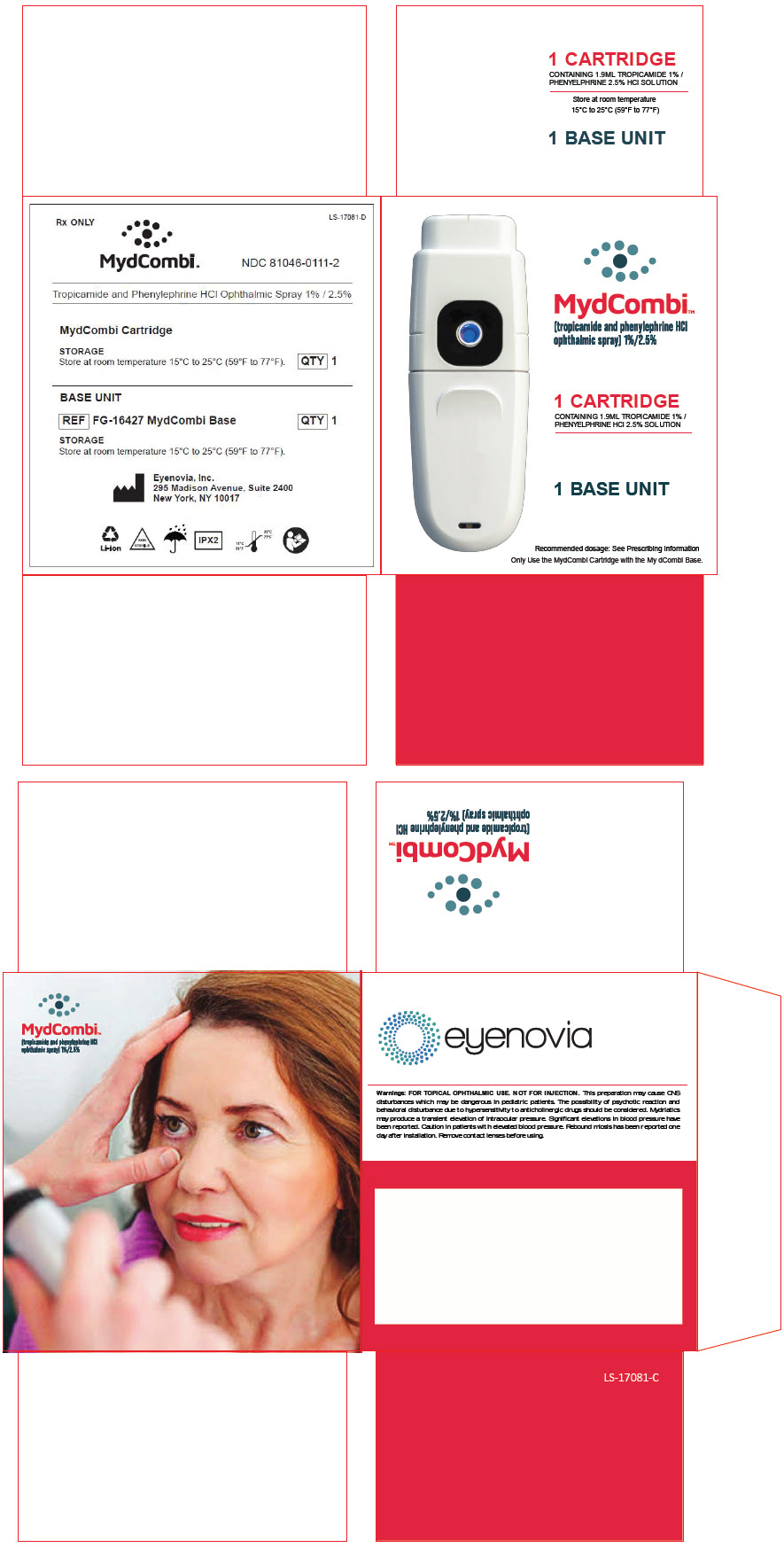
MYDCOMBI Tropicamide and Phenylephrine Hydrochloride .2; .08 mg/.008mL; mg/.008mL Spray, Metered, 1 cartridge — NDC 81046-0111-2 (Billing 81046-0111-02)
This is a package of 1 cartridge of MYDCOMBI Tropicamide and Phenylephrine Hydrochloride .2; .08 mg/.008mL; mg/.008mL Spray, Metered from Eyenovia, Inc., no longer marketed, no longer in the FDA NDC Directory.
NDC database record
One package, one record: these facts belong to NDC 81046-0111-2 alone.
- Record
- FDA NDC Directory package listing · Human prescription drug
- Code segments
- 81046 labeler · 0111 product · 2 package
- Barcode (UPC-A, from the NDC)
- 3 8104601112 1
- FDA record last changed
- Jul 16, 2026
Identity & classification
Regulatory identifiers FDA, NLM and CMS codes for this package
Where does this data come from?
- FDA openFDA NDC Directory · synced Oct 8, 2026
- FDA label on DailyMed · label index refreshed Oct 8, 2026
- RxNorm (NLM RxNav) · catalog refreshed Oct 1, 2026
- Medi-Span GPI (licensed)
- First Databank (licensed) · refreshed Oct 8, 2026
Clinical
Patient education
Supplement & herbal interactions
Where does this data come from?
- MedlinePlus (NLM) · refreshed Oct 8, 2026
- FDA label on DailyMed · label index refreshed Oct 8, 2026
Ask a licensed pharmacist directly — free, answered by our team.
Pricing
A drug doesn't have one price. Each row is a different public payment system, and none is what you'd pay at the counter — that depends on your insurance. The ⓘ on each row explains what it measures.
| Price system | Per mL | Per package |
|---|---|---|
| Retail pharmacies payNADAC · weekly | Not in the retail survey — common for institutional, discontinued, or low-volume packs. | |
| Medicaid paysCMS SDUD · 12 mo | No recent Medicaid claims on file for this NDC — rare and low-volume NDCs are suppressed in the public data. | |
| Medicare drug plans payPart D · quarterly | No Part D plan price is available for this NDC in our data. | |
Where does this data come from?
- CMS NADAC weekly file
- CMS ASP pricing files · refreshed Sep 20, 2026
- CMS Medicaid State Drug Utilization Data · refreshed Oct 8, 2026
- CMS Part D plan pricing files · refreshed Sep 24, 2026
- VA National Acquisition Center price file
Packaging — all sizes for this product
| Package NDC | Description | Marketing start | Marketing end | Status |
|---|---|---|---|---|
| 81046-0111-01 81046-0111-1 Main listing | 1 CARTRIDGE in 1 CARTON / 1.9 mL in 1 CARTRIDGE | 2023-05-09 | — | Inactivated by FDA |
| 81046-0111-02 You're viewing this | 1 CARTON in 1 BOX / 1 CARTRIDGE in 1 CARTON / 1.9 mL in 1 CARTRIDGE | 2023-05-09 | — | Inactivated by FDA |
| 81046-0111-05 81046-0111-5 | 5 CARTON in 1 BOX / 1 CARTRIDGE in 1 CARTON / 1.9 mL in 1 CARTRIDGE | 2023-05-09 | — | Inactivated by FDA |
Pack size FAQ
What quantity is in this package?
How does this package differ from NDC 81046-0111-01?
What NDC number is used to bill for this package of MYDCOMBI Tropicamide and Phenylephrine Hydrochloride .2; .08 mg/.008mL; mg/.008mL Spray, Metered?
Therapeutic equivalents
| Product | Labeler | Pack | NADAC/unit | TE | Status | Price vs. this |
|---|---|---|---|---|---|---|
| Mydcombi .2; .08 mg/.008mL; mg/.008mLthis 81046-0111-02 | Eyenovia, | 1 cartridge | — | — | Discontinued | — |
Where does this data come from?
- FDA openFDA NDC Directory · synced Oct 8, 2026
- FDA Orange Book · refreshed Oct 3, 2026
- CMS NADAC weekly file
Availability & generic status
We did not find an FDA-approved generic match for this exact strength, form and route. Patent/protection dates below may affect future generic timing.
Why the date isn’t exact: Generic timing can change because patents may be challenged, settled, licensed, added, removed, or worked around with a narrower label — and FDA approval does not always mean a pharmacy can get the generic today.
🛈 What do these terms mean?
- Patent
- Legal protection listed in the Orange Book that may delay generic approval or launch. Issued by the U.S. Patent & Trademark Office.
- Substance patent
- Covers the active drug molecule itself — the hardest to design around. A generic generally can’t launch until it expires.
- Formulation (product) patent
- Covers a specific formulation or dosage form. A generic can sometimes work around it with a different formulation.
- Method-of-use patent
- A patent covering one specific approved use of the drug — not necessarily the whole molecule. A generic can sometimes launch with a “skinny label” that carves out the protected use and keeps the others.
- Skinny label
- A generic label that omits a still-patented use when the FDA allows it — letting a generic reach the market for the unprotected uses.
- Exclusivity
- FDA-granted marketing protection, separate from patents — e.g. 5-yr new chemical entity, 7-yr orphan drug, or a +6-month pediatric extension.
- Paragraph IV
- A generic applicant’s formal challenge to a listed patent. It can potentially lead to earlier generic entry, but often involves litigation or a settlement.
- RLD / RS
- Reference Listed Drug — the brand product the FDA uses as the reference for generic applications. Reference Standard — the product the FDA expects generics to compare against in bioequivalence testing.
- TE / AB rating
- FDA therapeutic-equivalence rating. An AB rating generally means the FDA considers a generic therapeutically equivalent to — and substitutable for — the brand.
- LOE (loss of exclusivity)
- The latest patent or exclusivity currently listed — the loss-of-exclusivity / latest-listed-protection date shown on this page. Paragraph-IV challenges and settlements can move the real date earlier; FDA approval and a manufacturer’s decision to market can move it later.
Built from the FDA Orange Book. The bars above are scaled to each protection’s expiry; the red LOE marker is the last one to lapse.
| Patent | Type | Use code | Expires |
|---|---|---|---|
| US 11398306 ↗ | Method of use | U-3685 | Jul 15, 2031 |
| US 10839960 ↗ | Method of use | U-3685 | Jul 15, 2031 |
| US 11839487 ↗ | Method of use | U-3685 | Jul 15, 2031 |
| Code | What it grants | Expires |
|---|---|---|
| NP | New Product | May 5, 2026 |
Is there a generic version of this drug?
The FDA approved a generic — why can’t I get it at my pharmacy yet?
Why do different websites show different generic release dates?
What does “FDA listed” mean?
What does a patent or protection date mean here?
What does “current Orange Book estimate” mean?
Can a generic come out before the last patent expires?
Can a generic come out after the listed dates?
What is the difference between patents and exclusivity?
Why are there multiple patent dates?
Where does this data come from?
- FDA Orange Book · refreshed Oct 3, 2026
Inactive Ingredients / Excipients
Inactive ingredients, also called excipients, are components of the drug product other than the active ingredient. They may include fillers, dyes, coatings, preservatives, flavors, or other formulation ingredients.
💡 Tap an ingredient (hover on desktop) to see what it is and why it’s used.
-
UNII F5UM2KM3W7
Benzalkonium chloride is a chemical compound that works as a preservative and antimicrobial agent in medications. It prevents bacterial and fungal growth in liquid formulations to keep the product safe during storage and use.
-
UNII QTT17582CB
A strong acid used to adjust and maintain the proper pH level in liquid medicines, ensuring stability and preventing breakdown of active ingredients.
-
UNII 55X04QC32I
A strong alkaline chemical used to adjust and maintain the pH balance of liquid medicines. It helps keep the medicine stable and ensures it stays effective during storage.
-
UNII 059QF0KO0R
Water is a liquid solvent that dissolves and mixes ingredients together in liquid medicines, syrups, and injections. It helps distribute the active drug evenly throughout the product.
4 inactive ingredients listed in the exact product block matched to this NDC.
Where does this data come from?
ingredient classCode="IACT" elements from the exact product block matched by this NDC. Label-section narrative from DailyMed / the openFDA label index is shown separately when available.- FDA label on DailyMed · label index refreshed Oct 8, 2026
- FDA openFDA NDC Directory · synced Oct 8, 2026
Inactive ingredient FAQ
Are inactive ingredients the same for every manufacturer?
Why might an inactive ingredient be missing?
Can inactive ingredients matter?
Manufacturer & labeler
More NDCs from Eyenovia, Inc. labeler code 81046
Where does this data come from?
- FDA openFDA NDC Directory · synced Oct 8, 2026
- Drugs@FDA
Full prescribing information FDA SPL
🎯 Indications and Usage ▾
1 INDICATIONS AND USAGE MYDCOMBI (tropicamide and phenylephrine hydrochloride ophthalmic spray) 1% / 2.5% is indicated to induce mydriasis for diagnostic procedures and in conditions where short term pupil dilation is desired. MYDCOMBI is a combination of tropicamide, an anticholinergic, and phenylephrine hydrochloride, an alpha-1 adrenergic receptor agonist indicated to induce mydriasis for diagnostic procedures and in conditions where short term pupil dilation is desired ( 1 )
⏱️ Dosage and Administration ▾
2 DOSAGE AND ADMINISTRATION Administer one metered spray to the cornea of each eye to be dilated. Repeat after 5 minutes. ( 2.1 ) In pediatric patients younger than 1 year old, administer one metered spray to the cornea of each eye to be dilated, up to a maximum of 3 sprays per eye per day ( 2.1 )
2.1Recommended Dosage Administer one metered spray to the cornea of each eye to be dilated. Repeat after 5 minutes. Pediatric Patients Younger Than 1 Year Old In pediatric patients younger than 1 year old, administer one metered spray to the cornea of each eye to be dilated, up to a maximum of 3 sprays per eye per day.
2.2Administration Instructions The following steps should be followed sequentially: Load the MYDCOMBI dispenser by depressing the FILL BUTTON at the top of the dispenser once. Figure 1: MYDCOMBI Dispenser Front (L) and Back (R) View Hold MydCombi™ dispenser with thumb over Mist Button, wrapping other fingers around base. Bring MydCombi™ dispenser to patient's eye with Mirror facing the eye. – The dispenser should be as close as patient's nose. – To prevent blinking, use your other hand to gently pull lower eyelid down or ask patient to pull her/his lid down.
Aim Mist Opening toward the center of eye. Confirm Alignment Marks (on the Fill Button and the cartridge side) align with the center of eye. – Ask patient to confirm when their eye is centered on the BLUE Mirror. If patient is having trouble centering their eye on the blue light, ask that they look up, then look at the BLUE Mirror.
Firmly press and release Mist Button. – The drug solution should gently wet the eye. Repeat steps A to F if needed. Administer a second metered spray after 5 minutes to each dilated eye.
Repeat steps A to G for the contralateral eye if it is to be dilated. Figure 1
💊 Dosage Forms and Strengths ▾
3 DOSAGE FORMS AND STRENGTHS MYDCOMBI is a sterile, clear, colorless, topical ophthalmic spray containing tropicamide 1% (w/w) and phenylephrine hydrochloride 2.5% (w/w). Each metered spray delivers 0.008 mL which contains 0.08 mg tropicamide and 0.2 mg phenylephrine hydrochloride. Ophthalmic spray containing tropicamide 1% and phenylephrine hydrochloride 2.5%.
Each metered spray delivers 0.008 mL which contains 0.08 mg tropicamide and 0.2 mg phenylephrine HCl ( 3 )
⛔ Contraindications ▾
4 CONTRAINDICATIONS Known hypersensitivity to any component of the formulation ( 4.1 )
4.1Known Hypersensitivity Contraindicated in persons showing known hypersensitivity to any component of the formulation.
⚠️ Warnings and Cautions ▾
5 WARNINGS AND PRECAUTIONS Not for Injection : Topical ophthalmic use ( 5.1 ) Significant Elevations in Blood Pressure : Caution in pediatric patients less than 5 years of age, and in patients with cardiovascular disease or hyperthyroidism. In patients at high risk, monitor blood pressure post treatment ( 5.2 ) Central Nervous System Disturbances : Caution in pediatric patients where rare incidences of central nervous system disturbances have been reported ( 5.3 ) Intraocular Pressure : May produce a transient elevation ( 5.4 ) Rebound Miosis : Reported 1 day after administration ( 5.5 )
5.1Topical Ophthalmic Use MYDCOMBI is not indicated for injection.
5.2Blood Pressure Elevation Caution should be exercised with the use of MYDCOMBI in pediatric patients less than 5 years of age and patients with hyperthyroidism, or cardiovascular disease. The post-treatment blood pressure of patients with cardiac and endocrine diseases and any patients who develop symptoms should be carefully monitored.
5.3Central Nervous System Disturbances Tropicamide in MYDCOMBI may cause CNS disturbances which may be dangerous in pediatric patients. The possibility of psychotic reactions and behavioral disturbances due to hypersensitivity to anticholinergic drugs should be considered.
5.4Intraocular Pressure Mydriatics may produce a transient elevation of intraocular pressure.
5.5Rebound Miosis Rebound miosis has been reported one day after receiving phenylephrine hydrochloride ophthalmic solution, and re-administration of the drug produced a lesser mydriatic effect.
🤒 Adverse Reactions ▾
6 ADVERSE REACTIONS Because clinical trials are conducted under widely varying conditions, adverse reaction rates observed in the clinical trials of a drug cannot be directly compared to rates in the clinical trials of another drug and may not reflect the rates observed in practice. The most common adverse reactions (incidence < 2%) were transient blurred vision, reduced visual acuity, photophobia, and mild eye discomfort. Most common ocular adverse reactions include transient blurred vision, reduced visual acuity, photophobia, superficial punctate keratitis, and mild eye discomfort.
Increased intraocular pressure has been reported following the use of mydriatics ( 6.1 ) Systemic adverse reactions including dryness of the mouth, tachycardia, headache, allergic reactions, nausea, vomiting, pallor, central nervous system disturbances and muscle rigidity have been reported with the use of tropicamide ( 6.2 ) To report SUSPECTED ADVERSE REACTIONS, contact Eyenovia, Inc. at 1-833-393-6684 or FDA at 1-800-FDA-1088 or www.fda.gov/medwatch
6.1Ocular Adverse Reactions Transient blurred vision, reduced visual acuity, photophobia, superficial punctate keratitis, and mild eye discomfort may occur. Increased intraocular pressure has been reported following the use of mydriatics.
6.2Systemic Adverse Reactions Dryness of the mouth, tachycardia, headache, allergic reactions, nausea, vomiting, pallor, central nervous system disturbances and muscle rigidity have been reported with the use of tropicamide. Psychotic reactions, behavioral disturbances, and vasomotor or cardiorespiratory collapse in children have been reported with the use of anticholinergic drugs. A marked increase in blood pressure has been reported with the use of phenylephrine, particularly, but not limited to, low weight premature neonates, infants, and hypertensive patients.
🔄 Drug Interactions ▾
7 DRUG INTERACTIONS Atropine-like Drugs : May exaggerate the adrenergic pressor response ( 7.1 ) Cholinergic Agonists and Ophthalmic Cholinesterase Inhibitors : May interfere with the antihypertensive action of carbachol, pilocarpine, or ophthalmic cholinesterase inhibitors ( 7.2 ) Potent Inhalation Anesthetic Agents : May potentiate cardiovascular depressant effects of ( 7.3 )
7.1Agents That May Exaggerate Pressor Responses Phenylephrine in MYDCOMBI may enhance the pressor effects of atropine-like drugs and induce tachycardia in some patients.
7.2Cholinergic Agonists and Ophthalmic Cholinesterase Inhibitors Tropicamide in MYDCOMBI may interfere with the antihypertensive action of carbachol, pilocarpine, or ophthalmic cholinesterase inhibitors.
7.3Potent Inhalation Anesthetic Agents Phenylephrine in MYDCOMBI may potentiate the cardiovascular depressant effects of some inhalation anesthetic agents.
👥 Use in Specific Populations ▾
8 USE IN SPECIFIC POPULATIONS Pediatric Use : May rarely cause central nervous system disturbances which may be dangerous in pediatric patients ( 5.3 , 8.4 )
8.1Pregnancy Risk Summary There are no available data on MYDCOMBI use in pregnant women or animals to inform any drug-associated risks. It is also not known whether tropicamide or phenylephrine can cause fetal harm when administered to a pregnant woman or can affect reproduction capacity. MYDCOMBI should be given to a pregnant woman only if clearly needed.
8.2Lactation Risk Summary There are no data on the presence of tropicamide or phenylephrine in human milk from the administration of MYDCOMBI, the effects on the breastfed infant, or the effects on milk production. The developmental and health benefits of breastfeeding should be considered along with the mother's clinical need for MYDCOMBI and any potential adverse effects on the breastfed child from MYDCOMBI.
8.4Pediatric Use Tropicamide in MYDCOMBI may rarely cause CNS disturbances which may be dangerous in pediatric patients. Psychotic reactions, behavioral disturbances, and vasomotor or cardiorespiratory collapse in children have been reported with the use of anticholinergic drugs [see Warnings and Precautions (5.3) ] .
8.5Geriatric Use No overall differences in safety or effectiveness of MYDCOMBI have been observed between patients 65 years of age and older and younger adult patients.
🤰 Pregnancy ▾
8.1Pregnancy Risk Summary There are no available data on MYDCOMBI use in pregnant women or animals to inform any drug-associated risks. It is also not known whether tropicamide or phenylephrine can cause fetal harm when administered to a pregnant woman or can affect reproduction capacity. MYDCOMBI should be given to a pregnant woman only if clearly needed.
🧒 Pediatric Use ▾
8.4Pediatric Use Tropicamide in MYDCOMBI may rarely cause CNS disturbances which may be dangerous in pediatric patients. Psychotic reactions, behavioral disturbances, and vasomotor or cardiorespiratory collapse in children have been reported with the use of anticholinergic drugs [see Warnings and Precautions (5.3) ] .
🧓 Geriatric Use ▾
8.5Geriatric Use No overall differences in safety or effectiveness of MYDCOMBI have been observed between patients 65 years of age and older and younger adult patients.
🆘 Overdosage ▾
10 OVERDOSAGE Overdosage of MYDCOMBI may cause a rapid rise in blood pressure. It may also cause headache, anxiety, nausea and vomiting, and ventricular arrhythmias. Prompt injection of a rapidly acting alpha- adrenergic blocking agent such as phentolamine has been recommended.
🧬 Clinical Pharmacology ▾
12 CLINICAL PHARMACOLOGY
12.1Mechanism of Action Tropicamide, the anticholinergic component of MYDCOMBI, blocks the responses of the sphincter muscle of the iris, dilating the pupil (mydriasis). Phenylephrine hydrochloride, the alpha-1 adrenergic agonist component of MYDCOMBI, acts as a mydriatic agent by contracting the dilator muscle of the iris.
12.2Pharmacodynamics MYDCOMBI acts in 15 to 30 minutes with maximal mydriasis occurring in 20 to 90 minutes. Darker irides tend to dilate slower than lightly pigmented irides and to achieve maximal effect may require more doses than lighter irides. Mydriasis will reverse spontaneously with time, with recovery after 3 to 8 hours. Complete recovery from mydriasis in some individuals may require 24 hours.
🧬 Mechanism of Action ▾
12.1Mechanism of Action Tropicamide, the anticholinergic component of MYDCOMBI, blocks the responses of the sphincter muscle of the iris, dilating the pupil (mydriasis). Phenylephrine hydrochloride, the alpha-1 adrenergic agonist component of MYDCOMBI, acts as a mydriatic agent by contracting the dilator muscle of the iris.
📦 How Supplied / Storage and Handling ▾
14 HOW SUPPLIED/STORAGE AND HANDLING MYDCOMBI is supplied as sterile, clear, colorless solution in a 2 mL vial enclosed in a dispenser cartridge. Each MYDCOMBI cartridge holds approximately 180 sprays. Do not tamper with or attempt to open the MYDCOMBI cartridge.
Such action may damage the dispenser causing an incorrect medication discharge volume; additionally, the dispenser base may not function properly. Only use the MYDCOMBI cartridge with the MYDCOMBI Dispenser base which may be supplied separately. The MYDCOMBI base will not work with any other cartridges.
NDC 81046-0111-1. Carton containing one replacement sterile drug cartridge NDC 81046-0111-2. Box containing one carton with one sterile drug cartridge, and one carton with one base unit NDC 81046-0111-5.
Box containing five cartons, each with one replacement sterile drug cartridge The MYDCOMBI cartridge must be used prior to the expiration date on the cartridge. Storage: Store at room temperature 15°C to 25°C (59°F to 77°F).
📦 Storage and Handling ▾
Storage: Store at room temperature 15°C to 25°C (59°F to 77°F).
📋 Description ▾
11 DESCRIPTION MYDCOMBI is a sterile, clear, colorless fixed dose combination of an anticholinergic (tropicamide) and an alpha-adrenergic receptor agonist (phenylephrine hydrochloride) for topical ophthalmic use. The 2 active ingredients are represented by the chemical structures below. Tropicamide: Chemical Name: Benzeneacetamide, N-ethyl-α-(hydroxymethyl)-N-(4-pyridinylmethyl)- Molecular Formula: C 17 H 20 N 2 O 2 Molecular Weight: 284.35 g/mol Phenylephrine Hydrochloride: Chemical Name: (R)-3-hydroxy-α[(methylamino)methyl]benzenemethanol hydrochloride Molecular Formula: C 9 H 13 NO 2 ∙HCl Molecular Weight: 203.67 g/mol Each mL of MYDCOMBI ophthalmic spray (sterile) contains: ACTIVES: Phenylephrine Hydrochloride 2.5% (25 mg) equivalent to 20.6 mg of phenylephrine base, Tropicamide 1% (10 mg); INACTIVE: Hydrochloric Acid and/or Sodium Hydroxide may be added to adjust pH (pH 4.8–5.2), Water for Injection; PRESERVATIVE: Benzalkonium Chloride 0.01% (0.1 mg).
Chemical Structure Chemical Structure
💬 Information for Patients ▾
15 PATIENT COUNSELING INFORMATION Advise patients that they may experience sensitivity to light and blurred vision while their pupils are dilated. Advise patients not to drive, use machinery, or do any activity that requires clear vision until they are sure they can perform such activities safely.
🧬 Pharmacodynamics ▾
12.2Pharmacodynamics MYDCOMBI acts in 15 to 30 minutes with maximal mydriasis occurring in 20 to 90 minutes. Darker irides tend to dilate slower than lightly pigmented irides and to achieve maximal effect may require more doses than lighter irides. Mydriasis will reverse spontaneously with time, with recovery after 3 to 8 hours. Complete recovery from mydriasis in some individuals may require 24 hours.
🔬 Clinical Studies ▾
13 CLINICAL STUDIES Two Phase 3 clinical trials were conducted to evaluate the efficacy of MYDCOMBI for achievement of mydriasis. The MIST-1 study was a prospective, double-masked, active-controlled, 3-period cross-over, superiority study to compare the pupil dilating effect of MYDCOMBI to tropicamide 1% and to phenylephrine 2.5%, with all solutions topically administered by the Optejet ® Dispenser (N = 64 subjects; 128 eyes). The MIST-2 study was a prospective, multicenter, double-masked, placebo-controlled, 3-period crossover, superiority study to compare the pupil dilating effect of MYDCOMBI to placebo (eyewash solution), with both solutions topically administered by the Optejet Dispenser (N = 70 subjects; 140 eyes).
The primary efficacy endpoint for both studies was the mean change in 35-minute pupil diameter compared to baseline as measured by digital pupillometry in highly photopic conditions. Data from the 2 studies are presented in Table 1. At 35 minutes post-dose, the mean change in pupil diameter was 4.7 mm with MYDCOMBI, 4.1 mm with tropicamide, and 0.9 mm with phenylephrine in MIST-1, and was 4.8 mm with MYDCOMBI and 0.1 mm with placebo in MIST-2.
MYDCOMBI was statistically superior to tropicamide administered alone and phenylephrine administered alone. Table 1 Pupil Size and Change in Diameter from Baseline at 35 Minutes Post-Dose (MIST-1 and MIST-2) (Per-Protocol Population The per-protocol (PP) population included all randomized subjects who received at least one dose of study medication and completed all planned assessments (related to the primary endpoint) without major protocol violations. Two subjects in MIST-1 and one subject in MIST-2 who withdrew consent after their first treatment visit were not included in the PP populations which resulted in 62 completed subjects (124 eyes) in MIST-1 and 69 completed subjects (138 eyes) in MIST-2 comprised the PP populations.
Sensitivity analysis performed on the intent-to-treat (ITT) population including all randomized subjects resulted in consistent efficacy results. ) MIST-1 MIST-2 Visit MYDCOMBI (N = 124) Tropicamide Alone (N = 124) Phenylephrine Alone (N = 124) MYDCOMBI (N = 138) Placebo (N = 138) SD=Standard Deviation Mean Baseline (SD) 2.6 (0.05) 2.6 (0.05) 2.6 (0.05) 2.6 (0.04) 2.6 (0.04) 35-Minutes Post-Dose (SD) 7.3 (0.08) 6.7 (0.08) 3.5 (0.08) 7.3 (0.07) 2.7 (0.05) Change from Baseline (SD) 4.7 (0.07) 4.1 (0.06) 0.9 (0.08) 4.8 (0.07) 0.1 (0.04) Difference from MYDCOMBI (95% CI) Treatment differences and 95% confidence interval estimates were based on a mixed model including treatment, eye, baseline diameter, and carryover effect (for MIST-2 study only).
In both studies, an unstructured covariance structure was used to account for within-subject correlation between eyes. -- 0.6 (0.4, 0.8) 3.9 (3.7, 4.1) -- 4.7 (4.5, 4.8) MYDCOMBI provided a clinically significant effect in the proportion of eyes achieving pupil diameter of ≥ 6 mm at 35-minute post-dose in 94% of eyes compared to 78% of eyes administered tropicamide alone and 1.6% of eyes administered phenylephrine alone, and 0% of eyes administered placebo. As shown in Figure 2, peak effect was measured at the 80-minute evaluation when the mean change from baseline was 5.2 mm.
Treatment differences in mydriasis were observed as early as 20 minutes and still present at 180 minutes post-dose, the end of the protocol-specified observation period. Figure 2: MIST-1 and MIST-2 pooled, mean pupil diameter vs measurement time, by treatment group. Vertical bars show 95% confidence interval for the mean at each point.
Smooth curves are based on an 8 degrees of freedom (df) generalized additive model (GAM) smooth through time, adjusting for baseline pupil diameter. Confidence intervals are not adjusted for correlation. Figure 2
📖 Instructions for Use ▾
INSTRUCTIONS FOR USE MydCombi™ (Tropicamide and Phenylephrine HCl Ophthalmic Spray), 1%/2.5% Rx Only Contents Getting to know MydCombi™ 3 How the MydCombi™ Dispenser Works 3 Understanding the Mist and Battery Lights 4 Important Reminders and Cleaning Instructions 4 Storing the MydCombi™ Base and Cartridges 5 Assembling the MydCombi™ Dispenser 6 Preparing MydCombi™ for Use Each Day 8 Administering MydCombi™ 9 Troubleshooting Tips 10 Replacing the MydCombi™ Cartridge 10 Symbols Used in Labels on the MydCombi™ Cartridge, Base and Packaging 11 INSTRUCTIONS FOR USE MydCombi™ Ophthalmic Spray This "Instructions for Use" document has information about the administration of MydCombi™ (Tropicamide and Phenylephrine HCI Ophthalmic Spray) 1%/2.5%.
MydCombi™ is packaged in a dispenser that mists drug solution onto the eye. It has 2 parts – the cartridge that holds the drug solution, and the base that holds electronics. Getting to know MydCombi™ MydCombi™ Dispenser Parts MydCombi™ Assembled How the MydCombi™ Dispenser Works The MydCombi™ Cartridge holds the drug solution.
The MydCombi™ Base supplies power to the dispenser. The Fill Button is pressed to load the drug solution for topical ophthalmic administration. The Mist Opening is where drug solution comes out when the Mist Button is pressed.
The Light and Mirror around the Mist Opening and the Eye Alignment Marks on the top and each side of the cartridge help align the eye for drug administration. The Battery Light shows how much electrical charge remains in the Base . The Release Tabs on each side of the cartridge are used to separate the cartridge and base when replacing cartridges.
The MydCombi™ Base is charged using a Micro-USB to USB Cable with Wall Plug or USB port (supplied separately). See " MydCombi™ Base Charging and Electrical Information " . Understanding the Mist and Battery Lights The Mist Light and the Battery Light show the status of the MydCombi™ dispenser.
What the Mist and Battery Lights Mean If you see… It means… Mist Light SOLID BLUE Ready to dose Mist Light BLINKING BLUE with Battery Light BLINKING RED & BLUE Reset the dispenser - See " TROUBLESHOOTING TIPS " ( page 10 ) for dispenser reset instructions. If lights continue blinking after dispenser reset, reset again. If lights continue to blink after second reset, change the cartridge.
Battery Light BLINKING GREEN Battery is charging Battery Light SOLID GREEN Battery is fully charged Battery Light BLINKING RED Battery is low Battery Light SOLID RED Charge dispenser base at once Important Reminders and Cleaning Instructions Wash hands prior to using MydCombi™. Before each use, the exterior (including the mirror surface) of the dispenser should be cleaned using a 70% isopropyl alcohol (IPA) wipe or a clean dust-free, cotton cloth dampened with 70% IPA solution. Wipe the exterior for 3 minutes.
While wiping, pay close attention to all cracks, crevices, and any other hard to reach areas. Additional wipes may be used as needed. Allow the exterior to air dry.
Only manual, non-immersion cleaning as described should be used for the dispenser. Do not autoclave (steam sterilize) or immerse in cleaning fluids. Always disconnect power supply from source before cleaning.
If the patient wears soft contact lenses, they should be removed at least 10 minutes before drug administration. If the patient uses artificial tears, they should not be administered within 10 minutes of drug administration. Each MydCombi™ cartridge holds approximately 180 sprays.
Only use the MydCombi™ cartridge with the MydCombi™ base. The MydCombi™ base will not work with any other type of cartridges. See " MydCombi™ Base Charging and Electrical Information " contained with MydCombi ™ for complete instruction on charging and applicable electrical information.
Storing the MydCombi™ Base and Cartridges Store MydCombi™ bases and cartridges at room temperature 15°C to 25°C (59°F to 77°F). Protect from light and excessive heat. - Do not heat or freeze the MydComb… [Excerpted — this section continues on DailyMed.]
📄 Package Label / Principal Display Panel ▾
PRINCIPAL DISPLAY PANEL - MYDCOMBI Base Unit Label MydCombi™ Base Non-Sterile REF FG-16427 LOT F-##### YYYY-MM-DD Li-ion 15°C 59°F 25°C 77°F IPX2 Eyenovia, Inc. 295 Madison Ave, Ste 2400 New York, NY 10017 (01) 008600099909700 (10) F-123465 (17) 250405 Rx ONLY LS-17076-E Principal Display Panel - MYDCOMBI Base Unit Label
PRINCIPAL DISPLAY PANEL - MYDCOMBI Base Unit Carton eyenovia Rx ONLY LS-17075-D REF FG-16427 MydCombi™ Base LOT F-##### QTY 1 USE BY YYYY-MM-DD YYYY-MM-DD Eyenovia, Inc. 295 Madison Ave, Ste 2400 New York, NY 10017 Li-ion NON STERILE IPX2 15°C 59°F 25°C 77°F Principal Display Panel - MYDCOMBI Base Unit Carton
PRINCIPAL DISPLAY PANEL - MYDCOMBI Base Single Carton Label LS-17078-D MydCombi ™ Tropicamide and Phenylephrine HCl Ophthalmic Spray 1% / 2.5 % For Topical Ophthalmic Use Exp: YYYY-MM LOT ############ Manufactured for: Eyenovia, Inc. 295 Madison Ave, Ste 2400 New York, NY 10017 NDC 81046-0111-1 Sterile 1.9mL Rx Only Principal Display Panel - MYDCOMBI Base Single Carton Label
PRINCIPAL DISPLAY PANEL - MYDCOMBI Base Single Carton MydCombi ™ Sterile Rx Only Tropicamide and Phenylephrine HCl Ophthalmic Spray 1% / 2.5 % MydCombi Cartridge NDC 81046-0111-1 LOT ########## QTY 1 YYYY-MM Eyenovia, Inc. 295 Madison Ave, Ste 2400 New York, NY 10017 STORAGE Store at room temperature 15°C to 25°C (59°F to 77°F). Principal Display Panel - MYDCOMBI Base Single Carton
PRINCIPAL DISPLAY PANEL - MYDCOMBI Cartridge and Base Carton Rx ONLY LS-17081-D MydCombi ™ NDC: 81046-0111-2 Tropicamide and Phenylephrine HCl Ophthalmic Spray 1% / 2.5 % MydCombi Cartridge STORAGE Store at room temperature 15°C to 25°C (59°F to 77°F). QTY 1 BASE UNIT REF FG-16427 MydCombi Base QTY 1 STORAGE Store at room temperature 15°C to 25°C (59°F to 77°F). Eyenovia, Inc.
295 Madison Avenue, Suite 2400 New York, NY 10017 Li-ion NON STERILE IPX2 15°C 59°F 25°C 77°F Principal Display Panel - MYDCOMBI Cartridge and Base Carton
PRINCIPAL DISPLAY PANEL - MYDCOMBI Cartridge and Base 5 Pack Box MydCombi ™ QTY 5 Sterile Rx Only Tropicamide and Phenylephrine HCl Ophthalmic Spray 1% / 2.5 % Eyenovia, Inc. 295 Madison Avenue, Suite 2400 New York, NY 10017 MydCombi Cartridge NDC 81046-0111-5 STORAGE Store at room temperature 15°C to 25°C (59°F to 77°F). NDC: 81046-0111-05 SN: ABC098DEF765GHI432JK EXP: YYYY-MM Lot: MCL123 LOT ########## YYYY-MM LS-17079-E Principal Display Panel - MYDCOMBI Cartridge and Base 5 Pack Box
About this NDC listing & data coverage
What data is (and isn’t) available for this NDC — tap to expand
| NDC identity (package / product / labeler codes) | ✓ Available |
| Labeler | ✓ Available |
| Product & package description | ✓ Available |
| Marketing category & status | ✓ Available |
| Active ingredient / dosage form / route | ✓ Available |
| FDA label (SPL via DailyMed) | ✓ Available |
| Package photos | ✓ Available |
| Inactive ingredients (structured) | ✓ Available |
| NADAC pharmacy acquisition price (CMS) | — Not published for this NDC CMS publishes NADAC only for NDCs reported in its retail-pharmacy survey. |
| Orange Book / therapeutic-equivalence data | ✓ Available |
| HCPCS J-code billing crosswalk | — Not published for this NDC Most self-administered / retail products have no J-code — that is normal. |
| Medicaid utilization (CMS SDUD) | — Not published for this NDC CMS reports utilization only for NDCs with Medicaid claims above its privacy threshold. |