
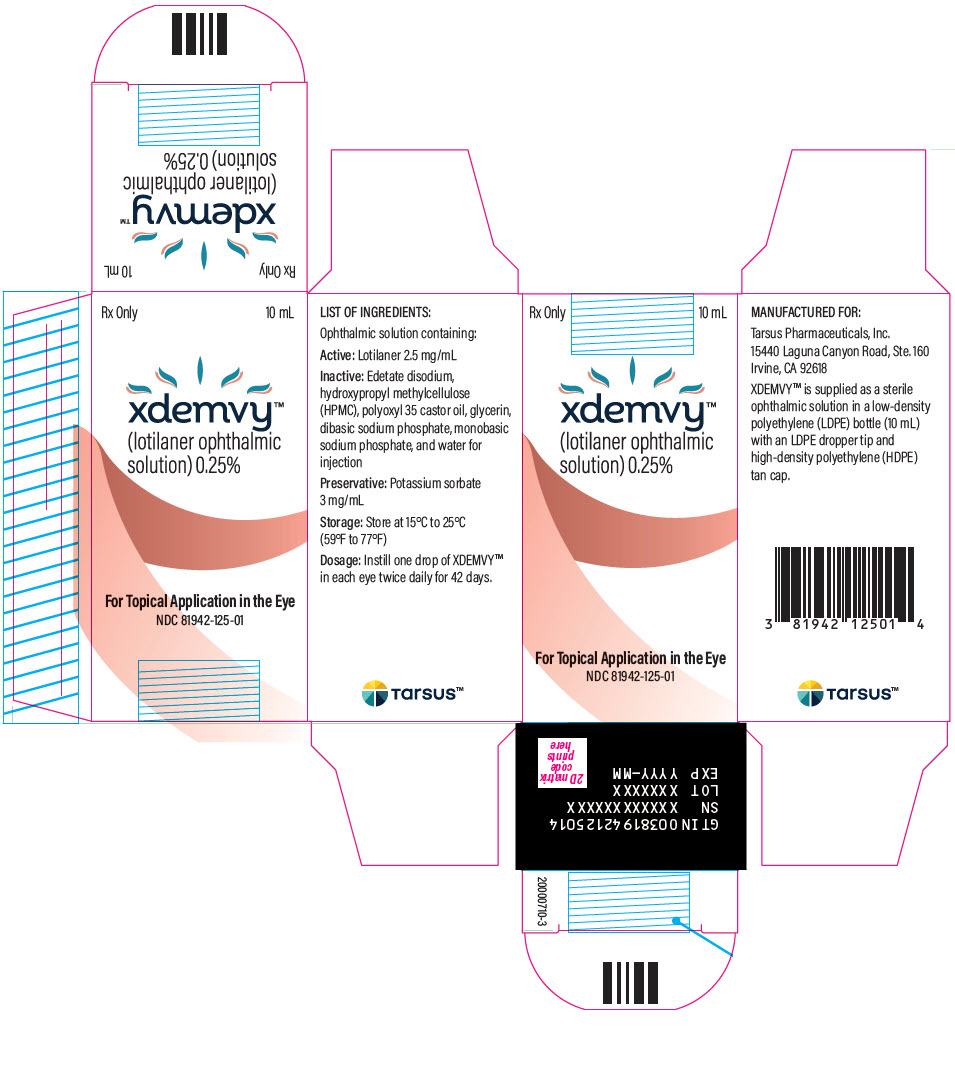
XDEMVY Lotilaner ophthalmic solution 2.5 mg/mL Solution/ Drops
🆔 Identity & classification
Where does this data come from?
🏷️ RxNorm drug class
This medicine belongs to the Ectoparasiticide class.
Where does this data come from?
🏭 Manufacturer & labeler
Where does this data come from?
🩺 Clinical
Patient education
Supplement & herbal interactions
Where does this data come from?
Ask a licensed pharmacist directly — free, answered by our team.
🧪 Inactive Ingredients / Excipients
Inactive ingredients, also called excipients, are components of the drug product other than the active ingredient. They may include fillers, dyes, coatings, preservatives, flavors, or other formulation ingredients.
Where does this data come from?
IACT rows and label-wide narrative are kept separate; availability and product-level specificity depend on the submitted label.Inactive ingredient FAQ
Are inactive ingredients the same for every manufacturer?
Why might an inactive ingredient be missing?
Can inactive ingredients matter?
💲 Pricing
A drug doesn't have one price. Each row is a different public payment system, and none is what you'd pay at the counter — that depends on your insurance. The ⓘ on each row explains what it measures.
| Price system | Per mL | Per package |
|---|---|---|
| Retail pharmacies payNADAC · weekly | Not in the retail survey — common for institutional, discontinued, or low-volume packs. | |
| Medicaid paysCMS SDUD · 12 mo | $196.97 | $1,969.73 / 10 ml |
| Medicare drug plans payPart D · Q2 2026 | $203.25 | $2,032.52 / 10 ml |
Where does this data come from?
🔁 Therapeutic equivalents
| Product | Labeler | Pack | NADAC/unit | TE | Status | Price vs. this |
|---|---|---|---|---|---|---|
| Xdemvy 2.5 mg/mLthis 81942-0125-01 | Tarsus | 1 bottle | — | — | FDA listed | — |
Where does this data come from?
⏳ Availability & generic status
We did not find an FDA-approved generic match for this exact strength, form and route. Patent/protection dates below may affect future generic timing.
Why the date isn’t exact: Generic timing can change because patents may be challenged, settled, licensed, added, removed, or worked around with a narrower label — and FDA approval does not always mean a pharmacy can get the generic today.
🛈 What do these terms mean?
- Patent
- Legal protection listed in the Orange Book that may delay generic approval or launch. Issued by the U.S. Patent & Trademark Office.
- Substance patent
- Covers the active drug molecule itself — the hardest to design around. A generic generally can’t launch until it expires.
- Formulation (product) patent
- Covers a specific formulation or dosage form. A generic can sometimes work around it with a different formulation.
- Method-of-use patent
- A patent covering one specific approved use of the drug — not necessarily the whole molecule. A generic can sometimes launch with a “skinny label” that carves out the protected use and keeps the others.
- Skinny label
- A generic label that omits a still-patented use when the FDA allows it — letting a generic reach the market for the unprotected uses.
- Exclusivity
- FDA-granted marketing protection, separate from patents — e.g. 5-yr new chemical entity, 7-yr orphan drug, or a +6-month pediatric extension.
- Paragraph IV
- A generic applicant’s formal challenge to a listed patent. It can potentially lead to earlier generic entry, but often involves litigation or a settlement.
- RLD / RS
- Reference Listed Drug — the brand product the FDA uses as the reference for generic applications. Reference Standard — the product the FDA expects generics to compare against in bioequivalence testing.
- TE / AB rating
- FDA therapeutic-equivalence rating. An AB rating generally means the FDA considers a generic therapeutically equivalent to — and substitutable for — the brand.
- LOE (loss of exclusivity)
- The latest patent or exclusivity currently listed — the loss-of-exclusivity / latest-listed-protection date shown on this page. Paragraph-IV challenges and settlements can move the real date earlier; FDA approval and a manufacturer’s decision to market can move it later.
Built from the FDA Orange Book. The bars above are scaled to each protection’s expiry; the red LOE marker is the last one to lapse.
| Patent | Type | Use code | Expires |
|---|---|---|---|
| US 11690827 ↗ | Method of use | U-3674 | Dec 14, 2038 |
| US 11690826 ↗ | Method of use | U-3674 | Dec 14, 2038 |
| US 11197847 ↗ | Method of use | U-3674 | Dec 14, 2038 |
| US 10835517 ↗ | Method of use | U-3674 | Dec 14, 2038 |
| US 12171750 ↗ | Method of use | U-3674 | Dec 14, 2038 |
| US 11752137 ↗ | Drug product | — | Dec 14, 2038 |
| US 12213964 ↗ | Drug product | — | Dec 14, 2038 |
| US 12364685 ↗ | Drug product | — | Dec 14, 2038 |
| US 8383659 ↗ | Drug substance | — | Jan 17, 2030 |
| Code | What it grants | Expires |
|---|---|---|
| NCE | New Chemical Entity (5-year) | Jul 24, 2028 |
Is there a generic version of XDEMVY 0.25% DROP?
The FDA approved a generic — why can’t I get it at my pharmacy yet?
Why do different websites show different generic release dates?
What does “FDA listed” mean?
What does a patent or protection date mean here?
What does “current Orange Book estimate” mean?
Can a generic come out before the last patent expires?
Can a generic come out after the listed dates?
What is the difference between patents and exclusivity?
Why are there multiple patent dates?
Where does this data come from?
🗺️ Medicaid utilization & spend
💊 Medicaid utilization by pack size
📊 Medicare Part D spend CMS · PART D · 2026 (Q1)
📦 Packaging — all sizes for this product
| Package NDC | Description | Marketing start | Status |
|---|---|---|---|
| 81942-0125-01 You're viewing this | 1 BOTTLE, DROPPER in 1 CARTON (81942-125-01) / 10 mL in 1 BOTTLE, DROPPER | 2023-08-14 | Active |
| 81942-0125-99 | 1 BOTTLE, DROPPER in 1 CARTON (81942-125-99) / 1.5 mL in 1 BOTTLE, DROPPER | 2023-08-14 | Active |
In Medicaid, this is the most-dispensed pack of this product — about 100% of fills over the last four reported quarters. See all packs ↓
Pack size FAQ
What quantity is in NDC 81942-0125-01?
What NDC number is used to bill for this package of XDEMVY Lotilaner ophthalmic solution 2.5 mg/mL Solution/ Drops?
🧭 About this NDC listing & data coverage
What data is (and isn’t) available for this NDC — tap to expand
| NDC identity (package / product / labeler codes) | ✓ Available |
| Labeler | ✓ Available |
| Product & package description | ✓ Available |
| Marketing category & status | ✓ Available |
| Active ingredient / dosage form / route | ✓ Available |
| FDA label (SPL via DailyMed) | ✓ Available |
| Package photos | ✓ Available |
| Inactive ingredients (structured) | — Not published for this NDC The labeler did not submit a structured excipient list, or no SPL is available. |
| NADAC pharmacy acquisition price (CMS) | — Not published for this NDC CMS publishes NADAC only for NDCs reported in its retail-pharmacy survey. |
| Orange Book / therapeutic-equivalence data | ✓ Available |
| HCPCS J-code billing crosswalk | — Not published for this NDC Most self-administered / retail products have no J-code — that is normal. |
| Medicaid utilization (CMS SDUD) | ✓ Available |
Questions about this listing
Why is there no price listed?
Is the NDC printed on the package the same as the 11-digit billing NDC?
What do the three segments of this NDC mean?
Is this package still being marketed?
Does this product come in other package sizes?
Who lists this product with the FDA?
Do I need a prescription for this product?
Where does this data come from?
📄 Full prescribing information FDA SPL
🎯 Indications and Usage ▾
1 INDICATIONS AND USAGE XDEMVY is indicated for the treatment of Demodex blepharitis. XDEMVY is an ectoparasiticide (anti-parasitic) indicated for the treatment of Demodex blepharitis. ( 1 )
⏱️ Dosage and Administration ▾
2 DOSAGE AND ADMINISTRATION Instill one drop of XDEMVY in each eye twice daily (approximately 12 hours apart) for 6 weeks. If more than one topical ophthalmic drug is being used, the drugs should be administered at least five (5) minutes apart. If one dose is missed, treatment should continue with the next scheduled dose. Instill one drop of XDEMVY in each eye twice daily (approximately 12 hours apart) for 6 weeks. ( 2 )
💊 Dosage Forms and Strengths ▾
3 DOSAGE FORMS AND STRENGTHS XDEMVY (lotilaner ophthalmic solution) is provided as an ophthalmic solution containing lotilaner 0.25% (2.5 mg/mL). Ophthalmic solution containing lotilaner 0.25%. ( 3 )
⛔ Contraindications ▾
4 CONTRAINDICATIONS None. None. ( 4 )
⚠️ Warnings and Cautions ▾
5 WARNINGS AND PRECAUTIONS
5.1Risk of Contamination Do not allow the tip of the dispensing container to contact the eye, surrounding structures, fingers, or any other surface in order to minimize contamination of the solution. Serious damage to the eye and subsequent loss of vision may result from using contaminated solutions .
5.2Use with Contact Lenses Contact lenses should be removed prior to instillation of XDEMVY and may be reinserted 15 minutes following its administration.
🤒 Adverse Reactions ▾
6 ADVERSE REACTIONS The most common adverse reaction was instillation site stinging and burning (10%). ( 6.1 ) To report SUSPECTED ADVERSE REACTIONS, contact Tarsus Pharmaceuticals at 1-888-421-4002 or FDA at 1-800-FDA-1088 or www.fda.gov/medwatch.
6.1Clinical Trials Experience Because clinical studies are conducted under widely varying conditions, adverse reaction rates observed in the clinical trials of a drug cannot be directly compared to rates in the clinical trials of another drug and may not reflect the rates observed in practice. XDEMVY was evaluated in 833 patients with Demodex blepharitis in two randomized, double-masked, vehicle-controlled studies (Saturn-1 and Saturn-2) with 42 days of treatment. The most common ocular adverse reaction observed in controlled clinical studies with XDEMVY was instillation site stinging and burning which was reported in 10% of patients.
Other ocular adverse reactions reported in less than 2% of patients were chalazion/hordeolum and punctate keratitis.
👥 Use in Specific Populations ▾
8 USE IN SPECIFIC POPULATIONS
8.1Pregnancy Risk Summary There are no available data on XDEMVY use in pregnant women to inform any drug associated risk; however, systemic exposure to lotilaner from ocular administration is low [see Clinical Pharmacology (12.3) ] . In animal reproduction studies, lotilaner did not produce malformations at clinically relevant doses. Data Animal Data In an oral embryofetal developmental study in pregnant rats dosed during organogenesis from gestation days 6-19, increased post-implantation loss, reduced fetal pup weight, and incomplete skeletal ossification were observed at 50 mg/kg/day (approximately 1390 times the recommended human ophthalmic dose (RHOD) on a body surface area basis) in the presence of maternal toxicity (i.e., decreased body weight and food consumption).
A rare malformation of situs inversus of the thoracic and abdominal viscera occurred in 1 fetus from a pregnant rat receiving 50 mg/kg/day; whether this finding was treatment-related could not be excluded. No maternal or embryofetal toxicity was observed at 18 mg/kg/day (approximately 501 times the RHOD on a body surface area basis). In an oral embryofetal development study in pregnant rabbits dosed during organogenesis from gestation days 7-19, no embryofetal toxicity or teratogenic findings were observed at 20 mg/kg/day (approximately 580-times the RHOD on an AUC basis), even in the presence of maternal toxicity (i.e., decreased food consumption and body weight).
In an oral two-generation reproductive toxicity study, F0 male and female rats were administered lotilaner at doses up to 40 mg/kg/day for 10 weeks before pairing and during the 2-week pairing period (3 weeks for males). Dosing for F0 females continued through lactation day 22. F1 male and female rats were administered lotilaner at 1 and 5 mg/kg/day post-weaning from day 23 for 10 weeks before pairing and during the 2-week pairing period (3 weeks for males).
Dosing for F1 parenteral females continued through lactation day 22. There were no clear adverse effects on the F1 generation, and a slightly lower mean body weight during lactation was noted for F2 pups at 5 mg/kg/day. The no observed adverse effect level (NOAEL) was determined to be 5 mg/kg/day (approximately 139 times the RHOD on a body surface area basis).
8.2Lactation Risk Summary There are no data on the presence of XDEMVY in human milk, the effects on the breastfed infant, or the effects on milk production. However, systemic exposure to lotilaner following 6 weeks of topical ocular administration is low and is >99% plasma protein bound [see Clinical Pharmacology (12.3) ] , thus it is not known whether measurable levels of lotilaner would be present in maternal milk following topical ocular administration. The developmental and health benefits of breastfeeding should be considered along with the mother's clinical need for XDEMVY and any potential adverse effects on the breast-fed child from XDEMVY.
8.4Pediatric Use Safety and effectiveness in pediatric patients below the age of 18 years have not been established.
8.5Geriatric Use No overall differences in safety or effectiveness have been observed between elderly and other adult patients.
🤰 Pregnancy ▾
8.1Pregnancy Risk Summary There are no available data on XDEMVY use in pregnant women to inform any drug associated risk; however, systemic exposure to lotilaner from ocular administration is low [see Clinical Pharmacology (12.3) ] . In animal reproduction studies, lotilaner did not produce malformations at clinically relevant doses. Data Animal Data In an oral embryofetal developmental study in pregnant rats dosed during organogenesis from gestation days 6-19, increased post-implantation loss, reduced fetal pup weight, and incomplete skeletal ossification were observed at 50 mg/kg/day (approximately 1390 times the recommended human ophthalmic dose (RHOD) on a body surface area basis) in the presence of maternal toxicity (i.e., decreased body weight and food consumption).
A rare malformation of situs inversus of the thoracic and abdominal viscera occurred in 1 fetus from a pregnant rat receiving 50 mg/kg/day; whether this finding was treatment-related could not be excluded. No maternal or embryofetal toxicity was observed at 18 mg/kg/day (approximately 501 times the RHOD on a body surface area basis). In an oral embryofetal development study in pregnant rabbits dosed during organogenesis from gestation days 7-19, no embryofetal toxicity or teratogenic findings were observed at 20 mg/kg/day (approximately 580-times the RHOD on an AUC basis), even in the presence of maternal toxicity (i.e., decreased food consumption and body weight).
In an oral two-generation reproductive toxicity study, F0 male and female rats were administered lotilaner at doses up to 40 mg/kg/day for 10 weeks before pairing and during the 2-week pairing period (3 weeks for males). Dosing for F0 females continued through lactation day 22. F1 male and female rats were administered lotilaner at 1 and 5 mg/kg/day post-weaning from day 23 for 10 weeks before pairing and during the 2-week pairing period (3 weeks for males).
Dosing for F1 parenteral females continued through lactation day 22. There were no clear adverse effects on the F1 generation, and a slightly lower mean body weight during lactation was noted for F2 pups at 5 mg/kg/day. The no observed adverse effect level (NOAEL) was determined to be 5 mg/kg/day (approximately 139 times the RHOD on a body surface area basis).
🧒 Pediatric Use ▾
8.4Pediatric Use Safety and effectiveness in pediatric patients below the age of 18 years have not been established.
🧓 Geriatric Use ▾
8.5Geriatric Use No overall differences in safety or effectiveness have been observed between elderly and other adult patients.
🧬 Clinical Pharmacology ▾
12 CLINICAL PHARMACOLOGY
12.1Mechanism of Action Lotilaner is a gamma-aminobutyric acid (GABA)-gated chloride channel inhibitor selective for mites. Inhibition of these GABA chloride channels causes a paralytic action in the target organism leading to its death. Lotilaner is not an inhibitor of mammalian GABA mediated chloride channels when tested at up to 30 µM (18 µg/mL) in vitro (approximately 1100 times the RHOD).
12.3Pharmacokinetics The systemic pharmacokinetic profile after topical ocular administration was evaluated in healthy volunteers after single and repeat dose administration. The systemic exposure was evaluated in patients at the end of 6 weeks of treatment. Absorption Maximum lotilaner concentration was observed 2 hours after a single ocular administration on Day 1 and 1 hour after the last drug administration on Day 42.
In healthy subjects, the peak concentration (C max ) and total exposure (AUC 0-12 ) of lotilaner in whole blood increased after 42 days of repeated ocular administration from 0.596 to 17.8 ng/mL and from 5.75 to 149 hr•ng/mL for C max and AUC 0-12 respectively. The effective half-life of lotilaner, which is based on the accumulation ratio over the dosing interval of 12 hours, was 264 hours (11 days). In patients with Demodex blepharitis (n=138) who received XDEMVY twice daily for 42 days, the mean (range) systemic exposure at the end of treatment was 12.0 ng/mL (0.4-46.1 ng/mL).
Distribution Lotilaner plasma protein binding is high (> 99.9%) in human plasma. The partitioning of lotilaner to human blood cells is approximately 10% (range 0-20%). Elimination The effective half-life in healthy subjects, which is based on the accumulation ratio over the dosing interval of 12 hours, is 264 hours (11 days).
Metabolism Lotilaner is not metabolized by CYP enzymes.
🧬 Mechanism of Action ▾
12.1Mechanism of Action Lotilaner is a gamma-aminobutyric acid (GABA)-gated chloride channel inhibitor selective for mites. Inhibition of these GABA chloride channels causes a paralytic action in the target organism leading to its death. Lotilaner is not an inhibitor of mammalian GABA mediated chloride channels when tested at up to 30 µM (18 µg/mL) in vitro (approximately 1100 times the RHOD).
📦 How Supplied / Storage and Handling ▾
16 HOW SUPPLIED/STORAGE AND HANDLING XDEMVY is supplied as a sterile ophthalmic solution in a white, opaque, low-density polyethylene (LDPE) multiple-dose bottle with a LDPE dropper tip and tan high-density polyethylene (HDPE) cap. 10 mL fill in a 11 mL container NDC # 81942-125-01 Storage Store at 15°C to 25°C (59°F to 77°F). After opening the XDEMVY bottle, it can be used until the expiration date on the bottle.
📦 Storage and Handling ▾
Storage Store at 15°C to 25°C (59°F to 77°F). After opening the XDEMVY bottle, it can be used until the expiration date on the bottle.
📋 Description ▾
11 DESCRIPTION Lotilaner is a member of the isoxazoline family of compounds. Its chemical name is 2-Thiophenecarboxamide, 5-[(5S)-4,5-dihydro-5-(3,4,5-trichlorophenyl)-5-(trifluoromethyl)-3-isoxazolyl]-3-methyl-N-[2-oxo-2-[(2,2,2-trifluoroethyl)amino]ethyl]-2-thiophenecarboxamide. The molecular formula is C 20 H 14 Cl 3 F 6 N 3 O 3 S.
The molecular weight is 596.76 g/mol. The chemical structure is: XDEMVY is a sterile, preserved, multi-dose, slightly yellowish, slightly opalescent, topical ophthalmic solution containing lotilaner, 0.25% as the active ingredient. It is preserved with potassium sorbate and contains the following additional inactive ingredients: edetate disodium, hydroxypropyl methylcellulose (HPMC), polyoxyl 35 castor oil, glycerin, dibasic sodium phosphate, monobasic sodium phosphate, and water for injection.
Chemical Structure
💬 Information for Patients ▾
17 PATIENT COUNSELING INFORMATION Handling the Container Instruct patients to avoid allowing the tip of the dispensing container to contact the eye, surrounding structures, fingers, or any other surface in order to minimize contamination of the solution. Serious damage to the eye and subsequent loss of vision may result from using contaminated solutions . When to Seek Physician Advice Advise patients that if they develop an intercurrent ocular condition (e.g., trauma or infection), have ocular surgery, or develop any ocular reactions, particularly conjunctivitis and eyelid reactions, they should immediately seek their physician's advice concerning the continued use of XDEMVY.
Use with Contact Lenses Advise patients that XDEMVY contains potassium sorbate, which may discolor soft contact lenses. Contact lenses should be removed prior to instillation of XDEMVY and may be reinserted 15 minutes following its administration. Use with Other Ophthalmic Drugs Advise patients that if more than one topical ophthalmic drug is being used, the drugs should be administered at least 5 minutes between applications.
Missed Dose Advise patients that if one dose is missed, treatment should continue with the next dose. XDEMVY and/or methods of use thereof may be covered by one or more of the patents listed at www.tarsusrx.com/patents XDEMVY is a trademark of Tarsus Pharmaceuticals, Inc.