
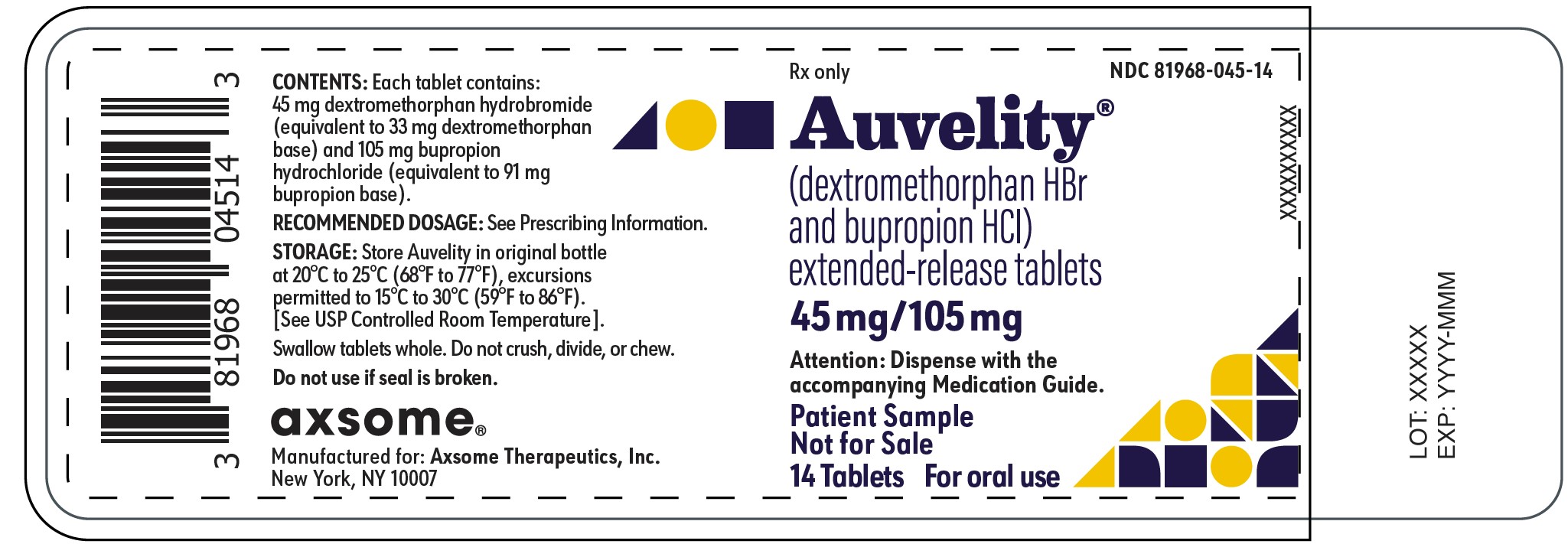
Auvelity dextromethorphan hydrobromide, bupropion hydrochloride 45 mg; 105 mg Tablet, Multilayer, Extended Release, 14-count — NDC 81968-045-14 (Billing 81968-0045-14)
This is a package of 14 tablets of Auvelity dextromethorphan hydrobromide, bupropion hydrochloride 45 mg; 105 mg Tablet, Multilayer, Extended Release from Axsome Therapeutics, Inc., marketed since Aug 2022 and currently FDA-listed.
NDC database record
One package, one record: these facts belong to NDC 81968-045-14 alone.
- Record
- FDA NDC Directory package listing · Human prescription drug
- Code segments
- 81968 labeler · 045 product · 14 package
- Package marketed since
- Sep 18, 2024
- Sample package
- Yes — professional sample, not for sale
- Listing certified through
- Dec 31, 2027
- Barcode (UPC)
- 0381968045600, 0381968030224, 0381968045310, 0381968045143
- FDA record last changed
- Oct 8, 2026
Identity & classification
Regulatory identifiers FDA, NLM and CMS codes for this package
Drug-database identifiers Medi-Span GPI and First Databank GCN / HICL / AHFS classification
- GSN (GCN sequence number): 083732
- GCN: 52775
- HICL (First Databank): 048220
- AHFS class code: 28:16.04.92
- RxCUI (RxNorm): 2611260
Where does this data come from?
- FDA openFDA NDC Directory · synced Oct 8, 2026
- FDA label on DailyMed · label index refreshed Oct 8, 2026
- RxNorm (NLM RxNav) · catalog refreshed Oct 8, 2026
- Medi-Span GPI (licensed)
- First Databank (licensed) · refreshed Oct 8, 2026
RxNorm drug class
This medicine belongs to the Uncompetitive N-methyl-D-aspartate Receptor Antagonist class.
Where does this data come from?
- RxClass (NLM) · catalog refreshed Oct 8, 2026
Clinical
Bupropion is used to treat depression. and seasonal affective disorder (SAD; episodes of depression that occur at the same time each year [usually in the fall and winter but rarely may occur in the spring or summer months]). Bupropion is also used to help people stop smoking. Bupropion is in a class of medications called antidepressants. It works by increasing certain types of activity in the brain.
Read the full MedlinePlus article ↗- You're right that dextromethorphan is found in many over-the-counter cough medicines, but at prescription doses combined with bupropion in Auvelity, it works on brain receptors in...
- What is Auvelity actually used for — I thought dextromethorphan was just a cough medicine?
- Bupropion plays two roles. First, it slows down the liver enzyme that would normally break down dextromethorphan very quickly, so dextromethorphan can reach and maintain levels in...
- Why are there two drugs in one pill — what does the bupropion do?
Patient education
Supplement & herbal interactions
Where does this data come from?
- MedlinePlus (NLM) · refreshed Oct 8, 2026
- FDA label on DailyMed · label index refreshed Oct 8, 2026
Ask a licensed pharmacist directly — free, answered by our team.
Pricing
A drug doesn't have one price. Each row is a different public payment system, and none is what you'd pay at the counter — that depends on your insurance. The ⓘ on each row explains what it measures.
| Price system | Per each | Per package |
|---|---|---|
| Retail pharmacies payNADAC · weekly | Not in the retail survey — common for institutional, discontinued, or low-volume packs. | |
| Medicaid paysCMS SDUD · 12 mo | No recent Medicaid claims on file for this NDC — rare and low-volume NDCs are suppressed in the public data. | |
| Medicare drug plans payPart D · Q2 2026 | $20.01 | $280.07 / 14 tablets |
Where does this data come from?
- CMS NADAC weekly file
- CMS ASP pricing files · refreshed Sep 20, 2026
- CMS Medicaid State Drug Utilization Data · refreshed Oct 9, 2026
- CMS Part D plan pricing files · refreshed Sep 24, 2026
- VA National Acquisition Center price file
Packaging — all sizes for this product
| Package NDC | Description | Per unit | Per pack | Marketing start | Marketing end | Status |
|---|---|---|---|---|---|---|
| 81968-0045-30 81968-045-30 | 30 TABLET, MULTILAYER, EXTENDED RELEASE in 1 BOTTLE | $19.90 / ea | $596.93 | 2022-08-18 | — | Active |
| 81968-0045-14 You're viewing this | 1 BOTTLE in 1 CARTON / 14 TABLET, MULTILAYER, EXTENDED RELEASE in 1 BOTTLE Sample | — | — | 2024-09-18 | — | Active |
| 81968-0045-31 81968-045-31 | 1 BOTTLE in 1 CARTON / 30 TABLET, MULTILAYER, EXTENDED RELEASE in 1 BOTTLE Sample | — | — | 2024-05-10 | Mar 28, 2027 | Active |
| 81968-0045-60 81968-045-60 Main listing | 60 TABLET, MULTILAYER, EXTENDED RELEASE in 1 BOTTLE | $19.90 / ea | $1,193.86 | 2024-06-28 | — | Active |
This pack shows little to no recent Medicaid volume — the 60 tablets pack carries most fills. See all packs ↓
Pack size FAQ
What quantity is in this package?
How does this package differ from NDC 81968-0045-30?
What NDC number is used to bill for this package of Auvelity dextromethorphan hydrobromide, bupropion hydrochloride 45 mg; 105 mg Tablet, Multilayer, Extended Release?
Prices are the latest CMS NADAC pharmacy acquisition cost per NDC; per-pack figures are per-unit × pack quantity, shown only when the pack is denominated in the same measure NADAC prices.
Therapeutic equivalents
| Product | Labeler | Pack | NADAC/unit | TE | Status | Price vs. this |
|---|---|---|---|---|---|---|
| Auvelity 45 mg/1; 105 mgthis 81968-0045-14 | Axsome | 14 tablets | — | — | FDA listed | — |
Where does this data come from?
- FDA openFDA NDC Directory · synced Oct 8, 2026
- FDA Orange Book · refreshed Oct 9, 2026
- CMS NADAC weekly file
Availability & generic status
We did not find an FDA-approved generic match for this exact strength, form and route. Patent/protection dates below may affect future generic timing.
Why the date isn’t exact: Generic timing can change because patents may be challenged, settled, licensed, added, removed, or worked around with a narrower label — and FDA approval does not always mean a pharmacy can get the generic today.
Our estimate: September 2038 about 12 years away
How sure: Very likely. Few things could still move it, but a court ruling or a new deal can.
Why then: The brand company and a generic maker settled their patent fight and agreed on when a generic can launch.
That is before the November 2043 date above, which is common: a court ruling or a deal with the brand’s maker often lets a generic in before the last patent runs out.
See the full forecast for generic Auvelity →🛈 What do these terms mean?
- Patent
- Legal protection listed in the Orange Book that may delay generic approval or launch. Issued by the U.S. Patent & Trademark Office.
- Substance patent
- Covers the active drug molecule itself — the hardest to design around. A generic generally can’t launch until it expires.
- Formulation (product) patent
- Covers a specific formulation or dosage form. A generic can sometimes work around it with a different formulation.
- Method-of-use patent
- A patent covering one specific approved use of the drug — not necessarily the whole molecule. A generic can sometimes launch with a “skinny label” that carves out the protected use and keeps the others.
- Skinny label
- A generic label that omits a still-patented use when the FDA allows it — letting a generic reach the market for the unprotected uses.
- Exclusivity
- FDA-granted marketing protection, separate from patents — e.g. 5-yr new chemical entity, 7-yr orphan drug, or a +6-month pediatric extension.
- Paragraph IV
- A generic applicant’s formal challenge to a listed patent. It can potentially lead to earlier generic entry, but often involves litigation or a settlement.
- RLD / RS
- Reference Listed Drug — the brand product the FDA uses as the reference for generic applications. Reference Standard — the product the FDA expects generics to compare against in bioequivalence testing.
- TE / AB rating
- FDA therapeutic-equivalence rating. An AB rating generally means the FDA considers a generic therapeutically equivalent to — and substitutable for — the brand.
- LOE (loss of exclusivity)
- The latest patent or exclusivity currently listed — the loss-of-exclusivity / latest-listed-protection date shown on this page. Paragraph-IV challenges and settlements can move the real date earlier; FDA approval and a manufacturer’s decision to market can move it later.
Built from the FDA Orange Book. The bars above are scaled to each protection’s expiry; the red LOE marker is the last one to lapse.
| Patent | Type | Use code | Expires |
|---|---|---|---|
| US 12146889 ↗ | Method of use | U-3419 | Feb 23, 2043 |
| US 11524008 ↗ | Method of use | U-3419 | Nov 5, 2034 |
| US 11524007 ↗ | Method of use | U-3419 | Nov 5, 2034 |
| US 11517542 ↗ | Method of use | U-3419 | Nov 5, 2034 |
| US 11517543 ↗ | Method of use | U-3419 | Nov 5, 2034 |
| US 11510918 ↗ | Method of use | U-3419 | Nov 5, 2034 |
| US 12310961 ↗ | Method of use | U-3419 | Jan 20, 2043 |
| US 11382874 ↗ | Method of use | U-3419 | Nov 5, 2034 |
| US 11364233 ↗ | Method of use | U-3419 | Nov 5, 2034 |
| US 9457025 ↗ | Method of use | U-3419 | Nov 5, 2034 |
| US 10058518 ↗ | Method of use | U-3419 | Nov 5, 2034 |
| US 9278095 ↗ | Method of use | U-3419 | Nov 5, 2034 |
| US 9867819 ↗ | Method of use | U-3419 | Nov 5, 2034 |
| US 9168234 ↗ | Method of use | U-3419 | Nov 5, 2034 |
| US 9861595 ↗ | Method of use | U-3419 | Nov 5, 2034 |
| US 8569328 ↗ | Method of use | U-3419 | Jul 18, 2032 |
| US 9700553 ↗ | Method of use | U-3419 | Nov 5, 2034 |
| US 11357744 ↗ | Method of use | U-3419 | Nov 5, 2034 |
| US 11344544 ↗ | Method of use | U-3419 | Nov 5, 2034 |
| US 9486450 ↗ | Method of use | U-3419 | Nov 5, 2034 |
| US 9474731 ↗ | Method of use | U-3419 | Nov 5, 2034 |
| US 9375429 ↗ | Method of use | U-3419 | Nov 5, 2034 |
| US 9421176 ↗ | Method of use | U-3419 | Nov 5, 2034 |
| US 9408815 ↗ | Method of use | U-3419 | Nov 5, 2034 |
| US 9763932 ↗ | Method of use | U-3419 | Nov 5, 2034 |
| US 11311534 ↗ | Method of use | U-3419 | Nov 5, 2034 |
| US 9205083 ↗ | Method of use | U-3419 | Nov 5, 2034 |
| US 9707191 ↗ | Method of use | U-3419 | Nov 5, 2034 |
| US 10898453 ↗ | Method of use | U-3419 | Nov 5, 2034 |
| US 11433067 ↗ | Method of use | U-3419 | Nov 5, 2034 |
| US 9700528 ↗ | Method of use | U-3419 | Nov 5, 2034 |
| US 9370513 ↗ | Method of use | U-3419 | Nov 5, 2034 |
| US 9457023 ↗ | Method of use | U-3419 | Nov 5, 2034 |
| US 9238032 ↗ | Method of use | U-3419 | Nov 5, 2034 |
| US 11096937 ↗ | Method of use | U-3419 | Nov 5, 2034 |
| US 11298352 ↗ | Method of use | U-3419 | Nov 5, 2034 |
| US 10966941 ↗ | Method of use | U-3419 | Nov 5, 2034 |
| US 11298351 ↗ | Method of use | U-3419 | Nov 5, 2034 |
| US 11090300 ↗ | Method of use | U-3419 | Nov 5, 2034 |
| US 10894047 ↗ | Method of use | U-3419 | Nov 5, 2034 |
| US 10064857 ↗ | Method of use | U-3419 | Nov 5, 2034 |
| US 11291665 ↗ | Method of use | U-3419 | Nov 5, 2034 |
| US 10780066 ↗ | Method of use | U-3419 | Nov 5, 2034 |
| US 10780064 ↗ | Method of use | U-3419 | Jan 7, 2040 |
| US 11291638 ↗ | Method of use | U-3419 | Nov 5, 2034 |
| US 10786469 ↗ | Method of use | U-3419 | Nov 5, 2034 |
| US 11253492 ↗ | Method of use | U-3419 | Nov 5, 2034 |
| US 10881657 ↗ | Method of use | U-3419 | Nov 5, 2034 |
| US 10874663 ↗ | Method of use | U-3419 | Nov 5, 2034 |
| US 10799497 ↗ | Method of use | U-3419 | Nov 5, 2034 |
| US 11058648 ↗ | Method of use | U-3419 | Nov 5, 2034 |
| US 11273133 ↗ | Method of use | U-3419 | Nov 5, 2034 |
| US 10864209 ↗ | Method of use | U-3419 | Nov 5, 2034 |
| US 10806710 ↗ | Method of use | U-3419 | Nov 5, 2034 |
| US 10881624 ↗ | Method of use | U-3419 | Nov 5, 2034 |
| US 10786496 ↗ | Method of use | U-3419 | Nov 5, 2034 |
| US 11020389 ↗ | Method of use | U-3419 | Nov 5, 2034 |
| US 11185515 ↗ | Method of use | U-3419 | Nov 5, 2034 |
| US 10945973 ↗ | Method of use | U-3419 | Nov 5, 2034 |
| US 10966942 ↗ | Method of use | U-3419 | Jan 7, 2040 |
| US 11285146 ↗ | Method of use | U-3419 | Nov 5, 2034 |
| US 11285118 ↗ | Method of use | U-3419 | Nov 5, 2034 |
| US 10596167 ↗ | Method of use | U-3419 | Nov 5, 2034 |
| US 11439636 ↗ | Method of use | U-3419 | Nov 5, 2034 |
| US 9314462 ↗ | Method of use | U-3419 | Nov 5, 2034 |
| US 9198905 ↗ | Method of use | U-3419 | Nov 5, 2034 |
| US 11426401 ↗ | Method of use | U-3419 | Nov 5, 2034 |
| US 11426370 ↗ | Method of use | U-3419 | Nov 5, 2034 |
| US 11419867 ↗ | Method of use | U-3419 | Nov 5, 2034 |
| US 12390428 ↗ | Method of use | U-3419 | Dec 1, 2041 |
| US 10772850 ↗ | Method of use | U-3419 | Nov 5, 2034 |
| US 10940124 ↗ | Method of use | U-3419 | Jan 7, 2040 |
| US 11273134 ↗ | Method of use | U-3419 | Nov 5, 2034 |
| US 11253491 ↗ | Method of use | U-3419 | Nov 5, 2034 |
| US 11234946 ↗ | Method of use | U-3419 | Nov 5, 2034 |
| US 10548857 ↗ | Method of use | U-3419 | Nov 5, 2034 |
| US 11229640 ↗ | Method of use | U-3419 | Nov 5, 2034 |
| US 10874665 ↗ | Method of use | U-3419 | Nov 5, 2034 |
| US 10933034 ↗ | Method of use | U-3419 | Nov 5, 2034 |
| US 10251879 ↗ | Method of use | U-3419 | Nov 5, 2034 |
| US 10925842 ↗ | Method of use | U-3419 | Jan 7, 2040 |
| US 10092561 ↗ | Method of use | U-3419 | Nov 5, 2034 |
| US 10894046 ↗ | Method of use | U-3419 | Nov 5, 2034 |
| US 11191739 ↗ | Method of use | U-3419 | Nov 5, 2034 |
| US 10874664 ↗ | Method of use | U-3419 | Nov 5, 2034 |
| US 10080727 ↗ | Method of use | U-3419 | Nov 5, 2034 |
| US 11197839 ↗ | Method of use | U-3419 | Nov 5, 2034 |
| US 11147808 ↗ | Method of use | U-3419 | Nov 5, 2034 |
| US 11207281 ↗ | Method of use | U-3419 | Nov 5, 2034 |
| US 11141416 ↗ | Method of use | U-3419 | Nov 5, 2034 |
| US 11141388 ↗ | Method of use | U-3419 | Nov 5, 2034 |
| US 11213521 ↗ | Method of use | U-3419 | Nov 5, 2034 |
| US 11129826 ↗ | Method of use | U-3419 | Nov 5, 2034 |
| US 11123343 ↗ | Method of use | U-3419 | Nov 5, 2034 |
| US 10966974 ↗ | Method of use | U-3419 | Nov 5, 2034 |
| US 10512643 ↗ | Method of use | U-3419 | Nov 5, 2034 |
| US 10463634 ↗ | Method of use | U-3419 | Nov 5, 2034 |
| US 10105361 ↗ | Method of use | U-3419 | Nov 5, 2034 |
| US 10105327 ↗ | Method of use | U-3419 | Nov 5, 2034 |
| US 10092560 ↗ | Method of use | U-3419 | Nov 5, 2034 |
| US 11752144 ↗ | Method of use | U-3419 | Feb 23, 2043 |
| US 11925636 ↗ | Method of use | U-3419 | Jan 20, 2043 |
| US 9968568 ↗ | Method of use | U-3419 | Nov 5, 2034 |
| US 12042473 ↗ | Method of use | U-3419 | Feb 23, 2043 |
| US 12036191 ↗ | Method of use | U-3419 | Feb 15, 2043 |
| US 11969421 ↗ | Method of use | U-3419 | Nov 5, 2034 |
| US 11590124 ↗ | Method of use | U-3419 | Nov 5, 2034 |
| US 11576909 ↗ | Method of use | U-3419 | Nov 5, 2034 |
| US 11571417 ↗ | Method of use | U-3419 | Nov 5, 2034 |
| US 11123344 ↗ | Method of use | U-3419 | Nov 5, 2034 |
| US 11065248 ↗ | Method of use | U-3419 | Nov 5, 2034 |
| US 11896563 ↗ | Method of use | U-3419 | Dec 1, 2041 |
| US 12357697 ↗ | Method of use | U-3419 | Jan 20, 2043 |
| US 11478468 ↗ | Method of use | U-3419 | Nov 5, 2034 |
| US 11541048 ↗ | Method of use | U-3419 | Nov 5, 2034 |
| US 11541021 ↗ | Method of use | U-3419 | Nov 5, 2034 |
| US 11534414 ↗ | Method of use | U-3419 | Nov 5, 2034 |
| US 11779579 ↗ | Method of use | U-3419 | Nov 5, 2034 |
| US 11617728 ↗ | Method of use | U-3419 | Nov 5, 2034 |
| US 11617747 ↗ | Method of use | U-3563 | Nov 5, 2034 |
| US 11730706 ↗ | Method of use | U-3419 | Jan 23, 2043 |
| US 11717518 ↗ | Method of use | U-3419 | Jan 20, 2043 |
| US 11596627 ↗ | Method of use | U-3419 | Nov 5, 2034 |
| US 11497721 ↗ | Method of use | U-3419 | Nov 5, 2034 |
| US 11844797 ↗ | Method of use | U-3778 | Apr 20, 2043 |
| US 11839612 ↗ | Method of use | U-3419 | Mar 2, 2043 |
| US 11883373 ↗ | Method of use | U-3419 | Jan 23, 2043 |
| US 11986444 ↗ | Method of use | U-3419 | Feb 15, 2043 |
| US 12109178 ↗ | Method of use | U-3419 | Nov 5, 2034 |
| US 12653795 ↗ | Method of use | U-4516 | Nov 28, 2043 |
| US 12661408 ↗ | Method of use | U-3419 | Jan 20, 2043 |
| US 9968568 ↗ | Method of use | U-4517 | Nov 5, 2034 |
| US 9968568 ↗ | Method of use | U-4517 | Nov 5, 2034 |
| US 11285146 ↗ | Method of use | U-4517 | Nov 5, 2034 |
| US 9168234 ↗ | Method of use | U-4517 | Nov 5, 2034 |
| US 9168234 ↗ | Method of use | U-4517 | Nov 5, 2034 |
| US 8569328 ↗ | Method of use | U-4516 | Jul 18, 2032 |
| US 10080727 ↗ | Method of use | U-4520 | Nov 5, 2034 |
| US 11382874 ↗ | Method of use | U-4517 | Nov 5, 2034 |
| US 11344544 ↗ | Method of use | U-4517 | Nov 5, 2034 |
| US 11571417 ↗ | Method of use | U-4526 | Nov 5, 2034 |
| US 11590124 ↗ | Method of use | U-4526 | Nov 5, 2034 |
| US 11298352 ↗ | Method of use | U-4517 | Nov 5, 2034 |
| US 11291638 ↗ | Method of use | U-4517 | Nov 5, 2034 |
| US 12370154 ↗ | Method of use | U-4518 | Feb 15, 2043 |
| US 12472155 ↗ | Method of use | U-4519 | Feb 23, 2043 |
| US 12194036 ↗ | Method of use | U-4521 | Apr 20, 2043 |
| US 12576078 ↗ | Method of use | U-4516 | Jun 5, 2040 |
| US 12576078 ↗ | Method of use | U-4516 | Jun 5, 2040 |
| US 12239642 ↗ | Method of use | U-4515 | Jan 20, 2043 |
| US 12194005 ↗ | Method of use | U-4523 | Jan 23, 2043 |
| US 12599576 ↗ | Method of use | U-4518 | Feb 15, 2043 |
| US 12364674 ↗ | Method of use | U-4516 | Jan 23, 2043 |
| US 11007189 ↗ | Method of use | U-4516 | Nov 5, 2034 |
| US 11007189 ↗ | Method of use | U-4516 | Nov 5, 2034 |
| US 12472174 ↗ | Method of use | U-4515 | Jan 20, 2043 |
| US 12472174 ↗ | Method of use | U-4515 | Jan 20, 2043 |
| US 12263161 ↗ | Method of use | U-4515 | Jan 20, 2043 |
| US 11534414 ↗ | Method of use | U-4516 | Nov 5, 2034 |
| US 11191739 ↗ | Method of use | U-4516 | Nov 5, 2034 |
| US 11197839 ↗ | Method of use | U-4516 | Nov 5, 2034 |
| US 11234946 ↗ | Method of use | U-4526 | Nov 5, 2034 |
| US 10881624 ↗ | Method of use | U-4517 | Nov 5, 2034 |
| US 9700528 ↗ | Method of use | U-4517 | Nov 5, 2034 |
| US 11253492 ↗ | Method of use | U-4526 | Nov 5, 2034 |
| US 9861595 ↗ | Method of use | U-4517 | Nov 5, 2034 |
| US 9861595 ↗ | Method of use | U-4517 | Nov 5, 2034 |
| US 9486450 ↗ | Method of use | U-4517 | Nov 5, 2034 |
| US 9314462 ↗ | Method of use | U-4517 | Nov 5, 2034 |
| US 9205083 ↗ | Method of use | U-4520 | Nov 5, 2034 |
| US 10092560 ↗ | Method of use | U-4517 | Nov 5, 2034 |
| US 11207281 ↗ | Method of use | U-4537 | Nov 5, 2034 |
| US 9457025 ↗ | Method of use | U-4517 | Nov 5, 2034 |
| US 9421176 ↗ | Method of use | U-4517 | Nov 5, 2034 |
| US 9700553 ↗ | Method of use | U-4517 | Nov 5, 2034 |
| US 9486450 ↗ | Method of use | U-4517 | Nov 5, 2034 |
| US 9370513 ↗ | Method of use | U-4520 | Nov 5, 2034 |
| US 9375429 ↗ | Method of use | U-4517 | Nov 5, 2034 |
| US 9314462 ↗ | Method of use | U-4517 | Nov 5, 2034 |
| US 9370513 ↗ | Method of use | U-4520 | Nov 5, 2034 |
| US 9457023 ↗ | Method of use | U-4517 | Nov 5, 2034 |
| US 9707191 ↗ | Method of use | U-4522 | Nov 5, 2034 |
| US 9474731 ↗ | Method of use | U-4520 | Nov 5, 2034 |
| US 11207281 ↗ | Method of use | U-4537 | Nov 5, 2034 |
| US 10092560 ↗ | Method of use | U-4517 | Nov 5, 2034 |
| US 11590124 ↗ | Method of use | U-4526 | Nov 5, 2034 |
| US 10780066 ↗ | Method of use | U-4517 | Nov 5, 2034 |
| US 9198905 ↗ | Method of use | U-4520 | Nov 5, 2034 |
| US 8569328 ↗ | Method of use | U-4516 | Jul 18, 2032 |
| US 9205083 ↗ | Method of use | U-4520 | Nov 5, 2034 |
| US 11253492 ↗ | Method of use | U-4526 | Nov 5, 2034 |
| US 9707191 ↗ | Method of use | U-4522 | Nov 5, 2034 |
| US 9198905 ↗ | Method of use | U-4520 | Nov 5, 2034 |
| US 10058518 ↗ | Method of use | U-4522 | Nov 5, 2034 |
| US 10064857 ↗ | Method of use | U-4517 | Nov 5, 2034 |
| US 11571417 ↗ | Method of use | U-4526 | Nov 5, 2034 |
| US 11426370 ↗ | Method of use | U-4526 | Nov 5, 2034 |
| US 10092561 ↗ | Method of use | U-4517 | Nov 5, 2034 |
| US 10105361 ↗ | Method of use | U-4522 | Nov 5, 2034 |
| US 10780066 ↗ | Method of use | U-4517 | Nov 5, 2034 |
| US 10251879 ↗ | Method of use | U-4517 | Nov 5, 2034 |
| US 10058518 ↗ | Method of use | U-4522 | Nov 5, 2034 |
| US 11285146 ↗ | Method of use | U-4517 | Nov 5, 2034 |
| US 11273134 ↗ | Method of use | U-4517 | Nov 5, 2034 |
| US 11273134 ↗ | Method of use | U-4517 | Nov 5, 2034 |
| US 11273133 ↗ | Method of use | U-4526 | Nov 5, 2034 |
| US 11273133 ↗ | Method of use | U-4526 | Nov 5, 2034 |
| US 11298352 ↗ | Method of use | U-4517 | Nov 5, 2034 |
| US 11344544 ↗ | Method of use | U-4517 | Nov 5, 2034 |
| US 11426370 ↗ | Method of use | U-4526 | Nov 5, 2034 |
| US 11382874 ↗ | Method of use | U-4517 | Nov 5, 2034 |
| US 12433884 ↗ | Method of use | U-4514 | Jun 5, 2040 |
| US 12433884 ↗ | Method of use | U-4514 | Jun 5, 2040 |
| US 12564587 ↗ | Method of use | U-4515 | Jan 20, 2043 |
| US 12478622 ↗ | Method of use | U-4515 | Jan 20, 2043 |
| US 12472156 ↗ | Method of use | U-4516 | Jun 5, 2040 |
| US 12472156 ↗ | Method of use | U-4516 | Jun 5, 2040 |
| US 11065248 ↗ | Method of use | U-4517 | Nov 5, 2034 |
| US 11433067 ↗ | Method of use | U-4516 | Nov 5, 2034 |
| US 11357744 ↗ | Method of use | U-4517 | Nov 5, 2034 |
| US 11576909 ↗ | Method of use | U-4526 | Nov 5, 2034 |
| US 11439636 ↗ | Method of use | U-4517 | Nov 5, 2034 |
| US 11426401 ↗ | Method of use | U-4517 | Nov 5, 2034 |
| US 10966941 ↗ | Method of use | U-4517 | Nov 5, 2034 |
| US 10806710 ↗ | Method of use | U-4517 | Nov 5, 2034 |
| US 10596167 ↗ | Method of use | U-4517 | Nov 5, 2034 |
| US 11234946 ↗ | Method of use | U-4526 | Nov 5, 2034 |
| US 9763932 ↗ | Method of use | U-4517 | Nov 5, 2034 |
| US 11617747 ↗ | Method of use | U-4526 | Nov 5, 2034 |
| US 11291638 ↗ | Method of use | U-4517 | Nov 5, 2034 |
| US 11285118 ↗ | Method of use | U-4526 | Nov 5, 2034 |
| US 11285118 ↗ | Method of use | U-4526 | Nov 5, 2034 |
| US 11419867 ↗ | Method of use | U-4517 | Nov 5, 2034 |
| US 11419867 ↗ | Method of use | U-4517 | Nov 5, 2034 |
| US 11291665 ↗ | Method of use | U-4517 | Nov 5, 2034 |
| US 11291665 ↗ | Method of use | U-4517 | Nov 5, 2034 |
| US 9278095 ↗ | Method of use | U-4517 | Nov 5, 2034 |
| US 9867819 ↗ | Method of use | U-4517 | Nov 5, 2034 |
| US 9763932 ↗ | Method of use | U-4517 | Nov 5, 2034 |
| US 9700553 ↗ | Method of use | U-4517 | Nov 5, 2034 |
| US 9700528 ↗ | Method of use | U-4517 | Nov 5, 2034 |
| US 9457023 ↗ | Method of use | U-4517 | Nov 5, 2034 |
| US 9421176 ↗ | Method of use | U-4517 | Nov 5, 2034 |
| US 9408815 ↗ | Method of use | U-4517 | Nov 5, 2034 |
| US 9238032 ↗ | Method of use | U-4520 | Nov 5, 2034 |
| US 9474731 ↗ | Method of use | U-4520 | Nov 5, 2034 |
| US 9457025 ↗ | Method of use | U-4517 | Nov 5, 2034 |
| US 9867819 ↗ | Method of use | U-4517 | Nov 5, 2034 |
| US 11123344 ↗ | Method of use | U-4517 | Nov 5, 2034 |
| US 10786496 ↗ | Method of use | U-4517 | Nov 5, 2034 |
| US 10105361 ↗ | Method of use | U-4522 | Nov 5, 2034 |
| US 10092561 ↗ | Method of use | U-4517 | Nov 5, 2034 |
| US 9278095 ↗ | Method of use | U-4517 | Nov 5, 2034 |
| US 9238032 ↗ | Method of use | U-4520 | Nov 5, 2034 |
| US 9375429 ↗ | Method of use | U-4517 | Nov 5, 2034 |
| US 10512643 ↗ | Method of use | U-4517 | Nov 5, 2034 |
| US 10512643 ↗ | Method of use | U-4517 | Nov 5, 2034 |
| US 10080727 ↗ | Method of use | U-4520 | Nov 5, 2034 |
| US 10251879 ↗ | Method of use | U-4517 | Nov 5, 2034 |
| US 9408815 ↗ | Method of use | U-4517 | Nov 5, 2034 |
| US 10463634 ↗ | Method of use | U-4517 | Nov 5, 2034 |
| US 10463634 ↗ | Method of use | U-4517 | Nov 5, 2034 |
| US 11617747 ↗ | Method of use | U-4526 | Nov 5, 2034 |
| US 10881624 ↗ | Method of use | U-4517 | Nov 5, 2034 |
| US 10064857 ↗ | Method of use | U-4517 | Nov 5, 2034 |
| US 12678506 ↗ | Drug product | — | Jan 20, 2043 |
| US 12678506 ↗ | Drug product | — | Jan 20, 2043 |
| US 12156914 ↗ | Drug product | — | Jan 20, 2043 |
| Code | What it grants | Expires |
|---|---|---|
| I-913 | New indication (3-year) | Apr 30, 2029 |
| I-913 | New indication (3-year) | Apr 30, 2029 |
Is there a generic version of AUVELITY ER 45-105 MG TABLET?
The FDA approved a generic — why can’t I get it at my pharmacy yet?
Why do different websites show different generic release dates?
What does “FDA listed” mean?
What does a patent or protection date mean here?
What does “current Orange Book estimate” mean?
Can a generic come out before the last patent expires?
Can a generic come out after the listed dates?
What is the difference between patents and exclusivity?
Why are there multiple patent dates?
Where does this data come from?
- FDA Orange Book · refreshed Oct 9, 2026
What it looks like
Where does this data come from?
- FDA label on DailyMed · label index refreshed Oct 8, 2026
Inactive Ingredients / Excipients
Inactive ingredients, also called excipients, are components of the drug product other than the active ingredient. They may include fillers, dyes, coatings, preservatives, flavors, or other formulation ingredients.
🧪 Avoiding an ingredient? See Dextromethorphan and Bupropion inactive ingredients by manufacturer: every current product's list side by side, so you can ask your pharmacy for the version that does not list it.
💡 Tap an ingredient (hover on desktop) to see what it is and why it’s used.
-
UNII 0A5MM307FC
A synthetic polymer that absorbs water and forms a thick, gel-like substance. In medicines, it works as a thickener and stabilizer to improve texture and help ingredients stay mixed together in creams, gels, and lotions.
-
UNII 2S7830E561
Crospovidone is a synthetic polymer derived from povidone. It acts as a disintegrant, helping the tablet or capsule break apart quickly in the stomach so the active ingredient can be absorbed.
-
UNII ZT934N0X4W
A naturally occurring amino acid salt used as a reducing agent and antioxidant in medications. It helps prevent ingredient breakdown and may improve product stability during storage.
-
UNII 1K09F3G675
Ferric oxide red is an inorganic iron compound used as a colorant in medicines. It gives tablets, capsules, or other dosage forms a red or reddish tint for identification and appearance.
-
UNII EX438O2MRT
Ferric oxide yellow is a naturally occurring iron compound used as a colorant in medications. It gives tablets, capsules, and other forms a yellow or golden hue for identification and appearance.
-
UNII TM2TZD4G4A
A plant-derived oily substance used as an emulsifier and solubilizer in medicines. It helps blend water and oil-based ingredients together and improves how the body absorbs certain active drugs.
-
UNII 70097M6I30
Magnesium stearate is a salt made from magnesium and stearic acid, a fatty substance. It's used in tablets and capsules as a lubricant and glidant to help ingredients flow smoothly during manufacturing and prevent sticking.
-
UNII OP1R32D61U
Microcrystalline cellulose is a purified form of cellulose, a natural fiber from plant sources. It acts as a binder and filler in tablets and capsules, helping hold ingredients together and give the medicine its shape and size.
-
UNII 532B59J990
Polyvinyl alcohol is a synthetic polymer made from plant-derived materials. It's used as a binder to hold ingredients together, a film-former in coatings, and a thickener in liquid formulations.
-
UNII ETJ7Z6XBU4
Silicon dioxide is a naturally occurring mineral used as a glidant and anti-caking agent. It helps powder ingredients flow smoothly and prevents clumping during manufacturing and storage.
-
UNII 368GB5141J
A detergent and foaming agent derived from coconut or palm oil. In medications, it helps break down and mix oil and water-based ingredients, aids in tablet disintegration, and improves how the drug dissolves and spreads in the mouth or digestive system.
-
UNII 4ELV7Z65AP
Stearic acid is a fatty acid derived from plant or animal sources. It acts as a binder and lubricant in tablets and capsules, helping them hold together and flow smoothly during manufacturing.
-
UNII 7SEV7J4R1U
A powder made from a naturally occurring mineral. In medicines, talc works as a glidant and anti-caking agent, helping tablets and capsules flow smoothly during manufacturing and preventing clumping.
-
UNII 15FIX9V2JP
Titanium dioxide is a bright white mineral powder commonly used as a colorant and opacifying agent. It makes pills and tablets white or lighter in color and helps make coatings non-transparent.
14 inactive ingredients listed in the exact product block matched to this NDC.
Where does this data come from?
ingredient classCode="IACT" elements from the exact product block matched by this NDC. Label-section narrative from DailyMed / the openFDA label index is shown separately when available.- FDA label on DailyMed · label index refreshed Oct 8, 2026
- FDA openFDA NDC Directory · synced Oct 8, 2026
Inactive ingredient FAQ
Are inactive ingredients the same for every manufacturer?
Why might an inactive ingredient be missing?
Can inactive ingredients matter?
Manufacturer & labeler
More NDCs from Axsome Therapeutics, Inc. labeler code 81968
- Symbravo meloxicam, rizatriptan 20 mg; 10 mg Tablet NDC 81968-020-02
- Auvelity dextromethorphan hydrobromide, bupropion hydrochloride 30 mg; 105 mg Tablet, Multilayer, Extended Release NDC 81968-030-22
- AUVELITY dextromethorphan hydrobromide, bupropion hydrochloride Kit NDC 81968-345-01
- Sunosi solriamfetol 75 mg Tablet, Film Coated NDC 81968-350-01
- Sunosi solriamfetol 150 mg Tablet, Film Coated NDC 81968-351-01
- AUVELITY dextromethorphan hydrobromide, bupropion hydrochloride Kit NDC 81968-453-01
Where does this data come from?
- FDA openFDA NDC Directory · synced Oct 8, 2026
- Drugs@FDA
Full prescribing information FDA SPL
🚨 Boxed Warning ▾
WARNING: SUICIDAL THOUGHTS AND BEHAVIORS Antidepressants increased the risk of suicidal thoughts and behaviors in pediatric and young adult patients in short-term studies. Closely monitor all antidepressant-treated patients for clinical worsening, and emergence of suicidal thoughts and behaviors [see Warnings and Precautions (5.1)] . AUVELITY is not approved for use in pediatric patients [see Use in Specific Populations (8.4)] .
WARNING: SUICIDAL THOUGHTS AND BEHAVIORS See full prescribing information for complete boxed warning. Increased risk of suicidal thoughts and behavior in pediatric and young adult patients taking antidepressants. Closely monitor all antidepressant-treated patients for clinical worsening and emergence of suicidal thoughts and behaviors.
AUVELITY is not approved for use in pediatric patients. ( 5.1 , 8.4 )
🎯 Indications and Usage ▾
1 INDICATIONS AND USAGE AUVELITY is a combination of dextromethorphan, an uncompetitive N -methyl D -aspartate (NMDA) receptor antagonist and sigma-1 receptor agonist, and bupropion, an aminoketone and CYP450 2D6 inhibitor, indicated for the treatment of major depressive disorder (MDD) in adults ( 1.1 ) the treatment of agitation associated with dementia due to Alzheimer’s disease ( 1.2 ) Limitations of Use: AUVELITY is not indicated as an as needed (“prn”) treatment for agitation associated with dementia due to Alzheimer’s disease (1.2).
1.1Major Depressive Disorder AUVELITY is indicated for the treatment of major depressive disorder (MDD) in adults.
1.2Agitation Associated with Dementia Due to Alzheimer’s Disease AUVELITY is indicated for the treatment of agitation associated with dementia due to Alzheimer’s disease. Limitations of Use: AUVELITY is not indicated as an as needed (“prn”) treatment for agitation associated with dementia due to Alzheimer’s disease [see Clinical Studies Section 14.2 ].
⏱️ Dosage and Administration ▾
2 DOSAGE AND ADMINISTRATION Prior to initiating treatment with AUVELITY: assess blood pressure; screen patients for history of bipolar disorder, mania, or hypomania; and determine if patients are receiving any other medications that contain bupropion or dextromethorphan. ( 2.1 ) For MDD, the starting dosage is AUVELITY 45 mg/105 mg once daily in the morning. On day 4, increase to the maximum recommended dosage of AUVELITY 45 mg/105 mg twice daily, separated by at least 8 hours.
Do not exceed two doses within the same day. ( 2.2 ) For agitation associated with dementia due to Alzheimer’s disease, the starting dosage is AUVELITY 30 mg/105 mg once daily in the morning. On day 8, increase to AUVELITY 30 mg/105 mg twice daily, separated by at least 8 hours, based on tolerability.
On day 15, increase to the maximum recommended dosage of AUVELITY 45 mg/105 mg twice daily, separated by at least 8 hours, based on tolerability. Do not exceed two doses within the same day. ( 2.3 ) Swallow tablets whole, do not crush, divide, or chew.
( 2.2 , 2.3 ) Moderate renal impairment: For patients with MDD or agitation associated with dementia due to Alzheimer’s disease, the maximum recommended dosage is one tablet of 45 mg/105 mg by mouth once daily in the morning. ( 2.4 , 8.6 ) CYP2D6 poor metabolizers: For patients with MDD or agitation associated with dementia due to Alzheimer’s disease, the maximum recommended dosage is one tablet of 45 mg/105 mg by mouth once daily in the morning. ( 2.6 , 8.8 , 12.3 )
2.1Important Recommendations Prior to Initiating and During Treatment with AUVELITY Prior to initiating and during treatment with AUVELITY: assess blood pressure and monitor periodically during treatment [see Warnings and Precautions ( 5.3 )] . screen patients for a personal or family history of bipolar disorder, mania, or hypomania [see Warnings and Precautions ( 5.4 )] . screen patients to determine if they are receiving any other medications that contain bupropion or dextromethorphan [see Warnings and Precautions ( 5.2 , 5.5 , 5.8 )] .
2.2Recommended Dosage for the Treatment of Major Depressive Disorder The recommended starting dosage ofis AUVELITY (45 mg of dextromethorphan hydrobromide and /105 mg of bupropion hydrochloride) is one tablet once daily in the morning. After 3 daysOn day 4, increase to the maximum recommended dosage of one tablet twice daily, given at least 8 hours apart. Do not exceed two doses within the same day.
Administer AUVELITY orally with or without food [see Clinical Pharmacology ( 12.3 )] . Swallow tablets whole, do not crush, divide, or chew.
2.3Recommended Dosage for Treatment of Agitation Associated with Dementia Due to Alzheimer’s Disease The recommended titration schedule is as follows: The recommended starting dose is AUVELITY 30 mg/105 mg once daily, in the morning. On day 8, increase to AUVELITY 30 mg/105 mg twice daily, given at least 8 hours apart, based on tolerability. On day 15, after starting AUVELITY, increase to the maximum recommended dosage of 45 mg/105 mg twice daily, given at least 8 hours apart, based on tolerability.
Do not exceed two doses within the same day. Administer AUVELITY orally with or without food [see Clinical Pharmacology ( 12.3 )]. Swallow tablets whole, do not crush, divide, or chew.
2.4Dosage Recommendations in Patients with Renal Impairment For patients with moderate renal impairment (eGFR 30 to 59 mL/minute/1.73 m²), the dosing recommendations for AUVELITY are as follows: For patients with MDD, the recommended starting and maximum dosage is 45 mg/105 mg once daily in the morning [see Use in Specific Populations ( 8.6 ), Clinical Pharmacology ( 12.3 )]. For patients with Agitation Associated with Dementia due to Alzheimer’s Disease, the recommended starting dosage is 30 mg/105 mg once daily in the morning.
On day 8, increase to the maximum recommended dosage of 45 mg/105 mg once daily in the morning, based on tolerability [see Use in Specific Populations ( 8.6 ), Clinical Ph… [Excerpted — this section continues on DailyMed.]
💊 Dosage Forms and Strengths ▾
3 DOSAGE FORMS AND STRENGTHS AUVELITY extended-release tablets are available in two strengths: 30 mg dextromethorphan hydrobromide/105 mg bupropion hydrochloride. The tablets are white and round with “AXS” above “30” debossed on one side 45 mg dextromethorphan hydrobromide/105 mg bupropion hydrochloride. The tablets are beige and round with “45/105” debossed on one side Extended-release tablets: dextromethorphan hydrobromide/ bupropion hydrochloride 45 mg/105 mg, 30 mg/105 mg.
( 3 )
⛔ Contraindications ▾
4 CONTRAINDICATIONS AUVELITY is contraindicated in patients: with a seizure disorder [see Warnings and Precautions ( 5.2 )] . with a current or prior diagnosis of bulimia or anorexia nervosa as a higher incidence of seizures was observed in such patients treated with the immediate-release formulation of bupropion [see Warnings and Precautions ( 5.2 )] . undergoing abrupt discontinuation of alcohol, benzodiazepines, barbiturates, and antiepileptic drugs [see Warnings and Precautions ( 5.2 ), Drug Interactions ( 7.1 )] . taking, or within 14 days of stopping, MAOIs due to the risk of serious and possibly fatal drug interactions, including hypertensive crisis and serotonin syndrome [see Dosage and Administration ( 2.7 ), Warnings and Precautions ( 5.8 ), Drug Interactions ( 7.1 )] .
Starting AUVELITY in a patient treated with reversible MAOIs such as linezolid or intravenous methylene blue is contraindicated. with known hypersensitivity to bupropion, dextromethorphan, or other components of AUVELITY. Anaphylactoid/anaphylactic reactions and Stevens-Johnson syndrome have been reported with bupropion. Arthralgia, myalgia, fever with rash, and other serum sickness-like symptoms suggestive of delayed hypersensitivity have also been reported with bupropion [see Adverse Reactions ( 6.2 )] .
Seizure disorder. ( 4 ) Current or prior diagnosis of bulimia or anorexia nervosa. ( 4 ) Abrupt discontinuation of alcohol, benzodiazepines, barbiturates, and antiepileptic drugs.
( 4 ) Use with an MAOI or within 14 days of stopping treatment with AUVELITY. Do not use AUVELITY within 14 days of discontinuing an MAOI. ( 4 ) Known hypersensitivity to bupropion, dextromethorphan, or other components of AUVELITY.
( 4 )
⚠️ Warnings and Cautions ▾
5 WARNINGS AND PRECAUTIONS Seizure: Risk is dose-related. Discontinue if seizure occurs. ( 4 , 5.2 ) Increased Blood Pressure and Hypertension: AUVELITY can increase blood pressure and cause hypertension.
Assess blood pressure before initiating treatment and monitor periodically during treatment. ( 5.3 ) Activation of Mania or Hypomania: Screen patients for bipolar disorder. ( 5.4 ) Psychosis and Other Neuropsychiatric Reactions: Instruct patients to contact a healthcare provider if such reactions occur.
( 5.5 ) Angle-Closure Glaucoma: Angle-closure glaucoma has occurred in patients with untreated anatomically narrow angles treated with antidepressants. ( 5.6 ) Dizziness: AUVELITY may cause dizziness. Take precautions to reduce falls and use caution when operating machinery.
( 5.7 ) Serotonin Syndrome: Use of AUVELITY with selective serotonin reuptake inhibitors (SSRIs) or tricyclic antidepressants increases the risk. Discontinue if occurs. ( 5.8 , 7.1 ) Embryo-fetal Toxicity: May cause fetal harm.
Advise pregnant females of the potential risk to a fetus. Discontinue treatment in pregnant females and use alternative treatment for females who are planning to become pregnant. ( 5.9 , 8.1 , 8.3 ) Hyponatremia: Can occur in association with SIADH.
( 5.10 )
5.1Suicidal Thoughts and Behaviors in Adolescents and Young Adults In pooled analyses of placebo-controlled trials of antidepressant drugs (SSRIs and other antidepressant classes) that included approximately 77,000 adult patients and 4,500 pediatric patients, the incidence of suicidal thoughts and behaviors in antidepressant-treated patients age 24 years and younger was greater than in placebo-treated patients. There was considerable variation in risk of suicidal thoughts and behaviors among drugs, but there was an increased risk identified in young patients for most drugs studied.
There were differences in absolute risk of suicidal thoughts and behaviors across the different indications, with the highest incidence in patients with MDD. The drug-placebo differences in the number of cases of suicidal thoughts and behaviors per 1000 patients treated are provided in Table 1. Table 1: Risk Differences of the Number of Patients of Suicidal Thoughts and Behavior in the Pooled Placebo-Controlled Trials of Antidepressants in Pediatric* and Adult Patients *AUVELITY is not approved for use in pediatric patients.
Age Range Drug-Placebo Difference in Number of Patients of Suicidal Thoughts or Behaviors per 1000 Patients Treated Increases Compared to Placebo <18 years old 14 additional patients 18-24 years old 5 additional patients Decreases Compared to Placebo 25-64 years old 1 fewer patient ≥65 years old 6 fewer patients It is unknown whether the risk of suicidal thoughts and behaviors in children, adolescents, and young adults extends to longer-term use, i.e., beyond four months. However, there is substantial evidence from placebo-controlled maintenance studies in adults with MDD that antidepressants delay the recurrence of depression and that depression itself is a risk factor for suicidal thoughts and behaviors.
Monitor all antidepressant-treated patients for any indication for clinical worsening and emergence of suicidal thoughts and behaviors, especially during the initial few months of drug therapy, and at times of dosage changes. Counsel family members or caregivers of patients to monitor for changes in behavior and to alert the healthcare provider. Consider changing the therapeutic regimen, including possibly discontinuing AUVELITY, in patients whose depression is persistently worse, or who are experiencing emergent suicidal thoughts or behaviors.
5.2Seizure Bupropion, a component of AUVELITY, can cause seizure. The risk of seizure with bupropion is dose-related. When a bupropion hydrochloride (HCl) sustained-release tablet was dosed up to 300 mg per day (approximately 1.5 times the maximum recommended daily dosage of AUVELITY), the incidence of seizure was approximately 0.1% (1/… [Excerpted — this section continues on DailyMed.]
🤒 Adverse Reactions ▾
6 ADVERSE REACTIONS The following adverse reactions are discussed in more detail in other sections of the labeling: Suicidal Thoughts and Behaviors in Adolescents and Young Adults [see Warnings and Precautions ( 5.1 )] Seizure [see Warnings and Precautions ( 5.2 )] Increased Blood Pressure and Hypertension [see Warnings and Precautions ( 5.3 )] Activation of Mania or Hypomania [see Warnings and Precautions ( 5.4 )] Psychosis and Other Neuropsychiatric Reactions [see Warnings and Precautions ( 5.5 )] Angle-closure Glaucoma [see Warnings and Precautions ( 5.6 )] Dizziness [see Warnings and Precautions ( 5.7 )] Serotonin Syndrome [see Warnings and Precautions ( 5.8 )] Embryo-fetal Toxicity [see Warnings and Precautions ( 5.9 )] Hyponatremia [see Warnings and Precautions ( 5.10 )] MDD: Most common adverse reactions (≥5% and more than twice as frequently as placebo): dizziness, headache, diarrhea, somnolence, dry mouth, sexual dysfunction, and hyperhidrosis.
(6.1) Agitation associated with dementia due to Alzheimer’s disease: Most common adverse reactions (≥5% and more than twice as frequently as placebo): dizziness and dyspepsia. (6.1) To report SUSPECTED ADVERSE REACTIONS, contact Axsome Therapeutics at 1-800-484-1672 or FDA at 1-800-FDA-1088 or www.fda.gov/medwatch .
6.1Clinical Trials Experience Because clinical trials are conducted under widely varying conditions, adverse reaction rates observed in the clinical trials of a drug cannot be directly compared to rates in the clinical trials of another drug and may not reflect the rates observed in clinical practice. AUVELITY has been evaluated for safety in 2,550 adult patients who participated in multiple-dose clinical trials for major depressive disorder, agitation associated with dementia due to Alzheimers disease, or another indication.
Among them, 918 patients were treated with AUVELITY for at least 6 months, and 251 patients were treated with AUVELITY for at least 1 year. Major Depressive Disorder The data below are based on the 6-week, placebo-controlled study in which either AUVELITY (n=162) or placebo (n=164) was administered twice daily to patients with MDD (Study 1). Demographics of the patients who participated in this study are summarized in Clinical Studies [see Clinical Studies (Section 14.1 )].
Adverse Reactions Leading to Discontinuation In the 6-week placebo-controlled study, 4% of patients treated with AUVELITY and 0% of placebo-treated patients discontinued participation due to adverse reactions. The adverse reaction that led to study discontinuation in 1% of patients treated with AUVELITY was anxiety (2%). Most Common Adverse Reactions In the 6-week placebo-controlled clinical study, the most common (incidence 5% for AUVELITY and more than twice as frequently as placebo) adverse reactions were dizziness (16%), headache (8%), diarrhea (7%), somnolence (7%), dry mouth (6%), sexual dysfunction (6%), and hyperhidrosis (5%).
Table 2 shows the incidence of adverse reactions that occurred in 2% of patients treated with AUVELITY and more frequently than in patients treated with placebo in Study 1. Table 2: Adverse Reactions Occurring in ≥2% of Adult Patients with MDD Treated with AUVELITY and More Frequently than in Patients Treated with Placebo in a 6-Week Placebo-Controlled Study (Study 1) a Sexual dysfunction includes orgasm abnormal, erectile dysfunction, libido decreased, anorgasmia b Fatigue includes fatigue, lethargy c Paraesthesia includes paraesthesia, hypoaesthesia Adverse Reaction AUVELITY (N=162) % Placebo (N=164) % Dizziness 16 6 Nausea 13 9 Headache 8 4 Diarrhea 7 3 Somnolence 7 3 Dry mouth 6 2 Sexual dysfunction a 6 0 Hyperhidrosis 5 0 Anxiety 4 1 Constipation 4 2 Decreased appetite 4 1 Insomnia 4 2 Arthralgia 3 0 Fatigue b 3 2 Paraesthesia c 3 0 Vision blurred 3 0 Agitation Associated with Dementia Due to Alzheimers Disease The data below are based on the 5-week, placebo-controlled, parallel-group study in which either AUVELITY (n=159) or placebo (n=1… [Excerpted — this section continues on DailyMed.]
🔄 Drug Interactions ▾
7 DRUG INTERACTIONS Strong CYP2D6 inhibitors: For patients with MDD or agitation associated with dementia due to Alzheimer’s disease, maximum recommended dosage is one tablet of 45 mg dextromethorphan hydrobromide/105 mg bupropion hydrochloride by mouth once daily in the morning. ( 2.5 , 7.1 ) Strong CYP2B6 inducers: Avoid use. ( 7.1 ) CYP2D6 Substrates: Increases the exposures of drugs that are substrates of CYP2D6.
( 7.1 ) Digoxin: May decrease plasma digoxin levels. Monitor digoxin levels. ( 7.1 ) Drugs that lower seizure threshold: Coadministration may increase risk of seizure.
( 7.1 ) Dopaminergic drugs: Central Nervous System (CNS) toxicity can occur with concomitant use. ( 7.1 ) Drug-laboratory test interactions: AUVELITY can cause false-positive urine test results for amphetamines. ( 7.2 )
7.1Drugs Having Clinically Important Interactions with AUVELITY Table 4: Clinically Important Drug Interactions with AUVELITY Monoamine Oxidase Inhibitors (MAOIs) Clinical Impact Concomitant use of AUVELITY with MAOIs increases the risk of hypertensive crisis and serotonin syndrome. Intervention AUVELITY is contraindicated in patients taking MAOIs (including MAOIs such as linezolid or intravenous methylene blue) or in patients who have taken MAOIs within the preceding 14 days. Allow at least 14 days after stopping AUVELITY before starting an MAOI [see Dosage and Administration ( 2.7 ), Contraindications ( 4 ), Warnings and Precautions ( 5.3 , 5.8 )] Serotonergic Drugs Clinical Impact Concomitant use of AUVELITY with other serotonergic drugs increases the risk of serotonin syndrome.
Intervention Monitor for symptoms of serotonin syndrome when AUVELITY is used concomitantly with other drugs that may affect the serotonergic neurotransmitter systems. If serotonin syndrome occurs, consider discontinuation of AUVELITY and/or concomitant serotonergic drug [see Dosage and Administration ( 2.1 ), Warnings and Precautions ( 5.8 )] . Drugs that Lower Seizure Threshold Clinical Impact AUVELITY contains bupropion which can cause seizure.
Co-administration with other drugs that lower seizure threshold may increase risk of seizure. Intervention Use caution when administering AUVELITY concomitantly with drugs that lower the seizure threshold [see Warnings and Precautions ( 5.2 )] . Discontinue AUVELITY and do not restart treatment if the patient experiences a seizure.
Strong Inhibitors of CYP2D6 Clinical Impact Concomitant use of AUVELITY with strong CYP2D6 inhibitors increases plasma concentrations of dextromethorphan. Intervention Dosage adjustment is necessary when AUVELITY is co-administered with strong inhibitors of CYP2D6 [see Dosage and Administration ( 2.5 )] . Monitor patients for adverse reactions potentially attributable to dextromethorphan, such as somnolence and dizziness.
Strong Inducers of CYP2B6 Clinical Impact Concomitant use of AUVELITY with strong CYP2B6 inducers decreases plasma concentrations of dextromethorphan and bupropion and may decrease efficacy of AUVELITY [see Clinical Pharmacology ( 12.3 )] . Intervention Avoid co-administration of AUVELITY with strong inducers of CYP2B6. Consider alternatives to strong CYP2B6 inducers if needed.
Drugs Metabolized by CYP2D6 Clinical Impact CYP2D6 Substrates Coadministration of AUVELITY with drugs that are metabolized by CYP2D6 can increase the exposures of drugs that are substrates of CYP2D6. Drugs that Require Metabolic Activation by CYP2D6 Drugs that require metabolic activation by CYP2D6 to be effective could have reduced efficacy when administered concomitantly with AUVELITY. Intervention CYP2D6 Substrates When used concomitantly with AUVELITY, it may be necessary to decrease the dose of CYP2D6 substrates, particularly for drugs with a narrow therapeutic index.
Drugs that Require Metabolic Activation by CYP2D6 Patients treated concomitantly with AUVELITY may require increased doses of drugs that require activation by CYP2D6 to be effective. Digoxin Clinical Impact Coadministration… [Excerpted — this section continues on DailyMed.]
👥 Use in Specific Populations ▾
8 USE IN SPECIFIC POPULATIONS Lactation: Breastfeeding not recommended. ( 8.2 ) Severe Hepatic Impairment: Avoid use. ( 8.7 )
8.1Pregnancy Pregnancy Exposure Registry There is a pregnancy exposure registry that monitors pregnancy outcomes in women exposed to antidepressants, including AUVELITY, during pregnancy. Healthcare providers are encouraged to register patients by contacting the National Pregnancy Registry for Antidepressants at 1-866-961-2388 or online at: https://womensmentalhealth.org/research/pregnancyregistry/antidepressants/ . Risk Summary Based on animal studies, AUVELITY may cause fetal harm when administered during pregnancy.
AUVELITY is not recommended during pregnancy. If a female becomes pregnant while being treated with AUVELITY, discontinue treatment and counsel the patient about the potential risk to a fetus [see Warnings and Precautions ( 5.9 )] . In oral studies conducted in rats and rabbits, a combination of dextromethorphan/quinidine demonstrated developmental toxicity, including fetal malformations (rabbits) and embryolethality, when given to pregnant animals.
When bupropion alone was administered to pregnant rats during organogenesis, there was no evidence of fetal malformations at doses up to approximately 21 times the maximum recommended human dose (MRHD) of 210 mg/day. When bupropion alone was given to pregnant rabbits during organogenesis, non-dose–related increases in incidence of fetal malformations, and skeletal variations were observed at doses approximately 2 to 5 times the MRHD and greater. Decreased fetal weights were seen at bupropion doses approximately 5 times the MRHD and greater.
Neurotoxicity findings were observed in juvenile rats treated with a combination of dextromethorphan/quinidine on postnatal day (PND) 7, which corresponds to the third trimester of gestation through the first few months of life and may extend through the first three years of life in humans. Based on these findings, AUVELITY may cause fetal harm when administered to pregnant women (see Data ) . The available clinical data on the use of AUVELITY during pregnancy is insufficient to evaluate for a drug-associated risk of major birth malformations, miscarriage, or other adverse maternal or fetal outcomes.
However, there are available data on one of the individual components of AUVELITY, bupropion. Data from epidemiological studies of pregnant women exposed to bupropion in the first trimester have not identified an increased risk of congenital malformations overall (see Data ) . There are risks to the mother associated with untreated depression in pregnancy (see Clinical Considerations ) .
The estimated background risk of major birth defects and miscarriage for the indicated population is unknown. All pregnancies have a background risk of birth defect, loss, or other adverse outcomes. In the U.S. general population, the estimated background risk of major birth defects and miscarriage in clinically recognized pregnancies is 2% to 4% and 15% to 20%, respectively.
Clinical Considerations Disease-Associated Maternal and/or Embryo/Fetal Risk A prospective, longitudinal study followed 201 pregnant women with a history of major depressive disorder who were euthymic and taking antidepressants during pregnancy at the beginning of pregnancy. The women who discontinued antidepressants during pregnancy were more likely to experience a relapse of major depression than women who continued antidepressants. Consider the risks to the mother of untreated depression and potential effects on the fetus when discontinuing or changing treatment with antidepressant medications during pregnancy and postpartum.
Data Human Data Bupropion Data from the international bupropion Pregnancy Registry (675 first trimester exposures) and a retrospective cohort study using the United Healthcare database (1,213 first trimester exposures) did not show an increased risk for malformations overall. The Registry was not designed or powered to evaluate spe… [Excerpted — this section continues on DailyMed.]
🤰 Pregnancy ▾
8.1Pregnancy Pregnancy Exposure Registry There is a pregnancy exposure registry that monitors pregnancy outcomes in women exposed to antidepressants, including AUVELITY, during pregnancy. Healthcare providers are encouraged to register patients by contacting the National Pregnancy Registry for Antidepressants at 1-866-961-2388 or online at: https://womensmentalhealth.org/research/pregnancyregistry/antidepressants/ . Risk Summary Based on animal studies, AUVELITY may cause fetal harm when administered during pregnancy.
AUVELITY is not recommended during pregnancy. If a female becomes pregnant while being treated with AUVELITY, discontinue treatment and counsel the patient about the potential risk to a fetus [see Warnings and Precautions ( 5.9 )] . In oral studies conducted in rats and rabbits, a combination of dextromethorphan/quinidine demonstrated developmental toxicity, including fetal malformations (rabbits) and embryolethality, when given to pregnant animals.
When bupropion alone was administered to pregnant rats during organogenesis, there was no evidence of fetal malformations at doses up to approximately 21 times the maximum recommended human dose (MRHD) of 210 mg/day. When bupropion alone was given to pregnant rabbits during organogenesis, non-dose–related increases in incidence of fetal malformations, and skeletal variations were observed at doses approximately 2 to 5 times the MRHD and greater. Decreased fetal weights were seen at bupropion doses approximately 5 times the MRHD and greater.
Neurotoxicity findings were observed in juvenile rats treated with a combination of dextromethorphan/quinidine on postnatal day (PND) 7, which corresponds to the third trimester of gestation through the first few months of life and may extend through the first three years of life in humans. Based on these findings, AUVELITY may cause fetal harm when administered to pregnant women (see Data ) . The available clinical data on the use of AUVELITY during pregnancy is insufficient to evaluate for a drug-associated risk of major birth malformations, miscarriage, or other adverse maternal or fetal outcomes.
However, there are available data on one of the individual components of AUVELITY, bupropion. Data from epidemiological studies of pregnant women exposed to bupropion in the first trimester have not identified an increased risk of congenital malformations overall (see Data ) . There are risks to the mother associated with untreated depression in pregnancy (see Clinical Considerations ) .
The estimated background risk of major birth defects and miscarriage for the indicated population is unknown. All pregnancies have a background risk of birth defect, loss, or other adverse outcomes. In the U.S. general population, the estimated background risk of major birth defects and miscarriage in clinically recognized pregnancies is 2% to 4% and 15% to 20%, respectively.
Clinical Considerations Disease-Associated Maternal and/or Embryo/Fetal Risk A prospective, longitudinal study followed 201 pregnant women with a history of major depressive disorder who were euthymic and taking antidepressants during pregnancy at the beginning of pregnancy. The women who discontinued antidepressants during pregnancy were more likely to experience a relapse of major depression than women who continued antidepressants. Consider the risks to the mother of untreated depression and potential effects on the fetus when discontinuing or changing treatment with antidepressant medications during pregnancy and postpartum.
Data Human Data Bupropion Data from the international bupropion Pregnancy Registry (675 first trimester exposures) and a retrospective cohort study using the United Healthcare database (1,213 first trimester exposures) did not show an increased risk for malformations overall. The Registry was not designed or powered to evaluate specific defects but suggested a possible increase in cardiac malformations. No increased risk for cardiovascular malformations o… [Excerpted — this section continues on DailyMed.]
🧒 Pediatric Use ▾
8.4Pediatric Use The safety and effectiveness of AUVELITY have not been established in pediatric patients. AUVELITY contains bupropion. Antidepressants, including bupropion, increase the risk of suicidal thoughts and behaviors in pediatric patients [see Boxed Warning , Warning and Precautions ( 5.1 )] .
🧓 Geriatric Use ▾
8.5Geriatric Use There were 720 patients 65 years of age and older in the clinical studies of AUVELITY for agitation associated with dementia due to Alzheimer’s disease [see Clinical Studies ( 14.2 ) ]. Of the total number of AUVELITY-treated patients in these studies, 368 were 65 to less than 75 years of age, while 352 were 75 years of age and over. No overall differences in safety or effectiveness were observed between these subjects and younger subjects and other reported clinical experience has not identified differences in responses between geriatric and younger patients, but greater sensitivity of some older individuals cannot be ruled out.
AUVELITY has been associated with clinically significant hyponatremia in geriatric patients, who may be at greater risk for this adverse event [see Warnings and Precautions ( 5.10 )] .
🆘 Overdosage ▾
10 OVERDOSAGE Human Experience There is limited clinical study experience regarding human overdosage with AUVELITY. Overdosage information is based on experience with the individual components, dextromethorphan and bupropion. Metabolism of the dextromethorphan component of AUVELITY is inhibited by the bupropion component, such that overdose due to AUVELITY might be more severe or more persistent compared to overdose of dextromethorphan alone.
Dextromethorphan Symptoms of dextromethorphan overdose include nausea, vomiting, stupor, coma, respiratory depression, seizures, tachycardia, hyperexcitability, and toxic psychosis. Other adverse effects include ataxia, nystagmus, dystonia, blurred vision, and changes in muscle reflexes. Dextromethorphan may cause serotonin syndrome, and this risk is increased by overdose, particularly if taken with other serotonergic agents, SSRIs or tricyclic antidepressants.
Bupropion Overdoses of up to 30 grams or more of bupropion (approximately 143 times the maximum recommended dose of AUVELITY) have been reported. Seizure was reported in approximately one-third of all cases. Other serious reactions reported with overdoses of bupropion alone included hallucinations, loss of consciousness, mental status changes, sinus tachycardia, ECG changes such as conduction disturbances (including QRS prolongation) or arrhythmias, clonus, myoclonus, and hyperreflexia.
Fever, muscle rigidity, rhabdomyolysis, hypotension, stupor, coma, and respiratory failure have been reported mainly when bupropion was part of multiple drug overdoses. Although most patients recovered without sequelae, deaths associated with overdoses of bupropion alone have been reported in patients ingesting large doses of the drug. Multiple uncontrolled seizures, bradycardia, cardiac failure, and cardiac arrest prior to death were reported in these patients.
Overdosage Management Treatment of dextromethorphan overdosage should be directed at symptomatic and supportive measures. There are no known antidotes for bupropion. In case of an overdose, provide supportive care, including close medical supervision and monitoring.
Consider the possibility of multiple drug overdose. Ensure an adequate airway, oxygenation, and ventilation. Monitor cardiac rhythm and vital signs.
Induction of emesis is not recommended. Consider contacting a Poison Help Line (1-800-222-1222) or a medical toxicologist for overdosage management recommendations for AUVELITY.
🧬 Clinical Pharmacology ▾
12 CLINICAL PHARMACOLOGY
12.1Mechanism of Action Dextromethorphan is an uncompetitive antagonist of the NMDA receptor (an ionotropic glutamate receptor) and a sigma-1 receptor agonist. The mechanism of dextromethorphan in the treatment of MDD and agitation associated with dementia due to Alzheimer’s disease is unclear. Bupropion increases plasma levels of dextromethorphan by competitively inhibiting cytochrome P450 2D6, which catalyzes a major biotransformation pathway for dextromethorphan.
The mechanism of action of bupropion in the treatment of MDD is unclear; however, it may be related to noradrenergic and/or dopaminergic mechanisms. Bupropion is a relatively weak inhibitor of the neuronal reuptake of norepinephrine and dopamine and does not inhibit monoamine oxidase or the reuptake of serotonin.
12.2Pharmacodynamics Cardiac Electrophysiology At the maximum recommended dose, AUVELITY does not prolong the QT interval to any clinically relevant extent.
12.3Pharmacokinetics AUVELITY is a combination of dextromethorphan and bupropion. Bupropion inhibits the metabolism of dextromethorphan via CYP2D6. Dextromethorphan when co-administered with bupropion displays nonlinear pharmacokinetics at steady state, with greater than dose-proportional changes in AUC and C max for varying doses of dextromethorphan [60 to 120 mg (0.67-1.33 times the maximum recommended dose of AUVELITY)] and less than dose-proportional changes for varying doses of bupropion [150 to 300 mg (0.71-1.43 times the maximum recommended dose of AUVELITY)].
Steady state plasma concentrations of dextromethorphan and bupropion when given as AUVELITY are achieved within 8 days. The accumulation ratios for dextromethorphan at steady state when given as AUVELITY are 20 and 32, respectively based on C max and AUC 0 ‑ 12 , compared to 1.3 and 1.4, respectively, for dextromethorphan given without bupropion. The accumulation ratios for bupropion at steady state are 1.1 and 1.5, respectively based on C max and AUC 0-12 .
Absorption The median T max of dextromethorphan and bupropion when given as AUVELITY was 3 hours and 2 hours, respectively. The C max of the hydroxybupropion metabolite occurred approximately 3 hours post-dose and was approximately 14 times the peak level of bupropion and its AUC 0-12 was about 19 times that of bupropion. The C max of the erythrohydroxybupropion and threohydroxybupropion metabolites occurred approximately 4 hours post-dose and were approximately equal to and 5 times that of bupropion, respectively.
The AUC 0-12 values were 1.2 and 7 times that of bupropion, respectively. Effect of Food AUVELITY can be taken with or without food. Dextromethorphan C max and AUC 0-12 were unchanged and decreased by 14%, respectively, and bupropion C max and AUC 0-12 were increased by 3% and 6%, respectively, when AUVELITY was administered with food.
Distribution The plasma protein binding of dextromethorphan is approximately 60-70% and bupropion is 84%. The extent of protein binding of the hydroxybupropion metabolite is similar to that for bupropion; whereas, the extent of protein binding of the threohydroxybupropion metabolite is about half that seen with bupropion. Elimination Following 8 days of administration of AUVELITY in extensive metabolizers, the mean elimination half-life of dextromethorphan was increased approximately 3-fold to 22 hours, as compared to dextromethorphan given without bupropion.
The mean elimination half-life of dextromethorphan and bupropion was 22 hours and 15 hours, respectively. The apparent elimination half-life of hydroxybupropion, erythrohydroxybupropion and threohydroxybupropion metabolites were approximately 35, 44 and 33 hours, respectively. Metabolism Dextromethorphan is primarily metabolized by CYP2D6 to dextrorphan.
Bupropion is extensively metabolized with three active metabolites: hydroxybupropion, which is formed via hydroxylation of the tert-butyl group of bupropion, and the amino-alcohol isomers, threohydroxybupropion… [Excerpted — this section continues on DailyMed.]
🧬 Mechanism of Action ▾
12.1Mechanism of Action Dextromethorphan is an uncompetitive antagonist of the NMDA receptor (an ionotropic glutamate receptor) and a sigma-1 receptor agonist. The mechanism of dextromethorphan in the treatment of MDD and agitation associated with dementia due to Alzheimer’s disease is unclear. Bupropion increases plasma levels of dextromethorphan by competitively inhibiting cytochrome P450 2D6, which catalyzes a major biotransformation pathway for dextromethorphan.
The mechanism of action of bupropion in the treatment of MDD is unclear; however, it may be related to noradrenergic and/or dopaminergic mechanisms. Bupropion is a relatively weak inhibitor of the neuronal reuptake of norepinephrine and dopamine and does not inhibit monoamine oxidase or the reuptake of serotonin.
📦 How Supplied / Storage and Handling ▾
16 HOW SUPPLIED/STORAGE AND HANDLING AUVELITY (dextromethorphan hydrobromide / bupropion hydrochloride) extended-release tablets are film-coated, round, bilayer tablets with debossing on one side. Dextromethorphan hydrobromide 30 mg/bupropion hydrochloride 105 mg tablets are white with “AXS” above “30” debossed on one side. Dextromethorphan hydrobromide 45mg/bupropion hydrochloride 105 mg tablets are beige with “45/105” debossed on one side.
Auvelity is supplied in the following packaging configurations: Titration Pack for agitation associated with dementia due to Alzheimer’s disease, NDC 81968-345-01, containing: AUVELITY 30 mg/105 mg: one bottle of 21 tablets AUVELITY 45 mg/105 mg: one bottle of 30 tablets Auvelity 45 mg/105 mg: Bottles of 30 tablets, NDC 81968-045-30 Bottles of 60 tablets, NDC 81968-045-60 Store AUVELITY in original bottle at 20°C to 25°C (68°F to 77°F), excursions permitted to 15°C to 30°C (59°F to 86°F) [see USP Controlled Room Temperature].
📋 Description ▾
11 DESCRIPTION AUVELITY is a combination of dextromethorphan hydrobromide, an uncompetitive NMDA receptor antagonist and sigma-1 receptor agonist, and bupropion hydrochloride, an aminoketone and CYP450 2D6 inhibitor. The chemical name of dextromethorphan hydrobromide is morphinan, 3- methoxy-17-methyl-, (9α, 13α, 14α), hydrobromide monohydrate. Dextromethorphan hydrobromide has the empirical formula C 18 H 25 NO•HBr•H 2 O and a molecular weight of 370.33 (271.4 dextromethorphan base).
The structural formula is: Dextromethorphan hydrobromide powder is white or almost white, crystalline, and sparingly soluble in water. The chemical name of bupropion hydrochloride is:(±)-1-(3-chlorophenyl)-2-[(1,1-dimethylethyl)amino]-1propanone hydrochloride. Bupropion hydrochloride has the empirical formula C 13 H 18 ClNO•HCl and a molecular weight of 276.2 (239.74 bupropion base).
The structural formula is: Bupropion hydrochloride powder is white and highly soluble in water. AUVELITY is for oral administration and is available as round bilayer tablets. Each tablet contains either 30 mg or 45 mg dextromethorphan hydrobromide (equivalent to 21.99 and 32.98 mg, respectively, dextromethorphan base) in an immediate-release formulation and 105 mg bupropion hydrochloride (equivalent to 91.14 mg bupropion base) in an extended-release formulation.
Each tablet contains the following inactive ingredients: carbomer homopolymer, colloidal silicon dioxide, crospovidone, glyceryl monocaprylocaprate, l-cysteine hydrochloride monohydrate, magnesium stearate, microcrystalline cellulose, polyvinyl alcohol, sodium lauryl sulfate, stearic acid, talc, and titanium dioxide. Beige tablets additionally contain red iron oxide and yellow iron oxide. Structural Formula - Dextromethorphan Hydrobromide Structural Formula - Bupropion Hydrochloride
💬 Information for Patients ▾
17 PATIENT COUNSELING INFORMATION Advise the patient to read the FDA-approved patient labeling (Medication Guide). Suicidal Thoughts and Behaviors Advise patients and caregivers to look for the emergence of suicidal ideation and behavior, especially early during treatment and when the dose is adjusted up or down, and instruct them to report such symptoms to the healthcare provider [see Boxed Warning, and Warnings and Precautions ( 5.1 )] Hypersensitivity Advise patients that both immediate and delayed hypersensitivity reactions to AUVELITY could occur.
Instruct patients to seek medical attention immediately if they experience symptoms indicative of hypersensitivity, such as skin rash, pruritus, hives, chest pain, edema, shortness of breath, arthralgia, myalgia, or fever after taking AUVELITY [see Contraindications ( 4 )] . Seizure Advise patients that AUVELITY can cause seizure and that excessive use or abrupt discontinuation of alcohol, benzodiazepines, antiepileptic drugs, or sedatives/hypnotics can increase the risk. Advise patients to minimize or avoid use of alcohol.
Instruct patients to use AUVELITY as directed and to discontinue, and not restart, AUVELITY if they experience a seizure while on treatment [see Contraindications ( 4 ), Warnings and Precautions ( 5.2 ), Drug Interactions ( 7.1 )] . Increased Blood Pressure and Hypertension Advise patients that AUVELITY can cause increased blood pressure and hypertension and that the risk is increased if used with some other medications such as MAOIs and drugs that increase dopaminergic or noradrenergic activity [see Warnings and Precautions ( 5.3 ), Drug Interactions ( 7.1 )] .
Activation of Mania or Hypomania Advise patients to observe for signs of activation of mania/hypomania and instruct them to report such symptoms to the healthcare provider [see Warnings and Precautions ( 5.4 )]. Psychosis and Other Neuropsychiatric Reactions Inform patients that changes in mood including delusions, hallucinations, psychosis, concentration disturbances, paranoia, and confusion have occurred with use of bupropion, a component of AUVELITY. Instruct patients to notify a healthcare provider if they experience such symptoms [see Warnings and Precautions ( 5.5 ), Adverse Reactions ( 6.2 )] .
Angle-closure Glaucoma Patients should be advised that taking AUVELITY can cause mild pupillary dilation, which in susceptible individuals, can lead to an episode of angle-closure glaucoma [see Warnings and Precautions ( 5.6 )] . Dizziness Advise patients that AUVELITY may cause dizziness. Inform patients to take precautions to reduce the risk of falls, particularly for patients with motor impairment affecting gait or a history of falls.
Caution patients about operating hazardous machinery, including motor vehicles, until they know how they will be affected by AUVELITY [see Warnings and Precautions ( 5.7 ), Adverse Reactions ( 6.1 )] . Serotonin Syndrome Caution patients about the risk of serotonin syndrome, particularly with the concomitant use of AUVELITY with SSRIs or tricyclic antidepressants. Instruct patients to contact their healthcare provider or report to the emergency room if they experience signs or symptoms of serotonin syndrome [see Warnings and Precautions ( 5.8 ), Drug Interactions ( 7.1 )] .
Embryo-fetal Toxicity Advise pregnant females and females of reproductive potential of the potential risk to a fetus [see Warning and Precautions ( 5.9 )] . Advise patients to notify their healthcare provider if they become pregnant or intend to become pregnant during therapy with AUVELITY. Advise patients that there is a pregnancy exposure registry that monitors pregnancy outcomes in women exposed to AUVELITY during pregnancy [see Use in Specific Populations ( 8.1 )] .
Hyponatremia Advise patients that if they are treated with diuretics, or are otherwise volume depleted, or are elderly, they may be at greater risk of developing hyponatremia while taking AUVELITY [see Warnings and Precautions ( 5.10 )… [Excerpted — this section continues on DailyMed.]
💬 Medication Guide ▾
This Medication Guide has been approved by the U.S. Food and Drug Administration. AUV-USMG-002.000-20260430 Issued: 04/2026 MEDICATION GUIDE AUVELITY ® (aw - VEHL - ah- tee) (dextromethorphan hydrobromide / bupropion hydrochloride) extended-release tablets, for oral use What is the most important information I should know about AUVELITY?
AUVELITY may cause serious side effects, including: Increased risk of suicidal thoughts and actions . AUVELITY and other antidepressant medicines may increase the risk of suicidal thoughts and actions in people 24 years of age and younger, especially within the first few months of treatment or when the dose is changed. AUVELITY is not for use in children.
Depression or other mental illnesses are the most important causes of suicidal thoughts or actions. How can I watch for and try to prevent suicidal thoughts and actions in myself or a family member? Pay close attention to any changes, especially sudden changes in mood, behavior, thoughts, or feelings or if you develop suicidal thoughts or actions.
This is very important when an antidepressant medicine is started or when the dose is changed. Call your healthcare provider right away to report new or sudden changes in mood, behavior, thoughts, or feelings or if you develop suicidal thoughts or actions. Keep all follow-up visits with your healthcare provider as scheduled.
Call your healthcare provider between visits as needed, especially if you have concerns about symptoms. Call your healthcare provider or get emergency help right away if you have any of the following symptoms, especially if they are new, worse, or worry you: thoughts about suicide or dying new or worse depression feeling very agitated or restless trouble sleeping (insomnia) suicide attempts new or worse anxiety panic attacks new or worse irritability acting aggressive, being angry, or violent an extreme increase in activity and talking (mania) acting on dangerous impulses other unusual changes in behavior or mood See “What are the possible side effects of AUVELITY?” for more information about side effects.
What is AUVELITY? AUVELITY is a prescription medicine used: to treat a certain type of depression called Major Depressive Disorder (MDD) in adults. to treat agitation that may happen with dementia due to Alzheimer’s disease. AUVELITY should not be used as an “as needed” treatment for agitation that may happen with dementia due to Alzheimer’s disease.
It is not known if AUVELITY is safe and effective for use in children. The ingredients in Auvelity, bupropion and dextromethorphan, are ingredients found in some other medicines approved for other uses. AUVELITY should not be used as an “as needed” treatment for agitation that may happen with dementia due to Alzheimer’s disease.
Do not take AUVELITY if you: have or had a seizure disorder. have or had an eating disorder such as anorexia nervosa or bulimia. have recently suddenly stopped drinking alcohol or use medicines called benzodiazepines, barbiturates, or anti-seizure medicines, and you have recently suddenly stopped taking them. take a monoamine oxidase inhibitor (MAOI) have stopped taking an MAOI in the last 14 days are being treated with the antibiotic linezolid or intravenous methylene blue are allergic to dextromethorphan, bupropion, or any of the ingredients in AUVELITY.
See the end of this Medication Guide for a complete list of ingredients in AUVELITY. Ask your healthcare provider or pharmacist if you are not sure if you take an MAOI or one of these medicines, including the antibiotic linezolid or intravenous methylene blue. Do not start AUVELITY if you stopped taking an MAOI in the last 14 days.
Do not start taking an MAOI for at least 14 days after you stop treatment with AUVELITY. Before taking AUVELITY, tell your healthcare provider about all your medical conditions, including if you: have or had seizures or convulsions have or had an eating disorder have or had a head injury have had a heart attack or have heart p… [Excerpted — this section continues on DailyMed.]
🧬 Pharmacokinetics ▾
12.3Pharmacokinetics AUVELITY is a combination of dextromethorphan and bupropion. Bupropion inhibits the metabolism of dextromethorphan via CYP2D6. Dextromethorphan when co-administered with bupropion displays nonlinear pharmacokinetics at steady state, with greater than dose-proportional changes in AUC and C max for varying doses of dextromethorphan [60 to 120 mg (0.67-1.33 times the maximum recommended dose of AUVELITY)] and less than dose-proportional changes for varying doses of bupropion [150 to 300 mg (0.71-1.43 times the maximum recommended dose of AUVELITY)].
Steady state plasma concentrations of dextromethorphan and bupropion when given as AUVELITY are achieved within 8 days. The accumulation ratios for dextromethorphan at steady state when given as AUVELITY are 20 and 32, respectively based on C max and AUC 0 ‑ 12 , compared to 1.3 and 1.4, respectively, for dextromethorphan given without bupropion. The accumulation ratios for bupropion at steady state are 1.1 and 1.5, respectively based on C max and AUC 0-12 .
Absorption The median T max of dextromethorphan and bupropion when given as AUVELITY was 3 hours and 2 hours, respectively. The C max of the hydroxybupropion metabolite occurred approximately 3 hours post-dose and was approximately 14 times the peak level of bupropion and its AUC 0-12 was about 19 times that of bupropion. The C max of the erythrohydroxybupropion and threohydroxybupropion metabolites occurred approximately 4 hours post-dose and were approximately equal to and 5 times that of bupropion, respectively.
The AUC 0-12 values were 1.2 and 7 times that of bupropion, respectively. Effect of Food AUVELITY can be taken with or without food. Dextromethorphan C max and AUC 0-12 were unchanged and decreased by 14%, respectively, and bupropion C max and AUC 0-12 were increased by 3% and 6%, respectively, when AUVELITY was administered with food.
Distribution The plasma protein binding of dextromethorphan is approximately 60-70% and bupropion is 84%. The extent of protein binding of the hydroxybupropion metabolite is similar to that for bupropion; whereas, the extent of protein binding of the threohydroxybupropion metabolite is about half that seen with bupropion. Elimination Following 8 days of administration of AUVELITY in extensive metabolizers, the mean elimination half-life of dextromethorphan was increased approximately 3-fold to 22 hours, as compared to dextromethorphan given without bupropion.
The mean elimination half-life of dextromethorphan and bupropion was 22 hours and 15 hours, respectively. The apparent elimination half-life of hydroxybupropion, erythrohydroxybupropion and threohydroxybupropion metabolites were approximately 35, 44 and 33 hours, respectively. Metabolism Dextromethorphan is primarily metabolized by CYP2D6 to dextrorphan.
Bupropion is extensively metabolized with three active metabolites: hydroxybupropion, which is formed via hydroxylation of the tert-butyl group of bupropion, and the amino-alcohol isomers, threohydroxybupropion and erythrohydroxybupropion, which are formed via reduction of the carbonyl group. In vitro findings suggest that CYP2B6 is the principal isoenzyme involved in the formation of hydroxybupropion, while cytochrome P450 enzymes are not involved in the formation of threohydroxybupropion. Oxidation of the bupropion side chain results in the formation of a glycine conjugate of meta-chlorobenzoic acid, which is then excreted as the major urinary metabolite.
The potency and toxicity of the metabolites relative to bupropion have not been fully characterized. However, it has been demonstrated in an antidepressant screening test in mice that hydroxybupropion is one-half as potent as bupropion, while threohydroxybupropion and erythrohydroxybupropion are 5‑fold less potent than bupropion. Excretion In CYP2D6 extensive metabolizers, approximately 37-52% of the orally administered dose of dextromethorphan is recovered in the urine.
Less than 2% of the administered dose… [Excerpted — this section continues on DailyMed.]
🧬 Pharmacodynamics ▾
12.2Pharmacodynamics Cardiac Electrophysiology At the maximum recommended dose, AUVELITY does not prolong the QT interval to any clinically relevant extent.
🔬 Clinical Studies ▾
14 CLINICAL STUDIES
14.1Major Depressive Disorder The efficacy of AUVELITY for the treatment of MDD in adults was demonstrated in a placebo-controlled clinical study (Study 1, NCT04019704) and confirmatory evidence which included a second study comparing AUVELITY to bupropion hydrochloride sustained-release tablets (Study 2, NCT03595579). In Study 1, adult patients (18 to 65 years of age) who met the Diagnostic and Statistical Manual of Mental Disorders (DSM‑5) criteria for MDD were randomized to receive AUVELITY (45 mg dextromethorphan hydrobromide / 105 mg bupropion hydrochloride) twice daily (N=156) or placebo twice daily (N=162) for 6 weeks.
Patients in Study 1 had a median age of 41 years and were 67% female, 55% Caucasian, 35% Black, and 5% Asian. The primary outcome measure was the change from baseline to Week 6 in the total score of the Montgomery-Asberg Depression Rating Scale (MADRS). The MADRS is a clinician-rated scale used to assess the severity of depressive symptoms.
Patients are rated on 10 items to assess feelings of sadness, inner tension, reduced sleep or appetite, difficulty concentrating, lassitude, lack of interest, pessimism, and suicidality. Scores on the MADRS range from 0 to 60, with higher scores indicating more severe depression. AUVELITY was statistically significantly superior to placebo in improvement of depressive symptoms as measured by decrease in MADRS total score at Week 6 (see Table 5).
Table 5: Primary Efficacy Results for Change from Baseline in MADRS Total Score at Week 6 in Adult Patients with MDD (Study 1) Study Treatment Group Mean Baseline Score (SD) LS Mean Change from Baseline (SE) LS Mean Difference a (95% CI) Study 1 AUVELITY (N=156) 33.6 (4.4) -15.9 (0.9) -3.9 (-6.4, -1.4) Placebo (N=162) 33.2 (4.4) -12.1 (0.9) --- SD=standard deviation; SE=standard error; LS Mean=least-squares mean; CI=confidence interval. a drug – placebo The change from baseline in MADRS total score by week in Study 1 is displayed in Figure 3.
The change in MADRS total score from baseline to Week 1 and from baseline to Week 2 were pre-specified secondary efficacy endpoints. The difference between AUVELITY and placebo in change from baseline in MADRS total score was statistically significant at Week 1 and at Week 2. Figure 3: Change from Baseline in MADRS Total Score by Week (Study 1) SE = Standard Error Examination of demographic subgroups by age, sex, and race did not suggest differences in response.
In Study 2, patients with MDD were randomized to receive AUVELITY or bupropion hydrochloride sustained-release tablets 105 mg twice daily for 6 weeks. The primary outcome measure was calculated by assessing the change from baseline in total MADRS score at each on-site visit from Week 1 to Week 6 and then taking the average of those scores. The results of the study demonstrated that dextromethorphan contributes to the antidepressant properties of AUVELITY.
Figure 3
14.2Agitation Associated with Dementia Due to Alzheimer’s Disease The efficacy of AUVELITY for the treatment of agitation associated with dementia due to Alzheimer’s disease was established in two randomized controlled studies. In these studies, patients were required to: Have a diagnosis of probable Alzheimer’s disease based on the 2011 National Institute on Aging-Alzheimer Association criteria, Have a diagnosis of agitation based on the International Psychogeriatric Association provisional definition of agitation, exhibit moderate to severe symptoms, and require pharmacological intervention for their agitation, and Have a Mini-Mental State Examination score of ≥10 and ≤24, and have a total score of ≥4 on the agitation/aggression item of the Neuropsychiatric Inventory.
Study 3 (NCT 03226522) was a 5-week, randomized, double-blind, placebo-controlled study. Patients were randomized to receive AUVELITY (titrated to 45 mg of dextromethorphan hydrobromide/105 mg of bupropion hydrochloride) twice daily (N=152), placebo twice daily (N=156), or 105 mg bupr… [Excerpted — this section continues on DailyMed.]
🔒 Drug Abuse and Dependence ▾
9 DRUG ABUSE AND DEPENDENCE
9.1Controlled Substance AUVELITY contains dextromethorphan and bupropion which are not controlled substances.
9.2Abuse Abuse is the intentional, non-therapeutic use of a drug, even once, for its desirable psychological or physiological effects. AUVELITY has not been systematically studied in animals or humans for its potential for abuse, tolerance, or physical dependence. However, AUVELITY is a combination product containing dextromethorphan and bupropion, and cases of dextromethorphan abuse have been reported.
While clinical studies with AUVELITY did not reveal drug-seeking behavior, these observations were not systematic and it is not possible to predict on the basis of this experience the extent to which AUVELITY will be misused, diverted, and/or abused once marketed. Therefore, patients with a history of drug abuse should be observed closely for signs of AUVELITY misuse or abuse (e.g., development of tolerance, increases in dose, drug-seeking behavior). AUVELITY is intended for oral use only.
Seizures and/or cases of death have been reported when bupropion has been administered intranasally or by parenteral injection. Dextromethorphan Dextromethorphan has not been systematically studied in animals or humans for its potential for abuse, tolerance, or physical dependence. Cases of dextromethorphan abuse have been reported, predominantly in adolescents.
Bupropion Controlled clinical trials conducted in normal volunteers, in subjects with a history of multiple drug abuse, and in depressed subjects showed some increase in motor activity and agitation/excitement, often typical of central stimulant activity. In a population of individuals experienced with drugs of abuse, a single oral dose of 400 mg of bupropion (approximately 1.9 times the maximum recommended daily dosage of AUVELITY) produced mild amphetamine-like activity as compared with placebo on the Morphine-Benzedrine Subscale of the Addiction Research Center Inventories (ARCI) and a score intermediate between placebo and amphetamine on the Liking Scale of the ARCI.
These scales measure general feelings of euphoria and drug liking which are often associated with abuse potential. Findings in clinical trials, however, are not known to reliably predict the abuse potential of drugs. Nonetheless, evidence from single-dose studies does suggest that the recommended daily dosage of bupropion when administered in divided doses is not likely to be significantly reinforcing to people who abuse amphetamines or CNS stimulants.
However, higher doses (which could not be tested because of the risk of seizure) might be modestly attractive to those who abuse CNS stimulant drugs.
🔒 Controlled Substance ▾
9.1Controlled Substance AUVELITY contains dextromethorphan and bupropion which are not controlled substances.
🧪 Nonclinical Toxicology ▾
13 NONCLINICAL TOXICOLOGY
13.1Carcinogenesis, Mutagenesis, Impairment of Fertility Carcinogenesis In a 26-week carcinogenicity study in the Tg.rasH2 transgenic mouse, dextromethorphan at oral doses up to 100 mg/kg/day did not show any evidence of carcinogenic potential. In a two-year carcinogenicity study in rats, dextromethorphan was administered at an oral dose of 50 mg/kg/day. No biologically significant tumor findings were observed.
This dose is approximately 5.4 times the maximum recommended human dose (MRHD) of 90 mg/day on a mg/m 2 basis. Lifetime carcinogenicity studies were performed in rats and mice at bupropion doses up to 300 and 150 mg/kg/day, respectively. These doses are approximately 13.9 and 3.5 times the MRHD, respectively, on a mg/m 2 basis.
In the rat study there was an increase in nodular proliferative lesions of the liver at doses of 100 to 300 mg/kg/day (approximately 4.6 to 13.9 times the MRHD on a mg/m 2 basis); lower doses were not tested. The question of whether or not such lesions may be precursors of neoplasms of the liver is currently unresolved. Similar liver lesions were not seen in the mouse study, and no increase in malignant tumors of the liver and other organs was seen in either study.
Mutagenesis Dextromethorphan was negative in in vitro (bacterial reverse mutation, chromosomal aberration in human lymphocytes) and in vivo (mouse micronucleus) assays. Bupropion produced a positive response (2 to 3 times control mutation rate) in 2 of 5 strains in the Ames bacterial mutagenicity assay. Bupropion produced an increase in chromosomal aberrations in 1 of 3 in vivo rat bone marrow cytogenetic studies.
Impairment of fertility When dextromethorphan was co-administered with quinidine orally (0/0, 5/100, 15/100, and 50/100 mg/kg/day) to male and female rats prior to and during mating, and continuing to Day 7 of gestation in females, no effect on fertility was observed up to the highest dose tested. There were no effects on male and female fertility when rats were administered oral doses of bupropion up to 300 mg/kg/day (approximately 14 times the MRHD on a mg/m 2 basis) in females prior to mating and either through Day 13 of gestation or through lactation, and in males for 60 days prior to and through mating.
However, doses of 200 mg/kg/day (approximately 9 times the MRHD on a mg/m 2 basis) or greater, caused transient ataxia or behavioral changes in adult female rats. There were also no adverse effects on fertility, reproduction, or growth and development of male or female offspring. The effects on fertility of administering dextromethorphan and bupropion in combination are not known at this time.
📄 Carcinogenesis, Mutagenesis, Impairment of Fertility ▾
13.1Carcinogenesis, Mutagenesis, Impairment of Fertility Carcinogenesis In a 26-week carcinogenicity study in the Tg.rasH2 transgenic mouse, dextromethorphan at oral doses up to 100 mg/kg/day did not show any evidence of carcinogenic potential. In a two-year carcinogenicity study in rats, dextromethorphan was administered at an oral dose of 50 mg/kg/day. No biologically significant tumor findings were observed.
This dose is approximately 5.4 times the maximum recommended human dose (MRHD) of 90 mg/day on a mg/m 2 basis. Lifetime carcinogenicity studies were performed in rats and mice at bupropion doses up to 300 and 150 mg/kg/day, respectively. These doses are approximately 13.9 and 3.5 times the MRHD, respectively, on a mg/m 2 basis.
In the rat study there was an increase in nodular proliferative lesions of the liver at doses of 100 to 300 mg/kg/day (approximately 4.6 to 13.9 times the MRHD on a mg/m 2 basis); lower doses were not tested. The question of whether or not such lesions may be precursors of neoplasms of the liver is currently unresolved. Similar liver lesions were not seen in the mouse study, and no increase in malignant tumors of the liver and other organs was seen in either study.
Mutagenesis Dextromethorphan was negative in in vitro (bacterial reverse mutation, chromosomal aberration in human lymphocytes) and in vivo (mouse micronucleus) assays. Bupropion produced a positive response (2 to 3 times control mutation rate) in 2 of 5 strains in the Ames bacterial mutagenicity assay. Bupropion produced an increase in chromosomal aberrations in 1 of 3 in vivo rat bone marrow cytogenetic studies.
Impairment of fertility When dextromethorphan was co-administered with quinidine orally (0/0, 5/100, 15/100, and 50/100 mg/kg/day) to male and female rats prior to and during mating, and continuing to Day 7 of gestation in females, no effect on fertility was observed up to the highest dose tested. There were no effects on male and female fertility when rats were administered oral doses of bupropion up to 300 mg/kg/day (approximately 14 times the MRHD on a mg/m 2 basis) in females prior to mating and either through Day 13 of gestation or through lactation, and in males for 60 days prior to and through mating.
However, doses of 200 mg/kg/day (approximately 9 times the MRHD on a mg/m 2 basis) or greater, caused transient ataxia or behavioral changes in adult female rats. There were also no adverse effects on fertility, reproduction, or growth and development of male or female offspring. The effects on fertility of administering dextromethorphan and bupropion in combination are not known at this time.
📄 Recent Major Changes ▾
RECENT MAJOR CHANGES Indications and Usage, Agitation Associated with Dementia Due to Alzheimer’s Disease ( 1.2 )------------------------------------------------------------------------- 4/2026 Dosage and Administration, Recommended Dosage for Treatment of Agitation Associated with Dementia Due to Alzheimer’s Disease ( 2.3 )----------- 4/2026 Warnings and Precautions, Hyponatremia ( 5.10 )------------------------------ 4/2026
📄 Package Label / Principal Display Panel ▾
PRINCIPAL DISPLAY PANEL - NDC: 81968-045-30 - 30-count Bottle Label Rx only NDC 81968-045-30 Auvelity ® (dextromethorphan HBr and bupropion HCl) extended-release tablets 45mg/105mg Attention: Dispense with the accompanying Medication Guide. 30 Tablets For oral use 30-count Bottle Label
PRINCIPAL DISPLAY PANEL - NDC: 81968-045-60 - 60-count Bottle Label Rx only NDC 81968-045-60 Auvelity® (dextromethorphan HBr and bupropion HCl) extended-release tablets 45mg/105mg Attention: Dispense with the accompanying Medication Guide. 60 Tablets For oral use image description
PRINCIPAL DISPLAY PANEL - NDC: 81968-045-31 - 30-count Physician Sample Bottle Label Rx only NDC 81968-045-31 Auvelity® (dextromethorphan HBr and bupropion HCl) extended-release tablets 45mg/105mg Attention: Dispense with the accompanying Medication Guide. Patient Sample Not for Sale 30 Tablets For oral use 30-count Physician Sample Bottle Label
PRINCIPAL DISPLAY PANEL - NDC: 81968-045-31 - 30-count Physician Sample Carton Label Rx only NDC 81968-045-31 Auvelity® (dextromethorphan HBr and bupropion HCl) extended-release tablets 45mg/105mg Patient Sample 30 Tablets For oral use Dispense with Medication Guide 30-count Physician Sample Carton Label
PRINCIPAL DISPLAY PANEL - NDC: 81968-045-14 - 14-count Physician Sample Bottle Label Rx only NDC 81968-045-14 Auvelity® (dextromethorphan HBr and bupropion HCl) extended-release tablets 45mg/105mg Attention: Dispense with the accompanying Medication Guide. Patient Sample Not for Sale 14 Tablets For oral use 14-count Physician Sample Bottle Label
PRINCIPAL DISPLAY PANEL - NDC: 81968-045-14 - 14-count Physician Sample Carton Label Rx only NDC 81968-045-14 Auvelity® (dextromethorphan HBr and bupropion HCl) extended-release tablets 45mg/105mg PATIENT SAMPLE 14 TABLETS FOR ORAL USE Attention: Dispense with the accompanying Medication Guide 14-count Physician Sample Carton Label
PRINCIPAL DISPLAY PANEL - NDC: 81968-030-22 - 21-count Physician Sample Carton Label (30mg/105mg) Rx only NDC 81968-030-22 PATIENT SAMPLE for Agitation Associated with Dementia Due to Alzheimer's Disease Auvelity® (dextromethorphan HBr and bupropion HCl) extended-release tablets 30mg/105mg FOR TITRATION Attention: Dispense with the accompanying Medication Guide NOT FOR SALE Auvelity should not be used as an "as needed" treatment for agitation that may happen with dementia due to Alzheimer's disease 21 tablets For oral use 21-count Physician Sample Carton Label (30mg/105mg)
PRINCIPAL DISPLAY PANEL - NDC: 81968-030-22 - 21-count Physician Sample Bottle Label (30mg/105mg) Rx only NDC 81968-030-22 Auvelity® (dextromethorphan HBr and bupropion HCl) extended-release tablets 30mg/105mg Attention: Dispense with the accompanying Medication Guide Patient Sample NOT FOR SALE 21 tablets For oral use 21-count Physician Sample Bottle Label (30mg/105mg)
PRINCIPAL DISPLAY PANEL - NDC: 81968-345-01 - Titration Kit for the Treatment of Agitation Associated with Dementia Due to Alzheimer's Disease Rx ony NDC 81968-345-01 Titration Pack for Agitation Associated with Dementia Due to Alzheimer's Disease AUVELITY AUVELITY (dextromethorphan HBr (dextromethorphan HBr and bupropion HCl) and bupropion HCl) extended-release tablets extended-release tablets 30 mg/105 mg 45 mg / 105 mg 21 tablets For oral use 30 Tablets For oral use Attention: Dispense with the accompanying Medication Guide.
Auvelity should not be used as an "as needed" treatment of agitation that may happen with dementia due to Alzheimer's disease. axsome Titration Kit for Agitation Associated with Dementia Due to AD
PRINCIPAL DISPLAY PANEL - NDC: 81968-030-21 - 21-count Carton Label (30mg/105mg) Rx only NDC 81968-030-21 Auvelity® (dextromethorphan HBr and bupropion HCl) extended-release tablets 30mg/105mg Attention: Dispense with the accompanying Medication Guide Not For Individual Sale 21 tablets For oral use 21-count Carton Label (30mg/105mg)
PRINCIPAL DISPLAY PANEL - NDC: 81968-030-21 - 21-count Bottle Labe… [Excerpted — this section continues on DailyMed.]
Medicaid utilization by pack size
Medicare Part D spend CMS · PART D · 2026 (Q1)
About this NDC listing & data coverage
What data is (and isn’t) available for this NDC — tap to expand
| NDC identity (package / product / labeler codes) | ✓ Available |
| Labeler | ✓ Available |
| Product & package description | ✓ Available |
| Marketing category & status | ✓ Available |
| Active ingredient / dosage form / route | ✓ Available |
| FDA label (SPL via DailyMed) | ✓ Available |
| Package photos | ✓ Available |
| Inactive ingredients (structured) | ✓ Available |
| NADAC pharmacy acquisition price (CMS) | — Not published for this NDC CMS publishes NADAC only for NDCs reported in its retail-pharmacy survey. |
| Orange Book / therapeutic-equivalence data | ✓ Available |
| HCPCS J-code billing crosswalk | — Not published for this NDC Most self-administered / retail products have no J-code — that is normal. |
| Medicaid utilization (CMS SDUD) | — Not published for this NDC CMS reports utilization only for NDCs with Medicaid claims above its privacy threshold. |