
Home › NDC Lookup › Ingredients › Tirofiban Hydrochloride › 82169-0025-50
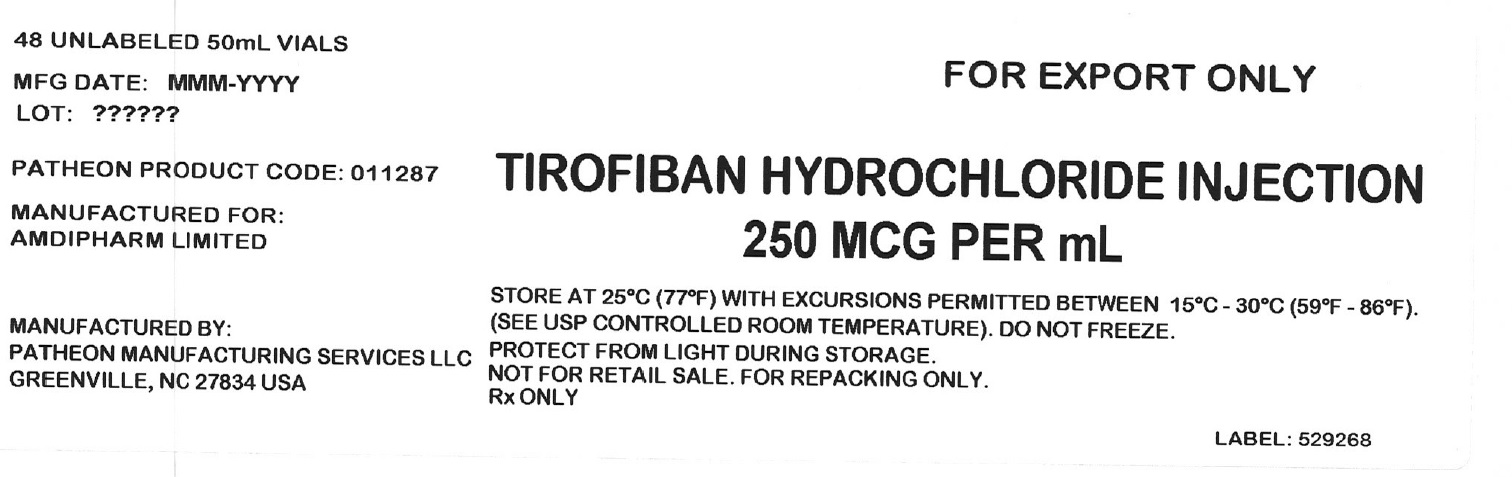
Tirofiban Hydrochloride .25 mg/mL Injection — NDC 82169-0025-50 package photo
Label image from the product's FDA listing (DailyMed) — may show a different pack size or an older label revision.

Tirofiban Hydrochloride .25 mg/mL Injection — NDC 82169-025-50 (Billing 82169-0025-50)

by Amdipharm Limited · 48 VIAL, GLASS in 1 CASE / 50 mL in 1 VIAL, GLASS

This is a package of Tirofiban Hydrochloride .25 mg/mL Injection from Amdipharm Limited, marketed since Jan 2022 and currently FDA-listed. It is this product's only package size.

NDC 82169-0025-50
🏷️ FDA NDC (as labeled) 82169-025-50 billing pads the product segment with a zero
On market Non-controlled ⇄ Compare with another NDC
🗂️ FDA directory synced Oct 1, 2026 · this listing last changed Oct 2, 2026 · sources: openFDA · FDA label (DailyMed) · FDA Orange & Purple Book · First Databank · CMS NADAC, ASP, Medicare & Medicaid · RxNorm
📋 All sources & update times →

Identity & classification

Regulatory identifiers FDA, NLM and CMS codes for this package

FDA NDC (as labeled) 82169-025-50
Product NDC 82169-025
11-digit billing NDC 82169002550
SPL Set ID 5cd35e38-b820-4309-ab72-b2111c769b4c
DEA schedule Non-controlled
Marketing category EXPORT ONLY
Marketing status On market
FDA listing status Listed (active directory)
Marketing start 2022-01-01
Dosage form INJECTION
Substance TIROFIBAN HYDROCHLORIDE
Why two NDCs? The FDA registers this code as 82169-025-50 — a 5-3-2 layout, and that's what's printed on the package and shown on DailyMed. For insurance claims, every NDC is standardized to a uniform 11-digit 5-4-2 format by adding a zero to the product segment → 82169-0025-50. Same drug, same package — only the format differs.
Where does this data come from?
Identifiers from the FDA openFDA NDC Directory and Structured Product Labeling; RxCUI from RxNorm (NLM); GPI from Medi-Span; GCN / HIC / AHFS / legend from First Databank.

Clinical

📗 Our plain-language guide HelloPharmacist
  • It lowers the chance of death, heart attack, or repeat heart problems in people with non-ST elevation acute coronary syndrome. It does this by keeping platelets from clumping into...
  • Only through an IV in a hospital setting. You get a quick starting dose and then a steady infusion for up to 18 hours. If your kidneys work less well, your team uses a lower rate.
  • Bleeding, often at the site where the catheter went in. Some people also have swelling, dizziness, leg or pelvic pain, sweating, or a slow heartbeat. Tell your nurse about anything...
  • Bleeding that won't stop, blood in urine or vomit, unusual bruising, or signs of a serious allergy like trouble breathing or swelling. Your team also checks your platelet counts wi...
📖 Read our full Tirofiban guide →
Where does this data come from?
Plain-language summary from MedlinePlus (U.S. National Library of Medicine); supplement & herbal interactions and nutrient depletion data from the Natural Medicines database; our full guide is HelloPharmacist editorial content.

Pricing

A drug doesn't have one price. Each row is a different public payment system, and none is what you'd pay at the counter — that depends on your insurance. The ⓘ on each row explains what it measures.

Price systemPer eachPer package
Retail pharmacies payNADAC · weekly Not in the retail survey — common for institutional, discontinued, or low-volume packs.
Medicaid paysCMS SDUD · 12 mo No recent Medicaid claims on file for this NDC — rare and low-volume NDCs are suppressed in the public data.
Medicare drug plans payPart D · quarterly No Part D plan price is available for this NDC in our data.
ℹ️
No price is published for this exact package yet. CMS surveys NADAC per package size, so a different pack of the same drug often has one.
Where does this data come from?
NADAC (National Average Drug Acquisition Cost) is the CMS weekly pharmacy-acquisition-cost survey — what pharmacies pay. ASP (Average Sales Price) is the CMS Medicare Part B drug-payment file, published quarterly. Medicaid pays is computed by us from CMS State Drug Utilization Data (total reimbursed ÷ units, trailing 12 months) — gross of rebates and inclusive of dispensing fees, so it reflects what Medicaid paid, not an acquisition cost. Medicare drug plans pay is the median negotiated point-of-sale unit cost across plans listing this NDC in the CMS quarterly Prescription Drug Plan pricing files, before rebates. The VA pays is the federal contract price (FSS, and the statutory Big 4 ceiling where listed) from the VA National Acquisition Center pharmaceutical price file. All are free public government data; each measures a different payer, so the figures are not directly comparable.

Packaging — all sizes for this product

Package NDCDescription Marketing startMarketing endStatus
82169-0025-50 You're viewing this Main listing 48 VIAL, GLASS in 1 CASE / 50 mL in 1 VIAL, GLASS — — Active

Therapeutic equivalents

ProductLabelerPackNADAC/unitTEStatusPrice vs. this
Tirofiban Hydrochloride .25 mg/mLthis 82169-0025-50 Amdipharm 48 vials — — FDA listed —
About this product: other versions of the same ingredient, strength and form are listed above, least expensive first, with FDA equivalence ratings where available.
Where does this data come from?
Equivalents are other NDCs of the same ingredient, form and route from the openFDA NDC Directory, ranked least-expensive-first by NADAC. Therapeutic-equivalence (AB) ratings come from the FDA Orange Book; biologics use the FDA Purple Book for biosimilar & interchangeable status.

Availability & generic status

🏛️
2022
On the market since
Jan 2022
📍
2026
Currently FDA-listed
4 years listed
🔒
·
Generic approved (availability unconfirmed)
see note
🔒Generic approved by FDA, but pharmacy availability is not confirmed

The FDA lists approved generic versions of this medicine, but that does not always mean a pharmacy can get one today. Patent rules, launch agreements, supply and pricing can affect when generics actually arrive.

Where does this data come from?
Patents and exclusivity from the FDA Orange Book (small-molecule drugs), refreshed from public FDA data. Generic launch timing is an estimate, not a guarantee.

Inactive Ingredients / Excipients

Inactive ingredients, also called excipients, are components of the drug product other than the active ingredient. They may include fillers, dyes, coatings, preservatives, flavors, or other formulation ingredients.

💡 Tap an ingredient (hover on desktop) to see what it is and why it’s used.

  • UNII XF417D3PSL
    Anhydrous citric acid is a sour, crystalline powder derived from citric acid with water removed. In medicines, it acts as a buffer to control pH, adds tartness to improve taste, and helps tablets disintegrate.
  • UNII 451W47IQ8X
    Sodium chloride is common table salt. It's used in medicines as a buffer to maintain proper pH, as a filler to add bulk, or to adjust the osmotic balance in liquid formulations.
  • UNII B22547B95K
    A salt derived from citric acid that helps maintain the proper acid-base balance in the medicine. It's used as a buffer to keep the product stable and at the right pH level.
  • UNII 059QF0KO0R
    Water is a liquid solvent that dissolves and mixes ingredients together in liquid medicines, syrups, and injections. It helps distribute the active drug evenly throughout the product.

4 inactive ingredients listed in the exact product block matched to this NDC.

Where does this data come from?
Data sourced from official FDA Structured Product Labeling (SPL) via DailyMed — ingredient classCode="IACT" elements from the exact product block matched by this NDC. Label-section narrative from DailyMed / the openFDA label index is shown separately when available.

Inactive ingredient FAQ

Are inactive ingredients the same for every manufacturer?
No. Inactive ingredients can differ by manufacturer, dosage form, strength, and package / product version.
Why might an inactive ingredient be missing?
Some SPLs do not provide a complete structured inactive-ingredient list, and older or unusual labels may only include the information in narrative text.
Can inactive ingredients matter?
Yes. They can matter for allergies, intolerances, dyes, gluten / lactose concerns, preservatives, and formulation differences — but confirm with a pharmacist or the manufacturer when it’s clinically important.

Manufacturer & labeler

LabelerAmdipharm Limited
Labeler code82169
First marketedJan 2022
Product typeBulk Ingredient
The labeler markets the product; the application holder owns the FDA approval. They’re often the same company but can differ (e.g. a repackager or an authorized generic). A mailing address / phone appears here when the manufacturer includes it in the product’s FDA label (not all do).
Where does this data come from?
Labeler, application holder and registered establishment from the FDA openFDA NDC Directory and Drugs@FDA; address/contact from the product’s FDA label.

Full FDA label FDA SPL

The complete FDA label for this product, verbatim, section by section. Jump with a chip, search within the label, or expand everything.
📄 FDA label 19 words ▾

No FDA label is on file for this product yet. Labels load from openFDA / DailyMed and refresh weekly.

Source: FDA Structured Product Labeling, mirrored from DailyMed / openFDA. Prefer the government’s original formatting? View this label on DailyMed ↗

Reported adverse events (FAERS)

Read carefully: FAERS reports are voluntary and unverified. Counts are not incidence, do not establish causation, are subject to reporting bias, and cannot be used to compare one drug to another. Shown for signal context only. Reports for Tirofiban Hydrochloride — the ingredient across all brands.

Top reported reactions

Thrombocytopenia17
Cerebral Haemorrhage15
Nausea8
Platelet Count Decreased8
Brain Herniation6
Gingival Bleeding6
Haematemesis6

Age at onset

Adult19
Elderly21

Reporter sex

132 reports
Male · 70%
Female · 28%
Unknown · 2%

Serious outcomes

Hospitalization54
Life-threatening28
Reports over time (by year) — tap or hover for the count & year
2019 2021 2023 2026 16 5
Most recent year is provisional (FAERS lags ~3 months).
Where does this data come from?
Adverse-event reports from the FDA Adverse Event Reporting System (FAERS) via openFDA. FAERS reports are voluntary and unverified — counts are not incidence and don’t establish causation.

About this NDC listing & data coverage

Bulk ingredient (not a finished retail product)

This is a bulk ingredient listing — not a retail prescription package

Tirofiban Hydrochloride .25 mg/mL INJECTION is listed with FDA as a bulk ingredient (a drug substance supplied for further manufacturing or licensed pharmacy compounding). It is not a finished product a patient would receive at a retail pharmacy, so consumer-style information — a patient label, retail pricing, package photos — generally does not exist for this NDC. The listing identifies the substance and package for supply-chain and regulatory purposes.

What data is (and isn’t) available for this NDC — tap to expand
NDC identity (package / product / labeler codes) ✓ Available
Labeler ✓ Available
Product & package description ✓ Available
Marketing category & status ✓ Available
Active ingredient / dosage form / route ✓ Available
FDA label (SPL via DailyMed) ✓ Available
Package photos ✓ Available
Inactive ingredients (structured) ✓ Available
NADAC pharmacy acquisition price (CMS) — Not published for this NDC CMS publishes NADAC only for NDCs reported in its retail-pharmacy survey.
Orange Book / therapeutic-equivalence data — Not published for this NDC Applies only to products approved under an NDA/ANDA; many listings are out of scope.
HCPCS J-code billing crosswalk — Not published for this NDC Most self-administered / retail products have no J-code — that is normal.
Medicaid utilization (CMS SDUD) — Not published for this NDC CMS reports utilization only for NDCs with Medicaid claims above its privacy threshold.
“Not published” reflects what the public FDA / CMS / NLM sources provide for this exact package code — it is a property of the data feeds, not a judgment about the product.

Questions about this listing

Is this NDC FDA-approved?
An NDC listing does not by itself establish FDA approval — the NDC Directory records that a product is listed with FDA, not that it was reviewed and approved. This listing's marketing category is "Export Only". Products approved under an application carry an NDA, ANDA, or BLA number.
Why is there no price listed?
The pricing shown on our NDC pages comes from CMS NADAC, a voluntary survey of retail community pharmacy invoices. CMS does not publish a NADAC for every NDC — packages outside the retail survey (institutional and hospital products, bulk packages, discontinued items, and many OTC items) may never receive one. A missing price reflects the survey's scope, not this product's actual cost, and does not mean the product is free or unavailable.
Can I get this product filled at a pharmacy?
Not as listed here. A bulk ingredient NDC identifies drug substance supplied for manufacturing or licensed compounding — it is not a finished, dispensable package. A pharmacy prescription would involve a finished product with its own NDC.
Is the NDC printed on the package the same as the 11-digit billing NDC?
Yes, they identify this exact package in different formats. The form printed on the packaging and shown on DailyMed is the one the FDA registered. Insurance claims use a fixed 11-digit 5-4-2 format, so the short segment is padded with a leading zero and the dashes are dropped. The Identity section at the top of this page lists each form of this code.
Is this package still being marketed?
Yes, per the latest FDA NDC Directory data on this page: this package is listed as actively marketed, with no marketing end date reported by Amdipharm Limited. Listing status can change — the directory data on this page refreshes weekly.
Who lists this product with the FDA?
Amdipharm Limited is the labeler of record for this NDC — the company under whose FDA-assigned code the package is listed. The labeler may be the manufacturer itself or a distributor marketing the product under its own code.
This page identifies an FDA-listed package (the NDC) and reports public regulatory and pricing data about the listing. It is reference information, not a medical recommendation — talk to your pharmacist or prescriber about your own medication.
Where does this data come from?
Listing facts (marketing category, packager status, marketing dates) from the FDA openFDA NDC Directory; label availability from DailyMed; pricing coverage from CMS NADAC; equivalence scope from the FDA Orange Book.
For educational and professional reference only — not medical advice. Pricing reflects published NADAC and CMS ASP (free public data) and may differ from your acquisition cost; always verify before billing or dispensing.