
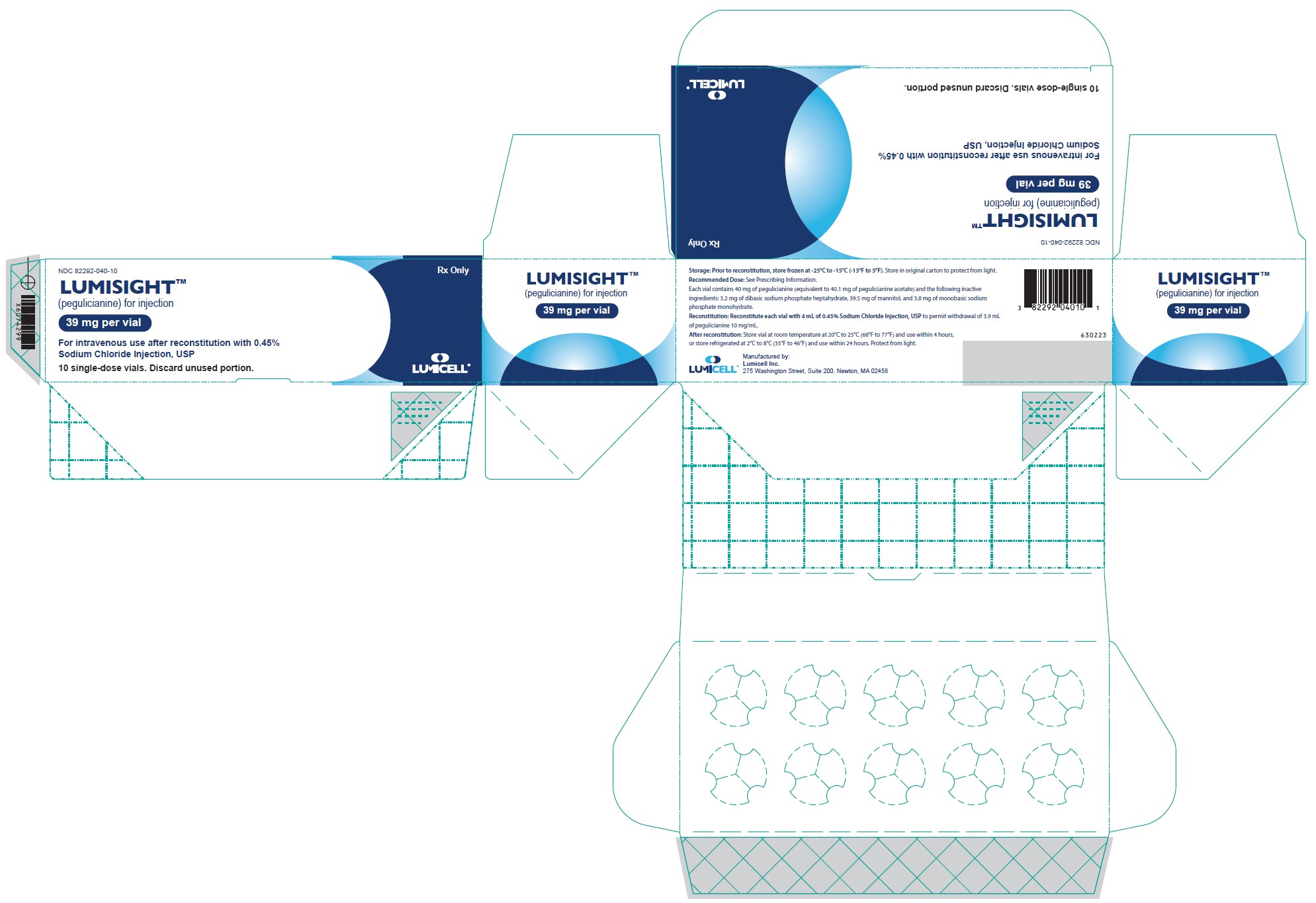
LUMISIGHT Pegulicianine 10 mg/mL Injection, Powder, Lyophilized, For Solution, 10 vials — NDC 82292-040-10 (Billing 82292-0040-10)
This is a package of 10 vials of LUMISIGHT Pegulicianine 10 mg/mL Injection, Powder, Lyophilized, For Solution from Lumicell, Inc., marketed since Apr 2024 and currently FDA-listed. It is this product's only package size.
NDC database record
One package, one record: these facts belong to NDC 82292-040-10 alone.
- Record
- FDA NDC Directory package listing · Human prescription drug
- Code segments
- 82292 labeler · 040 product · 10 package
- Package marketed since
- Apr 17, 2024
- Sample package
- No — commercial package
- Listing certified through
- Dec 31, 2027
- Billing quantity
- 10 EA per package
- Barcode (UPC-A, from the NDC)
- 3 8229204010 1
- FDA record last changed
- Jul 24, 2026
Identity & classification
Regulatory identifiers FDA, NLM and CMS codes for this package
Drug-database identifiers Medi-Span GPI and First Databank GCN / HICL / AHFS classification
- GSN (GCN sequence number): 085979
- GCN: 55596
- HICL (First Databank): 049530
- AHFS class code: 36:68.00.00
Where does this data come from?
- FDA openFDA NDC Directory · synced Oct 8, 2026
- FDA label on DailyMed · label index refreshed Oct 8, 2026
- RxNorm (NLM RxNav) · catalog refreshed Oct 1, 2026
- Medi-Span GPI (licensed)
- First Databank (licensed) · refreshed Oct 8, 2026
Clinical
Patient education
Supplement & herbal interactions
Where does this data come from?
- MedlinePlus (NLM) · refreshed Oct 8, 2026
- FDA label on DailyMed · label index refreshed Oct 8, 2026
Ask a licensed pharmacist directly — free, answered by our team.
Pricing
A drug doesn't have one price. Each row is a different public payment system, and none is what you'd pay at the counter — that depends on your insurance. The ⓘ on each row explains what it measures.
| Price system | Per mL | Per package |
|---|---|---|
| Retail pharmacies payNADAC · weekly | Not in the retail survey — common for institutional, discontinued, or low-volume packs. | |
| Medicaid paysCMS SDUD · 12 mo | No recent Medicaid claims on file for this NDC — rare and low-volume NDCs are suppressed in the public data. | |
| Medicare drug plans payPart D · quarterly | No Part D plan price is available for this NDC in our data. | |
Where does this data come from?
- CMS NADAC weekly file
- CMS ASP pricing files · refreshed Sep 20, 2026
- CMS Medicaid State Drug Utilization Data · refreshed Oct 8, 2026
- CMS Part D plan pricing files · refreshed Sep 24, 2026
- VA National Acquisition Center price file
Packaging — all sizes for this product
| Package NDC | Description | Marketing start | Marketing end | Status |
|---|---|---|---|---|
| 82292-0040-10 You're viewing this Main listing | 10 VIAL in 1 CARTON / 3.9 mL in 1 VIAL | 2024-04-17 | — | Active |
Therapeutic equivalents
| Product | Labeler | Pack | NADAC/unit | TE | Status | Price vs. this |
|---|---|---|---|---|---|---|
| Lumisight 10 mg/mLthis 82292-0040-10 | Lumicell, | 10 vials | — | — | FDA listed | — |
Where does this data come from?
- FDA openFDA NDC Directory · synced Oct 8, 2026
- FDA Orange Book · refreshed Oct 3, 2026
- CMS NADAC weekly file
Availability & generic status
We did not find an FDA-approved generic match for this exact strength, form and route. Patent/protection dates below may affect future generic timing.
Why the date isn’t exact: Generic timing can change because patents may be challenged, settled, licensed, added, removed, or worked around with a narrower label — and FDA approval does not always mean a pharmacy can get the generic today.
🛈 What do these terms mean?
- Patent
- Legal protection listed in the Orange Book that may delay generic approval or launch. Issued by the U.S. Patent & Trademark Office.
- Substance patent
- Covers the active drug molecule itself — the hardest to design around. A generic generally can’t launch until it expires.
- Formulation (product) patent
- Covers a specific formulation or dosage form. A generic can sometimes work around it with a different formulation.
- Method-of-use patent
- A patent covering one specific approved use of the drug — not necessarily the whole molecule. A generic can sometimes launch with a “skinny label” that carves out the protected use and keeps the others.
- Skinny label
- A generic label that omits a still-patented use when the FDA allows it — letting a generic reach the market for the unprotected uses.
- Exclusivity
- FDA-granted marketing protection, separate from patents — e.g. 5-yr new chemical entity, 7-yr orphan drug, or a +6-month pediatric extension.
- Paragraph IV
- A generic applicant’s formal challenge to a listed patent. It can potentially lead to earlier generic entry, but often involves litigation or a settlement.
- RLD / RS
- Reference Listed Drug — the brand product the FDA uses as the reference for generic applications. Reference Standard — the product the FDA expects generics to compare against in bioequivalence testing.
- TE / AB rating
- FDA therapeutic-equivalence rating. An AB rating generally means the FDA considers a generic therapeutically equivalent to — and substitutable for — the brand.
- LOE (loss of exclusivity)
- The latest patent or exclusivity currently listed — the loss-of-exclusivity / latest-listed-protection date shown on this page. Paragraph-IV challenges and settlements can move the real date earlier; FDA approval and a manufacturer’s decision to market can move it later.
Built from the FDA Orange Book. The bars above are scaled to each protection’s expiry; the red LOE marker is the last one to lapse.
| Patent | Type | Use code | Expires |
|---|---|---|---|
| US 10285759 ↗ | Method of use | U-3890 | Dec 8, 2031 |
| US 9763577 ↗ | Drug substance | U-3890 | Sep 14, 2034 |
| US 9532835 ↗ | Method of use | U-3890 | Dec 8, 2031 |
| US 9155471 ↗ | Method of use | U-3890 | Oct 12, 2031 |
| US 9032965 ↗ | Method of use | U-3890 | Dec 8, 2031 |
| US 11592396 ↗ | Drug substance | — | Sep 1, 2030 |
| Code | What it grants | Expires |
|---|---|---|
| NCE | New Chemical Entity (5-year) | Apr 17, 2029 |
Is there a generic version of LUMISIGHT 39 MG VIAL?
The FDA approved a generic — why can’t I get it at my pharmacy yet?
Why do different websites show different generic release dates?
What does “FDA listed” mean?
What does a patent or protection date mean here?
What does “current Orange Book estimate” mean?
Can a generic come out before the last patent expires?
Can a generic come out after the listed dates?
What is the difference between patents and exclusivity?
Why are there multiple patent dates?
Where does this data come from?
- FDA Orange Book · refreshed Oct 3, 2026
Inactive Ingredients / Excipients
Inactive ingredients, also called excipients, are components of the drug product other than the active ingredient. They may include fillers, dyes, coatings, preservatives, flavors, or other formulation ingredients.
💡 Tap an ingredient (hover on desktop) to see what it is and why it’s used.
-
UNII 3OWL53L36A
A natural sugar alcohol derived from seaweed or synthesized in the lab. It's used as a filler to add bulk, a sweetener in sugar-free formulas, and a disintegrant to help tablets break apart in the stomach.
-
UNII 70WT22SF4B
A mineral salt that acts as a buffer to maintain the pH balance of the medication. It helps stabilize the drug's potency and prevents unwanted chemical changes during storage.
-
UNII 593YOG76RN
A salt made from sodium and phosphate that helps regulate acidity and maintain proper pH balance in the medicine. It also acts as a buffer to keep the product stable.
3 inactive ingredients listed in the exact product block matched to this NDC.
Where does this data come from?
ingredient classCode="IACT" elements from the exact product block matched by this NDC. Label-section narrative from DailyMed / the openFDA label index is shown separately when available.- FDA label on DailyMed · label index refreshed Oct 8, 2026
- FDA openFDA NDC Directory · synced Oct 8, 2026
Inactive ingredient FAQ
Are inactive ingredients the same for every manufacturer?
Why might an inactive ingredient be missing?
Can inactive ingredients matter?
Manufacturer & labeler
Where does this data come from?
- FDA openFDA NDC Directory · synced Oct 8, 2026
- Drugs@FDA
Full prescribing information FDA SPL
🚨 Boxed Warning ▾
WARNING: ANAPHYLAXIS AND OTHER SERIOUS HYPERSENSITIVITY REACTIONS Serious hypersensitivity reactions, including anaphylaxis, can occur during or following administration of LUMISIGHT. Anaphylaxis occurred in 4/726 (0.6%) of patients in clinical studies. Signs and symptoms associated with other hypersensitivity reactions included pruritus, urticaria, hypotension, lip swelling, erythema, anxiety, chest pain, cyanosis, dizziness, dyspnea, headache, hypoesthesia, hyperventilation, maculopapular rash, nausea, paresthesia, visual changes, and vomiting.
Before LUMISIGHT administration, assess all patients for any history of hypersensitivity reaction to contrast media or products containing polyethylene glycol (PEG). Always have emergency resuscitation drugs, equipment, and trained personnel promptly available. Monitor all patients for hypersensitivity reactions.
If a hypersensitivity reaction is suspected, immediately discontinue the injection and initiate appropriate therapy. LUMISIGHT is contraindicated in patients with a history of hypersensitivity reactions to pegulicianine [see Warning and Precautions (5.1) ] . WARNING: ANAPHYLAXIS AND OTHER SERIOUS HYPERSENSITIVITY REACTIONS See full prescribing information for complete boxed warning.
Serious hypersensitivity reactions, including anaphylaxis, can occur during or following administration. Anaphylaxis has occurred in 4/726 (0.6%) of patients in clinical studies. Before LUMISIGHT administration, assess all patients for any history of hypersensitivity reaction to contrast media or products containing polyethylene glycol (PEG).
Always have emergency resuscitation drugs, equipment, and trained personnel available. Monitor all patients for hypersensitivity reactions. If a hypersensitivity reaction is suspected, immediately discontinue the injection and initiate appropriate therapy.
( 5.1 ).
🎯 Indications and Usage ▾
1 INDICATIONS AND USAGE LUMISIGHT is indicated for fluorescence imaging in adults with breast cancer as an adjunct for the intraoperative detection of cancerous tissue within the resection cavity following removal of the primary specimen during lumpectomy surgery. LUMISIGHT is an optical imaging agent indicated for fluorescence imaging in adults with breast cancer as an adjunct for the intraoperative detection of cancerous tissue within the resection cavity following removal of the primary specimen during lumpectomy surgery.
( 1 )
⏱️ Dosage and Administration ▾
2 DOSAGE AND ADMINISTRATION Recommended dose of LUMISIGHT is 1 mg/kg by intravenous injection over 3 minutes administered 2 hours to 6 hours prior to imaging. ( 2.1 ) See Full Prescribing Information for instructions on preparation, administration, and imaging. ( 2.2 , 2.3 , 2.4 )
2.1Recommended Dose The recommended dose of LUMISIGHT is 1 mg/kg actual body weight by intravenous injection over 3 minutes administered 2 hours to 6 hours prior to imaging.
2.2Preparation of LUMISIGHT Important Preparation Information Prior to reconstitution, store vials in the freezer at -25°C to -15°C (-13°F to 5°F). Protect from light. Use aseptic technique for the preparation of LUMISIGHT.
The recommended dose depends on the individual patient’s weight. Multiple vials of LUMISIGHT may need to be reconstituted to achieve the individual patient dose. Only use 0.45% Sodium Chloride Injection, USP for reconstitution of LUMISIGHT to prevent high osmolality.
Preparation Instructions Calculate the dose (1 mg/kg) and the total volume (mL) of LUMISIGHT based on the individual patient’s weight. Obtain the number of vials required to administer the patient dose. Allow the vials to acclimate to room temperature between 20°C to 25°C (68°F to 77°F) for approximately 5 minutes.
Reconstitute each vial of LUMISIGHT with 4 mL of 0.45% Sodium Chloride Injection, USP to permit withdrawal of 3.9 mL of LUMISIGHT 10 mg/mL. Visually inspect the reconstituted solution. It should be a clear, dark blue-colored solution free of particulate matter.
Discard if there is any discoloration or particulate matter. If not immediately used, store the reconstituted LUMISIGHT vial at room temperature at 20°C to 25°C (68°F to 77°F) and use within 4 hours, or store the reconstituted LUMISIGHT vial in the refrigerator at 2°C to 8°C (35°F to 46°F) and use within 24 hours. Protect from light.
Each vial of LUMISIGHT is for a single dose. Discard unused portion.
2.3Administration Withdraw the calculated volume from the appropriate number of vials into one syringe for administration of one single dose of 1 mg/kg. Verify that the syringe contains the intended volume. Prior to administration of LUMISIGHT, flush the peripheral intravenous (IV) line with 10 mL to 20 mL of 0.9% Sodium Chloride Injection, USP.
Administer LUMISIGHT as an IV injection over 3 minutes beginning 2 hours to 6 hours prior to imaging with the Lumicell DVS. After administration of LUMISIGHT, flush the IV line with 10 mL to 20 mL of 0.9% Sodium Chloride Injection, USP.
2.4Imaging LUMISIGHT is used with the Lumicell Direct Visualization System (DVS) or other fluorescence imaging device that is FDA-approved for specific use with pegulicianine in the indicated population. The device provides illumination to excite the fluorescent components of pegulicianine and collects images showing pegulicianine’s fluorescence emission. Regions suspected to contain cancerous tissue are highlighted as positive signals on the Lumicell DVS display [see Clinical Studies ( 14 )] .
Training on the use of the device is essential prior to employing the system in a lumpectomy procedure. Please refer to the device labeling for details on how to use the device and for training information.
💊 Dosage Forms and Strengths ▾
3 DOSAGE FORMS AND STRENGTHS For injection: dark blue lyophilized powder in a single-dose vial delivering 39 mg pegulicianine after reconstitution. For injection: lyophilized powder in a single-dose vial delivering 39 mg of pegulicianine after reconstitution. ( 3 )
⛔ Contraindications ▾
4 CONTRAINDICATIONS LUMISIGHT is contraindicated in patients with a history of hypersensitivity reaction to pegulicianine. Reactions have included anaphylaxis [see Warning and Precautions (5.1) ] . History of hypersensitivity reaction to pegulicianine. ( 4 )
⚠️ Warnings and Cautions ▾
5 WARNINGS AND PRECAUTIONS Risk of Misdiagnosis : Absence of signal in the surgical field does not rule out the presence of cancer. Positive signal may be seen in non-cancerous tissue. ( 5.2 ) Interference from Dyes Used for Sentinel Lymph Node Mapping : Avoid administration of dyes before imaging the lumpectomy cavity in patients receiving LUMISIGHT. ( 5.3 , 7 )
5.1Anaphylaxis and Other Serious Hypersensitivity Reactions Prepare for the possibility of drug hypersensitivity reactions (including anaphylaxis), which can occur during or following administration, and take the necessary precautions. In clinical studies, 4 of 726 (0.6%) patients treated with LUMISIGHT experienced signs and symptoms consistent with anaphylaxis. The onset was during administration in three patients.
Signs and symptoms associated with other hypersensitivity reactions included pruritus, urticaria, hypotension, lip swelling, erythema, anxiety, chest pain, cyanosis, dizziness, dyspnea, headache, hypoesthesia, hyperventilation, maculopapular rash, nausea, paresthesia, visual changes, and vomiting [see Adverse Reactions ( 6.1 )]. Before LUMISIGHT administration, assess all patients for any history of hypersensitivity reaction to contrast media or products containing polyethylene glycol (PEG), as these patients may have an increased risk for hypersensitivity reaction to LUMISIGHT.
In clinical studies, three out of four patients that experienced anaphylaxis did not have a history of hypersensitivity reaction to contrast media or products containing PEG. Always have emergency resuscitation drugs, equipment, and trained personnel available. Monitor all patients for hypersensitivity reactions through symptom reporting, direct observation, and vital sign measurements.
If a hypersensitivity reaction is suspected, immediately discontinue the injection and initiate appropriate therapy. LUMISIGHT is contraindicated in patients with a history of hypersensitivity reaction to pegulicianine [see Contraindications ( 4 )] .
5.2Risk of Misdiagnosis False positive and false negative findings may occur during use of LUMISIGHT to detect residual cancer. Absence of signal in the lumpectomy cavity does not rule out the presence of residual cancer. Additionally, positive signal has been observed in some non-cancerous tissue [see Clinical Studies ( 14 )].
5.3Interference from Dyes Used for Sentinel Lymph Node Mapping Blue dyes used for sentinel lymph node (SLN) mapping procedures interfere with LUMISIGHT imaging. The potential of other dyes to interfere with LUMISIGHT imaging has not been evaluated. Avoid administration of dyes used for SLN mapping procedures before imaging the lumpectomy cavity in patients receiving LUMISIGHT [see Drug Interactions ( 7 )].
🤒 Adverse Reactions ▾
6 ADVERSE REACTIONS The following clinically important adverse reactions are described elsewhere in the labeling: Anaphylaxis and Other Serious Hypersensitivity Reactions [see Warnings and Precautions ( 5.1 )] Most common adverse reactions (≥1%) were hypersensitivity and chromaturia. ( 6.1 ) To report SUSPECTED ADVERSE REACTIONS, contact Lumicell at 1-833-458-6387 or FDA at 1-800-FDA-1088 or www.fda.gov/medwatch.
6.1Clinical Trials Experience Because clinical trials are conducted under widely varying conditions, adverse reaction rates observed in the clinical trials of a drug cannot be directly compared to rates in the clinical trials of another drug and may not reflect the rates observed in practice. The safety of LUMISIGHT was evaluated in 726 patients who received a single dose of 1 mg/kg of LUMISIGHT. Among these 726 patients, 703 (97%) had breast cancer and 23 (3%) had other types of cancer.
The mean age of the patients was 62 years (range: 36 years to 95 years), and 98% of them were female. Distribution by race was 82% White, 7% Black or African American, 6% Asian, and 5% other or unreported. Distribution by ethnicity was 3% Hispanic/Latino, 93% non-Hispanic/Latino, and 4% unknown or unreported.
Adverse reactions occurring in ≥ 1% of patients receiving LUMISIGHT were hypersensitivity (1.4%, including anaphylaxis [4 out of 726]) and chromaturia (85%). Chromaturia resolved within 48 hours after administration in 93% of patients, with the longest time to resolution of 15 days. Adverse reactions occurring in use < 1% of patients were skin discoloration after extravasation, nausea, dyspnea, pyrexia, and vomiting.
🔄 Drug Interactions ▾
7 DRUG INTERACTIONS Blue dyes used for SLN mapping procedures generate a fluorescent signal that interferes with the signal from LUMISIGHT when injected into the breast prior to imaging with LUMISIGHT. The potential of other dyes to interfere with LUMISIGHT imaging has not been evaluated. Avoid administration of dyes used for SLN mapping procedure before imaging the lumpectomy cavity in patients receiving LUMISIGHT.
👥 Use in Specific Populations ▾
8 USE IN SPECIFIC POPULATIONS
8.1Pregnancy Risk Summary There are no available data on pegulicianine use in pregnant women to evaluate for a drug associated risk of major birth defects, miscarriage, or other adverse maternal or fetal outcomes. Animal reproduction studies were not conducted with pegulicianine. The background risk of major birth defects and miscarriage for the indicated population is unknown.
All pregnancies have a background risk of birth defect, loss, or other adverse outcomes. In the U.S. general population, the estimated background risk of major birth defects and miscarriage in clinically recognized pregnancies is 2% to 4% and 15% to 20%, respectively.
8.2Lactation Risk Summary There are no data on the presence of pegulicianine or its metabolites in either human or animal milk, the effects on the breastfed infant, or the effects on milk production. The developmental and health benefits of breastfeeding should be considered along with the mother’s clinical need for LUMISIGHT and any potential adverse effects on the breastfed infant from LUMISIGHT or from the underlying maternal condition.
8.4Pediatric Use Safety and effectiveness of LUMISIGHT in pediatric patients have not been established.
8.5Geriatric Use Of 703 patients in clinical studies of LUMISIGHT for breast cancer who received the recommended dose of 1 mg/kg, 44% were 65 years of age and over, while 8% were 75 and over. No overall differences in safety or effectiveness have been observed between these patients and younger adult patients.
🧬 Clinical Pharmacology ▾
12 CLINICAL PHARMACOLOGY
12.1Mechanism of Action Pegulicianine is a prodrug that is optically inactive when intact and produces a fluorescent signal after its peptide chain is cleaved by cathepsins and matrix metalloproteases (MMPs). The levels of these enzymes are higher in and around tumor and tumor-associated cells than normal cells. This enzymatic cleavage results in “fragment 2” and “fragment 3”, which are optically active metabolites that emit fluorescence, as well as “fragment 1” containing the fluorescence quencher that keeps the intact molecule optically inactive. “Fragment 2” and “fragment 3” absorb light in the visible light region with a peak absorption at 650 nm and fluoresce with a peak emission at 675 nm.
12.2Pharmacodynamics The relationships between the plasma concentrations of the optically active metabolites and the time course of pharmacodynamic response have not been fully characterized.
12.3Pharmacokinetics Elimination Metabolism Pegulicianine is cleaved by cathepsins and matrix metalloproteases to the active metabolites “fragment 2” and “fragment 3.” Pegulicianine undergoes minimal hepatic metabolism in vitro. Excretion Pegulicianine excretion pathway in humans is unknown. Observed blue/green discoloration of urine (chromaturia) in subjects receiving pegulicianine suggests that pegulicianine and/or its metabolites may be excreted renally.
Specific Populations Patients with Renal Impairment Mild renal impairment (RI) does not appear to have a clinically meaningful effect on the pharmacokinetics, safety, and efficacy of pegulicianine and fragment 3; fragment 2 data are not available. The effect of moderate or severe RI on the pharmacokinetics, safety, and efficacy of pegulicianine, fragment 2, and fragment 3 has not been evaluated.
📦 How Supplied / Storage and Handling ▾
16 HOW SUPPLIED/STORAGE AND HANDLING How supplied LUMISIGHT (pegulicianine) for injection is supplied as a dark blue lyophilized powder for reconstitution in a clear, glass single-dose vial in cartons of 10 vials (NDC 82292-040-10). After reconstitution, each vial delivers 39 mg pegulicianine. Storage and Handling Store vials of LUMISIGHT frozen at -25°C to -15°C (-13°F to 5°F) in the original carton to protect from light.
📋 Description ▾
11 DESCRIPTION LUMISIGHT (pegulicianine for injection) is an optical imaging agent for intravenous use. The chemical name of pegulicianine acetate is N-[6-(1-{2-[3,6-bis(2,3-dihydro-1H-indol-1-yl)xanthylium-9-yl]benzene-1-sulfonyl}piperidine-4-carboxamido)hexanoyl]glycylglycyl-L-arginyl-N6-(6-{2-[(1E,3E,5Z)-5-(1-ethyl-3,3-dimethyl-5-sulfonato-1,3-dihydro-2H-indol-2-ylidene)penta-1,3-dien-1-yl]-3,3-dimethyl-5-sulfonato-3H-indol-1-ium-1-yl}hexanoyl)-Llysyl-[2-(2-aminoethoxy)ethoxy]acetyl-S-[(3RS)-1-{6-[α-methylpoly(oxyethylene)-ω-amino]-6-oxohexyl}-2,5-dioxopyrrolidin-3-yl]-L-cysteinamide acetate with a molecular formula of C 116 H 147 N 19 O 23 S 4 (C 2 H 4 O) n , with n of approximately 450, a molecular weight of 20-25 kDa, and the following structural formula: Figure 1: Molecular structure of pegulicianine acetate LUMISIGHT is supplied as a sterile, dark blue lyophilized powder.
Each vial contains 40 mg of pegulicianine (equivalent to 40.1 mg of pegulicianine acetate) and the following inactive ingredients: 3.2 mg of dibasic sodium phosphate heptahydrate, 39.5 mg of mannitol, and 3.8 mg of monobasic sodium phosphate monohydrate to permit withdrawal of 3.9 mL of pegulicianine 10 mg/mL upon reconstitution with 4 mL of 0.45% sodium chloride injection, USP. The pH of the reconstituted solution is 6 to 7. image description
💬 Information for Patients ▾
17 PATIENT COUNSELING INFORMATION Anaphylaxis and Other Serious Hypersensitivity Reactions Inform patients of the risk of hypersensitivity reactions, including anaphylaxis, and instruct them to alert healthcare providers immediately if they experience signs and symptoms of a hypersensitivity reaction [see Warnings and Precautions ( 5.1 )]. Urine Discoloration Inform patients that LUMISIGHT may cause blue discoloration of the urine that in most cases will resolve within 48 hours [see Adverse Reactions ( 6.1 )]. Skin Discoloration After Extravasation Inform patients that if extravasation occurs, it may result in blue discoloration of the skin at the injection site that will be evident for several weeks [see Adverse Reactions ( 6.1 )].
🔬 Clinical Studies ▾
14 CLINICAL STUDIES The efficacy and safety of LUMISIGHT for the intraoperative detection of cancerous tissue within the resection cavity following removal of the primary specimen during lumpectomy surgery in patients with breast cancer were evaluated in a randomized, multicenter, intra-patient controlled clinical trial NCT03686215. A total of 406 adult patients with confirmed invasive breast cancer, ductal carcinoma in situ (DCIS), or both received 1 mg/kg LUMISIGHT by intravenous injection 2 hours to 6 hours prior to imaging with the Lumicell DVS.
Among them, 357 patients underwent LUMISIGHT-guided imaging after completion of the standard of care lumpectomy procedure. Patients who received neoadjuvant chemotherapy or radiotherapy prior to surgery were excluded from study. After the standard of care (SOC) lumpectomy was completed, the lumpectomy cavity was divided into six regions based on anatomic orientation and each region was imaged with the Lumicell DVS.
When positive fluorescence signal was detected, the tissue was resected with a cavity shave procedure and the region was re-imaged. A maximum of two LUMISIGHT-guided shaves were obtained from a single region. Histopathology analysis of excised tissue served as the reference standard.
Cavity regions that did not have a LUMISIGHT-guided cavity shave or tissue from a second surgery for a reference standard were assigned the margin status of the corresponding outermost surface of the lumpectomy specimen or SOC cavity shave, with a positive margin defined as tumor on ink for invasive cancers (with or without DCIS) or within 2 mm of the inked margin for DCIS alone. The mean age of patients was 62 years (range: 36 years to 83 years). Distribution by race was 82% White, 7% Black or African American, 6% Asian, and 5% other.
Distribution by ethnicity was 3% Hispanic/Latino, 94% non-Hispanic/Latino, and 3% unknown or unreported. In the study group, 70% of patients had invasive ductal carcinoma (with or without DCIS), 20% had DCIS only, 10% had invasive lobular carcinoma (with or without DCIS), and <1% had both invasive ductal and invasive lobular carcinoma. The study assessed the proportion of patients receiving LUMISIGHT who had residual cancer detected and removed using the Lumicell DVS after completion of SOC lumpectomy.
One hundred and sixty-six (166) of 357 (46%) patients had at least one LUMISIGHT-guided shave. A total of 27 of 357 patients had residual cancer confirmed by histopathology in at least one LUMISIGHT-guided shave (7.6%; 95% CI: 5.0%, 10.8%). Table 1 shows sensitivity and specificity of LUMISIGHT for residual breast cancer after completion of SOC lumpectomy calculated from the 2,346 evaluable images in the study.
Regions of the lumpectomy cavity from which LUMISIGHT-guided shaves were taken contributed more than one image to the analysis. A total of 155 of 357 (43%) patients had at least one false positive image, and 28 of 357 (8%) patients had at least one false negative image. Among the 166 patients with at least one LUMISIGHT-guided shave, the mean total LUMISIGHT-guided shave volume was 22 cm 3 ± 20 cm 3 , accounting for 20% ± 15% of the total volume of resection.
After completion of SOC lumpectomy, prior to LUMISIGHT-guided tissue removal, 62 of 357 patients (17%) had at least one cancer-positive margin. After LUMISIGHT-guided surgery, 9 of these 62 (15%) patients changed to having all cancer-negative margins, and 2 of the remaining 295 (1%) patients changed from having all cancer-negative margins to having at least one cancer-positive margin. table1
🧪 Nonclinical Toxicology ▾
13 NONCLINICAL TOXICOLOGY
13.1Carcinogenesis, Mutagenesis, Impairment of Fertility No studies in animals have been conducted to evaluate the carcinogenic potential of pegulicianine. The nonfluorescent major metabolite of pegulicianine was not mutagenic in nonclinical tests, i.e., in vitro reverse mutation test in bacteria (Ames test), in vitro chromosomal aberration test in human peripheral blood lymphocytes, and in vivo (mice) micronucleus test after intravenous doses up to 11.24 mg/kg (225 times the pegulicianine clinical dose of 1 mg/kg).
No reproductive and developmental toxicity studies in animals have been performed to evaluate the effects of pegulicianine on fertility.
📄 Package Label / Principal Display Panel ▾
PRINCIPAL DISPLAY PANEL - Vial Label Rx Only NDC 82292-040-01 LUMISIGHT (pegulicianine for injection) 39 mg per vial Single-Dose vial. Discard unused portion. For intravenous use after reconstitution with 0.45% Sodium Chloride Injection, USP After reconstitution, store at room temperature 20°C to 25°C (68°F to 77°F) and use within 4 hours or store refrigerated at 2°C to 8°C (35°F to 46°F) and use within 24 hours. Protect from light. image description
PRINCIPAL DISPLAY PANEL - Carton Label Rx Only NDC 82292-040-10 LUMISIGHT (pegulicianine for injection) 39 mg per vial Single-Dose vial. Discard unused portion. For intravenous use after reconstitution with 0.45% Sodium Chloride Injection, USP 10 single-dose vials.
Discard unused portion. Storage: Prior to reconstitution, store frozen at -25°C to -15°C (-13°F to 5°F). Store in original carton to protect from light.
Recommended Dose: See Prescribing Information. Each vial contains 40 mg of pegulicianine (equivalent to 40.1 mg of pegulicianine acetate) and the following inactive ingredients: 3.2 mg of dibasic sodium phosphate heptahydrate, 39.5 mg of mannitol, and 3.8 mg of monobasic sodium phosphate monohydrate. Reconstitution: Reconstitute each vial with 4 mL of 0.45% Sodium Chloride Injection, USP to permit withdrawal of 3.9 mL of pegulicianine 10 mg/mL.
After reconstitution: Store vial at room temperature at 20°C to 25°C (68°F to 77°F) and use within 4 hours, or store refrigerated at 2°C to 8°C (35°F to 46°F) and use within 24 hours. Protect from light. image description
Reported adverse events (FAERS)
Top reported reactions
Reporter sex
Serious outcomes
Where does this data come from?
About this NDC listing & data coverage
What data is (and isn’t) available for this NDC — tap to expand
| NDC identity (package / product / labeler codes) | ✓ Available |
| Labeler | ✓ Available |
| Product & package description | ✓ Available |
| Marketing category & status | ✓ Available |
| Active ingredient / dosage form / route | ✓ Available |
| FDA label (SPL via DailyMed) | ✓ Available |
| Package photos | ✓ Available |
| Inactive ingredients (structured) | ✓ Available |
| NADAC pharmacy acquisition price (CMS) | — Not published for this NDC CMS publishes NADAC only for NDCs reported in its retail-pharmacy survey. |
| Orange Book / therapeutic-equivalence data | ✓ Available |
| HCPCS J-code billing crosswalk | — Not published for this NDC Most self-administered / retail products have no J-code — that is normal. |
| Medicaid utilization (CMS SDUD) | — Not published for this NDC CMS reports utilization only for NDCs with Medicaid claims above its privacy threshold. |