
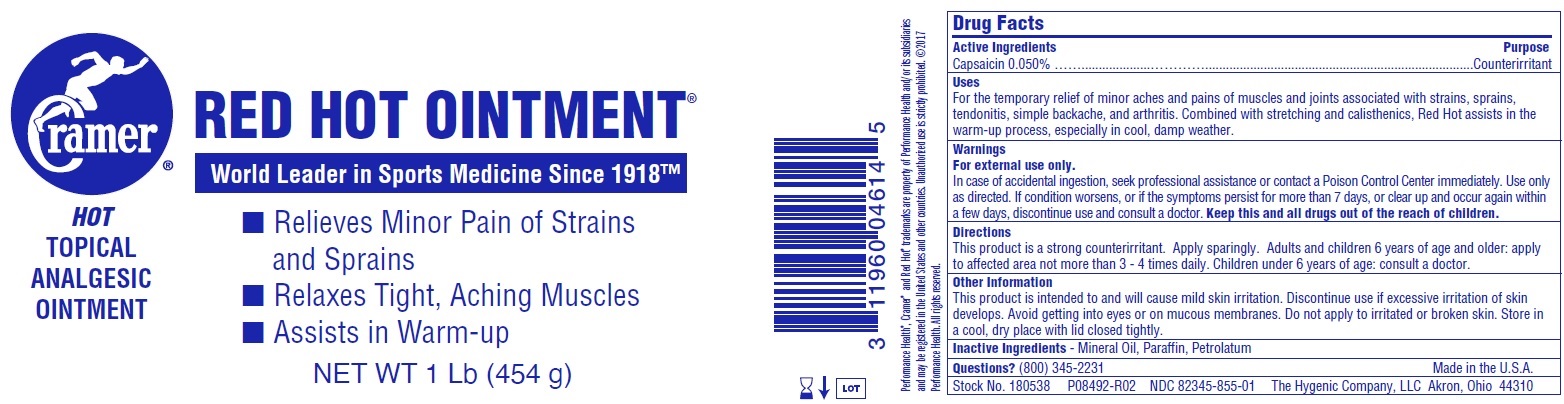
Red hot CAPSAICIN .5 mg/g Ointment, 454 g — NDC 82345-855-01 (Billing 82345-0855-01)
This is a package of 454 g of Red hot CAPSAICIN .5 mg/g Ointment from The Hygenic Company, LLC, marketed since Apr 2022 and currently FDA-listed. It is this product's only package size.
NDC database record
One package, one record: these facts belong to NDC 82345-855-01 alone.
- Record
- FDA NDC Directory package listing · Human OTC drug
- Code segments
- 82345 labeler · 855 product · 01 package
- Package marketed since
- Apr 1, 2022
- Sample package
- No — commercial package
- Listing certified through
- Dec 31, 2026
- Barcode (UPC-A, from the NDC)
- 3 8234585501 0
- FDA record last changed
- Jul 24, 2026
Identity & classification
Regulatory identifiers FDA, NLM and CMS codes for this package
- RxCUI (RxNorm): 1923327
Where does this data come from?
- FDA openFDA NDC Directory · synced Oct 8, 2026
- FDA label on DailyMed · label index refreshed Oct 8, 2026
- RxNorm (NLM RxNav) · catalog refreshed Oct 1, 2026
- Medi-Span GPI (licensed)
- First Databank (licensed) · refreshed Oct 8, 2026
RxNorm drug class
This medicine belongs to the Capsaicin and similar agents class.
Where does this data come from?
- RxClass (NLM) · catalog refreshed Oct 1, 2026
Clinical
Topical capsaicin is used to relieve minor pain in muscles and joints caused by arthritis, backaches, muscle strains, bruises, cramps, and sprains. Capsaicin is a substance that is found in chili peppers. It works by affecting nerve cells in the skin that are associated with pain, which results in decreased activity of these nerve cells and a reduced sense of pain.
Read the full MedlinePlus article ↗- Yes, completely normal — and it actually means the medicine is working. Capsaicin activates the same pain-sensing receptors in your skin that respond to heat and spicy food. That b...
- Why does capsaicin burn when I put it on? Is that normal?
- For most OTC creams and ointments, you can apply up to 3 to 4 times a day. For OTC patches, apply to clean, dry skin and remove after no more than 8 hours — again, up to 3 to 4 tim...
- How often should I apply capsaicin cream or use the patch?
Patient education
Supplement & herbal interactions
Some supplements/herbs that may interact with Capsaicin (prescription drug) — tap one for details:
Where does this data come from?
- MedlinePlus (NLM) · refreshed Oct 8, 2026
- FDA label on DailyMed · label index refreshed Oct 8, 2026
Ask a licensed pharmacist directly — free, answered by our team.
Pricing
A drug doesn't have one price. Each row is a different public payment system, and none is what you'd pay at the counter — that depends on your insurance. The ⓘ on each row explains what it measures.
| Price system | Per g | Per package |
|---|---|---|
| Retail pharmacies payNADAC · weekly | Not in the retail survey — common for institutional, discontinued, or low-volume packs. | |
| Medicaid paysCMS SDUD · 12 mo | No recent Medicaid claims on file for this NDC — rare and low-volume NDCs are suppressed in the public data. | |
| Medicare drug plans payPart D · quarterly | No Part D plan price is available for this NDC in our data. | |
Where does this data come from?
- CMS NADAC weekly file
- CMS ASP pricing files · refreshed Sep 20, 2026
- CMS Medicaid State Drug Utilization Data · refreshed Oct 8, 2026
- CMS Part D plan pricing files · refreshed Sep 24, 2026
- VA National Acquisition Center price file
Packaging — all sizes for this product
| Package NDC | Description | Marketing start | Marketing end | Status |
|---|---|---|---|---|
| 82345-0855-01 You're viewing this Main listing | 454 g in 1 BOTTLE | 2022-04-01 | — | Active |
Therapeutic equivalents
| Product | Labeler | Pack | NADAC/unit | TE | Status | Price vs. this |
|---|---|---|---|---|---|---|
| Red hot .5 mg/gthis 82345-0855-01 | The | 454 g | — | — | FDA listed | — |
Where does this data come from?
- FDA openFDA NDC Directory · synced Oct 8, 2026
- FDA Orange Book · refreshed Oct 3, 2026
- CMS NADAC weekly file
Availability & generic status
We did not find an FDA-approved generic match for this exact strength, form and route.
Where does this data come from?
- FDA Orange Book · refreshed Oct 3, 2026
Inactive Ingredients / Excipients
Inactive ingredients, also called excipients, are components of the drug product other than the active ingredient. They may include fillers, dyes, coatings, preservatives, flavors, or other formulation ingredients.
🧪 Avoiding an ingredient? See Capsaicin inactive ingredients by manufacturer: every current product's list side by side, so you can ask your pharmacy for the version that does not list it.
💡 Tap an ingredient (hover on desktop) to see what it is and why it’s used.
-
UNII T5L8T28FGP
Mineral oil is a clear, odorless liquid derived from crude oil. It acts as a lubricant and emollient in medications, helping pills slide smoothly during manufacturing and aiding moisture retention in topical products.
-
UNII I9O0E3H2ZE
Paraffin is a waxy, petroleum-derived substance used as a coating, lubricant, and hardening agent in tablets and capsules. It helps protect the medicine from moisture and gives pills a smooth finish.
-
UNII 4T6H12BN9U
Petrolatum is a purified mineral oil-based jelly derived from petroleum. In medicines, it acts as an emollient, lubricant, and moisture barrier to soften skin, reduce friction, and help prevent water loss from formulations.
3 inactive ingredients listed in the exact product block matched to this NDC.
Label-section wording can be broader than the structured product block and may mention additional formulation ingredients.
Where does this data come from?
ingredient classCode="IACT" elements from the exact product block matched by this NDC. Label-section narrative from DailyMed / the openFDA label index is shown separately when available.- FDA label on DailyMed · label index refreshed Oct 8, 2026
- FDA openFDA NDC Directory · synced Oct 8, 2026
Inactive ingredient FAQ
Are inactive ingredients the same for every manufacturer?
Why might an inactive ingredient be missing?
Can inactive ingredients matter?
Manufacturer & labeler
More NDCs from The Hygenic Company, LLC labeler code 82345
- Cramergesic MENTHOL, METHYL SALICYLATE 19 mg/g; 137 mg/g Ointment NDC 82345-854-01
- Atomic Balm METHYL SALICYLATE, CAPSAICIN 125 mg/g; .25 mg/g Ointment NDC 82345-856-01
- Iso-Quin hand sanitizer ALCOHOL 65 mL/100mL Liquid NDC 82345-858-10
- Skin-lube PETROLATUM, DIMETHICONE 850 mg/g; 15 mg/g Ointment NDC 82345-860-01
Where does this data come from?
- FDA openFDA NDC Directory · synced Oct 8, 2026
- Drugs@FDA
FDA label — Drug Facts FDA SPL
🎯 Indications and Usage ▾
Uses For the temporary relief of minor aches and pains of muscles and joints associated with strains, sprains, tendonitis, simple backache, and arthritis. Combined with stretching and calisthenics, Red Hot assists in the warm-up process, especially in cool, damp weather.
⏱️ Dosage and Administration ▾
Directions This product is a strong counterirritant. Apply sparingly. Adults and children 6 years of age and older: apply to affected area not more than 3 - 4 times daily. Children under 6 years of age: consult a doctor.
⚠️ Warnings ▾
Warnings In case of accidental ingestion, seek professional assistance or contact a Poison Control Center immediately. Use only as directed. If condition worsens, or if the symptoms persist for more than 7 days, or clear up and occur again within a few days, discontinue use and consult a doctor. For external use only. Keep this and all drugs out of the reach of children.
🧪 Active Ingredient ▾
Active Ingredients Methyl Salicylate 12.5% Capsaicin 0.025% Purpose Counterirritant
🧪 Inactive Ingredients ▾
Inactive Ingredients Mineral Oil, Paraffin, Petrolatum
🎯 Purpose ▾
Purpose Counterirritant
📄 Keep Out of Reach of Children ▾
Keep this and all drugs out of the reach of children.
📄 Questions or Comments ▾
Questions? (800) 345-2231
📄 Package Label / Principal Display Panel ▾
Package Labeling: Label8
About this NDC listing & data coverage
What data is (and isn’t) available for this NDC — tap to expand
| NDC identity (package / product / labeler codes) | ✓ Available |
| Labeler | ✓ Available |
| Product & package description | ✓ Available |
| Marketing category & status | ✓ Available |
| Active ingredient / dosage form / route | ✓ Available |
| FDA label (SPL via DailyMed) | ✓ Available |
| Package photos | ✓ Available |
| Inactive ingredients (structured) | ✓ Available |
| NADAC pharmacy acquisition price (CMS) | — Not published for this NDC CMS publishes NADAC only for NDCs reported in its retail-pharmacy survey. |
| Orange Book / therapeutic-equivalence data | — Not published for this NDC Applies only to products approved under an NDA/ANDA; many listings are out of scope. |
| HCPCS J-code billing crosswalk | — Not published for this NDC Most self-administered / retail products have no J-code — that is normal. |
| Medicaid utilization (CMS SDUD) | — Not published for this NDC CMS reports utilization only for NDCs with Medicaid claims above its privacy threshold. |