
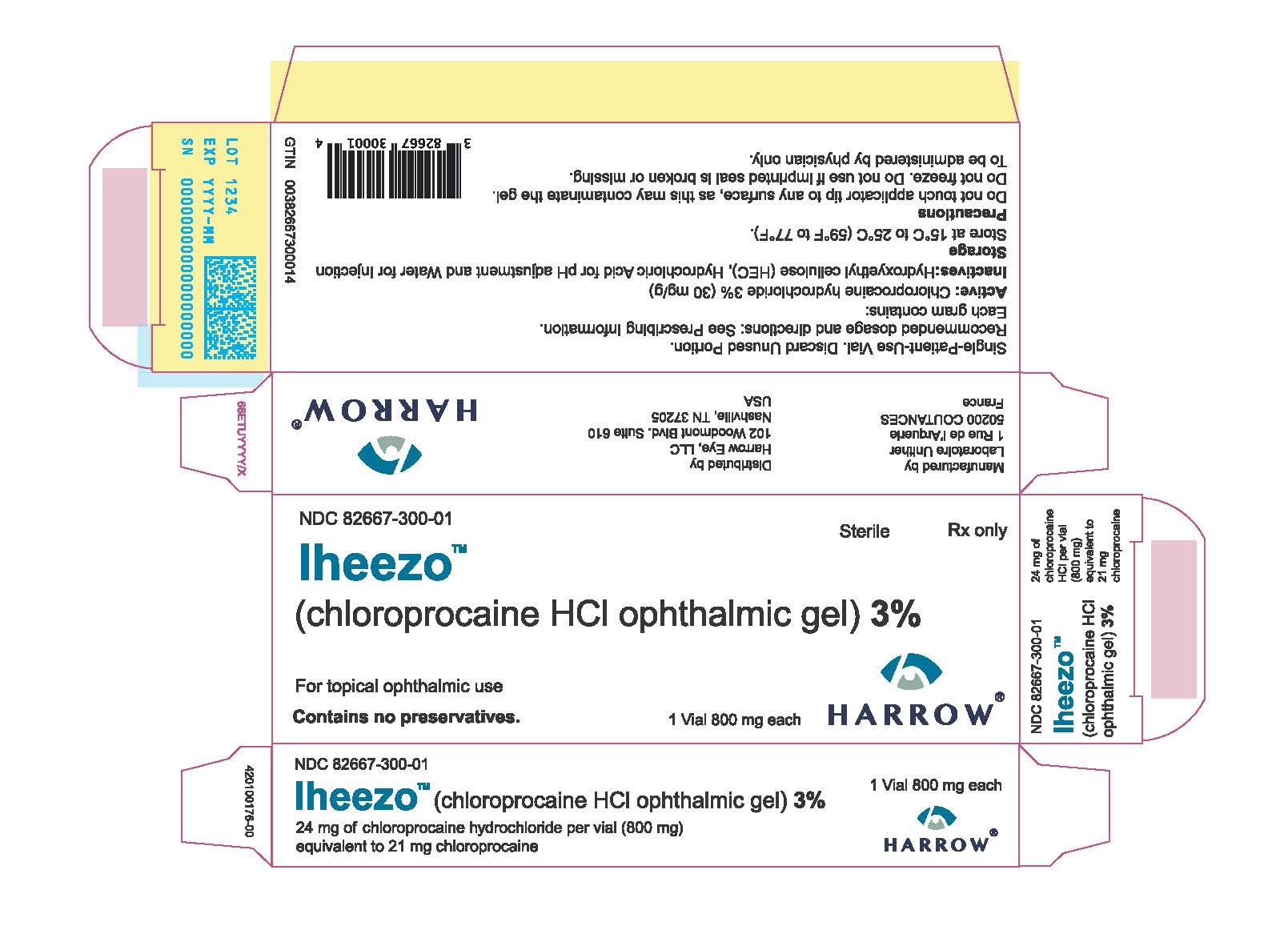
IHEEZO chloroprocaine hydrochloride ophthalmic gel 24 mg/800mg Gel — NDC 82667-300-01 (Billing 82667-0300-01)
This is a package of IHEEZO chloroprocaine hydrochloride ophthalmic gel 24 mg/800mg Gel from Harrow Eye, LLC, marketed since Sep 2022 and currently FDA-listed. It is the main listing for this product, which comes in 3 package sizes.
NDC database record
One package, one record: these facts belong to NDC 82667-300-01 alone.
- Record
- FDA NDC Directory package listing · Human prescription drug
- Code segments
- 82667 labeler · 300 product · 01 package
- Package marketed since
- Sep 27, 2022
- Sample package
- No — commercial package
- Listing certified through
- Dec 31, 2027
- Barcode (UPC)
- 0382667300007
- Medicaid fills, this package
- 3,549 prescriptions in the last four reported quarters
- FDA record last changed
- Jul 24, 2026
Identity & classification
Regulatory identifiers FDA, NLM and CMS codes for this package
Drug-database identifiers Medi-Span GPI and First Databank GCN / HICL / AHFS classification
- GSN (GCN sequence number): 083890
- GCN: 52959
- GPI-14 (Medi-Span): 86750012104020
- HICL (First Databank): 037210
- AHFS class code: 52:16.00.00
- RxCUI (RxNorm): 2613956
Where does this data come from?
- FDA openFDA NDC Directory · synced Oct 8, 2026
- FDA label on DailyMed · label index refreshed Oct 6, 2026
- RxNorm (NLM RxNav) · catalog refreshed Oct 1, 2026
- Medi-Span GPI (licensed)
- First Databank (licensed) · refreshed Oct 8, 2026
RxNorm drug class
This medicine belongs to the Ester Local Anesthetic class.
Where does this data come from?
- RxClass (NLM) · catalog refreshed Oct 1, 2026
Clinical
- It numbs an area so a procedure doesn't hurt. The injection forms are used for nerve blocks and numbing tissue, and Iheezo is used to numb the surface of the eye. Your provider cho...
- It works fast, usually in about 6 to 12 minutes. Numbness can last up to an hour, depending on how much is used and where it is given.
- How long does it take to work and how long does it last?
- No. A healthcare provider gives it. Iheezo in particular is not meant for self-administration, and it should never be injected.
Patient education
Supplement & herbal interactions
Where does this data come from?
- MedlinePlus (NLM) · refreshed Oct 1, 2026
- FDA label on DailyMed · label index refreshed Oct 6, 2026
Ask a licensed pharmacist directly — free, answered by our team.
Pricing
A drug doesn't have one price. Each row is a different public payment system, and none is what you'd pay at the counter — that depends on your insurance. The ⓘ on each row explains what it measures.
| Price system | Per g | Per package |
|---|---|---|
| Retail pharmacies payNADAC · weekly | Not in the retail survey — common for institutional, discontinued, or low-volume packs. | |
| Medicaid paysCMS SDUD · 12 mo | $382.39 | — |
| Medicare drug plans payPart D · quarterly | No Part D plan price is available for this NDC in our data. | |
| Medicare Part B allowsASP · J2403 | $0.721 / J2403 unit | — |
Where does this data come from?
- CMS NADAC weekly file
- CMS ASP pricing files · refreshed Sep 20, 2026
- CMS Medicaid State Drug Utilization Data · through Q1 2026
- CMS Part D plan pricing files · refreshed Sep 24, 2026
- VA National Acquisition Center price file
Billing & reimbursement
Where does this data come from?
- CMS ASP NDC-HCPCS crosswalk · refreshed Sep 22, 2026
- DMEPDAC NDC-HCPCS crosswalk
- openFDA NSDE billing units · refreshed Oct 7, 2026
Packaging — all sizes for this product
| Package NDC | Description | Marketing start | Marketing end | Status |
|---|---|---|---|---|
| 82667-0300-01 You're viewing this Main listing | 1 POUCH in 1 CARTON / 1 VIAL in 1 POUCH / 800 mg in 1 VIAL | 2022-09-27 | — | Active |
| 82667-0300-00 82667-300-00 | 1 POUCH in 1 CARTON / 1 VIAL in 1 POUCH / 800 mg in 1 VIAL Sample | 2023-03-15 | — | Active |
| 82667-0300-05 82667-300-05 | 5 POUCH in 1 CARTON / 1 VIAL in 1 POUCH / 800 mg in 1 VIAL | 2026-03-02 | — | Active |
In Medicaid, this is the most-dispensed pack of this product — about 100% of fills over the last four reported quarters. See all packs ↓
Pack size FAQ
What quantity is in this package?
What NDC number is used to bill for this package of IHEEZO chloroprocaine hydrochloride ophthalmic gel 24 mg/800mg Gel?
Therapeutic equivalents
| Product | Labeler | Pack | NADAC/unit | TE | Status | Price vs. this |
|---|---|---|---|---|---|---|
| Iheezo 24 mg/800mgthis 82667-0300-01 | Harrow | 1 pouch | — | — | FDA listed | — |
Where does this data come from?
- FDA openFDA NDC Directory · synced Oct 8, 2026
- FDA Orange Book · refreshed Oct 3, 2026
- CMS NADAC weekly file
Availability & generic status
We did not find an FDA-approved generic match for this exact strength, form and route. Patent/protection dates below may affect future generic timing.
Why the date isn’t exact: Generic timing can change because patents may be challenged, settled, licensed, added, removed, or worked around with a narrower label — and FDA approval does not always mean a pharmacy can get the generic today.
🛈 What do these terms mean?
- Patent
- Legal protection listed in the Orange Book that may delay generic approval or launch. Issued by the U.S. Patent & Trademark Office.
- Substance patent
- Covers the active drug molecule itself — the hardest to design around. A generic generally can’t launch until it expires.
- Formulation (product) patent
- Covers a specific formulation or dosage form. A generic can sometimes work around it with a different formulation.
- Method-of-use patent
- A patent covering one specific approved use of the drug — not necessarily the whole molecule. A generic can sometimes launch with a “skinny label” that carves out the protected use and keeps the others.
- Skinny label
- A generic label that omits a still-patented use when the FDA allows it — letting a generic reach the market for the unprotected uses.
- Exclusivity
- FDA-granted marketing protection, separate from patents — e.g. 5-yr new chemical entity, 7-yr orphan drug, or a +6-month pediatric extension.
- Paragraph IV
- A generic applicant’s formal challenge to a listed patent. It can potentially lead to earlier generic entry, but often involves litigation or a settlement.
- RLD / RS
- Reference Listed Drug — the brand product the FDA uses as the reference for generic applications. Reference Standard — the product the FDA expects generics to compare against in bioequivalence testing.
- TE / AB rating
- FDA therapeutic-equivalence rating. An AB rating generally means the FDA considers a generic therapeutically equivalent to — and substitutable for — the brand.
- LOE (loss of exclusivity)
- The latest patent or exclusivity currently listed — the loss-of-exclusivity / latest-listed-protection date shown on this page. Paragraph-IV challenges and settlements can move the real date earlier; FDA approval and a manufacturer’s decision to market can move it later.
Built from the FDA Orange Book. The bars above are scaled to each protection’s expiry; the red LOE marker is the last one to lapse.
| Patent | Type | Use code | Expires |
|---|---|---|---|
| US 10792271 ↗ | Method of use | U-3457 | Sep 15, 2038 |
| US 11969403 ↗ | Drug product | — | May 14, 2039 |
Is there a generic version of IHEEZO 3% GEL EYE DROP?
The FDA approved a generic — why can’t I get it at my pharmacy yet?
Why do different websites show different generic release dates?
What does “FDA listed” mean?
What does a patent or protection date mean here?
What does “current Orange Book estimate” mean?
Can a generic come out before the last patent expires?
Can a generic come out after the listed dates?
What is the difference between patents and exclusivity?
Why are there multiple patent dates?
Where does this data come from?
- FDA Orange Book · refreshed Oct 3, 2026
Inactive Ingredients / Excipients
Inactive ingredients, also called excipients, are components of the drug product other than the active ingredient. They may include fillers, dyes, coatings, preservatives, flavors, or other formulation ingredients.
🧪 Avoiding an ingredient? See Chloroprocaine inactive ingredients by manufacturer: every current product's list side by side, so you can ask your pharmacy for the version that does not list it.
💡 Tap an ingredient (hover on desktop) to see what it is and why it’s used.
-
UNII QTT17582CB
A strong acid used to adjust and maintain the proper pH level in liquid medicines, ensuring stability and preventing breakdown of active ingredients.
-
UNII T4V6TWG28D
A plant-derived thickening agent made from cellulose. It increases viscosity and helps form a gel or paste consistency in medications, and may serve as a binder or coating material in various formulations.
-
UNII 059QF0KO0R
Water is a liquid solvent that dissolves and mixes ingredients together in liquid medicines, syrups, and injections. It helps distribute the active drug evenly throughout the product.
3 inactive ingredients listed in the exact product block matched to this NDC.
Where does this data come from?
ingredient classCode="IACT" elements from the exact product block matched by this NDC. Label-section narrative from DailyMed / the openFDA label index is shown separately when available.- FDA label on DailyMed · label index refreshed Oct 6, 2026
- FDA openFDA NDC Directory · synced Oct 8, 2026
Inactive ingredient FAQ
Are inactive ingredients the same for every manufacturer?
Why might an inactive ingredient be missing?
Can inactive ingredients matter?
Manufacturer & labeler
More NDCs from Harrow Eye, LLC labeler code 82667
- Verkazia cyclosporine 1 mg/mL Emulsion NDC 82667-014-00
- ZERVIATE cetirizine 2.4 mg/mL For Solution NDC 82667-015-24
- Byooviz ranibizumab-nuna 10 mg/mL Injection, Solution NDC 82667-018-05
- BYQLOVI clobetasol propionate .5 mg/mL For Suspension NDC 82667-021-00
- Maxitrol neomycin sulfate, polymyxin b sulfate and dexamethasone 3.5 mg/mL; 10000 [USP'U]/mL; 1 mg/mL Suspension NDC 82667-100-05
- IOPIDINE 1% apraclonidine hydrochloride ophthalmic solution 10 mg/mL Solution/ Drops NDC 82667-200-01
- ILEVRO nepafenac 3 mg/mL Suspension/ Drops NDC 82667-400-03
- NEVANAC nepafenac 1 mg/mL Suspension/ Drops NDC 82667-500-03
- MAXIDEX dexamethasone 1 mg/mL For Suspension NDC 82667-600-05
- VIGAMOX moxifloxacin hydrochloride 5 mg/mL Solution/ Drops NDC 82667-700-03
- TRIESENCE triamcinolone acetonide 40 mg/mL Injection, Suspension NDC 82667-800-01
- VEVYE cyclosporine ophthalmic solution 1 mg/mL Solution/ Drops NDC 82667-900-00
Where does this data come from?
- FDA openFDA NDC Directory · synced Oct 8, 2026
- Drugs@FDA
Full prescribing information FDA SPL
🎯 Indications and Usage ▾
1 INDICATIONS AND USAGE IHEEZO TM is indicated for ocular surface anesthesia. IHEEZO TM is an ester anesthetic indicated for ocular surface anesthesia. ( 1 )
⏱️ Dosage and Administration ▾
2 DOSAGE AND ADMINISTRATION The recommended dose of IHEEZO TM is 3 drops applied topically to the ocular surface in the area of the planned procedure. IHEEZO TM may be reapplied as needed to maintain anesthetic effect. The recommended dose of IHEEZO TM is 3 drops applied topically to the ocular surface in the area of the planned procedure. ( 2 ) IHEEZO TM may be reapplied as needed to maintain anesthetic effect. ( 2 )
💊 Dosage Forms and Strengths ▾
3 DOSAGE FORMS AND STRENGTHS IHEEZO TM (chloroprocaine hydrochloride ophthalmic gel) 3% contains 24 mg of chloroprocaine hydrochloride per vial (800 mg of gel). IHEEZO TM (chloroprocaine hydrochloride ophthalmic gel) 3% contains 24 mg of chloroprocaine hydrochloride per vial (800 mg). Clear, colorless to light yellow gel in single‑patient‑use vial. ( 3 )
⛔ Contraindications ▾
4 CONTRAINDICATIONS IHEEZO TM is contraindicated in patients with a history of hypersensitivity to any component of this preparation. IHEEZO TM is contraindicated in patients with a history of hypersensitivity to any component of this preparation. ( 4 )
⚠️ Warnings and Cautions ▾
5 WARNINGS AND PRECAUTIONS Not for Injection or Intraocular Administration ( 5.1 ). Corneal Injury Due to Insensitivity ( 5.2 ). Corneal Opacification ( 5.3 ) For Administration by Healthcare Provider : IHEEZO TM is not intended for patient self-administration ( 5.5 ).
5.1Not for Injection or Intraocular Administration IHEEZO TM should not be injected or intraocularly administered.
5.2Corneal Injury Due to Insensitivity Patients should not touch the eye for at least 10 to 20 minutes after using anesthetic as accidental injuries can occur due to insensitivity of the eye.
5.3Corneal Opacification Prolonged use of a topical ocular anesthetic may produce permanent corneal opacification and ulceration with accompanying visual loss.
5.4Risk of Contamination Do not touch the dropper tip to any surface as this may contaminate the gel.
5.5For Administration by Healthcare Provider IHEEZO TM is indicated for administration under the direct supervision of a healthcare provider. IHEEZO TM is not intended for patient self-administration.
5.1Not for Injection or Intraocular Administration IHEEZO TM should not be injected or intraocularly administered.
5.2Corneal Injury Due to Insensitivity Patients should not touch the eye for at least 10 to 20 minutes after using anesthetic as accidental injuries can occur due to insensitivity of the eye.
5.3Corneal Opacification Prolonged use of a topical ocular anesthetic may produce permanent corneal opacification and ulceration with accompanying visual loss.
5.4Risk of Contamination Do not touch the dropper tip to any surface as this may contaminate the gel.
5.5For Administration by Healthcare Provider IHEEZO TM is indicated for administration under the direct supervision of a healthcare provider. IHEEZO TM is not intended for patient self-administration.
🤒 Adverse Reactions ▾
6 ADVERSE REACTIONS Most common adverse reaction is mydriasis (approximately 25%) ( 6.1 ) To report SUSPECTED ADVERSE REACTIONS, contact Harrow at 844.446.6979 or FDA at 1-800-FDA-1088 or www.fda.gov/medwatch .
6.1Clinical Trials Experience Because clinical trials are conducted under widely varying conditions, adverse reaction rates observed in the clinical trials of a drug cannot be directly compared to rates in the clinical trials of another drug and may not reflect the rates observed in practice. The data described below reflect 201 patients undergoing various surgical ocular procedures in two placebo-controlled trials (Study 1 and Study 2). Patients in Study 1 were randomized to receive a single instillation of 3 drops of IHEEZO TM or placebo.
Patients in Study 2 were randomized to receive a single or multiple instillations of 1, 3 or 3+3 drops of IHEEZO TM or placebo. The most common adverse reactions in these studies, (incidence greater than or equal to 5%) following IHEEZO TM administration were mydriasis, conjunctival hyperemia and eye irritation. Adverse Reactions Reported in Controlled Trials Table 1.
Adverse Reactions in 5% or more of IHEEZO TM Treated Patients in Studies 1 and 2 IHEEZO TM Placebo Preferred Term N=151 n (%) N=50 n (%) Mydriasis 39 (26%) 1 (2%) Conjunctival hyperemia 16 (11%) 6 (12%) Eye irritation 9 (6%) 2 (4%)
6.1Clinical Trials Experience Because clinical trials are conducted under widely varying conditions, adverse reaction rates observed in the clinical trials of a drug cannot be directly compared to rates in the clinical trials of another drug and may not reflect the rates observed in practice. The data described below reflect 201 patients undergoing various surgical ocular procedures in two placebo-controlled trials (Study 1 and Study 2). Patients in Study 1 were randomized to receive a single instillation of 3 drops of IHEEZO TM or placebo.
Patients in Study 2 were randomized to receive a single or multiple instillations of 1, 3 or 3+3 drops of IHEEZO TM or placebo. The most common adverse reactions in these studies, (incidence greater than or equal to 5%) following IHEEZO TM administration were mydriasis, conjunctival hyperemia and eye irritation. Adverse Reactions Reported in Controlled Trials Table 1.
Adverse Reactions in 5% or more of IHEEZO TM Treated Patients in Studies 1 and 2 IHEEZO TM Placebo Preferred Term N=151 n (%) N=50 n (%) Mydriasis 39 (26%) 1 (2%) Conjunctival hyperemia 16 (11%) 6 (12%) Eye irritation 9 (6%) 2 (4%)
👥 Use in Specific Populations ▾
8 USE IN SPECIFIC POPULATIONS
8.1Pregnancy Risk Summary There are no adequate and well-controlled studies of IHEEZO TM use in pregnant women to inform a drug associated risk. There are no animal reproduction studies for chloroprocaine.
8.2Lactation Risk Summary There are no data on the presence of chloroprocaine in human milk, the effects on the breastfed infant, or the effects on milk production. The developmental and health benefits of breastfeeding should be considered along with the mother’s clinical need for IHEEZO TM and any potential adverse effects on the breastfed infant from IHEEZO TM .
8.4Pediatric Use The safety and effectiveness of IHEEZO TM have not been established in pediatric patients.
8.5Geriatric Use No overall differences in safety or effectiveness of IHEEZO TM have been observed between elderly and younger patients.
8.1Pregnancy Risk Summary There are no adequate and well-controlled studies of IHEEZO TM use in pregnant women to inform a drug associated risk. There are no animal reproduction studies for chloroprocaine.
8.2Lactation Risk Summary There are no data on the presence of chloroprocaine in human milk, the effects on the breastfed infant, or the effects on milk production. The developmental and health benefits of breastfeeding should be considered along with the mother’s clinical need for IHEEZO TM and any potential adverse effects on the breastfed infant from IHEEZO TM .
8.4Pediatric Use The safety and effectiveness of IHEEZO TM have not been established in pediatric patients.
8.5Geriatric Use No overall differences in safety or effectiveness of IHEEZO TM have been observed between elderly and younger patients.
🧬 Clinical Pharmacology ▾
12 CLINICAL PHARMACOLOGY
12.1 Mechanism of Action
12.1Mechanism of Action Chloroprocaine, like other local anesthetics, blocks the generation and the conduction of nerve impulses, presumably by increasing the threshold for electrical excitation in the nerve, by slowing the propagation of the nerve impulse, and by reducing the rate of rise of the action potential. In general, the progression of anesthesia is related to the diameter, myelination, and conduction velocity of affected nerve fibers. Clinically, the order of loss of nerve function is as follows: (1) pain, (2) temperature, (3) touch, (4) proprioception, and (5) skeletal muscle tone.
12.3Pharmacokinetics The systemic exposure to chloroprocaine following topical ocular administration of IHEEZO TM has not been studied. Elimination Metabolism Chloroprocaine is metabolized by plasma pseudocholinesterases and nonspecific esterases in ocular tissues. Chloroprocaine is rapidly metabolized in plasma by hydrolysis of the ester linkage by pseudocholinesterase.
The hydrolysis of chloroprocaine results in the production of ß-diethylaminoethanol and 2-chloro-4-aminobenzoic acid, which inhibits the action of the sulfonamides. Excretion Chloroprocaine plasma half-life in vitro is approximately 25 seconds in adults and approximately 43 seconds in neonates. The kidney is the main excretory organ for most local anesthetics and their metabolites.
Urinary excretion is affected by urinary perfusion and factors affecting urinary pH.
12.1 Mechanism of Action
12.1Mechanism of Action Chloroprocaine, like other local anesthetics, blocks the generation and the conduction of nerve impulses, presumably by increasing the threshold for electrical excitation in the nerve, by slowing the propagation of the nerve impulse, and by reducing the rate of rise of the action potential. In general, the progression of anesthesia is related to the diameter, myelination, and conduction velocity of affected nerve fibers. Clinically, the order of loss of nerve function is as follows: (1) pain, (2) temperature, (3) touch, (4) proprioception, and (5) skeletal muscle tone.
12.3Pharmacokinetics The systemic exposure to chloroprocaine following topical ocular administration of IHEEZO TM has not been studied. Elimination Metabolism Chloroprocaine is metabolized by plasma pseudocholinesterases and nonspecific esterases in ocular tissues. Chloroprocaine is rapidly metabolized in plasma by hydrolysis of the ester linkage by pseudocholinesterase.
The hydrolysis of chloroprocaine results in the production of ß-diethylaminoethanol and 2-chloro-4-aminobenzoic acid, which inhibits the action of the sulfonamides. Excretion Chloroprocaine plasma half-life in vitro is approximately 25 seconds in adults and approximately 43 seconds in neonates. The kidney is the main excretory organ for most local anesthetics and their metabolites.
Urinary excretion is affected by urinary perfusion and factors affecting urinary pH.
📦 How Supplied / Storage and Handling ▾
16 HOW SUPPLIED/STORAGE AND HANDLING IHEEZO TM (chloroprocaine hydrochloride ophthalmic gel) 3% is supplied as a sterile, clear, colorless to light yellow gel in a single-patient‑use vial. Each single‑patient‑use vial contains 24 mg chloroprocaine in 800 mg of gel. Aluminum pouch containing 1 LDPE single-patient‑use vial of IHEEZO TM .
The outer surface of the vial is not sterile. NDC 82667-300-01 Package of 1 unit of 1.25 mL single-patient‑use vial (800 mg filled) NDC 82667-300-05 Package of 5 units of 1.25 mL single-patient‑use vials (800 mg filled) Storage Store at 15°C to 25°C (59°F to 77°F). Discard after use.
📋 Description ▾
11 DESCRIPTION IHEEZO TM is a sterile, single-patient‑use ophthalmic gel preparation for topical ocular anesthesia containing chloroprocaine hydrochloride as the active pharmaceutical ingredient. Chloroprocaine hydrochloride is an ester anesthetic. It is a water-soluble white crystalline powder and its chemical name is 2-(Diethylamino)ethyl 4‑amino-2-chlorobenzoate monohydrochloride.
The molecular weight is 307.22 and the molecular formula is C 13 H 19 ClN 2 O 2 ·HCl. It is represented by the following structural formula: IHEEZO TM contains: Active: 30 mg of chloroprocaine hydrochloride (equivalent to 26 mg of chloroprocaine) per gram of gel. Inactive ingredients: Hydroxyethyl Cellulose (HEC), and Water for Injection.
The pH may be adjusted to 3.0 to 5.0 with Hydrochloric Acid. This product does not contain an antimicrobial preservative. chemstru
🔬 Clinical Studies ▾
14 CLINICAL STUDIES
14.1Study 1 and 2 Study 1 (NCT04779606) and Study 2 (NCT04753710) were randomized, double-blinded placebo-controlled studies conducted to evaluate the efficacy, safety, and local tolerability of IHEEZO TM in 145 healthy volunteers. In Study 1 , 85 healthy male and female were randomized in a 4:1 ratio to receive a single ocular instillation of IHEEZO TM (N=68) or placebo (N=17). The double blinded treatment included a IHEEZO TM or a placebo dose of 3 drops instilled at 1 minute ± 15 seconds intervals in the right eye of each volunteer.
The median age was 39 years (range 19 to 55 years); 59% female and 41% male. In Study 2 , 60 healthy male and female were randomized (40:20) to receive single or multiple ocular instillations of IHEEZO TM dose of 3 drops in the right eye. The median age was 25 years (range 18 to 59 years); 54% female ad 46% male.
The efficacy in Study 1 and 2 was determined by proportion of patients achieving full conjunctival anesthesia evaluated by conjunctival pinching, 5 minutes after administration. Efficacy results of Study 1 The proportion of subjects with successful anesthesia was 90% in IHEEZO TM group and 12% in the placebo group (p<0.01). The median time for the IHEEZO TM group achieving anesthesia was 0.67 minutes.
The median duration of anesthesia was 14.3 minutes. Efficacy results of Study 2 The proportion of subjects with successful anesthesia was 95% in the IHEEZO TM group and 20% in the placebo group (p<0.01). The median time for the IHEEZO TM group achieving anesthesia was 0.67 minutes.
The median duration of anesthesia was 19.3 minutes.
14.2Study 3 Study 3 (NCT04685538) was a randomized, prospective, multi-center, active-controlled, observer-masked study conducted to evaluate the efficacy and safety of IHEEZO TM (N=166) versus tetracaine ophthalmic solution 0.5% (N=172) in patients undergoing cataract surgery. The primary endpoint was defined as the proportion of patients in each treatment group gaining successful anesthesia without any supplementation. On average, patients needed 1-1.5 minutes to obtain sufficient anesthesia to successfully perform the surgical procedure which lasted on average 22 minutes.
No patient treated with IHEEZO TM required supplemental treatment to complete the intended surgical procedure.
14.1Study 1 and 2 Study 1 (NCT04779606) and Study 2 (NCT04753710) were randomized, double-blinded placebo-controlled studies conducted to evaluate the efficacy, safety, and local tolerability of IHEEZO TM in 145 healthy volunteers. In Study 1 , 85 healthy male and female were randomized in a 4:1 ratio to receive a single ocular instillation of IHEEZO TM (N=68) or placebo (N=17). The double blinded treatment included a IHEEZO TM or a placebo dose of 3 drops instilled at 1 minute ± 15 seconds intervals in the right eye of each volunteer.
The median age was 39 years (range 19 to 55 years); 59% female and 41% male. In Study 2 , 60 healthy male and female were randomized (40:20) to receive single or multiple ocular instillations of IHEEZO TM dose of 3 drops in the right eye. The median age was 25 years (range 18 to 59 years); 54% female ad 46% male.
The efficacy in Study 1 and 2 was determined by proportion of patients achieving full conjunctival anesthesia evaluated by conjunctival pinching, 5 minutes after administration. Efficacy results of Study 1 The proportion of subjects with successful anesthesia was 90% in IHEEZO TM group and 12% in the placebo group (p<0.01). The median time for the IHEEZO TM group achieving anesthesia was 0.67 minutes.
The median duration of anesthesia was 14.3 minutes. Efficacy results of Study 2 The proportion of subjects with successful anesthesia was 95% in the IHEEZO TM group and 20% in the placebo group (p<0.01). The median time for the IHEEZO TM group achieving anesthesia was 0.67 minutes.
The median duration of anesthesia was 19.3 minutes.
14.2Study 3 Study 3 (NCT04685538) was a randomized, prospective, multi-center, active-c… [Excerpted — this section continues on DailyMed.]
🧪 Nonclinical Toxicology ▾
13 NONCLINICAL TOXICOLOGY
13.1Carcinogenesis, Mutagenesis, Impairment of Fertility Carcinogenesis Long-term studies in animals to evaluate carcinogenic potential of chloroprocaine have not been conducted. Mutagenesis 2-chloroprocaine and the main metabolite, ACBA, were negative in the in vitro bacterial reverse mutation test (Ames assay) and the in vitro chromosome aberrations assay. Impairment of Fertility Studies in animals to evaluate the impairment of fertility have not been conducted with chloroprocaine.
13.1Carcinogenesis, Mutagenesis, Impairment of Fertility Carcinogenesis Long-term studies in animals to evaluate carcinogenic potential of chloroprocaine have not been conducted. Mutagenesis 2-chloroprocaine and the main metabolite, ACBA, were negative in the in vitro bacterial reverse mutation test (Ames assay) and the in vitro chromosome aberrations assay. Impairment of Fertility Studies in animals to evaluate the impairment of fertility have not been conducted with chloroprocaine.
📄 Package Label / Principal Display Panel ▾
PRINCIPAL DISPLAY PANEL: CARTON 1PK NDC 82667-300-01 Sterile Rx Only Iheezo TM (chloroprocaine hydrochloride ophthalmic gel) 3% For topical ophthalmic use Contains no preservatives. 1 Vial 800 mg each HARROW ® carton
PRINCIPAL DISPLAY PANEL - Sample Carton NDC 82667-300-00 Professional sample - Not for sale Sterile Rx Only Iheezo TM (chloroprocaine hydrochloride ophthalmic gel) 3% For topical ophthalmic use Contains no preservatives. 1 Vial 800 mg each HARROW ® Sample Carton
PRINCIPAL DISPLAY PANEL: CARTON - 5PK NDC 82667-300-05 Sterile Rx Only Iheezo TM (chloroprocaine hydrochloride ophthalmic gel) 3% For topical ophthalmic use Contains no preservatives. 1 Vial 800 mg each HARROW ® Iheezo carton 5pk
Medicaid utilization & spend
Medicaid utilization by pack size
Reported adverse events (FAERS)
Top reported reactions
Reporter sex
Where does this data come from?
About this NDC listing & data coverage
What data is (and isn’t) available for this NDC — tap to expand
| NDC identity (package / product / labeler codes) | ✓ Available |
| Labeler | ✓ Available |
| Product & package description | ✓ Available |
| Marketing category & status | ✓ Available |
| Active ingredient / dosage form / route | ✓ Available |
| FDA label (SPL via DailyMed) | ✓ Available |
| Package photos | ✓ Available |
| Inactive ingredients (structured) | ✓ Available |
| NADAC pharmacy acquisition price (CMS) | — Not published for this NDC CMS publishes NADAC only for NDCs reported in its retail-pharmacy survey. |
| Orange Book / therapeutic-equivalence data | ✓ Available |
| HCPCS J-code billing crosswalk | ✓ Available |
| Medicaid utilization (CMS SDUD) | ✓ Available |