
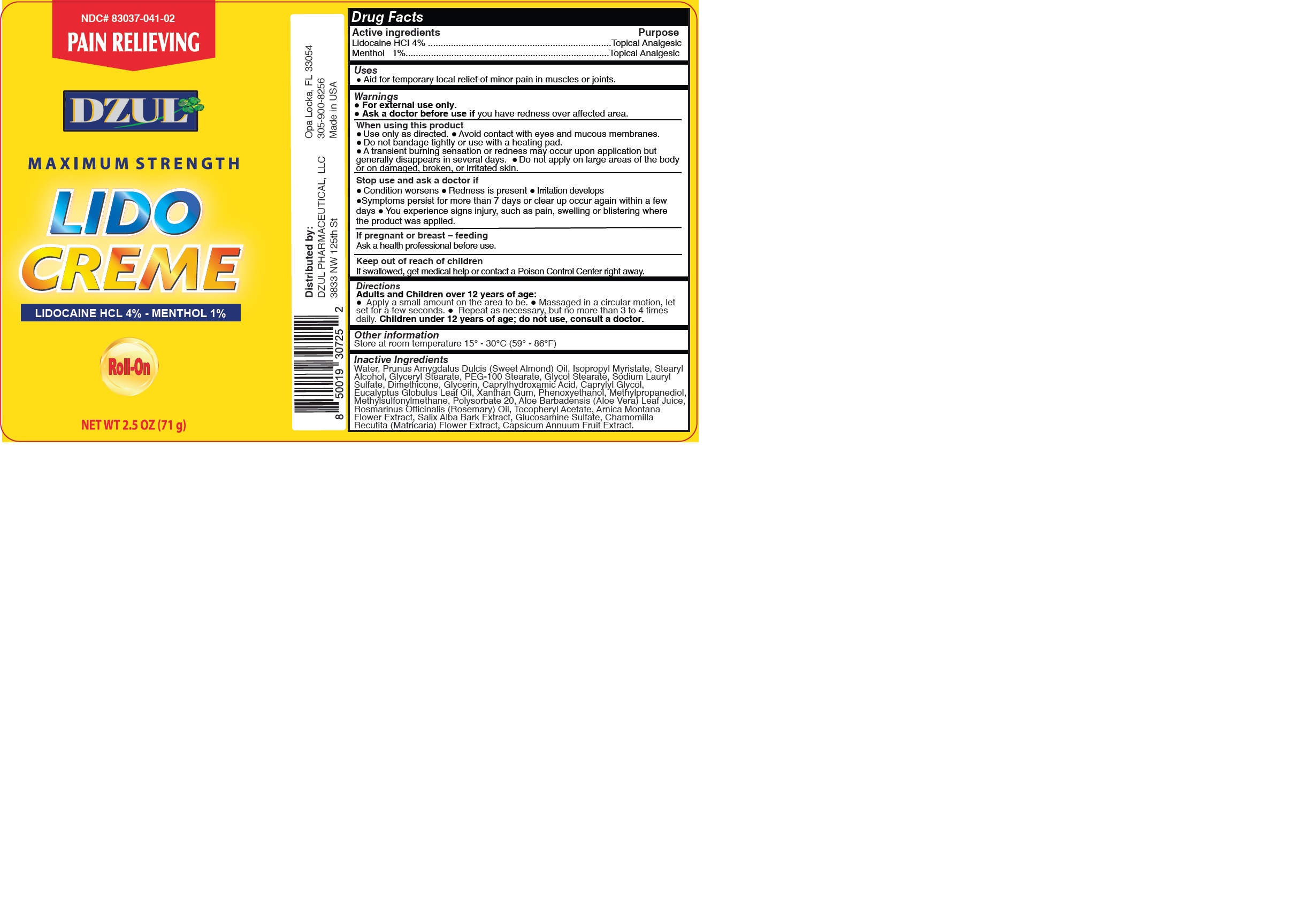
Dzul - Lido Creme Lidocaine HCl, Menthol 1 g/100g; 4 g/100g Lotion, 71 g — NDC 83037-041-02 (Billing 83037-0041-02)
This is a package of 71 g of Dzul - Lido Creme Lidocaine HCl, Menthol 1 g/100g; 4 g/100g Lotion from Caball Sales, Inc., marketed since Oct 2022 and currently FDA-listed. It is this product's only package size.
Identity & classification
Regulatory identifiers FDA, NLM and CMS codes for this package
- RxCUI (RxNorm): 2598162
Where does this data come from?
- FDA openFDA NDC Directory · synced Oct 1, 2026
- FDA label on DailyMed · label index refreshed Oct 1, 2026
- RxNorm (NLM RxNav) · catalog refreshed Oct 1, 2026
- Medi-Span GPI (licensed)
- First Databank (licensed) · refreshed Oct 1, 2026
RxNorm drug class
This medicine belongs to the Antiarrhythmic class.
Where does this data come from?
- RxClass (NLM) · catalog refreshed Oct 1, 2026
Clinical
Dzul-Lido Creme is a topical lotion containing lidocaine hydrochloride and menthol. Lidocaine is a local anesthetic typically used to numb the skin, while menthol is commonly included for its cooling sensation. This product is marketed as an over-the-counter monograph drug, meaning it follows FDA's established rules for its category rather than undergoing individual review. The combination is typically used as a temporary pain reliever applied directly to the skin.
Patient education
Supplement & herbal interactions
Where does this data come from?
- MedlinePlus (NLM) · refreshed Oct 1, 2026
- FDA label on DailyMed · label index refreshed Oct 1, 2026
Ask a licensed pharmacist directly — free, answered by our team.
Pricing
A drug doesn't have one price. Each row is a different public payment system, and none is what you'd pay at the counter — that depends on your insurance. The ⓘ on each row explains what it measures.
| Price system | Per g | Per package |
|---|---|---|
| Retail pharmacies payNADAC · weekly | Not in the retail survey — common for institutional, discontinued, or low-volume packs. | |
| Medicaid paysCMS SDUD · 12 mo | No recent Medicaid claims on file for this NDC — rare and low-volume NDCs are suppressed in the public data. | |
| Medicare drug plans payPart D · quarterly | No Part D plan price is available for this NDC in our data. | |
Where does this data come from?
- CMS NADAC weekly file
- CMS ASP pricing files · refreshed Sep 20, 2026
- CMS Medicaid State Drug Utilization Data · refreshed Oct 3, 2026
- CMS Part D plan pricing files · refreshed Sep 24, 2026
- VA National Acquisition Center price file
Packaging — all sizes for this product
| Package NDC | Description | Marketing start | Marketing end | Status |
|---|---|---|---|---|
| 83037-0041-02 You're viewing this Main listing | 71 g in 1 BOTTLE, WITH APPLICATOR | 2023-10-02 | — | Active |
Therapeutic equivalents
| Product | Labeler | Pack | NADAC/unit | TE | Status | Price vs. this |
|---|---|---|---|---|---|---|
| Dzul - Lido Creme 1 g/100g; 4 g/100gthis 83037-0041-02 | Caball | 71 g | — | — | FDA listed | — |
| Dermatool Nerve Care 1 g/100g; 4 g/100g 84728-0359-05 | Papalo | 1 bottle | — | — | FDA listed | — |
| Heal and Rescue Bunion Pain Relief 1 g/100g; 4 g/100g 29784-0410-02 | Rooftop | 1 bottle | — | — | FDA listed | — |
| Workvie 1 g/100g; 4 g/100g 72393-0203-25 | Marketites | 71 g | — | — | FDA listed | — |
Where does this data come from?
- FDA openFDA NDC Directory · synced Oct 1, 2026
- FDA Orange Book · refreshed Oct 3, 2026
- CMS NADAC weekly file
Availability & generic status
We did not find an FDA-approved generic match for this exact strength, form and route.
Where does this data come from?
- FDA Orange Book · refreshed Oct 3, 2026
Inactive Ingredients / Excipients
Inactive ingredients, also called excipients, are components of the drug product other than the active ingredient. They may include fillers, dyes, coatings, preservatives, flavors, or other formulation ingredients.
💡 Tap an ingredient (hover on desktop) to see what it is and why it’s used.
-
UNII 9E8X80D2L0
A synthetic form of vitamin E used as an antioxidant and preservative in medications. It helps prevent the active ingredients from degrading when exposed to oxygen or light.
-
UNII 66YXD4DKO9
A natural oil extracted from almond kernels. It's used in medicines as an emollient and solvent to help dissolve or suspend active ingredients and improve texture in topical and oral formulations.
-
UNII ZY81Z83H0X
Aloe vera leaf is a plant extract derived from the aloe plant. It is used in medicines as a natural moisturizer and skin-soothing agent in topical formulations.
-
UNII OZ0E5Y15PZ
A plant extract from arnica flowers, used as a flavoring agent or fragrance component in medicines. It may also provide mild soothing properties to certain topical formulations.
-
UNII UPY805K99W
A synthetic compound derived from caprylic acid that works as a preservative and antimicrobial agent to help prevent bacterial and fungal growth in the medicine.
-
UNII 00YIU5438U
Caprylyl glycol is a clear liquid derived from coconut oil. In medicines, it acts as a humectant to retain moisture, a preservative booster to prevent microbial growth, and a solvent to help dissolve or mix other ingredients.
-
UNII 7FKZ3QQQ1F
Capsicum annuum is the red bell pepper plant. It's used as a colorant and flavoring agent in medicines to make pills more visually distinctive and add mild flavor or heat sensation.
-
UNII FGL3685T2X
Chamomile is a plant extract used in medications as a flavoring agent and for its mild soothing properties in formulations. It helps improve taste and aroma of the medicine.
-
UNII MCU2324216
A silicone-based oil that reduces foaming and helps ingredients mix evenly. It's used as an antifoaming agent and lubricant in tablets, capsules, and liquid formulations.
-
UNII 9H4PO4Z4FT
A sulfur-containing organic compound used as a solvent and penetration enhancer in medicines. It helps dissolve active ingredients and improve their absorption through skin or mucous membranes.
-
UNII S546YLW6E6
Eucalyptus globulus leaf is a plant-derived ingredient that may serve as a flavoring agent or aromatic component in medications. It is commonly used to add taste or scent to oral formulations.
-
UNII 1FW7WLR731
Glucosamine sulfate is a natural compound derived from shellfish or made in laboratories. In medications, it acts as an active therapeutic ingredient rather than an inactive excipient, though it may also serve as a filler or binder in some formulations.
-
UNII PDC6A3C0OX
Glycerin is a clear, thick liquid derived from plant oils or fats. It acts as a humectant to retain moisture, a sweetener, and a solvent in medications.
-
UNII FCZ5MH785I
A waxy substance made from glycerin and stearic acid. It works as an emulsifier to help mix oil and water ingredients together, and as a thickener to give the medicine its proper texture and consistency.
-
UNII 0324G66D0E
Glycol stearate is a waxy compound made by combining stearic acid with ethylene glycol. It acts as an emulsifier and thickener, helping keep oil and water mixed together smoothly in liquid or semi-solid medicines.
-
UNII 0RE8K4LNJS
Isopropyl myristate is an oily liquid made from coconut or palm oil. It's used in medicines as an emollient and penetration enhancer to help the medicine absorb through skin or improve spreadability in topical products.
-
UNII N8F53B3R4R
A synthetic humectant and solvent derived from propane. It draws and holds moisture in the formulation, helping keep the medicine stable and improving texture or flow in liquid and semi-solid products.
-
UNII YD01N1999R
A waxy substance made from polyethylene glycol and stearic acid. It helps mix oil and water-based ingredients together and serves as an emulsifier and solubilizer in liquid and semi-solid medicines.
-
UNII HIE492ZZ3T
Phenoxyethanol is a synthetic preservative and antimicrobial agent used to prevent bacterial and fungal growth in medicines and cosmetic products, extending shelf life and maintaining product safety.
-
UNII 7T1F30V5YH
A synthetic emulsifier derived from sorbitol and oleic acid. It helps mix oil and water-based ingredients together and keeps them from separating in liquid formulations.
-
UNII 8LGU7VM393
Rosemary leaf oil is a natural aromatic oil extracted from rosemary plants. It's used in medicines as a flavoring agent and preservative to help protect the product from spoilage.
-
UNII 205MXS71H7
A plant extract from white willow bark. It's used as a natural flavoring agent and may help preserve the medicine by providing mild antioxidant properties in the formulation.
-
UNII 368GB5141J
A detergent and foaming agent derived from coconut or palm oil. In medications, it helps break down and mix oil and water-based ingredients, aids in tablet disintegration, and improves how the drug dissolves and spreads in the mouth or digestive system.
-
UNII 2KR89I4H1Y
Stearyl alcohol is a waxy, fatty substance derived from natural oils or made synthetically. It acts as an emulsifier and thickener in medicines, helping mix ingredients together and give the product the right texture.
-
UNII 059QF0KO0R
Water is a liquid solvent that dissolves and mixes ingredients together in liquid medicines, syrups, and injections. It helps distribute the active drug evenly throughout the product.
-
UNII TTV12P4NEE
Xanthan gum is a thickening and stabilizing ingredient made from fermented corn or other sugars. It's added to medicines to improve texture, prevent separation of liquids and solids, and help the product stay consistent.
26 inactive ingredients listed in the exact product block matched to this NDC.
Label-section wording can be broader than the structured product block and may mention additional formulation ingredients.
Where does this data come from?
ingredient classCode="IACT" elements from the exact product block matched by this NDC. Label-section narrative from DailyMed / the openFDA label index is shown separately when available.- FDA label on DailyMed · label index refreshed Oct 1, 2026
- FDA openFDA NDC Directory · synced Oct 1, 2026
Inactive ingredient FAQ
Are inactive ingredients the same for every manufacturer?
Why might an inactive ingredient be missing?
Can inactive ingredients matter?
Manufacturer & labeler
Where does this data come from?
- FDA openFDA NDC Directory · synced Oct 1, 2026
- Drugs@FDA
FDA label — Drug Facts FDA SPL
🎯 Indications and Usage ▾
USES: For temporary local relief of minor pain in muscles or joints.
⏱️ Dosage and Administration ▾
DIRECTIONS: Adults and children over 12 years of age Apply a small amount to the affected area. Massage in a circular motion, let set for a few seconds. Repeat as necessary, but no more than 3 to 4 times daily. Children under 12 years of age; do not use unless directed by doctor.
⚠️ Warnings ▾
For external use only. Ask a doctor before use if you have redness over affected area.
🧪 Active Ingredient ▾
Lidocaine HCl 4% Menthol 1%
🧪 Inactive Ingredients ▾
Water, Prunus Amygdalus Dulcis (Sweet Almond) Oil, Isopropyl Myristate, Glycol Stearate, Stearyl Alcohol, Glyceryl Stearate, PEG-100 Stearate, Sodium Lauryl Sulfate, Dimethicone, Glycerin, Caprylhydroxamic Acid, Caprylyl Glycol, Eucalyptus Globulus Leaf Oil, Phenoxyethanol, Methylpropanediol, Acrylamide/Sodium Acrylate Copolymer, Paraffinum Liquidum, Trideceth-6, Methylsulfonylmethane, Aloe Barbadensis (Aloe Vera) Leaf Juice, Rosmarinus Officinalis (Rosemary) Oil, Tocopheryl Acetate, Arnica Montana Flower Extract, Salix Alba Bark Extract, Glucosamine Sulfate, Chamomilla Recutita (Matricaria) Flower Extract, Capsicum Annuum Fruit Extract.
🎯 Purpose ▾
Topical Analgesic
📄 When Using This Product ▾
Use only as directed. Avoid contact with eyes and mucous membranes. Do not bandage tightly or use with a heating pad. A transient burning sensation or redness may occur upon application but generally disappears in several days. Do not apply on large areas of the body or on damaged, broken, or irritated skin.
📄 Stop Use and Ask a Doctor If ▾
STOP USE AND ASK A DOCTOR IF: Redness is present. Condition worsens. Irritation develops. Symptoms persist for more than 7 days or clear up and occur again within a few days. You experience signs injury, such as pain, swelling or blistering where the product was applied.
🤰 If Pregnant or Breast-Feeding ▾
Ask a health professional before use.
📄 Keep Out of Reach of Children ▾
If swallowed, get medical help or contact a Poison Control Center right away.
📄 Other Information ▾
Store at room temperature 15° - 30°C (59° - 86°F)
📄 Package Label / Principal Display Panel ▾
DZUL - LIDO CREME ROLL-ON LIDO CREME
About this NDC listing & data coverage
What data is (and isn’t) available for this NDC — tap to expand
| NDC identity (package / product / labeler codes) | ✓ Available |
| Labeler | ✓ Available |
| Product & package description | ✓ Available |
| Marketing category & status | ✓ Available |
| Active ingredient / dosage form / route | ✓ Available |
| FDA label (SPL via DailyMed) | ✓ Available |
| Package photos | ✓ Available |
| Inactive ingredients (structured) | ✓ Available |
| NADAC pharmacy acquisition price (CMS) | — Not published for this NDC CMS publishes NADAC only for NDCs reported in its retail-pharmacy survey. |
| Orange Book / therapeutic-equivalence data | — Not published for this NDC Applies only to products approved under an NDA/ANDA; many listings are out of scope. |
| HCPCS J-code billing crosswalk | — Not published for this NDC Most self-administered / retail products have no J-code — that is normal. |
| Medicaid utilization (CMS SDUD) | — Not published for this NDC CMS reports utilization only for NDCs with Medicaid claims above its privacy threshold. |