
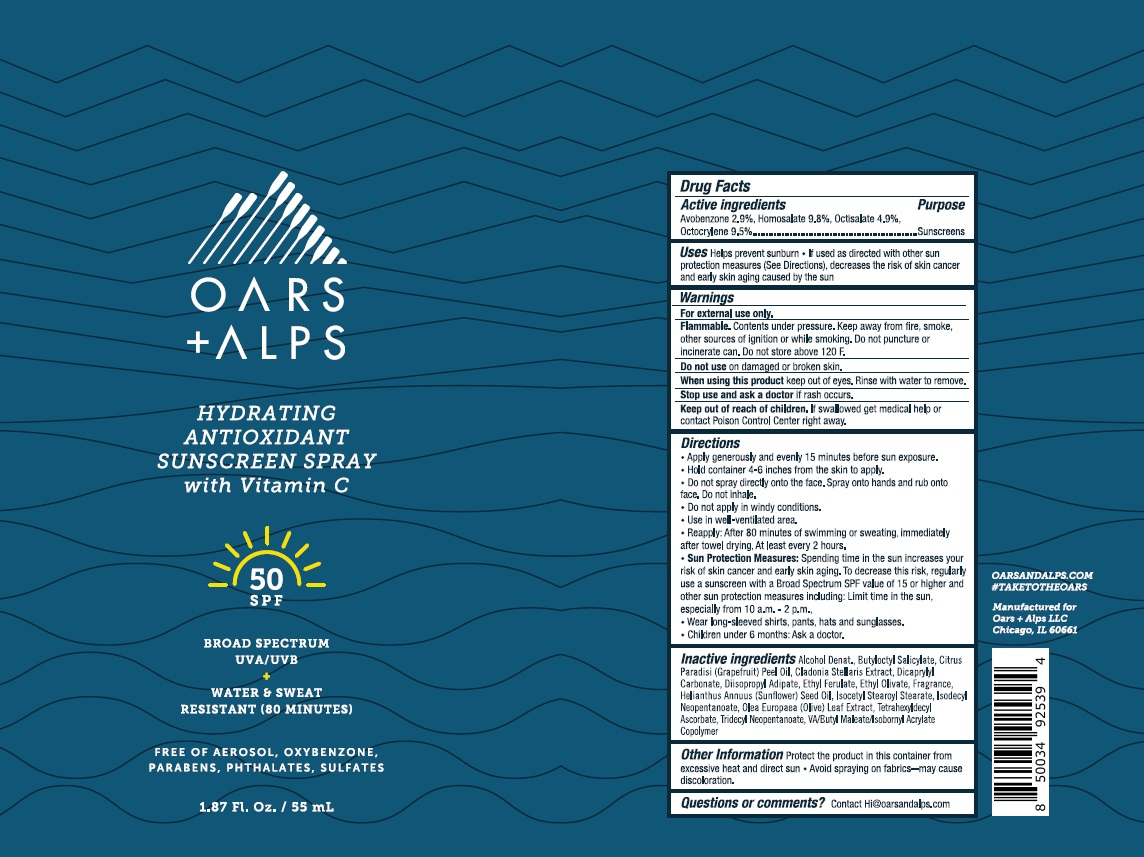
Oars and Alps SPF 50 Hydrating Antioxidant SunscreenSpray Avobenzone, Homosalate, Octisalate, Octocrylene 2.9 g/100mL; 9.8 g/100mL; 4.9 g/100mL; 9.5 g/100mL Spray, 177 mL — NDC 83046-360-13 (Billing 83046-0360-13)
This is a package of 177 mL of Oars and Alps SPF 50 Hydrating Antioxidant SunscreenSpray Avobenzone, Homosalate, Octisalate, Octocrylene 2.9 g/100mL; 9.8 g/100mL; 4.9 g/100mL; 9.5 g/100mL Spray from Oars and Alps LLC, marketed since Jan 2021 and currently FDA-listed. It is the main listing for this product, which comes in 2 package sizes.
Identity & classification
Regulatory identifiers FDA, NLM and CMS codes for this package
Where does this data come from?
- FDA openFDA NDC Directory · synced Oct 1, 2026
- FDA label on DailyMed · label index refreshed Oct 1, 2026
- RxNorm (NLM RxNav) · catalog refreshed Oct 1, 2026
- Medi-Span GPI (licensed)
- First Databank (licensed) · refreshed Oct 1, 2026
Clinical
Oars and Alps SPF 50 Hydrating Antioxidant Sunscreen is a topical spray sunscreen marketed as an over-the-counter monograph product. It contains four UV-filtering agents (avobenzone, homosalate, octisalate, and octocrylene) that are typically used together to absorb and reflect ultraviolet rays from the sun. This type of product is commonly applied to exposed skin to help protect against sunburn and sun damage. The spray formulation allows for convenient application over larger body areas.
Patient education
Supplement & herbal interactions
Where does this data come from?
- MedlinePlus (NLM) · refreshed Oct 1, 2026
- FDA label on DailyMed · label index refreshed Oct 1, 2026
Ask a licensed pharmacist directly — free, answered by our team.
Pricing
A drug doesn't have one price. Each row is a different public payment system, and none is what you'd pay at the counter — that depends on your insurance. The ⓘ on each row explains what it measures.
| Price system | Per mL | Per package |
|---|---|---|
| Retail pharmacies payNADAC · weekly | Not in the retail survey — common for institutional, discontinued, or low-volume packs. | |
| Medicaid paysCMS SDUD · 12 mo | No recent Medicaid claims on file for this NDC — rare and low-volume NDCs are suppressed in the public data. | |
| Medicare drug plans payPart D · quarterly | No Part D plan price is available for this NDC in our data. | |
Where does this data come from?
- CMS NADAC weekly file
- CMS ASP pricing files · refreshed Sep 20, 2026
- CMS Medicaid State Drug Utilization Data · refreshed Oct 3, 2026
- CMS Part D plan pricing files · refreshed Sep 24, 2026
- VA National Acquisition Center price file
Packaging — all sizes for this product
| Package NDC | Description | Marketing start | Marketing end | Status |
|---|---|---|---|---|
| 83046-0360-13 You're viewing this Main listing | 177 mL in 1 CAN | 2021-01-01 | — | Active |
| 83046-0360-14 83046-360-14 | 55 mL in 1 CAN | 2023-01-01 | — | Active |
You're viewing the largest of 2 pack sizes for this product.
Pack size FAQ
What quantity is in this package?
How does this package differ from NDC 83046-0360-14?
What NDC number is used to bill for this package of Oars and Alps SPF 50 Hydrating Antioxidant SunscreenSpray Avobenzone, Homosalate, Octisalate, Octocrylene 2.9 g/100mL; 9.8 g/100mL; 4.9 g/100mL; 9.5 g/100mL Spray?
Therapeutic equivalents
| Product | Labeler | Pack | NADAC/unit | TE | Status | Price vs. this |
|---|---|---|---|---|---|---|
| Oars and Alps SPF 70 Hydrating Antioxidant Sunscreen 2.9 g/100mL; 9.8 g/100mL; 4.9 g/100mL; 9.5 g/100mL 83046-0370-13 | Oars | 177 ml | — | — | FDA listed | — |
| Oars and Alps SPF 50 Hydrating Antioxidant SunscreenSpray 2.9 g/100mL; 9.8 g/100mL; 4.9 g/100mL; 9.5 g/100mLthis 83046-0360-13 | Oars | 177 ml | — | — | FDA listed | — |
Where does this data come from?
- FDA openFDA NDC Directory · synced Oct 1, 2026
- FDA Orange Book · refreshed Sep 3, 2026
- CMS NADAC weekly file
Availability & generic status
We did not find an FDA-approved generic match for this exact strength, form and route.
Where does this data come from?
- FDA Orange Book · refreshed Sep 3, 2026
Inactive Ingredients / Excipients
Inactive ingredients, also called excipients, are components of the drug product other than the active ingredient. They may include fillers, dyes, coatings, preservatives, flavors, or other formulation ingredients.
💡 Tap an ingredient (hover on desktop) to see what it is and why it’s used.
-
UNII 3K9958V90M
A liquid solvent derived from fermentation or chemical synthesis. In medicines, alcohol dissolves active ingredients, helps preserve the product, and improves how the body absorbs certain drugs.
-
UNII 2EH13UN8D3
A synthetic compound used as a solvent and penetration enhancer in topical formulations. It helps dissolve active ingredients and allows them to penetrate the skin more effectively.
-
UNII O21ZF987XQ
A lichen derived from the reindeer moss plant. It acts as a thickener and stabilizer in medicines, helping maintain consistent texture and prevent separation of ingredients.
-
UNII 4X371TMK9K
Dibutyl maleate is a synthetic chemical compound used as a plasticizer and solvent in pharmaceutical formulations. It helps soften and improve the flexibility of coatings and film-forming ingredients in medicines.
-
UNII 609A3V1SUA
A silky liquid derived from caprylic acid that acts as an emollient and solvent in formulations. It helps dissolve active ingredients and improves the spreadability and feel of lotions, creams, and topical products.
-
UNII P7E6YFV72X
Diisopropyl adipate is a clear, oily liquid derived from adipic acid. It acts as a plasticizer and solvent in medicines, helping soften coatings and improve how the drug dissolves or spreads in the body.
-
UNII 5B8915UELW
A plant-derived compound used as an antioxidant in medicines. It helps prevent spoilage and degradation of active ingredients during storage by protecting them from oxidative damage.
-
UNII KKJ108Y20W
Ethyl olivate is a plant-derived compound made from olive oil. It works as an emulsifier and solvent to help mix oil and water ingredients together in the medicine.
-
UNII YR377U58W9
Grapefruit oil is a natural aromatic extract from grapefruit peel. It's used in medicines as a flavoring agent to improve taste and sometimes as a fragrance component.
-
UNII IX0PRH184P
A synthetic compound made from borneol and acrylic acid, used as a film-forming agent and binder in pharmaceutical coatings and adhesive formulations to help create protective layers on tablets or control drug release.
-
UNII IJV4LS383R
A synthetic waxy ester made from fatty acids and alcohols, used as an emollient and emulsifier to help blend oil and water components together and soften the product texture.
-
UNII W60VYE24XC
A synthetic oily compound used as an emollient and solvent in topical medicines. It helps soften the skin, improve product spreadability, and dissolve active ingredients for better absorption through the skin.
-
UNII MJ95C3OH47
A plant extract from olive leaves used in formulations as an antioxidant and preservative. It helps protect the medicine from degradation and extend shelf life.
-
UNII 3W1JG795YI
Sunflower oil is a natural vegetable oil derived from sunflower seeds. It serves as a solvent, lubricant, and carrier in medicines, helping dissolve active ingredients and improve how the medication flows and absorbs in the body.
-
UNII 9LBV3F07AZ
A synthetic, oil-soluble form of vitamin C used as an antioxidant to prevent degradation of the medicine and maintain its stability during storage.
-
UNII 3Z8H1DA7J5
A synthetic oily compound used as an emollient and lubricant in topical medicines. It helps soften the skin and allows smooth application of the medication across the affected area.
-
UNII L9MK238N77
Vinyl acetate is a synthetic polymer used primarily as a film-coating agent in tablets and capsules. It helps create a smooth, protective outer layer that controls how quickly the medicine dissolves and improves appearance.
17 inactive ingredients listed in the exact product block matched to this NDC.
Label-section wording can be broader than the structured product block and may mention additional formulation ingredients.
Where does this data come from?
ingredient classCode="IACT" elements from the exact product block matched by this NDC. Label-section narrative from DailyMed / the openFDA label index is shown separately when available.- FDA label on DailyMed · label index refreshed Oct 1, 2026
- FDA openFDA NDC Directory · synced Oct 1, 2026
Inactive ingredient FAQ
Are inactive ingredients the same for every manufacturer?
Why might an inactive ingredient be missing?
Can inactive ingredients matter?
Manufacturer & labeler
Where does this data come from?
- FDA openFDA NDC Directory · synced Oct 1, 2026
- Drugs@FDA
FDA label — Drug Facts FDA SPL
🎯 Indications and Usage ▾
Uses • Helps prevent sunburn • If used as directed with other sun protection measures (see Directions), decreases the risk of skin cancer and early skin aging caused by the sun.
⏱️ Dosage and Administration ▾
Directions Apply generously and evenly 15 minutes before sun exposure Hold container 4-6 inches from the skin to apply Do not spray directly onto the face. Spray onto hands and rub onto face. Do not inhale.
Do not apply in windy conditions. Use in well ventilated area. Reapply: After 80 minutes of swimming or sweating, immedately after towl drying, at least every 2 hours.
Sun Protection Measures: Spending time in the sun increases your risk of skin cancer and early skin aging. To decrease this risk, regularly use a sunscreen with a Broad Spectrum SPF value of 15 or higher and other sun protection measures including: • Limit time in the sun especially from 10 a.m. – 2 p.m. • Wear long-sleeved shirts, pants, hats, and sunglasses. Children under six months: Ask a doctor.
⚠️ Warnings ▾
For external use only. Flammable. Contents under pressure. Keep away from fire, smoke, other sources of ignition or while smoking. Do not puncture of incinerate can. Do not store above 120 F. Do not use on damaged or broken skin. When using this product keep out of eyes. Rinse with water to remove. Stop use and ask a doctor if rash occurs.
🧪 Active Ingredient ▾
Avobenzone - 2.9% Homosalate - 9.8% Octisalate - 4.9% Octocrylene - 9.5%
🧪 Inactive Ingredients ▾
Alcohol Denat., Butyloctyl Salicylate, Citrus Paradisi (Grapefruit) Peel Oil, Cladonia Stellaris Extract, Dicaprylyl Carbonate, Diisopropyl Adipate, Ethyl Ferulate, Ethyl Olivate, Fragrance, Helianthus Annuus (Sunflower) Seed Oil, Isocetyl Stearoyl Stearate, Isodecyl Neopentanoate, Olea Europaea (Olive) Leaf Extract, Tetrahexyldecyl Ascorbate, Tridecyl Neopentanoate, VA/Butyl Maleate/Isobornyl Acrylate Copolymer
🎯 Purpose ▾
Sunscreen
📄 Keep Out of Reach of Children ▾
Keep out of reach of children . If swallowed, get medical help or contact a Poison Control Center right away.
📄 Other Information ▾
Protect the product in this container from excessive heat and direct sun Avoid spraying on facbrics - may cause discoloration
📄 Questions or Comments ▾
Contact [email protected]
📄 Package Label / Principal Display Panel ▾
2 1
About this NDC listing & data coverage
What data is (and isn’t) available for this NDC — tap to expand
| NDC identity (package / product / labeler codes) | ✓ Available |
| Labeler | ✓ Available |
| Product & package description | ✓ Available |
| Marketing category & status | ✓ Available |
| Active ingredient / dosage form / route | ✓ Available |
| FDA label (SPL via DailyMed) | ✓ Available |
| Package photos | ✓ Available |
| Inactive ingredients (structured) | ✓ Available |
| NADAC pharmacy acquisition price (CMS) | — Not published for this NDC CMS publishes NADAC only for NDCs reported in its retail-pharmacy survey. |
| Orange Book / therapeutic-equivalence data | — Not published for this NDC Applies only to products approved under an NDA/ANDA; many listings are out of scope. |
| HCPCS J-code billing crosswalk | — Not published for this NDC Most self-administered / retail products have no J-code — that is normal. |
| Medicaid utilization (CMS SDUD) | — Not published for this NDC CMS reports utilization only for NDCs with Medicaid claims above its privacy threshold. |