
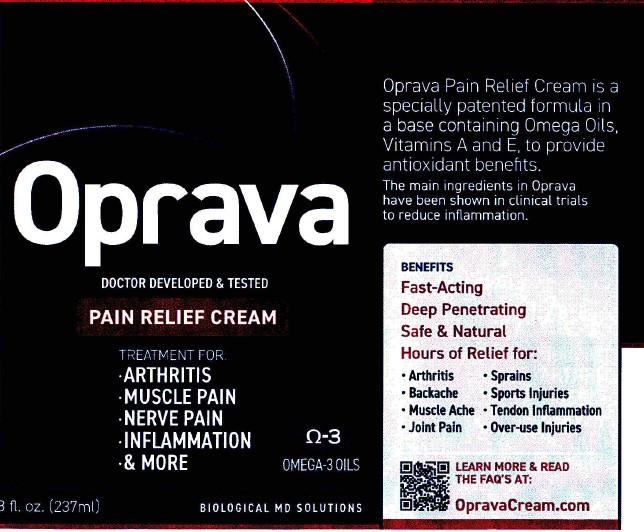
OPRAVA METHYL SALICYLATE, MENTHOL, CAPSAICIN 10 g/100mL; .03 g/100mL; 1 g/100mL Cream, 237 mL — NDC 83538-102-18 (Billing 83538-0102-18)
This is a package of 237 mL of OPRAVA METHYL SALICYLATE, MENTHOL, CAPSAICIN 10 g/100mL; .03 g/100mL; 1 g/100mL Cream from Biological M.D. Solutions LLC, marketed since Aug 2023 and currently FDA-listed. It is this product's only package size.
NDC database record
One package, one record: these facts belong to NDC 83538-102-18 alone.
- Record
- FDA NDC Directory package listing · Human OTC drug
- Code segments
- 83538 labeler · 102 product · 18 package
- Package marketed since
- Aug 8, 2023
- Sample package
- No — commercial package
- Listing certified through
- Dec 31, 2026
- Barcode (UPC-A, from the NDC)
- 3 8353810218 8
- FDA record last changed
- Aug 27, 2026
Identity & classification
Regulatory identifiers FDA, NLM and CMS codes for this package
- RxCUI (RxNorm): 2644111
Where does this data come from?
- FDA openFDA NDC Directory · synced Oct 1, 2026
- FDA label on DailyMed · label index refreshed Oct 5, 2026
- RxNorm (NLM RxNav) · catalog refreshed Oct 1, 2026
- Medi-Span GPI (licensed)
- First Databank (licensed) · refreshed Oct 1, 2026
RxNorm drug class
This medicine belongs to the Capsaicin and similar agents class.
Where does this data come from?
- RxClass (NLM) · catalog refreshed Oct 1, 2026
Clinical
Oprava is a topical cream containing three active ingredients commonly used in over-the-counter pain-relief products. Methyl salicylate and menthol are typically included to produce a warming or cooling sensation and are believed to help relieve minor muscle and joint aches. Capsaicin, a compound found in hot peppers, is commonly used in topical products for similar purposes. This is an OTC monograph drug, meaning it is marketed under FDA's established rules for its product category rather than through individual product approval.
Patient education
Supplement & herbal interactions
Where does this data come from?
- MedlinePlus (NLM) · refreshed Oct 1, 2026
- FDA label on DailyMed · label index refreshed Oct 5, 2026
Ask a licensed pharmacist directly — free, answered by our team.
Pricing
A drug doesn't have one price. Each row is a different public payment system, and none is what you'd pay at the counter — that depends on your insurance. The ⓘ on each row explains what it measures.
| Price system | Per g | Per package |
|---|---|---|
| Retail pharmacies payNADAC · weekly | Not in the retail survey — common for institutional, discontinued, or low-volume packs. | |
| Medicaid paysCMS SDUD · 12 mo | No recent Medicaid claims on file for this NDC — rare and low-volume NDCs are suppressed in the public data. | |
| Medicare drug plans payPart D · quarterly | No Part D plan price is available for this NDC in our data. | |
Where does this data come from?
- CMS NADAC weekly file
- CMS ASP pricing files · refreshed Sep 20, 2026
- CMS Medicaid State Drug Utilization Data · refreshed Oct 5, 2026
- CMS Part D plan pricing files · refreshed Sep 24, 2026
- VA National Acquisition Center price file
Packaging — all sizes for this product
| Package NDC | Description | Marketing start | Marketing end | Status |
|---|---|---|---|---|
| 83538-0102-18 You're viewing this Main listing | 237 mL in 1 BOTTLE | 2023-08-08 | — | Active |
Therapeutic equivalents
| Product | Labeler | Pack | NADAC/unit | TE | Status | Price vs. this |
|---|---|---|---|---|---|---|
| Med O-3 Bio- 10 g/100mL; .03 g/100mL; 1 g/100mL 83538-0101-18 | Biological | 237 ml | — | — | FDA listed | — |
| Oprava 10 g/100mL; .03 g/100mL; 1 g/100mLthis 83538-0102-18 | Biological | 237 ml | — | — | FDA listed | — |
Where does this data come from?
- FDA openFDA NDC Directory · synced Oct 1, 2026
- FDA Orange Book · refreshed Oct 3, 2026
- CMS NADAC weekly file
Availability & generic status
We did not find an FDA-approved generic match for this exact strength, form and route.
Where does this data come from?
- FDA Orange Book · refreshed Oct 3, 2026
Inactive Ingredients / Excipients
Inactive ingredients, also called excipients, are components of the drug product other than the active ingredient. They may include fillers, dyes, coatings, preservatives, flavors, or other formulation ingredients.
💡 Tap an ingredient (hover on desktop) to see what it is and why it’s used.
-
UNII 9E8X80D2L0
A synthetic form of vitamin E used as an antioxidant and preservative in medications. It helps prevent the active ingredients from degrading when exposed to oxygen or light.
-
UNII ZY81Z83H0X
Aloe vera leaf is a plant extract derived from the aloe plant. It is used in medicines as a natural moisturizer and skin-soothing agent in topical formulations.
-
UNII 15NDG5B709
Atlantic salmon oil is a fish-derived oil rich in omega-3 fatty acids. It's used as a supplement ingredient and may serve as a lubricant or emollient in formulations.
-
UNII F8XAG1755S
A plant-derived oil from borage seeds, rich in fatty acids. It's used in formulations as an emollient and skin-conditioning agent to help maintain moisture and improve texture.
-
UNII 0A5MM307FC
A synthetic polymer that absorbs water and forms a thick, gel-like substance. In medicines, it works as a thickener and stabilizer to improve texture and help ingredients stay mixed together in creams, gels, and lotions.
-
UNII 2DMT128M1S
A waxy solid derived from plant or animal sources. It acts as an emulsifier to blend oil and water components, and also thickens the medicine to give it the right texture and consistency.
-
UNII 936JST6JCN
Cetyl alcohol is a waxy, fatty substance derived from plant or animal sources. It acts as an emulsifier and thickener in medicines, helping blend oil and water components and giving products a smooth, creamy texture.
-
UNII MP1J8420LU
A salt derived from edetic acid that binds to trace metals in medicines. It serves as a chelating agent and preservative to prevent metal-catalyzed breakdown of the drug and extend shelf life.
-
UNII 2R04ONI662
Eucalyptus oil is a fragrant liquid extracted from eucalyptus tree leaves. It's used in medicines as a flavor, scent, or soothing agent in topical products and cough preparations.
-
UNII 6YSS42VSEV
Fructose is a natural sugar derived from fruits and plants. It's used in medicines as a sweetener and filler to improve taste and add bulk to tablets or syrups.
-
UNII 930MLC8XGG
A plant oil extracted from grape seeds, used as an emollient and solvent in medicines. It helps dissolve active ingredients and improve the texture and absorption of topical or liquid formulations.
-
UNII ZBP1YXW0H8
A fragrant oil extracted from lavender plants, used as a flavoring and scent agent in medicines to improve taste and aroma.
-
UNII A2I8C7HI9T
Methylparaben is a preservative derived from benzoic acid that prevents growth of bacteria, fungi, and mold in medicines. It extends the product's shelf life and maintains safety during storage.
-
UNII 6UYK2W1W1E
A natural oil extracted from olives. It acts as an emollient and lubricant in formulations, helping to soften ingredients and improve how the medicine spreads or flows.
-
UNII HIE492ZZ3T
Phenoxyethanol is a synthetic preservative and antimicrobial agent used to prevent bacterial and fungal growth in medicines and cosmetic products, extending shelf life and maintaining product safety.
-
UNII CAL22UVI4M
A synthetic emulsifier derived from sorbitol and fatty acids. It helps mix oil and water-based ingredients together and improves the texture and stability of the medicine.
-
UNII 6DC9Q167V3
Propylene glycol is a clear liquid derived from petroleum or vegetable sources. It acts as a solvent, humectant, and preservative in medicines, helping dissolve active ingredients and maintain product stability.
-
UNII Z8IX2SC1OH
Propylparaben is a chemical preservative used to prevent bacterial and fungal growth in medicines and personal care products. It helps extend shelf life and maintain product safety during storage.
-
UNII 55X04QC32I
A strong alkaline chemical used to adjust and maintain the pH balance of liquid medicines. It helps keep the medicine stable and ensures it stays effective during storage.
-
UNII GW89575KF9
Squalane is a lightweight oil derived from plant sources or synthesized. It acts as an emollient and lubricant in formulations, helping ingredients blend smoothly and improving product texture and spreadability.
-
UNII 4ELV7Z65AP
Stearic acid is a fatty acid derived from plant or animal sources. It acts as a binder and lubricant in tablets and capsules, helping them hold together and flow smoothly during manufacturing.
-
UNII 2KR89I4H1Y
Stearyl alcohol is a waxy, fatty substance derived from natural oils or made synthetically. It acts as an emulsifier and thickener in medicines, helping mix ingredients together and give the product the right texture.
-
UNII R0ZB2556P8
Tocopherol is a form of vitamin E derived from plant oils. It acts as an antioxidant in medicines to prevent oils and fats from breaking down and spoiling during storage.
-
UNII 059QF0KO0R
Water is a liquid solvent that dissolves and mixes ingredients together in liquid medicines, syrups, and injections. It helps distribute the active drug evenly throughout the product.
24 inactive ingredients listed in the exact product block matched to this NDC.
Label-section wording can be broader than the structured product block and may mention additional formulation ingredients.
Where does this data come from?
ingredient classCode="IACT" elements from the exact product block matched by this NDC. Label-section narrative from DailyMed / the openFDA label index is shown separately when available.- FDA label on DailyMed · label index refreshed Oct 5, 2026
- FDA openFDA NDC Directory · synced Oct 1, 2026
Inactive ingredient FAQ
Are inactive ingredients the same for every manufacturer?
Why might an inactive ingredient be missing?
Can inactive ingredients matter?
Manufacturer & labeler
More NDCs from Biological M.D. Solutions LLC labeler code 83538
Where does this data come from?
- FDA openFDA NDC Directory · synced Oct 1, 2026
- Drugs@FDA
FDA label — Drug Facts FDA SPL
🎯 Indications and Usage ▾
USES TEMPORARILY RELIEVES ARTHRITIS MUSCLE PAIN INFLAMMATION
⏱️ Dosage and Administration ▾
DIRECTIONS APPLY GENEROUSLY. GENTLY MASSAGE INTO PAINFUL AREA UNTIL THOROUGHLY ABSORBED. REPEAT AS NECESSARY, UP TO FOUR TIMES DAILY. PRODUCT CAN BE USED WITH A WRAP.
⚠️ Warnings ▾
WARNING FOR EXTERNAL USE ONLY. AVOID CONTACT WITH EYES, MUCOUS MEMBRANES AND BROKEN OR IRRITATED SKIN. IF CONDITION WORSENS, OR IF SYMPTOMS PERSIST FOR MORE THAN 7 DAYS, OR IF REDNESS IS PRESENT, DISCONTINUE USE AND CONSULT A PHYSICIAN. USE ONLY AS DIRECTED. NOT FOR USE IN CHILDREN UNDER 12 YEARS OF AGE.
📦 Storage and Handling ▾
STORE AT CONTROLLED ROOM TEMPERATURE. 59° - 86°F (15° - 30°C).
🧪 Active Ingredient ▾
ACTIVE INGREDIENTS METHYL SALICYLATE 10% MENTHOL 1% CAPSAICIN 0.03%
🧪 Inactive Ingredients ▾
INACTIVE INGREDIENTS ALOE VERA, VITAMINS A AND E, ANTIOXIDANTS, ALOE BARBADENSIS LEAF JUICE, BORAGE OIL, CARBOMER, CETEARYL ALCOHOL, CETYL ALCOHOL, DEIONIZED WATER, EUCALYPTUS GLOBULUS LEAF OIL, FRUCTOSE, LAVANDULA ANGUSTIFOLIA (LAVENDER) OIL, METHYL PARABEN, OLEA EUROPAEA (OLIVE) FRUIT OIL, PHENOXYETHANOL, POLYSORBATE-60, PROPYL PARABEN, PROPYLENE GLYCOL, SALMON OIL, SODIUM HYDROXIDE, SQUALANE, STEARYL ALCOHOL, STEARIC ACID, TETRASODIUM EDTA, TOCOPHEROL, TOCOPHERYL ACETATE, VITIS VINIFERA (GRAPE) SEED OIL
🎯 Purpose ▾
PURPOSE FOR TEMPORARY PAIN RELIEF
📄 Keep Out of Reach of Children ▾
KEEP OUT OF REACH OF CHILDREN. IF SWALLOWED, SEEK PROFESSIONAL ASSISTANCE OR CALL A POISON CONTROL CENTER IMMEDIATELY.
📄 Package Label / Principal Display Panel ▾
PDP DF1 DF2
About this NDC listing & data coverage
What data is (and isn’t) available for this NDC — tap to expand
| NDC identity (package / product / labeler codes) | ✓ Available |
| Labeler | ✓ Available |
| Product & package description | ✓ Available |
| Marketing category & status | ✓ Available |
| Active ingredient / dosage form / route | ✓ Available |
| FDA label (SPL via DailyMed) | ✓ Available |
| Package photos | ✓ Available |
| Inactive ingredients (structured) | ✓ Available |
| NADAC pharmacy acquisition price (CMS) | — Not published for this NDC CMS publishes NADAC only for NDCs reported in its retail-pharmacy survey. |
| Orange Book / therapeutic-equivalence data | — Not published for this NDC Applies only to products approved under an NDA/ANDA; many listings are out of scope. |
| HCPCS J-code billing crosswalk | — Not published for this NDC Most self-administered / retail products have no J-code — that is normal. |
| Medicaid utilization (CMS SDUD) | — Not published for this NDC CMS reports utilization only for NDCs with Medicaid claims above its privacy threshold. |