
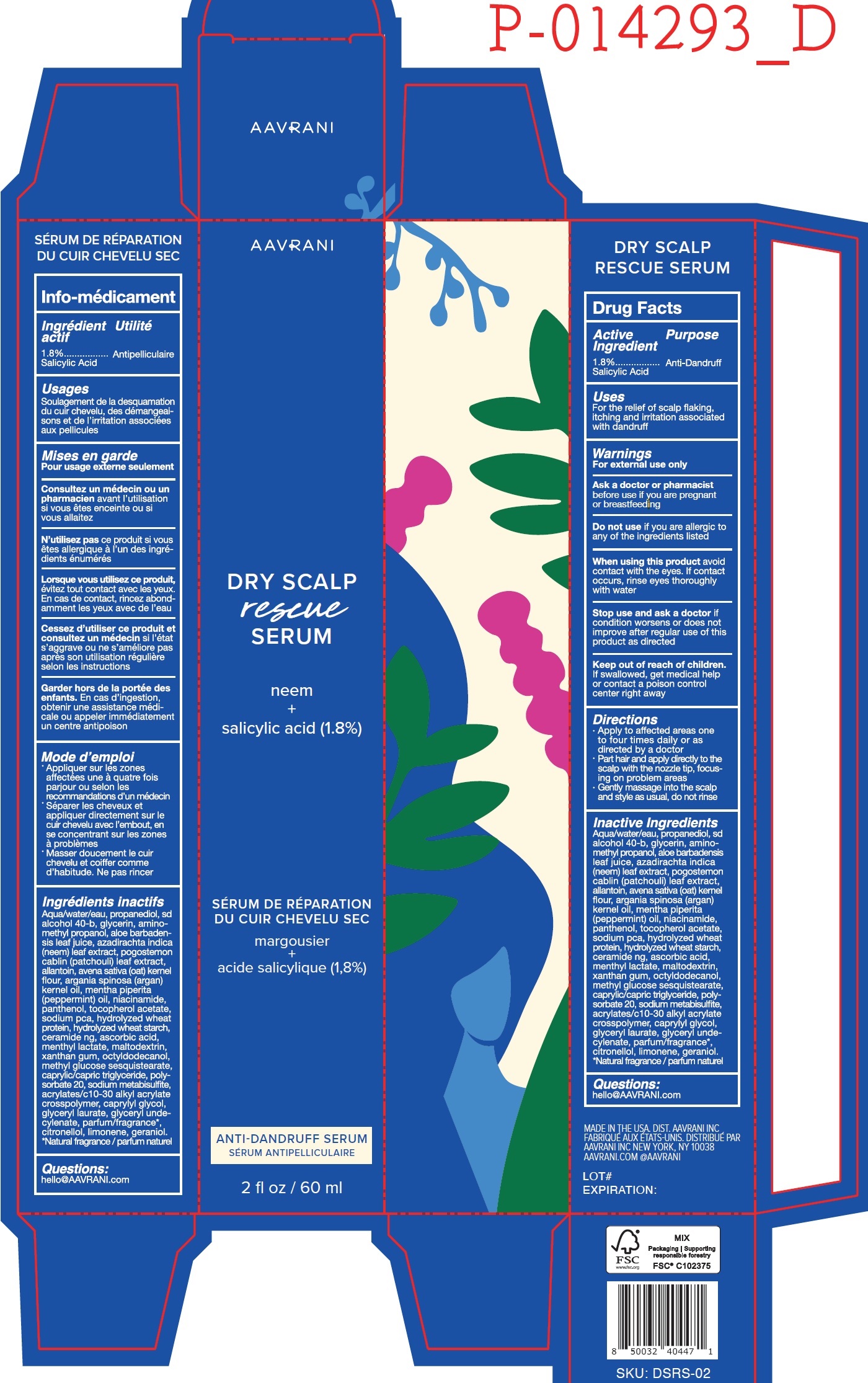
AAVRANI DRY SCALP RESCUE SERUM SALICYLIC ACID 18 mg/mL Liquid — NDC 83707-426-00 (Billing 83707-0426-00)
This is a package of AAVRANI DRY SCALP RESCUE SERUM SALICYLIC ACID 18 mg/mL Liquid from AAVRANI, INC., marketed since Oct 2023 and currently FDA-listed. It is this product's only package size.
Identity & classification
Regulatory identifiers FDA, NLM and CMS codes for this package
- RxCUI (RxNorm): 2627647
Where does this data come from?
- FDA openFDA NDC Directory · synced Oct 1, 2026
- FDA label on DailyMed · label index refreshed Oct 1, 2026
- RxNorm (NLM RxNav) · catalog refreshed Oct 1, 2026
- Medi-Span GPI (licensed)
- First Databank (licensed) · refreshed Oct 1, 2026
RxNorm drug class
This medicine belongs to the Salicylic acid and derivatives class.
Where does this data come from?
- RxClass (NLM) · catalog refreshed Oct 1, 2026
Clinical
Topical salicylic acid is used to help clear and prevent pimples and skin blemishes in people who have acne. Topical salicylic acid is also used to treat skin conditions that involve scaling or overgrowth of skin cells such as psoriasis (a skin disease in which red, scaly patches form on some areas of the body), ichthyoses (inborn conditions that cause skin dryness and scaling), dandruff, corns, calluses, and warts on the hands or feet. Topical salicylic acid should not be used to treat genital warts, warts on the face, warts with hair growing from them, warts in the nose or mouth, moles, or b...
Read the full MedlinePlus article ↗- It is used in a facial routine for acne-prone and oil-prone skin. The routine includes a cleanser, serum, toner and emulsion. Salicylic acid helps loosen and shed dead skin cells.
- Use the cleanser morning and evening, and the serum in the morning after cleansing. Use the toner in the evening on dry skin, and the emulsion at night after cleansing. Avoid your...
- Mild stinging, burning, itching, dryness and extra peeling can happen. If dryness or peeling bothers you, try using the serum or toner every other day. If it gets excessive, stop a...
- It is best not to. Using another topical acne medication at the same time makes irritation and dryness more likely. If you get irritated, use only one at a time.
Patient education
Supplement & herbal interactions
Where does this data come from?
- MedlinePlus (NLM) · refreshed Oct 1, 2026
- FDA label on DailyMed · label index refreshed Oct 1, 2026
Ask a licensed pharmacist directly — free, answered by our team.
Pricing
A drug doesn't have one price. Each row is a different public payment system, and none is what you'd pay at the counter — that depends on your insurance. The ⓘ on each row explains what it measures.
| Price system | Per mL | Per package |
|---|---|---|
| Retail pharmacies payNADAC · weekly | Not in the retail survey — common for institutional, discontinued, or low-volume packs. | |
| Medicaid paysCMS SDUD · 12 mo | No recent Medicaid claims on file for this NDC — rare and low-volume NDCs are suppressed in the public data. | |
| Medicare drug plans payPart D · quarterly | No Part D plan price is available for this NDC in our data. | |
Where does this data come from?
- CMS NADAC weekly file
- CMS ASP pricing files · refreshed Sep 20, 2026
- CMS Medicaid State Drug Utilization Data · refreshed Oct 3, 2026
- CMS Part D plan pricing files · refreshed Sep 24, 2026
- VA National Acquisition Center price file
Packaging — all sizes for this product
| Package NDC | Description | Marketing start | Marketing end | Status |
|---|---|---|---|---|
| 83707-0426-00 You're viewing this Main listing | 1 TUBE in 1 BOX / 60 mL in 1 TUBE | 2023-10-02 | — | Active |
Therapeutic equivalents
| Product | Labeler | Pack | NADAC/unit | TE | Status | Price vs. this |
|---|---|---|---|---|---|---|
| Kerastase Paris K Symbiose Serum Nuit Antipelliculaire Intensif Antidandruff Treatment 18 mg/mL 49967-0363-01 | L'Oreal | 1 bottle | — | — | FDA listed | — |
| Shea Moisture 1.8 g/100mL 64942-2391-01 | Conopco, | 118 ml | — | — | FDA listed | — |
| Aavrani Dry Scalp Rescue Serum 18 mg/mLthis 83707-0426-00 | AAVRANI, | 1 tube | — | — | FDA listed | — |
| Bubble Knock Out Acne Spot Treatment 18 mg/mL 83509-0002-01 | BUBBLE | 1 tube | — | — | FDA listed | — |
| Brickell Mens Products Relieving Anti-Dandruff 18 mg/mL 82247-0617-00 | BRICKELL | 237 ml | — | — | FDA listed | — |
Where does this data come from?
- FDA openFDA NDC Directory · synced Oct 1, 2026
- FDA Orange Book · refreshed Oct 3, 2026
- CMS NADAC weekly file
Availability & generic status
We did not find an FDA-approved generic match for this exact strength, form and route.
Where does this data come from?
- FDA Orange Book · refreshed Oct 3, 2026
Inactive Ingredients / Excipients
Inactive ingredients, also called excipients, are components of the drug product other than the active ingredient. They may include fillers, dyes, coatings, preservatives, flavors, or other formulation ingredients.
💡 Tap an ingredient (hover on desktop) to see what it is and why it’s used.
-
UNII 9E8X80D2L0
A synthetic form of vitamin E used as an antioxidant and preservative in medications. It helps prevent the active ingredients from degrading when exposed to oxygen or light.
-
UNII P01OUT964K
A fragrant plant-derived alcohol used as a flavoring agent and fragrance component in medicines. It provides taste and aroma to make the product more pleasant to use.
-
UNII 344S277G0Z
Allantoin is a naturally derived compound that helps soften and soothe skin. In medicines, it works as a skin-conditioning agent and may help support wound healing and reduce irritation in topical formulations.
-
UNII ZY81Z83H0X
Aloe vera leaf is a plant extract derived from the aloe plant. It is used in medicines as a natural moisturizer and skin-soothing agent in topical formulations.
-
UNII LU49E6626Q
A synthetic organic compound used as a pH buffer and neutralizing agent in medicines. It helps maintain the proper acidity level in liquid formulations to improve stability and comfort.
-
UNII 4V59G5UW9X
Argan oil is a plant-derived oil from argan tree kernels. It's used in medicines as an emollient and skin-conditioning agent to help soften and moisturize the product's texture.
-
UNII PQ6CK8PD0R
Ascorbic acid, also known as vitamin C, is a white crystalline powder. It serves as an antioxidant to prevent degradation of other ingredients and may also function as a preservative in the formulation.
-
UNII HKY915780T
A plant extract from the neem tree, used as a natural flavoring agent and preservative in medicines. It may help maintain product stability and add bitter taste characteristics.
-
UNII 00YIU5438U
Caprylyl glycol is a clear liquid derived from coconut oil. In medicines, it acts as a humectant to retain moisture, a preservative booster to prevent microbial growth, and a solvent to help dissolve or mix other ingredients.
-
UNII C04977SRJ5
Ceramide NG is a naturally occurring lipid compound that helps form protective barriers in skin and cosmetic formulations. It functions as an emollient and skin-conditioning agent, helping products retain moisture and maintain smooth texture.
-
UNII L837108USY
Geraniol is a natural fragrant compound found in plants like roses and lemons. It's used in medicines as a flavoring agent and to improve the taste or aroma of the product.
-
UNII PDC6A3C0OX
Glycerin is a clear, thick liquid derived from plant oils or fats. It acts as a humectant to retain moisture, a sweetener, and a solvent in medications.
-
UNII Y98611C087
Glyceryl laurate is an emulsifier made by combining glycerin and lauric acid. It helps mix oil and water-based ingredients together in the medicine and may improve how the product feels or spreads.
-
UNII GFD7C86Q1W
A natural oil extracted from citrus peels, (+)-limonene is used as a flavoring agent and solvent in medicines. It helps dissolve active ingredients and provides a lemon or orange taste.
-
UNII 7CVR7L4A2D
A starch-derived carbohydrate produced by breaking down corn, potato, or tapioca starch. It functions as a filler and binder to give the medicine bulk and texture, and sometimes as a mild sweetener or texture enhancer in powders and tablets.
-
UNII C9H2L21V7U
A fat derived from coconut or palm oil containing shorter fatty acid chains. It serves as a solvent and carrier to help dissolve or suspend active ingredients, improving absorption and stability in liquid formulations.
-
UNII 2BF9E65L7I
A chemical compound combining menthol with lactic acid. It's used in medicines as a flavoring agent and to provide a cooling or soothing sensation on the skin or mouth.
-
UNII V1YW10H14D
A waxy substance made from glucose and stearic acid that acts as an emulsifier and thickener in medicines, helping to blend ingredients together and create a smooth, stable texture in creams and ointments.
-
UNII 25X51I8RD4
Niacinamide is a form of vitamin B3, a water-soluble nutrient. In medicines, it may be added as a nutritional supplement or to support skin health, though its primary role here is as an active ingredient rather than a traditional inactive filler.
-
UNII Z6J799EAJK
Oat is a cereal grain used in medicines as a filler and binder. It helps give the medication its shape and structure while adding bulk to the formulation.
-
UNII 461N1O614Y
A synthetic oily liquid used as an emollient and solvent in medications. It helps dissolve active ingredients and improves how the medicine spreads or absorbs through the skin.
-
UNII WV9CM0O67Z
Panthenol is a humectant and skin-conditioning agent derived from pantothenic acid. It's added to medicines to help retain moisture and soothe skin irritation.
-
UNII AV092KU4JH
A natural oil extracted from peppermint plants. It's used as a flavoring agent to mask bitter tastes and add a refreshing mint flavor to medicines, making them easier to take.
-
UNII F3IN55X5PO
A plant-derived essential oil from patchouli leaves. It serves as a fragrance and flavoring agent to improve the taste and smell of the medicine.
-
UNII 7T1F30V5YH
A synthetic emulsifier derived from sorbitol and oleic acid. It helps mix oil and water-based ingredients together and keeps them from separating in liquid formulations.
-
UNII 5965N8W85T
Propanediol is a clear liquid organic compound derived from vegetable sources or synthesized chemically. It acts as a humectant to retain moisture, a solvent to dissolve active ingredients, and a preservative booster in liquid medications and supplements.
-
UNII 4VON5FNS3C
Sodium metabisulfite is a preservative derived from sulfur compounds. It prevents microbial growth and oxidation in medicines, helping extend shelf life and maintain product stability.
-
UNII 469OTG57A2
Sodium pyrrolidone carboxylate is a synthetic polymer derived from pyrrolidone chemistry. It functions as a solubilizer and binder in medications, helping dissolve poorly water-soluble drugs and hold tablet ingredients together.
-
UNII 059QF0KO0R
Water is a liquid solvent that dissolves and mixes ingredients together in liquid medicines, syrups, and injections. It helps distribute the active drug evenly throughout the product.
-
UNII TTV12P4NEE
Xanthan gum is a thickening and stabilizing ingredient made from fermented corn or other sugars. It's added to medicines to improve texture, prevent separation of liquids and solids, and help the product stay consistent.
30 inactive ingredients listed in the exact product block matched to this NDC.
Label-section wording can be broader than the structured product block and may mention additional formulation ingredients.
Where does this data come from?
ingredient classCode="IACT" elements from the exact product block matched by this NDC. Label-section narrative from DailyMed / the openFDA label index is shown separately when available.- FDA label on DailyMed · label index refreshed Oct 1, 2026
- FDA openFDA NDC Directory · synced Oct 1, 2026
Inactive ingredient FAQ
Are inactive ingredients the same for every manufacturer?
Why might an inactive ingredient be missing?
Can inactive ingredients matter?
Manufacturer & labeler
Where does this data come from?
- FDA openFDA NDC Directory · synced Oct 1, 2026
- Drugs@FDA
FDA label — Drug Facts FDA SPL
🎯 Indications and Usage ▾
Uses For the relief of scalp flaking, itching and irritation associated with dandruff
⏱️ Dosage and Administration ▾
Directions Apply to affected areas one to four times daily or as directed by a doctor Part hair and apply directly to the scalp with the nozzle tip, focusing on problem areas Gently massage into the scalp and style as usual, do not rinse
⚠️ Warnings ▾
Warnings For external use only As a doctor or pharmacist before use if you are pregnant or breastfeeding Do not use if you are allergic to any of the ingredients listed When using this product avoid contact with the eyes. If contact occurs, rinse eyes thoroughly with water Stop use and ask a doctor if condition worsens or does not improve after regular use of this product as directed Keep out of reach of children. If swallowed, get medical help or contact a poison control center right away.
🧪 Active Ingredient ▾
Active Ingredient 1.8% Salicylic Acid Purpose Anti-Dandruff
🧪 Inactive Ingredients ▾
Inactive Ingredients Aqua/water/eau, propanediol, sd alcohol 40-b, glycerin, aminomethyl propanol, aloe barbadensis leaf juice, azadirachta indica (neem) leaf extract, pogostemon cablin (patchouli) leaf extract, allantoin, avena sativa (oat) kernel flour, argania spinosa (argan) kernel oil, mentha piperita (peppermint) Oil, niacinamide, panthenol, tocopherol acetate, sodium pca, hydrolyzed wheat protein, hydrolyzed wheat starch, ceramide ng, ascorbic acid, menthyl lactate, maltodextrin, xanthan gum, octyldodecanol, methyl glucose sesquistearate, caprylic/capric triglyceride, polysorbate 20, sodium metabisulfite, acrylates/c 10-30 alkyl acrylate crosspolymer, caprylyl glycol, glyceryl laurate, glyceryl undecylenate, parfum/fragrance*, citronellol, limonene, geraniol.*Natural fragrance/parfum naturel
🎯 Purpose ▾
Purpose Anti-Dandruff
📄 Do Not Use ▾
Do not use if you are allergic to any of the ingredients listed
📄 When Using This Product ▾
When using this product avoid contact with the eyes. If contact occurs, rinse eyes thoroughly with water
📄 Stop Use and Ask a Doctor If ▾
Stop use and ask a doctor if condition worsens or does not improve after regular use of this product as directed
🤰 If Pregnant or Breast-Feeding ▾
As a doctor or pharmacist before use if you are pregnant or breastfeeding
📄 Keep Out of Reach of Children ▾
Keep out of reach of children. If swallowed, get medical help or contact a poison control center right away.
📄 Questions or Comments ▾
Questions: [email protected]
📄 Package Label / Principal Display Panel ▾
Package Labeling: Label0
Medicare Part D spend CMS · PART D · 2026 (Q1)
Reported adverse events (FAERS)
Top reported reactions
Reporter sex
Where does this data come from?
About this NDC listing & data coverage
What data is (and isn’t) available for this NDC — tap to expand
| NDC identity (package / product / labeler codes) | ✓ Available |
| Labeler | ✓ Available |
| Product & package description | ✓ Available |
| Marketing category & status | ✓ Available |
| Active ingredient / dosage form / route | ✓ Available |
| FDA label (SPL via DailyMed) | ✓ Available |
| Package photos | ✓ Available |
| Inactive ingredients (structured) | ✓ Available |
| NADAC pharmacy acquisition price (CMS) | — Not published for this NDC CMS publishes NADAC only for NDCs reported in its retail-pharmacy survey. |
| Orange Book / therapeutic-equivalence data | — Not published for this NDC Applies only to products approved under an NDA/ANDA; many listings are out of scope. |
| HCPCS J-code billing crosswalk | — Not published for this NDC Most self-administered / retail products have no J-code — that is normal. |
| Medicaid utilization (CMS SDUD) | — Not published for this NDC CMS reports utilization only for NDCs with Medicaid claims above its privacy threshold. |