
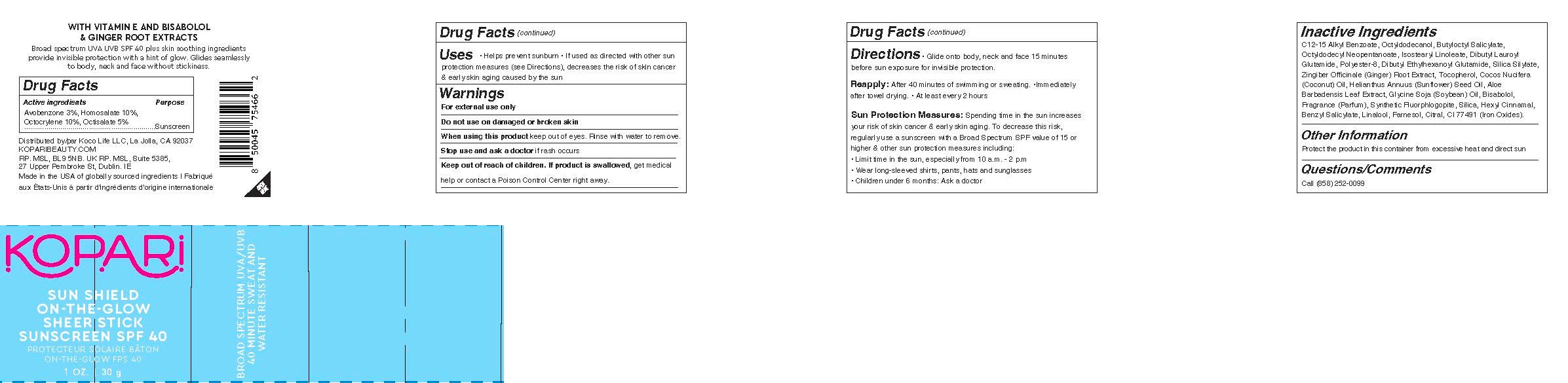
Sun Shield On-the-Glow Sheer Stick SPF40 Avobenzone, Homosalate, Octocrylene, Octisalate 10 g/100g; 5 g/100g; 3 g/100g; 10 g/100g Stick, 30 g
🆔 Identity & classification
Where does this data come from?
🏭 Manufacturer & labeler
Where does this data come from?
🩺 Clinical
Sun Shield On-the-Glow Sheer Stick SPF40 is a topical sunscreen stick marketed as an OTC monograph drug. It contains four active ingredients that function as ultraviolet (UV) filters: avobenzone, homosalate, octisalate, and octocrylene. These ingredients are typically used together in sunscreen products to absorb and scatter UV radiation from the sun. The stick form is designed for convenient, portable application to exposed skin areas.
Patient education
Supplement & herbal interactions
Where does this data come from?
Ask a licensed pharmacist directly — free, answered by our team.
🧪 Inactive Ingredients / Excipients
Inactive ingredients, also called excipients, are components of the drug product other than the active ingredient. They may include fillers, dyes, coatings, preservatives, flavors, or other formulation ingredients.
💡 Tap an ingredient (hover on desktop) to see what it is and why it’s used.
-
UNII 7X6O37OK2I
A synthetic fragrance compound used as a flavoring agent or aromatic component in medicines. It adds pleasant taste or smell to make the medication more acceptable to patients.
-
UNII A9EJ3J61HQ
A synthetic liquid derived from benzoic acid and long-chain alcohols. It functions as a solvent and penetration enhancer in topical formulations, helping active ingredients dissolve and absorb into the skin.
-
UNII ZY81Z83H0X
Aloe vera leaf is a plant extract derived from the aloe plant. It is used in medicines as a natural moisturizer and skin-soothing agent in topical formulations.
-
UNII WAO5MNK9TU
Benzyl salicylate is a fragrant chemical compound used as a flavor and scent ingredient in medicines. It helps mask unpleasant tastes or odors in liquid or oral formulations.
-
UNII 2EH13UN8D3
A synthetic compound used as a solvent and penetration enhancer in topical formulations. It helps dissolve active ingredients and allows them to penetrate the skin more effectively.
-
UNII T7EU0O9VPP
Citral is a natural oil compound found in lemon and citrus plants. It's used in medicines as a flavoring agent and to add pleasant lemon or citrus scent to the product.
-
UNII Q9L0O73W7L
Coconut oil is a natural fat extracted from coconut fruit. It's used in medicines as a lubricant, emollient, or carrier to help dissolve or deliver active ingredients smoothly through the formulation.
-
UNII 0IAF2L30VS
A synthetic chemical compound used as a plasticizer and conditioning agent in topical formulations. It helps soften and improve the flexibility of film coatings and suspensions applied to skin.
-
UNII 3V7K3IA58X
A synthetic compound derived from glutamic acid, used as an emulsifier and skin-conditioning agent in topical formulations to help blend oil and water components and improve product texture and spreadability.
-
UNII EB41QIU6JL
Farnesol is a natural fragrant compound found in plants. It's used in medicines as a preservative and flavoring agent to improve taste and help prevent microbial growth.
-
UNII 1K09F3G675
Ferric oxide red is an inorganic iron compound used as a colorant in medicines. It gives tablets, capsules, or other dosage forms a red or reddish tint for identification and appearance.
-
UNII C5529G5JPQ
Ginger is a plant-derived ingredient used as a flavoring agent to add taste and aroma to medicines. It may also provide mild soothing properties to support product palatability.
-
UNII 4778M3HR0N
A plant-derived oil used as an emollient and lubricant in topical formulations. It helps soften the skin and improves how the medicine spreads and absorbs.
-
UNII 24WE03BX2T
Levomenol is a naturally derived alcohol compound used as a skin-conditioning and anti-inflammatory agent in topical formulations. It helps soothe and protect the skin while improving product texture and absorption.
-
UNII F4VNO44C09
Linalool is a natural fragrant compound found in flowers and plants. It's added to medicines as a flavor and scent agent to improve taste and aroma.
-
UNII YK3DC63Y5M
A mineral compound derived from natural or synthetic sources that acts as an anti-caking agent and flow aid. It helps prevent clumping and improves the powder's ability to flow smoothly during manufacturing and tablet formation.
-
UNII 461N1O614Y
A synthetic oily liquid used as an emollient and solvent in medications. It helps dissolve active ingredients and improves how the medicine spreads or absorbs through the skin.
-
UNII X8725R883T
A synthetic oily liquid derived from branched carboxylic acids, used as an emollient and skin-conditioning agent in topical formulations. It helps soften and smooth the product's texture while improving how it spreads on skin.
-
UNII T9296U138P
A synthetic polymer derived from polyester chemistry, modified with a cyanodiphenylpropenoyl cap. It serves as a film-former and binder in pharmaceutical formulations, helping create protective coatings on tablets or improving product consistency.
-
UNII ETJ7Z6XBU4
Silicon dioxide is a naturally occurring mineral used as a glidant and anti-caking agent. It helps powder ingredients flow smoothly and prevents clumping during manufacturing and storage.
-
UNII 241ATL177A
Soybean oil is a natural plant oil derived from soybean seeds. It's used in medicines as a solvent and carrier to help dissolve or suspend active ingredients and improve how the body absorbs them.
-
UNII 3W1JG795YI
Sunflower oil is a natural vegetable oil derived from sunflower seeds. It serves as a solvent, lubricant, and carrier in medicines, helping dissolve active ingredients and improve how the medication flows and absorbs in the body.
-
UNII R0ZB2556P8
Tocopherol is a form of vitamin E derived from plant oils. It acts as an antioxidant in medicines to prevent oils and fats from breaking down and spoiling during storage.
23 inactive ingredients listed in the exact product block matched to this NDC.
Label-section wording can be broader than the structured product block and may mention additional formulation ingredients.
Where does this data come from?
ingredient classCode="IACT" elements from the exact product block matched by this NDC. Label-section narrative from DailyMed / the openFDA label index is shown separately when available.Inactive ingredient FAQ
Are inactive ingredients the same for every manufacturer?
Why might an inactive ingredient be missing?
Can inactive ingredients matter?
💲 Pricing
A drug doesn't have one price. Each row is a different public payment system, and none is what you'd pay at the counter — that depends on your insurance. The ⓘ on each row explains what it measures.
| Price system | Per each | Per package |
|---|---|---|
| Retail pharmacies payNADAC · weekly | Not in the retail survey — common for institutional, discontinued, or low-volume packs. | |
| Medicaid paysCMS SDUD · 12 mo | No recent Medicaid claims on file for this NDC — rare and low-volume NDCs are suppressed in the public data. | |
| Medicare drug plans payPart D · quarterly | No Part D plan price is available for this NDC in our data. | |
Where does this data come from?
🔁 Therapeutic equivalents
| Product | Labeler | Pack | NADAC/unit | TE | Status | Price vs. this |
|---|---|---|---|---|---|---|
| Sun Shield On-the-Glow Sheer Stick SPF40 10 g/100g; 5 g/100g; 3 g/100g; 10 g/100gthis 84130-0004-10 | Koco | 30 g | — | — | FDA listed | — |
Where does this data come from?
⏳ Availability & generic status
We did not find an FDA-approved generic match for this exact strength, form and route.
Where does this data come from?
🔬 Reported adverse events (FAERS)
Top reported reactions
Age at onset
Reporter sex
Serious outcomes
Where does this data come from?
📦 Packaging — all sizes for this product
| Package NDC | Description | Marketing start | Status |
|---|---|---|---|
| 84130-0004-10 You're viewing this | 30 g in 1 CONTAINER (84130-004-10) | 2024-06-28 | Active |
🧭 About this NDC listing & data coverage
What data is (and isn’t) available for this NDC — tap to expand
| NDC identity (package / product / labeler codes) | ✓ Available |
| Labeler | ✓ Available |
| Product & package description | ✓ Available |
| Marketing category & status | ✓ Available |
| Active ingredient / dosage form / route | ✓ Available |
| FDA label (SPL via DailyMed) | ✓ Available |
| Package photos | ✓ Available |
| Inactive ingredients (structured) | ✓ Available |
| NADAC pharmacy acquisition price (CMS) | — Not published for this NDC CMS publishes NADAC only for NDCs reported in its retail-pharmacy survey. |
| Orange Book / therapeutic-equivalence data | — Not published for this NDC Applies only to products approved under an NDA/ANDA; many listings are out of scope. |
| HCPCS J-code billing crosswalk | — Not published for this NDC Most self-administered / retail products have no J-code — that is normal. |
| Medicaid utilization (CMS SDUD) | — Not published for this NDC CMS reports utilization only for NDCs with Medicaid claims above its privacy threshold. |
Questions about this listing
Is this NDC FDA-approved?
Why is there no price listed?
Is the NDC printed on the package the same as the 11-digit billing NDC?
What do the three segments of this NDC mean?
Is this package still being marketed?
Who lists this product with the FDA?
Do I need a prescription for this product?
Where does this data come from?
📄 FDA label — Drug Facts FDA SPL
🎯 Indications and Usage ▾
Uses • Helps prevent sunburn • If used as directed with other sun protection measures (see Directions), decreases the risk of skin cancer & early skin aging caused by the sun
⏱️ Dosage and Administration ▾
Directions • Glide onto body, neck and face 15 minutesbefore sun exposure for invisible protection. Reapply: After 40 minutes of swimming or sweating. •Immediately after towel drying. • At least every 2 hours Sun Protection Measures: Spending time in the sun increases your risk of skin cancer & early skin aging. To decrease this risk, regularly use a sunscreen with a Broad Spectrum SPF value of 15 or higher & other sun protection measures including:• Limit time in the sun, especially from 10 a.m. - 2 p.m• Wear long-sleeved shirts, pants, hats and sunglasses• Children under 6 months: Ask a doctor
⚠️ Warnings ▾
Warnings For external use only Do not use on damaged or broken skin When using this product keep out of eyes. Rinse with water to remove. Stop use and ask a doctor if rash occurs Keep out of reach of children. If product is swallowed , get medical help or contact a Poison Control Center right away.
📦 Storage and Handling ▾
Other information Protect the product in this container from excessive heat and direct sun
🧪 Active Ingredient ▾
Active ingredients Avobenzone 3%, Homosalate 10%, Octocrylene 10%, Octisalate 5%
🧪 Inactive Ingredients ▾
Inactive ingredients C12-15 Alkyl Benzoate, Octyldodecanol, Butyloctyl Salicylate, Octyldodecyl Neopentanoate, Isostearyl Linoleate, Dibutyl Lauroyl Glutamide, Polyester-8, Dibutyl Ethylhexanoyl Glutamide, Silica Silylate, Zingiber Officinale (Ginger) Root Extract, Tocopherol, Cocos Nucifera (Coconut) Oil, Helianthus Annuus (Sunflower) Seed Oil, Aloe Barbadensis Leaf Extract, Glycine Soja (Soybean) Oil, Bisabolol, Fragrance (Parfum), Synthetic Fluorphlogopite, Silica, Hexyl Cinnamal, Benzyl Salicylate, Linalool, Farnesol, Citral, CI 77491 (Iron Oxides)
🎯 Purpose ▾
Purpose Avobenzone 3%, Homosalate 10%, Octocrylene 10%, Octisalate 5%...................Sunscreen