
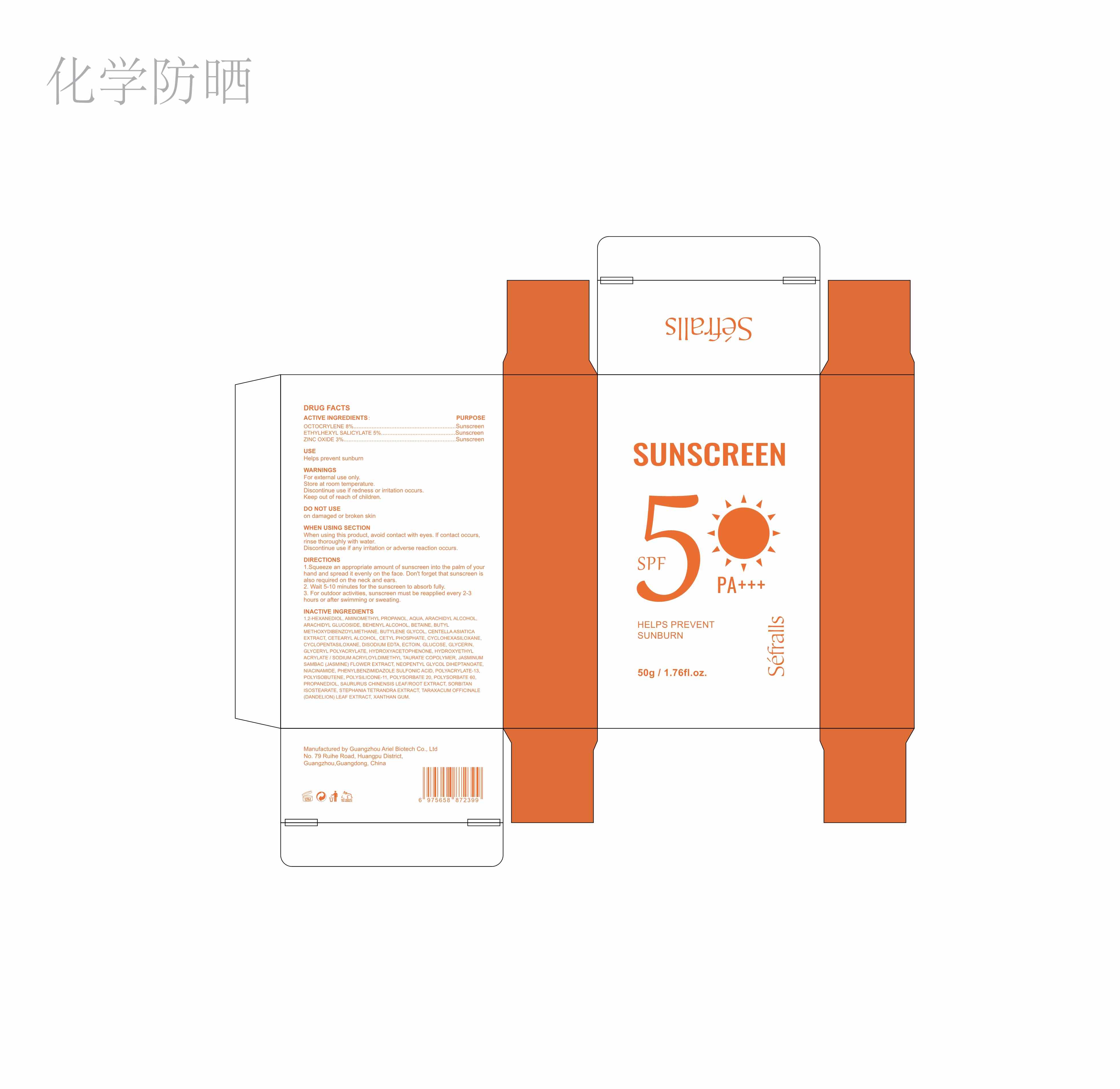
Sunscreen SPF 50 5 g/100g; 8 g/100g; 3 g/100g Cream, 50 g — NDC 84148-002-01 (Billing 84148-0002-01)
This is a package of 50 g of Sunscreen SPF 50 5 g/100g; 8 g/100g; 3 g/100g Cream from Guangzhou Ariel Biotech Co., Ltd., marketed since Mar 2024 and currently FDA-listed. It is this product's only package size.
Identity & classification
Regulatory identifiers FDA, NLM and CMS codes for this package
Where does this data come from?
- FDA openFDA NDC Directory · synced Oct 1, 2026
- FDA label on DailyMed · label index refreshed Oct 1, 2026
- RxNorm (NLM RxNav) · catalog refreshed Oct 1, 2026
- Medi-Span GPI (licensed)
- First Databank (licensed) · refreshed Oct 1, 2026
Clinical
This is a topical sunscreen cream containing three active ingredients that work together to protect skin from ultraviolet (UV) radiation. Octisalate and octocrylene are organic UV filters that absorb UV rays, while zinc oxide is a mineral UV filter that reflects UV rays away from the skin. The product is formulated as an over-the-counter monograph sunscreen and is typically applied to exposed skin to help prevent sunburn and reduce UV exposure.
Patient education
Supplement & herbal interactions
Where does this data come from?
- MedlinePlus (NLM) · refreshed Oct 1, 2026
- FDA label on DailyMed · label index refreshed Oct 1, 2026
Ask a licensed pharmacist directly — free, answered by our team.
Pricing
A drug doesn't have one price. Each row is a different public payment system, and none is what you'd pay at the counter — that depends on your insurance. The ⓘ on each row explains what it measures.
| Price system | Per g | Per package |
|---|---|---|
| Retail pharmacies payNADAC · weekly | Not in the retail survey — common for institutional, discontinued, or low-volume packs. | |
| Medicaid paysCMS SDUD · 12 mo | No recent Medicaid claims on file for this NDC — rare and low-volume NDCs are suppressed in the public data. | |
| Medicare drug plans payPart D · quarterly | No Part D plan price is available for this NDC in our data. | |
Where does this data come from?
- CMS NADAC weekly file
- CMS ASP pricing files · refreshed Sep 20, 2026
- CMS Medicaid State Drug Utilization Data · refreshed Oct 2, 2026
- CMS Part D plan pricing files · refreshed Sep 24, 2026
- VA National Acquisition Center price file
Packaging — all sizes for this product
| Package NDC | Description | Marketing start | Marketing end | Status |
|---|---|---|---|---|
| 84148-0002-01 You're viewing this Main listing | 50 g in 1 BOTTLE | 2024-03-28 | — | Active |
Therapeutic equivalents
| Product | Labeler | Pack | NADAC/unit | TE | Status | Price vs. this |
|---|---|---|---|---|---|---|
| Sunscreen SPF 50 5 g/100g; 8 g/100g; 3 g/100gthis 84148-0002-01 | Guangzhou | 50 g | — | — | FDA listed | — |
Where does this data come from?
- FDA openFDA NDC Directory · synced Oct 1, 2026
- FDA Orange Book · refreshed Sep 3, 2026
- CMS NADAC weekly file
Availability & generic status
We did not find an FDA-approved generic match for this exact strength, form and route.
Where does this data come from?
- FDA Orange Book · refreshed Sep 3, 2026
Inactive Ingredients / Excipients
Inactive ingredients, also called excipients, are components of the drug product other than the active ingredient. They may include fillers, dyes, coatings, preservatives, flavors, or other formulation ingredients.
💡 Tap an ingredient (hover on desktop) to see what it is and why it’s used.
-
UNII TR046Y3K1G
A liquid alcohol derived from petroleum or plant sources. It acts as a solvent and humectant in medicines, helping dissolve active ingredients and retain moisture in the formulation.
-
UNII LU49E6626Q
A synthetic organic compound used as a pH buffer and neutralizing agent in medicines. It helps maintain the proper acidity level in liquid formulations to improve stability and comfort.
-
UNII 5SL0G7R0OK
A simple sugar made from corn or other plants, used in medicines as a filler and sweetener. It helps create the right texture and taste in tablets, powders, and liquid formulations.
-
UNII 1QR1QRA9BU
A fatty alcohol derived from peanut oil or made synthetically. It serves as an emollient and thickener in creams and ointments, helping create smooth texture and improve product consistency.
-
UNII 6JVW35JOOJ
Arachidyl glucoside is a plant-derived emulsifier and skin-conditioning agent made from arachidyl alcohol and glucose. It helps mix oil and water-based ingredients together in formulations and improves product texture and spreadability.
-
UNII G63QQF2NOX
A chemical compound used as an active sunscreen filter in some formulations to absorb ultraviolet light. In medicines, it helps protect the product or skin from UV damage during storage or use.
-
UNII AIK06F3ZZY
A synthetic organic compound used in pharmaceuticals as a colorant and pH indicator. It may help stabilize certain formulations and provide visual identification of the medication.
-
UNII 3XUS85K0RA
Butylene glycol is a clear liquid derived from petroleum or plants that acts as a humectant, solvent, and preservative booster in medicines. It helps keep formulations stable, dissolve active ingredients, and maintain moisture in topical products.
-
UNII 4YS74Q4G4J
A plant extract from Centella asiatica containing natural compounds called triterpenoids. It's used as an active ingredient in some formulations for its purported skin-supporting properties, though it functions as a botanical additive rather than a structural component of the medicine.
-
UNII 2DMT128M1S
A waxy solid derived from plant or animal sources. It acts as an emulsifier to blend oil and water components, and also thickens the medicine to give it the right texture and consistency.
-
UNII VT07D6X67O
Cetyl phosphate is a waxy substance derived from fatty acids. It acts as an emulsifier to help mix oil and water-based ingredients, and may also serve as a thickener or stabilizer in creams and lotions.
-
UNII XHK3U310BA
Cyclohexasiloxane is a silicon-based liquid that acts as a solvent and conditioning agent in medicines. It helps dissolve or carry other ingredients and improves how the product spreads or feels on the skin.
-
UNII KCK5L8VU47
A silicone-based liquid that helps distribute other ingredients evenly throughout the product. It acts as a solvent and lubricant to improve how the medicine flows and feels when applied.
-
UNII 9E4CO0W6C5
A silicone-based polymer that forms soft, spongy particles. Used as a texture modifier and suspending agent to improve how the product feels and flows, and to help keep ingredients evenly distributed throughout the formulation.
-
UNII 9G1OE216XY
Docosanol is a waxy, fatty alcohol derived from plant sources. It acts as an emollient and thickener in topical medicines, helping to soften the skin and improve product texture and stability.
-
UNII 7GXZ3858RY
Ectoine is a naturally derived protective compound used in pharmaceuticals as a stabilizer and humectant. It helps preserve the integrity of active ingredients and maintain moisture in formulations.
-
UNII 7FLD91C86K
Edetate disodium is a chemical compound that binds and removes certain metal ions. In medicines, it acts as a preservative and stabilizer by preventing metals like calcium from interfering with the product's shelf life and consistency.
-
UNII 9YQ9DI1W42
A chemical compound used as a UV filter in topical formulations. It absorbs ultraviolet light to help protect the product and its active ingredients from degradation during storage and use.
-
UNII PDC6A3C0OX
Glycerin is a clear, thick liquid derived from plant oils or fats. It acts as a humectant to retain moisture, a sweetener, and a solvent in medications.
-
UNII G1L3HT4CMH
A synthetic compound used in medicines as a preservative and antimicrobial agent. It helps prevent bacterial and fungal growth, extending the product's shelf life.
-
UNII 86FQE96TZ4
A synthetic polymer, this ingredient acts as a thickener and suspending agent in liquid formulations. It helps maintain uniform consistency and keeps particles evenly distributed throughout the medicine.
-
UNII 2S686I937F
Jasminum sambac flower is a natural plant extract from jasmine flowers. It's used in medicines as a flavoring and fragrance agent to improve taste and smell.
-
UNII 5LKW3C543X
A synthetic oily liquid derived from neopentyl glycol and heptanoic acid. It serves as an emollient and solvent in formulations, helping to dissolve or suspend active ingredients and improve the texture and spreadability of topical products.
-
UNII 25X51I8RD4
Niacinamide is a form of vitamin B3, a water-soluble nutrient. In medicines, it may be added as a nutritional supplement or to support skin health, though its primary role here is as an active ingredient rather than a traditional inactive filler.
-
UNII FS2D4T67EA
Polyacrylate-13 is a synthetic polymer used as a film-coating agent. It forms a protective layer around tablets or capsules to control how quickly the medicine dissolves and is absorbed in the body.
-
UNII 5XB3A63Y52
A synthetic rubber polymer used as a glidant and lubricant in tablet and capsule formulations. It reduces friction between particles and equipment surfaces, helping medicines flow smoothly during manufacturing and preventing sticking.
-
UNII 7T1F30V5YH
A synthetic emulsifier derived from sorbitol and oleic acid. It helps mix oil and water-based ingredients together and keeps them from separating in liquid formulations.
-
UNII CAL22UVI4M
A synthetic emulsifier derived from sorbitol and fatty acids. It helps mix oil and water-based ingredients together and improves the texture and stability of the medicine.
-
UNII 5965N8W85T
Propanediol is a clear liquid organic compound derived from vegetable sources or synthesized chemically. It acts as a humectant to retain moisture, a solvent to dissolve active ingredients, and a preservative booster in liquid medications and supplements.
-
UNII 9L0SCP0SKZ
A plant extract from Chinese lizard's tail flowers used as a natural ingredient. It may function as a preservative, antioxidant, or flavoring agent in the formulation.
-
UNII 01S2G2C1E4
Sorbitan isostearate is an emulsifier derived from sorbitol and isostearic acid. It helps mix oil and water-based ingredients together and keeps them blended throughout the medicine's shelf life.
-
UNII 7S7TV2F4XC
A plant extract from Stephania tetrandra, a vine used traditionally in herbal preparations. In medications, it may serve as an active botanical ingredient or provide binding and consistency properties to the formulation.
-
UNII 39981FM375
A plant extract from the common dandelion, used as a natural flavoring agent or botanical ingredient to add taste and plant-derived components to the medicine.
-
UNII 059QF0KO0R
Water is a liquid solvent that dissolves and mixes ingredients together in liquid medicines, syrups, and injections. It helps distribute the active drug evenly throughout the product.
-
UNII TTV12P4NEE
Xanthan gum is a thickening and stabilizing ingredient made from fermented corn or other sugars. It's added to medicines to improve texture, prevent separation of liquids and solids, and help the product stay consistent.
35 inactive ingredients listed in the exact product block matched to this NDC.
Label-section wording can be broader than the structured product block and may mention additional formulation ingredients.
Where does this data come from?
ingredient classCode="IACT" elements from the exact product block matched by this NDC. Label-section narrative from DailyMed / the openFDA label index is shown separately when available.- FDA label on DailyMed · label index refreshed Oct 1, 2026
- FDA openFDA NDC Directory · synced Oct 1, 2026
Inactive ingredient FAQ
Are inactive ingredients the same for every manufacturer?
Why might an inactive ingredient be missing?
Can inactive ingredients matter?
Manufacturer & labeler
Where does this data come from?
- FDA openFDA NDC Directory · synced Oct 1, 2026
- Drugs@FDA
FDA label — Drug Facts FDA SPL
🎯 Indications and Usage ▾
WHEN USING SECTION When using this product, avoid contact with eyes. lf contact occurs. rinse thoroughly with water. Discontinue use if any irritation or adverse reaction occurs
⏱️ Dosage and Administration ▾
DIRECTIONS 1.Squeeze an appropriate amount of sunscreen into the palm of yourhand and spread it evenly on the face. Don't forget that sunscreen isalso required on the neck and ears.2. Wait 5-10 minutes for the sunscreen to absorb fully.3. For outdoor activities, sunscreen must be reapplied every 2-3hours or after swimming or sweating.
⚠️ Warnings ▾
Warnings: WARNINGSFor external use only.Store at room temperatureDiscontinue use if redness or irritation occurs
🧪 Active Ingredient ▾
ACTIVE INGREDIENTS : ACTIVE INGREDIENTSPURPOSEOCTOCRYLENE8%…………Sunscreen ETHYLHEXYL SALICYLATE 5%.…………Sunscreen ZINC OXIDE 3%.....Sunscreen
🧪 Inactive Ingredients ▾
INACTIVE INGREDIENTS 1,2-HEXANEDIOL, AMINOMETHYL PROPANOL, AQUA, ARACHIDYL ALCOHOLARACHIDYL GLUCOSIDE, BEHENYL ALCOHOL, BETAINE, BUTYLMETHOXYDIBENZOYLMETHANE, BUTYLENE GLYCOL, CENTELLA ASIATICAEXTRACT, CETEARYL ALCOHOL, CETYL PHOSPHATE, CYCLOHEXASILOXANECYCLOPENTASILOXANE, DISODIUM EDTA, ECTOIN, GLUCOSE, GLYCERIN,GLYCERYL POLYACRYLATE, HYDROXYACETOPHENONE, HYDROXYETHYLACRYLATE / SODIUM ACRYLOYLDIMETHYL TAURATE COPOLYMER, JASMINUMSAMBAC (JASMINE) FLOWER EXTRACT, NEOPENTYL GLYCOL DIHEPTANOATENIACINAMIDE, PHENYLBENZIMIDAZOLE SULFONIC ACID, POLYACRYLATE-13.POLYISOBUTENE, POLYSILICONE-11, POLYSORBATE 20, POLYSORBATE 60.PROPANEDIOL, SAURURUS CHINENSIS LEAF/ROOT EXTRACT, SORBITANISOSTEARATE, STEPHANIA TETRANDRA EXTRACT, TARAXACUM OFFICINALE(DANDELION) LEAF EXTRACT, XANTHAN GUM.
🎯 Purpose ▾
Sunscreen
📋 Description ▾
Use: Helps prevent sunburn
Reported adverse events (FAERS)
Top reported reactions
Age at onset
Reporter sex
Serious outcomes
Where does this data come from?
About this NDC listing & data coverage
What data is (and isn’t) available for this NDC — tap to expand
| NDC identity (package / product / labeler codes) | ✓ Available |
| Labeler | ✓ Available |
| Product & package description | ✓ Available |
| Marketing category & status | ✓ Available |
| Active ingredient / dosage form / route | ✓ Available |
| FDA label (SPL via DailyMed) | ✓ Available |
| Package photos | ✓ Available |
| Inactive ingredients (structured) | ✓ Available |
| NADAC pharmacy acquisition price (CMS) | — Not published for this NDC CMS publishes NADAC only for NDCs reported in its retail-pharmacy survey. |
| Orange Book / therapeutic-equivalence data | — Not published for this NDC Applies only to products approved under an NDA/ANDA; many listings are out of scope. |
| HCPCS J-code billing crosswalk | — Not published for this NDC Most self-administered / retail products have no J-code — that is normal. |
| Medicaid utilization (CMS SDUD) | — Not published for this NDC CMS reports utilization only for NDCs with Medicaid claims above its privacy threshold. |