
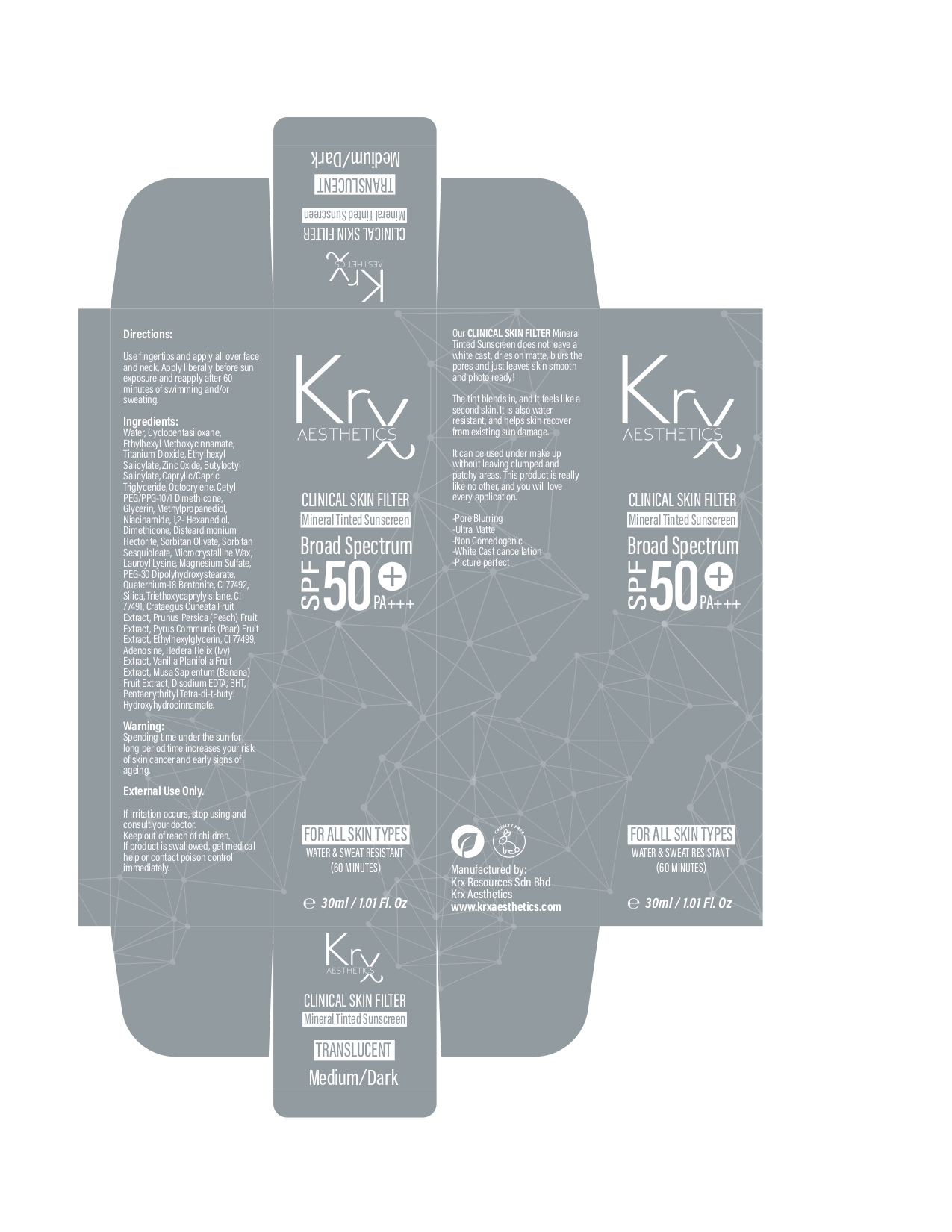
Clinical Skin Filter Tinted Sunscreen Medium Dark 1.182 mg/30mL; 1.734 mg/30mL; .9 mg/30mL Cream, 30 mL — NDC 84755-0004-1 (Billing 84755-0004-01)
This is a package of 30 mL of Clinical Skin Filter Tinted Sunscreen Medium Dark 1.182 mg/30mL; 1.734 mg/30mL; .9 mg/30mL Cream from KRX RESOURCES SDN. BHD., marketed since Sep 2024 and currently FDA-listed. It is this product's only package size.
NDC database record
One package, one record: these facts belong to NDC 84755-0004-1 alone.
- Record
- FDA NDC Directory package listing · Human OTC drug
- Code segments
- 84755 labeler · 0004 product · 1 package
- Package marketed since
- Sep 1, 2024
- Sample package
- No — commercial package
- Listing certified through
- Dec 31, 2026
- Barcode (UPC-A, from the NDC)
- 3 8475500041 7
- FDA record last changed
- Aug 27, 2026
Identity & classification
Regulatory identifiers FDA, NLM and CMS codes for this package
Where does this data come from?
- FDA openFDA NDC Directory · synced Oct 8, 2026
- FDA label on DailyMed · label index refreshed Oct 8, 2026
- RxNorm (NLM RxNav) · catalog refreshed Oct 1, 2026
- Medi-Span GPI (licensed)
- First Databank (licensed) · refreshed Oct 8, 2026
Clinical
This is a tinted sunscreen cream applied to the skin. It contains three active ingredients: octocrylene, titanium dioxide, and zinc oxide. Titanium dioxide and zinc oxide are mineral UV filters that work by reflecting and scattering ultraviolet light away from the skin. Octocrylene is an organic UV filter that absorbs ultraviolet rays. Together, these ingredients are typically used in sunscreen products intended to provide sun protection and reduce UV exposure to the skin.
Patient education
Supplement & herbal interactions
Where does this data come from?
- MedlinePlus (NLM) · refreshed Oct 8, 2026
- FDA label on DailyMed · label index refreshed Oct 8, 2026
Ask a licensed pharmacist directly — free, answered by our team.
Pricing
A drug doesn't have one price. Each row is a different public payment system, and none is what you'd pay at the counter — that depends on your insurance. The ⓘ on each row explains what it measures.
| Price system | Per g | Per package |
|---|---|---|
| Retail pharmacies payNADAC · weekly | Not in the retail survey — common for institutional, discontinued, or low-volume packs. | |
| Medicaid paysCMS SDUD · 12 mo | No recent Medicaid claims on file for this NDC — rare and low-volume NDCs are suppressed in the public data. | |
| Medicare drug plans payPart D · quarterly | No Part D plan price is available for this NDC in our data. | |
Where does this data come from?
- CMS NADAC weekly file
- CMS ASP pricing files · refreshed Sep 20, 2026
- CMS Medicaid State Drug Utilization Data · refreshed Oct 8, 2026
- CMS Part D plan pricing files · refreshed Sep 24, 2026
- VA National Acquisition Center price file
Packaging — all sizes for this product
| Package NDC | Description | Marketing start | Marketing end | Status |
|---|---|---|---|---|
| 84755-0004-01 You're viewing this Main listing | 30 mL in 1 PACKAGE | 2024-09-01 | — | Active |
Therapeutic equivalents
| Product | Labeler | Pack | NADAC/unit | TE | Status | Price vs. this |
|---|---|---|---|---|---|---|
| Clinical Skin Filter Tinted Sunscreen Medium Dark 1.182 mg/30mL; 1.734 mg/30mL; .9 mg/30mLthis 84755-0004-01 | KRX | 30 ml | — | — | FDA listed | — |
Where does this data come from?
- FDA openFDA NDC Directory · synced Oct 8, 2026
- FDA Orange Book · refreshed Oct 3, 2026
- CMS NADAC weekly file
Availability & generic status
We did not find an FDA-approved generic match for this exact strength, form and route.
Where does this data come from?
- FDA Orange Book · refreshed Oct 3, 2026
Inactive Ingredients / Excipients
Inactive ingredients, also called excipients, are components of the drug product other than the active ingredient. They may include fillers, dyes, coatings, preservatives, flavors, or other formulation ingredients.
💡 Tap an ingredient (hover on desktop) to see what it is and why it’s used.
-
UNII TR046Y3K1G
A liquid alcohol derived from petroleum or plant sources. It acts as a solvent and humectant in medicines, helping dissolve active ingredients and retain moisture in the formulation.
-
UNII 2EH13UN8D3
A synthetic compound used as a solvent and penetration enhancer in topical formulations. It helps dissolve active ingredients and allows them to penetrate the skin more effectively.
-
UNII V2W71V8T0X
A silicone-based compound that mixes oil and water together. Used in formulations as an emulsifier to help blend ingredients and improve texture and stability of creams, lotions, and other topical products.
-
UNII 98TEA9T639
Crataegus cuneata fruit is a plant extract from hawthorn berries. It may be used as a filler or binding agent to add bulk and help hold tablet or capsule ingredients together.
-
UNII RO266O364U
Dimethicone is a silicone-based lubricant and anti-foaming agent. It reduces friction between particles and prevents foam formation in liquid or semi-solid medicines, helping with smooth mixing and texture.
-
UNII X687XDK09L
A clay mineral processed to carry positive charges, used as a thickener and suspending agent in liquid medicines. It helps keep solid particles evenly distributed throughout the product.
-
UNII S3KFG6Q5X8
An organic chemical compound used as a UV filter in topical formulations. It helps protect the medicine or product from degradation caused by sunlight exposure during storage and use.
-
UNII 147D247K3P
Ethylhexylglycerin is a synthetic preservative used to prevent bacteria and mold from growing in medicines and personal care products. It helps keep the product safe and stable throughout its shelf life.
-
UNII PDC6A3C0OX
Glycerin is a clear, thick liquid derived from plant oils or fats. It acts as a humectant to retain moisture, a sweetener, and a solvent in medications.
-
UNII ZP9XFG71A7
A plant extract from ivy leaves used as a natural ingredient. It may function as a preservative, emollient, or flavoring agent in medications and topical formulations.
-
UNII 113171Q70B
Lauroyl lysine is a compound made by combining an amino acid (lysine) with a fatty acid (lauric acid). It works as a glidant and lubricant to help powder particles flow smoothly during manufacturing and tablet compression.
-
UNII NDT563S5VZ
A salt derived from the chemical compound EDTA, used as a chelating agent and preservative. It binds to metal ions in the formulation to prevent spoilage and maintain product stability.
-
UNII N8F53B3R4R
A synthetic humectant and solvent derived from propane. It draws and holds moisture in the formulation, helping keep the medicine stable and improving texture or flow in liquid and semi-solid products.
-
UNII XOF597Q3KY
A refined form of wax made from petroleum, microcrystalline wax is used in medicines as a coating agent, binder, and hardening ingredient. It helps give tablets and capsules their shape and protective outer layer.
-
UNII 25X51I8RD4
Niacinamide is a form of vitamin B3, a water-soluble nutrient. In medicines, it may be added as a nutritional supplement or to support skin health, though its primary role here is as an active ingredient rather than a traditional inactive filler.
-
UNII 9713Q0S7FO
A synthetic emulsifier derived from polyethylene glycol and fatty acids. It helps blend water and oil-based ingredients together in the formulation, improving texture and stability.
-
UNII K29QC5YCW8
Pentamethyl cyclopentasiloxane is a silicone-based liquid used in medications as a skin-conditioning agent and lubricant. It helps the product spread smoothly and reduces friction on skin or in the mouth.
-
UNII YI4N487572
A mineral salt combination containing potassium, magnesium, and sulfate. It may be used in formulations as a buffer to help maintain pH balance or as a filler to add bulk to the medicine.
-
UNII U08429QT99
A plant extract from peach fruit and plant material used in some formulations as a flavoring agent or natural ingredient to add taste and aroma to the medicine.
-
UNII 80UKV9Y4B3
A plant extract from common pear fruit used as a natural flavoring agent and sweetener in medicines. It adds taste appeal and may help mask bitter drug flavors in oral formulations.
-
UNII O7757NO1VL
A synthetic preservative and antimicrobial agent used to prevent bacterial and fungal growth in liquid formulations. It helps extend the shelf life of medicines by inhibiting microbial contamination.
-
UNII MDL271E3GR
Sorbitan olivate is an emulsifier derived from sorbitol and olive oil. It helps blend water and oil ingredients together to maintain consistent texture and appearance throughout the medicine.
-
UNII 0W8RRI5W5A
A fatty acid derivative used as an emulsifier and surfactant in medications. It helps blend oily and water-based ingredients together to create a stable, uniform product.
-
UNII LDC331P08E
A silicone-based compound that acts as a glidant and flow agent in solid medications. It reduces friction between powder particles, helping the medicine flow smoothly during manufacturing and tablet compression.
-
UNII BOS0R5Y21O
A flavoring ingredient derived from vanilla orchid pods. It adds vanilla taste and aroma to make the medicine more palatable, especially in products for children or those requiring better taste masking.
-
UNII 059QF0KO0R
Water is a liquid solvent that dissolves and mixes ingredients together in liquid medicines, syrups, and injections. It helps distribute the active drug evenly throughout the product.
26 inactive ingredients listed in the exact product block matched to this NDC.
Label-section wording can be broader than the structured product block and may mention additional formulation ingredients.
Where does this data come from?
ingredient classCode="IACT" elements from the exact product block matched by this NDC. Label-section narrative from DailyMed / the openFDA label index is shown separately when available.- FDA label on DailyMed · label index refreshed Oct 8, 2026
- FDA openFDA NDC Directory · synced Oct 8, 2026
Inactive ingredient FAQ
Are inactive ingredients the same for every manufacturer?
Why might an inactive ingredient be missing?
Can inactive ingredients matter?
Manufacturer & labeler
More NDCs from KRX RESOURCES SDN. BHD. labeler code 84755
- Krx Aesthetics All Day Glow Sunblocker 1 g/50g; 2.5 g/50g; 1 g/50g Cream NDC 84755-0001-1
- Pfect A solar barrier Serum Textured 1.5 mg/50mL; 2.5 mg/50mL Elixir NDC 84755-0002-1
- Clinical Skin Filter Tinted Sunscreen 1.182 mg/30mL; 1.734 mg/30mL; .9 mg/30mL Cream NDC 84755-0003-1
- Krx Aesthetics Biophase Molecular Night Peel 10 mg/U; 100 mg/U Cream NDC 84755-0005-1
- Beauty Body Factorie Body Shield SPF 30 mg/mL; 30 mg/mL; 30 mg/mL; 30 mg/mL; 30 mg/mL Lotion NDC 84755-0006-1
- KRX Aesthetics PD-13 Therapy 1.95 mg/15mL Spray NDC 84755-0010-1
Where does this data come from?
- FDA openFDA NDC Directory · synced Oct 8, 2026
- Drugs@FDA
FDA label — Drug Facts FDA SPL
🎯 Indications and Usage ▾
Our CLINICAL SKIN FILTER Mineral Tinted Sunscreen does not leave a white cast, dries on matte, blurs the pores and just leaves skin smooth and photo ready! The tint blends in, and It feels like a second skin, It is also water resistant, and helps skin recover from existing sun damage. It can be used under make up without leaving clumped and patchy areas.
This product is really like no other, and you will love every application. -Pore Blurring -Ultra Matte -Non Comedogenic -White Cast cancellation -Picture perfect CRUELTY FREE.
⏱️ Dosage and Administration ▾
Use fingertips and apply all over face and neck, Apply liberally before sun exposure and reapply after 60 minutes of swimming and/or sweating.
⚠️ Warnings ▾
Warning: Spending time under the sun for long period time increases your risk of skin cancer and early signs of ageing. External Use Only. If Irritation occurs, stop using and consult your doctor. Keep out of reach of children. If product is swallowed, get medical help or contact poison control immediately.
🧪 Active Ingredient ▾
Active: Cyclopentasiloxane -8% Titanium Dioxide - 5.78% Zinc Oxide - 3.94% Octocrylene -3%
🧪 Inactive Ingredients ▾
Inactive Ingredients: Water, Cyclopentasiloxane, Ethylhexyl Methoxycinnamate, Titanium Dioxide, Ethylhexyl Salicylate, Zinc Oxide, Butyloctyl Salicylate, Caprylic/Capric Triglyceride, Octocrylene, Cetyl PEG/PPG-10/1 Dimethicone, Glycerin, Methylpropanediol, Niacinamide, 1,2- Hexanediol, Dimethicone, Disteardimonium Hectorite, Sorbitan Olivate, Sorbitan Sesquioleate, Microcrystalline Wax, Lauroyl Lysine, Magnesium Sulfate, PEG-30 Dipolyhydroxystearate, Quaternium-18 Bentonite, CI 77492, Silica, Triethoxycaprylylsilane, CI 77491, Crataegus Cuneata Fruit Extract, Prunus Persica (Peach) Fruit Extract, Pyrus Communis (Pear) Fruit Extract, Ethylhexylglycerin, CI 77499, Adenosine, Hedera Helix (Ivy) Extract, Vanilla Planifolia Fruit Extract, Musa Sapientum (Banana) Fruit Extract, Disodium EDTA, BHT, Pentaerythrityl Tetra-di-t-butyl Hydroxyhydrocinnamate.
🎯 Purpose ▾
FOR ALL SKIN TYPES WATER & SWEAT RESISTANT (60 MINUTES) CLINICAL SKIN FILTER Mineral Tinted Sunscreen TRANSLUCENT Light/Medium Directions: Use fingertips and apply all over face and neck, Apply liberally before sun exposure and reapply after 60 minutes of swimming and/or sweating.
📄 Keep Out of Reach of Children ▾
Keep out of reach of children.
📄 Package Label / Principal Display Panel ▾
CLINICAL SKIN FILTER Mineral Tinted Sunscreen TRANSLUCENT Medium/Dark Content of Labeling
About this NDC listing & data coverage
Listed without an FDA application
This product's marketing category indicates it is marketed without an approved FDA application (no NDA, ANDA, or BLA on file). Having an NDC does not by itself establish FDA approval — the NDC Directory is a listing system, not an approval decision. Approval-linked data such as Orange Book therapeutic-equivalence ratings therefore does not apply.
What data is (and isn’t) available for this NDC — tap to expand
| NDC identity (package / product / labeler codes) | ✓ Available |
| Labeler | ✓ Available |
| Product & package description | ✓ Available |
| Marketing category & status | ✓ Available |
| Active ingredient / dosage form / route | ✓ Available |
| FDA label (SPL via DailyMed) | ✓ Available |
| Package photos | ✓ Available |
| Inactive ingredients (structured) | ✓ Available |
| NADAC pharmacy acquisition price (CMS) | — Not published for this NDC CMS publishes NADAC only for NDCs reported in its retail-pharmacy survey. |
| Orange Book / therapeutic-equivalence data | — Not published for this NDC Applies only to products approved under an NDA/ANDA; many listings are out of scope. |
| HCPCS J-code billing crosswalk | — Not published for this NDC Most self-administered / retail products have no J-code — that is normal. |
| Medicaid utilization (CMS SDUD) | — Not published for this NDC CMS reports utilization only for NDCs with Medicaid claims above its privacy threshold. |