
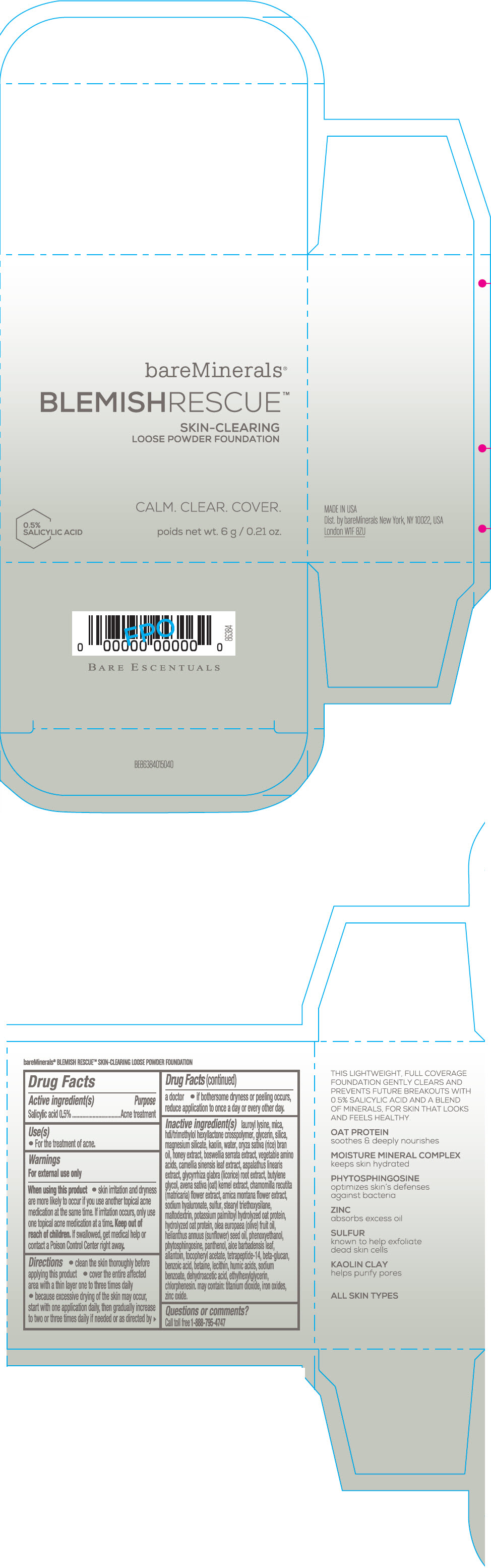
bareMinerals Blemish Rescue Skin-Clearing Loose Foundation Deepest Deep 6C SALICYLIC ACID 30 mg/6g Powder
🆔 Identity & classification
Where does this data come from?
🏭 Manufacturer & labeler
Where does this data come from?
🩺 Clinical
This is a loose powder foundation for facial application that contains salicylic acid as its active ingredient. Salicylic acid is typically used in skin-clearing products to help reduce blemishes and promote clearer skin. The product functions as both a cosmetic foundation and an over-the-counter skin treatment, combining coverage with topical salicylic acid application.
Patient education
Supplement & herbal interactions
Where does this data come from?
Ask a licensed pharmacist directly — free, answered by our team.
🧪 Inactive Ingredients / Excipients
Inactive ingredients, also called excipients, are components of the drug product other than the active ingredient. They may include fillers, dyes, coatings, preservatives, flavors, or other formulation ingredients.
💡 Tap an ingredient (hover on desktop) to see what it is and why it’s used.
-
UNII WR1WPI7EW8
A synthetic form of vitamin E used as an antioxidant. It prevents oils and fats in the medicine from breaking down and becoming rancid, helping keep the product stable during storage.
-
UNII 344S277G0Z
Allantoin is a naturally derived compound that helps soften and soothe skin. In medicines, it works as a skin-conditioning agent and may help support wound healing and reduce irritation in topical formulations.
-
UNII ZY81Z83H0X
Aloe vera leaf is a plant extract derived from the aloe plant. It is used in medicines as a natural moisturizer and skin-soothing agent in topical formulations.
-
UNII OZ0E5Y15PZ
A plant extract from arnica flowers, used as a flavoring agent or fragrance component in medicines. It may also provide mild soothing properties to certain topical formulations.
-
UNII 8SKN0B0MIM
Benzoic acid is a naturally occurring organic acid used as a preservative in medicines and foods. It helps prevent bacterial and fungal growth to extend shelf life and maintain product stability.
-
UNII 3SCV180C9W
Betaine is a naturally occurring organic compound found in plants and animals. In medicines, it acts as an osmoprotectant and stabilizer, helping maintain the product's moisture balance and preserve its chemical stability during storage.
-
UNII 3XUS85K0RA
Butylene glycol is a clear liquid derived from petroleum or plants that acts as a humectant, solvent, and preservative booster in medicines. It helps keep formulations stable, dissolve active ingredients, and maintain moisture in topical products.
-
UNII FGL3685T2X
Chamomile is a plant extract used in medications as a flavoring agent and for its mild soothing properties in formulations. It helps improve taste and aroma of the medicine.
-
UNII I670DAL4SZ
A preservative that fights bacteria and fungi. It keeps medicines and topical products stable and safe from microbial contamination during storage and use.
-
UNII 2KAG279R6R
Dehydroacetic acid is a synthetic preservative that prevents mold, yeast, and bacterial growth in medicines. It extends shelf life by protecting the product from spoilage during storage and use.
-
UNII 147D247K3P
Ethylhexylglycerin is a synthetic preservative used to prevent bacteria and mold from growing in medicines and personal care products. It helps keep the product safe and stable throughout its shelf life.
-
UNII 1K09F3G675
Ferric oxide red is an inorganic iron compound used as a colorant in medicines. It gives tablets, capsules, or other dosage forms a red or reddish tint for identification and appearance.
-
UNII EX438O2MRT
Ferric oxide yellow is a naturally occurring iron compound used as a colorant in medications. It gives tablets, capsules, and other forms a yellow or golden hue for identification and appearance.
-
UNII XM0M87F357
A dark iron oxide compound that gives medicines their black or dark color. It's used as a colorant in tablets and capsules to help identify the product and make it visually distinctive.
-
UNII PDC6A3C0OX
Glycerin is a clear, thick liquid derived from plant oils or fats. It acts as a humectant to retain moisture, a sweetener, and a solvent in medications.
-
UNII 2788Z9758H
A plant extract from licorice root used as a sweetener, flavoring agent, and natural emulsifier in medicines. It helps improve taste and may aid in keeping ingredients evenly mixed throughout the product.
-
UNII W2ZU1RY8B0
A plant extract from green tea leaves. It's used as an antioxidant ingredient to help preserve the medicine and maintain its stability during storage.
-
UNII WB5K9Y35Y9
A synthetic crosslinked polymer made by combining hexamethylene diisocyanate with trimethylol hexyllactone. It's used as a film-former and binder to help create protective coatings on tablets or capsules and improve product stability.
-
UNII Y9H1V576FH
Honey is a natural sweetener made by bees from flower nectar. In medicines, it adds sweetness to improve taste and may help soothe throat irritation in lozenges or syrups.
-
UNII YSE9PPT4TH
Hyaluronate sodium is a natural carbohydrate that holds moisture. It's used in medicines as a lubricant, thickener, and moisture-retaining agent to improve texture and delivery of the active ingredient.
-
UNII 4PW41QCO2M
Indian frankincense is a natural resin extracted from trees native to India. It is used in medicines as a binder and thickening agent to help hold ingredients together and improve texture.
-
UNII 24H4NWX5CO
Kaolin is a naturally occurring clay mineral. It's used in tablets and capsules as a filler and absorbent to add bulk, improve texture, and help bind ingredients together.
-
UNII 113171Q70B
Lauroyl lysine is a compound made by combining an amino acid (lysine) with a fatty acid (lauric acid). It works as a glidant and lubricant to help powder particles flow smoothly during manufacturing and tablet compression.
-
UNII 1DI56QDM62
A natural fatty substance from soybeans that helps mix oil and water-based ingredients together. It acts as an emulsifier and lubricant in medicines to improve texture and help the product break down properly in your body.
-
UNII 9B9691B2N9
Magnesium silicate is a mineral compound used in tablets and capsules as a glidant and anti-caking agent. It helps powder ingredients flow smoothly during manufacturing and prevents clumping in the final product.
-
UNII 7CVR7L4A2D
A starch-derived carbohydrate produced by breaking down corn, potato, or tapioca starch. It functions as a filler and binder to give the medicine bulk and texture, and sometimes as a mild sweetener or texture enhancer in powders and tablets.
-
UNII V8A1AW0880
Mica is a naturally occurring mineral that's ground into fine powder. It's used in medicines as a colorant and anti-caking agent to improve appearance and prevent clumping in tablets or powders.
-
UNII Z6J799EAJK
Oat is a cereal grain used in medicines as a filler and binder. It helps give the medication its shape and structure while adding bulk to the formulation.
-
UNII 6UYK2W1W1E
A natural oil extracted from olives. It acts as an emollient and lubricant in formulations, helping to soften ingredients and improve how the medicine spreads or flows.
-
UNII WV9CM0O67Z
Panthenol is a humectant and skin-conditioning agent derived from pantothenic acid. It's added to medicines to help retain moisture and soothe skin irritation.
-
UNII HIE492ZZ3T
Phenoxyethanol is a synthetic preservative and antimicrobial agent used to prevent bacterial and fungal growth in medicines and cosmetic products, extending shelf life and maintaining product safety.
-
UNII GIN46U9Q2Q
Phytosphingosine is a naturally derived fatty compound that helps stabilize and thicken skincare and cosmetic formulations. It works as an emollient and conditioning agent to improve texture and skin feel in topical products.
-
UNII LZO6K1506A
Rice bran oil is a natural oil extracted from rice grain. It's used in medicines as an emollient and solvent to help dissolve or suspend active ingredients and improve how the medicine feels when applied or taken.
-
UNII ETJ7Z6XBU4
Silicon dioxide is a naturally occurring mineral used as a glidant and anti-caking agent. It helps powder ingredients flow smoothly and prevents clumping during manufacturing and storage.
-
UNII OJ245FE5EU
Sodium benzoate is a salt derived from benzoic acid, a preservative. It's added to medicines to prevent growth of bacteria, fungi, and other microorganisms that could spoil the product.
-
UNII 1VN9P25L8H
A silicone compound used as a surface modifier and lubricant in tablet and capsule formulations. It reduces friction between particles and equipment during manufacturing, helping ensure smooth production and consistent tablet appearance.
-
UNII 70FD1KFU70
Sulfur is a naturally occurring chemical element. It works as an anti-caking agent and preservative in medicines, helping the product stay dry and preventing spoilage.
-
UNII 3W1JG795YI
Sunflower oil is a natural vegetable oil derived from sunflower seeds. It serves as a solvent, lubricant, and carrier in medicines, helping dissolve active ingredients and improve how the medication flows and absorbs in the body.
-
UNII 15FIX9V2JP
Titanium dioxide is a bright white mineral powder commonly used as a colorant and opacifying agent. It makes pills and tablets white or lighter in color and helps make coatings non-transparent.
-
UNII 059QF0KO0R
Water is a liquid solvent that dissolves and mixes ingredients together in liquid medicines, syrups, and injections. It helps distribute the active drug evenly throughout the product.
-
UNII SOI2LOH54Z
Zinc oxide is a white mineral powder used in medicines as a protective barrier agent and color additive. It helps shield skin in topical products and may also serve as a filler or opacifying ingredient.
41 inactive ingredients listed in the exact product block matched to this NDC.
Label-section wording can be broader than the structured product block and may mention additional formulation ingredients.
Where does this data come from?
ingredient classCode="IACT" elements from the exact product block matched by this NDC. Label-section narrative from DailyMed / the openFDA label index is shown separately when available.Inactive ingredient FAQ
Are inactive ingredients the same for every manufacturer?
Why might an inactive ingredient be missing?
Can inactive ingredients matter?
💲 Pricing
A drug doesn't have one price. Each row is a different public payment system, and none is what you'd pay at the counter — that depends on your insurance. The ⓘ on each row explains what it measures.
| Price system | Per g | Per package |
|---|---|---|
| Retail pharmacies payNADAC · weekly | Not in the retail survey — common for institutional, discontinued, or low-volume packs. | |
| Medicaid paysCMS SDUD · 12 mo | No recent Medicaid claims on file for this NDC — rare and low-volume NDCs are suppressed in the public data. | |
| Medicare drug plans payPart D · quarterly | No Part D plan price is available for this NDC in our data. | |
Where does this data come from?
🔁 Therapeutic equivalents
Where does this data come from?
⏳ Availability & generic status
We did not find an FDA-approved generic match for this exact strength, form and route.
Where does this data come from?
📊 Medicare Part D spend CMS · PART D · 2026 (Q1)
🔬 Reported adverse events (FAERS)
Top reported reactions
Age at onset
Reporter sex
Serious outcomes
Where does this data come from?
📦 Packaging — all sizes for this product
| Package NDC | Description | Marketing start | Status |
|---|---|---|---|
| 98132-0250-03 | 1 JAR in 1 CARTON (98132-250-03) / .75 g in 1 JAR | 2019-12-01 | Active |
| 98132-0250-21 You're viewing this | 1 JAR in 1 CARTON (98132-250-21) / 6 g in 1 JAR | 2019-12-01 | Active |
Pack size FAQ
What quantity is in NDC 98132-0250-21?
What NDC number is used to bill for this package of bareMinerals Blemish Rescue Skin-Clearing Loose Foundation Deepest Deep 6C SALICYLIC ACID 30 mg/6g Powder?
🧭 About this NDC listing & data coverage
What data is (and isn’t) available for this NDC — tap to expand
| NDC identity (package / product / labeler codes) | ✓ Available |
| Labeler | ✓ Available |
| Product & package description | ✓ Available |
| Marketing category & status | ✓ Available |
| Active ingredient / dosage form / route | ✓ Available |
| FDA label (SPL via DailyMed) | ✓ Available |
| Package photos | ✓ Available |
| Inactive ingredients (structured) | ✓ Available |
| NADAC pharmacy acquisition price (CMS) | — Not published for this NDC CMS publishes NADAC only for NDCs reported in its retail-pharmacy survey. |
| Orange Book / therapeutic-equivalence data | — Not published for this NDC Applies only to products approved under an NDA/ANDA; many listings are out of scope. |
| HCPCS J-code billing crosswalk | — Not published for this NDC Most self-administered / retail products have no J-code — that is normal. |
| Medicaid utilization (CMS SDUD) | — Not published for this NDC CMS reports utilization only for NDCs with Medicaid claims above its privacy threshold. |
Questions about this listing
Is this NDC FDA-approved?
Why is there no price listed?
Is the NDC printed on the package the same as the 11-digit billing NDC?
What do the three segments of this NDC mean?
Is this package still being marketed?
Does this product come in other package sizes?
Who lists this product with the FDA?
Do I need a prescription for this product?
Where does this data come from?
📄 FDA label — Drug Facts FDA SPL
🎯 Indications and Usage ▾
Uses For the treatment of acne.
⏱️ Dosage and Administration ▾
Directions clean the skin thoroughly before applying this product cover the entire affected area with a thin layer one to three times daily because excessive drying of the skin may occur, start with one application daily, then gradually increase to two or three times daily if needed or as directed by a doctor if bother some dryness or peeling occurs, reduce application to once a day or every other day."
⚠️ Warnings ▾
Warning For external use only When using this product skin irritation and dryness is more likely to occur if you use another topical acne medication at the same time. If irritation occurs, only use one topical acne medication at a time. keep out of reach of children if swallowed, get medical help or contact a Poison Control Center right away
🧪 Active Ingredient ▾
Active ingredients Salicylic acid 0.5%
🧪 Inactive Ingredients ▾
Inactive Ingredients lauroyl lysine, hdi/trimethylol hexyllactone crosspolymer, mica, glycerin, silica, magnesium silicate, kaolin, water, oryza sativa (rice) bran oil, honey extract, boswellia serrata extract, vegetable amino acids, camellia sinensis leaf extract, aspalathus linearis extract, glycyrrhiza glabra (licorice) root extract, butylene glycol, avena sativa (oat) kernel extract, chamomilla recutita (matricaria) flower extract, arnica montana flower extract, sodium hyaluronate, sulfur, stearyl triethoxysilane, maltodextrin, potassium palmitoyl hydrolyzed oat protein, hydrolyzed oat protein, olea europaea (olive) fruit oil, helianthus annuus (sunflower) seed oil, phenoxyethanol, phytosphingosine, panthenol, aloe barbadensis leaf, allantoin, tocopheryl acetate, tetrapeptide-14, beta-glucan, benzoic acid, betaine, lecithin, humic acids, sodium benzoate, dehydroacetic acid, ethylhexylglycerin, chlorphenesin. may contain: titanium dioxide, iron oxides, zinc oxide.
🎯 Purpose ▾
Purpose Acne treatment