
AFA Ingredients & Drug Interactions
What is this page for?
First and foremost: checking AFA against your medications. The heart of this page is the interaction checker and the full interaction report — how this product’s ingredients may interact with prescription and over-the-counter medicines you may be taking.
Around that, we add a pharmacist’s high-level view of the product as a whole — what’s inside, the evidence for its stated use, how transparent the label is, and what safety data exists — so you can see the full picture in one place. It’s educational information from our licensed clinical databases and the clinical staff at HelloPharmacist — not medical advice — and we don’t sell or endorse products. Our editorial policy
AFA is a dietary supplement by Naturgin Products USA with 1 active ingredient. Its ingredients are commonly taken for general nutrition and energy, antioxidant support, cholesterol and metabolic health.Based on those ingredients, 327 medications have a known interaction with it, the most serious rated moderate. The ingredients most likely to interact are Aphanizomenon flos-aquae. Use the checker below to test your specific medication, or read the full HelloPharmacist Interaction Report.
Check Your Meds Against AFA by Naturgin Products USA
Ask about any prescription or over-the-counter medication and we check it for interactions with AFA by Naturgin Products USA — and tell you which ingredient is responsible.
AI summaries are generated from our interaction database for education only — always confirm with your pharmacist. How we use AI
Ask the Pharmacist
A licensed pharmacist will answer your question by email — free, usually within 24 hours.
Got it — thank you!
A licensed pharmacist will answer within 24 hours. Keep an eye on your email (worth checking spam, just in case).
HelloPharmacist Scorecard of AFA by Naturgin Products USA
Our pharmacy team’s full take, with four database checks built into the cards below — a summary of what is known, not a grade of the product itself.
What’s inside
Full disclosure
AFA contains one active ingredient, Aphanizomenon flos-aquae, a blue-green algae. The data we hold does not describe its specific role in the product beyond it being the active ingredient.
The capsule also lists inactive ingredients, which are non-active fillers and binders: hydroxypropylmethylcellulose, magnesium stearate, silica, and quinoa flour.
Does it work?
Moderate evidence
Evidence for blue-green algae is limited. The only rating we hold is possibly effective for hypertension (high blood pressure).
For acne, allergic rhinitis (hay fever), iron deficiency anemia, and arsenic poisoning, there is insufficient reliable evidence to rate it.
How safe is it?
Well-documented data
Blue-green algae is generally well tolerated in the data we hold. The most common reported effects include abdominal cramps, bloating, diarrhea, dizziness, fatigue, gas, headache, nausea, and vomiting.
Allergic reactions, including hives and itching, have occurred, and one case report describes anaphylaxis in a 14-year-old. Gum bleeding and bruising were reported in a small number of trial participants.
Our safety notes flag that quality varies and that some products can be contaminated with toxins or heavy metals. They also say safety data is limited, so it is best to avoid it.
We have no pregnancy or breastfeeding data on file for this product, so please talk with your doctor or pharmacist for personalized advice.
Meds to double-check
Moderate interaction found
Double-check these medication types before taking AFA, all rated Moderate: blood thinners (anticoagulants) and antiplatelet drugs, immunosuppressants, and antidiabetes drugs. Your own doctor or pharmacist can tell you whether any of these apply to you.
You can also use the search tool on this page to check specific medications.
The bottom line
Scorecard at a glanceFully disclosed formula with some supporting evidence behind its ingredients' uses. Moderate medication interactions have been identified, and safety information is well characterized.
People considering AFA are mostly looking at its possible blood pressure benefit, since that is the one area with a possibly effective rating. If you take blood thinners, immunosuppressants, or diabetes medication, or you are pregnant or breastfeeding, be careful and talk it over with your own doctor or pharmacist before starting.
Quality and contamination concerns apply to this product as well.
Educational only — not medical advice; always confirm with your pharmacist. Our editorial policy · How we use AI
Assessment coverage: 1 of 1 active ingredient matched to our full ingredient reviews (monographs). Based on the product label dated Dec 21, 2024.
This Scorecard evaluates available label information, ingredient evidence, and known medication-safety considerations. It does not independently verify product identity, purity, potency, contamination, or manufacturing quality. How these ratings are computed
General information
Key facts about AFA, straight from the product label.
| Brand | Naturgin Products USA |
|---|---|
| Barcode (UPC) | 793283997425 |
| Net contents | 60 Veggie Capsule(s) |
| Market status | On market |
| Date entered into DSLD | Dec 21, 2024 |
| DSLD ID | 321979 |
| Product type | Non-nutrient/non-botanical |
| Supplement form | Capsule |
| Dietary claims / uses | All Other, Structure/Function |
| Intended target group(s) | Adult (18 - 50 Years), Women (not pregnant or lactating), Gluten Free |
Everything in this section is reproduced from the manufacturer’s own product label — it’s the label speaking, not HelloPharmacist. We show it so you can see exactly what the maker states; we don’t verify or endorse those statements.
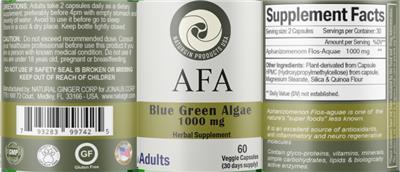
Supplement Facts
The label details for AFA by Naturgin Products USA, sourced from the NIH Dietary Supplement Label Database.
Supplement Facts
| Ingredient | Amount | % DV |
|---|---|---|
| Aphanizomenon flos-aquae | 1000 mg | -- |
Other ingredients: Hydroxypropylmethylcellulose, Magnesium Stearate, Silica, Quinoa Flour
Tap any ingredient to jump to its full detail below.
These statements are the manufacturer’s wording, reproduced from the product label — the label is saying it, not HelloPharmacist. We don’t verify or endorse them.
Suggested/Recommended/Usage/Directions
Directions: Adults take 2 capsules daily as a dietary supplement, preferably before 4pm with empty stomach and plenty of water.
Precautions
Avoid to use it before going to sleep. Caution: Do not exceed recommended dose. Consult your healthcare professional before use this product if you are a person with a known medical condition. Do not use if safety seal is broken or missing
Do not use if you are under 18 years old, pregnant or breastfeeding. Keep out of reach of children
Do not use if you are under 18 years old, pregnant or breastfeeding.
Storage
Store in a cool & dry place. Keep bottle tightly closed.
Seals/Symbols
GMP Good Manufacturing Practice Quality Product Made in the U.S.A. With Pride
General Statements
Cruelty free
(30 Days Supply)
Formulation
GF Gluten free
Formula
Blue Green Algae 1000 mg
Adults
Aphanizomenon Flos-aguae is one of the nature's "super foods" less known. It is an excellent source of antioxidants, anti-inflammatory and neuro regenerative molecules Contain glyco-proteins, vitamins, minerals, simple carbohydrates, lipids & biologically active enzymes.
FDA Statement of Identity
Herbal Supplement
FDA Disclaimer Statement
These statements have not been evaluated by the Food and Drug Administration. This product is not intended to diagnose, treat, cure or prevent any disease.
Is this label outdated? Report a formula or label change and our pharmacy team will review it.
AFA by Naturgin Products USA label
The label scan from the NIH Dietary Supplement Label Database. Tap to enlarge.
Label images are published by the NIH Dietary Supplement Label Database for the version of this product on file. Always read your actual product label.
View the full label (PDF)The Ingredients in AFA by Naturgin Products USA
This is the 1 active ingredient this product is made of. Select it to open its full monograph.
Serving size2 Capsule(s) Dosage formCapsule Servings per container30 Amounts shown are per serving.
Aphanizomenon flos-aquae
Interacts with327 drugs
Blue-green algae are nutrient-rich aquatic microorganisms (such as spirulina and Klamath Lake algae) taken as a supplement for energy, nutrition, and...
Aphanizomenon flos-aquae monograph & interactionsOther (inactive) ingredients: Hydroxypropylmethylcellulose, Magnesium Stearate, Silica, Quinoa Flour. These complete the product’s ingredient list but are not active constituents.
AFA by Naturgin Products USA Drug Interactions
HelloPharmacist Interaction Report
AFA by Naturgin Products USA is one to double-check before you start.
Its single active ingredient, Aphanizomenon flos-aquae (a blue-green algae), is linked to interactions with three types of medication, and the most serious rating we hold for it is Moderate. Blood thinners (anticoagulants) and antiplatelet drugs are the first concern, because the algae might increase the risk of bleeding when taken with them, though the data describes this as unlikely.
Read the full breakdown — every affected drug type, severity by severity
Immunosuppressants, the medications that calm the immune system, may be affected as well, since the algae can stimulate immune activity and might interfere with their effect (Moderate). Antidiabetes drugs carry a Moderate rating too, because the algae might increase the risk of low blood sugar (hypoglycemia).
Altogether, these interactions span 327 individual medications. Use the search tool on this page to check your exact medications, and talk through any results with your own doctor or pharmacist.
Check your own medications below · Editorial policy · How we use AI
Want to check YOUR meds against AFA?
Ask about interactions with your drugs in plain English — “Can I take it with lisinopril?” — and we find you the answer in seconds, ingredient by ingredient.
Go to the checkerIngredients driving the most interactions
Individual Drug Interactions
The ingredients in AFA interact with 327 drugs. Click any drug to see the details.
1 of the 1 ingredient in AFA interact with drugs. Each result below shows which ingredient is responsible. Aphanizomenon flos-aquae
EculizumabSoliris
How Eculizumab interacts with AFA — through 1 ingredient. Tap an ingredient for the detail:
Aphanizomenon Flos-aquaeImmunosuppressants Moderate
Interaction Summary
Theoretically, concurrent use of blue-green algae might interfere with immunosuppressive therapy.
Read the full Aphanizomenon Flos-aquae + Eculizumab interactionEdoxabanSavaysa
How Edoxaban interacts with AFA — through 1 ingredient. Tap an ingredient for the detail:
Aphanizomenon Flos-aquaeAnticoagulant/antiplatelet Drugs Moderate
Interaction Summary
Theoretically, spirulina blue-green algae might increase the risk of bleeding if used with other anticoagulant or antiplatelet drugs.
Read the full Aphanizomenon Flos-aquae + Edoxaban interactionEfalizumabRaptiva
How Efalizumab interacts with AFA — through 1 ingredient. Tap an ingredient for the detail:
Aphanizomenon Flos-aquaeImmunosuppressants Moderate
Interaction Summary
Theoretically, concurrent use of blue-green algae might interfere with immunosuppressive therapy.
Read the full Aphanizomenon Flos-aquae + Efalizumab interactionEffientPrasugrel
How Effient interacts with AFA — through 1 ingredient. Tap an ingredient for the detail:
Aphanizomenon Flos-aquaeAnticoagulant/antiplatelet Drugs Moderate
Interaction Summary
Theoretically, spirulina blue-green algae might increase the risk of bleeding if used with other anticoagulant or antiplatelet drugs.
Read the full Aphanizomenon Flos-aquae + Effient interactionEfgartigimod Alfa-fcabVyvgart
How Efgartigimod Alfa-fcab interacts with AFA — through 1 ingredient. Tap an ingredient for the detail:
Aphanizomenon Flos-aquaeImmunosuppressants Moderate
Interaction Summary
Theoretically, concurrent use of blue-green algae might interfere with immunosuppressive therapy.
Read the full Aphanizomenon Flos-aquae + Efgartigimod Alfa-fcab interactionElranatamabElrexfio
How Elranatamab interacts with AFA — through 1 ingredient. Tap an ingredient for the detail:
Aphanizomenon Flos-aquaeImmunosuppressants Moderate
Interaction Summary
Theoretically, concurrent use of blue-green algae might interfere with immunosuppressive therapy.
Read the full Aphanizomenon Flos-aquae + Elranatamab interactionEmapalumab-lzsgGamifant
How Emapalumab-lzsg interacts with AFA — through 1 ingredient. Tap an ingredient for the detail:
Aphanizomenon Flos-aquaeImmunosuppressants Moderate
Interaction Summary
Theoretically, concurrent use of blue-green algae might interfere with immunosuppressive therapy.
Read the full Aphanizomenon Flos-aquae + Emapalumab-lzsg interactionEmpagliflozinJardiance
How Empagliflozin interacts with AFA — through 1 ingredient. Tap an ingredient for the detail:
Aphanizomenon Flos-aquaeAntidiabetes Drugs Moderate
Interaction Summary
Theoretically, taking blue-green algae with antidiabetes drugs might increase the risk of hypoglycemia.
Read the full Aphanizomenon Flos-aquae + Empagliflozin interactionEmpagliflozin, Linagliptin, Metformin HydrochlorideTrijardy XR
How Empagliflozin, Linagliptin, Metformin Hydrochloride interacts with AFA — through 1 ingredient. Tap an ingredient for the detail:
Aphanizomenon Flos-aquaeAntidiabetes Drugs Moderate
Interaction Summary
Theoretically, taking blue-green algae with antidiabetes drugs might increase the risk of hypoglycemia.
Read the full Aphanizomenon Flos-aquae + Empagliflozin, Linagliptin, Metformin Hydrochloride interactionEmpagliflozin, MetforminSynjardy
How Empagliflozin, Metformin interacts with AFA — through 1 ingredient. Tap an ingredient for the detail:
Aphanizomenon Flos-aquaeAntidiabetes Drugs Moderate
Interaction Summary
Theoretically, taking blue-green algae with antidiabetes drugs might increase the risk of hypoglycemia.
Read the full Aphanizomenon Flos-aquae + Empagliflozin, Metformin interactionEmpagliflozin, Metformin HydrochlorideSynjardy XR
How Empagliflozin, Metformin Hydrochloride interacts with AFA — through 1 ingredient. Tap an ingredient for the detail:
Aphanizomenon Flos-aquaeAntidiabetes Drugs Moderate
Interaction Summary
Theoretically, taking blue-green algae with antidiabetes drugs might increase the risk of hypoglycemia.
Read the full Aphanizomenon Flos-aquae + Empagliflozin, Metformin Hydrochloride interactionEnoxaparinLovenox
How Enoxaparin interacts with AFA — through 1 ingredient. Tap an ingredient for the detail:
Aphanizomenon Flos-aquaeAnticoagulant/antiplatelet Drugs Moderate
Interaction Summary
Theoretically, spirulina blue-green algae might increase the risk of bleeding if used with other anticoagulant or antiplatelet drugs.
Read the full Aphanizomenon Flos-aquae + Enoxaparin interactionEpcoritamab-byspEpkinly
How Epcoritamab-bysp interacts with AFA — through 1 ingredient. Tap an ingredient for the detail:
Aphanizomenon Flos-aquaeImmunosuppressants Moderate
Interaction Summary
Theoretically, concurrent use of blue-green algae might interfere with immunosuppressive therapy.
Read the full Aphanizomenon Flos-aquae + Epcoritamab-bysp interactionEptifibatideIntegrilin
How Eptifibatide interacts with AFA — through 1 ingredient. Tap an ingredient for the detail:
Aphanizomenon Flos-aquaeAnticoagulant/antiplatelet Drugs Moderate
Interaction Summary
Theoretically, spirulina blue-green algae might increase the risk of bleeding if used with other anticoagulant or antiplatelet drugs.
Read the full Aphanizomenon Flos-aquae + Eptifibatide interactionErtugliflozinSteglatro
How Ertugliflozin interacts with AFA — through 1 ingredient. Tap an ingredient for the detail:
Aphanizomenon Flos-aquaeAntidiabetes Drugs Moderate
Interaction Summary
Theoretically, taking blue-green algae with antidiabetes drugs might increase the risk of hypoglycemia.
Read the full Aphanizomenon Flos-aquae + Ertugliflozin interactionErtugliflozin, Metformin HydrochlorideSegluromet
How Ertugliflozin, Metformin Hydrochloride interacts with AFA — through 1 ingredient. Tap an ingredient for the detail:
Aphanizomenon Flos-aquaeAntidiabetes Drugs Moderate
Interaction Summary
Theoretically, taking blue-green algae with antidiabetes drugs might increase the risk of hypoglycemia.
Read the full Aphanizomenon Flos-aquae + Ertugliflozin, Metformin Hydrochloride interactionEsomeprazole, NaproxenVimovo
How Esomeprazole, Naproxen interacts with AFA — through 1 ingredient. Tap an ingredient for the detail:
Aphanizomenon Flos-aquaeAnticoagulant/antiplatelet Drugs Moderate
Interaction Summary
Theoretically, spirulina blue-green algae might increase the risk of bleeding if used with other anticoagulant or antiplatelet drugs.
Read the full Aphanizomenon Flos-aquae + Esomeprazole, Naproxen interactionEtanercept-szzsErelzi
How Etanercept-szzs interacts with AFA — through 1 ingredient. Tap an ingredient for the detail:
Aphanizomenon Flos-aquaeImmunosuppressants Moderate
Interaction Summary
Theoretically, concurrent use of blue-green algae might interfere with immunosuppressive therapy.
Read the full Aphanizomenon Flos-aquae + Etanercept-szzs interactionEtanercept-ykroEticovo
How Etanercept-ykro interacts with AFA — through 1 ingredient. Tap an ingredient for the detail:
Aphanizomenon Flos-aquaeImmunosuppressants Moderate
Interaction Summary
Theoretically, concurrent use of blue-green algae might interfere with immunosuppressive therapy.
Read the full Aphanizomenon Flos-aquae + Etanercept-ykro interactionEtrasimodVelsipity
How Etrasimod interacts with AFA — through 1 ingredient. Tap an ingredient for the detail:
Aphanizomenon Flos-aquaeImmunosuppressants Moderate
Interaction Summary
Theoretically, concurrent use of blue-green algae might interfere with immunosuppressive therapy.
Read the full Aphanizomenon Flos-aquae + Etrasimod interactionExenatideBydureon, Byetta
How Exenatide interacts with AFA — through 1 ingredient. Tap an ingredient for the detail:
Aphanizomenon Flos-aquaeAntidiabetes Drugs Moderate
Interaction Summary
Theoretically, taking blue-green algae with antidiabetes drugs might increase the risk of hypoglycemia.
Read the full Aphanizomenon Flos-aquae + Exenatide interactionExenatide SyntheticBydureon BCISE
How Exenatide Synthetic interacts with AFA — through 1 ingredient. Tap an ingredient for the detail:
Aphanizomenon Flos-aquaeAntidiabetes Drugs Moderate
Interaction Summary
Theoretically, taking blue-green algae with antidiabetes drugs might increase the risk of hypoglycemia.
Read the full Aphanizomenon Flos-aquae + Exenatide Synthetic interactionFamotidine, IbuprofenDuexis
How Famotidine, Ibuprofen interacts with AFA — through 1 ingredient. Tap an ingredient for the detail:
Aphanizomenon Flos-aquaeAnticoagulant/antiplatelet Drugs Moderate
Interaction Summary
Theoretically, spirulina blue-green algae might increase the risk of bleeding if used with other anticoagulant or antiplatelet drugs.
Read the full Aphanizomenon Flos-aquae + Famotidine, Ibuprofen interactionFingolimodGilenya, Tascenso ODT
How Fingolimod interacts with AFA — through 1 ingredient. Tap an ingredient for the detail:
Aphanizomenon Flos-aquaeImmunosuppressants Moderate
Interaction Summary
Theoretically, concurrent use of blue-green algae might interfere with immunosuppressive therapy.
Read the full Aphanizomenon Flos-aquae + Fingolimod interactionFish Oil TriglyceridesOmegaven
How Fish Oil Triglycerides interacts with AFA — through 1 ingredient. Tap an ingredient for the detail:
Aphanizomenon Flos-aquaeAnticoagulant/antiplatelet Drugs Moderate
Interaction Summary
Theoretically, spirulina blue-green algae might increase the risk of bleeding if used with other anticoagulant or antiplatelet drugs.
Read the full Aphanizomenon Flos-aquae + Fish Oil Triglycerides interactionFludrocortisoneFlorinef Acetate
How Fludrocortisone interacts with AFA — through 1 ingredient. Tap an ingredient for the detail:
Aphanizomenon Flos-aquaeImmunosuppressants Moderate
Interaction Summary
Theoretically, concurrent use of blue-green algae might interfere with immunosuppressive therapy.
Read the full Aphanizomenon Flos-aquae + Fludrocortisone interactionFluorouracil (iv)Fluorouracil
How Fluorouracil (iv) interacts with AFA — through 1 ingredient. Tap an ingredient for the detail:
Aphanizomenon Flos-aquaeImmunosuppressants Moderate
Interaction Summary
Theoretically, concurrent use of blue-green algae might interfere with immunosuppressive therapy.
Read the full Aphanizomenon Flos-aquae + Fluorouracil (iv) interactionFlupenthixolFluanxol
How Flupenthixol interacts with AFA — through 1 ingredient. Tap an ingredient for the detail:
Aphanizomenon Flos-aquaeImmunosuppressants Moderate
Interaction Summary
Theoretically, concurrent use of blue-green algae might interfere with immunosuppressive therapy.
Read the full Aphanizomenon Flos-aquae + Flupenthixol interactionFondaparinuxArixtra
How Fondaparinux interacts with AFA — through 1 ingredient. Tap an ingredient for the detail:
Aphanizomenon Flos-aquaeAnticoagulant/antiplatelet Drugs Moderate
Interaction Summary
Theoretically, spirulina blue-green algae might increase the risk of bleeding if used with other anticoagulant or antiplatelet drugs.
Read the full Aphanizomenon Flos-aquae + Fondaparinux interactionFostamatinibTavalisse
How Fostamatinib interacts with AFA — through 1 ingredient. Tap an ingredient for the detail:
Aphanizomenon Flos-aquaeImmunosuppressants Moderate
Interaction Summary
Theoretically, concurrent use of blue-green algae might interfere with immunosuppressive therapy.
Read the full Aphanizomenon Flos-aquae + Fostamatinib interactionEach ingredient & the kinds of drugs it affects
For each ingredient in AFA with known interactions, here are the types of medications it can affect. Open any type for the detail — or search your exact drug in the checker above.
Aphanizomenon flos-aquae
Anticoagulant/Antiplatelet Drugs
Theoretically, spirulina blue-green algae might increase the risk of bleeding if used with other anticoagulant or antiplatelet drugs. However, this is unlikely.
Spirulina blue-green algae have shown antiplatelet and anticoagulant effects in vitro. However, one preliminary study in 24 patients receiving spirulina blue-green algae 2.3 grams daily for 2 weeks showed no effect on platelet activation or measures of clotting time.
Antidiabetes Drugs
Theoretically, taking blue-green algae with antidiabetes drugs might increase the risk of hypoglycemia.
Human research shows that spirulina blue-green algae can have hypoglycemic effects in patients with diabetes, at least some of whom were using antidiabetes drugs. However, blue-green algae does not seem to improve glycated hemoglobin (HbA1c) levels in patients with diabetes. A meta-analysis of animal studies also suggests that spirulina blue-green algae have hypoglycemic effects.
Immunosuppressants
Theoretically, concurrent use of blue-green algae might interfere with immunosuppressive therapy.
Blue-green algae have been shown to stimulate the immune system.
Brand information
Manufacturer and brand details for AFA, from the product label.
Naturgin Products USA
See all Naturgin Products USA products- Name
- Natural Ginger Corp for Jonaus Corp
- Street Address
- 7781 NW 73 Court
- City
- Medley
- State
- FL
- ZipCode
- 33166
- Web Address
- www.naturgin.com
AFA by Naturgin Products USA: Common Questions
Does AFA by Naturgin Products USA interact with any medications?
How can one product interact with so many drugs?
Where does this information come from?
Does AFA work for high blood pressure?
Does AFA help with iron deficiency anemia?
What are the side effects of AFA?
Can I take AFA while pregnant or breastfeeding?
What is the active ingredient in AFA?
Written and reviewed by the HelloPharmacist editorial staff. Our editorial policy
Not sure if AFA is safe with your meds?
Our pharmacists answer your medication & supplement questions — free.
Label information is sourced from the NIH Dietary Supplement Label Database and reflects the product version on file; always read your actual product label. This page is for education only and is not a substitute for professional medical advice. Confirm with your pharmacist or doctor before combining supplements and medications.
The Full Monographs Behind AFA’s Ingredients
Every ingredient we hold a full HelloPharmacist monograph for — uses, evidence, safety, and the complete interaction list.
Sources & How We Checked
AFA's label data comes from the NIH Dietary Supplement Label Database; the ingredient interaction data is from the Natural Medicines database, reviewed by our pharmacists.
- NIH Dietary Supplement Label Database (DSLD) — The official product label on file for this supplement.
- Natural Medicines (Therapeutic Research Center) — Evidence-graded clinical reference behind the ingredient interaction data.
Content is written and reviewed by licensed HelloPharmacist pharmacists. See our data sources and editorial standards for how this information is built and checked.
The 22 references behind this product’s interaction data
Every citation that drives the interaction findings for this product’s ingredients, from the evidence-graded Natural Medicines (TRC Healthcare) database. Open an ingredient to browse its citations — links open the study on PubMed or the publisher’s site.
Blue-green Algae 22 references
- Jensen GS, Ginsberg DJ, Huerta P, et al. Consumption of Aphanizomenon flos-aquae has rapid effects on the circulation and function of immune cells in humans. A novel approach to nutritional mobilization of the immune system. JANA 2000;2:50-6.
- Iwasa M, Yamamoto M, Tanaka Y, et al. Spirulina-associated hepatotoxicity. Am J Gastroenterol 2002;97:3212-13. PubMed
- Hayashi O, Katoh T, Okuwaki Y. Enhancement of antibody production in mice by dietary Spirulina platensis. J Nutr Sci Vitaminol (Tokyo) 1994;40:431-41.. PubMed
- Vitale S, Miller NR, Mejico LJ, et al. A randomized, placebo-controlled, crossover clinical trial of super blue-green algae in patients with essential blepharospasm or Meige syndrome. Am J Ophthalmol 2004;138:18-32. PubMed
- Mani UV, Desai S, Iyer U. Studies on the long-term effect of spirulina supplementation on serum lipid profile and glycated proteins in NIDDM patients. J Nutraceut 2000;2(3):25-32. DOI
- Chiu HF, Yang SP, Kuo YL, et al. Mechanisms involved in the antiplatelet effect of C-phycocyanin. Br J Nutr 2006;95:435-40. PubMed
- Hsiao G, Chou PH, Shen MY, et al. C-phycocyanin, a very potent and novel platelet aggregation inhibitor from Spirulina platensis. J Agric Food Chem 2005;53:7734-40.
- Katz M, Levine AA, Kol-Degani H, Kav-Venaki L. A compound herbal preparation (CHP) in the treatment of children with ADHD: a randomized controlled trial. J Atten Disord 2010;14:281-91. PubMed
- Madhyastha, H. K., Radha, K. S., Sugiki, M., Omura, S., and Maruyama, M. Purification of c-phycocyanin from Spirulina fusiformis and its effect on the induction of urokinase-type plasminogen activator from calf pulmonary endothelial cells. Phytomedicine PubMed
- Mazokopakis, E. E., Karefilakis, C. M., Tsartsalis, A. N., Milkas, A. N., and Ganotakis, E. S. Acute rhabdomyolysis caused by Spirulina (Arthrospira platensis). Phytomedicine. 2008;15(6-7):525-527. PubMed
- Halidou, Doudou M., Degbey, H., Daouda, H., Leveque, A., Donnen, P., Hennart, P., and Dramaix-Wilmet, M. [The effect of spiruline during nutritional rehabilitation: systematic review]. Rev.Epidemiol.Sante Publique 2008;56(6):425-431.
- Konno, T., Umeda, Y., Umeda, M., Kawachi, I., Oyake, M., and Fujita, N. [A case of inflammatory myopathy with widely skin rash following use of supplements containing Spirulina]. Rinsho Shinkeigaku 2011;51(5):330-333. PubMed
- Le TM, Knulst AC, Röckmann H. Anaphylaxis to Spirulina confirmed by skin prick test with ingredients of Spirulina tablets. Food Chem Toxicol 2014;74:309-10. PubMed
- Rzymski P, Niedzielski P, Kaczmarek N, Jurczak T, Klimaszyk P. The multidisciplinary approach to safety and toxicity assessment of microalgae-based food supplements following clinical cases of poisoning. Harmful Algae 2015;46:34-42. DOI
- Petrus M, Culerrier R, Campistron M, et al. First case report of anaphylaxis to spirulin: identification of phycocyanin as responsible allergen. Allergy 2010;65(7):924-5. PubMed
- Marles RJ, Barrett ML, Barnes J, et al. United States Pharmacopeia safety evaluation of spirulina. Crit Rev Food Sci Nutr 2011;51(7):593-604. PubMed
- Majdoub H, Ben Mansour M, Chaubet F, et al. Anticoagulant activity of a sulfated polysaccharide from the green alga Arthrospira platensis. Biochim Biophys Acta 2009;1790(10):1377-81. PubMed
- Cha BG, Kwak HW, Park AR, et al. Structural characteristics and biological performance of silk fibroin nanofiber containing microalgae spirulina extract. Biopolymers 2014;101(4):307-18. PubMed
- Jensen GS, Drapeau C, Lenninger M, Benson KF. Clinical safety of a high dose of phycocyanin-enriched aqueous extract from Arthrospira (Spirulina) platensis: results from a randomized, double-Blind, placebo-controlled study with a focus on anticoagulant ac
- Hamedifard Z, Milajerdi A, Reiner Z, Taghizadeh M, Kolahdooz F, Asemi Z. The effects of spirulina on glycemic control and serum lipoproteins in patients with metabolic syndrome and related disorders: A systematic review and meta-analysis of randomized con
- Moradi S, Zobeiri M, Feizi A, Clark CCT, Entezari MH. The effects of spirulina (Arthrospira platensis) supplementation on anthropometric indices, blood pressure, sleep quality, mental health, fatigue status and quality of life in patients with ulcerative
- Ghanbari F, Amerizadeh A, Behshood P, Moradi S, Asgary S. Effect of microalgae arthrospira on biomarkers of glycemic control and glucose metabolism: a systematic Review and meta-analysis. Curr Probl Cardiol 2022;47(10):100942. PubMed
Parts of this content are provided by the Therapeutic Research Center, LLC.
DISCLAIMER: Currently this does not check for drug-drug interactions. This is not an all-inclusive comprehensive list of potential interactions and is for informational purposes only. Not all interactions are known or well-reported in the scientific literature, and new interactions are continually being reported. Input is needed from a qualified healthcare provider including a pharmacist before starting any therapy. Application of clinical judgment is necessary.
© 2021 Therapeutic Research Center, LLC