
Black Henna Alcohol Free Ingredients & Drug Interactions
by Herbal Terra
What is this page for?
First and foremost: checking Black Henna Alcohol Free against your medications. The heart of this page is the interaction checker and the full interaction report — how this product’s ingredients may interact with prescription and over-the-counter medicines you may be taking.
Around that, we add a pharmacist’s high-level view of the product as a whole — what’s inside, the evidence for its stated use, how transparent the label is, and what safety data exists — so you can see the full picture in one place. It’s educational information from our licensed clinical databases and the clinical staff at HelloPharmacist — not medical advice — and we don’t sell or endorse products. Our editorial policy
Black Henna Alcohol Free is a dietary supplement by Herbal Terra with 1 active ingredient. Its ingredients are commonly taken for hair and skin dye, cooling and skin care, wound and skin healing (traditional).Based on those ingredients, 1 medication has a known interaction with it, the most serious rated moderate. The ingredients most likely to interact are Black Henna Extract, Dry, Powder. Use the checker below to test your specific medication, or read the full HelloPharmacist Interaction Report.
Check Your Meds Against Black Henna Alcohol Free by Herbal Terra
Ask about any prescription or over-the-counter medication and we check it for interactions with Black Henna Alcohol Free by Herbal Terra — and tell you which ingredient is responsible.
AI summaries are generated from our interaction database for education only — always confirm with your pharmacist. How we use AI
Ask the Pharmacist
A licensed pharmacist will answer your question by email — free, usually within 24 hours.
Got it — thank you!
A licensed pharmacist will answer within 24 hours. Keep an eye on your email (worth checking spam, just in case).
HelloPharmacist Scorecard of Black Henna Alcohol Free by Herbal Terra
Our pharmacy team’s full take, with four database checks built into the cards below — a summary of what is known, not a grade of the product itself.
What’s inside
Full disclosure
This product has one active ingredient, black henna extract (dry powder), which comes from the henna plant. It is the ingredient used for its coloring and skin-applied purpose.
The other listed ingredients, glycerin and water, are inactive ingredients that make up the liquid base.
Does it work?
Couldn't assess
Evidence for this ingredient is not established in the data we hold. Henna has been studied for chemotherapy-induced peripheral neuropathy, chemotherapy-induced acral erythema, contact dermatitis, and wound healing, but each of these is rated as insufficient reliable evidence to rate.
That means we cannot say whether it works for any of these uses.
How safe is it?
Well-documented data
Topical use on skin is generally well tolerated, but it can cause contact dermatitis, with redness, itching, burning, swelling, blistering, or scarring. Much of this reaction is linked to the added compound para-phenylenediamine (PPD), which is often added to 'black' henna and is not found naturally in henna.
Oral use is the bigger concern: it has been linked to upset stomach, rhabdomyolysis, kidney injury, hemolytic anemia, and death. Our safety notes advise against oral use and 'black henna,' and the data on hemolysis in people with glucose 6-phosphate dehydrogenase (G6PD) deficiency is a reason for extra caution.
The pregnancy and breastfeeding rating for this ingredient is unsafe, so the safety data advises against using it during pregnancy or while breastfeeding. Please talk with your own doctor or pharmacist for advice that fits your situation.
Meds to double-check
Moderate interaction found
The medication type to double-check is lithium, which carries a Moderate interaction rating because henna may reduce how quickly your body clears it. Your doctor may need to adjust your lithium dose.
No other medication types are documented for this product in our data, but that is not a guarantee that none exist, so please confirm your exact medications with your doctor or pharmacist.
The bottom line
Scorecard at a glanceFully disclosed formula with no assessable stated purpose. Moderate medication interactions have been identified, and safety information is well characterized.
This product may appeal to people looking for a topical, alcohol-free henna liquid. People who take lithium, are pregnant or breastfeeding, have G6PD deficiency, or are considering any oral use should be especially careful.
Because the ingredient's pregnancy and breastfeeding rating is unsafe and there are documented lithium interactions, talk it over with your own doctor or pharmacist before using it.
Educational only — not medical advice; always confirm with your pharmacist. Our editorial policy · How we use AI
Assessment coverage: 1 of 1 active ingredient matched to our full ingredient reviews (monographs). Based on the product label dated Jan 23, 2025.
This Scorecard evaluates available label information, ingredient evidence, and known medication-safety considerations. It does not independently verify product identity, purity, potency, contamination, or manufacturing quality. How these ratings are computed
General information
Key facts about Black Henna Alcohol Free, straight from the product label.
| Brand | Herbal Terra |
|---|---|
| Barcode (UPC) | 7238361160344 |
| Net contents | 2 Fluid Ounce(s); 60 mL |
| Market status | On market |
| Date entered into DSLD | Jan 23, 2025 |
| DSLD ID | 323975 |
| Product type | Botanical |
| Supplement form | Liquid |
| Dietary claims / uses | All Other, Structure/Function |
| Intended target group(s) | Adult (18 - 50 Years), Gluten Free, Sugar Free |
Everything in this section is reproduced from the manufacturer’s own product label — it’s the label speaking, not HelloPharmacist. We show it so you can see exactly what the maker states; we don’t verify or endorse those statements.
Supplement Facts
The label details for Black Henna Alcohol Free by Herbal Terra, sourced from the NIH Dietary Supplement Label Database.
Supplement Facts
| Ingredient | Amount | % DV |
|---|---|---|
| Black Henna Extract, Dry, Powder | 1156 mg | -- |
Other ingredients: Glycerin, Water
Tap any ingredient to jump to its full detail below.
These statements are the manufacturer’s wording, reproduced from the product label — the label is saying it, not HelloPharmacist. We don’t verify or endorse them.
Suggested/Recommended/Usage/Directions
Shake well before use. Adults take up to 30 drops (1 mL, one full squeeze of the dropper bulb) in 3-4 fl. oz. of juice or water up to 4 times a day.
Precautions
We recommend to seek expert medical advice before taking. May have contraindications and cause adverse reaction.
Consult a physician before giving to children under 18, before using during pregnancy, if nursing, or if you are on any medications.
Consult a physician before giving to children under 18, before using during pregnancy, if nursing, or if you are on any medications. Keep out of the reach of children!
Do not use if you are allergic to any ingredients.
Storage
Store in a cool, dry, dark place.
FDA Disclaimer Statement
This product has not been evaluated by the FDA and is not intended to diagnose, treat, cure or prevent any disease.
Formulation
cGMP Made in compliance with cGMP 21 CFR 111 in an FDA registered and inspected facility.
Sugar free
Expertly extracted 100% natural Premium product
No alcohol (ethyl), artificial ingredients, color additives, fillers or binders.
Natural Gluten free
Formula
Indigofera tinctoria
FDA Statement of Identity
Herbal Supplement
General Statements
Organic raw material.
Seals/Symbols
Made in USA
Is this label outdated? Report a formula or label change and our pharmacy team will review it.
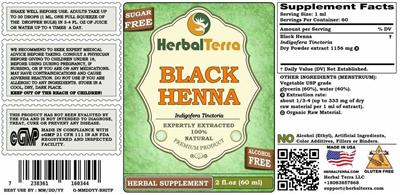
Black Henna Alcohol Free by Herbal Terra label
The label scan from the NIH Dietary Supplement Label Database. Tap to enlarge.
Label images are published by the NIH Dietary Supplement Label Database for the version of this product on file. Always read your actual product label.
View the full label (PDF)The Ingredients in Black Henna Alcohol Free by Herbal Terra
This is the 1 active ingredient this product is made of. Select it to open its full monograph.
Serving size1 mL Dosage formLiquid Servings per container60 Amounts shown are per serving.
Black Henna Extract, Dry, Powder
Interacts with1 drug
Henna is a plant most widely used as a natural dye for hair, skin, and nails, and has a long history in traditional medicine for skin and minor wound...
Black Henna Extract, Dry, Powder monograph & interactionsOther (inactive) ingredients: Glycerin, Water. These complete the product’s ingredient list but are not active constituents.
Black Henna Alcohol Free by Herbal Terra Drug Interactions
HelloPharmacist Interaction Report
Black Henna Alcohol Free from Herbal Terra interacts with one medication type, through its black henna extract.
The main concern is lithium, a mood-stabilizing medicine, with a Moderate severity rating. Henna is thought to have diuretic properties (it may make you pass more urine), so it might reduce how much lithium your body clears.
That could raise lithium levels, and your dose might need to be lowered.
Read the full breakdown — every affected drug type, severity by severity
Altogether, these interactions span 1 individual medications. Because this is the only interaction documented for this product, no other drug types are listed in our data.
Please talk with your own doctor or pharmacist before combining this product with any prescription medicine. To check your exact medications, use the search tool on this page.
Check your own medications below · Editorial policy · How we use AI
Want to check YOUR meds against Black Henna Alcohol Free?
Ask about interactions with your drugs in plain English — “Can I take it with lisinopril?” — and we find you the answer in seconds, ingredient by ingredient.
Go to the checkerIngredients driving the most interactions
Individual Drug Interactions
The ingredients in Black Henna Alcohol Free interact with 1 drug. Click any drug to see the details.
1 of the 1 ingredient in Black Henna Alcohol Free interact with drugs. Each result below shows which ingredient is responsible. Black Henna Extract, Dry, Powder
Lithium Carbonate (prescription Drug)Eskalith, Lithium Carbonate
How Lithium Carbonate (prescription Drug) interacts with Black Henna Alcohol Free — through 1 ingredient. Tap an ingredient for the detail:
Black Henna Extract, Dry, PowderLithium Moderate
Interaction Summary
Henna is thought to have diuretic properties.
Read the full Black Henna Extract, Dry, Powder + Lithium Carbonate (prescription Drug) interactionEach ingredient & the kinds of drugs it affects
For each ingredient in Black Henna Alcohol Free with known interactions, here are the types of medications it can affect. Open any type for the detail — or search your exact drug in the checker above.
Black Henna Extract, Dry, Powder
Lithium
Henna is thought to have diuretic properties. Theoretically, due to these potential diuretic effects, henna might reduce excretion and increase levels of lithium. The dose of lithium might need to be decreased.
Brand information
Manufacturer and brand details for Black Henna Alcohol Free, from the product label.
Herbal Terra
See all Herbal Terra products- Name
- Herbal Terra LLC
- Phone Number
- +18083857868
- Web Address
- herbalterra.com
Black Henna Alcohol Free by Herbal Terra: Common Questions
Does Black Henna Alcohol Free by Herbal Terra interact with any medications?
How can one product interact with so many drugs?
Where does this information come from?
Is Black Henna Alcohol Free safe to use during pregnancy?
What side effects can black henna extract cause on the skin?
Does black henna extract work for wound healing?
Written and reviewed by the HelloPharmacist editorial staff. Our editorial policy
Not sure if Black Henna Alcohol Free is safe with your meds?
Our pharmacists answer your medication & supplement questions — free.
Label information is sourced from the NIH Dietary Supplement Label Database and reflects the product version on file; always read your actual product label. This page is for education only and is not a substitute for professional medical advice. Confirm with your pharmacist or doctor before combining supplements and medications.
The Full Monographs Behind Black Henna Alcohol Free’s Ingredients
Every ingredient we hold a full HelloPharmacist monograph for — uses, evidence, safety, and the complete interaction list.
Sources & How We Checked
Black Henna Alcohol Free's label data comes from the NIH Dietary Supplement Label Database; the ingredient interaction data is from the Natural Medicines database, reviewed by our pharmacists.
- NIH Dietary Supplement Label Database (DSLD) — The official product label on file for this supplement.
- Natural Medicines (Therapeutic Research Center) — Evidence-graded clinical reference behind the ingredient interaction data.
Content is written and reviewed by licensed HelloPharmacist pharmacists. See our data sources and editorial standards for how this information is built and checked.
The 30 references behind this product’s interaction data
Every citation that drives the interaction findings for this product’s ingredients, from the evidence-graded Natural Medicines (TRC Healthcare) database. Open an ingredient to browse its citations — links open the study on PubMed or the publisher’s site.
Henna 30 references
- McGuffin M, Hobbs C, Upton R, Goldberg A, eds. American Herbal Products Association's Botanical Safety Handbook. Boca Raton, FL: CRC Press, LLC 1997.
- Gruenwald J, Brendler T, Jaenicke C. PDR for Herbal Medicines. 1st ed. Montvale, NJ: Medical Economics Company, Inc., 1998.
- Lyon MJ, Shaw JC. Allergic contact dermatitis reaction to henna. Arch Dermatol 2000;136:124-5. PubMed
- Garcia Ortiz JC, Terron M, Bellido J. Contact allergy to henna. Int Arch Allergy Immunol 1997;114:298-9. PubMed
- Kandil HH, al-Ghanem MM, Sarwat MA, al-Thallab FS. Henna (Lawsonia inermis Linn.) inducing haemolysis among G6PD-deficient newborns. A new clinical observation. Ann Trop Paediatr 1996;16:287-91. PubMed
- Majoie IM, Bruynzeel DP. Occupational immediate-type hypersensitivity to henna in a hairdresser. Am J Contact Dermat 1996;7:38-40. DOI
- Lewin PK. Temporary henna tattoo with permanent scarification. CMAJ 1999;160:310.
- Lestringant GG, Bener A, Frossard PM. Cutaneous reactions to henna and associated additives. Br J Dermatol 1999;141:598-600. PubMed
- Etienne A, Piletta P, Hauser C, Pasche-Koo F. Ectopic contact dermatitis from henna. Contact Dermatitis 1997;:183. PubMed
- Wantke F, Gotz M, Jarisch R. Contact dermatitis due to henna, solvent red 1 and solvent red 3, a case report. Contact Dermatitis 1992;27:346-7. PubMed
- Nigam PK, Saxena AK. Allergic contact dermatitis from henna. Contact Dermatitis 1988;18:55-6. PubMed
- Gupta BN, Mathur AK, Agarwal C, Singh A. Contact sensitivity to henna. Contact Dermatitis 1986;15:303-4. PubMed
- Pasricha JS, Gupta R, Panjwani S. Contact dermatitis to henna (Lawsonia). Contact Dermatitis 1980;6:288-9. PubMed
- Cronin E. Immediate type hypersensitivity to henna. Contact Dermatitis 1979;5:198-9. PubMed
- Raupp P, Hassan JA, Varughese M, Kristiansson B. Henna causes life threatening haemolysis in glucose-6-phosphate dehydrogenase deficiency. Arch Dis Child 2001;85:411-2.. PubMed
- Akpolat ND, Aras A. Local hypertrichosis: A rare complication of a temporary henna tattoo. Turk J Pediatr. 2016;58(4):413-414. PubMed
- Goldscheider I, Herzinger T, Varga R, et al. Childhood lichen planus pemphigoides: report of two cases treated successfully with systemic glucocorticoids and dapsone. Pediatr Dermatol. 2014;31(6):751-3. PubMed
- Ilyas S, Wasif K, Saif MW. Topical henna ameliorated capecitabine-induced hand-foot syndrome. Cutan Ocul Toxicol. 2014;33(3):253-5. PubMed
- Katar S, Devecioglu C, Ozbek MN, Ecer S. Henna causes life-threatening hyperbilirubinaemia in glucose-6-phosphate dehydrogenase deficiency. Clin Exp Dermatol. 2007;32(2):235-6. PubMed
- Kheir A, Gaber I, Gafer S, Ahmed W. Life-threatening haemolysis induced by henna in a Sudanese child with glucose-6-phosphate dehydrogenase deficiency. East Mediterr Health J. 2017;23(1):28-30.
- Khine YY. Acute Kidney Injury following Ingestion of Henna Leaf Extract: A Case Report from Myanmar. Blood Purif. 2017;44 Suppl 1:41-45. PubMed
- Kind F, Scherer K, Bircher AJ. Contact dermatitis to para-phenylenediamine in hair dye following sensitization to black henna tattoos - an ongoing problem. J Dtsch Dermatol Ges. 2012;10(8):572-8. PubMed
- Rund D, Schaap T, Da'as N, Ben Yehuda D, Kalish J. Plasma exchange as treatment for Lawsone (henna) intoxication. J Clin Apher. 2007;22(4):243-5. PubMed
- Uygur-Bayramicli O, Dabak R, Sargin M. Acute chemical colitis resulting from oral intake of henna. J Clin Gastroenterol. 2005;39(10):920-1. PubMed
- Poursadra E, Anvari-Tafti M, Dehghani A, Eghbali-Babadi M, Rafiei Z. Comparing the effect of henna oil and olive oil on pressure ulcer grade one in intensive care units patients. Adv Biomed Res. 2019 Nov 27;8:68. PubMed
- Zibanejad S, Miraj S, Rafieian Kopaei M. Healing effect of Quercus persica and Lawsonia inermis ointment on episiotomy wounds in primiparous women. J Res Med Sci. 2020 Feb 20;25:11. PubMed
- Kubat S, Aksu H, Hasbal NB. Acute renal failure due to henna stone ingestion as a remedy of diabetes. Nefrologia. 2020 Jul 20:S0211-6995(20)30083-7. PubMed
- Asgari S, Esfandbod M, Haghshomar M. Henna-induced hemolysis and acute kidney injury in an 85-year-old man; A case report. Arch Acad Emerg Med. 2020 Oct 14;8(1):e82.
- Niazi M, Mehrabani M, Namazi MR, et al. Efficacy of a topical formulation of henna (Lawsonia inermis L.) in contact dermatitis in patients using prosthesis: A double-blind randomized placebo-controlled clinical trial. Complement Ther Med. 2020 Mar;49:1023 PubMed
- Arslan S, Zorba Bahceli P, Ilik Y, Artaç M. The preliminary effects of henna on chemotherapy-induced peripheral neuropathy in women receiving oxaliplatin-based treatment: A parallel-group, randomized, controlled pilot trial. Eur J Oncol Nurs. 2020 Oct;48: PubMed
Parts of this content are provided by the Therapeutic Research Center, LLC.
DISCLAIMER: Currently this does not check for drug-drug interactions. This is not an all-inclusive comprehensive list of potential interactions and is for informational purposes only. Not all interactions are known or well-reported in the scientific literature, and new interactions are continually being reported. Input is needed from a qualified healthcare provider including a pharmacist before starting any therapy. Application of clinical judgment is necessary.
© 2021 Therapeutic Research Center, LLC