
Cand-E-Cleanse Ingredients & Drug Interactions
What is this page for?
First and foremost: checking Cand-E-Cleanse against your medications. The heart of this page is the interaction checker and the full interaction report — how this product’s ingredients may interact with prescription and over-the-counter medicines you may be taking.
Around that, we add a pharmacist’s high-level view of the product as a whole — what’s inside, the evidence for its stated use, how transparent the label is, and what safety data exists — so you can see the full picture in one place. It’s educational information from our licensed clinical databases and the clinical staff at HelloPharmacist — not medical advice — and we don’t sell or endorse products. Our editorial policy
Cand-E-Cleanse is a dietary supplement by Herbally Grounded with 4 active ingredients. Its ingredients are commonly taken for mouth and gum irritation, sore throat, minor wound and skin care.Based on those ingredients, 552 medications have a known interaction with it, the most serious rated moderate. The ingredients most likely to interact are Chaparral, Pau d'Arco, Myrrh Gum. Use the checker below to test your specific medication, or read the full HelloPharmacist Interaction Report.
Check Your Meds Against Cand-E-Cleanse by Herbally Grounded
Ask about any prescription or over-the-counter medication and we check it for interactions with Cand-E-Cleanse by Herbally Grounded — and tell you which ingredient is responsible.
AI summaries are generated from our interaction database for education only — always confirm with your pharmacist. How we use AI
Ask the Pharmacist
A licensed pharmacist will answer your question by email — free, usually within 24 hours.
Got it — thank you!
A licensed pharmacist will answer within 24 hours. Keep an eye on your email (worth checking spam, just in case).
HelloPharmacist Scorecard of Cand-E-Cleanse by Herbally Grounded
Our pharmacy team’s full take, with four database checks built into the cards below — a summary of what is known, not a grade of the product itself.
What’s inside
Low disclosure
Cand-E-Cleanse contains four active ingredients: myrrh gum, chaparral, olive, and pau d'arco — each selected for traditional cleansing purposes. The product also contains cellulose as an inactive ingredient (a capsule filler).
Myrrh and pau d'arco have been used historically in herbal practice, while olive is familiar from food. Chaparral is a desert plant extract.
Does it work?
Not established
The evidence we hold doesn't support effectiveness claims for any condition this product might be marketed for. Myrrh shows insufficient evidence for back pain, cancer, colds, dental issues, and Crohn disease, and it's actually rated likely ineffective for schistosomiasis.
Olive, pau d'arco, and chaparral all show insufficient evidence or no established ratings for their traditional uses. This is an important gap — you should talk with your pharmacist or doctor about whether there's clinical support for what you're hoping this product will do.
How safe is it?
Well-documented data
This product carries real safety red flags. Chaparral has been linked to severe liver damage, including cirrhosis and liver failure requiring transplant in multiple reported cases — the safety data advises against it altogether.
Myrrh may cause diarrhea at higher doses and is traditionally thought to stimulate the uterus, so it should be avoided in pregnancy. Pau d'arco may cause anemia and bleeding risk at higher doses, and should be avoided in pregnancy and while breastfeeding.
Olive is generally well tolerated in food amounts, but the safety of concentrated supplements hasn't been well studied. One person in a trial reported skin problems after taking olive leaf extract.
Meds to double-check
Moderate interaction found
Check with your pharmacist before using this if you take any drug that affects the liver, blood thinners like warfarin or newer anticoagulants, antiplatelet drugs like aspirin, or diabetes medications. Chaparral's liver toxicity poses the most serious risk.
The bottom line
Scorecard at a glanceFormula with limited ingredient disclosure with no established evidence rating for its marketed use. Moderate medication interactions have been identified, and safety information is well characterized.
This is not a product we'd recommend without serious caution. Chaparral carries unacceptable liver toxicity risk, and the other ingredients present real interaction and safety concerns.
If you're considering it, talk with your pharmacist first — especially if you take any blood thinners, diabetes medication, or drugs that affect the liver. Pregnant or breastfeeding?
Avoid it; the data advises against it.
Educational only — not medical advice; always confirm with your pharmacist. Our editorial policy · How we use AI
Assessment coverage: 4 of 4 active ingredients matched to our full ingredient reviews (monographs). Based on the product label dated Sep 25, 2024.
This Scorecard evaluates available label information, ingredient evidence, and known medication-safety considerations. It does not independently verify product identity, purity, potency, contamination, or manufacturing quality. How these ratings are computed
General information
Key facts about Cand-E-Cleanse, straight from the product label.
| Brand | Herbally Grounded |
|---|---|
| Barcode (UPC) | 718122288328 |
| Net contents | 120 Capsule(s) |
| Market status | On market |
| Date entered into DSLD | Sep 25, 2024 |
| DSLD ID | 318503 |
| Product type | Botanical |
| Supplement form | Capsule |
| Dietary claims / uses | All Other, Structure/Function |
| Intended target group(s) | Vegetarian, Adult (18 - 50 Years), Kosher, Dairy Free |
Everything in this section is reproduced from the manufacturer’s own product label — it’s the label speaking, not HelloPharmacist. We show it so you can see exactly what the maker states; we don’t verify or endorse those statements.
Supplement Facts
The label details for Cand-E-Cleanse by Herbally Grounded, sourced from the NIH Dietary Supplement Label Database.
Supplement Facts
| Ingredient | Amount | % DV |
|---|---|---|
| Proprietary Blend | 2000 mg | -- |
| Myrrh Gum | 0 NP | -- |
| Chaparral | 0 NP | -- |
| Olive | 0 NP | -- |
| Pau d'Arco | 0 NP | -- |
Other ingredients: Cellulose
Tap any ingredient to jump to its full detail below.
These statements are the manufacturer’s wording, reproduced from the product label — the label is saying it, not HelloPharmacist. We don’t verify or endorse them.
Suggested/Recommended/Usage/Directions
Recommended use: Take 4 capsules twice a day for 2 weeks. If flu-like symptoms appear, reduce to 2 capsules a day until bottle is empty.
Formulation
The average modern diet is filled with highly refined carbohydrates, chemicals, processed foods, and pesticides that can upset the body's natural harmony. Cand-E-Cleanse has been formulated to support the body's natural balance of beneficial digestive flora and a healthy digestive system.
Vegetarian
Our herbs are always: Optimally organic or ethically wild-crafted when available
100% Raw
No fillers or toxic flowing agents
Never irradiated or fumigated
FDA Statement of Identity
Herbal Supplement
Precautions
Seek advice from a health care practitioner before use and, in so doing, inform them if you have had, or may have liver disease, frequently use alcoholic beverages, or are using any medications. Rare reports of serious liver disease have been associated with ingestion of chaparral.
Discontinue use and see a doctor if vomiting, fever, fatigue, abdominal pain, loss of appetite, or jaundice (e.g., dark urine, pale stools, yellow discoloration of the eyes) should occur.
FDA Disclaimer Statement
The statements on this label have not been evaluated by the FDA. This product is not intended to diagnose, treat, cure, or prevent any disease.
Seals/Symbols
Vegetarian
GMP Certified High-Quality Products
K Parve K-1604 (Kosher)
Formula
K Parve K-1604 (Kosher)
Is this label outdated? Report a formula or label change and our pharmacy team will review it.
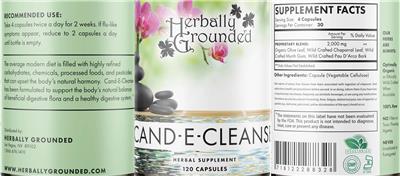
Cand-E-Cleanse by Herbally Grounded label
The label scan from the NIH Dietary Supplement Label Database. Tap to enlarge.
Label images are published by the NIH Dietary Supplement Label Database for the version of this product on file. Always read your actual product label.
View the full label (PDF)The Ingredients in Cand-E-Cleanse by Herbally Grounded
These are the 4 active ingredients this product is made of. Select any to open its full monograph.
Serving size4 Capsule(s) Dosage formCapsule Servings per container30 Amounts shown are per serving.
Most supplement products combine several ingredients, and a medication can interact with the product through any one of them. Each ingredient below shows whether it has known drug interactions.
Proprietary Blend
- › Myrrh Gum
- › Chaparral
- › Olive
- › Pau d'Arco
Other (inactive) ingredients: Cellulose. These complete the product’s ingredient list but are not active constituents.
Cand-E-Cleanse by Herbally Grounded Drug Interactions
HelloPharmacist Interaction Report
Cand-E-Cleanse by Herbally Grounded does interact with several medication types, and some of those interactions are serious.
The most concerning is chaparral, one of its four active ingredients, which can damage the liver when combined with other drugs that affect the liver (hepatotoxic drugs) — a Moderate-severity interaction. Chaparral itself carries significant safety concerns independent of drug interactions.
Read the full breakdown — every affected drug type, severity by severity
Myrrh gum in this product may increase the risk of low blood sugar (hypoglycemia) when combined with diabetes medications, and it may reduce how well warfarin (a blood thinner) works — both Moderate-severity concerns. Pau d'arco may raise bleeding risk when taken alongside blood thinners or antiplatelet drugs like aspirin, also Moderate severity.
Olive in this product has no interactions documented in our data, though that's not a guarantee none exist. Altogether, these interactions span 535 individual medications.
Before you start Cand-E-Cleanse, run your exact prescriptions and over-the-counter medications through the checker on this page.
Check your own medications below · Editorial policy · How we use AI
Want to check YOUR meds against Cand-E-Cleanse?
Ask about interactions with your drugs in plain English — “Can I take it with lisinopril?” — and we find you the answer in seconds, ingredient by ingredient.
Go to the checkerIngredients driving the most interactions
Individual Drug Interactions
The ingredients in Cand-E-Cleanse interact with 552 drugs. Click any drug to see the details.
3 of the 4 ingredients in Cand-E-Cleanse interact with drugs. Each result below shows which ingredient is responsible. Chaparral Pau d'Arco Myrrh Gum
6-mercaptopurinePurinethol
How 6-mercaptopurine interacts with Cand-E-Cleanse — through 1 ingredient. Tap an ingredient for the detail:
ChaparralHepatotoxic Drugs Moderate
Interaction Summary
Theoretically, chaparral might have additive adverse effects on the liver when used with hepatotoxic drugs.
Read the full Chaparral + 6-mercaptopurine interactionAbacavir Sulfate, Dolutegravir, LamivudineTriumeq
How Abacavir Sulfate, Dolutegravir, Lamivudine interacts with Cand-E-Cleanse — through 1 ingredient. Tap an ingredient for the detail:
ChaparralHepatotoxic Drugs Moderate
Interaction Summary
Theoretically, chaparral might have additive adverse effects on the liver when used with hepatotoxic drugs.
Read the full Chaparral + Abacavir Sulfate, Dolutegravir, Lamivudine interactionAbacavir, LamivudineEpzicom
How Abacavir, Lamivudine interacts with Cand-E-Cleanse — through 1 ingredient. Tap an ingredient for the detail:
ChaparralHepatotoxic Drugs Moderate
Interaction Summary
Theoretically, chaparral might have additive adverse effects on the liver when used with hepatotoxic drugs.
Read the full Chaparral + Abacavir, Lamivudine interactionAbciximabReoPro
How Abciximab interacts with Cand-E-Cleanse — through 1 ingredient. Tap an ingredient for the detail:
Pau D'arcoAnticoagulant/antiplatelet Drugs Moderate
Interaction Summary
Theoretically, pau d'arco might increase the risk of bleeding when taken with anticoagulant or antiplatelet drugs.
Read the full Pau D'arco + Abciximab interactionAbiraterone
How Abiraterone interacts with Cand-E-Cleanse — through 1 ingredient. Tap an ingredient for the detail:
ChaparralHepatotoxic Drugs Moderate
Interaction Summary
Theoretically, chaparral might have additive adverse effects on the liver when used with hepatotoxic drugs.
Read the full Chaparral + Abiraterone interactionAbiraterone AcetateYonsa, Zytiga
How Abiraterone Acetate interacts with Cand-E-Cleanse — through 1 ingredient. Tap an ingredient for the detail:
ChaparralHepatotoxic Drugs Moderate
Interaction Summary
Theoretically, chaparral might have additive adverse effects on the liver when used with hepatotoxic drugs.
Read the full Chaparral + Abiraterone Acetate interactionAbrocitinibCibinqo
How Abrocitinib interacts with Cand-E-Cleanse — through 1 ingredient. Tap an ingredient for the detail:
Pau D'arcoAnticoagulant/antiplatelet Drugs Moderate
Interaction Summary
Theoretically, pau d'arco might increase the risk of bleeding when taken with anticoagulant or antiplatelet drugs.
Read the full Pau D'arco + Abrocitinib interactionAcarboseGlucobay, Prandase, Precose
How Acarbose interacts with Cand-E-Cleanse — through 2 ingredients. Tap an ingredient for the detail:
Myrrh GumAntidiabetes Drugs Moderate
Interaction Summary
Theoretically, myrrh might increase the risk of hypoglycemia when taken with antidiabetes drugs.
Read the full Myrrh Gum + Acarbose interactionChaparralHepatotoxic Drugs Moderate
Interaction Summary
Theoretically, chaparral might have additive adverse effects on the liver when used with hepatotoxic drugs.
Read the full Chaparral + Acarbose interactionAcebutololRhotral, Sectral
How Acebutolol interacts with Cand-E-Cleanse — through 1 ingredient. Tap an ingredient for the detail:
ChaparralHepatotoxic Drugs Moderate
Interaction Summary
Theoretically, chaparral might have additive adverse effects on the liver when used with hepatotoxic drugs.
Read the full Chaparral + Acebutolol interactionAcenocoumarolSintrom
How Acenocoumarol interacts with Cand-E-Cleanse — through 1 ingredient. Tap an ingredient for the detail:
Pau D'arcoAnticoagulant/antiplatelet Drugs Moderate
Interaction Summary
Theoretically, pau d'arco might increase the risk of bleeding when taken with anticoagulant or antiplatelet drugs.
Read the full Pau D'arco + Acenocoumarol interactionAcetaminophenChildren's Tylenol, Children's Tylenol Meltaways, Tylenol, Tylenol Ex Strength
How Acetaminophen interacts with Cand-E-Cleanse — through 1 ingredient. Tap an ingredient for the detail:
ChaparralHepatotoxic Drugs Moderate
Interaction Summary
Theoretically, chaparral might have additive adverse effects on the liver when used with hepatotoxic drugs.
Read the full Chaparral + Acetaminophen interactionAcetaminophen, AspirinGemnisyn
How Acetaminophen, Aspirin interacts with Cand-E-Cleanse — through 2 ingredients. Tap an ingredient for the detail:
Pau D'arcoAnticoagulant/antiplatelet Drugs Moderate
Interaction Summary
Theoretically, pau d'arco might increase the risk of bleeding when taken with anticoagulant or antiplatelet drugs.
Read the full Pau D'arco + Acetaminophen, Aspirin interactionChaparralHepatotoxic Drugs Moderate
Interaction Summary
Theoretically, chaparral might have additive adverse effects on the liver when used with hepatotoxic drugs.
Read the full Chaparral + Acetaminophen, Aspirin interactionAcetaminophen, Aspirin, CaffeineExcedrin, Excedrin Extra Strength, Excedrin Migraine
How Acetaminophen, Aspirin, Caffeine interacts with Cand-E-Cleanse — through 2 ingredients. Tap an ingredient for the detail:
ChaparralHepatotoxic Drugs Moderate
Interaction Summary
Theoretically, chaparral might have additive adverse effects on the liver when used with hepatotoxic drugs.
Read the full Chaparral + Acetaminophen, Aspirin, Caffeine interactionPau D'arcoAnticoagulant/antiplatelet Drugs Moderate
Interaction Summary
Theoretically, pau d'arco might increase the risk of bleeding when taken with anticoagulant or antiplatelet drugs.
Read the full Pau D'arco + Acetaminophen, Aspirin, Caffeine interactionAcetaminophen, Brompheniramine, PhenylpropanolamineDimetapp Cold and Flu
How Acetaminophen, Brompheniramine, Phenylpropanolamine interacts with Cand-E-Cleanse — through 1 ingredient. Tap an ingredient for the detail:
ChaparralHepatotoxic Drugs Moderate
Interaction Summary
Theoretically, chaparral might have additive adverse effects on the liver when used with hepatotoxic drugs.
Read the full Chaparral + Acetaminophen, Brompheniramine, Phenylpropanolamine interactionAcetaminophen, ButalbitalAxocet, Bancap, Bucet, Butex Forte, Esgic CF, Orbivan CF +5 more
How Acetaminophen, Butalbital interacts with Cand-E-Cleanse — through 1 ingredient. Tap an ingredient for the detail:
ChaparralHepatotoxic Drugs Moderate
Interaction Summary
Theoretically, chaparral might have additive adverse effects on the liver when used with hepatotoxic drugs.
Read the full Chaparral + Acetaminophen, Butalbital interactionAcetaminophen, Butalbital, CaffeineEsgic, Esgic Plus, Fiogesic, Fioricet, Repan, Tecnal +1 more
How Acetaminophen, Butalbital, Caffeine interacts with Cand-E-Cleanse — through 1 ingredient. Tap an ingredient for the detail:
ChaparralHepatotoxic Drugs Moderate
Interaction Summary
Theoretically, chaparral might have additive adverse effects on the liver when used with hepatotoxic drugs.
Read the full Chaparral + Acetaminophen, Butalbital, Caffeine interactionAcetaminophen, Butalbital, Caffeine, CodeineEsgic with Codeine, Fioricet w/ Codeine
How Acetaminophen, Butalbital, Caffeine, Codeine interacts with Cand-E-Cleanse — through 1 ingredient. Tap an ingredient for the detail:
ChaparralHepatotoxic Drugs Moderate
Interaction Summary
Theoretically, chaparral might have additive adverse effects on the liver when used with hepatotoxic drugs.
Read the full Chaparral + Acetaminophen, Butalbital, Caffeine, Codeine interactionAcetaminophen, Butalbital, CodeineBancap w/ Codeine
How Acetaminophen, Butalbital, Codeine interacts with Cand-E-Cleanse — through 1 ingredient. Tap an ingredient for the detail:
ChaparralHepatotoxic Drugs Moderate
Interaction Summary
Theoretically, chaparral might have additive adverse effects on the liver when used with hepatotoxic drugs.
Read the full Chaparral + Acetaminophen, Butalbital, Codeine interactionAcetaminophen, Butalbital, Codeine PhosphatePhrenilin #3
How Acetaminophen, Butalbital, Codeine Phosphate interacts with Cand-E-Cleanse — through 1 ingredient. Tap an ingredient for the detail:
ChaparralHepatotoxic Drugs Moderate
Interaction Summary
Theoretically, chaparral might have additive adverse effects on the liver when used with hepatotoxic drugs.
Read the full Chaparral + Acetaminophen, Butalbital, Codeine Phosphate interactionAcetaminophen, Caffeine, Chlorpheniramine, Hydrocodone, PhenylephrineHycomine Compound
How Acetaminophen, Caffeine, Chlorpheniramine, Hydrocodone, Phenylephrine interacts with Cand-E-Cleanse — through 1 ingredient. Tap an ingredient for the detail:
ChaparralHepatotoxic Drugs Moderate
Interaction Summary
Theoretically, chaparral might have additive adverse effects on the liver when used with hepatotoxic drugs.
Read the full Chaparral + Acetaminophen, Caffeine, Chlorpheniramine, Hydrocodone, Phenylephrine interactionAcetaminophen, Caffeine, CodeineGesic C15, Gesic C30, Gesic C8, Lenoltec 1, Lenoltec 2, Lenoltec 3 +1 more
How Acetaminophen, Caffeine, Codeine interacts with Cand-E-Cleanse — through 1 ingredient. Tap an ingredient for the detail:
ChaparralHepatotoxic Drugs Moderate
Interaction Summary
Theoretically, chaparral might have additive adverse effects on the liver when used with hepatotoxic drugs.
Read the full Chaparral + Acetaminophen, Caffeine, Codeine interactionAcetaminophen, Caffeine, Codeine, SalicylamideCodalan No.1, Codalan No.2, Codalan No.3
How Acetaminophen, Caffeine, Codeine, Salicylamide interacts with Cand-E-Cleanse — through 1 ingredient. Tap an ingredient for the detail:
ChaparralHepatotoxic Drugs Moderate
Interaction Summary
Theoretically, chaparral might have additive adverse effects on the liver when used with hepatotoxic drugs.
Read the full Chaparral + Acetaminophen, Caffeine, Codeine, Salicylamide interactionAcetaminophen, Caffeine, DihydrocodeineDHC Plus, Panlor DC, Panlor SS
How Acetaminophen, Caffeine, Dihydrocodeine interacts with Cand-E-Cleanse — through 1 ingredient. Tap an ingredient for the detail:
ChaparralHepatotoxic Drugs Moderate
Interaction Summary
Theoretically, chaparral might have additive adverse effects on the liver when used with hepatotoxic drugs.
Read the full Chaparral + Acetaminophen, Caffeine, Dihydrocodeine interactionAcetaminophen, Caffeine, IsomethepteneMigralam
How Acetaminophen, Caffeine, Isometheptene interacts with Cand-E-Cleanse — through 1 ingredient. Tap an ingredient for the detail:
ChaparralHepatotoxic Drugs Moderate
Interaction Summary
Theoretically, chaparral might have additive adverse effects on the liver when used with hepatotoxic drugs.
Read the full Chaparral + Acetaminophen, Caffeine, Isometheptene interactionAcetaminophen, Caffeine, PyrilamineMidol Max Strength Menstrual
How Acetaminophen, Caffeine, Pyrilamine interacts with Cand-E-Cleanse — through 1 ingredient. Tap an ingredient for the detail:
ChaparralHepatotoxic Drugs Moderate
Interaction Summary
Theoretically, chaparral might have additive adverse effects on the liver when used with hepatotoxic drugs.
Read the full Chaparral + Acetaminophen, Caffeine, Pyrilamine interactionAcetaminophen, Chlorpheniramine Maleate, Dextromethorphan HbrVicks Formula 44M Cough, Cold & Flu Relief
How Acetaminophen, Chlorpheniramine Maleate, Dextromethorphan Hbr interacts with Cand-E-Cleanse — through 1 ingredient. Tap an ingredient for the detail:
ChaparralHepatotoxic Drugs Moderate
Interaction Summary
Theoretically, chaparral might have additive adverse effects on the liver when used with hepatotoxic drugs.
Read the full Chaparral + Acetaminophen, Chlorpheniramine Maleate, Dextromethorphan Hbr interactionAcetaminophen, Chlorpheniramine, Codeine, PhenylephrineColrex
How Acetaminophen, Chlorpheniramine, Codeine, Phenylephrine interacts with Cand-E-Cleanse — through 1 ingredient. Tap an ingredient for the detail:
ChaparralHepatotoxic Drugs Moderate
Interaction Summary
Theoretically, chaparral might have additive adverse effects on the liver when used with hepatotoxic drugs.
Read the full Chaparral + Acetaminophen, Chlorpheniramine, Codeine, Phenylephrine interactionAcetaminophen, Chlorpheniramine, DextromethorphanCoricidin II Extra Strength Cold and Flu
How Acetaminophen, Chlorpheniramine, Dextromethorphan interacts with Cand-E-Cleanse — through 1 ingredient. Tap an ingredient for the detail:
ChaparralHepatotoxic Drugs Moderate
Interaction Summary
Theoretically, chaparral might have additive adverse effects on the liver when used with hepatotoxic drugs.
Read the full Chaparral + Acetaminophen, Chlorpheniramine, Dextromethorphan interactionAcetaminophen, Chlorpheniramine, Dextromethorphan HydrobromideCoricidin HBP Maximum Strength Flu
How Acetaminophen, Chlorpheniramine, Dextromethorphan Hydrobromide interacts with Cand-E-Cleanse — through 1 ingredient. Tap an ingredient for the detail:
ChaparralHepatotoxic Drugs Moderate
Interaction Summary
Theoretically, chaparral might have additive adverse effects on the liver when used with hepatotoxic drugs.
Read the full Chaparral + Acetaminophen, Chlorpheniramine, Dextromethorphan Hydrobromide interactionAcetaminophen, Chlorpheniramine, Dextromethorphan, PhenylpropanolamineMulti Symptom Cold Relief
How Acetaminophen, Chlorpheniramine, Dextromethorphan, Phenylpropanolamine interacts with Cand-E-Cleanse — through 1 ingredient. Tap an ingredient for the detail:
ChaparralHepatotoxic Drugs Moderate
Interaction Summary
Theoretically, chaparral might have additive adverse effects on the liver when used with hepatotoxic drugs.
Read the full Chaparral + Acetaminophen, Chlorpheniramine, Dextromethorphan, Phenylpropanolamine interactionEach ingredient & the kinds of drugs it affects
For each ingredient in Cand-E-Cleanse with known interactions, here are the types of medications they can affect. Open any type for the detail — or search your exact drug in the checker above.
Chaparral
Hepatotoxic Drugs
Theoretically, chaparral might have additive adverse effects on the liver when used with hepatotoxic drugs.
Pau d'Arco
Anticoagulant/Antiplatelet Drugs
Theoretically, pau d'arco might increase the risk of bleeding when taken with anticoagulant or antiplatelet drugs.
In vitro research shows that pau d'arco reduces platelet aggregation and may interfere with vitamin K. One clinical study shows that taking the lapachol constituent of pau d'arco in doses above 1.5 grams daily increases the risk of bleeding. The effects of whole pau d'arco or pau d'arco extract in humans are unclear.
Myrrh Gum
Antidiabetes Drugs
Theoretically, myrrh might increase the risk of hypoglycemia when taken with antidiabetes drugs.
In vitro and animal research suggests that myrrh has hypoglycemic effects.
Warfarin (Coumadin)
Theoretically, myrrh might decrease the effectiveness of warfarin.
In one case, a patient who was previously stable on warfarin had a significant decline in international normalized ratio (INR) following consumption of an aqueous extract of myrrh.
Brand information
Manufacturer and brand details for Cand-E-Cleanse, from the product label.
Herbally Grounded
See all Herbally Grounded products- Name
- Herbally Grounded
- City
- Las Vegas
- State
- NV
- ZipCode
- 89102
- Phone Number
- 1.866.676.1410
- Web Address
- www.herballygrounded.com
Cand-E-Cleanse by Herbally Grounded: Common Questions
Does Cand-E-Cleanse by Herbally Grounded interact with any medications?
How can one product interact with so many drugs?
Where does this information come from?
What's chaparral, and why is it a concern?
Can I take this while pregnant or breastfeeding?
Will this product actually work for what it claims?
What side effects might I experience?
Is this safe to take with my blood thinner?
What about with diabetes medication?
Written and reviewed by the HelloPharmacist editorial staff. Our editorial policy
Not sure if Cand-E-Cleanse is safe with your meds?
Our pharmacists answer your medication & supplement questions — free.
Label information is sourced from the NIH Dietary Supplement Label Database and reflects the product version on file; always read your actual product label. This page is for education only and is not a substitute for professional medical advice. Confirm with your pharmacist or doctor before combining supplements and medications.
The Full Monographs Behind Cand-E-Cleanse’s Ingredients
Every ingredient we hold a full HelloPharmacist monograph for — uses, evidence, safety, and the complete interaction list.
Myrrh
Interacts with 88 drugsMyrrh is a fragrant gum resin from Commiphora trees that has long been used in mouthwashes, throat remedies, and skin care. Modern evidence for most of its uses is limited and comes mostly f...
Read the full Myrrh monograph → Herb & supplement monographChaparral
Interacts with 370 drugsChaparral is a desert shrub long used in traditional medicine, but there is no reliable proof it treats any condition. It has been linked to serious and sometimes irreversible liver and kidn...
Read the full Chaparral monograph → Herb & supplement monographOlive
Olive comes from the same tree that gives us olives and olive oil, and its leaf and fruit contain antioxidant compounds like oleuropein and hydroxytyrosol. Olive oil as part of a Mediterrane...
Read the full Olive monograph → Herb & supplement monographPau D'arco
Interacts with 122 drugsPau d'arco is a South American tree bark traditionally used for infections and inflammation, and it contains compounds like lapachol that show activity in lab studies. However, strong human...
Read the full Pau D'arco monograph →Sources & How We Checked
Cand-E-Cleanse's label data comes from the NIH Dietary Supplement Label Database; the ingredient interaction data is from the Natural Medicines database, reviewed by our pharmacists.
- NIH Dietary Supplement Label Database (DSLD) — The official product label on file for this supplement.
- Natural Medicines (Therapeutic Research Center) — Evidence-graded clinical reference behind the ingredient interaction data.
Content is written and reviewed by licensed HelloPharmacist pharmacists. See our data sources and editorial standards for how this information is built and checked.
The 32 references behind this product’s interaction data
Every citation that drives the interaction findings for this product’s ingredients, from the evidence-graded Natural Medicines (TRC Healthcare) database. Open an ingredient to browse its citations — links open the study on PubMed or the publisher’s site.
Myrrh 8 references
- Newall CA, Anderson LA, Philpson JD. Herbal Medicine: A Guide for Healthcare Professionals. London, UK: The Pharmaceutical Press, 1996.
- The Review of Natural Products by Facts and Comparisons. St. Louis, MO: Wolters Kluwer Co., 1999.
- McGuffin M, Hobbs C, Upton R, Goldberg A, eds. American Herbal Products Association's Botanical Safety Handbook. Boca Raton, FL: CRC Press, LLC 1997.
- Brinker F. Herb Contraindications and Drug Interactions. 2nd ed. Sandy, OR: Eclectic Medical Publications, 1998.
- Al Faraj S. Antagonism of the anticoagulant effect of warfarin caused by the use of Commiphora molmol as a herbal medication: a case report. Ann Trop Med Parasitol 2005;99:219-20.
- Al-Jaroudi D, Kaddour O, Al-Amin N. Risks of myrrh use in pregnancy. JBRA Assist Reprod 2016;20(4):257-8.
- Xu YY, Li L, Xuan L, Guan K. Patch test diagnosis of non-immediate cutaneous reaction to myrrh following oral intake of a traditional Chinese medicine decoction. Contact Dermatitis. 2019;80(2):135-136. PubMed
- Al-Romaiyan A, Huang GC, Jones P, Persaud S. Commiphora myrrha stimulates insulin secretion from mouse and human islets of Langerhans. J Ethnopharmacol. 2021 Jan 10;264:113075. PubMed
Chaparral 16 references
- Smith BC, Desmond PV. Acute hepatitis induced by ingestion of the herbal medication chaparral. Aust N Z J Med 1993;23:526.. PubMed
- Gordon DW, Rosenthal G, Hart J, et al. Chaparral ingestion: the broadening spectrum of liver injury caused by herbal medications. JAMA 1995;273:489-90.
- Batchelor WB, Heathcote J, Wanless IR. Chaparral-induced hepatic injury. Am J Gastroenterol 1995;90:831-3.
- Katz M, Saibil F. Herbal hepatitis: subacute hepatic necrosis secondary to chaparral leaf. J Clin Gastroenterol 1990;12:203-6.
- Klepser TB, Klepser ME. Unsafe and potentially safe herbal therapies. Am J Health Syst Pharm 1999;56:125-38. PubMed
- Sheikh NM, Philen RM, Love LA. Chaparral-associated hepatotoxicity. Arch Intern Med 1997;157:913-9. DOI
- Heron S, Yarnell E. The safety of low-dose Larrea tridentata (DC) Coville (creosote bush or chaparral): a retrospective clinical study. J Altern Complement Med 2001;7:175-85..
- Chaparral-induced toxic hepatitis-California and Texas, 1992. MMWR Morb Mortal Wkly Rep 1992;41:812-4.. DOI
- Estes JD, Stolpman D, Olyaei A, et al. High prevalence of potentially hepatotoxic herbal supplement use in patients with fulminant hepatic failure. Arch Surg 2003;138:852-8.. PubMed
- Lambert JD, Zhao D, Meyers RO, et al. Nordihydroguaiaretic acid: hepatotoxicity and detoxification in the mouse. Toxicon 2002;40:1701-8.. PubMed
- Shasky DR. Contact dermatitis from Larrea tridentata (creosote bush). J Am Acad Dermatol 1986;15:302.. PubMed
- Smith AY, Feddersen RM, Gardner KD Jr, Davis CJ Jr. Cystic renal cell carcinoma and acquired renal cystic disease associated with consumption of chaparral tea: a case report. J Urol 1994;152:2089-91.. PubMed
- Kauma, H., Koskela, R., Makisalo, H., Autio-Harmainen, H., Lehtola, J., and Hockerstedt, K. Toxic acute hepatitis and hepatic fibrosis after consumption of chaparral tablets. Scand.J Gastroenterol. 2004;39(11):1168-1171. PubMed
- Leonforte, J. F. Contact dermatitis from Larrea (creosote bush). J Am Acad.Dermatol. 1986;14(2 Pt 1):202-207. PubMed
- Alderman, S., Kailas, S., Goldfarb, S., Singaram, C., and Malone, D. G. Cholestatic hepatitis after ingestion of chaparral leaf: confirmation by endoscopic retrograde cholangiopancreatography and liver biopsy. J Clin.Gastroenterol. 1994;19(3):242-247.
- Clark, F. Chaparral-induced toxic hepatitis: California and Texas, 1992. MMWR Morb Mortal Wkly Rep. 1992;41:812-814. DOI
Olive 2 references
- Liccardi G, D'Amato M, D'Amato G. Oleaceae pollinosis: a review. Int Arch Allergy Immunol 1996;111:210-7. PubMed
- Somerville V, Moore R, Braakhuis A. The effect of olive leaf extract on upper respiratory illness in high school athletes: A randomised control trial. Nutrients. 2019;11(2). pii: E358. PubMed
Pau D'arco 6 references
- Gómez Castellanos JR, Prieto JM, Heinrich M. Red Lapacho (Tabebuia impetiginosa)--a global ethnopharmacological commodity? J Ethnopharmacol 2009;121:1-13. PubMed
- Guerra, Mde O., Mazoni, A. S., Brandao, M. A., and Peters, V. M. Toxicology of Lapachol in rats: embryolethality. Braz.J Biol. 2001;61(1):171-174. PubMed
- Felicio, A. C., Chang, C. V., Brandao, M. A., Peters, V. M., and Guerra, Mde O. Fetal growth in rats treated with lapachol. Contraception 2002;66(4):289-293. PubMed
- Son, D. J., Lim, Y., Park, Y. H., Chang, S. K., Yun, Y. P., Hong, J. T., Takeoka, G. R., Lee, K. G., Lee, S. E., Kim, M. R., Kim, J. H., and Park, B. S. Inhibitory effects of Tabebuia impetiginosa inner bark extract on platelet aggregation and vascular s
- Block JB, Serpick AA, Miller W, Wiernik PH. Early clinical studies with lapachol (NSC-11905). Cancer Chemother Rep 2. 1974;4(4):27-8.
- Algranti E, Mendonça EM, Ali SA, Kokron CM, Raile V. Occupational asthma caused by Ipe (Tabebuia spp) dust. J Investig Allergol Clin Immunol 2005;15(1):81-3.
Parts of this content are provided by the Therapeutic Research Center, LLC.
DISCLAIMER: Currently this does not check for drug-drug interactions. This is not an all-inclusive comprehensive list of potential interactions and is for informational purposes only. Not all interactions are known or well-reported in the scientific literature, and new interactions are continually being reported. Input is needed from a qualified healthcare provider including a pharmacist before starting any therapy. Application of clinical judgment is necessary.
© 2021 Therapeutic Research Center, LLC