
Cherry Fruit Extract Ingredients & Drug Interactions
by Bluebonnet
What is this page for?
First and foremost: checking Cherry Fruit Extract against your medications. The heart of this page is the interaction checker and the full interaction report — how this product’s ingredients may interact with prescription and over-the-counter medicines you may be taking.
Around that, we add a pharmacist’s high-level view of the product as a whole — what’s inside, the evidence for its stated use, how transparent the label is, and what safety data exists — so you can see the full picture in one place. It’s educational information from our licensed clinical databases and the clinical staff at HelloPharmacist — not medical advice — and we don’t sell or endorse products. Our editorial policy
Cherry Fruit Extract is a dietary supplement by Bluebonnet with 3 active ingredients. Its ingredients are commonly taken for muscle soreness after exercise, gout and joint discomfort, sleep support.Based on those ingredients, 643 medications have a known interaction with it, the most serious rated moderate. The ingredients most likely to interact are Black Cherry Fruit Extract. Use the checker below to test your specific medication, or read the full HelloPharmacist Interaction Report.
Check Your Meds Against Cherry Fruit Extract by Bluebonnet
Ask about any prescription or over-the-counter medication and we check it for interactions with Cherry Fruit Extract by Bluebonnet — and tell you which ingredient is responsible.
AI summaries are generated from our interaction database for education only — always confirm with your pharmacist. How we use AI
Ask the Pharmacist
A licensed pharmacist will answer your question by email — free, usually within 24 hours.
Got it — thank you!
A licensed pharmacist will answer within 24 hours. Keep an eye on your email (worth checking spam, just in case).
HelloPharmacist Scorecard of Cherry Fruit Extract by Bluebonnet
Our pharmacy team’s full take, with four database checks built into the cards below — a summary of what is known, not a grade of the product itself.
What’s inside
Low disclosure
This capsule contains three active cherry fruit extracts: tart cherry, black cherry, and sweet cherry. Each brings different compounds; tart cherry has been studied most for athletic recovery, while sweet cherry is eaten widely as food.
The product also contains inactive ingredients — cellulose, hypromellose, purified water, magnesium stearate, and silicon dioxide — which are fillers and capsule materials.
Does it work?
Couldn't assess
The evidence for this product's benefits is limited. Tart cherry is possibly effective for athletic performance, but for attention, cognitive function, muscle soreness, infection risk, and fibromyalgia, we don't have enough reliable data.
Sweet cherry's potential role in heart health, blood sugar, weight, and joint pain also lacks established evidence in our data. Black cherry has no effectiveness ratings on file.
How safe is it?
Well-documented data
Tart cherry is generally well tolerated as whole fruit, but concentrated supplements are less studied — some people report abdominal pain, loose stools, or gastrointestinal upset. Rarely, allergic skin reactions have been reported.
Black cherry is a concern: it contains cyanide-forming compounds and should not be used in large amounts; it's considered likely unsafe in pregnancy and the safety data advises against it while breastfeeding. Sweet cherry is widely eaten as food and generally well tolerated, though allergic reactions (ranging from mouth irritation to difficulty breathing) are possible in sensitive people.
For pregnancy and lactation, tart cherry and sweet cherry are rated likely safe, but concentrated supplement safety during pregnancy and breastfeeding hasn't been established — talk with your doctor or pharmacist for personalized advice.
Meds to double-check
Moderate interaction found
Before you take this, check with your doctor or pharmacist if you take any drugs metabolized by cytochrome P450 3A4 (CYP3A4) — a common liver enzyme system affected by black cherry. This includes many cholesterol medications, antifungals, and others.
No other interactions are documented for tart cherry or sweet cherry in our data.
The bottom line
Scorecard at a glanceFormula with limited ingredient disclosure with no assessable stated purpose. Moderate medication interactions have been identified, and safety information is well characterized.
This product is mainly for those interested in cherry's potential for athletic performance or recovery, though the evidence is modest. If you're pregnant, breastfeeding, or take any medications — especially cholesterol or antifungal drugs — discuss it with your doctor or pharmacist first.
The black cherry content and cyanide risk mean this isn't for everyone.
Educational only — not medical advice; always confirm with your pharmacist. Our editorial policy · How we use AI
Assessment coverage: 3 of 3 active ingredients matched to our full ingredient reviews (monographs). Based on the product label dated Jul 25, 2024.
This Scorecard evaluates available label information, ingredient evidence, and known medication-safety considerations. It does not independently verify product identity, purity, potency, contamination, or manufacturing quality. How these ratings are computed
General information
Key facts about Cherry Fruit Extract, straight from the product label.
| Brand | Bluebonnet |
|---|---|
| Barcode (UPC) | 743715009813 |
| Net contents | 120 Vegetable Capsule(s) |
| Market status | On market |
| Date entered into DSLD | Jul 25, 2024 |
| DSLD ID | 315007 |
| Product type | Botanical |
| Supplement form | Capsule |
| Dietary claims / uses | All Other, Structure/Function |
| Intended target group(s) | Vegan, Vegetarian, Adult (18 - 50 Years), Kosher, No Allergies, Gluten Free |
Everything in this section is reproduced from the manufacturer’s own product label — it’s the label speaking, not HelloPharmacist. We show it so you can see exactly what the maker states; we don’t verify or endorse those statements.
Supplement Facts
The label details for Cherry Fruit Extract by Bluebonnet, sourced from the NIH Dietary Supplement Label Database.
Supplement Facts
| Ingredient | Amount | % DV |
|---|---|---|
| Tart Cherry Fruit Extract | 0 NP | -- |
| Black Cherry Fruit Extract | 0 NP | -- |
| Sweet Cherry Fruit Extract | 0 NP | -- |
| Cherry Fruit Extract Blend | 1000 mg | -- |
Other ingredients: Cellulose, Hypromellose, Water, Purified, Magnesium Stearate, Silicon Dioxide
Tap any ingredient to jump to its full detail below.
These statements are the manufacturer’s wording, reproduced from the product label — the label is saying it, not HelloPharmacist. We don’t verify or endorse them.
Formula
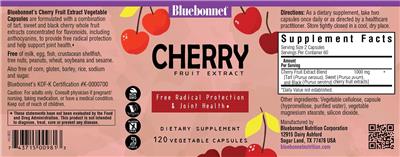
Bluebonnet's Cherry Fruit Extract Vegetable Capsules are formulated with a combination of tart, sweet and black cherry whole fruit extracts concentrated for flavonoids, including anthocyanins, to provide free radical protection and help support joint health.
Bluebonnet's KOF-K Certification #K-0000700
K Parve (Kosher)
Formulation
Free of milk, egg, fish, crustacean shellfish, tree nuts, peanuts, wheat, soybeans and sesame. Also free of corn, gluten, barley, rice, sodium and sugar.
Non GMO
Vegan
Gluten free
Free radical protection & joint health
Precautions
Caution: For adults only.
Consult physician if pregnant/nursing, taking medication, or have a medical condition.
Keep out of reach of children.
FDA Disclaimer Statement
These statements have not been evaluated by the Food and Drug Administration. This product is not intended to diagnose, treat, cure or prevent any disease.
Seals/Symbols
Vegan
K Parve (Kosher)
FDA Statement of Identity
Dietary Supplement
Suggested/Recommended/Usage/Directions
Directions: As a dietary supplement, take two capsules once daily or as directed by a healthcare practitioner.
Storage
Store tightly closed in a cool, dry place.
Is this label outdated? Report a formula or label change and our pharmacy team will review it.
Cherry Fruit Extract by Bluebonnet label
The label scan from the NIH Dietary Supplement Label Database. Tap to enlarge.
Label images are published by the NIH Dietary Supplement Label Database for the version of this product on file. Always read your actual product label.
View the full label (PDF)The Ingredients in Cherry Fruit Extract by Bluebonnet
These are the 3 active ingredients this product is made of. Select any to open its full monograph.
Serving size2 Capsule(s) Dosage formCapsule Servings per container60 Amounts shown are per serving.
Most supplement products combine several ingredients, and a medication can interact with the product through any one of them. Each ingredient below shows whether it has known drug interactions.
Cherry Fruit Extract Blend
Other (inactive) ingredients: Cellulose, Hypromellose, Water, Purified, Magnesium Stearate, Silicon Dioxide. These complete the product’s ingredient list but are not active constituents.
Cherry Fruit Extract by Bluebonnet Drug Interactions
HelloPharmacist Interaction Report
Bluebonnet's Cherry Fruit Extract contains black cherry fruit extract, which has documented interactions with medications.
The most serious concern is a moderate interaction with drugs metabolized by cytochrome P450 3A4 (CYP3A4) — a major liver enzyme system. In vitro testing suggests black cherry may slow how your body breaks down these drugs, potentially raising their levels in your bloodstream, though this hasn't been reported in actual patients yet.
Read the full breakdown — every affected drug type, severity by severity
Although tart cherry and sweet cherry extracts in this product show no known interactions in our data, the black cherry content means you'll want to check any medications you take before starting. Altogether, these interactions span 644 individual medications.
Use the search tool below to verify your exact prescriptions. If you take any CYP3A4 substrate drug — common cholesterol, antifungal, or other medications — run it through before you begin.
Check your own medications below · Editorial policy · How we use AI
Want to check YOUR meds against Cherry Fruit Extract?
Ask about interactions with your drugs in plain English — “Can I take it with lisinopril?” — and we find you the answer in seconds, ingredient by ingredient.
Go to the checkerIngredients driving the most interactions
Individual Drug Interactions
The ingredients in Cherry Fruit Extract interact with 643 drugs. Click any drug to see the details.
1 of the 3 ingredients in Cherry Fruit Extract interact with drugs. Each result below shows which ingredient is responsible. Black Cherry Fruit Extract
Ado-trastuzumab EmtansineKadcyla
How Ado-trastuzumab Emtansine interacts with Cherry Fruit Extract — through 1 ingredient. Tap an ingredient for the detail:
Black Cherry Fruit ExtractCytochrome P450 3a4 (cyp3a4) Substrates Moderate
Interaction Summary
In vitro research suggests that wild cherry can inhibit cytochrome P450 3A4 (CYP3A4) enzymes.
Read the full Black Cherry Fruit Extract + Ado-trastuzumab Emtansine interactionAbemaciclibVerzenio
How Abemaciclib interacts with Cherry Fruit Extract — through 1 ingredient. Tap an ingredient for the detail:
Black Cherry Fruit ExtractCytochrome P450 3a4 (cyp3a4) Substrates Moderate
Interaction Summary
In vitro research suggests that wild cherry can inhibit cytochrome P450 3A4 (CYP3A4) enzymes.
Read the full Black Cherry Fruit Extract + Abemaciclib interactionAbiraterone
How Abiraterone interacts with Cherry Fruit Extract — through 1 ingredient. Tap an ingredient for the detail:
Black Cherry Fruit ExtractCytochrome P450 3a4 (cyp3a4) Substrates Moderate
Interaction Summary
In vitro research suggests that wild cherry can inhibit cytochrome P450 3A4 (CYP3A4) enzymes.
Read the full Black Cherry Fruit Extract + Abiraterone interactionAbiraterone AcetateYonsa, Zytiga
How Abiraterone Acetate interacts with Cherry Fruit Extract — through 1 ingredient. Tap an ingredient for the detail:
Black Cherry Fruit ExtractCytochrome P450 3a4 (cyp3a4) Substrates Moderate
Interaction Summary
In vitro research suggests that wild cherry can inhibit cytochrome P450 3A4 (CYP3A4) enzymes.
Read the full Black Cherry Fruit Extract + Abiraterone Acetate interactionAcalabrutinibCalquence
How Acalabrutinib interacts with Cherry Fruit Extract — through 1 ingredient. Tap an ingredient for the detail:
Black Cherry Fruit ExtractCytochrome P450 3a4 (cyp3a4) Substrates Moderate
Interaction Summary
In vitro research suggests that wild cherry can inhibit cytochrome P450 3A4 (CYP3A4) enzymes.
Read the full Black Cherry Fruit Extract + Acalabrutinib interactionAcetaminophen, Aspirin, CaffeineExcedrin, Excedrin Extra Strength, Excedrin Migraine
How Acetaminophen, Aspirin, Caffeine interacts with Cherry Fruit Extract — through 1 ingredient. Tap an ingredient for the detail:
Black Cherry Fruit ExtractCytochrome P450 3a4 (cyp3a4) Substrates Moderate
Interaction Summary
In vitro research suggests that wild cherry can inhibit cytochrome P450 3A4 (CYP3A4) enzymes.
Read the full Black Cherry Fruit Extract + Acetaminophen, Aspirin, Caffeine interactionAcetaminophen, Butalbital, CaffeineEsgic, Esgic Plus, Fiogesic, Fioricet, Repan, Tecnal +1 more
How Acetaminophen, Butalbital, Caffeine interacts with Cherry Fruit Extract — through 1 ingredient. Tap an ingredient for the detail:
Black Cherry Fruit ExtractCytochrome P450 3a4 (cyp3a4) Substrates Moderate
Interaction Summary
In vitro research suggests that wild cherry can inhibit cytochrome P450 3A4 (CYP3A4) enzymes.
Read the full Black Cherry Fruit Extract + Acetaminophen, Butalbital, Caffeine interactionAcetaminophen, Butalbital, Caffeine, CodeineEsgic with Codeine, Fioricet w/ Codeine
How Acetaminophen, Butalbital, Caffeine, Codeine interacts with Cherry Fruit Extract — through 1 ingredient. Tap an ingredient for the detail:
Black Cherry Fruit ExtractCytochrome P450 3a4 (cyp3a4) Substrates Moderate
Interaction Summary
In vitro research suggests that wild cherry can inhibit cytochrome P450 3A4 (CYP3A4) enzymes.
Read the full Black Cherry Fruit Extract + Acetaminophen, Butalbital, Caffeine, Codeine interactionAcetaminophen, Caffeine, Chlorpheniramine, Hydrocodone, PhenylephrineHycomine Compound
How Acetaminophen, Caffeine, Chlorpheniramine, Hydrocodone, Phenylephrine interacts with Cherry Fruit Extract — through 1 ingredient. Tap an ingredient for the detail:
Black Cherry Fruit ExtractCytochrome P450 3a4 (cyp3a4) Substrates Moderate
Interaction Summary
In vitro research suggests that wild cherry can inhibit cytochrome P450 3A4 (CYP3A4) enzymes.
Read the full Black Cherry Fruit Extract + Acetaminophen, Caffeine, Chlorpheniramine, Hydrocodone, Phenylephrine interactionAcetaminophen, Caffeine, CodeineGesic C15, Gesic C30, Gesic C8, Lenoltec 1, Lenoltec 2, Lenoltec 3 +1 more
How Acetaminophen, Caffeine, Codeine interacts with Cherry Fruit Extract — through 1 ingredient. Tap an ingredient for the detail:
Black Cherry Fruit ExtractCytochrome P450 3a4 (cyp3a4) Substrates Moderate
Interaction Summary
In vitro research suggests that wild cherry can inhibit cytochrome P450 3A4 (CYP3A4) enzymes.
Read the full Black Cherry Fruit Extract + Acetaminophen, Caffeine, Codeine interactionAcetaminophen, Caffeine, Codeine, SalicylamideCodalan No.1, Codalan No.2, Codalan No.3
How Acetaminophen, Caffeine, Codeine, Salicylamide interacts with Cherry Fruit Extract — through 1 ingredient. Tap an ingredient for the detail:
Black Cherry Fruit ExtractCytochrome P450 3a4 (cyp3a4) Substrates Moderate
Interaction Summary
In vitro research suggests that wild cherry can inhibit cytochrome P450 3A4 (CYP3A4) enzymes.
Read the full Black Cherry Fruit Extract + Acetaminophen, Caffeine, Codeine, Salicylamide interactionAcetaminophen, Caffeine, DihydrocodeineDHC Plus, Panlor DC, Panlor SS
How Acetaminophen, Caffeine, Dihydrocodeine interacts with Cherry Fruit Extract — through 1 ingredient. Tap an ingredient for the detail:
Black Cherry Fruit ExtractCytochrome P450 3a4 (cyp3a4) Substrates Moderate
Interaction Summary
In vitro research suggests that wild cherry can inhibit cytochrome P450 3A4 (CYP3A4) enzymes.
Read the full Black Cherry Fruit Extract + Acetaminophen, Caffeine, Dihydrocodeine interactionAcetaminophen, Caffeine, IsomethepteneMigralam
How Acetaminophen, Caffeine, Isometheptene interacts with Cherry Fruit Extract — through 1 ingredient. Tap an ingredient for the detail:
Black Cherry Fruit ExtractCytochrome P450 3a4 (cyp3a4) Substrates Moderate
Interaction Summary
In vitro research suggests that wild cherry can inhibit cytochrome P450 3A4 (CYP3A4) enzymes.
Read the full Black Cherry Fruit Extract + Acetaminophen, Caffeine, Isometheptene interactionAcetaminophen, Caffeine, PyrilamineMidol Max Strength Menstrual
How Acetaminophen, Caffeine, Pyrilamine interacts with Cherry Fruit Extract — through 1 ingredient. Tap an ingredient for the detail:
Black Cherry Fruit ExtractCytochrome P450 3a4 (cyp3a4) Substrates Moderate
Interaction Summary
In vitro research suggests that wild cherry can inhibit cytochrome P450 3A4 (CYP3A4) enzymes.
Read the full Black Cherry Fruit Extract + Acetaminophen, Caffeine, Pyrilamine interactionAcetaminophen, Chlorpheniramine Maleate, Dextromethorphan HbrVicks Formula 44M Cough, Cold & Flu Relief
How Acetaminophen, Chlorpheniramine Maleate, Dextromethorphan Hbr interacts with Cherry Fruit Extract — through 1 ingredient. Tap an ingredient for the detail:
Black Cherry Fruit ExtractCytochrome P450 3a4 (cyp3a4) Substrates Moderate
Interaction Summary
In vitro research suggests that wild cherry can inhibit cytochrome P450 3A4 (CYP3A4) enzymes.
Read the full Black Cherry Fruit Extract + Acetaminophen, Chlorpheniramine Maleate, Dextromethorphan Hbr interactionAcetaminophen, Chlorpheniramine, Codeine, PhenylephrineColrex
How Acetaminophen, Chlorpheniramine, Codeine, Phenylephrine interacts with Cherry Fruit Extract — through 1 ingredient. Tap an ingredient for the detail:
Black Cherry Fruit ExtractCytochrome P450 3a4 (cyp3a4) Substrates Moderate
Interaction Summary
In vitro research suggests that wild cherry can inhibit cytochrome P450 3A4 (CYP3A4) enzymes.
Read the full Black Cherry Fruit Extract + Acetaminophen, Chlorpheniramine, Codeine, Phenylephrine interactionAcetaminophen, Chlorpheniramine, DextromethorphanCoricidin II Extra Strength Cold and Flu
How Acetaminophen, Chlorpheniramine, Dextromethorphan interacts with Cherry Fruit Extract — through 1 ingredient. Tap an ingredient for the detail:
Black Cherry Fruit ExtractCytochrome P450 3a4 (cyp3a4) Substrates Moderate
Interaction Summary
In vitro research suggests that wild cherry can inhibit cytochrome P450 3A4 (CYP3A4) enzymes.
Read the full Black Cherry Fruit Extract + Acetaminophen, Chlorpheniramine, Dextromethorphan interactionAcetaminophen, Chlorpheniramine, Dextromethorphan HydrobromideCoricidin HBP Maximum Strength Flu
How Acetaminophen, Chlorpheniramine, Dextromethorphan Hydrobromide interacts with Cherry Fruit Extract — through 1 ingredient. Tap an ingredient for the detail:
Black Cherry Fruit ExtractCytochrome P450 3a4 (cyp3a4) Substrates Moderate
Interaction Summary
In vitro research suggests that wild cherry can inhibit cytochrome P450 3A4 (CYP3A4) enzymes.
Read the full Black Cherry Fruit Extract + Acetaminophen, Chlorpheniramine, Dextromethorphan Hydrobromide interactionAcetaminophen, Chlorpheniramine, Dextromethorphan, PhenylpropanolamineMulti Symptom Cold Relief
How Acetaminophen, Chlorpheniramine, Dextromethorphan, Phenylpropanolamine interacts with Cherry Fruit Extract — through 1 ingredient. Tap an ingredient for the detail:
Black Cherry Fruit ExtractCytochrome P450 3a4 (cyp3a4) Substrates Moderate
Interaction Summary
In vitro research suggests that wild cherry can inhibit cytochrome P450 3A4 (CYP3A4) enzymes.
Read the full Black Cherry Fruit Extract + Acetaminophen, Chlorpheniramine, Dextromethorphan, Phenylpropanolamine interactionAcetaminophen, Chlorpheniramine, Dextromethorphan, PseudoephedrineChildren's Tylenol Cold Plus Cough, Tylenol Cold Ex Strength
How Acetaminophen, Chlorpheniramine, Dextromethorphan, Pseudoephedrine interacts with Cherry Fruit Extract — through 1 ingredient. Tap an ingredient for the detail:
Black Cherry Fruit ExtractCytochrome P450 3a4 (cyp3a4) Substrates Moderate
Interaction Summary
In vitro research suggests that wild cherry can inhibit cytochrome P450 3A4 (CYP3A4) enzymes.
Read the full Black Cherry Fruit Extract + Acetaminophen, Chlorpheniramine, Dextromethorphan, Pseudoephedrine interactionAcetaminophen, Chlorpheniramine, Guaifenesin, Phenylephrine, SalicylamideRhinogesic GG
How Acetaminophen, Chlorpheniramine, Guaifenesin, Phenylephrine, Salicylamide interacts with Cherry Fruit Extract — through 1 ingredient. Tap an ingredient for the detail:
Black Cherry Fruit ExtractCytochrome P450 3a4 (cyp3a4) Substrates Moderate
Interaction Summary
In vitro research suggests that wild cherry can inhibit cytochrome P450 3A4 (CYP3A4) enzymes.
Read the full Black Cherry Fruit Extract + Acetaminophen, Chlorpheniramine, Guaifenesin, Phenylephrine, Salicylamide interactionAcetaminophen, Chlorpheniramine, PhenylephrineAlka-Seltzer PLUS, Histex SR, Protid
How Acetaminophen, Chlorpheniramine, Phenylephrine interacts with Cherry Fruit Extract — through 1 ingredient. Tap an ingredient for the detail:
Black Cherry Fruit ExtractCytochrome P450 3a4 (cyp3a4) Substrates Moderate
Interaction Summary
In vitro research suggests that wild cherry can inhibit cytochrome P450 3A4 (CYP3A4) enzymes.
Read the full Black Cherry Fruit Extract + Acetaminophen, Chlorpheniramine, Phenylephrine interactionAcetaminophen, Chlorpheniramine, Phenylephrine, SalicylamideRhinogesic, Rhinogesic JR
How Acetaminophen, Chlorpheniramine, Phenylephrine, Salicylamide interacts with Cherry Fruit Extract — through 1 ingredient. Tap an ingredient for the detail:
Black Cherry Fruit ExtractCytochrome P450 3a4 (cyp3a4) Substrates Moderate
Interaction Summary
In vitro research suggests that wild cherry can inhibit cytochrome P450 3A4 (CYP3A4) enzymes.
Read the full Black Cherry Fruit Extract + Acetaminophen, Chlorpheniramine, Phenylephrine, Salicylamide interactionAcetaminophen, Chlorpheniramine, PhenylpropanolamineAlumadrine, Conex, Sinadrin Max Strength, Sinulin
How Acetaminophen, Chlorpheniramine, Phenylpropanolamine interacts with Cherry Fruit Extract — through 1 ingredient. Tap an ingredient for the detail:
Black Cherry Fruit ExtractCytochrome P450 3a4 (cyp3a4) Substrates Moderate
Interaction Summary
In vitro research suggests that wild cherry can inhibit cytochrome P450 3A4 (CYP3A4) enzymes.
Read the full Black Cherry Fruit Extract + Acetaminophen, Chlorpheniramine, Phenylpropanolamine interactionAcetaminophen, Chlorpheniramine, Phenylpropanolamine, OpiumHista-Derfule
How Acetaminophen, Chlorpheniramine, Phenylpropanolamine, Opium interacts with Cherry Fruit Extract — through 1 ingredient. Tap an ingredient for the detail:
Black Cherry Fruit ExtractCytochrome P450 3a4 (cyp3a4) Substrates Moderate
Interaction Summary
In vitro research suggests that wild cherry can inhibit cytochrome P450 3A4 (CYP3A4) enzymes.
Read the full Black Cherry Fruit Extract + Acetaminophen, Chlorpheniramine, Phenylpropanolamine, Opium interactionAcetaminophen, Chlorpheniramine, Phenylpropanolamine, PhenyltoloxamineNorel Plus
How Acetaminophen, Chlorpheniramine, Phenylpropanolamine, Phenyltoloxamine interacts with Cherry Fruit Extract — through 1 ingredient. Tap an ingredient for the detail:
Black Cherry Fruit ExtractCytochrome P450 3a4 (cyp3a4) Substrates Moderate
Interaction Summary
In vitro research suggests that wild cherry can inhibit cytochrome P450 3A4 (CYP3A4) enzymes.
Read the full Black Cherry Fruit Extract + Acetaminophen, Chlorpheniramine, Phenylpropanolamine, Phenyltoloxamine interactionAcetaminophen, Chlorpheniramine, PseudoephedrineAlka-Seltzer PLUS Liquid Gels, Children's Tylenol Cold, Codimal, Comtrex, Extra Strength Tylenol Allergy Sinus, Lorsin +3 more
How Acetaminophen, Chlorpheniramine, Pseudoephedrine interacts with Cherry Fruit Extract — through 1 ingredient. Tap an ingredient for the detail:
Black Cherry Fruit ExtractCytochrome P450 3a4 (cyp3a4) Substrates Moderate
Interaction Summary
In vitro research suggests that wild cherry can inhibit cytochrome P450 3A4 (CYP3A4) enzymes.
Read the full Black Cherry Fruit Extract + Acetaminophen, Chlorpheniramine, Pseudoephedrine interactionAcetaminophen, DextromethorphanTylenol Cough Ex Strength
How Acetaminophen, Dextromethorphan interacts with Cherry Fruit Extract — through 1 ingredient. Tap an ingredient for the detail:
Black Cherry Fruit ExtractCytochrome P450 3a4 (cyp3a4) Substrates Moderate
Interaction Summary
In vitro research suggests that wild cherry can inhibit cytochrome P450 3A4 (CYP3A4) enzymes.
Read the full Black Cherry Fruit Extract + Acetaminophen, Dextromethorphan interactionAcetaminophen, Dextromethorphan, Doxylamine, PseudoephedrineVicks NyQuil
How Acetaminophen, Dextromethorphan, Doxylamine, Pseudoephedrine interacts with Cherry Fruit Extract — through 1 ingredient. Tap an ingredient for the detail:
Black Cherry Fruit ExtractCytochrome P450 3a4 (cyp3a4) Substrates Moderate
Interaction Summary
In vitro research suggests that wild cherry can inhibit cytochrome P450 3A4 (CYP3A4) enzymes.
Read the full Black Cherry Fruit Extract + Acetaminophen, Dextromethorphan, Doxylamine, Pseudoephedrine interactionAcetaminophen, Dextromethorphan, Guaifenesin, PhenylephrineConar-A
How Acetaminophen, Dextromethorphan, Guaifenesin, Phenylephrine interacts with Cherry Fruit Extract — through 1 ingredient. Tap an ingredient for the detail:
Black Cherry Fruit ExtractCytochrome P450 3a4 (cyp3a4) Substrates Moderate
Interaction Summary
In vitro research suggests that wild cherry can inhibit cytochrome P450 3A4 (CYP3A4) enzymes.
Read the full Black Cherry Fruit Extract + Acetaminophen, Dextromethorphan, Guaifenesin, Phenylephrine interactionEach ingredient & the kinds of drugs it affects
For each ingredient in Cherry Fruit Extract with known interactions, here are the types of medications it can affect. Open any type for the detail — or search your exact drug in the checker above.
Black Cherry Fruit Extract
Cytochrome P450 3A4 (Cyp3A4) Substrates
In vitro research suggests that wild cherry can inhibit cytochrome P450 3A4 (CYP3A4) enzymes. Theoretically, wild cherry might increase levels of drugs metabolized by CYP3A4. However, so far, this interaction has not been reported in humans.
Some drugs metabolized by CYP3A4 include lovastatin (Mevacor), ketoconazole (Nizoral), itraconazole (Sporanox), fexofenadine (Allegra), triazolam (Halcion), and others.
Brand information
Manufacturer and brand details for Cherry Fruit Extract, from the product label.
Bluebonnet
- Name
- Bluebonnet Nutrition Corporation
- Street Address
- 12915 Dairy Ashford
- City
- Sugar Land
- State
- Texas
- ZipCode
- 77478
- Web Address
- www.bluebonnetnutrition.com
Cherry Fruit Extract by Bluebonnet: Common Questions
Does Cherry Fruit Extract by Bluebonnet interact with any medications?
How can one product interact with so many drugs?
Where does this information come from?
Is tart cherry actually effective for muscle soreness after exercise?
Can I take this if I'm pregnant or breastfeeding?
What are the side effects I should watch for?
Why does this product contain black cherry if it has safety warnings?
What is this product actually for?
Written and reviewed by the HelloPharmacist editorial staff. Our editorial policy
Not sure if Cherry Fruit Extract is safe with your meds?
Our pharmacists answer your medication & supplement questions — free.
Label information is sourced from the NIH Dietary Supplement Label Database and reflects the product version on file; always read your actual product label. This page is for education only and is not a substitute for professional medical advice. Confirm with your pharmacist or doctor before combining supplements and medications.
The Full Monographs Behind Cherry Fruit Extract’s Ingredients
Every ingredient we hold a full HelloPharmacist monograph for — uses, evidence, safety, and the complete interaction list.
Sour Cherry
Sour cherry (often sold as tart cherry or Montmorency cherry) is a fruit-based supplement rich in antioxidants that people use for muscle recovery, joint and gout symptoms, and sleep. Early...
Read the full Sour Cherry monograph → Herb & supplement monographWild Cherry
Interacts with 643 drugsWild cherry bark is a traditional cough remedy found in many old-fashioned cough syrups and lozenges, but there is little modern scientific evidence proving it works. The bark, leaves, and s...
Read the full Wild Cherry monograph → Herb & supplement monographSweet Cherry
Sweet cherry (Prunus avium) is a popular fruit rich in antioxidants and natural plant pigments, and it is sometimes used as a supplement for gout, sore muscles, and sleep. The research that...
Read the full Sweet Cherry monograph →Sources & How We Checked
Cherry Fruit Extract's label data comes from the NIH Dietary Supplement Label Database; the ingredient interaction data is from the Natural Medicines database, reviewed by our pharmacists.
- NIH Dietary Supplement Label Database (DSLD) — The official product label on file for this supplement.
- Natural Medicines (Therapeutic Research Center) — Evidence-graded clinical reference behind the ingredient interaction data.
Content is written and reviewed by licensed HelloPharmacist pharmacists. See our data sources and editorial standards for how this information is built and checked.
The 11 references behind this product’s interaction data
Every citation that drives the interaction findings for this product’s ingredients, from the evidence-graded Natural Medicines (TRC Healthcare) database. Open an ingredient to browse its citations — links open the study on PubMed or the publisher’s site.
Sour Cherry 4 references
- Schumacher HR, Pullman-Mooar S, Gupta SR, et al. Randomized double-blind crossover study of the efficacy of a tart cherry juice blend in treatment of osteoarthritis (OA) of the knee. Osteoarthritis Cartilage 2013;21(8):1035-41. PubMed
- Seymour EM, Warber SM, Kirakosyan A, et al. Anthocyanin pharmacokinetics and dose-dependent plasma antioxidant pharmacodynamics following whole tart cherry intake in healthy humans. J Funct Food 2014;11:509-16. DOI
- Elliot DL, Kuehl KS, Jones KD, Dulacki K. Using an eccentric exercise-testing protocol to assess the beneficial effects of tart cherry juice in fibromyalgia patients. Integ Med 2010;9(6):25-9.
- Soltanifar A, Moharreri F, Bakhtiari E, Hosseinpour A. The Effect of Adding Sour Cherry Concentrate to The Usual Treatment of Attention Deficit Hyperactivity Disorder In 6 To 12 Years Old Children. J Atten Disord 2023;27(2):214-219. PubMed
Wild Cherry 4 references
- Gruenwald J, Brendler T, Jaenicke C. PDR for Herbal Medicines. 1st ed. Montvale, NJ: Medical Economics Company, Inc., 1998.
- Brinker F. Herb Contraindications and Drug Interactions. 2nd ed. Sandy, OR: Eclectic Medical Publications, 1998.
- Budzinski JW, Foster BC, Vandenhoek S, Arnason JT. An in vitro evaluation of human cytochrome P450 3A4 inhibition by selected commercial herbal extracts and tinctures. Phytomedicine 2000;7:273-82. PubMed
- Pentore, R., Venneri, A., and Nichelli, P. Accidental choke-cherry poisoning: early symptoms and neurological sequelae of an unusual case of cyanide intoxication. Ital.J Neurol.Sci. 1996;17(3):233-235. PubMed
Sweet Cherry 3 references
- Serrano M, Guillen F, Martinez-Romero D, et al. Chemical constiuents and antioxidant activity of sweet cherry at different ripening stages. J Agric Food Chem 2005;53:2741-5.
- Ballmer-Weber BK, Scheurer S, Fritsche P, et al. Component-resolved diagnosis with recombinant allergens in patients with cherry allergy. J Allergy Clin Immunol 2002;110:167-73. PubMed
- Goncalves B, Landbo AK, Knudsen D, et al. Effect of ripeness and postharvest storage on the phenolic profiles of Cherries (Prunus avium L.). J Agric Food Chem 2004;52:523-30.
Parts of this content are provided by the Therapeutic Research Center, LLC.
DISCLAIMER: Currently this does not check for drug-drug interactions. This is not an all-inclusive comprehensive list of potential interactions and is for informational purposes only. Not all interactions are known or well-reported in the scientific literature, and new interactions are continually being reported. Input is needed from a qualified healthcare provider including a pharmacist before starting any therapy. Application of clinical judgment is necessary.
© 2021 Therapeutic Research Center, LLC