
Chitosan Ingredients & Drug Interactions
What is this page for?
First and foremost: checking Chitosan against your medications. The heart of this page is the interaction checker and the full interaction report — how this product’s ingredients may interact with prescription and over-the-counter medicines you may be taking.
Around that, we add a pharmacist’s high-level view of the product as a whole — what’s inside, the evidence for its stated use, how transparent the label is, and what safety data exists — so you can see the full picture in one place. It’s educational information from our licensed clinical databases and the clinical staff at HelloPharmacist — not medical advice — and we don’t sell or endorse products. Our editorial policy
Chitosan is a dietary supplement by Indiana Botanic Gardens with 1 active ingredient. Its ingredients are commonly taken for weight management, lowering cholesterol, wound care.Based on those ingredients, 3 medications have a known interaction with it, the most serious rated moderate. The ingredients most likely to interact are Chitosan. Use the checker below to test your specific medication, or read the full HelloPharmacist Interaction Report.
Check Your Meds Against Chitosan by Indiana Botanic Gardens
Ask about any prescription or over-the-counter medication and we check it for interactions with Chitosan by Indiana Botanic Gardens — and tell you which ingredient is responsible.
AI summaries are generated from our interaction database for education only — always confirm with your pharmacist. How we use AI
Ask the Pharmacist
A licensed pharmacist will answer your question by email — free, usually within 24 hours.
Got it — thank you!
A licensed pharmacist will answer within 24 hours. Keep an eye on your email (worth checking spam, just in case).
HelloPharmacist Scorecard of Chitosan by Indiana Botanic Gardens
Our pharmacy team’s full take, with four database checks built into the cards below — a summary of what is known, not a grade of the product itself.
What’s inside
Full disclosure
This product contains one active ingredient: chitosan, a fiber derived from shellfish shells. Chitosan works by binding to dietary fats and cholesterol in your digestive tract, potentially reducing how much your body absorbs.
The capsule itself is made from gelatin and microcrystalline cellulose (a plant-based binder).
Does it work?
Moderate evidence
The evidence for chitosan is mixed. Research suggests it may be possibly effective for weight management and for postoperative recovery—meaning some data supports it, but more study is needed to be certain.
For high blood pressure, the data also points to possibly effective. However, for Crohn disease and dry eye, we don't have enough reliable evidence to say whether it works.
How safe is it?
Well-documented data
Chitosan is generally well tolerated in the short term, though quality data is limited. The most common side effects are constipation, diarrhea, gas, stomach discomfort, nausea, and throat dryness.
A few people have reported excessive fat in the stool and, in one case, itching during longer-term use. Because chitosan comes from shellfish shells, it poses a risk for anyone with a shellfish allergy.
There isn't enough safety data to recommend chitosan during pregnancy or while breastfeeding. Talk with your doctor or pharmacist before using it if you're pregnant, planning to become pregnant, or nursing.
Meds to double-check
Moderate interaction found
Before you take this product, check with your doctor or pharmacist if you take warfarin (a blood thinner) or acyclovir (an antiviral medication). Warfarin carries a Moderate risk of increased bleeding, and acyclovir carries a Moderate risk of reduced absorption and treatment failure.
The bottom line
Scorecard at a glanceFully disclosed formula with some supporting evidence behind its ingredients' uses. Moderate medication interactions have been identified, and safety information is well characterized.
Chitosan may be worth considering if you're looking for support with weight management or blood pressure, though the evidence is modest. If you take warfarin or acyclovir, you'll need to check with your doctor or pharmacist first—this product can interfere with how both work.
Anyone with a shellfish allergy should avoid it, and pregnant or breastfeeding women should talk it over with their healthcare provider before starting.
Educational only — not medical advice; always confirm with your pharmacist. Our editorial policy · How we use AI
Assessment coverage: 1 of 1 active ingredient matched to our full ingredient reviews (monographs). Based on the product label dated Feb 25, 2013.
This Scorecard evaluates available label information, ingredient evidence, and known medication-safety considerations. It does not independently verify product identity, purity, potency, contamination, or manufacturing quality. How these ratings are computed
General information
Key facts about Chitosan, straight from the product label.
| Brand | Indiana Botanic Gardens |
|---|---|
| Barcode (UPC) | 703308030204 |
| Net contents | 90 Capsule(s) |
| Market status | On market |
| Date entered into DSLD | Feb 25, 2013 |
| DSLD ID | 18307 |
| Product type | Non-nutrient/non-botanical |
| Supplement form | Capsule |
| Dietary claims / uses | All Other, Structure/Function |
| Intended target group(s) | Adult (18 - 50 Years) |
Everything in this section is reproduced from the manufacturer’s own product label — it’s the label speaking, not HelloPharmacist. We show it so you can see exactly what the maker states; we don’t verify or endorse those statements.
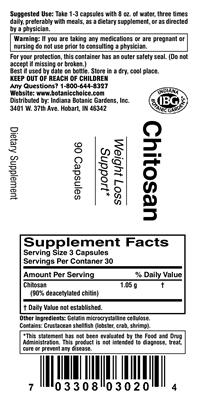
Supplement Facts
The label details for Chitosan by Indiana Botanic Gardens, sourced from the NIH Dietary Supplement Label Database.
Supplement Facts
| Ingredient | Amount | % DV |
|---|---|---|
| Chitosan | 1.05 g | -- |
Other ingredients: Gelatin, Microcrystalline Cellulose
Tap any ingredient to jump to its full detail below.
These statements are the manufacturer’s wording, reproduced from the product label — the label is saying it, not HelloPharmacist. We don’t verify or endorse them.
Formula
Contains: Crustacean shellfish (lobster, crab, shrimp).
FDA Disclaimer Statement
*This statement has not been evaluated by the Food & Drug Administration. This product is not intended to diagnose, treat, cure or prevent any disease.
Precautions
Warning: If you are taking any medications or are pregnant or nursing do not use prior to consulting a physician.
For your protection, this container has an outer safety seal. (Do not accept if missing or broken.)
KEEP OUT OF REACH OF CHILDREN
General Statements
Best if used by date on bottle.
Weight Loss Support*
Storage
Store in a dry, cool place.
Seals/Symbols
IBG INDIANA BOTANIC GARDENS(R)
FDA Statement of Identity
Dietary Supplement
Suggested/Recommended/Usage/Directions
Suggested Use: Take 1-3 capsules with 8 oz. of water, three times daily, preferably with meals, as a dietary supplement, or as directed by a physician.
Is this label outdated? Report a formula or label change and our pharmacy team will review it.
Chitosan by Indiana Botanic Gardens label
The label scan from the NIH Dietary Supplement Label Database. Tap to enlarge.
Label images are published by the NIH Dietary Supplement Label Database for the version of this product on file. Always read your actual product label.
View the full label (PDF)The Ingredients in Chitosan by Indiana Botanic Gardens
This is the 1 active ingredient this product is made of. Select it to open its full monograph.
Serving size1 Capsule(s) Dosage formCapsule Servings per container30 Amounts shown are per serving.
Chitosan
Interacts with3 drugs
Chitosan is a fiber-like substance made from the shells of shrimp, crabs, and other shellfish, often marketed for weight loss and cholesterol. The evi...
Chitosan monograph & interactionsOther (inactive) ingredients: Gelatin, Microcrystalline Cellulose. These complete the product’s ingredient list but are not active constituents.
Chitosan by Indiana Botanic Gardens Drug Interactions
HelloPharmacist Interaction Report
Chitosan by Indiana Botanic Gardens has documented interactions with a small number of medications.
The most serious concern is with warfarin (a blood thinner used to prevent clots). In a case report, a patient's blood-clotting measure (INR) rose significantly after starting chitosan 1200 mg daily—a sign of increased bleeding risk—and returned to normal once chitosan was stopped and vitamin K was given.
The patient later restarted warfarin without the supplement.
Read the full breakdown — every affected drug type, severity by severity
Chitosan can also reduce how well your body absorbs acyclovir (an antiviral for herpes). Research shows that taking chitosan with acyclovir 200 mg lowered the amount of drug in the bloodstream, which could reduce how well the antiviral works.
Although only these two medications are documented in our data, if you take warfarin, acyclovir, or any other prescription medication, run the specific names through the interaction checker on this page before you start.
Check your own medications below · Editorial policy · How we use AI
Want to check YOUR meds against Chitosan?
Ask about interactions with your drugs in plain English — “Can I take it with lisinopril?” — and we find you the answer in seconds, ingredient by ingredient.
Go to the checkerIngredients driving the most interactions
Individual Drug Interactions
The ingredients in Chitosan interact with 3 drugs. Click any drug to see the details.
1 of the 1 ingredient in Chitosan interact with drugs. Each result below shows which ingredient is responsible. Chitosan
AcyclovirAvaclyr, Sitavig, Zovirax, Zovirax Injection
How Acyclovir interacts with Chitosan — through 1 ingredient. Tap an ingredient for the detail:
ChitosanAcyclovir (zovirax) Moderate
Interaction Summary
Chitosan can reduce the absorption of acyclovir, potentially increasing the risk for treatment failure.
Read the full Chitosan + Acyclovir interactionWarfarinWarfarin
How Warfarin interacts with Chitosan — through 1 ingredient. Tap an ingredient for the detail:
ChitosanWarfarin (coumadin) Moderate
Interaction Summary
Theoretically, chitosan might increase the risk of bleeding when taken with warfarin.
Read the full Chitosan + Warfarin interactionWarfarin SodiumCoumadin, Panwarfin, Sofarin
How Warfarin Sodium interacts with Chitosan — through 1 ingredient. Tap an ingredient for the detail:
ChitosanWarfarin (coumadin) Moderate
Interaction Summary
Theoretically, chitosan might increase the risk of bleeding when taken with warfarin.
Read the full Chitosan + Warfarin Sodium interactionEach ingredient & the kinds of drugs it affects
For each ingredient in Chitosan with known interactions, here are the types of medications it can affect. Open any type for the detail — or search your exact drug in the checker above.
Chitosan
Acyclovir (Zovirax)
Chitosan can reduce the absorption of acyclovir, potentially increasing the risk for treatment failure.
Clinical research in humans shows that taking chitosan along with acyclovir 200 mg reduces acyclovir absorption. Concomitant administration of chitosan 400 mg or 1000 mg reduced the acyclovir area under the curve (AUC) and peak plasma concentration by about 30% and 40%, respectively, compared with control. Concomitant administration with chitosan 1000 mg also increased time to peak concentration from 1 hour to 2 hours. In vitro research suggests that the mechanism for reduced absorption is due to acyclovir entrapment in chitosan-mucus complexes, which reduces intestinal absorption.
Warfarin (Coumadin)
Theoretically, chitosan might increase the risk of bleeding when taken with warfarin.
In a case report, a patient taking warfarin had a significantly increased international normalized ratio (INR) after starting chitosan 1200 mg daily. The INR normalized after chitosan was discontinued and vitamin K was administered. The patient once again started taking chitosan and again had a significant increase in INR. The INR stabilized again once chitosan was discontinued. Researchers theorize that this interaction might occur because chitosan decreases absorption of fat-soluble vitamins, including vitamin K, which could increase the anticoagulant effect of warfarin.
Brand information
Manufacturer and brand details for Chitosan, from the product label.
Indiana Botanic Gardens
See all Indiana Botanic Gardens products- Name
- Indiana Botanic Gardens, Inc.
- Street Address
- 3401 W. 37th Ave.
- City
- Hobart
- State
- IN
- ZipCode
- 46342
Chitosan by Indiana Botanic Gardens: Common Questions
Does Chitosan by Indiana Botanic Gardens interact with any medications?
How can one product interact with so many drugs?
Where does this information come from?
Can I take this if I'm allergic to shellfish?
What does chitosan actually do?
Is there good evidence that this works?
What side effects should I expect?
Can I take this while pregnant or breastfeeding?
Written and reviewed by the HelloPharmacist editorial staff. Our editorial policy
Not sure if Chitosan is safe with your meds?
Our pharmacists answer your medication & supplement questions — free.
Label information is sourced from the NIH Dietary Supplement Label Database and reflects the product version on file; always read your actual product label. This page is for education only and is not a substitute for professional medical advice. Confirm with your pharmacist or doctor before combining supplements and medications.
The Full Monographs Behind Chitosan’s Ingredients
Every ingredient we hold a full HelloPharmacist monograph for — uses, evidence, safety, and the complete interaction list.
Sources & How We Checked
Chitosan's label data comes from the NIH Dietary Supplement Label Database; the ingredient interaction data is from the Natural Medicines database, reviewed by our pharmacists.
- NIH Dietary Supplement Label Database (DSLD) — The official product label on file for this supplement.
- Natural Medicines (Therapeutic Research Center) — Evidence-graded clinical reference behind the ingredient interaction data.
Content is written and reviewed by licensed HelloPharmacist pharmacists. See our data sources and editorial standards for how this information is built and checked.
The 17 references behind this product’s interaction data
Every citation that drives the interaction findings for this product’s ingredients, from the evidence-graded Natural Medicines (TRC Healthcare) database. Open an ingredient to browse its citations — links open the study on PubMed or the publisher’s site.
Chitosan 17 references
- Jing SB, Li L, Ji D, et al. Effect of chitosan on renal function in patients with chronic renal failure. J Pharm Pharmacol 1997;49:721-3. PubMed
- Pittler MH, Abbot NC, Harkness EF, Ernst E. Randomized, double-blind trial of chitosan for body weight reduction. Eur J Clin Nutr 1999;53:379-81. PubMed
- Ho SC, Tai ES, Eng PH, et al. In the absence of dietary surveillance, chitosan does not reduce plasma lipids or obesity in hypercholesterolaemic obese Asian subjects. Singapore Med J 2001;42:6-10.
- Bokura H, Kobayashi S. Chitosan decreases total cholesterol in women: a randomized, double-blind, placebo-controlled trial. Eur J Clin Nutr 2003;57:721-5. PubMed
- Mhurchu CN, Poppitt SD, McGill AT, et al. The effect of the dietary supplement, Chitosan, on body weight: a randomised controlled trial in 250 overweight and obese adults. Int J Obes Relat Metab Disord 2004;28:1149-56. PubMed
- Huang SS, Sung SH, Chiang CE. Chitosan potentiation of warfarin effect. Ann Pharmacother 2007;41:1912-4. PubMed
- Tsai, G. J. and Su, W. H. Antibacterial activity of shrimp chitosan against Escherichia coli. J Food Prot. 1999;62(3):239-243. PubMed
- Wuolijoki, E., Hirvela, T., and Ylitalo, P. Decrease in serum LDL cholesterol with microcrystalline chitosan. Methods Find.Exp Clin Pharmacol. 1999;21(5):357-361. PubMed
- Nelson, J. L., Alexander, J. W., Gianotti, L., Chalk, C. L., and Pyles, T. Influence of dietary fiber on microbial growth in vitro and bacterial translocation after burn injury in mice. Nutrition 1994;10(1):32-36.
- Schiller RN, Barrager E, Schauss EA, and et al. A randomized, double-blind, placebo-controlled study examining the effects of a rapidly soluble chitosan dietary supplement on weight loss and body composition in overweight and mildly obese individuals. J
- Koide, S. S. Chitin-chitosan: properties, benefits and risks. Nutrition Research 1998;8(6):1091-1101. DOI
- Maezaki Y, Tsuji K, Nakawa, and et al. Hypocholesterolaemic effect of chitosan in adult males. Biosc Biochem Biotech 1993;57:1439-1444.
- Kubbinga M, Nguyen MA, Staubach P, et al. The influence of chitosan on the oral bioavailability of acyclovir-a comparative bioavailability study in humans. Pharm Res 2015;32(7):2241-9. PubMed
- Jull AB, Ni Mhurchu C, Bennett DA, et al. Chitosan for overweight or obesity. Cochrane Database Syst Rev 2008;(3):CD003892. PubMed
- Schmidl D, Werkmeister R, Kaya S, et al. A Controlled, Randomized Double-Blind Study to Evaluate the Safety and Efficacy of Chitosan-N-Acetylcysteine for the Treatment of Dry Eye Syndrome. J Ocul Pharmacol Ther. 2017;33(5):375-382.
- Moraru C, Mincea MM, Frandes M, Timar B, Ostafe V. A meta-analysis on randomised controlled clinical trials evaluating the effect of the dietary supplement chitosan on weight loss, lipid parameters and blood pressure. Medicina (Kaunas). 2018;54(6):109. PubMed
- García MA, Hensler G, Al-Gousous J, Pielenhofer J, Wagner M, Lennernäs H, Langguth P. Novel food drug interaction mechanism involving acyclovir, chitosan and endogenous mucus. Drug Metab Pharmacokinet. 2023;49:100491. PubMed
Parts of this content are provided by the Therapeutic Research Center, LLC.
DISCLAIMER: Currently this does not check for drug-drug interactions. This is not an all-inclusive comprehensive list of potential interactions and is for informational purposes only. Not all interactions are known or well-reported in the scientific literature, and new interactions are continually being reported. Input is needed from a qualified healthcare provider including a pharmacist before starting any therapy. Application of clinical judgment is necessary.
© 2021 Therapeutic Research Center, LLC